Introduction
Asset discovery refers to the automated process of identifying, cataloging, and monitoring every hardware, software, and virtual component within an organization’s network. In a modern IT ecosystem, an asset is no longer just a physical server in a rack; it includes cloud instances, containers, mobile devices, and even specialized Internet of Things (IoT) sensors. These tools act as the “eyes” of an IT department, providing a real-time map of the digital terrain and ensuring that no “shadow IT”—unauthorized or forgotten devices—remains hidden.
As we navigate the complexities asset discovery has moved from a periodic administrative task to a continuous security requirement. With the rise of hybrid work and ephemeral cloud workloads, a network’s perimeter is constantly shifting. Without a robust discovery mechanism, security teams cannot protect what they cannot see. Automated discovery serves as the foundation for vulnerability management, compliance auditing, and efficient incident response, turning raw data into actionable intelligence for the modern enterprise.
Real-World Use Cases
- Cybersecurity Posture Management: Identifying unpatched or unauthorized devices that could serve as entry points for a breach.
- Cloud Cost Optimization: Discovering “zombie” cloud instances or over-provisioned resources that are inflating monthly bills without providing value.
- Compliance Auditing: Automatically generating inventory reports required for frameworks like SOC 2, HIPAA, or GDPR to prove that all data-bearing assets are accounted for.
- Mergers and Acquisitions: Rapidly mapping the IT infrastructure of an acquired company to identify integration risks and hardware redundancies.
- Software License Management: Tracking all installed applications to ensure the organization is neither overpaying for unused seats nor risking fines for under-licensing.
Evaluation Criteria for Buyers
- Deployment Flexibility: Does the tool support both agentless (network-based) and agent-based (software-on-device) discovery?
- Real-Time Visibility: How quickly can the tool detect a new device connecting to the network or a new instance spawning in the cloud?
- Integration Depth: Can it push data seamlessly into your existing CMDB, ITSM, or Security Orchestration (SOAR) platforms?
- Asset Contextualization: Does it provide just an IP address, or does it identify the owner, the OS version, and the business criticality?
- Scalability: Is the platform capable of handling millions of assets across global regions without performance degradation?
- Automation Capabilities: Can it trigger workflows, such as quarantining an unknown device or alerting a technician to a configuration drift?
- Security & Compliance: Does the tool itself meet high security standards, providing encrypted data transport and robust access controls?
Best for: IT Operations managers, Security Operations Center (SOC) analysts, and Chief Information Officers (CIOs) who need absolute visibility across hybrid and multi-cloud environments to maintain security and operational standards.
Not ideal for: Very small businesses with fewer than 20 devices where a manual spreadsheet might still be manageable, or organizations with purely static, legacy environments that never change.
Key Trends in Asset Discovery Software
- AI-Driven Device Fingerprinting: Using machine learning to identify the exact make and model of a device based on its network behavior, even when it is behind a firewall.
- Focus on Ephemeral Assets: Specialized discovery for short-lived containers and serverless functions that may only exist for a few minutes but still pose a security risk.
- Integration with Digital Twins: Linking discovered IT assets to physical building management systems to create a unified view of corporate infrastructure.
- Zero Trust Discovery: Shifting away from “trusting” the network and instead verifying every identity and asset every time it attempts a connection.
- Edge Computing Visibility: Extending discovery capabilities to the far edges of the network, including branch offices and remote IoT installations.
- Automated Asset Dependency Mapping: Visualizing not just what assets exist, but exactly how they communicate with each other to support critical business services.
- Self-Healing Inventories: AI agents that can automatically correct missing metadata or update ownership information by analyzing user login patterns.
- SaaS Stack Discovery: Moving beyond hardware to identify every SaaS application a user accesses, helping to curb shadow IT in the browser.
How We Selected These Tools
- Market Visibility and Trust: We selected tools that are recognized as leaders by global analysts and have significant deployments in Fortune 500 companies.
- Technical Innovation: Priority was given to platforms that have pioneered real-time scanning and AI-based asset correlation.
- Ecosystem Breadth: We evaluated how well these tools connect with other major IT platforms like ServiceNow, Jira, and AWS.
- Deployment Reliability: Each tool was vetted for its ability to operate in complex, high-security environments without disrupting network traffic.
- User Feedback and Success Stories: Our selection includes tools with high marks for ease of implementation and a low rate of “false positives.”
- Future-Ready Roadmap: We focused on vendors who are actively investing in cloud-native discovery and advanced cybersecurity automation.
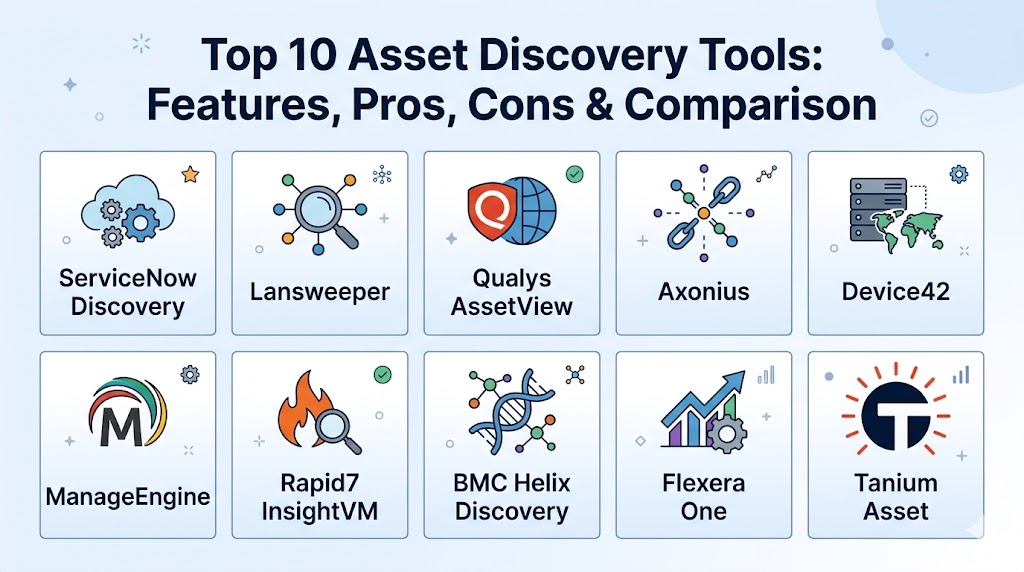
Top 10 Asset Discovery Software Tools
1. ServiceNow Discovery
ServiceNow Discovery is a cornerstone of enterprise IT, providing a highly automated way to populate and maintain a Configuration Management Database (CMDB). It is designed to find every piece of hardware and software across on-premises and cloud environments, creating a single source of truth for the entire organization.
Key Features
- Automated mapping of complex business services and their underlying technical dependencies.
- Seamless integration with the broader ServiceNow platform for incident and change management.
- Support for agentless discovery across Windows, Linux, and major networking hardware.
- Real-time visibility into cloud resources across AWS, Azure, and Google Cloud Platform.
- Advanced “fingerprinting” to identify unique software installations and configurations.
Pros
- Deepest integration with enterprise ITIL processes available on the market.
- Extremely powerful for visualizing how a single server failure impacts a critical business app.
Cons
- Implementation can be long and require specialized administrative knowledge.
- Premium pricing model that is best suited for large-scale enterprises.
Platforms / Deployment
Web / Windows / macOS / Linux
Cloud / Hybrid
Security & Compliance
Provides robust SSO/SAML support, encryption at rest, and detailed audit trails.
SOC 2, ISO 27001, and GDPR compliant.
Integrations & Ecosystem
As a market leader, it integrates with virtually every major security and monitoring tool. It serves as the primary data consumer for many other discovery and management platforms.
Support & Community
Unmatched professional community, extensive documentation, and a global network of certified implementation partners.
2. Lansweeper
Lansweeper is an agentless discovery platform that excels at finding everything connected to a network, from servers and PCs to printers and smart office devices. It is widely praised for its ease of setup and its ability to provide immediate value without complex configuration.
Key Features
- True agentless discovery that requires no software installation on the target devices.
- Comprehensive hardware and software inventory including warranty and lifecycle data.
- Specialized discovery for IoT, OT, and virtualized environments.
- Built-in reporting for software license compliance and security vulnerabilities.
- High-speed scanning that can map thousands of devices in minutes.
Pros
- One of the fastest implementation times in the industry.
- Excellent at finding “hidden” assets like network switches and specialized hardware.
Cons
- The user interface can feel slightly dated compared to modern cloud-first apps.
- Advanced cloud discovery features are not as deep as specialized cloud platforms.
Platforms / Deployment
Windows / Web
Local / Hybrid
Security & Compliance
Uses secure credential management and role-based access controls.
Not publicly stated for all modules, but widely used in regulated industries.
Integrations & Ecosystem
Offers a wide range of connectors for ITSM tools and security platforms, allowing asset data to flow into other business systems easily.
Support & Community
Very active user forums and a large library of pre-made reports that users share with each other.
3. Qualys AssetView
Qualys AssetView is a security-first discovery tool that provides a continuous, real-time inventory of all global IT assets. Because it is part of the Qualys security suite, it focuses heavily on the security posture and vulnerability status of every discovered device.
Key Features
- Continuous monitoring of assets via a lightweight cloud agent or network-based scanning.
- Real-time asset tagging to group devices by business function or risk level.
- Integration with vulnerability management to identify “at-risk” assets instantly.
- Global scale capability, monitoring millions of assets across diverse regions.
- Dynamic dashboards that provide a 360-degree view of the attack surface.
Pros
- The best choice for teams where security is the primary driver for asset discovery.
- Cloud-native architecture makes it very easy to scale across multiple locations.
Cons
- Can be more expensive than general IT inventory tools.
- Primarily focused on security; may lack some specialized ITAM features like contract management.
Platforms / Deployment
Windows / macOS / Linux / iOS / Android
Cloud
Security & Compliance
Top-tier security including MFA, end-to-end encryption, and rigorous audit logs.
FedRAMP, SOC 2, and ISO 27001 compliant.
Integrations & Ecosystem
Integrates deeply with SIEM and SOAR platforms, as well as major cloud providers and DevOps pipelines.
Support & Community
Comprehensive 24/7 technical support and a wealth of training videos and webinars for security professionals.
4. Axonius
Axonius takes a unique approach to discovery by connecting to the tools you already use (like AWS, Active Directory, and endpoint security) to create a comprehensive asset inventory. It focuses on finding the gaps between what your tools see and what is actually on your network.
Key Features
- Integration-based discovery that pulls data from over 400 different sources.
- Automated gap analysis to find devices that are missing security agents or patches.
- Powerful query language to find specific subsets of assets in seconds.
- Continuous enforcement of security policies via automated actions.
- Unified view of users and the devices they are associated with.
Pros
- Eliminates the need for yet another network scanner by leveraging existing data.
- Incredible for identifying “shadow IT” that other tools might miss.
Cons
- Requires that your existing tools are already providing some level of data.
- Pricing is aimed at mid-market and enterprise organizations.
Platforms / Deployment
Web
Cloud / Hybrid
Security & Compliance
Enterprise-grade authentication and data protection protocols.
SOC 2 compliant.
Integrations & Ecosystem
Its entire value proposition is based on its massive library of integrations, making it the “glue” for an organization’s security stack.
Support & Community
Highly rated for its customer success teams and responsive technical support.
5. Device42
Device42 provides a complete view of the IT infrastructure, including data center assets, IP addresses, and application dependencies. It is a preferred choice for organizations looking to move from manual tracking to a sophisticated, automated CMDB.
Key Features
- Automated dependency mapping that shows how applications rely on specific hardware.
- Integrated IP Address Management (IPAM) and password management.
- Comprehensive data center infrastructure management including rack and cable tracking.
- Support for cloud, virtual, and physical assets in a single interface.
- Robust API for building custom workflows and integrations.
Pros
- Offers a very broad feature set that replaces multiple disconnected tools.
- The application dependency mapping is world-class for troubleshooting.
Cons
- The interface has a high density of information which can be intimidating.
- Setup of the dependency mapping requires careful planning of network permissions.
Platforms / Deployment
Windows / Linux / Web
Local / Hybrid
Security & Compliance
Includes built-in password vaulting and granular permission controls.
Not publicly stated.
Integrations & Ecosystem
Strong connectors for Jira, Zendesk, and ServiceNow, ensuring that asset data is available where work happens.
Support & Community
Strong technical documentation and a responsive support team that assists with complex installations.
6. ManageEngine AssetExplorer
ManageEngine AssetExplorer is an affordable yet powerful tool that manages the entire lifecycle of an IT asset, from procurement to disposal. It is a favorite among mid-sized companies looking for a reliable, all-in-one inventory and compliance solution.
Key Features
- Multi-source discovery using network scanning, agent-based discovery, and manual imports.
- Integrated software license management to track usage and avoid audit penalties.
- Purchase order and contract management to track the financial lifecycle of assets.
- Built-in remote desktop tools to assist in managing discovered assets.
- Comprehensive reports on asset depreciation and total cost of ownership.
Pros
- Highly cost-effective compared to larger enterprise platforms.
- Part of a wider suite of ManageEngine tools that work seamlessly together.
Cons
- Scaling to hundreds of thousands of assets may require more infrastructure than competitors.
- The reporting engine can be less flexible than more modern, data-driven platforms.
Platforms / Deployment
Windows / Web
Local / Hybrid
Security & Compliance
Standard role-based access and secure data handling.
Supports GDPR and HIPAA compliance workflows.
Integrations & Ecosystem
Best used within the ManageEngine ecosystem, but also offers integrations with standard helpdesk and monitoring tools.
Support & Community
Extensive online knowledge base and a global community of IT administrators.
7. Rapid7 InsightVM
Rapid7 InsightVM is primarily a vulnerability management tool, but its asset discovery capabilities are critical for identifying risk. It uses a combination of network scanning and cloud-based agents to maintain a live view of the network’s health.
Key Features
- Live, dynamic discovery of assets as they enter or leave the network.
- Automatic correlation of assets with known security threats and exploits.
- Policy-based scanning to ensure all devices meet corporate security standards.
- Cloud-native discovery for AWS, Azure, and GCP environments.
- Integration with project management tools to automate the remediation of issues.
Pros
- Excellent for organizations that prioritize risk-based asset management.
- The “Liveboard” provides a real-time pulse of the entire environment’s security.
Cons
- Licensing is often tied to the number of assets, which can grow expensive.
- Not designed for detailed financial IT asset management (ITAM).
Platforms / Deployment
Windows / macOS / Linux
Cloud / Hybrid
Security & Compliance
Uses hardened agents and secure cloud transport for all data.
ISO 27001 and SOC 2 compliant.
Integrations & Ecosystem
Deeply integrated with the Rapid7 Insight platform and major SIEM/SOAR solutions.
Support & Community
Strong professional services and a very active security research community.
8. BMC Helix Discovery
BMC Helix Discovery is a cloud-native solution that provides instant visibility into hardware, software, and service dependencies. It is built for high-scale enterprise environments where speed and accuracy are paramount.
Key Features
- Rapid, lightweight discovery that minimizes network impact.
- Automated service modeling to understand the health of business-critical apps.
- Specialized discovery for mainframes, cloud, and containerized workloads.
- Continuous updates that keep the CMDB accurate in real-time.
- Integration with AIOps to predict and prevent system failures.
Pros
- Proven at massive scales within the world’s largest organizations.
- The “Start anywhere” discovery approach makes it very flexible.
Cons
- Requires a significant investment in time and budget.
- The interface can be complex for teams not already familiar with BMC products.
Platforms / Deployment
Web
Cloud / Hybrid
Security & Compliance
Complies with the highest levels of global government and enterprise security.
SOC 2 and FedRAMP compliant.
Integrations & Ecosystem
Primarily designed to work with the BMC Helix suite but maintains a wide range of industry integrations.
Support & Community
Excellent enterprise-level support and a long history of serving the global IT community.
9. Flexera One
Flexera One is a comprehensive platform that focuses on the value and risk of technology assets. It is particularly strong in software asset management (SAM) and cloud cost optimization, helping organizations understand what they own and what it costs.
Key Features
- Automated discovery and normalization using a massive global database of software titles.
- Detailed visibility into SaaS usage and subscription costs.
- Advanced analytics for optimizing license spend and negotiating contracts.
- Integration with procurement systems to track asset acquisition.
- Comprehensive cloud cost management across multi-cloud environments.
Pros
- The market leader for complex software license optimization.
- Excellent for identifying wasted spending in large organizations.
Cons
- Extremely powerful, which often results in a steep learning curve.
- Primarily focused on the “business” side of assets rather than real-time security scanning.
Platforms / Deployment
Web
Cloud
Security & Compliance
Highest levels of data security and governance for sensitive financial data.
ISO 27001 and SOC 2 compliant.
Integrations & Ecosystem
Integrates with all major ERP and financial systems, as well as ITSM and cloud platforms.
Support & Community
Very high-end professional support and a community focused on IT financial management.
10. Tanium Asset
Tanium Asset provides real-time visibility and control across every endpoint in an organization. Using its unique linear-chain architecture, it can scan millions of devices in seconds, providing data that is always current.
Key Features
- Real-time queries that return data from millions of endpoints in seconds.
- Unified view of hardware, software, and configuration data.
- Ability to take direct action on discovered assets, such as deploying a patch or software.
- Specialized modules for risk, compliance, and performance monitoring.
- High-performance discovery that operates even over low-bandwidth connections.
Pros
- The fastest tool in the market for large-scale, real-time data retrieval.
- Combines discovery with immediate remediation and control.
Cons
- The unique architecture requires careful planning for initial deployment.
- Price and complexity are generally out of reach for smaller companies.
Platforms / Deployment
Windows / macOS / Linux / AIX / Solaris
Cloud / Hybrid
Security & Compliance
Built for high-security environments, including military and financial institutions.
FIPS 140-2 and SOC 2 compliant.
Integrations & Ecosystem
Integrates with major security and IT platforms, often serving as the “edge data source” for other tools.
Support & Community
Highly rated professional support and a dedicated community of advanced security and IT engineers.
Comparison Table
| Tool Name | Best For | Platform(s) Supported | Deployment | Standout Feature | Public Rating |
| 1. ServiceNow Discovery | Large Enterprises | Win, macOS, Linux, Web | Hybrid | Dependency Mapping | N/A |
| 2. Lansweeper | SMB & Mid-Market | Win, Linux, Web | Hybrid | Agentless Scanning | N/A |
| 3. Qualys AssetView | Security Teams | Win, macOS, Linux, Mobile | Cloud | Real-time Tagging | N/A |
| 4. Axonius | Gap Analysis | Web | Cloud | 400+ Integrations | N/A |
| 5. Device42 | Data Centers | Win, Linux, Web | Hybrid | IPAM/Rack Mgmt | N/A |
| 6. ManageEngine | Cost & Compliance | Win, Web | Hybrid | Lifecycle Tracking | N/A |
| 7. Rapid7 InsightVM | Risk Management | Win, macOS, Linux | Hybrid | Vulnerability Sync | N/A |
| 8. BMC Helix Discovery | Multi-Cloud | Web | Hybrid | AIOps Integration | N/A |
| 9. Flexera One | License Optimization | Web | Cloud | SAM Expertise | N/A |
| 10. Tanium Asset | Real-time Control | Win, macOS, Linux, Unix | Hybrid | Linear Architecture | N/A |
Evaluation & Scoring
| Tool Name | Core (25%) | Ease (15%) | Integrations (15%) | Security (10%) | Perf (10%) | Support (10%) | Value (15%) | Total |
| 1. ServiceNow | 10 | 4 | 10 | 9 | 8 | 9 | 5 | 8.15 |
| 2. Lansweeper | 8 | 9 | 8 | 7 | 9 | 8 | 10 | 8.25 |
| 3. Qualys | 9 | 7 | 9 | 10 | 9 | 8 | 7 | 8.35 |
| 4. Axonius | 8 | 8 | 10 | 8 | 9 | 9 | 7 | 8.25 |
| 5. Device42 | 9 | 6 | 9 | 7 | 8 | 8 | 8 | 7.85 |
| 6. ManageEngine | 7 | 8 | 7 | 7 | 7 | 8 | 9 | 7.40 |
| 7. Rapid7 | 9 | 7 | 9 | 9 | 8 | 8 | 7 | 8.05 |
| 8. BMC Helix | 10 | 4 | 9 | 9 | 9 | 8 | 6 | 7.85 |
| 9. Flexera One | 9 | 5 | 8 | 9 | 8 | 9 | 7 | 7.75 |
| 10. Tanium | 10 | 3 | 8 | 10 | 10 | 8 | 6 | 7.75 |
The scoring matrix above is designed to help you compare these tools based on professional priorities. While ServiceNow and BMC score high on core features, they are more difficult to implement (Ease of Use). Tools like Lansweeper and ManageEngine offer exceptional value for smaller teams, whereas Qualys and Tanium are the top choices for performance and security. Every score is a trade-off; for instance, a 10 in performance often comes at the cost of a lower score in ease of implementation due to the technical complexity of high-speed scanning.
Which Asset Discovery Software Tool Is Right for You?
Solo / Freelancer
For the independent consultant or a tiny startup, Lansweeper is the most practical choice. Its free tier and quick agentless setup provide immediate visibility without the need for a monthly subscription or complex hardware.
SMB
Small to medium-sized businesses will find the best balance in ManageEngine AssetExplorer. It provides all the necessary tools for inventory and license compliance in a cost-effective, easy-to-manage package.
Mid-Market
Organizations in this range should prioritize Axonius or Qualys. These tools offer a professional level of discovery and security without the massive administrative overhead required by the top-tier enterprise suites.
Enterprise
For global organizations with complex, multi-site infrastructures, ServiceNow Discovery or BMC Helix are the industry standards. They offer the necessary depth to manage massive datasets and complex service dependencies.
Budget vs Premium
If budget is the primary concern, Blender is free, but ManageEngine is the professional budget king. If the budget is available for premium features and support, ServiceNow and Tanium offer the highest level of capability.
Feature Depth vs Ease of Use
If you need a tool that “just works” out of the box, choose Lansweeper. If you need to map every single interaction between a mainframe and a microservice, be prepared to invest the time required for Houdini or Maya.
Integrations & Scalability
For a growing company, Axonius is unbeatable due to its 400+ connectors. For absolute scalability across millions of devices, Tanium is the only tool that can provide sub-second responses at that size.
Security & Compliance Needs
If your organization operates in a highly regulated industry like healthcare or finance, Qualys and Rapid7 are the best choices because their asset data is natively integrated with security compliance workflows.
Frequently Asked Questions (FAQs)
1. What is the main difference between ITAM and asset discovery?
Asset discovery is the technical process of finding what is on the network, while IT Asset Management (ITAM) is the business process of managing those assets throughout their entire life.
2. Can I use these tools for both on-premises and cloud assets?
Yes, most modern discovery tools are “hybrid-ready,” meaning they can scan local servers and laptops while simultaneously pulling data from cloud providers via APIs.
3. Is agent-based or agentless discovery better?
Agentless is faster to set up and less intrusive, but agent-based discovery provides much deeper data (like real-time process usage) and works even when a device is off the corporate network.
4. How often should asset discovery scans be run?
For static environments, once a day is often enough. For dynamic cloud environments or high-security networks, discovery should be continuous or run every few minutes.
5. What is “Shadow IT” and why is it dangerous?
Shadow IT refers to devices or apps used by employees without the IT department’s knowledge. It is dangerous because these assets are often unpatched and unmonitored, creating security blind spots.
6. Do these tools help with software audits?
Absolutely. Specialized tools like Flexera and ManageEngine can automatically detect all installed software and compare it against your purchased licenses to ensure you are compliant.
7. Can asset discovery tools identify IoT devices?
Yes, advanced tools like Lansweeper and Qualys can identify non-traditional hardware like smart cameras, industrial sensors, and medical equipment by analyzing their network behavior.
8. How do these tools impact network performance?
Modern tools are designed to be “lightweight,” using low-bandwidth techniques. However, poorly configured full-network scans can still cause temporary spikes in traffic if not managed correctly.
9. What is a “Dependency Map”?
It is a visual chart that shows which hardware and software assets are required to keep a specific business service (like an e-commerce site or payroll system) running.
10. Can discovery tools automate security actions?
Yes, high-end tools like Tanium or Axonius can trigger automated responses, such as blocking a device from the network if it is found to be missing a required security update.
Conclusion
Hyper-connected world, comprehensive asset discovery is the bedrock of a successful IT strategy. The ability to see and understand every component of your network—from a physical server to a virtual container—is no longer a luxury but a necessity for security, cost control, and operational efficiency. Whether you choose the deep procedural insights of an enterprise suite like ServiceNow or the rapid, cost-effective visibility of a tool like Lansweeper, the goal remains the same: a clear, real-time map of your digital ecosystem. As technology continues to shift toward more ephemeral and cloud-native models, staying proactive with the right discovery tool will ensure that your organization remains secure and optimized for the future.

Best Cardiac Hospitals Near You
Discover top heart hospitals, cardiology centers & cardiac care services by city.
Advanced Heart Care • Trusted Hospitals • Expert Teams
View Best Hospitals