Introduction
Asset Performance Management (APM) platforms are specialized industrial software suites designed to optimize the reliability and availability of physical assets such as turbines, pumps, and manufacturing lines. Unlike traditional maintenance software that merely tracks work orders, APM focuses on “asset intelligence”—using data from IoT sensors, historical records, and physics-based models to predict when an asset will fail and how to extend its useful life. In the modern industrial landscape, these platforms act as the bridge between Operational Technology (OT) and Information Technology (IT), transforming raw sensor data into actionable financial and operational insights.
As we move deeper into the era of hyper-automation and the industrial metaverse, APM has become a critical requirement for competitive survival. Industries are shifting away from fixed-interval maintenance toward a strategy centered on actual equipment condition and risk. This evolution is driven by the need to reduce carbon footprints, manage aging infrastructure, and navigate a global workforce shortage where expert knowledge must be digitized. A modern APM platform allows an organization to see its entire fleet through a single pane of glass, ensuring that maintenance spend is directed exactly where it provides the most value.
Best for: Heavy asset-intensive industries like power generation, oil and gas, chemical processing, mining, and large-scale discrete manufacturing looking to eliminate unplanned downtime and optimize total cost of ownership.
Not ideal for: Small office environments, light retail operations, or companies with purely digital assets that do not require physical sensor monitoring or complex reliability engineering.
Key Trends in Asset Performance Management Software
- Generative AI for Prescriptive Actions: Platforms are moving beyond predicting failure to using large language models to draft specific maintenance procedures and safety checklists based on historical repair data.
- Sustainability and ESG Integration: Modern APM now includes modules to track energy intensity and carbon emissions at the individual asset level, linking reliability directly to environmental targets.
- Digital Twins as Living Systems: High-fidelity 3D replicas are now being used to run “what-if” simulations, allowing engineers to test stress loads in a virtual environment before applying them to physical machinery.
- Edge-to-Cloud Analytics: To reduce latency, more analytical processing is happening directly on the sensor or gateway, with only high-level insights being pushed to the central cloud platform.
- Outcome-Based Service Models: There is a growing shift where software providers and OEMs offer “uptime as a service,” with APM data serving as the legal source of truth for performance contracts.
- Visual Inspection via Computer Vision: Automated drone and fixed-camera feeds are being integrated into APM workflows to detect corrosion, leaks, or thermal anomalies without human intervention.
- Augmented Reality (AR) Field Enablement: Direct synchronization between the APM health score and a technician’s mobile or wearable device to provide real-time guidance during a repair.
- Standardization via Open Data Initiatives: Industry-wide adoption of protocols that allow assets from different manufacturers to share health data seamlessly within a single APM platform.
How We Selected These Tools
- Industrial Vertical Leadership: We focused on platforms that have a dominant presence in specialized sectors such as energy, process, and discrete manufacturing.
- Predictive Capability Maturity: Selection was based on the sophistication of the underlying machine learning models and the ability to provide early warning signals.
- Enterprise Scalability: We prioritized tools capable of managing thousands of assets across multiple global sites within a unified architecture.
- Integration with Core Systems: Evaluation included how effectively the APM suite connects with existing ERP and EAM systems like SAP, Oracle, or IBM.
- Security and OT Resilience: Platforms were screened for their ability to operate securely in sensitive industrial environments and comply with global cybersecurity standards.
- User Persona Alignment: We looked for tools that provide relevant dashboards for everyone from the shop floor technician to the Chief Operating Officer.
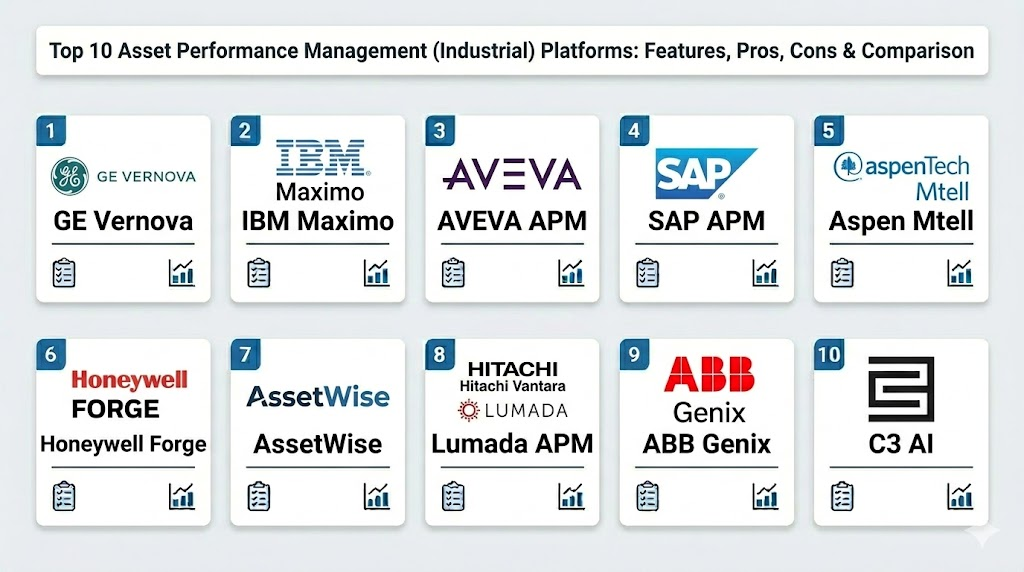
Top 10 Asset Performance Management (Industrial) Platforms
1. GE Vernova APM
A pioneer in the category, this platform is specifically engineered for the world’s most complex and high-stakes industrial assets. It excels at managing large fleets where the cost of a single hour of downtime can reach millions of dollars.
Key Features
- Comprehensive Asset Strategy Optimization (ASO) to balance cost, risk, and performance.
- Deep library of “Digital Ghost” models for detecting subtle deviations in turbine performance.
- Integrated Reliability Centered Maintenance (RCM) and Root Cause Analysis (RCA) modules.
- Advanced health dashboards that aggregate data from heterogeneous sensor networks.
- High-fidelity thermal and mechanical stress simulation for power generation assets.
Pros
- Unrivaled domain expertise in power and heavy industrial equipment.
- The most sophisticated predictive analytics for high-speed rotating machinery.
Cons
- Significant infrastructure and time required for a full enterprise deployment.
- User interface can be complex for teams used to simpler maintenance tools.
Platforms / Deployment
Windows / Web / iOS / Android
Cloud / Hybrid
Security & Compliance
ISO 27001, SOC 2 Type II, and NERC CIP compliant.
SSO/SAML and multi-factor authentication integrated.
Integrations & Ecosystem
Built to serve as an agnostic layer, it connects to any major historian or EAM system. It features pre-built connectors for SAP and IBM Maximo to ensure a seamless data flow from health insight to work execution.
Support & Community
Industry-leading professional services and a vast global user community. Support includes 24/7 technical assistance and dedicated reliability consulting.
2. IBM Maximo Health, Predict & Monitor
This suite is part of the broader Maximo Application Suite, offering a unique advantage by combining world-class maintenance execution with advanced AI-driven performance monitoring in a single codebase.
Key Features
- AI-powered failure prediction using Watson Machine Learning models.
- Visual inspection tools that use computer vision to identify defects automatically.
- Unified asset health scoring based on real-time sensor data and maintenance history.
- Seamless transition from a health alert to a generated work order.
- Remote monitoring capabilities that support massive IoT sensor deployments.
Pros
- The only platform that offers a truly unified EAM and APM experience.
- Strongest AI and machine learning capabilities through the Watson ecosystem.
Cons
- Requires a transition to the newer Red Hat OpenShift-based architecture.
- Pricing can be complex due to the AppPoints licensing model.
Platforms / Deployment
Web / Windows / macOS / iOS / Android
Cloud / Hybrid / Self-hosted
Security & Compliance
FedRAMP, SOC 2, and GDPR compliant.
Advanced RBAC and audit logging for industrial safety.
Integrations & Ecosystem
Leverages the IBM ecosystem to connect with weather data, GIS systems, and enterprise finance modules. It is highly extensible via specialized industry-specific add-ons.
Support & Community
Extensive documentation and a massive global network of implementation partners. Training is available through the IBM Skills Gateway.
3. AVEVA APM
Focused heavily on the process industries, this platform leverages its deep heritage in SCADA and data historians to provide real-time visibility into continuous manufacturing environments.
Key Features
- Native integration with the PI System (formerly OSIsoft) for high-speed data ingestion.
- Predictive analytics that identify anomalies in pressure, flow, and temperature.
- Mobile operator rounds that digitize manual inspections on the plant floor.
- Risk-based inspection (RBI) modules specifically designed for refineries and chemical plants.
- Library of thousands of pre-configured asset templates for rapid onboarding.
Pros
- Exceptional at handling high-frequency time-series data from process sensors.
- Strongest visual “Digital Twin” integration for plant-wide visualization.
Cons
- Deployment can be resource-intensive for organizations without a clean data strategy.
- Often requires other AVEVA components to reach its full potential.
Platforms / Deployment
Windows / Web / Mobile
Cloud / Hybrid
Security & Compliance
Verified for critical infrastructure protection standards.
Not publicly stated.
Integrations & Ecosystem
Highly compatible with various industrial control systems and historians. It acts as the analytical layer on top of complex SCADA and MES environments.
Support & Community
Excellent technical support with a strong focus on the oil, gas, and chemical sectors. Training is provided via a dedicated customer success portal.
4. SAP Asset Performance Management
Designed for organizations that run their entire business on the SAP backbone, this platform ensures that asset health data is directly tied to financial and procurement workflows.
Key Features
- Native connectivity to S/4HANA for real-time cost and resource alignment.
- Centralized asset registry that synchronizes master data across the enterprise.
- Health monitoring based on IoT sensor data and automated rule-based alerts.
- Integration with SAP Field Service Management for rapid technician dispatch.
- Advanced reliability engineering tools including FMEA and RCM.
Pros
- Zero-middleware integration for existing SAP customers.
- Ensures maintenance decisions are made with full visibility of the financial impact.
Cons
- May feel restricted for organizations not already committed to the SAP ecosystem.
- Focus is more on enterprise alignment than deep physics-based modeling.
Platforms / Deployment
Web (SAP BTP)
Cloud-native
Security & Compliance
Full compliance with SAP’s global security and data privacy standards.
ISO 27001 and SOC 2 compliant.
Integrations & Ecosystem
Deeply integrated with the SAP Business Network, allowing for collaborative asset management with OEMs and service providers.
Support & Community
Global support network with extensive enterprise-level documentation and community forums.
5. AspenTech Mtell
This platform is a leader in low-touch machine learning, specializing in detecting precise patterns that precede equipment failure without requiring massive data science teams.
Key Features
- Autonomous agents that “learn” the normal operating behavior of specific assets.
- Precise “Time-to-Failure” predictions that provide weeks of advance warning.
- Prescriptive guidance that tells operators exactly how to mitigate an impending issue.
- Fast deployment model that can be scaled across similar asset classes rapidly.
- Integration with AspenTech’s process simulation tools for advanced look-ahead.
Pros
- The most accurate failure detection with the fewest false positives.
- Specifically designed to be used by reliability engineers rather than data scientists.
Cons
- Best suited for high-value rotating equipment; less effective for simple assets.
- Requires clean historical data to train the initial machine learning agents.
Platforms / Deployment
Windows / Web
Local / Hybrid
Security & Compliance
Standard industrial software security protocols for on-premise and cloud nodes.
Not publicly stated.
Integrations & Ecosystem
Connects to all major historians and is often used alongside other AspenTech supply chain and process optimization tools.
Support & Community
Professional support with a high degree of technical expertise in process manufacturing and reliability.
6. Honeywell Forge APM
Honeywell Forge is an enterprise-level platform that focuses on asset health and energy optimization across diverse fleets, including buildings, aircraft, and industrial plants.
Key Features
- Cross-industry health scoring that normalizes data from different equipment types.
- Advanced energy management modules that link asset performance to utility costs.
- Enterprise-wide visibility for multi-site organizations through a single dashboard.
- AI-driven anomaly detection for HVAC, boilers, and industrial process units.
- Mobile-first worker productivity tools for guided inspections and repairs.
Pros
- Excellent for managing diverse “mixed” fleets across multiple geographic regions.
- Strong focus on both operational reliability and sustainability metrics.
Cons
- Can be broad; may require customization for very specific deep-industrial use cases.
- Full value is realized when used within the broader Honeywell Forge ecosystem.
Platforms / Deployment
Web / iOS / Android
Cloud-native
Security & Compliance
Advanced cybersecurity monitoring built into the platform architecture.
SOC 2 compliant.
Integrations & Ecosystem
Strongest when integrated with Honeywell’s own control systems, but supports a wide range of third-party data sources and historians.
Support & Community
Comprehensive global support with dedicated customer success managers for large enterprise accounts.
7. Bentley AssetWise
This suite is the industry standard for “linear assets” and critical infrastructure, such as rail networks, water utilities, and bridges, where geospatial context is vital.
Key Features
- Geospatial asset management that links health data to precise locations.
- Advanced information management for complex engineering documents and 3D models.
- Corrosion and structural integrity monitoring for long-term infrastructure health.
- Compliance and safety tracking designed for highly regulated public sectors.
- Operational analytics for water and wastewater network optimization.
Pros
- The best platform for assets that span large physical distances (roads, rails, pipes).
- Exceptional handling of 3D engineering data and “as-built” documentation.
Cons
- Interface is geared toward engineers and may be complex for general maintenance.
- Not optimized for high-speed discrete manufacturing lines.
Platforms / Deployment
Windows / Web / Mobile
Cloud / Hybrid
Security & Compliance
Meets international standards for public infrastructure security and data integrity.
Not publicly stated.
Integrations & Ecosystem
Part of the broader Bentley infrastructure digital twin ecosystem, providing a continuous data thread from design through operation.
Support & Community
Strong academic and professional network with specialized training for infrastructure engineers.
8. Hitachi Lumada APM
Lumada APM focuses on “intelligent” asset management for the energy and transport sectors, utilizing Hitachi’s deep heritage in both physical machinery and digital systems.
Key Features
- Physics-based models for high-voltage electrical assets like transformers and breakers.
- AI-driven fleet analytics for predictive maintenance in rail and transit systems.
- Integration of weather and environmental data to assess asset risk.
- Condition-based maintenance planning for large-scale utility grids.
- Sophisticated digital twin visualization for complex electrical systems.
Pros
- Deep specialized knowledge in electrical grid and transportation assets.
- Strong hybrid approach combining data science with mechanical engineering.
Cons
- Very focused on specific niches; may feel limited for general manufacturing.
- Scaling can be complex for organizations with very old legacy equipment.
Platforms / Deployment
Web / Mobile
Cloud / Hybrid
Security & Compliance
Compliant with major utility and grid security standards worldwide.
Not publicly stated.
Integrations & Ecosystem
Designed to integrate with enterprise asset management and grid control systems, supporting a wide range of industrial protocols.
Support & Community
Professional enterprise support with specialized consulting for the energy and transport sectors.
9. ABB Ability Genix APM
ABB’s platform is an AI-powered suite designed for utility and transport industries, focusing on 360-degree insights that combine asset health with operational efficiency.
Key Features
- Pre-built AI/ML models for standard industrial equipment like motors and drives.
- Integrated view of asset health, process performance, and environmental impact.
- Predictive maintenance modules for minimizing unplanned downtime in remote sites.
- Scalable architecture that supports both single plants and global enterprises.
- Digital reliability center for centralized monitoring of distributed asset fleets.
Pros
- Exceptional at monitoring power and automation hardware.
- Provides a holistic view that includes sustainability and energy efficiency.
Cons
- Optimized for ABB-heavy environments, though it is technically agnostic.
- The breadth of the “Genix” suite can make initial selection confusing.
Platforms / Deployment
Web / Windows / Mobile
Cloud / Hybrid
Security & Compliance
Multi-layered security approach designed for industrial control network isolation.
Not publicly stated.
Integrations & Ecosystem
Strongest when working with ABB’s massive portfolio of industrial hardware and control systems, but supports open standards.
Support & Community
Global network of ABB service centers and professional training programs.
10. C3 AI Reliability
A modern, AI-first entry into the APM space that uses a sophisticated data-orchestration layer to provide predictive insights at a massive scale for complex industrial environments.
Key Features
- Scalable machine learning pipeline that can process petabytes of sensor data.
- Unified data image that resolves data across multiple legacy systems into a single view.
- High-fidelity anomaly detection for pumps, compressors, and power systems.
- Prescriptive maintenance alerts with automated root-cause explanations.
- Rapid application development environment for custom reliability models.
Pros
- Extremely powerful at finding hidden patterns in massive, messy datasets.
- Fastest path to value for organizations with significant “Big Data” challenges.
Cons
- Requires a mature digital infrastructure to provide the necessary data volume.
- Pricing is often at a premium, targeted at large enterprise players.
Platforms / Deployment
Web / Mobile
Cloud-native (AWS, Azure, GCP)
Security & Compliance
SOC 2 Type II, HIPAA, and GDPR compliant.
Advanced encryption and secure data residency options.
Integrations & Ecosystem
Works across all major cloud providers and integrates with existing EAM systems like Maximo or SAP.
Support & Community
High-level enterprise support with dedicated data science and engineering resources for onboarding.
Comparison Table
| Tool Name | Best For | Platform(s) Supported | Deployment | Standout Feature | Public Rating |
| 1. GE Vernova | Heavy Industry | Win, Web, Mobile | Hybrid | Physics-Based Models | N/A |
| 2. IBM Maximo | Unified Strategy | Web, Mobile, Win | Hybrid | Native EAM/APM | N/A |
| 3. AVEVA APM | Process Industries | Win, Web, Mobile | Hybrid | PI System Integration | N/A |
| 4. SAP APM | SAP Ecosystem | Web (BTP) | Cloud | S/4HANA Connectivity | N/A |
| 5. Aspen Mtell | ML Failure Patterns | Win, Web | Hybrid | Low-Touch AI Agents | N/A |
| 6. Honeywell Forge | Mixed Fleet | Web, Mobile | Cloud | Energy/ESG Focus | N/A |
| 7. AssetWise | Infrastructure | Win, Web, Mobile | Hybrid | Geospatial Context | N/A |
| 8. Lumada APM | Energy Grids | Web, Mobile | Hybrid | Grid Health Physics | N/A |
| 9. ABB Genix | Power/Transport | Web, Win, Mobile | Hybrid | 360 Health Insights | N/A |
| 10. C3 AI | Big Data Scale | Web, Mobile | Cloud | Data Orchestration | N/A |
Evaluation & Scoring
| Tool Name | Core (25%) | Ease (15%) | Integrations (15%) | Security (10%) | Perf (10%) | Support (10%) | Value (15%) | Total |
| 1. GE Vernova | 10 | 4 | 9 | 10 | 10 | 9 | 6 | 8.20 |
| 2. IBM Maximo | 9 | 6 | 10 | 9 | 9 | 9 | 8 | 8.55 |
| 3. AVEVA APM | 9 | 5 | 10 | 8 | 10 | 8 | 7 | 8.05 |
| 4. SAP APM | 8 | 7 | 10 | 9 | 8 | 8 | 7 | 8.15 |
| 5. Aspen Mtell | 10 | 8 | 8 | 7 | 10 | 7 | 7 | 8.30 |
| 6. Honeywell Forge | 8 | 8 | 9 | 9 | 8 | 8 | 8 | 8.20 |
| 7. AssetWise | 9 | 5 | 8 | 8 | 9 | 8 | 7 | 7.70 |
| 8. Lumada APM | 9 | 4 | 8 | 9 | 9 | 8 | 6 | 7.55 |
| 9. ABB Genix | 8 | 6 | 9 | 9 | 9 | 8 | 7 | 7.90 |
| 10. C3 AI | 10 | 5 | 8 | 9 | 10 | 7 | 5 | 7.70 |
The scoring indicates a high level of performance across the board, reflecting the maturity of these platforms. Tools like IBM Maximo and AspenTech Mtell score exceptionally well because they balance high technical performance with better-than-average user accessibility and value. Conversely, platforms like GE Vernova and C3 AI represent the highest tier of “Core” capability but require a more significant investment in time and resources, which is reflected in their Ease of Use and Value scores.
Which Asset Performance Management (Industrial) Platform Is Right for You?
Solo / Freelancer
For an independent reliability consultant, a tool like AspenTech Mtell is often preferred due to its fast deployment and the ability to demonstrate immediate value without needing to overhaul a client’s entire IT infrastructure.
SMB
Small to medium manufacturers should look at Honeywell Forge or IBM Maximo (modular entry). These platforms offer a lower entry point while providing the scalability to grow as the business matures digitally.
Mid-Market
Mid-sized organizations with specialized processes should prioritize AVEVA APM if they are in chemical or process sectors, or SAP APM if they already use SAP for their business operations to avoid integration headaches.
Enterprise
Global enterprises with massive rotating assets and critical downtime risks will find the most value in GE Vernova or C3 AI. These tools are built to handle the sheer volume of data and complexity found in top-tier global industrial operations.
Budget vs Premium
A budget-conscious approach might involve starting with ABB Genix or Honeywell Forge for specific asset classes, whereas a “Premium” strategy involves the full Maximo Application Suite or GE Vernova to cover the entire asset lifecycle.
Feature Depth vs Ease of Use
If your team is highly technical and math-driven, SideFX Houdini (for visualization) and Aspen Mtell (for modeling) are perfect. For teams that need results quickly with a cleaner UI, IBM Maximo or Honeywell Forge are superior.
Integrations & Scalability
For pure integration speed, SAP APM and AVEVA lead the pack. For massive horizontal scalability across millions of IoT devices, C3 AI and IBM Maximo Monitor are the strongest contenders.
Security & Compliance Needs
Organizations in regulated utilities or government-adjacent sectors must prioritize GE Vernova, Hitachi Lumada, or Bentley AssetWise, as these platforms are specifically tuned to the security and audit requirements of national infrastructure.
Frequently Asked Questions (FAQs)
1. What is the difference between EAM and APM?
EAM (Enterprise Asset Management) focuses on the “business” of maintenance like work orders and parts, while APM focuses on the “science” of asset health and predicting failure.
2. Can I use APM without having IoT sensors on all my machines?
Yes, modern platforms can use “virtual sensors” or infer health from existing electrical and process data, though having direct physical sensors will always provide higher accuracy.
3. How long does a typical APM implementation take?
A pilot program can be up and running in 8 to 12 weeks, but a full global enterprise rollout for complex assets typically takes 12 to 24 months.
4. Does APM replace my existing maintenance team?
No, it empowers them. It moves them from “firefighting” reactive repairs to planned, strategic maintenance, allowing them to focus on high-value reliability work.
5. How much data is needed to train a predictive model?
Ideally, a platform needs 6 to 12 months of historical sensor data to identify patterns, though some modern AI agents can start providing value in as little as 30 days.
6. What is the ROI of an APM platform?
Most industrial firms see an ROI within 12 to 18 months through a 10% to 20% reduction in maintenance costs and a 2% to 5% increase in total equipment availability.
7. Can APM help with sustainability and carbon reporting?
Absolutely. Many platforms now track energy consumption per asset, allowing companies to identify “energy hogs” that are performing inefficiently and contributing to high emissions.
8. What is a “Digital Twin” in the context of APM?
It is a virtual model that mirrors the behavior of a physical asset, allowing engineers to run simulations and see the future impact of different operating conditions.
9. Is my industrial data safe in the cloud?
Modern APM providers use “One-Way” data diodes and advanced encryption to ensure that data flows safely from the plant to the cloud without exposing the plant control network.
10. Do I need a data scientist on staff to use these tools?
While helpful, it is no longer required. Most modern platforms are designed for reliability engineers to use “low-code” or “no-code” interfaces to build and manage their own models.
Conclusion
Navigating the complex landscape of industrial Asset Performance Management requires a clear understanding of your organization’s digital maturity and specific operational risks. The platforms highlighted here represent the pinnacle of reliability technology, offering diverse paths to achieving a zero-downtime future. Whether you prioritize deep physics-based modeling, enterprise-wide financial alignment, or geospatial infrastructure context, the right tool is the one that transforms your raw data into a strategic advantage. As industrial environments continue to modernize, the transition from reactive repair to proactive performance management is no longer a luxury—it is the foundation of a resilient, sustainable, and profitable enterprise.

Best Cardiac Hospitals Near You
Discover top heart hospitals, cardiology centers & cardiac care services by city.
Advanced Heart Care • Trusted Hospitals • Expert Teams
View Best Hospitals