Introduction
B2B e-commerce platforms are specialized software solutions designed to facilitate the digital sale of goods and services between businesses. Unlike standard consumer-facing stores, these platforms must handle immense structural complexity, including multi-layered company hierarchies, negotiated contract pricing, and high-volume wholesale transactions. In the current global economy, digital B2B interactions have overtaken traditional sales representative-led models, making a robust online presence a requirement for survival. These tools empower manufacturers, distributors, and wholesalers to automate their order-to-cash cycles while providing a self-service experience that modern procurement teams now demand.
The criteria for a successful B2B platform have shifted from simple digital catalogs to intelligent, integrated ecosystems. Buyers now evaluate platforms based on their ability to sync in real-time with back-office systems like ERPs and CRMs, the flexibility of their API architecture for “headless” deployments, and the maturity of their built-in security frameworks. For a business to remain competitive, its digital storefront must function as a seamless extension of its physical operations, capable of handling everything from complex quote-to-order workflows to restricted regional product visibility.
Best for: Large-scale manufacturers, global distributors, high-volume wholesalers, and enterprise organizations requiring deep integration with complex supply chain and financial systems.
Not ideal for: Small local retailers, individual sellers, or businesses with extremely simple product catalogs that do not require contract-based pricing or multi-user account management.
Key Trends in B2B E-commerce Software
- Agentic AI Procurement: AI agents are now being used by buyers to automatically scan catalogs, negotiate quotes based on predefined budget parameters, and execute orders without human intervention.
- Hyper-Personalized Contract Portals: Platforms now offer “stores of one,” where every aspect of the interface—from pricing and catalog visibility to shipping terms—is tailored to a specific corporate contract.
- B2B Buy Now, Pay Later (BNPL): Embedded fintech solutions are providing instant credit underwriting at checkout, allowing business buyers to access net-terms financing through third-party providers.
- Headless and Composable Shifts: The decoupling of the front-end user experience from the back-end logic allows enterprises to push commerce capabilities into mobile apps, IoT devices, and procurement software.
- Real-Time ERP Synchronization: Modern platforms have moved away from batch updates, instead offering “always-on” connectivity to inventory and credit limit data to prevent order errors.
- Sustainable Sourcing Transparency: New regulatory requirements have led to platforms integrating carbon footprint tracking and ethical sourcing certifications directly into the product discovery phase.
- Omnichannel Sales Rooms: Digital sales rooms are replacing traditional slide decks, allowing reps and buyers to collaborate on a single, shared digital space to finalize complex six-figure deals.
- Self-Service High-Value Transactions: Increased trust in digital security has led to a surge in buyers placing orders exceeding $500,000 through purely self-service channels.
How We Selected These Tools
- Enterprise-Grade Scalability: We focused on platforms capable of handling millions of SKUs and thousands of concurrent high-volume transactions.
- B2B Native Logic: Only tools with built-in support for complex account hierarchies, quote management, and custom pricing were considered.
- Architectural Flexibility: Preference was given to “API-first” and “Open SaaS” models that allow for deep customization and headless deployments.
- Security Posture: Evaluation included the presence of critical certifications and the robustness of identity management and audit logging features.
- Ecosystem Maturity: We looked for platforms with established global partner networks and a wide variety of pre-built integrations for industry-standard ERPs.
- Market Leadership and Vision: The selection includes tools that are actively leading the industry in the adoption of AI-driven commerce and composable architecture.
Top 10 B2B E-commerce Software Tools
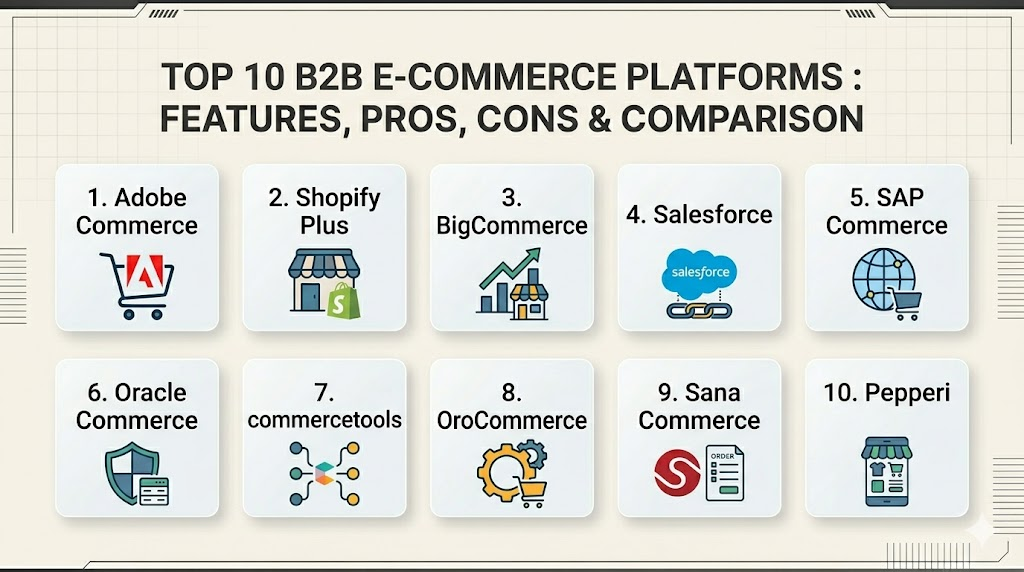
1. Adobe Commerce
A highly flexible, feature-rich platform that is widely regarded as the most customizable solution for complex B2B enterprises. It excels at managing multiple brands and international storefronts from a single administrative hub.
Key Features
- Robust B2B module for managing company accounts and credit limits.
- Advanced quote management system with automated negotiation workflows.
- Integrated B2B-specific search powered by artificial intelligence.
- Native support for complex multi-warehouse inventory management.
- Extensive library of B2B themes and specialized extensions.
Pros
- Total architectural freedom to build highly unique buyer experiences.
- Deep integration with the broader suite of professional marketing and data tools.
Cons
- Requires a high level of technical expertise for implementation and maintenance.
- Total cost of ownership can be significant due to hosting and development needs.
Platforms / Deployment
Windows / macOS / Linux (Development)
Cloud / On-premise / Hybrid
Security & Compliance
PCI DSS Level 1, SOC 2 Type II, and ISO 27001 compliant.
Features granular role-based access control and detailed activity logs.
Integrations & Ecosystem
Boasts one of the largest partner ecosystems in the world. It provides native connectors for major ERP systems and a powerful API layer for headless commerce.
Support & Community
A massive global community of developers and agencies. Professional support is available through dedicated technical account managers and a vast documentation library.
2. Shopify Plus
Once known mainly for retail, this platform has rapidly evolved into a formidable B2B competitor. It is the preferred choice for businesses prioritizing speed to market and ease of use without sacrificing enterprise power.
Key Features
- Built-in B2B features including company profiles and customer-specific catalogs.
- Automated wholesale pricing logic and volume-based discounts.
- B2B-specific checkout that supports net-terms and vaulted credit cards.
- Powerful automation tool for streamlining repetitive back-office tasks.
- Headless commerce capabilities via a robust Storefront API.
Pros
- Incredibly fast deployment compared to traditional enterprise software.
- Reliable, high-performance hosting that handles massive traffic spikes with ease.
Cons
- Less flexibility for highly non-standard checkout logic compared to open-source tools.
- Transaction-based fee structures may impact high-volume, low-margin businesses.
Platforms / Deployment
Web / iOS / Android
Cloud
Security & Compliance
Level 1 PCI DSS compliant and SOC 2 Type II certified.
Standard data protection including MFA and secure employee permissions.
Integrations & Ecosystem
Features a massive app store with thousands of ready-made integrations. It is highly compatible with modern marketing stacks and CRM platforms.
Support & Community
Includes 24/7 priority support and a dedicated launch manager for enterprise accounts. The community is large and highly active in the small-to-mid-market space.
3. BigCommerce B2B Edition
This platform offers an “Open SaaS” approach, combining the security of the cloud with the flexibility of open-source software. Its B2B Edition is specifically designed for the needs of manufacturers and distributors.
Key Features
- Advanced sales representative masquerading and quoting tools.
- Multi-storefront management for global or multi-brand operations.
- Native support for complex buyer roles and approval workflows.
- High-performance APIs designed for heavy data synchronization.
- Built-in tools for managing restricted catalogs and price lists.
Pros
- Excellent balance of out-of-the-box features and API flexibility.
- Lower maintenance overhead compared to fully self-hosted platforms.
Cons
- Some advanced B2B features require the specific “B2B Edition” add-on.
- The admin interface can be more complex to navigate than basic retail tools.
Platforms / Deployment
Web / Windows / macOS
Cloud
Security & Compliance
ISO certified and PCI DSS Level 1 compliant.
Provides robust audit logs and encrypted data transmission as standard.
Integrations & Ecosystem
Strong focus on “best-of-breed” integrations. It features pre-built connectors for major ERP systems like SAP, NetSuite, and Microsoft Dynamics.
Support & Community
Offers 24/7 technical support and a dedicated success manager for enterprise clients. The community is professional and focused on scalable growth.
4. Salesforce Commerce Cloud
Built on the world’s leading CRM platform, this tool provides a unified view of the customer across sales, service, and commerce. it is ideal for companies that want a data-driven, CRM-led commerce strategy.
Key Features
- AI-driven product recommendations and personalized search results.
- Direct integration with sales and service modules for a 360-degree buyer view.
- Support for complex B2B business models including B2B2C.
- Powerful tools for managing global sites with multi-currency support.
- Native mobile app development capabilities for field sales teams.
Pros
- Unmatched data intelligence and customer segmentation capabilities.
- Strongest choice for organizations already deeply invested in the Salesforce ecosystem.
Cons
- Implementation is often long and requires specialized consulting.
- Pricing is premium and can be complex to calculate as the business grows.
Platforms / Deployment
Web / iOS / Android
Cloud
Security & Compliance
Complies with the strictest global data privacy laws including GDPR and ISO.
Features enterprise-grade encryption and sophisticated identity management.
Integrations & Ecosystem
Seamlessly connects to the entire Salesforce portfolio. It also features a wide range of third-party integrations through the AppExchange.
Support & Community
Comprehensive support through the Trailhead learning platform and global success teams. The community is enterprise-focused and highly professional.
5. SAP Commerce Cloud
A high-end enterprise solution designed for the most complex global supply chains. It is the preferred choice for large organizations that require deep, native integration with SAP’s ERP suite.
Key Features
- Industry-specific “accelerators” for rapid deployment in specialized sectors.
- Powerful product content management for massive, complex catalogs.
- Native support for multi-level organizational structures and permissions.
- Integrated self-service portals for order tracking and invoice management.
- Advanced omnichannel orchestration for global operations.
Pros
- The most stable and powerful choice for deep SAP ERP integration.
- Capable of handling the most extreme catalog and pricing complexities.
Cons
- Very high entry cost and maintenance requirements.
- The interface can feel more technical and less “modern” than SaaS competitors.
Platforms / Deployment
Windows / Linux
Cloud / Hybrid
Security & Compliance
Meets the highest global security standards, including SOC 2 and ISO 27001.
Includes built-in threat detection and advanced data residency options.
Integrations & Ecosystem
Deeply woven into the SAP ecosystem. It provides the strongest path for companies running SAP S/4HANA as their core business engine.
Support & Community
Professional support tiers designed for mission-critical enterprise operations. The community is composed of high-level IT professionals and consultants.
6. Oracle Commerce Cloud
A modern, API-first platform built on Oracle’s robust cloud infrastructure. It is designed for large-scale enterprises that need to manage both B2B and B2C models from a single architecture.
Key Features
- Unified platform for B2B and B2C commerce management.
- Advanced AI-driven personalization and marketing automation.
- Sophisticated catalog and pricing tools for global commerce.
- Integrated configuration and quoting (CPQ) capabilities.
- High-velocity search and navigation optimized for large datasets.
Pros
- Extremely scalable architecture that grows with the business.
- Strongest for organizations already utilizing Oracle’s database and ERP tools.
Cons
- Requires a specialized technical team for effective setup and management.
- Can be slower to innovate on the front-end compared to pure-play SaaS tools.
Platforms / Deployment
Web / Windows / Linux
Cloud
Security & Compliance
Enterprise-grade security featuring ISO 27001 and HIPAA readiness.
Standard inclusion of MFA, encryption at rest, and detailed audit trails.
Integrations & Ecosystem
Directly integrates with Oracle’s financial and supply chain applications. It also provides a flexible framework for third-party API connections.
Support & Community
Global support network with dedicated enterprise assistance. The community is focused on large-scale digital transformation and IT governance.
7. commercetools
A leader in the “headless” movement, this platform is built entirely on MACH principles. It provides the back-end “brain” for commerce, allowing developers to build any front-end experience imaginable.
Key Features
- Purely API-first architecture for maximum flexibility and decoupling.
- Microservices-based design for independent scaling of commerce functions.
- Cloud-native SaaS model that eliminates the need for manual upgrades.
- High-performance GraphQL and REST APIs for rapid data delivery.
- Infinite scalability for high-traffic and high-data environments.
Pros
- Provides total freedom to create completely unique digital experiences.
- Eliminates “version lock” and the need for expensive platform migrations.
Cons
- Does not provide a “out-of-the-box” storefront; requires a development team.
- Management of a composable architecture requires higher technical maturity.
Platforms / Deployment
Web / Mobile / IoT / Custom
Cloud
Security & Compliance
SOC 2 Type II certified and GDPR compliant.
Security is managed at the microservice level with robust API protections.
Integrations & Ecosystem
Designed to be the center of a “best-of-breed” stack. It integrates easily with any CMS, PIM, or search tool through its open API.
Support & Community
Professional support focused on developer success and API performance. The community is composed of forward-thinking architects and developers.
8. OroCommerce
Unlike platforms that adapted from retail, this tool was built from the ground up specifically for B2B. It features a built-in CRM and is highly optimized for manufacturers and wholesalers.
Key Features
- Native B2B-first features including RFQ management and approval workflows.
- Integrated CRM for managing the entire B2B sales funnel.
- Sophisticated multi-website and multi-catalog management tools.
- Built-in capabilities for managing complex corporate account structures.
- Powerful reporting and analytics designed for wholesale performance.
Pros
- The most complete “out-of-the-box” B2B feature set on the market.
- Highly flexible for complex, non-standard business logic.
Cons
- The community and partner network are smaller than the major giants.
- The learning curve for the back-office can be steeper due to the depth of features.
Platforms / Deployment
Windows / Linux
Cloud / On-premise / Hybrid
Security & Compliance
GDPR and HIPAA ready with strong data encryption as standard.
Includes secure user permissions and detailed system audit trails.
Integrations & Ecosystem
Features a strong API and several pre-built connectors for major ERPs. Its built-in CRM reduces the need for external sales tools.
Support & Community
Professional support provided by the core engineering team. The community is specialized and highly knowledgeable in B2B-specific workflows.
9. Sana Commerce
This platform is uniquely designed to sit directly inside your ERP system. It uses the logic already established in your SAP or Microsoft Dynamics environment to power the e-commerce storefront.
Key Features
- Direct, real-time integration with SAP and Microsoft Dynamics.
- Leverages ERP logic for pricing, inventory, and credit checks.
- Simplified management by using the ERP as the single source of truth.
- Native support for B2B ordering, reordering, and returns.
- Fast implementation times due to the integrated architecture.
Pros
- Eliminates data silos and synchronization errors entirely.
- Easiest way to get an ERP-centric business online quickly.
Cons
- Only available for businesses using specific SAP or Microsoft ERPs.
- Front-end flexibility is more limited compared to pure headless platforms.
Platforms / Deployment
Web / Windows / macOS
Cloud / Hybrid
Security & Compliance
Leverages the high-level security of the host ERP system.
Standard web encryption and PCI compliance are included.
Integrations & Ecosystem
Strongest possible integration with Microsoft and SAP. It is designed specifically to extend the value of these enterprise systems.
Support & Community
Expert-led implementation and 24/7 global technical support. The community is focused on maximizing the value of ERP-integrated commerce.
10. Pepperi
A specialized B2B commerce platform that excels at combining e-commerce with mobile merchandising and field sales. It is ideal for companies that have a strong presence in physical wholesale and distribution.
Key Features
- Unified platform for B2B e-commerce and field sales representative tools.
- Advanced mobile merchandising and retail execution capabilities.
- Native support for complex trade promotions and volume pricing.
- High-performance mobile apps for offline ordering in the field.
- Real-time inventory visibility for both buyers and sales reps.
Pros
- Perfect for businesses that need to bridge the gap between online and field sales.
- Provides a consumer-grade experience for professional wholesale buyers.
Cons
- Less focused on high-end film-level visuals or abstract web design.
- May be more than necessary for businesses with zero field sales staff.
Platforms / Deployment
Web / iOS / Android
Cloud
Security & Compliance
Fully secure cloud architecture with data encryption and ISO certification.
Robust backup and recovery protocols are standard.
Integrations & Ecosystem
Integrates with a wide variety of ERPs and back-office systems. It is designed to be a “mobile-first” extension of existing business data.
Support & Community
High-quality customer success team and an online training academy. Support is responsive and geared toward active field teams.
Comparison Table
| Tool Name | Best For | Platform(s) Supported | Deployment | Standout Feature | Public Rating |
| 1. Adobe Commerce | Extreme Customization | Win, macOS, Linux | Hybrid | B2B Workflow Logic | N/A |
| 2. Shopify Plus | Fast Growth & Ease | Web, iOS, Android | Cloud | User Interface | N/A |
| 3. BigCommerce | Mid-market Scalability | Web, Win, macOS | Cloud | Sales Rep Tools | N/A |
| 4. Salesforce | CRM-Integrated Sales | Web, iOS, Android | Cloud | AI Data Insights | N/A |
| 5. SAP Commerce | Complex ERP Systems | Win, Linux | Hybrid | Multi-level Hierarchy | N/A |
| 6. Oracle Commerce | Global Operations | Web, Win, Linux | Cloud | Unified B2B/B2C | N/A |
| 7. commercetools | Headless Architecture | Web, Mobile, IoT | Cloud | API-first MACH | N/A |
| 8. OroCommerce | B2B-First Features | Win, Linux | Hybrid | Built-in B2B CRM | N/A |
| 9. Sana Commerce | Microsoft/SAP Users | Web, Win, macOS | Hybrid | Direct ERP Logic | N/A |
| 10. Pepperi | Field Sales Teams | Web, iOS, Android | Cloud | Mobile Merchandising | N/A |
Evaluation & Scoring
| Tool Name | Core (25%) | Ease (15%) | Integrations (15%) | Security (10%) | Perf (10%) | Support (10%) | Value (15%) | Total |
| 1. Adobe Commerce | 10 | 4 | 10 | 9 | 8 | 9 | 5 | 8.15 |
| 2. Shopify Plus | 8 | 10 | 8 | 9 | 10 | 9 | 8 | 8.60 |
| 3. BigCommerce | 9 | 8 | 9 | 9 | 9 | 8 | 8 | 8.55 |
| 4. Salesforce | 10 | 6 | 10 | 10 | 9 | 9 | 6 | 8.45 |
| 5. SAP Commerce | 10 | 3 | 10 | 10 | 10 | 8 | 5 | 7.95 |
| 6. Oracle Commerce | 9 | 5 | 9 | 10 | 9 | 8 | 6 | 7.90 |
| 7. commercetools | 9 | 4 | 10 | 9 | 10 | 8 | 7 | 7.95 |
| 8. OroCommerce | 10 | 6 | 8 | 8 | 8 | 8 | 9 | 8.25 |
| 9. Sana Commerce | 7 | 8 | 10 | 9 | 8 | 8 | 8 | 8.10 |
| 10. Pepperi | 8 | 8 | 8 | 8 | 9 | 8 | 8 | 8.00 |
The scoring model above reflects how these platforms perform in a professional enterprise environment. Shopify Plus and BigCommerce score highly on total value and ease of use, making them excellent choices for businesses that need to scale rapidly without massive technical overhead. Specialized tools like SAP and Adobe Commerce score higher in core features and integration depth, which are critical for the world’s most complex organizations, even if they are more difficult to manage. Scoring is comparative and should be used to weigh which criteria matter most to your specific business model.
Which B2B E-commerce Platform Tool Is Right for You?
Solo / Freelancer
While most enterprise platforms are overkill for a single person, a solo entrepreneur running a wholesale operation would benefit most from the lower entry barrier of a standard SaaS tool. The focus should be on a platform that handles hosting and security automatically.
SMB
Small to medium businesses should prioritize ease of use and rapid setup. A platform that offers built-in B2B features without requiring a large development team will provide the highest return on investment and allow the business to focus on sales rather than software maintenance.
Mid-Market
Growing companies in the mid-market need a balance of professional features and architectural flexibility. They should look for “Open SaaS” models that allow them to customize the buyer journey and integrate with their existing business software as they scale toward enterprise status.
Enterprise
For the largest organizations, integration depth and security are the primary drivers. The ideal platform is one that can handle multi-national operations and connect natively to a massive ERP system while maintaining the highest levels of data privacy and uptime.
Budget vs Premium
Lower-budget options often rely on revenue-sharing or transaction fees, which can be affordable at first but expensive at scale. Premium platforms require a significant upfront investment but offer more predictable long-term costs and deeper specialized capabilities.
Feature Depth vs Ease of Use
If your business has highly unique, complex quoting and approval workflows, you must choose a tool with significant feature depth. However, if your business is moving from manual orders to digital for the first time, a tool that is easy for your team to adopt is more important.
Integrations & Scalability
Your platform is only as good as its ability to talk to your warehouse and finance systems. For businesses with high growth targets, choosing an API-first platform ensures that you won’t outgrow your software and be forced into an expensive migration later.
Security & Compliance Needs
Organizations in regulated industries like healthcare or government contracting must prioritize platforms with the highest level of security certifications. For international companies, ensuring that the platform can manage regional data residency and privacy laws is critical for legal compliance.
Frequently Asked Questions (FAQs)
1. What is the main difference between B2B and B2C platforms?
B2B platforms must handle complex structural needs such as negotiated pricing, bulk ordering, account hierarchies with different user permissions, and net-terms payment options that are not standard in consumer retail.
2. Can I use a standard retail store for B2B sales?
While possible for very simple wholesale needs, standard retail stores often lack the built-in logic for complex B2B workflows like quote requests and customer-specific catalogs, leading to manual work and errors as you grow.
3. What is headless commerce in a B2B context?
Headless commerce decouples the front-end design from the back-end logic, allowing B2B companies to use a single commerce “engine” to power different experiences on websites, mobile apps, and direct-to-procurement systems.
4. How long does a B2B e-commerce implementation usually take?
A basic SaaS implementation can take 3 to 4 months, while a complex enterprise build with deep ERP integration and multi-region deployment can take 8 to 12 months or longer.
5. Why is ERP integration so important for B2B?
The ERP is the “brain” of a B2B business, holding all pricing, inventory, and customer credit data. Direct integration ensures the e-commerce site shows accurate, real-time information to professional buyers.
6. What are Net 30 or Net 60 payment terms?
These are standard B2B credit terms where a buyer is allowed to pay for their order 30 or 60 days after the invoice date, which requires the platform to manage credit limits and billing rather than just instant checkout.
7. Do B2B platforms support mobile ordering?
Yes, modern platforms are mobile-responsive or offer native apps, which is critical for field sales reps and buyers who place orders while on the go or in a warehouse setting.
8. What is a Request for Quote (RFQ) workflow?
An RFQ workflow allows a buyer to submit a “wish list” to a seller to negotiate pricing for a specific large order, rather than simply paying the price shown on the website.
9. Is security more important for B2B than B2C?
B2B transactions often involve much higher values and sensitive contract data, making features like SOC 2 compliance, audit logs, and sophisticated identity management critical for protecting business relationships.
10. How does AI help in B2B e-commerce?
AI is used to automate quoting, predict when a customer needs to reorder based on previous cycles, and provide highly personalized product recommendations tailored to a specific industry or role.
Conclusion
Selecting the right B2B e-commerce platform is a foundational decision that determines your organization’s ability to scale in an increasingly digital-first market. The ideal solution must not only handle the functional complexities of wholesale trade—such as tiered pricing and account hierarchy—but also provide the architectural flexibility to adapt to emerging trends like AI-driven procurement and headless commerce. Whether you prioritize the speed and ease of a SaaS model or the deep integration of an ERP-led system, the key is to choose a platform that aligns with your technical maturity and long-term commercial goals. By moving away from manual processes and toward an automated, secure digital ecosystem, businesses can drive efficiency and meet the evolving expectations of the modern professional buyer.

Best Cardiac Hospitals Near You
Discover top heart hospitals, cardiology centers & cardiac care services by city.
Advanced Heart Care • Trusted Hospitals • Expert Teams
View Best Hospitals