Introduction
Blockchain technology has moved far beyond its origins in cryptocurrency to become the foundational “trust layer” for the global digital economy. A blockchain platform is essentially a distributed ledger that allows multiple parties—who may not trust each other—to share a single, immutable version of the truth. These platforms serve as the essential plumbing for decentralized finance, transparent supply chains, and the secure management of digital identities. By removing the need for central intermediaries, blockchain reduces costs, accelerates transaction speeds, and provides a level of data integrity that traditional databases cannot match.
For modern organizations, the choice of a blockchain platform is a strategic decision that affects scalability, security, and interoperability. As industries transition to Web3, the focus has shifted from simple transaction recording to complex “programmable money” and automated business logic via smart contracts. Today’s leading platforms are characterized by their ability to process thousands of transactions per second while maintaining high levels of decentralization and energy efficiency, meeting both the performance demands of enterprises and the sustainability expectations of the global community.
Best for: Enterprise architects, DeFi developers, supply chain managers, and government agencies seeking to automate trust, secure sensitive data, and build transparent peer-to-peer networks.
Not ideal for: High-frequency trading requiring microsecond latency, simple internal data storage that doesn’t require multi-party verification, or projects with extremely limited technical budgets.
Key Trends in Blockchain Platforms
- Modular Architecture Transition: The industry is moving away from monolithic blockchains toward modular designs that separate execution, data availability, and consensus for extreme scalability.
- Zero-Knowledge Proofs (ZKP) Integration: Platforms are increasingly adopting ZKPs to provide “privacy-by-design,” allowing users to prove information is true without revealing the underlying sensitive data.
- Tokenization of Real-World Assets (RWA): The migration of traditional assets—like real estate, bonds, and carbon credits—onto blockchain rails for fractional ownership.
- Eco-Friendly Consensus Models: High-energy “Proof of Work” has largely been replaced by “Proof of Stake” and other green mechanisms to meet global ESG (Environmental, Social, and Governance) standards.
- Interoperability Protocols: New cross-chain standards are making it possible for different blockchain networks to communicate as seamlessly as different websites on the internet.
- Institutional DeFi: Platforms are building “permissioned” DeFi layers that combine decentralized efficiency with the regulatory compliance required by major banks.
- Layer 2 Scaling Maturity: Rollups and sidechains have become the primary way to scale public networks like Ethereum, moving transaction volume off the main chain to reduce fees.
- AI and Blockchain Convergence: Blockchains are being used to provide an immutable “audit trail” for AI decision-making, ensuring that machine learning models are transparent and accountable.
How We Selected These Tools
- Ecosystem Maturity & Mindshare: We prioritized platforms with the largest developer communities and the highest number of live, production-grade applications.
- Scalability & Throughput: Each platform was evaluated based on its verified ability to handle high transaction volumes without network congestion.
- Security Architecture: We assessed the robustness of the consensus mechanisms and the platform’s history of maintaining network uptime.
- Enterprise Features: Selection criteria included support for private/permissioned networks, regulatory compliance tools, and high-quality administrative consoles.
- Interoperability Support: Priority was given to platforms that support cross-chain communication and industry-standard file formats like USD and JSON.
- Developer Experience: We evaluated the quality of the SDKs, documentation, and the availability of specialized programming languages like Solidity or Rust.
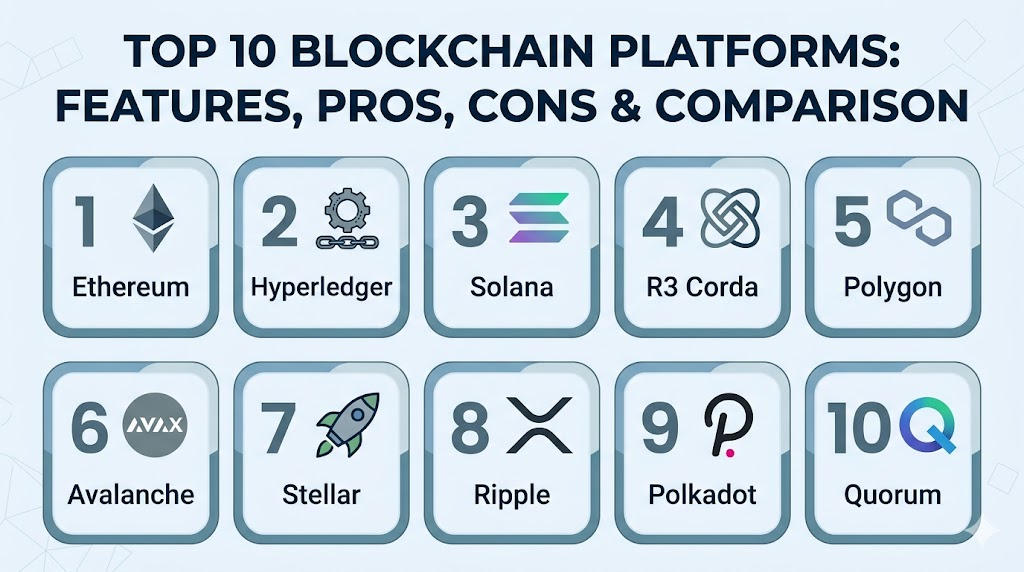
Top 10 Blockchain Platforms
1. Ethereum
The undisputed leader in the smart contract space, Ethereum serves as the primary foundation for decentralized finance (DeFi) and NFTs. With its recent upgrades, it has become more energy-efficient and scalable while maintaining the highest level of decentralization.
Key Features
- Ethereum Virtual Machine (EVM): The industry standard for executing smart contracts.
- Solidity Support: The most widely used language for blockchain development.
- Layer 2 Ecosystem: Massive support for scaling solutions like Arbitrum and Optimism.
- Proof of Stake: A highly secure and energy-efficient consensus mechanism.
- ERC Token Standards: Universal standards for fungible and non-fungible tokens.
Pros
- Largest developer community and most mature toolset in the world.
- High level of security and true decentralization.
Cons
- High transaction fees on the main network during periods of high demand.
- Complexity in managing different Layer 2 scaling options.
Platforms / Deployment
Windows / macOS / Linux
Public / Hybrid
Security & Compliance
Standardized smart contract auditing and decentralized governance.
Not publicly stated.
Integrations & Ecosystem
Integrates with virtually every wallet, exchange, and DeFi protocol in existence. It is the hub of the broader Web3 ecosystem.
Support & Community
Unparalleled global community support with thousands of forums, open-source projects, and official documentation from the Ethereum Foundation.
2. Hyperledger Fabric
An enterprise-grade, permissioned blockchain framework hosted by the Linux Foundation. It is specifically designed for complex industrial use cases where privacy and modularity are the top priorities.
Key Features
- Channels for Privacy: Allows participants to create private sub-networks for sensitive transactions.
- Modular Architecture: Pluggable consensus and membership services to fit specific business needs.
- Multi-Language Support: Smart contracts (Chaincode) can be written in Go, Java, or Node.js.
- No Native Cryptocurrency: Focuses purely on business logic rather than financial speculation.
- High Throughput: Designed for low-latency transaction finality in corporate environments.
Pros
- Exceptional privacy controls for regulated industries like healthcare and finance.
- Highly flexible and customizable for unique supply chain requirements.
Cons
- High complexity to set up and manage compared to public chains.
- Requires significant technical expertise to maintain the network infrastructure.
Platforms / Deployment
Linux / Windows / macOS
Private / Permissioned
Security & Compliance
Robust identity management through Membership Service Providers (MSP).
Not publicly stated.
Integrations & Ecosystem
Deeply integrated with IBM Cloud and other enterprise-grade infrastructure. Used widely in global trade finance and food safety networks.
Support & Community
Strong corporate backing from IBM and the Linux Foundation with professional support tiers available.
3. Solana
Solana is built for speed. It is a high-performance public blockchain that uses a unique “Proof of History” mechanism to process tens of thousands of transactions per second at a fraction of a cent.
Key Features
- Proof of History (PoH): A cryptographic clock that sequences transactions before they reach consensus.
- Tower BFT: A high-speed version of the Byzantine Fault Tolerance algorithm.
- Sea Level: A parallel smart contract runtime that processes thousands of contracts simultaneously.
- Low Transaction Costs: Fees are consistently a small fraction of a dollar.
- Rust-Based Smart Contracts: Uses a powerful, memory-safe language for high-performance apps.
Pros
- Fastest transaction finality among major public blockchains.
- Ideally suited for high-frequency trading and real-time gaming.
Cons
- Has experienced occasional network outages during high-traffic events.
- Requires specialized, high-end hardware to run a validator node.
Platforms / Deployment
Linux / Windows / macOS
Public
Security & Compliance
Advanced cryptographic sequencing and a large validator network.
Not publicly stated.
Integrations & Ecosystem
Growing rapidly in the NFT and DeFi sectors, with strong links to high-frequency trading platforms.
Support & Community
A very active and growing developer community with significant venture capital backing.
4. R3 Corda
Corda is a distributed ledger platform designed specifically for the financial services industry. Unlike traditional blockchains, it only shares data with those who have a “need to know.”
Key Features
- Point-to-Point Communication: Transactions are shared only between the parties involved.
- Legally Identifiable Participants: Every node on the network corresponds to a known legal entity.
- Pluggable Consensus: Allows organizations to choose the level of verification they need.
- JVM Support: Smart contracts can be written in Kotlin or Java.
- Interoperability: Designed to work seamlessly with existing legacy banking systems.
Pros
- The most privacy-focused platform for highly regulated banking sectors.
- Reduces transaction costs by automating complex, multi-party legal agreements.
Cons
- Not a traditional “blockchain” in the sense of global data sharing.
- Limited use cases outside of finance and trade insurance.
Platforms / Deployment
Windows / Linux / macOS
Private / Permissioned
Security & Compliance
Designed specifically for regulatory compliance and auditability.
Not publicly stated.
Integrations & Ecosystem
Strongest integration with global financial infrastructure like SWIFT and major central banks.
Support & Community
Managed by the R3 Consortium with professional enterprise support for all members.
5. Polygon
Originally a scaling solution for Ethereum, Polygon has evolved into a complete framework for building and connecting Ethereum-compatible blockchain networks.
Key Features
- AggLayer: A unified bridge that allows for cross-chain transactions with near-instant finality.
- zkEVM: A Zero-Knowledge rollup that is fully compatible with Ethereum smart contracts.
- Proof of Stake Sidechain: A fast, low-cost environment for retail applications.
- Modular SDK: Tools for building custom, application-specific blockchains.
- Strong Brand Partnerships: Used by major global brands for loyalty programs and digital assets.
Pros
- Provides the security of Ethereum with the speed of a private chain.
- Extremely easy for Ethereum developers to migrate their applications.
Cons
- The ecosystem is highly complex, with multiple different technical layers.
- Dependency on Ethereum’s core development roadmap.
Platforms / Deployment
Windows / macOS / Linux
Public / Hybrid
Security & Compliance
Inherits security from the Ethereum mainnet for its Layer 2 solutions.
Not publicly stated.
Integrations & Ecosystem
Vast integration with mainstream retail, gaming, and social media platforms.
Support & Community
Huge developer following and excellent documentation for builders moving from 2D to Web3.
6. Avalanche
Avalanche is a platform for building custom, interoperable blockchains called “Subnets.” It is known for its incredible speed and its ability to finalize transactions in less than two seconds.
Key Features
- Avalanche Consensus: A unique, leaderless protocol that ensures high speed and security.
- Subnet Architecture: Allows organizations to launch their own blockchains with custom rules.
- EVM Compatibility: Supports all existing Ethereum tools and smart contracts.
- High Scalability: Capable of handling thousands of transactions per second across its network.
- Eco-Friendly: One of the most energy-efficient Proof of Stake networks.
Pros
- Unbeatable transaction finality speed for user-facing applications.
- Excellent for building custom enterprise chains that stay connected to a wider network.
Cons
- The native ecosystem is smaller than Ethereum’s.
- Managing multiple subnets can become architecturally complex for developers.
Platforms / Deployment
Linux / macOS / Windows
Public / Hybrid
Security & Compliance
Probabilistic consensus that is highly resistant to attacks.
Not publicly stated.
Integrations & Ecosystem
Growing influence in the enterprise space, particularly with financial institutions testing private subnets.
Support & Community
Strong developer support through Ava Labs and a professional academic community.
7. Stellar
Stellar is a decentralized, open-source network designed for moving money. It is optimized for cross-border payments and the issuance of digital representations of any currency.
Key Features
- Stellar Consensus Protocol (SCP): A low-latency consensus mechanism that is highly energy-efficient.
- Built-in Asset Issuance: Allows anyone to create a digital token in minutes.
- Distributed Exchange: A native order book for trading any issued asset.
- Horizon API: A developer-friendly set of tools for connecting to the network.
- Low Fees: Designed for microtransactions and affordable global remittances.
Pros
- The fastest and cheapest platform for global payment applications.
- Highly regarded by non-profits and financial institutions for financial inclusion.
Cons
- Not designed for complex, high-logic smart contracts (like gaming).
- The ecosystem is narrow, focusing almost entirely on financial services.
Platforms / Deployment
Windows / macOS / Linux
Public / Permissioned
Security & Compliance
Designed with built-in compliance tools for KYC (Know Your Customer) and AML.
Not publicly stated.
Integrations & Ecosystem
Integrates with global payment anchors and major money transfer services like MoneyGram.
Support & Community
Managed by the Stellar Development Foundation with a strong focus on professional and social impact use cases.
8. Ripple (XRP Ledger)
The XRP Ledger is a decentralized public blockchain that focuses on providing fast and efficient liquidity for financial institutions and cross-border payments.
Key Features
- Consensus Ledger: Does not require mining, making it extremely fast and green.
- XRP as a Bridge Currency: Facilitates instant liquidity between different fiat currencies.
- Escrow Features: Built-in tools for conditional payments and time-locked transactions.
- High Availability: The network has a history of high uptime and stability.
- DEX Integration: A native decentralized exchange for fast asset swaps.
Pros
- Extremely efficient for large-scale institutional fund transfers.
- Very low transaction costs and predictable performance.
Cons
- Often perceived as more centralized than other public blockchains.
- Has faced significant regulatory scrutiny in various jurisdictions.
Platforms / Deployment
Linux / Windows
Public / Permissioned
Security & Compliance
Strong focus on institutional security and regulatory reporting.
Not publicly stated.
Integrations & Ecosystem
Used by hundreds of banks and financial institutions globally through RippleNet.
Support & Community
Backed by Ripple Labs with professional support for financial partners.
9. Polkadot
Polkadot is a “meta-protocol” that allows different blockchains (Parachains) to connect and share security. It is built to enable a fully decentralized and interoperable web.
Key Features
- Relay Chain: The heart of the network that provides shared security to all connected chains.
- Parachains: Custom blockchains that can be optimized for specific use cases.
- Substrate Framework: A modular toolkit for building your own blockchain in minutes.
- On-Chain Governance: Transparent voting systems for all network upgrades.
- Cross-Chain Messaging (XCM): A standard for sending data between different blockchains.
Pros
- The most sophisticated platform for building a multi-chain future.
- Allows specialized chains to benefit from a massive pool of shared security.
Cons
- The architecture is highly academic and difficult for beginners to grasp.
- The process for securing a Parachain slot can be expensive and competitive.
Platforms / Deployment
Linux / macOS / Windows
Public / Hybrid
Security & Compliance
Shared security model where the Relay Chain protects all connected networks.
Not publicly stated.
Integrations & Ecosystem
A large ecosystem of custom-built blockchains for gaming, privacy, and identity.
Support & Community
High-quality documentation and strong support from the Web3 Foundation.
10. Quorum (by ConsenSys)
Quorum is an enterprise-focused version of Ethereum. It combines the public standards of the Ethereum ecosystem with the private, high-performance needs of the corporate world.
Key Features
- Private Transactions: Uses the “Tessera” manager to keep transaction data hidden from unauthorized nodes.
- Pluggable Consensus: Supports Raft and Istanbul BFT for faster performance.
- EVM Compatibility: Can run any standard Ethereum smart contract.
- Permissioning: Granular control over who can join the network and view data.
- Tethered to Public Mainnet: Can be configured to periodically “checkpoint” to the public Ethereum chain for extra security.
Pros
- The best of both worlds: Enterprise privacy with Ethereum standards.
- Seamlessly compatible with the largest library of 3D and Web3 tools.
Cons
- Development can be slower as it follows the main Ethereum roadmap.
- Requires significant management overhead for private transaction layers.
Platforms / Deployment
Linux / Windows / macOS
Private / Permissioned
Security & Compliance
Enhanced privacy and identity management for corporate use.
Not publicly stated.
Integrations & Ecosystem
Widely used by J.P. Morgan and other major financial institutions for internal tokenization.
Support & Community
Managed by ConsenSys with professional support and a strong enterprise user group.
Comparison Table
| Tool Name | Best For | Platform(s) Supported | Deployment | Standout Feature | Public Rating |
| 1. Ethereum | General DeFi / Web3 | Windows, macOS, Linux | Public / Hybrid | Smart Contract Hub | N/A |
| 2. Hyperledger | Industrial Supply Chain | Linux, Windows | Private | Modular Privacy | N/A |
| 3. Solana | High-Speed Trading | Linux, Windows | Public | Proof of History | N/A |
| 4. R3 Corda | Regulated Banking | Windows, Linux | Private | Legal Finality | N/A |
| 5. Polygon | Scaling & Retail | Windows, macOS, Linux | Public / Hybrid | AggLayer Scaling | N/A |
| 6. Avalanche | Custom Subnets | Linux, Windows | Public / Hybrid | 2-Second Finality | N/A |
| 7. Stellar | Global Payments | Windows, macOS, Linux | Public | Asset Issuance | N/A |
| 8. Ripple | Bank Liquidity | Linux, Windows | Public / Perm. | Bridge Currency | N/A |
| 9. Polkadot | Interoperability | Linux, macOS, Windows | Public / Hybrid | Parachain Model | N/A |
| 10. Quorum | Enterprise Ethereum | Linux, Windows | Private | Private Transactions | N/A |
Evaluation & Scoring
| Tool Name | Core (25%) | Ease (15%) | Integrations (15%) | Security (10%) | Perf (10%) | Support (10%) | Value (15%) | Total |
| 1. Ethereum | 10 | 6 | 10 | 10 | 6 | 10 | 9 | 8.65 |
| 2. Hyperledger | 9 | 4 | 9 | 9 | 8 | 9 | 7 | 7.85 |
| 3. Solana | 9 | 7 | 8 | 7 | 10 | 8 | 9 | 8.25 |
| 4. R3 Corda | 8 | 5 | 8 | 9 | 8 | 9 | 7 | 7.60 |
| 5. Polygon | 9 | 8 | 9 | 8 | 9 | 8 | 10 | 8.75 |
| 6. Avalanche | 9 | 7 | 8 | 9 | 9 | 8 | 8 | 8.25 |
| 7. Stellar | 7 | 9 | 8 | 8 | 9 | 8 | 9 | 8.00 |
| 8. Ripple | 7 | 8 | 9 | 8 | 9 | 8 | 8 | 8.10 |
| 9. Polkadot | 9 | 3 | 7 | 10 | 8 | 8 | 7 | 7.40 |
| 10. Quorum | 9 | 6 | 9 | 9 | 8 | 8 | 8 | 8.15 |
The scoring above focuses on the platform’s ability to provide a complete, stable, and future-proof environment for decentralized applications. Polygon and Ethereum lead the scores due to their massive ecosystems and the sheer number of live integrations available to developers. Solana and Avalanche score high on performance, making them the top choices for speed-critical tasks. Specialized enterprise platforms like R3 Corda and Hyperledger Fabric score lower on general “Value” and “Ease” because they require a highly technical setup, but they are the premium choice for high-security regulated environments.
Which Blockchain Platform Is Right for You?
Solo / Freelancer
For independent developers, Ethereum (via Layer 2s like Polygon) is the best choice. It has the most tutorials, the largest pool of ready-made code, and the best tools for getting a project from an idea to a live application quickly.
SMB
Small to medium-sized businesses looking to launch digital loyalty programs or basic tokenization should focus on Stellar or Polygon. They offer extremely low transaction fees and simple developer tools that don’t require an expensive team of blockchain architects.
Mid-Market
For growing companies needing a balance between speed and a wide talent pool, Solana or Avalanche are excellent choices. They provide high performance for consumer-facing apps while being easier to manage than custom private networks.
Enterprise
Large-scale organizations with strict compliance and privacy needs should choose Hyperledger Fabric or Quorum. These platforms provide the fine-grained controls necessary for internal supply chains and multi-party corporate agreements.
Budget vs Premium
Stellar and Blender (in the 3D world) are the kings of budget, while R3 Corda and Hyperledger are premium enterprise services that require significant investment in both time and infrastructure.
Feature Depth vs Ease of Use
Stellar is the easiest to use for financial apps, while Polkadot and Houdini (in the VFX world) provide the most depth but require a much steeper learning curve to master.
Integrations & Scalability
If your primary goal is to reach the largest possible number of users and wallets, Ethereum and Polygon are the leaders. If you need to process massive amounts of high-speed data, Solana is the most scalable option.
Security & Compliance Needs
For highly regulated industries like banking or government, R3 Corda and Ripple provide the most mature compliance frameworks and the highest level of auditability required by international law.
Frequently Asked Questions (FAQs)
1. What is the difference between a public and private blockchain?
A public blockchain is open to anyone to join and view (like the internet), while a private blockchain is a closed network where only invited participants can see and verify transactions (like a corporate intranet).
2. Does blockchain always involve cryptocurrency?
No. While many public blockchains use a native token to pay for transaction fees, enterprise platforms like Hyperledger Fabric focus purely on data management and don’t require a currency to operate.
3. Is blockchain technology energy-efficient?
Most platforms use “Proof of Stake,” which uses 99% less energy than the older “Proof of Work” systems used by early versions of Bitcoin.
4. Can I change data once it is on a blockchain?
Technically, no. One of the core features of blockchain is “immutability,” meaning once a transaction is verified, it cannot be edited or deleted. You must issue a new transaction to correct a mistake.
5. What is a “Smart Contract”?
A smart contract is a piece of computer code that automatically executes an agreement when certain conditions are met, removing the need for a middleman like a lawyer or a bank.
6. Do I need a high-end computer to use blockchain?
To use blockchain as an end-user (e.g., using a wallet), you only need a smartphone or a standard browser. However, running a “validator” node to secure a network usually requires professional hardware.
7. How much do blockchain transactions cost?
Costs vary wildly. On the Ethereum mainnet, a transaction could cost several dollars, while on platforms like Solana or Stellar, it costs a fraction of a cent.
8. What is “Interoperability” in blockchain?
It is the ability for two different blockchain networks to talk to each other and exchange data or assets directly, similar to how different email providers can send messages to each other.
9. Is blockchain secure against hackers?
While the blockchain itself is extremely secure due to its distributed nature, the “smart contracts” or wallets built on top of it can be vulnerable if they are not properly coded or protected.
10. How long does it take to build a blockchain application?
For a simple application using pre-made tools, it can take a few weeks. For a complex, custom enterprise network, development and testing can take six months to a year.
Conclusion
The selection of a blockchain platform is no longer about following the hype; it is about choosing the right architectural foundation for your specific business goals. As the technology has matured into 2026, the clear distinction between high-speed public networks like Solana and privacy-focused enterprise tools like Hyperledger Fabric allows organizations to be much more targeted in their approach. The key to success lies in balancing the need for decentralization with the realities of performance, cost, and regulatory compliance. By starting with a clear understanding of your data needs and scaling requirements, you can build a resilient digital infrastructure that thrives in the decentralized economy.

Best Cardiac Hospitals Near You
Discover top heart hospitals, cardiology centers & cardiac care services by city.
Advanced Heart Care • Trusted Hospitals • Expert Teams
View Best Hospitals