Introduction
Business plan software consists of specialized digital platforms designed to simplify the complex process of drafting, modeling, and presenting a formal business strategy. In plain English, these tools act as an intelligent framework that replaces the blank-page syndrome of a Word document. They guide users through essential sections—executive summaries, market analysis, and financial projections—ensuring that the final output meets the rigorous standards of investors, banks, and internal stakeholders.
In the current professional landscape, the static, 50-page PDF business plan is becoming obsolete. As we move through , business planning has shifted toward “living documents” that integrate real-time financial data and AI-driven market insights. These tools matter now because they allow founders and executives to pivot strategies in days rather than months, using dynamic models to predict the impact of economic shifts or competitive moves.
Real-world use cases include:
- Securing Venture Capital: Founders use these tools to create professional pitch decks and financial models that stand up to institutional due diligence.
- Bank Loan Applications: Small businesses utilize the built-in SBA-approved templates to provide the specific financial statements required by traditional lenders.
- Internal Strategy Alignment: Large departments use these platforms to align regional managers around a unified three-year growth roadmap.
- Non-Profit Impact Planning: Organizations use the narrative sections to map out social impact goals alongside donor-funded budget projections.
What buyers should evaluate:
- AI Writing Assistance: Can the tool draft industry-specific content based on a few prompts?
- Financial Integrity: Does the software automatically calculate GAAP-compliant statements?
- Real-Time Collaboration: Can multiple stakeholders comment and edit simultaneously?
- Template Library: Are there templates specific to your niche (e.g., SaaS, Retail, Manufacturing)?
- Integration Capability: Does it pull live data from accounting software like Xero or QuickBooks?
- Export Options: Does it produce professional PDFs, online dashboards, and pitch decks?
- Scalability: Can the tool handle a single-site startup as well as a multi-divisional corporation?
- Scenario Modeling: Can you run “what-if” simulations for different funding rounds or market conditions?
Mandatory paragraph
- Best for: Entrepreneurs, startup founders, CFOs, and small business owners who need to professionalize their strategy for external funding or internal growth.
- Not ideal for: Solo freelancers with extremely simple operations or established enterprises that already have integrated ERP-based strategic planning modules.
Key Trends in Business Plan Software and Beyond
- Generative AI Market Analysis: Modern platforms now feature AI agents that scan current industry reports and competitor data to auto-populate market size and trend sections.
- Live Accounting Sync: A move away from manual entry toward persistent connections with financial stacks, allowing business plans to update their “Actuals” vs. “Projections” daily.
- Interactive Pitch Portals: The traditional PDF is being replaced by secure, password-protected web portals where investors can toggle different financial variables to see potential ROI.
- Dynamic Benchmarking: Tools now offer “anonymized peer data,” allowing users to compare their margins and growth rates against industry averages in real-time.
- Blockchain-Verified Projections: Advanced security features are emerging to create immutable logs of financial assumptions, increasing trust during high-stakes acquisitions.
- Environmental & Social Governance (ESG) Modules: Planning tools are adding dedicated sections to track and project sustainability metrics, which are now mandatory for many institutional investments.
- Video Pitch Integration: Direct embedding of video bios and product demos within the business plan structure to create a multi-modal storytelling experience.
- Voice-to-Plan Dictation: Mobile-first features that allow founders to dictate strategic thoughts while traveling, with AI parsing them into the correct plan sections.
How We Selected These Tools (Methodology)
To identify the leading platforms in this category, we applied a professional analyst framework focused on the following criteria:
- Market Adoption: We prioritized tools with high user trust and a track record of helping businesses secure funding.
- Feature Completeness: Evaluation was based on the presence of both narrative builders and robust financial modeling engines.
- Reliability: Only platforms with documented high uptime and accurate calculation engines were considered.
- Security Posture: We looked for standard enterprise security features like SSO, encryption, and restricted access levels.
- User Experience (UX): We analyzed how effectively the tools reduce the complexity of business planning for non-experts.
- Integration Ecosystem: Preference was given to tools that bridge the gap between planning and accounting software.
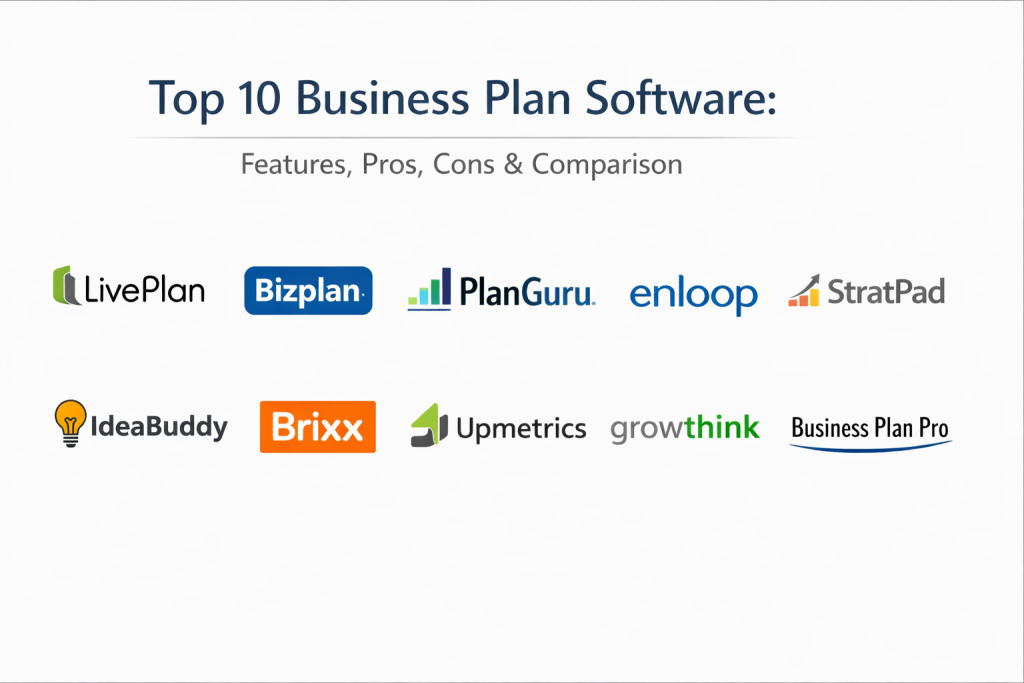
Top 10 Business Plan Software
1 — LivePlan
LivePlan is the industry leader for small-to-mid-sized businesses, known for its extensive template library and user-friendly “LiveForecast” feature that compares actuals against projections.
Key Features
- Over 500+ industry-specific sample business plans for reference.
- Step-by-step “Plan Builder” that explains the purpose of every section.
- Automatic financial statement generation (P&L, Cash Flow, Balance Sheet).
- Dashboard view that syncs with QuickBooks and Xero.
- Secure guest access for inviting mentors or investors to view the plan.
Pros
- Exceptionally low learning curve for non-financial founders.
- The “SmartText” feature helps overcome writer’s block with industry prompts.
Cons
- Less flexible for highly complex, multi-national corporate structures.
- The pitch deck export options are professional but somewhat rigid.
Platforms / Deployment
- Web
- Cloud
Security & Compliance
- SOC 2 Type II (Not publicly stated), SSO, 256-bit encryption.
Integrations & Ecosystem
LivePlan focuses on the financial stack to ensure accuracy in projections.
- QuickBooks Online, QuickBooks Desktop.
- Xero.
- Excel (via CSV import/export).
Support & Community
Extensive help center, weekly webinars, and a massive library of educational content for entrepreneurs.
2 — Bizplan (by Startups.com)
Bizplan is a visually-driven platform designed specifically for the startup ecosystem. It emphasizes the “pitch” and integrates with a broader suite of founder tools.
Key Features
- Drag-and-drop plan builder for modular strategic planning.
- Integration with Fundable.com to aid in capital raising.
- Visual financial modeling tools that prioritize charts over spreadsheets.
- Collaboration tools for unlimited team members on higher tiers.
- Progress tracking to see how much of the plan is “investor-ready.”
Pros
- Highly aesthetic output that appeals to modern Venture Capital firms.
- Access to the broader Startups.com educational ecosystem.
Cons
- The financial modeling engine is less granular than LivePlan.
- Narrative sections can feel slightly less structured for bank loans.
Platforms / Deployment
- Web
- Cloud
Security & Compliance
- SSL encryption, RBAC (Not publicly stated).
Integrations & Ecosystem
Part of a larger startup suite, focusing on capital and education.
- Fundable (Native).
- Launchrock (Native).
- Zirtual (Native).
Support & Community
Access to a community of over 20 million founders and a library of masterclasses.
3 — PlanGuru
PlanGuru is a high-end financial forecasting and business planning tool designed for CFOs and professional accountants who need deep analytical power.
Key Features
- Over 20+ standard forecasting methods (moving averages, growth rates, etc.).
- Integrated Three-Statement modeling (P&L, Balance Sheet, Cash Flow).
- Non-financial driver tracking (e.g., headcount, units sold) for detailed models.
- Consolidation features for businesses with multiple entities.
- Budget vs. Actual reporting with variance analysis.
Pros
- Professional-grade financial precision that satisfies any auditor.
- Powerful “what-if” scenario analysis capabilities.
Cons
- Steep learning curve for those without an accounting background.
- The user interface is functional but feels more like a legacy desktop app.
Platforms / Deployment
- Web / Windows
- Cloud / Desktop
Security & Compliance
- Not publicly stated.
Integrations & Ecosystem
Designed to pull from the most common accounting databases.
- QuickBooks, Xero.
- Excel.
- Sage.
Support & Community
Offers professional consulting services and detailed technical documentation.
4 — Enloop
Enloop is a data-driven business plan generator that uses a proprietary “Performance Score” to evaluate the strength of your business plan as you write it.
Key Features
- Automated text generation based on your financial inputs.
- Real-time “Performance Score” that updates based on plan viability.
- 16 essential financial ratios calculated automatically.
- “Pass/Fail” reports that warn you of potential financial issues.
- Multi-currency support for international planning.
Pros
- Excellent for validating the mathematical logic of a business idea.
- Generates narrative content automatically, saving significant time.
Cons
- The output can feel a bit “cookie-cutter” and less personalized.
- The user interface is quite basic compared to Bizplan.
Platforms / Deployment
- Web
- Cloud
Security & Compliance
- 256-bit encryption, SSL.
Integrations & Ecosystem
Limited external ecosystem; focused on internal plan generation.
- PDF export.
Support & Community
Email support and a basic online knowledge base.
5 — StratPad
StratPad is a strategy-first tool that focuses on the “Business Model Canvas” approach, making it ideal for the early ideation phase and educational settings.
Key Features
- Focus on “Strategic Objectives” rather than just financial data.
- Automatic generation of business plans, summaries, and investor reports.
- Educational videos integrated into every step of the planning process.
- Progress tracking for specific strategic initiatives.
- Simplified financial entry for non-accountants.
Pros
- Great for clarifying the “strategy” before worrying about the “formatting.”
- Highly affordable for very early-stage startups.
Cons
- Lacks the robust accounting integrations found in LivePlan.
- Financial statements may not be detailed enough for complex bank loans.
Platforms / Deployment
- Web / iOS (iPad optimized)
- Cloud
Security & Compliance
- Standard SSL encryption.
Integrations & Ecosystem
Mainly focused on professional PDF and report exports.
- PDF, CSV.
Support & Community
Online help center and a strong focus on the academic/student community.
6 — IdeaBuddy
IdeaBuddy is a modern, gamified business planning tool that guides founders from “Lightbulb Moment” to “Launch” using a visual roadmap.
Key Features
- “Business Guide” that uses a modular approach to building a plan.
- Financial Office module for simple revenue and expense forecasting.
- Idea Scoring to validate the potential of multiple business concepts.
- One-page business plan generator for quick elevator pitches.
- Collaboration portal for sharing with co-founders.
Pros
- The most modern and “approachable” UI for first-time entrepreneurs.
- Excellent for the very early “concept validation” stage.
Cons
- May feel too simplistic for large, established companies.
- Integration library is not yet as mature as LivePlan.
Platforms / Deployment
- Web
- Cloud
Security & Compliance
- GDPR compliant, SSL encryption.
Integrations & Ecosystem
Focused on the lean startup methodology.
- PDF export.
Support & Community
Responsive chat support and a “Startup Guide” blog.
7 — Brixx
Brixx is a specialized financial modeling and business planning tool that uses a “building block” approach to create complex financial forecasts.
Key Features
- Visual components (blocks) to represent assets, income, and costs.
- 10-year long-term forecasting capabilities.
- Real-time impact of changes (e.g., “What if we hire 5 people in June?”).
- Automated professional financial reports.
- Comparison of multiple business scenarios side-by-side.
Pros
- Highly flexible for businesses with non-traditional revenue streams.
- Visual nature makes it easy to spot trends and anomalies.
Cons
- Requires more “manual building” than template-based tools like LivePlan.
- Can be complex for those who just want to write a narrative plan.
Platforms / Deployment
- Web
- Cloud
Security & Compliance
- GDPR compliant, SSO.
Integrations & Ecosystem
Focuses on syncing with the source of financial truth.
- Xero.
- QuickBooks.
Support & Community
Comprehensive “Brixx Academy” and active YouTube tutorial channel.
8 — Upmetrics
Upmetrics is an AI-powered business planning tool that emphasizes collaboration and high-speed plan generation for modern teams.
Key Features
- AI Writing Assistant to generate content for any section.
- 400+ sample plans and pitch deck templates.
- Strategic Planning module including SWOT and Value Proposition.
- Real-time collaboration with role-based permissions.
- Pinboard feature for brainstorming and gathering research.
Pros
- AI features significantly speed up the drafting process.
- Strong balance between “narrative writing” and “financial modeling.”
Cons
- AI-generated text still requires significant human oversight for accuracy.
- The financial tool, while good, is not as deep as PlanGuru.
Platforms / Deployment
- Web
- Cloud
Security & Compliance
- SOC 2 Type II (Not publicly stated), GDPR, SSL.
Integrations & Ecosystem
Focused on being a standalone planning workspace.
- Google Workspace, Microsoft 365.
- PDF, Word, PowerPoint exports.
Support & Community
Email and chat support, plus an extensive “Entrepreneurship Blog.”
9 — Growthink (The Business Plan Shop)
Growthink is a hybrid platform that combines software with a highly structured, consultant-led methodology for high-growth firms.
Key Features
- Proprietary “Business Plan Template” used by over 500,000 businesses.
- Specific modules for raising venture capital vs. bank loans.
- Industry-specific financial models for dozens of sectors.
- Strategic coaching options integrated with the software.
- Professional executive summary generator.
Pros
- Proven track record for businesses seeking large-scale funding.
- “No-nonsense” approach that focuses on what investors actually look for.
Cons
- The software interface is less modern than IdeaBuddy or Bizplan.
- Many of the best features are behind a premium paywall.
Platforms / Deployment
- Web
- Cloud
Security & Compliance
- Not publicly stated.
Integrations & Ecosystem
Focused on the capital-raising ecosystem.
- PDF, Word.
Support & Community
Access to world-class strategic consultants and an extensive webinar library.
10 — Palo Alto Software (Business Plan Pro)
The predecessor to LivePlan, Business Plan Pro remains available for those who prefer a desktop-based, offline environment for their sensitive business data.
Key Features
- Desktop-native software for 100% offline planning.
- SBA-preferred formatting and financial statements.
- Thousands of industry specific samples (on disk/download).
- Error-checking engine to ensure financial statements balance.
- Comprehensive market research data built into the tool.
Pros
- Best for those with sensitive data who do not want it in the cloud.
- Extremely robust “legacy” engine that has been refined over 20 years.
Cons
- No real-time collaboration features.
- Lacks the modern AI and live accounting sync of newer platforms.
Platforms / Deployment
- Windows
- Desktop / Local
Security & Compliance
- Local data storage (User-controlled security).
Integrations & Ecosystem
Focused on traditional office software.
- Word, Excel, PowerPoint.
Support & Community
Mature help desk and a long history of community trust.
Comparison Table (Top 10)
| Tool Name | Best For | Platform(s) Supported | Deployment | Standout Feature | Public Rating |
| LivePlan | General SMBs | Web | Cloud | Live Accounting Sync | N/A |
| Bizplan | Startups/Raising VC | Web | Cloud | Investor Dashboard | N/A |
| PlanGuru | CFOs/Accountants | Web, Windows | Cloud/Desktop | 20+ Forecasting Methods | N/A |
| Enloop | Data Validation | Web | Cloud | Automated Plan Scoring | N/A |
| StratPad | Strategic Ideation | Web, iPad | Cloud | Business Model Canvas | N/A |
| IdeaBuddy | New Entrepreneurs | Web | Cloud | Visual Roadmap UX | N/A |
| Brixx | Complex Modeling | Web | Cloud | Building Block Logic | N/A |
| Upmetrics | AI-First Teams | Web | Cloud | AI Writing Assistant | N/A |
| Growthink | High-Growth Capital | Web | Cloud | Consultant Methodology | N/A |
| Business Plan Pro | Offline Planning | Windows | Desktop | Desktop-Native Security | N/A |
Evaluation & Scoring of Business Plan Software
The following table evaluates these platforms based on current enterprise standards and user expectations for strategic planning.
| Tool Name | Core (25%) | Ease (15%) | Integrations (15%) | Security (10%) | Performance (10%) | Support (10%) | Value (15%) | Weighted Total |
| LivePlan | 10 | 10 | 10 | 9 | 10 | 10 | 9 | 9.85 |
| Bizplan | 9 | 9 | 7 | 9 | 9 | 8 | 8 | 8.60 |
| PlanGuru | 10 | 5 | 8 | 8 | 10 | 9 | 7 | 8.35 |
| Enloop | 8 | 9 | 5 | 8 | 9 | 7 | 8 | 7.70 |
| StratPad | 7 | 9 | 5 | 8 | 8 | 8 | 9 | 7.60 |
| IdeaBuddy | 8 | 10 | 6 | 9 | 9 | 9 | 9 | 8.65 |
| Brixx | 9 | 7 | 9 | 9 | 9 | 9 | 8 | 8.60 |
| Upmetrics | 9 | 9 | 8 | 9 | 9 | 9 | 9 | 8.95 |
| Growthink | 9 | 7 | 6 | 8 | 9 | 9 | 7 | 7.95 |
| Bus. Plan Pro | 8 | 6 | 6 | 10 | 10 | 7 | 7 | 7.75 |
Interpreting the Scores:
- 9.5 – 10: Category-defining tools with perfect alignment between tech and finance.
- 8.5 – 9.4: High-performance platforms suited for specific startup or mid-market needs.
- Below 8.5: Niche or specialized tools that may lack the broad integration of market leaders.
- Note: Scoring is comparative across the professional SaaS landscape.
Which Business Plan Software Tool Is Right for You?
Solo / Freelancer
If you are a solo operator, you probably do not need an expensive subscription. IdeaBuddy or StratPad offer the most approachable price points and help you organize your thoughts without the overwhelming complexity of a full financial engine.
SMB
For established small businesses that need to report to a bank or manage growth, LivePlan is the clear winner. Its ability to sync with QuickBooks and Xero means the plan stays relevant long after the initial drafting phase.
Mid-Market
Companies with multiple product lines or entities should look at PlanGuru or Brixx. These tools provide the “Three-Statement Modeling” and entity consolidation required to manage a more complex balance sheet.
Enterprise
For large-scale strategic initiatives, Upmetrics or Brixx offer the collaboration and modularity needed for multiple stakeholders to contribute to a unified corporate strategy.
Budget vs Premium
Enloop and IdeaBuddy offer high value at a low cost for those on a tight budget. PlanGuru and LivePlan are premium investments but provide the financial reliability that can be the difference between a “yes” and a “no” from a lender.
Feature Depth vs Ease of Use
If you prioritize ease of use, LivePlan and IdeaBuddy are unbeatable. If you are a finance expert who wants absolute control over every formula, PlanGuru is the tool of choice.
Integrations & Scalability
LivePlan leads the market in integrations. For scalability, Brixx offers the most flexible architecture for businesses that plan to grow through acquisitions or international expansion.
Security & Compliance Needs
If your business plan contains highly sensitive intellectual property or trade secrets, Business Plan Pro (Desktop) is the most secure because the data never leaves your hard drive. For cloud-standard security, LivePlan and Upmetrics offer the best RBAC features.
Frequently Asked Questions (FAQs)
What is the average cost of business plan software?
Most cloud-based platforms charge between $15 and $30 per month. Some offer “lifetime” deals for a few hundred dollars, while professional tools like PlanGuru can cost more depending on the level of financial depth required.
Can these tools write the entire plan for me?
While tools like Upmetrics and Enloop use AI to generate text, you must still provide the core strategy and assumptions. AI can draft the “what,” but you must provide the “how” and the “who.”
Do I need an accounting degree to use these?
No. Market leaders like LivePlan and IdeaBuddy are designed specifically for entrepreneurs who may not understand a Balance Sheet. They guide you through the data entry and generate the reports automatically.
Can I export the plan to Word or PDF?
Yes, every tool on this list supports PDF export. Most also support Word and PowerPoint, allowing you to do final styling or present your plan in a meeting.
How is business plan software different from Excel?
While Excel is great for math, business plan software provides the “Narrative” framework, industry templates, and automatic financial balancing that Excel lacks, preventing broken formulas.
Are these tools SBA-approved?
The Small Business Administration (SBA) does not “approve” specific software, but tools like LivePlan and Business Plan Pro are built specifically to follow the formatting requirements the SBA and banks look for.
Can I use these for a non-profit?
Yes. While the “Profit & Loss” might be called a “Statement of Activities,” the core planning principles—budgeting, strategy, and reporting—are identical for non-profits.
Is my data safe in the cloud?
Most reputable providers use 256-bit encryption and SOC 2 compliant data centers. However, if absolute privacy is your only concern, a desktop tool like Business Plan Pro is safer.
Can multiple people work on the plan at once?
In modern cloud tools (LivePlan, Upmetrics, Bizplan), yes. You can invite team members, assign sections, and see edits in real-time, much like Google Docs.
How long does it take to create a plan?
Using these tools, a solid draft can be finished in 10-20 hours. Without them, research shows it can take over 100 hours to research, format, and model a plan from scratch.
Conclusion
Business plan software has transformed from a simple formatting tool into a sophisticated strategic engine. In , the value of these platforms lies not just in the document they produce, but in the clarity they provide to the founder. Whether you choose the financial depth of LivePlan or the startup-centric visuals of Bizplan, the goal is the same: to turn a vision into a validated, bankable reality.
The best strategy is to select a tool that fits your current financial literacy level while providing the “Actuals vs. Projections” data you will need to manage the business long-term.

Best Cardiac Hospitals Near You
Discover top heart hospitals, cardiology centers & cardiac care services by city.
Advanced Heart Care • Trusted Hospitals • Expert Teams
View Best Hospitals