Introduction
Claims fraud detection has evolved into a highly sophisticated technical discipline, particularly as insurance carriers and financial institutions face an era of industrialized deception. In the current landscape, fraud is no longer characterized by isolated incidents of exaggeration; it is driven by coordinated networks using generative AI to produce synthetic identities and fabricated documentation. Modern detection tools serve as a critical intelligence layer, sitting atop core claims systems to analyze behavioral signals, cross-reference global data networks, and apply machine learning to identify anomalies in real time.
The cost of fraudulent claims continues to pressure premiums and operational margins. The primary challenge for organizations is balancing aggressive fraud prevention with a seamless customer experience. Legitimate claimants expect rapid, automated settlements, while the system must remain vigilant against deepfake media and automated “claim mills.” Evaluating a tool now requires looking beyond simple rule-based triggers and focusing on “explainable AI” and the ability to integrate fragmented data silos into a unified risk profile.
Best for: Insurance carriers, third-party administrators (TPAs), digital banks, and self-insured enterprises that handle high volumes of claims and require automated, high-precision risk scoring to combat organized fraud rings.
Not ideal for: Small agencies with low claim volumes where manual review is still cost-effective, or organizations with extremely limited digital data infrastructure that cannot support advanced API-driven analytics.
Key Trends in Claims Fraud Detection Tools
- Generative AI Defense: Tools are increasingly incorporating “forensic AI” to detect manipulated images, deepfake videos, and AI-generated medical reports submitted as evidence.
- Behavioral Biometrics at FNOL: Monitoring how a user interacts with a digital claim form—such as hesitation, copy-pasting patterns, or unusual navigation—to flag potential coaching or synthetic intent.
- Network Link Analysis: The shift toward graph database technology to map hidden connections between claimants, witnesses, and service providers across different geographic regions.
- Explainable AI (XAI): A move toward “whitebox” models that provide investigators with a clear rationale for why a claim was flagged, ensuring regulatory compliance and fairness.
- Real-Time Automated Settlement: Integrating fraud scoring directly into the “Straight-Through Processing” (STP) workflow, allowing low-risk claims to be paid in minutes while high-risk ones are diverted.
- Consortium Data Sharing: Increased reliance on shared industry databases that allow carriers to spot “cross-carrier” fraud where a single loss is claimed multiple times.
- Digital Footprint Intelligence: Using social media, public records, and dark web monitoring to validate the digital history and physical presence of a claimant.
- Predictive Medical Analysis: Using natural language processing (NLP) to scan medical bills for “upcoding” or inconsistencies with the reported injury or loss type.
How We Selected These Tools
- Deep Learning Capabilities: We prioritized tools that utilize advanced neural networks to identify subtle patterns that traditional rules-based systems miss.
- Insurance-Specific Logic: The selection focuses on platforms that have specialized models for P&C, Health, and Life insurance, rather than generic fraud tools.
- Integration Maturity: We evaluated how easily these tools plug into standard claims management systems like Guidewire, Duck Creek, and Salesforce.
- Real-Time Performance: Only tools capable of delivering risk scores within milliseconds at the point of First Notice of Loss (FNOL) were considered for the top spots.
- Regulatory Alignment: Selection was based on the ability to support audit trails and data privacy standards required for global financial operations.
- Market Provenance: We looked for solutions with a proven track record of reducing loss ratios and improving the efficiency of Special Investigation Units (SIUs).
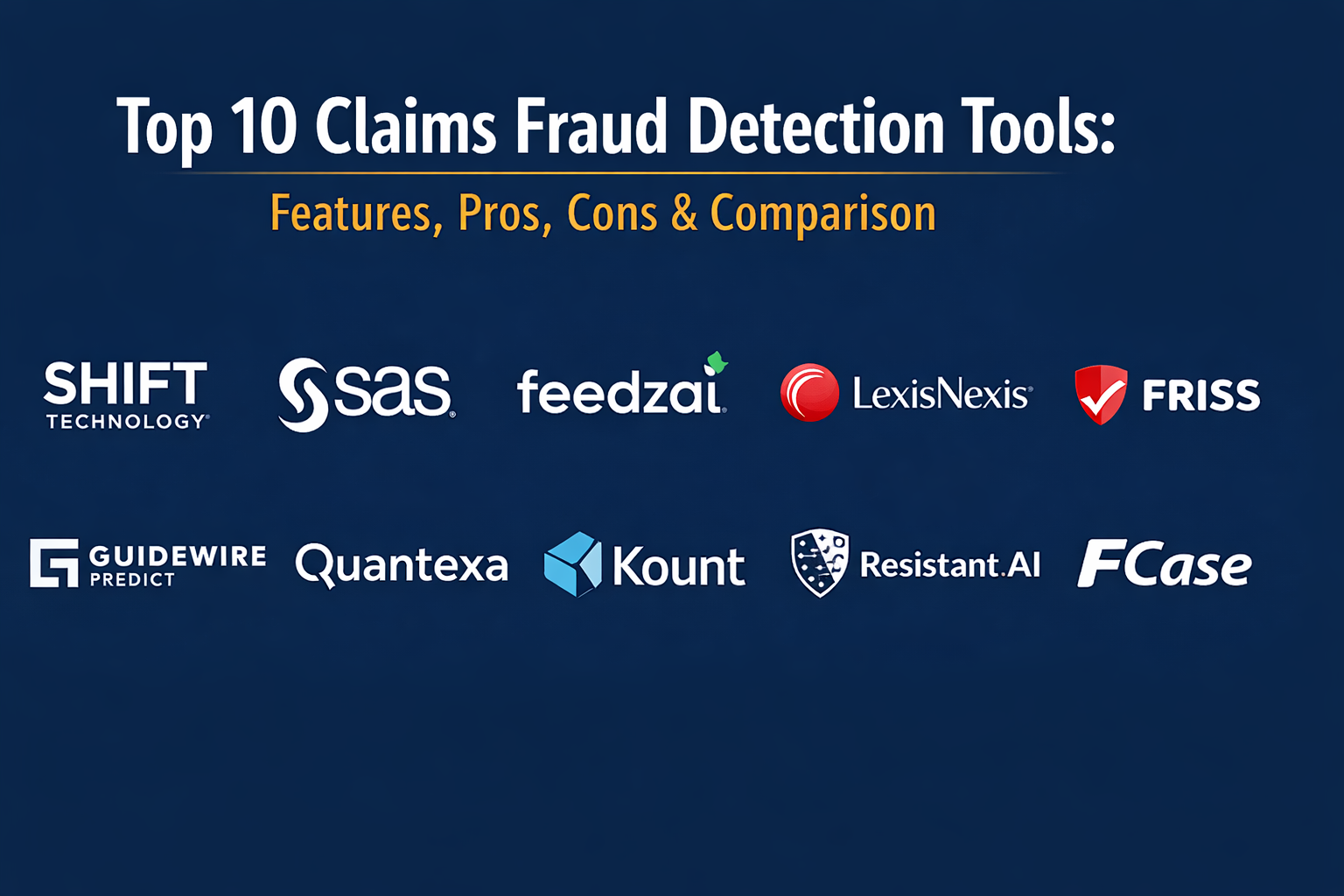
Top 10 Claims Fraud Detection Tools
1. Shift Technology
Shift Technology is widely regarded as the market leader in AI-native insurance fraud detection. Its platform is built specifically for the insurance industry, using large-scale machine learning to automate the claim-triage process and identify organized fraud networks.
Key Features
- AI-driven “Reasoning Engines” that explain exactly why a claim is considered suspicious.
- Specialized models for various lines of business including motor, property, and health.
- Advanced network analysis to visualize relationships between diverse parties in a claim.
- Automated evidence gathering that pulls from external public and private sources.
- Seamless integration with core insurance platforms for real-time decisioning.
Pros
- Exceptional accuracy in reducing false positives for legitimate claimants.
- Deeply verticalized for the insurance industry with pre-built fraud scenarios.
Cons
- Implementation can be complex and resource-heavy for mid-sized carriers.
- The premium pricing model reflects its high-end enterprise positioning.
Platforms / Deployment
Windows / Web
Cloud
Security & Compliance
SOC 2, ISO 27001, and GDPR compliant.
SSO/SAML, MFA, and comprehensive audit logs.
Integrations & Ecosystem
The platform features native connectors for Guidewire and Duck Creek. It is designed to act as an intelligence layer that enhances existing claims management workflows without requiring a full system overhaul.
Support & Community
Provides dedicated customer success managers and specialized training for SIU teams. Support is high-touch and tailored to large-scale enterprise deployments.
2. SAS Detection and Investigation
SAS offers a robust, multi-layered defense system that combines business rules, machine learning, and social network analysis. It is favored by global insurers who need to monitor vast amounts of data across multiple business lines.
Key Features
- Hybrid detection approach using rules, anomalies, and predictive modeling.
- Visual investigator interface that allows analysts to explore complex data relationships.
- Real-time scoring at the moment a claim is filed or updated.
- Customizable dashboards for monitoring fraud trends and investigator performance.
- High-performance analytics that can handle billions of rows of historical data.
Pros
- Extremely flexible and customizable for highly specific regional fraud patterns.
- Proven scalability for the world’s largest financial institutions.
Cons
- Requires a high level of internal technical expertise to manage and tune.
- The user interface can feel more technical than some of the newer AI-first competitors.
Platforms / Deployment
Windows / Linux
Cloud / Hybrid
Security & Compliance
Enterprise-grade security with support for high-compliance government and financial standards.
Not publicly stated for specific regional modules.
Integrations & Ecosystem
Strong integration with enterprise data lakes and legacy core systems. It is part of the broader SAS analytics ecosystem, allowing for deep data cross-pollination.
Support & Community
Extensive documentation and a global network of certified consultants. Professional support is available 24/7 for critical enterprise issues.
3. Feedzai
Feedzai is a high-speed AI platform that specializes in the “RiskOps” approach. It unifies fraud detection and AML compliance into a single stream, focusing on real-time behavioral analytics to stop fraud before payment.
Key Features
- Pulse behavioral biometrics to monitor user interaction during claim submission.
- Genome technology for link analysis and identifying coordinated attacks.
- Open ML architecture that allows carriers to import their own custom models.
- Automated alert prioritization to focus investigators on the highest-value cases.
- Real-time stream processing for instant risk evaluation of digital claims.
Pros
- Excellent at spotting “synthetic” fraud and account takeovers early.
- High speed and low latency, making it ideal for mobile-first claim apps.
Cons
- Historically more focused on payments, though its insurance capabilities are expanding.
- Can generate high volumes of alerts if the ML models are not properly tuned.
Platforms / Deployment
Web / Cloud-native
Cloud
Security & Compliance
SOC 2 Type II and ISO 27001 certified.
Advanced RBAC and full data encryption.
Integrations & Ecosystem
Connects well with modern fintech stacks and digital-first core systems. Offers robust APIs for custom integration into mobile and web portals.
Support & Community
Responsive professional support with a focus on collaborative model tuning and performance optimization.
4. LexisNexis ThreatMetrix
ThreatMetrix focuses on the identity and device aspect of claims fraud. By leveraging a global digital identity network, it can instantly determine if the person filing a claim is who they say they are and if their device has a history of fraud.
Key Features
- Digital Identity Network that analyzes billions of transactions worldwide.
- SmartID device fingerprinting to detect spoofing and hidden automated bots.
- TrustScore for real-time risk assessment of every digital interaction.
- Dynamic decision platform for building custom automated workflows.
- Integration of physical identity data with digital behavior signals.
Pros
- Unbeatable for stopping identity-related fraud at the point of onboarding and FNOL.
- Low-friction experience for legitimate users who have a clean digital history.
Cons
- Less focus on the “content” of the claim (e.g., medical bill fraud) compared to Shift.
- Dependency on its proprietary network data for maximum effectiveness.
Platforms / Deployment
Web
Cloud
Security & Compliance
High-level financial compliance standards.
Full SSO and MFA support.
Integrations & Ecosystem
Designed to sit at the “front door” of the claims process. It integrates with most web and mobile application frameworks via simple APIs.
Support & Community
Strong enterprise support with regular insights and reports on emerging global fraud trends.
5. FRISS
FRISS provides a dedicated “Trust Automation” platform for P&C insurers. It is designed to provide a “Risk Score” for every claim, helping carriers automate the green-lighting of honest claims while stopping fraud.
Key Features
- Pre-configured “Fraud Schemes” library tailored for property and casualty.
- Real-time automated checks against external data sources and blacklists.
- Intuitive “Traffic Light” system for quick investigator decision-making.
- Specialized module for evaluating service provider and vendor risk.
- Knowledge-sharing network that benefits from anonymized industry data.
Pros
- Faster implementation time compared to broader enterprise platforms.
- Highly intuitive interface that is loved by non-technical claim adjusters.
Cons
- Primarily focused on P&C; may not be as deep for complex health or life claims.
- Customization options are more limited than the larger platforms like SAS.
Platforms / Deployment
Web
Cloud / Hybrid
Security & Compliance
ISO 27001 certified and GDPR compliant.
Not publicly stated.
Integrations & Ecosystem
Known for its “Ready for Guidewire” and “Duck Creek” accelerators, making it one of the easiest tools to deploy for carriers on those platforms.
Support & Community
Excellent onboarding support and a strong community presence in the European and North American insurance markets.
6. Guidewire Predict (formerly HazardHub/Cyence)
As part of the leading claims management ecosystem, Guidewire Predict uses advanced data science to embed fraud risk scores directly into the claim adjuster’s daily workspace.
Key Features
- Embedded predictive analytics that require no toggling between systems.
- Massive library of geospatial and property hazard data to validate claims.
- Machine learning models that learn from historical claim outcomes.
- Automated routing of suspicious claims to SIU based on score thresholds.
- Visual dashboards for tracking loss ratios and fraud detection accuracy.
Pros
- Zero-friction workflow for adjusters already using Guidewire ClaimCenter.
- Access to proprietary data sets that help validate physical loss conditions.
Cons
- Only available to organizations already using the Guidewire platform.
- Analytics depth can vary depending on the quality of historical data provided.
Platforms / Deployment
Web
Cloud
Security & Compliance
Standard Guidewire Cloud security and compliance certifications.
Full enterprise identity management.
Integrations & Ecosystem
Native integration with the Guidewire Marketplace, allowing for easy layering of other specialized data services.
Support & Community
Backed by Guidewire’s massive global support infrastructure and a well-established user community.
7. Quantexa
Quantexa specializes in “Decision Intelligence,” using massive-scale entity resolution to find hidden links between people, addresses, and organizations that traditional systems miss.
Key Features
- Contextual Decision Intelligence that resolves millions of data points into single entities.
- High-performance graph analytics to uncover complex fraud rings and money laundering.
- Real-time monitoring of vast data streams for emerging risk signals.
- Open architecture that integrates with existing data warehouses and lakes.
- Advanced visualization of “Who knows Whom” across a multi-party claim.
Pros
- Best-in-class for identifying organized, large-scale coordinated fraud.
- Can ingest and process unstructured data from multiple disparate sources.
Cons
- A highly technical platform that requires a specialized engineering team to maintain.
- Overkill for simple, high-frequency “soft” fraud detection.
Platforms / Deployment
Linux
Cloud / Hybrid
Security & Compliance
Enterprise security standards including RBAC and full encryption.
Not publicly stated.
Integrations & Ecosystem
Designed as an infrastructure-level tool that connects to any core claims system through robust APIs and data connectors.
Support & Community
Provides high-level engineering support and works closely with major system integrators for deployment.
8. Kount (an Equifax Company)
Kount provides an AI-driven platform that excels in identity trust and payment fraud, making it highly effective for digital-first claims processing and protecting loyalty program redemptions.
Key Features
- Identity Trust Global Network based on billions of data points.
- Real-time AI that uses both supervised and unsupervised learning.
- Specialized tools for account takeover (ATO) and synthetic ID protection.
- User-friendly “Command” center for managing fraud rules and investigations.
- Advanced device intelligence that detects proxies and VPN usage.
Pros
- Very easy to deploy for digital portals and mobile applications.
- Backed by Equifax’s massive credit and identity data ecosystem.
Cons
- Less specialized in the “mechanics” of an insurance claim (e.g., medical coding).
- Best used as a first-line identity defense rather than a deep investigative tool.
Platforms / Deployment
Web
Cloud
Security & Compliance
PCI DSS, SOC 2, and ISO 27001 compliant.
Full SSO and MFA capabilities.
Integrations & Ecosystem
Integrates easily with standard web frameworks and e-commerce-style digital portals.
Support & Community
Strong support with a focus on data science consultation and performance optimization.
9. Resistant AI
Resistant AI is a specialized tool that focuses on “Document Forensics.” It is essential for detecting when PDFs, medical bills, or identity documents have been digitally altered by AI or editing software.
Key Features
- Automated detection of digital “scars” left by photo editing or AI generation.
- Serial fraud detection that identifies reused templates across different claims.
- Low-latency API that can scan thousands of documents in seconds.
- Explainable alerts that show exactly which part of a document was tampered with.
- Overlay technology that works on top of any existing claims management system.
Pros
- Provides a critical defense against the new wave of AI-generated documentation.
- Extremely lightweight and easy to add to an existing tech stack.
Cons
- Focused only on document/identity authenticity, not broader claim logic.
- Requires a primary fraud system or manual workflow to act on its alerts.
Platforms / Deployment
Web
Cloud
Security & Compliance
GDPR compliant with secure API processing.
Not publicly stated.
Integrations & Ecosystem
Designed to be an “add-on” via API. It fits into any document ingestion workflow or claims portal.
Support & Community
Growing community of fraud investigators focusing on the forensic aspects of digital evidence.
10. FCase
FCase is a “Fraud Orchestration” platform that focuses on the investigation and resolution side of the house, unifying alerts from multiple detection engines into a single, automated workbench.
Key Features
- Centralized case management for all fraud, AML, and compliance alerts.
- Automated investigation workflows that guide analysts through required steps.
- Integration of data from multiple 3rd party detection engines.
- Real-time reporting on SIU productivity and fraud prevention ROI.
- Regulatory reporting automation to ensure compliance with financial authorities.
Pros
- Drastically reduces the time investigators spend jumping between systems.
- Provides a unified “source of truth” for the entire fraud department.
Cons
- It is not a detection engine itself; it requires other tools to feed it alerts.
- Success depends on the quality of integrations with existing detection tools.
Platforms / Deployment
Windows / Web
Cloud / Hybrid
Security & Compliance
Full audit trails and secure case handling protocols.
Not publicly stated.
Integrations & Ecosystem
Acts as the “connective tissue” between detection tools like LexisNexis or Kount and the core claims system.
Support & Community
Specialized support for building custom investigation workflows and automated reporting structures.
Comparison Table
| Tool Name | Best For | Platform(s) Supported | Deployment | Standout Feature | Public Rating |
| 1. Shift Technology | Insurance Claims | Web | Cloud | AI Reasoning Engine | N/A |
| 2. SAS | Enterprise Data | Windows, Linux | Hybrid | Hybrid Detection | N/A |
| 3. Feedzai | Real-Time RiskOps | Web | Cloud | Genome Graphing | N/A |
| 4. LexisNexis | Identity Trust | Web | Cloud | ID Network | N/A |
| 5. FRISS | P&C Carriers | Web | Hybrid | Traffic Light Scoring | N/A |
| 6. Guidewire Predict | Claims Workflow | Web | Cloud | Native Integration | N/A |
| 7. Quantexa | Coordinated Rings | Linux | Hybrid | Entity Resolution | N/A |
| 8. Kount | Digital Portals | Web | Cloud | Identity Trust | N/A |
| 9. Resistant AI | Doc Forensics | Web | Cloud | Tamper Detection | N/A |
| 10. FCase | Orchestration | Windows, Web | Hybrid | Unified Workbench | N/A |
Evaluation & Scoring
| Tool Name | Core (25%) | Ease (15%) | Integrations (15%) | Security (10%) | Perf (10%) | Support (10%) | Value (15%) | Total |
| 1. Shift Tech | 10 | 6 | 9 | 9 | 9 | 9 | 7 | 8.45 |
| 2. SAS | 10 | 3 | 8 | 10 | 9 | 8 | 6 | 7.55 |
| 3. Feedzai | 9 | 7 | 9 | 9 | 10 | 8 | 7 | 8.45 |
| 4. LexisNexis | 8 | 8 | 10 | 9 | 10 | 9 | 8 | 8.70 |
| 5. FRISS | 8 | 9 | 9 | 8 | 8 | 8 | 9 | 8.35 |
| 6. Guidewire | 7 | 8 | 10 | 9 | 8 | 8 | 7 | 7.95 |
| 7. Quantexa | 10 | 2 | 8 | 9 | 10 | 7 | 6 | 7.30 |
| 8. Kount | 7 | 9 | 9 | 9 | 10 | 8 | 9 | 8.35 |
| 9. Resistant AI | 9 | 10 | 9 | 8 | 10 | 7 | 9 | 8.90 |
| 10. FCase | 6 | 7 | 10 | 9 | 8 | 8 | 8 | 7.60 |
The scoring model highlights that no single tool is perfect for every scenario. High total scores for tools like Resistant AI and LexisNexis reflect their extreme focus and ease of use in their specific niches (document tampering and identity). However, an enterprise carrier might prioritize Shift Technology or SAS despite their lower “Ease of Use” because their core logic is deeply specialized for the insurance lifecycle. Quantexa remains the most powerful for complex investigation, though it requires significant technical heavy lifting.
Which Claims Fraud Detection Tool Is Right for You?
Solo / Freelancer
If you are an independent investigator or a small TPA, Resistant AI or Kount are the most accessible. They offer a “pay-as-you-go” style utility that doesn’t require a massive IT infrastructure to implement.
SMB
Mid-market insurers should look for tools with pre-built “accelerators” like FRISS. These platforms offer a high ROI by focusing on common P&C fraud schemes without the multi-year implementation cycles of larger suites.
Mid-Market
For carriers growing their digital footprint, Feedzai or Kount provide the best balance of identity protection and behavioral analytics, ensuring that as you grow your mobile user base, you are protected from account takeover.
Enterprise
Global carriers need the heavy hitters: Shift Technology or SAS. These tools offer the depth of logic and multi-line support required to manage risk across continents and complex product portfolios.
Budget vs Premium
Blender is not an option in the fraud world; you generally get what you pay for. However, “Budget” options like Resistant AI can be layered onto existing systems for a low cost, while “Premium” all-in-one suites like Shift provide a complete transformation of the SIU.
Feature Depth vs Ease of Use
FRISS and Guidewire Predict are the easiest to use within a daily workflow. Houdini-style depth is found in Quantexa and SAS, which are better suited for the back-office technical analyst than the frontline adjuster.
Integrations & Scalability
If you are already on Guidewire, staying within their ecosystem is the most scalable choice. If you are building a custom, modern tech stack, Feedzai and LexisNexis offer the most flexible API-first architectures.
Security & Compliance Needs
For carriers in highly regulated markets like the EU or the US, SAS and LexisNexis offer the most robust documentation and compliance certifications to ensure your fraud detection methods stand up to legal scrutiny.
Frequently Asked Questions (FAQs)
1. How does AI actually detect a fraudulent insurance claim?
AI scans thousands of data points—including timestamps, location data, medical codes, and historical patterns—to find anomalies that suggest a claim was staged, exaggerated, or fabricated.
2. Can these tools really catch deepfake images or videos?
Yes, specialized forensic tools like Resistant AI analyze the digital metadata and noise patterns of a file to detect if it has been generated or altered by AI software.
3. Will these tools slow down the payment of honest claims?
Actually, the goal is the opposite. By accurately flagging high-risk claims, these tools allow insurers to “Fast-Track” low-risk claims for instant payment without manual intervention.
4. What is Straight-Through Processing (STP) in insurance?
STP refers to a claim that is filed, assessed for fraud, and paid out automatically by software without ever requiring a human adjuster to review the file.
5. How do fraud rings use “Synthetic Identities”?
Fraudsters combine real and fake data—like a real social security number with a fake name—to create a “ghost” person who can then take out policies and file fraudulent claims.
6. What is the difference between “Hard” and “Soft” fraud?
Hard fraud is a deliberate act like staging a car accident. Soft fraud is the exaggeration of a legitimate claim, such as overstating the value of stolen items in a home burglary.
7. Can I integrate these tools into my existing Salesforce or Guidewire system?
Yes, most top-tier fraud detection tools offer pre-built connectors or robust APIs specifically designed to work within your existing claims management platform.
8. Why is “Explainable AI” so important for fraud investigators?
If a claim is denied, the insurer must be able to prove why. Explainable AI ensures that the “black box” provides a clear reason that an investigator can verify and defend in court.
9. Do these tools share data with other insurance companies?
Many platforms participate in “Consortiums” where anonymized data is shared across the industry to help everyone spot habitual fraudsters and cross-carrier claims.
10. Is it expensive to implement these fraud detection systems?
While the upfront costs can be significant, the ROI is usually measured in the reduction of “Loss Ratio” and operational savings, often paying for itself within the first year.
Conclusion
The selection of a claims fraud detection platform is a strategic move that directly impacts both your bottom line and your customer’s trust. In an era where fraud tactics are evolving as fast as the technology they exploit, relying on static rules is no longer a viable defense. The most effective strategy involves layering specialized tools—combining high-level identity trust with deep-dive forensic analysis of claim documents. By prioritizing real-time decisioning and explainable AI, organizations can protect their assets from sophisticated rings while delivering the rapid, friction-free experience that modern policyholders demand.

Best Cardiac Hospitals Near You
Discover top heart hospitals, cardiology centers & cardiac care services by city.
Advanced Heart Care • Trusted Hospitals • Expert Teams
View Best Hospitals