Introduction
Clinical terminology management involves the centralized governance, mapping, and distribution of standardized medical code sets such as SNOMED CT, ICD-10, LOINC, and RxNorm. In a modern healthcare ecosystem, these tools act as the “semantic translator” that ensures data generated in a physician’s note remains accurate and interoperable as it moves into an electronic health record, a billing system, or a research database. Without robust terminology management, healthcare organizations face fragmented data silos, increased medical errors due to misinterpretation, and significant financial leakage in the revenue cycle.
The necessity for these tools has escalated. The rise of value-based care and the mandate for real-time interoperability through FHIR-based APIs mean that “static” code lists are no longer sufficient. Modern platforms now leverage artificial intelligence to automate the mapping of unstructured clinical text to structured codes, ensuring that high-velocity data remains “analytics-ready” the moment it is captured. Organizations must evaluate these platforms based on their ability to handle massive terminology updates, their support for multi-lingual clinical environments, and their capacity to integrate directly into the clinician’s existing workflow.
Best for: Health information exchanges (HIEs), large-scale hospital networks, pharmaceutical research institutions, and national health departments requiring a single source of truth for clinical data standards.
Not ideal for: Small independent medical practices with basic documentation needs or organizations that rely entirely on the native, pre-configured coding libraries provided by a single-vendor EHR without any need for cross-system data normalization.
Key Trends in Clinical Terminology Management Tools
- Generative AI for Semantic Mapping: Platforms are integrating Large Language Models to suggest highly accurate mappings between local, non-standard clinical terms and global standards, reducing manual labor by up to 80%.
- FHIR-Native Terminology Services: The shift toward Fast Healthcare Interoperability Resources (FHIR) has made API-first terminology servers the standard for real-time data exchange across disparate systems.
- Ambient Documentation Integration: Terminology tools are moving “upstream,” working behind the scenes of ambient listening devices to code clinical conversations in real-time without user intervention.
- Automated Regulatory Synchronization: Systems now offer “auto-update” features that pull the latest versions of ICD, CPT, and SNOMED releases the moment they are published by regulatory bodies.
- Semantic Normalization for Data Lakes: High-performance engines are being used to clean and normalize massive “messy” datasets in cloud data warehouses to fuel predictive AI models.
- Graph-Based Terminology Modeling: Moving beyond flat lists, newer tools use graph databases to map the complex hierarchical and lateral relationships between different medical concepts.
- Multi-Lingual Clinical Support: Global health initiatives are driving the need for tools that can manage synonyms and clinical terms across multiple languages while maintaining a single conceptual ID.
- Edge-Based Terminology Servers: To support low-latency applications, lightweight terminology services are being deployed via containerized environments (Docker) closer to the point of care.
How We Selected These Tools
- Clinical Depth and Breadth: We prioritized tools that support the full spectrum of global standards, including SNOMED CT, LOINC, ICD-10/11, and RxNorm.
- Workflow Integration: Each tool was evaluated on its ability to embed directly into major EHR systems or clinical analytics platforms.
- Automation Intelligence: Preference was given to platforms using AI and machine learning to assist in the heavy lifting of data mapping and normalization.
- Scalability and Performance: We selected tools proven to handle the high-concurrency demands of enterprise-level healthcare environments.
- Governance and Auditability: The selection includes platforms with robust version control and transparent audit trails for regulatory compliance.
- Interoperability Leadership: Priority was given to software that leads the industry in implementing FHIR-based terminology services and open APIs.
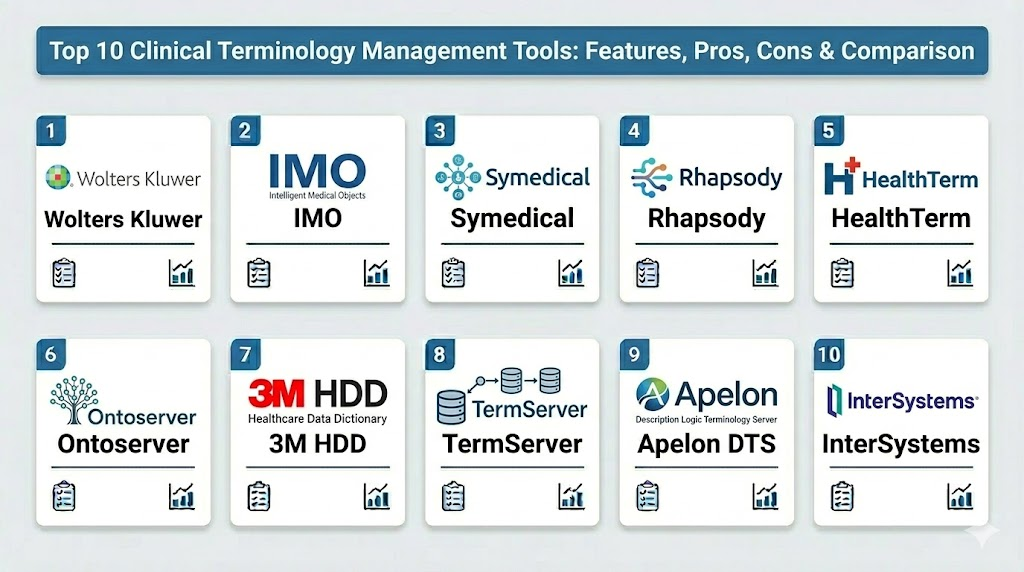
Top 10 Clinical Terminology Management Tools
1. Wolters Kluwer Health Language
This is a comprehensive data platform designed to help healthcare organizations manage clinical data and standard codes with high precision. It is particularly well-known for its “Data Quality Workbench” which streamlines the governance of complex terminology maps.
Key Features
- Curation of over 100 standard and proprietary terminology libraries.
- AI-powered automated mapping engine to reduce manual clinician intervention.
- Centralized portal for managing value sets and clinical groupings.
- FHIR-based terminology server for real-time application integration.
- Specialized modules for laboratory, pharmacy, and oncology data.
Pros
- Exceptional depth in clinical content and pre-built maps.
- Strong focus on clinical decision support and revenue cycle alignment.
Cons
- Enterprise pricing model can be prohibitive for mid-sized organizations.
- Requires a dedicated internal team to fully leverage its advanced governance tools.
Platforms / Deployment
Web / Windows
Cloud / Hybrid
Security & Compliance
HIPAA, SOC 2, and ISO 27001 compliant.
SSO/SAML and multi-factor authentication.
Integrations & Ecosystem
Integrates with nearly all major EHR vendors and data warehouse platforms. It offers a robust suite of cloud APIs for custom application development and population health analytics.
Support & Community
Professional onboarding with 24/7 technical support. They maintain an extensive library of documentation and host regular user summits for knowledge sharing.
2. Intelligent Medical Objects (IMO)
IMO is famous for its “Clinical Interface Terminology,” which bridges the gap between the natural language doctors use and the rigid codes required by computers. It is a dominant force in the North American EHR market.
Key Features
- Precision normalizer that standardizes disparate data sets automatically.
- Clinician-friendly search interface that maps directly to ICD and SNOMED.
- Automated maintenance of terminologies to ensure compliance with the latest releases.
- Specialized terminology sets for surgical, laboratory, and diagnostic workflows.
- Keyword tagging for improved data retrieval and research.
Pros
- Extremely high adoption rate and familiarity among clinicians.
- Seamless, often native integration with major EHRs like Epic and Oracle Health.
Cons
- Primarily focused on the clinical interface; less emphasis on long-term research governance.
- Advanced normalization features may require additional licensing fees.
Platforms / Deployment
Web / Windows / macOS
Cloud / Hybrid
Security & Compliance
HIPAA and SOC 2 compliant.
Audit logging and RBAC enabled.
Integrations & Ecosystem
Embedded deeply into the workflow of most major EHR systems. It connects with billing and revenue cycle management tools to ensure coding accuracy from the start.
Support & Community
Extensive online training resources and a large professional community within the health IT space.
3. Clinical Architecture (Symedical)
Symedical is an advanced clinical content management platform that focuses on the “runtime” of healthcare. It uses intelligent logic to automate the manual work of mapping and updating clinical lists across an entire enterprise.
Key Features
- “Landa” AI engine for high-speed automated mapping and normalization.
- Semantic normalization that groups similar medical concepts for better analytics.
- Centralized governance workflows to ensure organizational consistency.
- Automated updates for standard terminologies like LOINC and RxNorm.
- Tools specifically designed for checking and improving clinical data quality.
Pros
- Powerful automation tools that significantly reduce the cost of data mapping.
- Very flexible platform that allows for complex, custom business rules.
Cons
- High technical complexity requires skilled staff for initial setup.
- Documentation can be dense for non-technical terminology managers.
Platforms / Deployment
Web / Windows
Cloud / Self-hosted
Security & Compliance
SOC 2 and HIPAA compliant.
Secure API access and data encryption.
Integrations & Ecosystem
Strong support for FHIR and legacy standards, making it ideal for organizations going through EHR migrations or mergers.
Support & Community
Direct access to technical experts and a consultative onboarding process tailored to complex enterprise needs.
4. Rhapsody Semantic Manager
Rhapsody offers a high-performance semantic integration engine that serves as a vital component for Health Information Exchanges. It focuses on maintaining interoperability across a vast network of different providers.
Key Features
- Native FHIR-based terminology server designed for modern app ecosystems.
- High-speed mapping of local codes to national and international standards.
- Centralized terminology repository with full version control and history.
- Collaborative governance tools for multi-stakeholder environments.
- Real-time terminology lookups for high-velocity data pipelines.
Pros
- Optimized for high-concurrency environments like national HIEs.
- Excellent performance in translating data “on-the-wire” during exchange.
Cons
- Less focus on the clinician’s front-end documentation interface.
- Requires a strong understanding of integration patterns to maximize value.
Platforms / Deployment
Web / Linux
Cloud / Hybrid
Security & Compliance
HIPAA and GDPR compliant.
Advanced encryption and secure gateway protocols.
Integrations & Ecosystem
Deeply integrated with the broader Rhapsody Interoperability Suite, connecting seamlessly to various data sources and clinical systems.
Support & Community
Global 24/7 support with a strong presence in the integration and engineering community.
5. HealthTerm by CareCom
HealthTerm is a flexible and user-friendly platform used extensively by both national governments and large private organizations to create a “single source of truth” for medical terminology.
Key Features
- Web-based interface optimized for non-technical terminology managers.
- Collaborative workflows for creating and approving new medical terms.
- Support for massive, national-level code sets and multi-lingual synonyms.
- API-driven architecture for easy integration with third-party systems.
- Robust version management for tracking changes across different code versions.
Pros
- Very intuitive user interface that reduces the learning curve for new users.
- Proven track record in managing large-scale, international terminology projects.
Cons
- Smaller presence in the US private hospital market compared to IMO or Maya.
- Less focus on automated AI-driven mapping than some competitors.
Platforms / Deployment
Web
Cloud / Hybrid
Security & Compliance
GDPR and HIPAA compliant.
Secure cloud hosting and data residency options.
Integrations & Ecosystem
Used as a central repository that feeds standardized data to registries, EHRs, and reporting systems globally.
Support & Community
Highly rated for customer service and the willingness to work closely on custom international standards.
6. Ontoserver (by CSIRO)
Developed by the Australian national science agency, Ontoserver is a high-performance FHIR-native terminology server. it is widely regarded as one of the most advanced tools for handling complex SNOMED CT workflows.
Key Features
- Exceptional performance in searching and filtering massive SNOMED CT datasets.
- “Syndication” feature for distributing terminologies across a large network.
- Advanced support for the SNOMED Expression Constraint Language (ECL).
- Lightweight containerized deployment using Docker for cloud scalability.
- Full support for FHIR terminology services including ValueSet and CodeSystem.
Pros
- The industry leader for technical teams working with SNOMED CT and FHIR.
- Very efficient resource usage, making it easy to scale in modern cloud environments.
Cons
- Lacks a sophisticated “user-friendly” UI for non-technical clinicians.
- Focuses strictly on the server/API layer rather than the full governance workflow.
Platforms / Deployment
Linux (Containerized)
Cloud / Self-hosted
Security & Compliance
Security depends on the local or cloud deployment environment.
Supports standard secure API protocols.
Integrations & Ecosystem
Widely adopted by national health programs and independent software vendors looking for a high-speed terminology backend.
Support & Community
Active community of developers and terminology experts, particularly in regions using the FHIR standard.
7. 3M Healthcare Data Dictionary (HDD)
3M’s HDD is a foundational tool for organizations that sit at the intersection of clinical care and complex revenue cycle management. It is built on a deep history of medical coding and classification expertise.
Key Features
- Extensive, curated libraries that link clinical concepts to billing codes.
- Automated synchronization with national regulatory code changes.
- Robust governance tools for managing custom, organizational terminologies.
- Clinical concept management that ensures longitudinal data consistency.
- Tools to support complex data mapping during system migrations.
Pros
- Unrivaled expertise in the relationship between clinical terms and reimbursement.
- Strong stability and a long-standing reputation in the enterprise health space.
Cons
- Interface can feel dated compared to newer, cloud-native platforms.
- Onboarding and implementation cycles tend to be longer than modern API-based tools.
Platforms / Deployment
Web / Windows
Cloud / Hybrid
Security & Compliance
ISO 27001, SOC 2, and HIPAA compliant.
Deep encryption and enterprise-level access controls.
Integrations & Ecosystem
A core component for large health systems that use 3M’s broader suite of coding and financial tools.
Support & Community
Highly structured professional support and formal training certifications are available for administrators.
8. West Coast Informatics (TermServer)
TermServer is a modern, specialized tool that focuses on high performance and the latest semantic standards. It is often the choice for research-heavy organizations and high-tech health platforms.
Key Features
- Modern, cloud-native architecture designed for rapid API performance.
- Comprehensive knowledge base for managing complex relationships between terms.
- Native support for the latest clinical standards and cross-standard mapping.
- Highly customizable dashboard for terminology governance and reporting.
- Integrated tools for testing and validating terminology maps before deployment.
Pros
- Very fast performance and a modern, developer-friendly API.
- Highly specialized team with deep expertise in the underlying medical logic.
Cons
- Smaller company footprint compared to giants like 3M or Wolters Kluwer.
- May require more technical involvement from the client side during setup.
Platforms / Deployment
Web
Cloud / Hybrid
Security & Compliance
HIPAA and SOC 2 compliant.
SSO and secure data storage enabled.
Integrations & Ecosystem
Strong focus on helping modern health-tech startups and research groups build scalable terminology foundations.
Support & Community
Collaborative and highly technical support team that works closely on project-specific challenges.
9. Apelon Distributed Terminology System (DTS)
Apelon DTS is a veteran in the field, offering a robust framework for terminology governance. It has a long history of serving national governments and major international standards bodies.
Key Features
- Centralized repository for all standardized and local terminologies.
- Advanced mapping and crosswalk tools with full historical tracking.
- Workflow-driven governance for multi-user terminology management.
- Extensible architecture that allows for custom terminology models.
- Comprehensive APIs for integrating with clinical and research applications.
Pros
- A mature, battle-tested platform with a long history of successful deployments.
- Extremely deep support for complex, large-scale terminology governance.
Cons
- Learning curve for the administration portal can be steep for new users.
- Performance in real-time “on-the-wire” translation may be slower than FHIR-native servers.
Platforms / Deployment
Web / Windows / Linux
Cloud / Hybrid
Security & Compliance
Enterprise licensing and security protocols are standard.
Not publicly stated.
Integrations & Ecosystem
Widely used as the “backbone” for national health registries and large-scale biomedical research projects.
Support & Community
Strong community of senior terminology experts and long-term professional support contracts.
10. InterSystems HealthShare Terminology
InterSystems provides a terminology service as a first-class component of its broader health platform. It is designed for massive scale and high-reliability environments.
Key Features
- Seamless normalization across disparate EHR datasets within a single platform.
- High-performance APIs for querying complex hierarchical relationships.
- Integrated natural language processing to extract terms from clinical narratives.
- Automated distribution of updated terminology sets across a provider network.
- Native alignment with reporting and advanced clinical analytics.
Pros
- Extremely high reliability and performance in large-scale health systems.
- Part of a unified platform, reducing the need for complex external integrations.
Cons
- Best value is realized when using the broader InterSystems ecosystem.
- Initial licensing and setup represent a significant enterprise investment.
Platforms / Deployment
Web / Linux
Cloud / Hybrid
Security & Compliance
Global, multi-standard compliance including HIPAA and GDPR.
Deep encryption and continuous identity verification.
Integrations & Ecosystem
Acts as the semantic layer for the InterSystems HealthShare suite, connecting payers, providers, and research organizations.
Support & Community
Global, 24/7 support with a massive community of healthcare developers and experts worldwide.
Comparison Table
| Tool Name | Best For | Platform(s) Supported | Deployment | Standout Feature | Public Rating |
| 1. Wolters Kluwer | Large Health Systems | Win, Web | Hybrid | Quality Workbench | N/A |
| 2. IMO | Clinical Interface | Win, Web, macOS | Hybrid | Clinician Search | N/A |
| 3. Symedical | Automated Mapping | Win, Web | Hybrid | Landa AI Engine | N/A |
| 4. Rhapsody | HIEs / Integration | Linux, Web | Hybrid | Semantic Engine | N/A |
| 5. HealthTerm | National Govs | Web | Hybrid | Collaborative UI | N/A |
| 6. Ontoserver | FHIR / SNOMED CT | Linux | Cloud | ECL Support | N/A |
| 7. 3M HDD | Billing & Coding | Win, Web | Hybrid | Regulatory Sync | N/A |
| 8. TermServer | Research / Modern Ops | Web | Hybrid | API Performance | N/A |
| 9. Apelon DTS | Governance | Win, Web, Linux | Hybrid | Knowledgebase | N/A |
| 10. InterSystems | Enterprise Networks | Linux, Web | Hybrid | Data Normalization | N/A |
Evaluation & Scoring
| Tool Name | Core (25%) | Ease (15%) | Integrations (15%) | Security (10%) | Perf (10%) | Support (10%) | Value (15%) | Total |
| Wolters Kluwer | 10 | 6 | 9 | 10 | 8 | 9 | 6 | 8.20 |
| IMO | 9 | 10 | 10 | 9 | 8 | 8 | 7 | 8.70 |
| Symedical | 9 | 5 | 8 | 9 | 9 | 8 | 7 | 7.70 |
| Rhapsody | 8 | 6 | 10 | 9 | 10 | 9 | 7 | 8.20 |
| HealthTerm | 8 | 8 | 8 | 8 | 8 | 9 | 8 | 8.15 |
| Ontoserver | 9 | 4 | 9 | 7 | 10 | 7 | 9 | 7.75 |
| 3M HDD | 9 | 6 | 9 | 10 | 7 | 8 | 6 | 7.75 |
| TermServer | 8 | 7 | 9 | 8 | 9 | 8 | 8 | 8.05 |
| Apelon DTS | 9 | 5 | 8 | 8 | 7 | 8 | 7 | 7.35 |
| InterSystems | 9 | 6 | 10 | 10 | 9 | 9 | 6 | 8.25 |
The scoring results highlight a diverse market where “best” is highly contextual. IMO leads the pack for sheer ease of use and interface adoption, which is critical for clinician-facing applications. InterSystems and Rhapsody score highly for their integration and performance, making them the preferred choices for data-heavy engineering environments. Specialized tools like Ontoserver might have lower total scores due to their narrow focus and technical difficulty, yet they are nearly unbeatable for organizations that are strictly focused on modern FHIR and SNOMED implementations.
Which Clinical Terminology Management Tool Is Right for You?
Solo / Freelancer
While most of these are enterprise-grade tools, independent consultants or small research groups should look toward Ontoserver or HealthTerm. These offer the most modern, API-first approaches that can be implemented without a massive legacy infrastructure.
SMB
Small to medium-sized health tech companies or regional clinics should prioritize IMO. Its plug-and-play nature with most EHRs means you can achieve high-quality clinical documentation without needing a team of dedicated terminology experts.
Mid-Market
For mid-sized health networks and growing HIEs, Rhapsody or West Coast Informatics provide the best balance. They offer enough power to handle cross-system data exchange while remaining flexible enough for smaller IT teams to manage.
Enterprise
Large-scale health systems and pharmaceutical companies should invest in Wolters Kluwer or 3M HDD. These platforms offer the depth of content and the rigorous governance workflows required to manage data across thousands of users and multiple regulatory jurisdictions.
Budget vs Premium
If the budget is the primary constraint, exploring open-source versions of tools like Apelon or the community versions of Ontoserver is a viable path. However, for organizations where clinical risk and billing accuracy are paramount, the premium support and curated libraries of IMO or Wolters Kluwer are well worth the investment.
Feature Depth vs Ease of Use
If your priority is a deep, math-based control over semantic relationships, Symedical or Apelon are the leaders. If you need a tool that a non-technical health information manager can use daily, HealthTerm or IMO are the superior choices.
Integrations & Scalability
For systems that must scale across national borders or massive integrated delivery networks, InterSystems and Ontoserver offer the most robust architecture for high-concurrency data requests.
Security & Compliance Needs
For organizations operating in highly regulated environments (such as government contracts or clinical trials), 3M and Wolters Kluwer provide the most established compliance frameworks and extensive audit capabilities to ensure data integrity during official inspections.
Frequently Asked Questions (FAQs)
1. What exactly is a terminology server?
A terminology server is a specialized database and API layer that stores and manages medical code sets, allowing other software to look up terms, validate codes, and map data in real-time.
2. Why can’t I just use the terminology features built into my EHR?
While EHRs have basic libraries, they often struggle with cross-system data exchange and complex research needs. Dedicated tools provide better governance, version control, and mapping to external systems.
3. Is SNOMED CT the only standard I need to worry about?
No. While SNOMED is great for clinical findings, you will also need LOINC for laboratory tests, RxNorm for medications, and ICD-10/11 for billing and global statistics.
4. How does AI help in terminology management?
AI can analyze unstructured text (like a doctor’s notes) and automatically suggest the correct medical code, drastically reducing the time staff spend on manual data entry and mapping.
5. What is semantic interoperability?
It is the ability of two systems to not only exchange data but to actually understand the meaning of that data, ensuring that “High Blood Pressure” in one system is recognized as “Hypertension” in another.
6. Do these tools support international medical standards?
Yes, most top-tier tools on this list are designed to support international versions of code sets and can manage clinical synonyms across dozens of different languages.
7. How often are these medical code sets updated?
Standard terminologies are updated at different intervals, some monthly and others bi-annually. The best tools automate these updates so your organization is always using the current version.
8. Can I manage my own custom, local codes in these tools?
Yes, a primary function of these platforms is to allow organizations to manage their own proprietary codes and map them to global standards for reporting and analytics.
9. Are these platforms HIPAA compliant?
Yes, any professional-grade clinical terminology tool will include robust security features, encryption, and audit logs to ensure compliance with HIPAA, GDPR, and other health data laws.
10. How difficult is it to migrate data between these tools?
Migrations are complex but manageable. Modern tools that use standard formats like FHIR and RF2 make it significantly easier to move your terminology maps from one platform to another.
Conclusion
In the current era of data-driven medicine, clinical terminology management has transitioned from a niche administrative task to a core strategic necessity for any healthcare organization. The ability to maintain a clear, standardized, and interoperable “medical language” across thousands of patient records is the foundation upon which artificial intelligence, population health, and accurate financial cycles are built. Selecting the right platform requires a careful assessment of your technical infrastructure, your team’s expertise, and your long-term goals for data utility. By investing in a robust terminology foundation today, you are not just cleaning up data—you are ensuring that your organization can speak the universal language of healthcare with precision and trust, ultimately leading to better patient outcomes and a more resilient clinical operation.

Best Cardiac Hospitals Near You
Discover top heart hospitals, cardiology centers & cardiac care services by city.
Advanced Heart Care • Trusted Hospitals • Expert Teams
View Best Hospitals