Introduction
Code review tools help teams check code changes before they are merged into shared branches. They make collaboration safer by adding structured discussions, approvals, automated checks, and traceability. In simple terms, they reduce bugs, improve code quality, enforce standards, and help teams share knowledge.
This category matters now because teams ship more frequently, work remotely, and depend on automation for security and quality. Modern code review is not only about human comments. It includes required approvals, policy gates, code ownership rules, automated test checks, security scanning hooks, and auditable review trails.
Common real-world use cases include reviewing pull requests before merging, enforcing mandatory approvals on sensitive code, keeping consistent style through automated checks, mentoring junior developers through structured feedback, and maintaining compliance evidence through audit-ready review history.
When evaluating code review tools, buyers should focus on:
- Review workflow quality (comments, threads, suggestions, approvals)
- Policy controls (required reviewers, code owners, protected branches)
- Integration with CI checks and status gates
- Handling of large diffs and large repositories
- Support for multi-repo organizations and monorepos
- Access control, audit trails, and review traceability
- Notifications and collaboration experience
- Integration with issue tracking and project workflows
- Automation support (bots, templates, review rules)
- Cost, scalability, and operational overhead
Best for: development teams, DevOps teams, platform teams, security teams, and any organization that merges shared code and needs consistent quality gates.
Not ideal for: solo projects with no collaboration, one-off scripts, or teams that only need offline review without structured approvals and traceability.
Key Trends in Code Review Tools
- Stronger policy gates: required checks, approvals, and protected branches
- More code ownership and reviewer assignment automation
- Better handling of large diffs and complex refactors
- More integration with security scanning and compliance workflows
- Increased demand for audit-ready traceability in regulated environments
- Better review ergonomics: suggestions, batch commenting, and improved UI
- More automation and bots for repetitive review feedback
- Improved support for monorepos and multi-team ownership
- More focus on reviewer productivity: filters, search, and smarter notifications
- Standardization of review templates and decision logs across organizations
How We Selected These Tools
- Widely adopted and credible in real engineering organizations
- Strong core review workflows: comments, approvals, merge gates
- Practical governance controls for teams of different sizes
- Reliability and performance with real production repos
- Integration depth with CI checks and delivery workflows
- Fit across segments: small teams to enterprise organizations
- Collaboration experience that reduces review friction
- Support options and community signals where relevant
- Balance of platform-based and review-specialized approaches
- Long-term viability and common usage patterns across industries
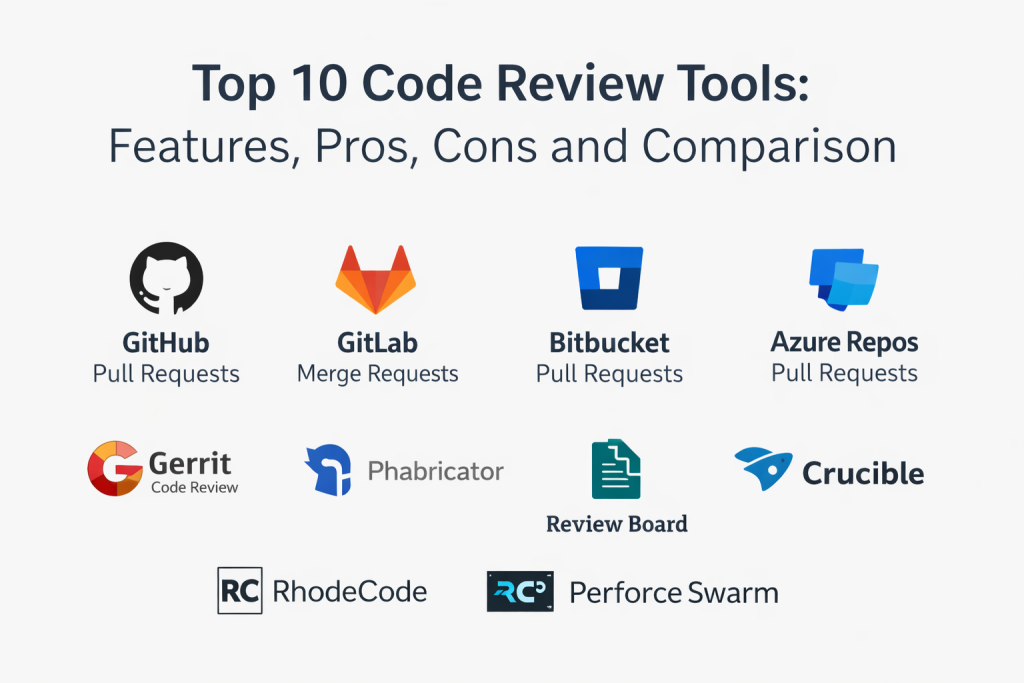
Top 10 Code Review Tools
1 — GitHub Pull Requests
GitHub Pull Requests is one of the most widely used code review systems, built around Git workflows. It fits teams that want strong collaboration, approvals, and integration patterns across modern development toolchains. GitHub
Key Features
- Pull requests with threaded discussions and inline comments
- Required approvals and protected branch rules
- Status checks and merge gating with automated validation
- Code owners and reviewer assignment patterns
- Templates for pull requests and review consistency
- Rich diff experience and history browsing
- Strong integrations through a broad ecosystem
Pros
- Very familiar workflow for many developers
- Strong ecosystem and automation options
- Good usability for daily review work
Cons
- Governance depth depends on plan and configuration
- Large enterprise processes require careful policy design
- Review effectiveness depends on team discipline and templates
Platforms / Deployment
- Web
- Cloud / Hybrid
Security and Compliance
- SSO/SAML, MFA, audit logs, RBAC: Varies by plan and configuration
- Compliance certifications: Not publicly stated
Integrations and Ecosystem
Strong fit for teams that rely on automated checks and ecosystem tooling.
- CI status checks and merge gates
- Integration with issue tracking and planning workflows
- APIs and webhooks for automation and bots
- Review templates and workflow standardization
- Integration with security scanning tools via setup
Support and Community
Large community and documentation base. Support varies by plan.
2 — GitLab Merge Requests
GitLab Merge Requests provides strong code review with governance controls, approvals, and policy workflows. It fits teams that want structured review processes and consistent enforcement across many projects. GitLab
Key Features
- Merge requests with approvals, discussions, and review rules
- Protected branches and policy-driven merge gating
- Code owners and required reviewer controls
- Strong project and group organization for governance
- Built-in review checks and status validations via configuration
- Supports structured workflows across many repos
- Strong traceability for enterprise processes
Pros
- Strong governance and review rule controls
- Good fit for structured enterprise workflows
- Scales well with groups and policies
Cons
- Best outcomes come from consistent GitLab standardization
- Feature depth varies by edition and configuration
- Self-managed setups require operational ownership
Platforms / Deployment
- Web / Linux
- Cloud / Self-hosted / Hybrid
Security and Compliance
- RBAC, audit logs, approvals, protected branches: Varies by configuration
- Compliance certifications: Not publicly stated
Integrations and Ecosystem
Fits teams that want review workflows aligned with broader delivery processes.
- Integrates with pipelines and status checks
- APIs and webhooks for workflow automation
- Works with issue planning and traceability patterns
- Supports review templates and enforcement rules
- Ecosystem integrations via configuration and extensions
Support and Community
Strong documentation and vendor support options. Community is broad.
3 — Bitbucket Pull Requests
Bitbucket Pull Requests supports Git-based review workflows and works especially well for teams using Atlassian tools. It fits organizations that want structured reviews aligned with issue tracking and team planning workflows. Atlassian
Key Features
- Pull requests with inline comments and discussions
- Branch permissions and merge checks
- Review rules and required approvals via configuration
- Strong integration patterns with Atlassian workflows
- Supports notifications and reviewer assignment workflows
- Good controls for team collaboration
- Practical review UI for common workflows
Pros
- Strong fit for Atlassian-centric organizations
- Good review and merge controls for teams
- Familiar workflow for many enterprise teams
Cons
- Ecosystem breadth can be narrower outside Atlassian tooling
- Advanced controls depend on configuration and plan
- Review experience varies by team workflow setup
Platforms / Deployment
- Web / Windows / Linux
- Cloud / Self-hosted / Hybrid
Security and Compliance
- SSO/MFA/audit logs/permissions: Varies by plan and configuration
- Compliance certifications: Not publicly stated
Integrations and Ecosystem
Best when the team uses integrated planning and collaboration workflows.
- Works well with issue tracking and release planning patterns
- APIs and webhooks for automation
- Integrates with CI status checks and merge gates
- Supports standardized review templates
- Works with developer toolchains through configuration
Support and Community
Vendor support options exist. Community usage is strong in Atlassian ecosystems.
4 — Azure Repos Pull Requests
Azure Repos Pull Requests provides code review inside Azure DevOps, with strong branch policies and enterprise governance. It fits teams that need strict review controls and tight integration with enterprise workflows. Microsoft
Key Features
- Pull requests with comments, threads, and approvals
- Branch policies with required checks and reviewers
- Merge gating through policy enforcement
- Strong integration with Azure DevOps work tracking
- Supports structured enterprise permission models
- Good traceability for compliance workflows
- Review workflows aligned with pipeline validation patterns
Pros
- Strong governance and branch policy enforcement
- Good fit for enterprise and regulated workflows
- Tight integration with Azure DevOps toolchain
Cons
- Best experience is inside the Azure DevOps ecosystem
- Can feel heavy without standard templates and practices
- Some teams prefer broader ecosystem-based platforms
Platforms / Deployment
- Web
- Cloud / Hybrid
Security and Compliance
- Enterprise access control and auditing: Varies by configuration
- Compliance certifications: Not publicly stated
Integrations and Ecosystem
Best for organizations standardizing on Azure DevOps workflows.
- Integrates with pipeline validation and checks
- Supports traceability to work items and releases
- APIs for automation and workflow enforcement
- Works with enterprise identity systems via configuration
- Supports branch policy standardization across repos
Support and Community
Strong vendor documentation and enterprise support ecosystem.
5 — Gerrit Code Review
Gerrit Code Review is designed for strict review-first workflows where changes must be approved before they are merged. It fits organizations that want strong control, traceability, and policy enforcement around code changes.
Key Features
- Review-first workflow with strict approval gating
- Fine-grained controls for who can approve and submit
- Strong audit trails for review decisions
- Works well for large org workflows with strict governance
- Supports integration with automated checks through plugins
- Useful for controlled release pipelines
- Designed for disciplined, policy-driven engineering culture
Pros
- Very strong governance and review gating
- Clear traceability of approvals and decisions
- Good fit for regulated and controlled environments
Cons
- Workflow differs from typical pull request models
- Setup and admin effort can be significant
- Onboarding can require training and clear process rules
Platforms / Deployment
- Linux
- Self-hosted / Hybrid
Security and Compliance
- RBAC and auditing: Varies by configuration
- Compliance certifications: Not publicly stated
Integrations and Ecosystem
Often paired with automation to enforce consistent quality gates.
- Integrates with CI checks through plugins and hooks
- Supports strict policy workflows for merges
- Works with enterprise identity through configuration
- Enables consistent review rules across many repos
- Fits organizations that need review traceability
Support and Community
Community exists and can be strong in certain engineering cultures. Support depends on internal ownership.
6 — Phabricator
Phabricator is a development collaboration platform that includes code review workflows and tooling for managing changes. It fits organizations that want structured review workflows and internal collaboration patterns.
Key Features
- Code review workflows built around change sets
- Discussion threads and inline commenting
- Supports review assignment and governance patterns
- Useful for organizations with internal tooling ecosystems
- Helps manage review queues and reviewer workflows
- Provides traceability of review decisions
- Supports workflow standardization through configuration
Pros
- Structured review workflow with strong collaboration focus
- Good fit for internal platform-style setups
- Useful for review queue management patterns
Cons
- Setup and maintenance can be complex
- Ecosystem momentum varies by organization adoption
- Best fit depends on existing workflow alignment
Platforms / Deployment
- Linux
- Self-hosted
Security and Compliance
- Access control and auditing: Varies by configuration
- Compliance certifications: Not publicly stated
Integrations and Ecosystem
Fits organizations that want review workflows integrated into a broader internal dev platform.
- Hooks and APIs for automation
- Works with internal authentication systems via setup
- Supports review workflow customization
- Integrates with build and test systems through configuration
- Useful for standardized change management patterns
Support and Community
Community resources exist, but strength varies. Support typically depends on internal ownership.
7 — Review Board
Review Board is a dedicated code review tool that supports reviews across multiple version control systems. It fits teams that want a standalone review system, especially in environments that are not fully standardized on one hosting platform.
Key Features
- Standalone code review workflows
- Supports multiple repository types via configuration
- Inline commenting and discussion threads
- Review request tracking and review queue management
- Integrates with automated checks through setup
- Useful for teams that want review outside hosting platforms
- Supports structured review processes for legacy toolchains
Pros
- Dedicated review tool with multi-repo flexibility
- Good for mixed toolchain environments
- Useful for structured review queues and tracking
Cons
- May require more admin effort than hosted PR tools
- UI and workflows can feel different from modern PR platforms
- Integration depth depends on configuration effort
Platforms / Deployment
- Web / Linux
- Self-hosted
Security and Compliance
- Security and auditing depend on configuration
- Compliance certifications: Not publicly stated
Integrations and Ecosystem
Useful for organizations that want review workflows independent of a single SCM hosting system.
- Integrates through hooks and APIs
- Works with CI checks via configuration
- Supports multiple repo types in one review hub
- Useful for regulated workflows needing traceability
- Customizable review workflows
Support and Community
Support depends on your chosen model. Community resources are available.
8 — Crucible
Crucible is a code review tool often associated with structured review workflows in enterprise environments. It fits teams that want formal review processes and traceability for decisions, especially where audits matter.
Key Features
- Structured review workflows and discussion threads
- Formal review processes for teams with governance needs
- Supports review tracking and participation records
- Useful for teams with compliance-driven review expectations
- Works well when processes require documented sign-off
- Helps standardize review practices
- Supports internal collaboration around code changes
Pros
- Strong fit for formal review processes
- Good for traceability and compliance-style workflows
- Useful for structured review documentation
Cons
- May feel heavier than PR-based workflows
- Adoption depends on existing enterprise tooling
- Ecosystem integration depends on configuration and stack
Platforms / Deployment
- Web
- Self-hosted / Hybrid
Security and Compliance
- Security features depend on deployment setup
- Compliance certifications: Not publicly stated
Integrations and Ecosystem
Works best when teams want review as a formal, auditable process.
- Integrates with enterprise workflows through setup
- Supports review tracking and governance documentation
- Works with SCM systems via configuration
- Fits regulated environments needing explicit sign-off
- Customization depends on enterprise practices
Support and Community
Support depends on vendor agreements and internal adoption. Community resources vary.
9 — RhodeCode
RhodeCode provides an enterprise-style platform for code collaboration and review across repositories. It fits organizations that need governance controls, structured workflows, and centralized administration.
Key Features
- Code review workflows with approvals and discussions
- Centralized repository administration and governance patterns
- Fine-grained permission controls via configuration
- Supports multi-team collaboration and repo organization
- Useful for enterprises needing structured workflows
- Review traceability and audit-friendly history
- Integrations through APIs and hooks
Pros
- Strong governance and centralized admin capabilities
- Good fit for organizations needing structured workflows
- Supports enterprise permission models
Cons
- Can require operational ownership and admin effort
- Best fit depends on how standardized workflows are
- Ecosystem breadth may be narrower than large public platforms
Platforms / Deployment
- Web / Linux
- Self-hosted / Hybrid
Security and Compliance
- RBAC and auditing: Varies by configuration
- Compliance certifications: Not publicly stated
Integrations and Ecosystem
RhodeCode fits when centralized governance is a priority.
- APIs and webhooks for automation
- Integrates with CI validation via configuration
- Supports enterprise identity patterns through setup
- Works with structured release workflows
- Useful for organizations managing many repos
Support and Community
Vendor support is typically a key factor. Community strength varies by adoption.
10 — Perforce Swarm
Perforce Swarm provides code review capabilities aligned with Perforce version control workflows. It fits teams using Perforce Helix Core, especially in environments with large assets and strict governance requirements. Perforce
Key Features
- Review workflows aligned with Perforce change management
- Supports discussions, approvals, and review tracking
- Useful for large files and asset-heavy environments
- Strong fit for enterprises using Helix Core
- Supports governance patterns and controlled workflows
- Integrates with automation and validation via setup
- Enables traceability across changes and reviews
Pros
- Best fit for Perforce-based environments
- Strong for large assets and controlled workflows
- Useful traceability for review and change history
Cons
- Limited value if you are not using Perforce Helix Core
- Setup and administration require expertise
- Ecosystem integration depends on enterprise tooling choices
Platforms / Deployment
- Web / Linux
- Self-hosted / Hybrid
Security and Compliance
- Security controls depend on configuration
- Compliance certifications: Not publicly stated
Integrations and Ecosystem
Swarm fits organizations that rely on Perforce workflows and want review integrated into the change lifecycle.
- Integrates with Perforce-based build and validation workflows
- Supports hooks and automation through configuration
- Works with enterprise identity patterns via setup
- Useful for large-scale asset pipelines
- Fits controlled engineering environments
Support and Community
Vendor support is a typical strength. Community is strong in Perforce-heavy industries.
Comparison Table
| Tool Name | Best For | Platform(s) Supported | Deployment | Standout Feature | Public Rating |
|---|---|---|---|---|---|
| GitHub Pull Requests | Broad PR-based review workflows | Web | Cloud, Hybrid | Strong ecosystem and usability | N/A |
| GitLab Merge Requests | Policy-driven review governance | Web, Linux | Cloud, Self-hosted, Hybrid | Strong review rules and approvals | N/A |
| Bitbucket Pull Requests | Atlassian-centered review workflows | Web, Windows, Linux | Cloud, Self-hosted, Hybrid | Atlassian workflow alignment | N/A |
| Azure Repos Pull Requests | Enterprise branch policy enforcement | Web | Cloud, Hybrid | Strong branch policies and checks | N/A |
| Gerrit Code Review | Strict review-first gating | Linux | Self-hosted, Hybrid | Deep approval control and traceability | N/A |
| Phabricator | Structured collaboration review workflows | Linux | Self-hosted | Review queues and change management | N/A |
| Review Board | Standalone review across repo types | Web, Linux | Self-hosted | Multi-repo review hub | N/A |
| Crucible | Formal, compliance-style reviews | Web | Self-hosted, Hybrid | Structured review documentation | N/A |
| RhodeCode | Centralized enterprise governance | Web, Linux | Self-hosted, Hybrid | Admin controls and permissions | N/A |
| Perforce Swarm | Review for Perforce environments | Web, Linux | Self-hosted, Hybrid | Works well with large assets | N/A |
Evaluation and Scoring of Code Review Tools
Scoring uses a 1–10 scale per criterion, then a weighted total using these weights: Core features 25%, Ease of use 15%, Integrations and ecosystem 15%, Security and compliance 10%, Performance and reliability 10%, Support and community 10%, Price and value 15%. Scores are comparative estimates based on typical strengths and common usage patterns, not absolute measurements.
| Tool Name | Core (25%) | Ease (15%) | Integrations (15%) | Security (10%) | Performance (10%) | Support (10%) | Value (15%) | Weighted Total |
|---|---|---|---|---|---|---|---|---|
| GitHub Pull Requests | 9 | 9 | 10 | 8 | 8 | 9 | 8 | 8.95 |
| GitLab Merge Requests | 9 | 8 | 9 | 8 | 8 | 8 | 8 | 8.50 |
| Bitbucket Pull Requests | 8 | 8 | 8 | 8 | 8 | 8 | 7 | 7.85 |
| Azure Repos Pull Requests | 8 | 7 | 8 | 8 | 8 | 8 | 7 | 7.70 |
| Gerrit Code Review | 8 | 5 | 6 | 8 | 8 | 6 | 7 | 6.85 |
| Phabricator | 7 | 6 | 6 | 7 | 7 | 6 | 7 | 6.65 |
| Review Board | 7 | 6 | 6 | 7 | 7 | 6 | 7 | 6.65 |
| Crucible | 6 | 6 | 6 | 7 | 7 | 6 | 6 | 6.30 |
| RhodeCode | 7 | 6 | 6 | 7 | 7 | 6 | 6 | 6.45 |
| Perforce Swarm | 7 | 6 | 6 | 7 | 8 | 6 | 6 | 6.65 |
How to interpret the scores:
- Higher Core favors approvals, discussions, policies, and review traceability
- Higher Ease favors smoother daily review experience and faster onboarding
- Higher Integrations favors CI checks, automation hooks, and ecosystem tooling
- Security depends on configuration, identity integration, and audit controls
- Weighted Total helps shortlist tools, but best choice depends on repo hosting and governance needs
Which Code Review Tool Is Right for You
Solo / Freelancer
If you work alone but still want review discipline, GitHub Pull Requests can be useful for self-review, even if approvals are not required. If you prefer strict change control, Gerrit can support a review-first workflow, but it usually adds more overhead than needed for solo work.
SMB
SMBs often need a smooth review workflow with minimal overhead. GitHub Pull Requests and GitLab Merge Requests are usually the best balance of usability and governance. Bitbucket Pull Requests is a strong choice if the team already uses Atlassian planning and collaboration workflows.
Mid-Market
Mid-market teams typically need review rules, code ownership, and reliable merge gates. GitLab Merge Requests is strong for policy-driven governance across many projects. GitHub Pull Requests is strong for ecosystem breadth and developer adoption. Azure Repos Pull Requests is a strong option when teams standardize on Azure DevOps pipelines and work item traceability.
Enterprise
Enterprises need strong audit trails, strict branch policies, required approvals, and consistent enforcement. GitLab and GitHub can both work well when configured with strong rules and code owners. Azure Repos fits regulated enterprises already aligned with Azure DevOps. Gerrit is a strong option when strict gating and review-first workflows are required. RhodeCode and Perforce Swarm become relevant when the organization needs centralized governance beyond typical PR platforms.
Budget vs Premium
If budget is limited, platform-based PR tools often provide the best value because review is included as part of the hosting workflow. Dedicated review platforms can be justified when you need review processes that are independent of hosting platforms, or when compliance requires more formal review documentation.
Feature Depth vs Ease of Use
If ease matters most, GitHub and Bitbucket typically offer smooth workflows. If governance depth matters most, GitLab and Azure Repos offer strong policy controls. If strict review gating is a must, Gerrit is a serious option but requires process maturity and training.
Integrations and Scalability
For deep ecosystem integrations, GitHub and GitLab are usually strongest. Azure Repos fits best inside Azure DevOps. Review Board and RhodeCode can help in multi-toolchain environments. For scaling review across many teams, code owners, required checks, and standardized templates matter as much as the tool choice.
Security and Compliance Needs
If audits and compliance matter, prioritize strong traceability, approvals, and immutable review history. Enforce branch protections, require reviews for sensitive paths, and connect automated checks so risky code cannot merge without validation. Combine review rules with secure identity integration for consistent governance.
Frequently Asked Questions
- Why is code review important even when tests exist?
Tests catch many issues, but reviews catch design problems, unclear code, security risks, and maintainability issues. Reviews also help teams share knowledge and enforce standards. - What is the difference between a pull request and a review-first workflow?
Pull requests are the common model where changes are reviewed before merge. Review-first workflows, like Gerrit, can be stricter and require approval before changes are allowed into the main branch. - How many reviewers should approve a change?
It depends on risk. Many teams require one reviewer for normal changes and two for sensitive components. Code ownership rules help route reviews to the right experts. - How do code owners improve review quality?
Code owners ensure that changes to specific areas are reviewed by the people responsible for those areas. This reduces blind spots and improves accountability. - What are common mistakes teams make during code reviews?
They focus only on style, skip tests, allow large unreviewable changes, and do not enforce standards consistently. Another mistake is unclear review expectations and no templates. - How can teams speed up code reviews without reducing quality?
Keep changes small, use templates, automate formatting and tests, and define clear review checklists. Also, rotate reviewers fairly to avoid bottlenecks. - How do tools help enforce review policies?
They can require approvals, block merges when checks fail, enforce protected branches, and log decisions. This makes governance consistent and reduces reliance on manual discipline. - Are standalone review tools still useful today?
Yes, especially in mixed toolchain environments or when compliance requires formal review records outside the repo hosting platform. They can also help when multiple SCM systems exist. - How do code review tools support security goals?
They enforce review gates, integrate security checks, and provide traceability. Combined with scanning tools, they reduce the chance of risky code being merged unnoticed. - What is the best way to choose a code review tool?
Choose the tool that aligns with your repo hosting and workflow. Run a pilot using real repos, enforce required checks and approvals, measure review speed and quality, then standardize templates and rules.
Conclusion
Code review tools are a core part of safe software delivery because they create a structured checkpoint before code reaches shared branches. The best choice depends on your hosting platform, governance needs, and team culture. GitHub Pull Requests and GitLab Merge Requests are strong choices for most teams due to usability, strong policy controls, and broad integrations. Bitbucket Pull Requests fits well in Atlassian-centered workflows, while Azure Repos Pull Requests is strong for enterprises standardizing on Azure DevOps and branch policies. Gerrit is a powerful option for strict review-first gating, while Review Board, RhodeCode, and Perforce Swarm can be valuable in specialized environments that need centralized governance. A practical next step is to shortlist two or three options, run a pilot with required checks and review rules, validate traceability and access control needs, and then standardize review templates so quality stays consistent across teams.

Best Cardiac Hospitals Near You
Discover top heart hospitals, cardiology centers & cardiac care services by city.
Advanced Heart Care • Trusted Hospitals • Expert Teams
View Best Hospitals