Introduction
Competitive Intelligence (CI) platforms are specialized digital ecosystems designed to collect, curate, and analyze external market signals to drive strategic decision-making. Unlike general business intelligence, which focuses on internal data, CI tools scan the “outside-in” landscape—monitoring competitor pricing shifts, product launches, executive movements, and customer sentiment. In the current enterprise environment, these platforms serve as an early warning system, transforming vast amounts of unstructured web data into structured, actionable insights that allow teams to pivot before a market shift becomes a threat.
The relevance of CI has reached a critical inflection point as traditional manual research fails to keep pace with digital-first competitors. Modern platforms leverage advanced automation to filter out noise, ensuring that stakeholders receive only high-impact intelligence. Real-world use cases include sales teams using live battlecards to counter objections in real-time, product managers identifying feature gaps in rival roadmaps, and executive leadership benchmarking market share shifts. When evaluating these platforms, buyers must prioritize data freshness, the quality of AI-driven summarization, and how seamlessly the intelligence integrates into existing workflows like CRM or communication tools.
Mandatory paragraph
- Best for: Revenue operations, product marketing managers, strategic planners, and sales enablement leads in competitive B2B and consumer markets.
- Not ideal for: Small businesses with no direct competition, or organizations seeking purely internal financial analytics without a need for external market tracking.
Key Trends in Competitive Intelligence Platforms
- Agentic AI Research: Platforms are deploying autonomous agents that don’t just find data but synthesize it into executive-ready briefs without human prompting.
- Win/Loss Integration: Direct links between CI data and CRM outcomes allow teams to see exactly which competitor insights are leading to closed deals.
- Neural Web Monitoring: Moving beyond simple “change detection,” modern tools use computer vision to identify subtle shifts in a competitor’s visual branding or UI.
- Semantic Signal Filtering: Advanced natural language processing now identifies the intent behind a competitor’s job posting or press release, distinguishing between routine updates and strategic pivots.
- Dark Social & Community Tracking: Systems are increasingly capable of monitoring non-public signals from Slack communities, Discord, and niche industry forums.
- Predictive Roadmap Modeling: Using historical data patterns to forecast a competitor’s likely next move in product development or geographic expansion.
How We Selected These Tools (Methodology)
To determine the top 10 CI platforms, we utilized a framework centered on enterprise readiness and insight velocity:
- Signal Accuracy: We evaluated the platform’s ability to filter out “false positives” such as A/B tests or routine website maintenance.
- Actionability: Preference was given to tools that offer “push” intelligence (alerts where the user works) rather than just “pull” dashboards.
- Depth of Source Coverage: We looked for platforms that scan a diverse range of sources, including SEC filings, review sites, and social media.
- Sales Enablement Focus: The ability to generate and maintain dynamic battlecards was a primary selection criterion.
- AI Sophistication: We prioritized tools using generative models for summarization and competitive “talk track” generation.
- Market Presence: The list includes industry leaders with proven track records in high-growth technology and manufacturing sectors.
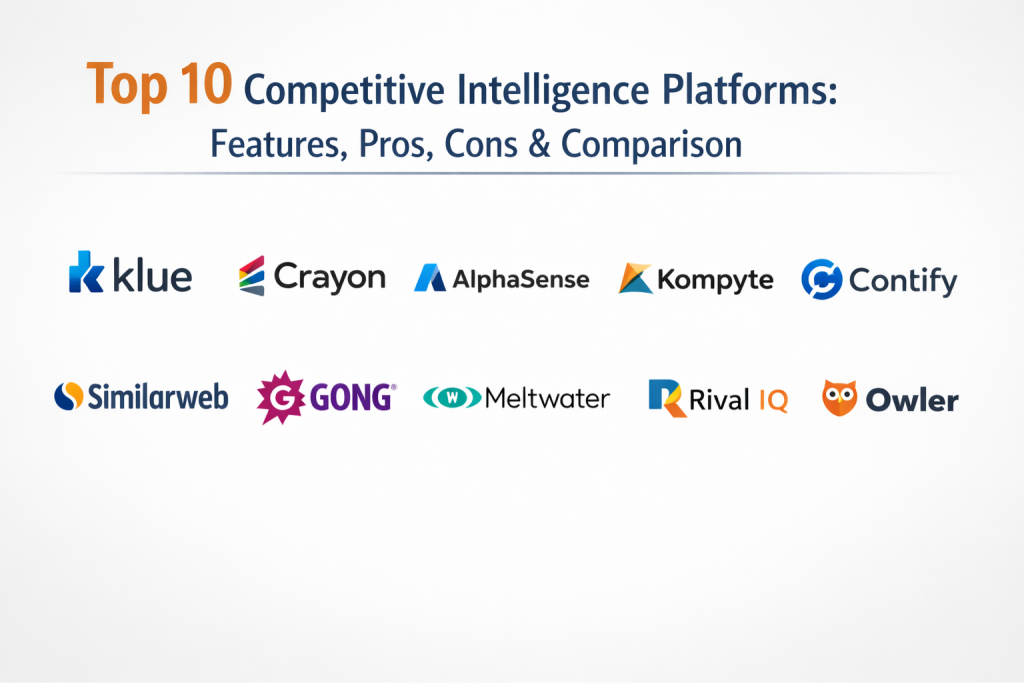
Top 10 Competitive Intelligence Software Tools
1. Klue
Klue is a leading competitive enablement platform that excels at gathering external signals and combining them with internal “tribal knowledge” from sales and success teams. It is designed to be the central repository for everything a company knows about its rivals.
Key Features
- Compete Agent: An AI-driven assistant that automates the curation of battlecards and summaries.
- Internal Intelligence Collection: Easy-to-use extensions for reps to feed field intelligence back into the system.
- Win/Loss Analysis: Integrated module to track why deals are won or lost against specific competitors.
- Dynamic Battlecards: Real-time updated cards that live inside CRM and email tools.
- Tactic Tracking: Ability to see which competitive talk tracks are most effective in live sales calls.
Pros
- Highest rated for sales adoption and ease of use in the category.
- Seamlessly bridges the gap between marketing research and sales execution.
Cons
- Requires significant initial effort to set up the internal “feedback loop.”
- Higher price point targeted primarily at mid-market and enterprise.
Platforms / Deployment
- Web / Windows / macOS / iOS / Android
- Cloud
Security & Compliance
- SSO/SAML, SOC 2 Type II, GDPR compliant.
- Advanced RBAC for sensitive competitive projects.
Integrations & Ecosystem
Klue is built to live where sales teams spend their time.
- Salesforce / HubSpot
- Slack / Microsoft Teams
- Gong / Chorus
- Highspot / Seismic
Support & Community
Extensive “Klue Academy” for training and a very active community of “Compete” professionals.
2. Crayon
Crayon specializes in automated competitive intelligence, monitoring millions of pages across the web to catch every move a competitor makes. It is particularly strong in its ability to track visual changes and messaging shifts on competitor websites.
Key Features
- Automated Website Monitoring: Real-time tracking of every page on a competitor’s domain.
- AI Insights Engine: Automatically categorizes signals into buckets like “Pricing,” “Product,” or “Messaging.”
- Customizable Dashboards: Allows different stakeholders to see only the data relevant to their role.
- Competitive Newsletter: Automated reports distributed to the company via email or Slack.
- Salesforce Integration: Pushes alerts and battlecards directly into account and lead views.
Pros
- Exceptional at catching subtle messaging changes that others miss.
- Massive data breadth covering millions of external sources.
Cons
- The sheer volume of data can feel overwhelming without strict filters.
- Setup process for tracking a large number of competitors can be time-consuming.
Platforms / Deployment
- Web
- Cloud
Security & Compliance
- SSO, MFA, SOC 2 compliant.
- Data encryption at rest and in transit.
Integrations & Ecosystem
Deep focus on the revenue stack.
- Salesforce
- HubSpot
- Slack
- Microsoft Teams
Support & Community
Dedicated success managers for enterprise accounts and a robust library of CI templates.
3. AlphaSense
AlphaSense is a market intelligence platform that focuses on high-value “premium” content, such as broker research, expert call transcripts, and financial filings. It is the go-to for strategic and financial competitive analysis.
Key Features
- AI Search & Discovery: Semantic search that understands financial and industry-specific terminology.
- Expert Insights: Access to thousands of transcripts from former employees and industry experts.
- Sentiment Analysis: AI that tracks changes in executive tone during earnings calls.
- Smart Summaries: Generative AI that condenses long filings into key bullet points.
- Company Benchmarking: Side-by-side financial and operational comparisons.
Pros
- Unrivaled access to non-publicly available professional research.
- Extremely powerful for deep-dive strategic planning and M&A.
Cons
- Less focused on day-to-day “sales battlecards” than Klue or Crayon.
- Pricing is typically on a per-user basis, which can scale quickly.
Platforms / Deployment
- Web / iOS / Android
- Cloud
Security & Compliance
- SOC 2, SSO/SAML, ISO 27001.
- Highly secure environment used by global financial institutions.
Integrations & Ecosystem
Focuses on research and knowledge management.
- Microsoft Office Suite
- Evernote
- API access for internal data lakes.
Support & Community
Top-tier research support with dedicated analysts available to help refine search queries.
4. Kompyte (by Semrush)
Kompyte is a CI tool that leans heavily into digital marketing and SEO intelligence. Since its acquisition by Semrush, it has integrated deep web traffic data with traditional sales enablement features.
Key Features
- Digital Footprint Tracking: Monitors SEO, PPC, and social media moves alongside website changes.
- Automated Battlecards: Updates sales assets automatically when a competitor changes their pricing or features.
- Win/Loss Tracking: Captures competitive outcomes directly from the CRM.
- Real-Time Alerts: Notifies teams of competitor “breaking news” across the web.
- Ad Monitoring: Tracks what competitors are spending on search and social ads.
Pros
- Great value for mid-market teams, especially those already using Semrush.
- Strongest digital marketing and traffic analysis features in the CI space.
Cons
- Smaller ecosystem of native integrations compared to the market leaders.
- AI summarization is less advanced than some enterprise-focused rivals.
Platforms / Deployment
- Web
- Cloud
Security & Compliance
- Standard SaaS security protocols and GDPR compliance.
- SSO available on higher-tier plans.
Integrations & Ecosystem
Leverages the broader Semrush marketing ecosystem.
- Salesforce / HubSpot
- Slack
- Semrush marketing suite
Support & Community
Access to Semrush’s extensive training resources and global support network.
5. Contify
Contify is an AI-enabled market and competitive intelligence platform that excels at multi-language tracking and global source coverage. It is built for large organizations that need to monitor markets in various regions.
Key Features
- Multi-Language Support: Monitors and translates signals from dozens of languages.
- Custom Intelligence Briefs: Manually curated or AI-generated newsletters for executives.
- API-First Design: Easily pushes curated intelligence into internal portals or intranets.
- Noise Filtering: Advanced algorithms to ensure high signal-to-noise ratios.
- Strategic Dashboards: High-level views of market trends and competitor health.
Pros
- Best choice for global companies tracking non-English speaking markets.
- Highly flexible delivery methods (API, RSS, Portal, Email).
Cons
- User interface is more functional than modern compared to Klue.
- Can require more configuration to get the exact “look and feel” desired.
Platforms / Deployment
- Web / iOS / Android
- Cloud / Hybrid
Security & Compliance
- ISO 27001, SOC 2, GDPR compliant.
- Options for dedicated private cloud instances.
Integrations & Ecosystem
Designed to feed internal knowledge management systems.
- Microsoft Teams / Slack
- Salesforce
- API for custom integrations
Support & Community
Known for highly responsive account management and custom setup assistance.
6. Similarweb
Similarweb provides the “missing piece” of competitive intelligence: actual traffic and engagement data. It allows companies to see exactly how much traffic their competitors are getting and where it originates.
Key Features
- Traffic Benchmarking: Comparative views of visits, bounce rates, and time on site.
- Marketing Channel Analysis: See if rivals are winning through search, social, or referrals.
- Keyword Gap Analysis: Identify search terms where competitors are outperforming you.
- Audience Insights: Data on the demographics and interests of a competitor’s users.
- Conversion Estimates: Proprietary data to estimate a rival’s digital sales performance.
Pros
- The gold standard for digital benchmarking and traffic estimations.
- Extremely intuitive visual dashboards that are boardroom-ready.
Cons
- Not a dedicated “sales enablement” tool; lacks battlecard builders.
- Data is based on estimates and panel behavior, not direct server access.
Platforms / Deployment
- Web / Browser Extension
- Cloud
Security & Compliance
- SOC 2, GDPR compliant.
- Transparent data collection methodology.
Integrations & Ecosystem
- Google Sheets / Excel
- API for data visualization tools (Tableau/PowerBI)
- Salesforce
Support & Community
Global support footprint with extensive “Digital Insights” webinars and reports.
7. Gong (for CI)
While primarily a conversation intelligence platform, Gong has become a critical CI tool by capturing the “voice of the customer.” It identifies when competitors are mentioned in live sales calls and what is being said.
Key Features
- Competitor Tracker: Automatically tags every call where a specific rival is mentioned.
- Sentiment Detection: Analyzes the buyer’s tone when discussing a competitor.
- Talk Track Analysis: Sees which competitive responses lead to deal progression.
- Market Trends: Aggregates call data to show which competitors are trending up or down.
- Win/Loss Correlation: Links competitor mentions directly to final deal outcomes.
Pros
- Captures “real world” field intelligence that doesn’t exist on the public web.
- Zero manual entry required for sales reps.
Cons
- Only monitors competitors mentioned on calls; misses wider market moves.
- Requires a broader investment in conversation intelligence to be effective.
Platforms / Deployment
- Web / iOS / Android
- Cloud
Security & Compliance
- SOC 2 Type II, ISO 27001, GDPR, HIPAA (for relevant versions).
- Advanced PII redaction capabilities.
Integrations & Ecosystem
- Salesforce / HubSpot
- Slack
- Zoom / Teams / Webex
Support & Community
Massive community of “Revenue Intelligence” professionals and world-class support.
8. Meltwater
Meltwater is a media and social intelligence platform that provides massive-scale monitoring of news, social media, and online discussions. It is the best tool for tracking “Brand Sentiment” as a competitive metric.
Key Features
- Social Listening: Real-time tracking of brand mentions and competitor conversations.
- News Monitoring: Scans 300,000+ global news sources in real-time.
- Influencer Tracking: See which industry voices are supporting your competitors.
- Competitive Benchmarking: Share of Voice (SOV) metrics against rivals.
- Crisis Detection: Early alerts when a competitor is facing PR or product issues.
Pros
- Widest coverage of news and social media signals in this list.
- Powerful sentiment analysis across multiple languages.
Cons
- Less focus on “hard” competitive data like pricing or product features.
- The platform can feel built for PR/Comms rather than Sales/Product.
Platforms / Deployment
- Web / iOS / Android
- Cloud
Security & Compliance
- Standard SaaS security and GDPR compliance.
Integrations & Ecosystem
- Slack / Microsoft Teams
- Salesforce
- Various social media management tools
Support & Community
Global 24/7 support and a large library of industry-specific CI reports.
9. Rival IQ
Rival IQ focuses specifically on social media competitive intelligence. It provides deep, granular data on how competitors are performing across every major social platform.
Key Features
- Social Benchmarking: Automated comparisons of engagement rates and post frequency.
- Boosted Post Detection: Identifies which of a competitor’s posts are likely paid ads.
- Content Inspiration: Surfaces the most successful content types in your industry.
- Audience Growth Tracking: Monitors how fast rival communities are expanding.
- Automated Reporting: Generates presentation-ready social audits in seconds.
Pros
- Best-in-class social media metrics and ease of reporting.
- Very affordable compared to enterprise-grade CI platforms.
Cons
- Strictly limited to social media and some web data; not a full-spectrum CI tool.
- No internal battlecard or sales enablement features.
Platforms / Deployment
- Web
- Cloud
Security & Compliance
- Standard SaaS security.
Integrations & Ecosystem
- Google Data Studio
- Slack
- Social Media platforms directly
Support & Community
Excellent “Social Media Benchmark” reports and responsive chat support.
10. Owler
Owler is a community-powered business information platform. It provides real-time news alerts and company profiles, making it a great “lightweight” entry point for competitive monitoring.
Key Features
- Owler Max: Enterprise version with advanced filtering and CRM sync.
- Community Intelligence: Crowdsourced data on company revenue and headcount.
- Daily Snapshots: Brief morning emails summarizing the news on your competitors.
- Competitive Sets: Pre-built lists of rivals for instant tracking.
- Exclusive Insights: Data points like “CEO Approval” and “Employee Sentiment.”
Pros
- One of the most affordable ways to get professional competitor alerts.
- Very simple to set up; literally takes minutes to start tracking a list.
Cons
- Crowdsourced data (revenue/headcount) may be less accurate than official filings.
- Lacks the deep analytical tools found in Crayon or Klue.
Platforms / Deployment
- Web / iOS / Android
- Cloud
Security & Compliance
- Standard SaaS security.
Integrations & Ecosystem
- Salesforce
- HubSpot
- Slack
Support & Community
Strong community of millions of users who contribute to the data accuracy.
Comparison Table
| Tool Name | Best For | Platform(s) Supported | Deployment | Standout Feature | Public Rating |
| 1. Klue | Sales Enablement | Win, Mac, iOS, Android | Cloud | Win/Loss Integration | N/A |
| 2. Crayon | Website Monitoring | Web | Cloud | Visual Change Detection | N/A |
| 3. AlphaSense | Strategic Research | Win, Mac, iOS, Android | Cloud | Expert Transcripts | N/A |
| 4. Kompyte | Mid-Market Digital | Web | Cloud | Semrush Traffic Data | N/A |
| 5. Contify | Global Market Intel | Win, Mac, iOS, Android | Hybrid | Multi-Language Tracking | N/A |
| 6. Similarweb | Traffic Benchmarking | Web | Cloud | Audience Insight Data | N/A |
| 7. Gong | Voice of Customer | Win, Mac, iOS, Android | Cloud | Call Competitor Tags | N/A |
| 8. Meltwater | PR & Social Intel | Win, Mac, iOS, Android | Cloud | Share of Voice (SOV) | N/A |
| 9. Rival IQ | Social Benchmarking | Web | Cloud | Boosted Post Detection | N/A |
| 10. Owler | Lightweight Alerts | Win, Mac, iOS, Android | Cloud | Community Crowdsourcing | N/A |
Evaluation & Scoring of Competitive Intelligence Platforms
| Tool Name | Core (25%) | Ease (15%) | Integrations (15%) | Security (10%) | Performance (10%) | Support (10%) | Value (15%) | Weighted Total |
| 1. Klue | 10 | 9 | 10 | 9 | 9 | 9 | 7 | 9.15 |
| 2. Crayon | 10 | 7 | 9 | 9 | 9 | 8 | 7 | 8.55 |
| 3. AlphaSense | 9 | 7 | 7 | 10 | 10 | 9 | 6 | 8.15 |
| 4. Kompyte | 8 | 8 | 8 | 7 | 8 | 8 | 9 | 8.10 |
| 5. Contify | 9 | 6 | 8 | 9 | 9 | 8 | 8 | 8.15 |
| 6. Similarweb | 7 | 9 | 8 | 8 | 10 | 8 | 7 | 8.05 |
| 7. Gong | 6 | 10 | 10 | 10 | 10 | 9 | 8 | 8.55 |
| 8. Meltwater | 8 | 7 | 8 | 8 | 9 | 8 | 7 | 7.75 |
| 9. Rival IQ | 5 | 10 | 7 | 7 | 9 | 8 | 9 | 7.20 |
| 10. Owler | 5 | 10 | 8 | 7 | 8 | 7 | 10 | 7.40 |
This scoring model prioritizes platforms that offer a complete end-to-end intelligence cycle—from collection to sales enablement. While niche tools like Rival IQ score high in ease of use, they score lower in core CI capabilities because they only cover a single channel. Enterprise leaders like Klue and Crayon provide the highest weighted totals because they solve the primary problem: getting intelligence into the hands of the people who can use it to win deals.
Which Competitive Intelligence Software Tool Is Right for You?
Solo / Freelancer
For an individual consultant or solo marketer, Owler or the free tier of Similarweb provides enough data to stay informed without a heavy financial commitment. These tools offer high-level alerts that are easy to manage alongside other tasks.
SMB
Small and medium businesses should look at Kompyte or Rival IQ. These tools provide professional-grade digital tracking at a price point that doesn’t require a six-figure budget, allowing smaller teams to punch above their weight in the digital arena.
Mid-Market
Companies in the mid-market range benefit most from Klue or Crayon. At this stage, the value of having a centralized battlecard system for a growing sales team far outweighs the license cost, leading to higher win rates almost immediately.
Enterprise
Enterprise organizations typically require a “stack” approach. This often involves Klue for sales enablement, AlphaSense for strategic financial research, and Contify or Meltwater for global and social monitoring. Security and RBAC are non-negotiable at this level.
Budget vs Premium
If budget is the primary driver, Owler is the best entry point. If you are looking for a premium, high-touch solution where the software does the “heavy lifting” of analysis, Klue and AlphaSense are the leaders in their respective sub-categories.
Feature Depth vs Ease of Use
Similarweb and Gong offer the best user experiences, requiring almost no training. Houdini-level depth in CI is found in Contify or AlphaSense, which offer massive power but require a dedicated researcher to get the most out of the system.
Integrations & Scalability
Klue and Crayon are the most scalable in terms of integrations, designed to act as the “source of truth” that feeds intelligence into every other piece of software in the company’s revenue stack.
Security & Compliance Needs
Organizations in finance, healthcare, or government should prioritize AlphaSense or Gong, as they maintain the highest levels of certification (SOC 2, ISO, HIPAA) and provide the most granular control over data access.
Frequently Asked Questions
What is the difference between Business Intelligence and Competitive Intelligence?
Business Intelligence (BI) focuses on analyzing internal company data, whereas Competitive Intelligence (CI) focuses on external market signals and competitor activity.
Can I automate the creation of sales battlecards?
Yes, tools like Klue and Crayon use AI to pull in the latest competitor pricing and feature updates to keep your battlecards current without manual editing.
How often should I monitor my competitors?
Most modern platforms provide real-time or daily alerts, but a deep-dive strategic review is typically performed on a quarterly basis.
Is it legal to track a competitor’s website changes?
Yes, CI tools only track publicly available information. Ethical CI practices prohibit any form of hacking, misrepresentation, or theft of trade secrets.
Can these tools see my competitor’s private revenue?
No, unless the competitor is a public company. For private companies, tools like Owler or AlphaSense use estimates and community data to provide a likely range.
What is “Share of Voice”?
This is a metric provided by tools like Meltwater that measures how much of the online conversation in your industry is about your brand compared to your rivals.
Do I need a dedicated person to manage these tools?
For mid-market and enterprise, a “Competitive Intelligence Manager” is highly recommended to ensure the insights are properly filtered and applied to strategy.
How does AI help in competitive intelligence?
AI is used for summarization, sentiment analysis, and filtering out “noise,” such as small formatting changes on a website that don’t represent a strategic move.
Can CI tools track social media ads?
Yes, tools like Rival IQ and Kompyte can identify which posts a competitor is “boosting” and see their active search ad copy.
What is a “Signal”?
In the context of CI, a signal is any individual data point—like a job posting, a new review, or a pricing update—that could indicate a shift in a competitor’s strategy.
Conclusion
The selection of a competitive intelligence platform is a foundational decision that determines whether your organization stays ahead of market shifts or is constantly reacting to them. In an era where digital signals are generated every second, the “best” platform is one that filters through the noise to deliver high-impact insights directly into the workflows of your sales and product teams. Whether you prioritize the deep financial insights of AlphaSense or the sales-enablement power of Klue, the goal is to build a proactive culture where data drives every strategic move. To begin, we suggest shortlisting two platforms that align with your primary goal—be it sales enablement or digital benchmarking—and initiating a proof-of-concept project. This will allow you to validate the data accuracy and team adoption before making a long-term investment in your market leadership.

Best Cardiac Hospitals Near You
Discover top heart hospitals, cardiology centers & cardiac care services by city.
Advanced Heart Care • Trusted Hospitals • Expert Teams
View Best Hospitals