Introduction
Compliance training platforms are specialized digital learning systems designed to help organizations manage, deliver, and track mandatory employee training. Unlike a standard learning management system, these platforms focus specifically on mitigating legal and regulatory risks by ensuring that every member of an organization stays current with laws, ethical standards, and internal policies. In a globalized economy where a single data breach or regulatory lapse can result in multi-million dollar fines, these tools act as an essential insurance policy for the modern enterprise.
In the current professional landscape, the move toward remote and hybrid work has made centralized, automated compliance monitoring more critical than ever. Organizations no longer rely on sporadic in-person seminars; they require “always-on” platforms that can verify completions in real-time. These tools now feature sophisticated automation that can trigger training based on a person’s role, geographic location, or even the specific laws governing their industry, such as HIPAA in healthcare or GDPR in data privacy.
Real-World Use Cases
- Anti-Harassment and Ethics Training: Ensuring all employees complete legally mandated sensitivity and conduct training to foster a safe workplace.
- Data Privacy and Cybersecurity: Delivering continuous education on how to handle sensitive customer data and recognize sophisticated phishing attempts.
- Safety and OSHA Compliance: Managing certifications for frontline or industrial workers to prevent accidents and meet labor department standards.
- Anti-Bribery and Corruption: Providing specialized modules for sales and executive teams operating in high-risk international jurisdictions.
- Financial Services Regulation: Tracking mandatory certifications for financial advisors to ensure they remain licensed and compliant with local financial authorities.
Evaluation Criteria for Buyers
- Automated Enrollment: Can the tool automatically assign courses based on HR data like job title or hire date?
- Content Library Depth: Does the platform offer a pre-built library of high-quality, legally vetted compliance courses?
- Audit-Ready Reporting: Can you generate a complete compliance transcript for any employee within seconds during an audit?
- Mobile Accessibility: Is the training available on smartphones for “deskless” workers or employees on the move?
- Recertification Logic: Does the system automatically trigger “refresher” courses every year or whenever a law changes?
- Global Localization: Are courses available in multiple languages with region-specific legal nuances?
- Integration Depth: How easily does it sync with your existing HR Information System (HRIS) or Identity Provider?
- User Engagement: Does the platform use gamification or interactive elements to ensure employees actually retain the information?
Best for: HR departments, legal counsel, and Chief Compliance Officers at organizations ranging from high-growth startups to Fortune 500 enterprises.
Not ideal for: Very small teams with low-risk profiles who can manage occasional training through manual checklists or basic document sharing.
Key Trends in Compliance Training Platforms and Beyond
- AI-Generated Hyper-Personalization: Platforms now use large language models to tailor course scenarios to a specific employee’s daily tasks, making the training feel more relevant and less like a generic chore.
- Microlearning and Just-In-Time Delivery: Moving away from long-form annual videos toward 2-minute “knowledge bursts” delivered directly in the flow of work via Slack or Microsoft Teams.
- Predictive Risk Analytics: Using machine learning to identify departments or individuals most at risk of a compliance failure based on training engagement and assessment scores.
- Extended Reality (XR) Simulations: Implementing VR and AR for high-stakes compliance training, such as workplace safety or emergency response, to improve muscle memory.
- Automated Regulatory Mapping: Software that automatically updates training content the moment a new law is passed or an existing regulation is modified.
- Skills-Based Compliance Tracking: Integrating compliance status into a broader “skills graph,” allowing managers to see how regulatory certifications contribute to an employee’s career progression.
- Biometric Identity Verification: Using advanced authentication to ensure the person taking the mandatory assessment is actually the employee being certified.
- Gamified Compliance Ecosystems: Incorporating competitive leaderboards and digital badges to turn mandatory “boring” training into an engaging internal competition.
How We Selected These Tools (Methodology)
To identify the top 10 compliance training platforms, we analyzed the market using a structured evaluation framework:
- Regulatory Mindshare: We prioritized platforms recognized by auditors and legal experts for their robust record-keeping and content accuracy.
- Automation Sophistication: Evaluation centered on how effectively the tool removes manual administrative work for HR and Legal teams.
- Content Quality and Breadth: We looked for platforms that offer either a massive library of ready-made courses or superior authoring tools for custom content.
- User Experience (UX): Preference was given to tools that reduce “learner friction,” ensuring high completion rates without constant nagging from managers.
- Enterprise Security: We assessed the platforms based on their ability to handle sensitive employee data and their support for enterprise-grade authentication.
- Scalability: The ability of the platform to serve a 50-person startup as effectively as a 50,000-person global conglomerate.
- Reporting and Analytics: Priority was given to tools that provide “one-click” audit trails and executive-level dashboards.
- Deployment Flexibility: We considered how well the tools function across different environments, from corporate offices to remote field sites.
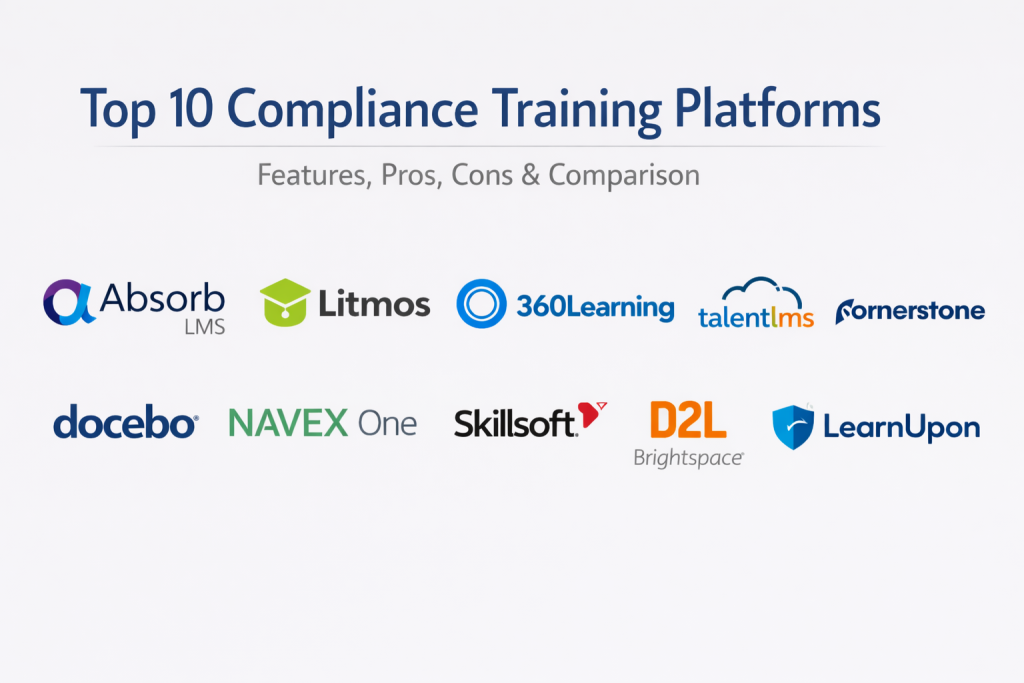
Top 10 Compliance Training Platforms
1.Absorb LMS
Absorb LMS is a cloud-based learning management system that places a heavy emphasis on a “learner-first” experience. It is designed for mid-to-large enterprises that want to automate the complex web of compliance requirements while keeping the interface modern and engaging. Its “Smart Administration” features allow legal teams to set up “if-then” rules that handle course assignments and reminders without human intervention.
Key Features
- Smart Administration for automated enrollment based on user attributes.
- Absorb Analyze for deep, customizable compliance reporting.
- Built-in content library with specialized compliance modules.
- AI-driven recommendations to help employees find relevant elective training.
- Mercury Module for creating custom, branded learner billboards.
- Robust mobile app with offline learning capabilities.
Pros
- Highly intuitive interface for both admins and learners.
- Powerful automation that significantly reduces manual follow-up.
Cons
- Pricing can be higher than entry-level competitors.
- Some advanced reporting features require a learning curve to master.
Platforms / Deployment
- Web / iOS / Android
- Cloud
Security & Compliance
- SSO/SAML, MFA, encryption, RBAC.
- SOC 2, ISO 27001, GDPR.
Integrations & Ecosystem
Absorb is built to be the center of the HR tech stack. It offers pre-built connectors and a robust API.
- Major HRIS systems (Workday, BambooHR).
- Salesforce for partner or customer training.
- Zoom and Microsoft Teams for instructor-led compliance sessions.
Support & Community
Offers 24/7 global support and an extensive “Absorb Academy” for admin training.
2.Litmos
Litmos is widely known for its speed of deployment and ease of use. It is a favorite among mid-market companies that need to get a compliance program running in days rather than months. It comes with a massive library of off-the-shelf compliance content that is localized for various global jurisdictions, making it an “instant” solution for many organizations.
Key Features
- Litmos Content library with thousands of pre-built compliance courses.
- Automated certification management and expiration tracking.
- Gamification features like badges and leaderboards to drive engagement.
- Built-in content authoring tool for quick policy updates.
- Multi-tenant capability for training different departments or external partners.
- Video assessment tools to verify learner understanding.
Pros
- Rapid implementation—often ready to use “out of the box.”
- Excellent pre-built content that meets most standard regulatory needs.
Cons
- UI customization is somewhat limited compared to more complex systems.
- Reporting dashboards are functional but less “visual” than some competitors.
Platforms / Deployment
- Web / iOS / Android
- Cloud
Security & Compliance
- SSO, MFA, Audit logs.
- SOC 2, GDPR.
Integrations & Ecosystem
Litmos connects easily with a wide range of business applications to keep training data in sync.
- HRIS platforms.
- CRM systems (Salesforce).
- Communication tools (Slack, Teams).
Support & Community
Strong community forum and a dedicated customer success model for enterprise clients.
3.360Learning
360Learning takes a unique “collaborative learning” approach to compliance. Instead of just pushing top-down content, it allows subject matter experts within the company to quickly create and update compliance modules. This is ideal for fast-moving industries like Tech or FinTech where internal policies change as frequently as external regulations.
Key Features
- Collaborative authoring tools to turn internal experts into course creators.
- AI-powered “Robo-Assistant” to help structure courses and quizzes.
- Peer-to-peer feedback loops within the learning modules.
- Automated tracking of mandatory certifications.
- Mobile-first design optimized for the modern workforce.
- Real-time dashboard to identify “bottlenecks” where employees are stuck.
Pros
- Best-in-class for creating custom internal compliance content.
- High engagement rates due to the social and collaborative features.
Cons
- Not ideal for companies that only want to use third-party pre-built content.
- Requires internal “champions” to keep the collaborative engine running.
Platforms / Deployment
- Web / iOS / Android
- Cloud
Security & Compliance
- SSO/SAML, MFA, encryption.
- ISO 27001, GDPR.
Integrations & Ecosystem
Focuses on making learning part of the daily digital workspace.
- Deep Microsoft Teams and Slack integrations.
- HRIS and payroll system sync.
- API for custom data visualization.
Support & Community
Excellent onboarding support and a strong emphasis on “Collaborative Learning” methodology training.
4.TalentLMS
TalentLMS is an accessible, highly customizable platform that caters to startups and SMBs while remaining powerful enough for enterprise use. It is known for its “no-nonsense” approach, providing all the essential compliance tracking features without the bloat of legacy enterprise software. It is particularly strong in its “TalentLibrary” which houses essential safety and ethics modules.
Key Features
- Simple drag-and-drop course builder.
- TalentLibrary for instant access to compliance-focused content.
- Automated email reminders for overdue training.
- Branching for creating separate training portals for different regions.
- Custom reporting engine to filter data by department or role.
- Extensive white-labeling options to match company branding.
Pros
- Very affordable and transparent pricing model.
- Extremely easy to set up and manage for a small HR team.
Cons
- Lacks some of the deep “AI-predictive” analytics of high-end tools.
- Advanced automation rules are not as granular as enterprise competitors.
Platforms / Deployment
- Web / iOS / Android
- Cloud
Security & Compliance
- MFA, encryption, RBAC.
- SOC 2, GDPR.
Integrations & Ecosystem
Offers a wide range of “one-click” integrations through its marketplace.
- Zapier for connecting to thousands of apps.
- HRIS tools like BambooHR.
- E-commerce integrations for selling training externally.
Support & Community
Highly responsive email support and a massive library of “how-to” articles.
5.Cornerstone OnDemand
Cornerstone is an enterprise-grade Talent Management suite that includes one of the most powerful compliance engines on the market. It is designed for massive global organizations with complex, multi-jurisdictional regulatory needs. It excels at linking compliance training directly to performance management and succession planning.
Key Features
- Global compliance management across 190+ countries.
- Deep integration between learning and performance reviews.
- Advanced AI for mapping skills and identifying compliance gaps.
- Specialized “Content Anytime” subscriptions for compliance.
- Predictive analytics to forecast future regulatory risks.
- Highly scalable infrastructure capable of supporting millions of users.
Pros
- The most comprehensive “all-in-one” talent and learning suite.
- Exceptional for high-stakes, large-scale global deployments.
Cons
- Can be overwhelming and complex for smaller organizations.
- Implementation typically requires a dedicated project team and several months.
Platforms / Deployment
- Web / iOS / Android
- Cloud
Security & Compliance
- SSO/SAML, MFA, RBAC, Audit trails.
- SOC 2, ISO 27001, FedRAMP (in specific versions).
Integrations & Ecosystem
As an industry giant, it serves as the “hub” for most enterprise ecosystems.
- Full HCM (Human Capital Management) suite integration.
- Global payroll and finance system connections.
- Extensive marketplace of third-party content providers.
Support & Community
Global enterprise support with dedicated technical account managers.
6.Docebo
Docebo is an AI-powered platform that focuses on making compliance training “personalized.” It uses an AI engine to analyze how employees interact with content and then adapts their learning path accordingly. This is perfect for organizations that want to reduce “training fatigue” by only showing employees what they actually need to know.
Key Features
- Docebo Shape (AI) for turning internal documents into e-learning modules.
- Automated certification and retraining workflows.
- Mobile app with “offline mode” for field workers.
- Audit trail logging for every single learner interaction.
- Skills Management to align compliance with job competency.
- Multi-language support with automated localized UI.
Pros
- Cutting-edge AI features that save time on content creation.
- Very sleek, modern UI that employees actually enjoy using.
Cons
- Advanced AI features often come at an additional cost.
- Configuring complex multi-domain environments can be technical.
Platforms / Deployment
- Web / iOS / Android
- Cloud
Security & Compliance
- SSO, MFA, encryption, RBAC.
- SOC 2, ISO 27001, GDPR.
Integrations & Ecosystem
Emphasizes “Learning in the flow of work” through widespread connectivity.
- Microsoft Teams and Slack.
- Salesforce and other major CRMs.
- 400+ available API endpoints for custom builds.
Support & Community
Strong customer success program and a vibrant user community (Docebo University).
7.NAVEX One
Unlike general-purpose LMS platforms, NAVEX One is a dedicated Ethics and Compliance platform. It is built from the ground up to handle whistleblowing, policy management, and training in one unified GRC (Governance, Risk, and Compliance) ecosystem. This is the gold standard for companies where “Compliance” is a major separate department rather than just an HR task.
Key Features
- Fully integrated GRC suite including an ethics hotline.
- Legally vetted courseware focused on workplace conduct and financial ethics.
- Policy management system that tracks employee “attestation” (sign-offs).
- Risk-based training assignments based on internal audit data.
- Advanced “Benchmarking” to see how your compliance rates compare to peers.
- Holistic dashboard showing training status alongside hotline reports.
Pros
- Specifically built for compliance, not just general learning.
- Content is authored and vetted by legal experts.
Cons
- Not a full-featured “Learning Management System” for non-compliance training.
- The interface is more “corporate-legal” than “modern-creative.”
Platforms / Deployment
- Web
- Cloud
Security & Compliance
- SSO/SAML, MFA, encryption, deep audit logs.
- SOC 2, HIPAA, GDPR.
Integrations & Ecosystem
Integrates with other legal and risk management tools.
- Internal HRIS for user syncing.
- Conflict of interest and disclosure software.
- Third-party risk management platforms.
Support & Community
Specialized support from legal and compliance experts.
8.Skillsoft (Percipio)
Skillsoft is a content giant that provides its own intelligent platform called Percipio. It is best suited for organizations that want a “Netflix-style” experience for their compliance training, where the quality of the video content and the ease of discovery are the top priorities.
Key Features
- “Compliance Content Anytime” library with cinematic-quality videos.
- Percipio platform with AI-driven personalized “channels.”
- Multi-modal learning (watch, read, listen, practice).
- Built-in digital badges and verifiable certifications.
- Automated compliance reminders and manager dashboards.
- Support for “Compliance Impact” assessments before and after training.
Pros
- Some of the highest-quality, most engaging compliance videos in the industry.
- Incredible depth of content across every imaginable regulatory topic.
Cons
- The platform (Percipio) can feel massive and sometimes hard to navigate.
- Pricing is typically based on content access, which can scale up quickly.
Platforms / Deployment
- Web / iOS / Android
- Cloud
Security & Compliance
- SSO, MFA, encryption.
- ISO 27001, GDPR.
Integrations & Ecosystem
Works well as a content provider for other LMS platforms or as a standalone hub.
- Integration with Workday, SAP SuccessFactors, and Cornerstone.
- Browser extensions for “learning while you work.”
- API for custom LMS connectivity.
Support & Community
Large-scale enterprise support with deep expertise in content curation.
9.D2L Brightspace
D2L Brightspace is a highly flexible platform that is widely used in both corporate and academic settings. It is favored by organizations that need to create highly complex, scenario-based compliance training (like medical simulations or complex engineering safety protocols) that go beyond simple “true/false” quizzes.
Key Features
- High-degree of configurability for complex learning paths.
- “Intelligent Agents” that automate personalized interventions for learners.
- Mastery-based tracking to ensure true competency, not just completion.
- Video-based assessments and peer review tools.
- Accessibility-first design (WCAG 2.1 AAA compliant).
- Strong portfolio and evidence-collection tools.
Pros
- Unmatched flexibility for creating sophisticated, high-stakes training.
- Excellent accessibility features for a diverse workforce.
Cons
- The sheer number of options can make the initial setup intimidating.
- Requires a dedicated “Instructional Designer” to get the most value.
Platforms / Deployment
- Web / iOS / Android
- Cloud
Security & Compliance
- SSO, MFA, encryption, RBAC.
- SOC 2, ISO 27001, GDPR.
Integrations & Ecosystem
Robust connectivity with enterprise and education tech stacks.
- Deep LTI (Learning Tools Interoperability) support.
- Major HRIS and ERP integrations.
- API for custom internal tool connections.
Support & Community
Top-tier customer support and a dedicated “Success Academy” for admins.
10.LearnUpon
LearnUpon is designed for companies that need to balance internal employee compliance with training for external partners or customers. It allows you to create separate “portals” (learning environments) that share the same compliance content but have different branding and reporting.
Key Features
- Multi-portal architecture for internal and external audiences.
- Automated “Learning Paths” that guide users through multi-course certifications.
- Clean, minimalist admin interface that saves time.
- Built-in exam engine with randomized question banks.
- Detailed “Manager Views” to track team progress in real-time.
- Native integration with webinar tools for hybrid compliance training.
Pros
- Excellent for “extended enterprise” use cases (partners/franchisees).
- Very easy for managers to pull reports without calling IT.
Cons
- Lacks the deep GRC/Hotline features of a tool like NAVEX.
- Not as many AI-driven “content creation” tools as Docebo or 360Learning.
Platforms / Deployment
- Web / iOS / Android
- Cloud
Security & Compliance
- SSO/SAML, MFA, encryption.
- SOC 2, GDPR.
Integrations & Ecosystem
Focuses on the core tools a growing business uses.
- Salesforce (industry-leading integration).
- Zoom, GoToWebinar, Webex.
- HRIS tools like Workday and HiBob.
Support & Community
Highly rated customer success team with a focus on fast response times.
Comparison Table (Top 10)
| Tool Name | Best For | Platform(s) Supported | Deployment | Standout Feature | Public Rating |
| Absorb LMS | Mid-Large Enterprise | Web / iOS / Android | Cloud | Smart Administration automation | N/A |
| Litmos | Fast Deployment | Web / iOS / Android | Cloud | Massive off-the-shelf library | N/A |
| 360Learning | Collaborative Teams | Web / iOS / Android | Cloud | Social course co-creation | N/A |
| TalentLMS | Startups & SMBs | Web / iOS / Android | Cloud | Simplified, affordable setup | N/A |
| Cornerstone | Global Conglomerates | Web / iOS / Android | Cloud | Full Talent/HCM integration | N/A |
| Docebo | AI-Driven Personalization | Web / iOS / Android | Cloud | AI-powered content adaptation | N/A |
| NAVEX One | Dedicated GRC/Legal | Web | Cloud | Integrated Ethics Hotline & GRC | N/A |
| Skillsoft | Engaging Video Content | Web / iOS / Android | Cloud | “Netflix-style” video quality | N/A |
| D2L Brightspace | High-Stakes Simulations | Web / iOS / Android | Cloud | Complex, mastery-based paths | N/A |
| LearnUpon | Partners & External Use | Web / iOS / Android | Cloud | Multi-portal/Extended enterprise | N/A |
Evaluation & Scoring of Compliance Training Platforms
| Tool Name | Core (25%) | Ease (15%) | Integrations (15%) | Security (10%) | Performance (10%) | Support (10%) | Value (15%) | Weighted Total |
| Absorb LMS | 9 | 9 | 9 | 9 | 9 | 9 | 7 | 8.75 |
| LearnUpon | 8 | 9 | 8 | 8 | 9 | 10 | 8 | 8.50 |
| Litmos | 8 | 10 | 8 | 8 | 9 | 8 | 8 | 8.45 |
| Docebo | 9 | 8 | 9 | 9 | 9 | 8 | 7 | 8.45 |
| 360Learning | 8 | 9 | 8 | 8 | 9 | 9 | 8 | 8.40 |
| Skillsoft | 9 | 8 | 9 | 8 | 9 | 8 | 7 | 8.25 |
| Cornerstone | 10 | 5 | 10 | 10 | 9 | 9 | 6 | 8.15 |
| TalentLMS | 7 | 10 | 7 | 8 | 8 | 8 | 10 | 8.10 |
| NAVEX One | 10 | 6 | 7 | 10 | 9 | 9 | 6 | 8.10 |
| D2L Brightspace | 9 | 6 | 8 | 9 | 10 | 9 | 7 | 8.10 |
Interpreting the Scores
- Core (25%): Reflects the depth of compliance-specific tools (automation, certification tracking, audit trails).
- Ease (15%): How quickly an admin can get the system running and how easily a learner can complete a course.
- Integrations (15%): Connectivity with the broader HR and security ecosystem.
- Value (15%): The return on investment relative to the price point and features provided.
- Total Score: A comparative measure of overall platform strength for a standard enterprise.
Which Compliance Training Platforms Is Right for You?
Solo / Freelancer
If you are an independent consultant who needs to provide certification to your clients, TalentLMS is the best choice. It offers a free tier for a small number of users and is simple enough that you don’t need an IT person to set it up.
SMB
For a small to medium business that needs to get “compliant” quickly for a contract or audit, Litmos is the recommended choice. Its library of pre-built, legally vetted courses means you don’t have to spend months creating your own content.
Mid-Market
Companies that are growing fast and want to build a “learning culture” should look at 360Learning or Docebo. These tools use social features and AI to make training feel less like a burden and more like a competitive advantage.
Enterprise
For massive organizations with complex hierarchies, Absorb LMS or Cornerstone are the strategic winners. They provide the deep automation rules and robust security needed to manage tens of thousands of employees across multiple global jurisdictions.
Budget vs Premium
- Budget: TalentLMS or the entry tiers of LearnUpon.
- Premium: NAVEX One and Cornerstone. These are “buy once, use forever” solutions for companies with high-risk profiles.
Feature Depth vs Ease of Use
If you need deep, custom simulations for medical or industrial use, choose D2L Brightspace. if you want a platform that is so easy that employees never have to ask “how do I use this?”, choose Litmos.
Integrations & Scalability
Cornerstone and Absorb LMS lead the market in their ability to sit at the center of a massive global HR tech stack. If your primary need is syncing training with a CRM for external partners, LearnUpon is the top choice.
Security & Compliance Needs
If your primary concern is an upcoming high-stakes audit (like SOC 2 or HIPAA), NAVEX One provides the most specialized, audit-ready environment with built-in policy attestation features.
Frequently Asked Questions (FAQs)
What makes a “Compliance” platform different from a regular LMS?
A compliance platform prioritizes “proof of learning.” This includes tamper-proof audit trails, automated recertification logic, and legally vetted content libraries, whereas a regular LMS might focus more on general skill-building.
How do these platforms handle new regulations?
Most top-tier platforms (like Litmos or Skillsoft) automatically update their content libraries when laws change. For custom content, AI-driven tools like Docebo can help you quickly re-author sections of your training to reflect new internal policies.
Are these platforms secure enough for sensitive employee data?
Yes, most enterprise tools are SOC 2 and ISO 27001 certified. They use advanced encryption and role-based access controls to ensure that only authorized HR or Legal staff can see detailed training transcripts.
Can I use these for remote or frontline workers?
Absolutely. Most of the tools on this list have native mobile apps with offline modes, allowing workers on factory floors or in remote field sites to complete their safety training without a constant internet connection.
How much do these platforms cost?
Pricing usually follows a “per user per month” model. For SMBs, it might range from $2 to $5 per user, while large enterprise deals are often negotiated as flat annual fees based on usage tiers.
Can I create my own courses within the platform?
Yes, most include a “Course Builder.” Platforms like 360Learning are specifically designed for this, allowing you to turn a PDF or a recorded video into an interactive, trackable module in minutes.
What is “Read and Understood” tracking?
This is a critical compliance feature where the system records a digital signature or a specific checkbox click from an employee, proving they have read a specific company policy and agree to abide by it.
Do these tools integrate with Slack or Microsoft Teams?
Most modern platforms do. This allows employees to receive training reminders or even complete short “microlearning” modules without ever leaving their primary communication app.
How do I handle employees who don’t complete their training?
The platforms feature “Escalation Workflows.” If an employee misses a deadline, the system can automatically notify their manager, and if they miss a second deadline, it can escalate to HR or even temporarily lock their system access.
Can I use these for external partners or franchises?
Yes, tools like LearnUpon and Docebo offer “Multi-tenancy,” allowing you to create separate branded environments for each partner while managing all the compliance data from one central dashboard.
Conclusion
The right compliance training platform transforms regulatory adherence from a “checkbox exercise” into a streamlined, automated process that protects your brand. Whether you prioritize the deep legal content of NAVEX One, the AI-driven personalization of Docebo, or the simplicity of TalentLMS, the goal remains the same: staying audit-ready without sacrificing employee productivity. To take the next step, analyze your most urgent regulatory requirement—whether it’s an upcoming SOC 2 audit or mandatory anti-harassment training—and shortlist three tools for a “sandbox” trial to test their reporting speed and learner interface.

Best Cardiac Hospitals Near You
Discover top heart hospitals, cardiology centers & cardiac care services by city.
Advanced Heart Care • Trusted Hospitals • Expert Teams
View Best Hospitals