Introduction
Confidential computing is the final frontier of data protection, addressing the vulnerability of data while it is actively being processed in memory. While traditional encryption secures data at rest and in transit, confidential computing uses hardware-based Trusted Execution Environments (TEEs) to protect data in use. This technology ensures that sensitive information—such as financial records, personal health data, or proprietary AI models—remains encrypted and inaccessible even to the cloud provider, system administrators, or malicious actors with physical access to the server.
The shift toward multi-party analytics and highly regulated cloud migrations has made these platforms essential. Organizations can now collaborate on shared datasets without ever “seeing” each other’s raw data, unlocking insights that were previously hindered by privacy concerns. As we move deeper into the era of specialized hardware and zero-trust architecture, confidential computing is transitioning from a niche security requirement to a foundational element of the global digital infrastructure.
Best for: Data scientists, security architects, and compliance officers in highly regulated sectors like banking, healthcare, and defense who need to process sensitive workloads in public or hybrid cloud environments.
Not ideal for: General-purpose web hosting, non-sensitive public data processing, or organizations with extremely limited budgets that do not handle high-risk personal or financial information.
Key Trends in Confidential Computing Platforms
- Hardware-Agnostic Abstraction: New software layers are emerging that allow developers to run confidential workloads across different hardware providers (Intel, AMD, NVIDIA) without rewriting code.
- Confidential AI and MLOps: A massive surge in using TEEs to protect large language models (LLMs) and training data, ensuring that AI intellectual property remains secure during inference.
- Attestation as a Service: The rise of independent verification services that prove a hardware enclave is genuine and running the exact code it claims to be running.
- Expansion to the Edge: Confidential computing is moving into IoT and edge devices to secure data processing at the point of collection in decentralized environments.
- Multi-Party Computation (MPC) Integration: Combining hardware enclaves with cryptographic MPC to provide multiple layers of mathematical and physical security.
- Kubernetes Native Enclaves: The integration of confidential computing into container orchestration, allowing for “Confidential Containers” that deploy as easily as standard microservices.
- Regulatory Alignment: Platforms are increasingly mapping their hardware security features directly to compliance frameworks like GDPR, HIPAA, and specialized financial sovereignty laws.
- GPU-Based Enclaves: The introduction of confidential GPUs, allowing for the hardware-protected acceleration of massive datasets and complex AI training.
How We Selected These Tools
- Hardware Root of Trust: We prioritized platforms that rely on proven hardware-level isolation rather than just software-based encryption.
- Ease of Integration: Selection was based on how easily a professional team can port existing applications into a confidential environment.
- Cloud Availability: We looked for platforms supported by major global cloud providers to ensure high availability and scalability.
- Attestation Capabilities: A key factor was the platform’s ability to provide cryptographically signed proof of the environment’s integrity.
- Performance Overhead: We evaluated how much “security tax” the platform imposes on processing speeds and memory usage.
- Ecosystem Maturity: Priority was given to platforms with robust documentation, active developer communities, and proven enterprise use cases.
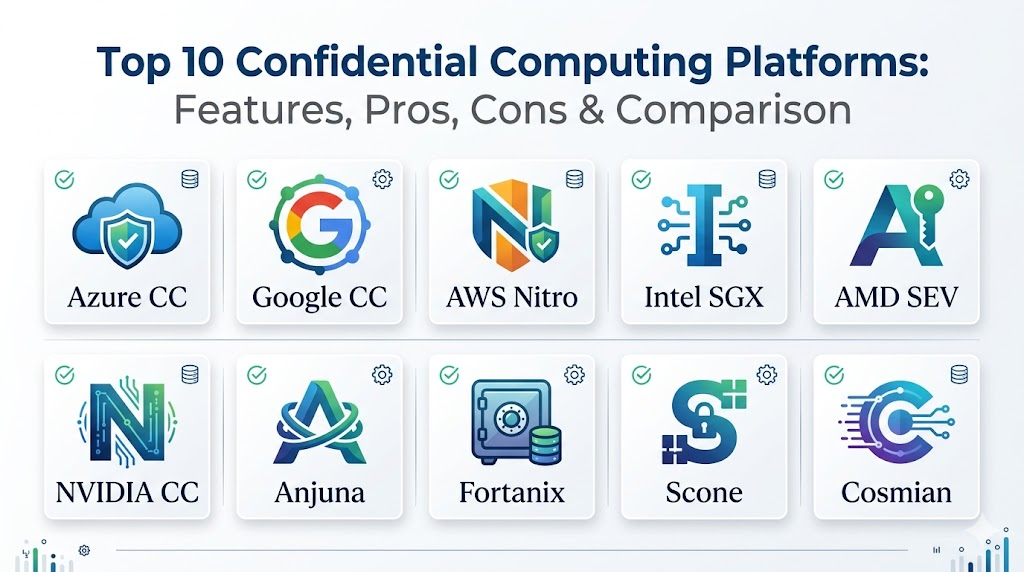
Top 10 Confidential Computing Platforms
1. Azure Confidential Computing
Microsoft has pioneered the space by offering a wide range of hardware options, including Intel SGX and AMD SEV-SNP. It is arguably the most mature ecosystem for enterprise-grade confidential workloads in the public cloud.
Key Features
- Support for Intel SGX enclaves for application-level isolation.
- Confidential Virtual Machines using AMD SEV-SNP for lift-and-shift security.
- Integrated Azure Attestation service for verifying hardware integrity.
- Confidential Containers support via Azure Kubernetes Service.
- Hardware-protected managed HSMs for key management.
Pros
- The most comprehensive set of confidential services in a single cloud provider.
- Excellent integration with existing Azure security and identity tools.
Cons
- Can be complex to configure for specific application-level enclaves.
- Pricing is higher than standard non-confidential compute instances.
Platforms / Deployment
Windows / Linux / Cloud
Cloud
Security & Compliance
FIPS 140-2 Level 3, SOC 2, HIPAA, and GDPR compliant.
ISO 27001 / SOC 2 compliant.
Integrations & Ecosystem
Deeply integrated with the Microsoft 365 security stack and the broader Azure ecosystem. It supports various open-source frameworks like Confidential Consortium Framework.
Support & Community
Extensive enterprise support and a leading role in the Confidential Computing Consortium.
2. Google Cloud Confidential Computing
Google focuses on “Confidential VMs” that require zero code changes. By utilizing AMD SEV technology, they provide a seamless way to protect data in use across their global infrastructure.
Key Features
- Confidential VMs powered by AMD EPYC processors.
- Confidential GKE (Google Kubernetes Engine) for node-level encryption in use.
- Always-on encryption of memory without performance degradation.
- Support for Shielded VMs to ensure boot-level integrity.
- Integration with Google Cloud External Key Manager.
Pros
- Exceptional “Ease of Use” as it requires no code modifications.
- Minimal performance overhead compared to standard virtual machines.
Cons
- Less granular control compared to application-level enclaves like SGX.
- Hardware options are primarily focused on AMD.
Platforms / Deployment
Linux / Windows / Cloud
Cloud
Security & Compliance
Strong alignment with global privacy regulations and internal data sovereignty.
Not publicly stated.
Integrations & Ecosystem
Integrates with Google’s data analytics stack, including BigQuery and Dataflow, for secure data processing.
Support & Community
Strong documentation and active participation in industry-wide security standards groups.
3. AWS Confidential Computing (Nitro Enclaves)
AWS takes a unique approach with Nitro Enclaves, which are isolated compute environments created from an EC2 instance. They lack persistent storage and interactive access, significantly reducing the attack surface.
Key Features
- Nitro Enclaves for creating highly isolated execution environments.
- Cryptographic attestation for verifying the identity of the enclave.
- Nitro Security Chip for hardware-based root of trust.
- Graviton-based instances with built-in memory encryption.
- Integration with AWS Key Management Service (KMS).
Pros
- Extreme isolation with no persistent storage or operator access.
- Compatible with a wide range of EC2 instance types.
Cons
- Requires a specialized workflow to package and deploy applications.
- Debugging can be difficult due to the highly restricted environment.
Platforms / Deployment
Linux / Cloud
Cloud
Security & Compliance
FIPS-validated hardware modules and broad global compliance certifications.
Not publicly stated.
Integrations & Ecosystem
Works seamlessly with the AWS Nitro System and KMS, providing a familiar environment for AWS users.
Support & Community
Dedicated AWS security support and extensive technical whitepapers for implementation.
4. Intel SGX (Software Guard Extensions)
Intel SGX is the foundational hardware technology that enables application-level enclaves. It allows developers to partition their code into “enclaves” that are protected even if the OS is compromised.
Key Features
- Fine-grained isolation at the application code level.
- Direct hardware-level protection of memory regions.
- Remote attestation to verify the software running in the enclave.
- Support for “Enclave Page Cache” for managing protected memory.
- Broad support across enterprise-grade Xeon processors.
Pros
- Highest level of isolation as it protects against compromised privileged software.
- Industry-standard technology with the longest track record in the market.
Cons
- Requires specialized development and code refactoring.
- Limited memory size in older versions of the technology.
Platforms / Deployment
Linux / Windows / Local
Local / Hybrid
Security & Compliance
Hardware-level security that meets the most stringent isolation requirements.
Not publicly stated.
Integrations & Ecosystem
The core technology behind many other platforms on this list, including Azure and various open-source frameworks.
Support & Community
Massive developer ecosystem and extensive technical documentation for low-level development.
5. AMD SEV (Secure Encrypted Virtualization)
AMD’s approach focuses on encrypting entire virtual machines. This makes it ideal for enterprise “lift-and-shift” scenarios where changing the application code is not feasible.
Key Features
- Full VM encryption where each VM has its own unique key.
- SEV-SNP (Secure Nested Paging) for protection against hypervisor attacks.
- Hardware-managed key generation within the secure processor.
- No application code changes required for deployment.
- High performance with dedicated hardware acceleration.
Pros
- Best “Ease of Use” for securing existing legacy applications.
- Strong support across all major cloud providers.
Cons
- Less granular than SGX; an entire VM must be trusted.
- Security relies on the integrity of the VM’s internal operating system.
Platforms / Deployment
Linux / Windows / Cloud
Hybrid / Cloud
Security & Compliance
Designed to meet modern cloud multi-tenancy security requirements.
Not publicly stated.
Integrations & Ecosystem
The primary hardware choice for Google Cloud and many Azure confidential instances.
Support & Community
Strong partnership with major server OEMs and cloud providers.
6. NVIDIA Confidential Computing (H100/A100)
NVIDIA has extended confidential computing to the GPU, allowing for the protection of massive AI models and sensitive data during high-performance computing (HPC) tasks.
Key Features
- Hardware-protected GPU memory for sensitive AI workloads.
- Secure communication between the CPU enclave and the GPU.
- Support for confidential AI inference and training.
- Integration with CUDA for high-performance development.
- Cryptographic verification of the GPU state.
Pros
- The only viable solution for high-performance confidential AI.
- Protects valuable IP (AI models) during processing.
Cons
- Requires specific high-end NVIDIA hardware.
- Extremely high cost compared to standard CPU-based confidential compute.
Platforms / Deployment
Linux / Cloud
Hybrid / Cloud
Security & Compliance
Built for the most demanding high-performance and secure research environments.
Not publicly stated.
Integrations & Ecosystem
Integrates with the NVIDIA AI Enterprise suite and major cloud GPU instances.
Support & Community
Highly specialized support for AI researchers and enterprise data scientists.
7. Anjuna Confidential Computing
Anjuna provides a software abstraction layer that makes it easy to run any application inside a hardware enclave (SGX, SEV, Nitro) without any code changes.
Key Features
- Instant “Enclavization” of existing applications and containers.
- Support for multiple hardware providers and cloud platforms.
- Centralized management of attestation and security policies.
- Automated secrets management integration.
- High-performance networking for confidential workloads.
Pros
- Drastically reduces the time to market for confidential applications.
- Provides a consistent experience across different cloud providers.
Cons
- Additional software license cost on top of cloud infrastructure.
- Introduces a third-party dependency in the security stack.
Platforms / Deployment
Linux / Cloud / Hybrid
Cloud / Hybrid
Security & Compliance
Simplifies the path to achieving compliance for sensitive data in the cloud.
Not publicly stated.
Integrations & Ecosystem
Works across Azure, AWS, and GCP, supporting a wide range of enterprise software like Redis and HashiCorp Vault.
Support & Community
High-touch enterprise support with a focus on rapid deployment.
8. Fortanix Confidential Computing Manager
Fortanix is a leader in “Runtime Encryption,” offering a platform that manages the lifecycle of confidential applications across a diverse fleet of hardware.
Key Features
- Orchestration of confidential containers and virtual machines.
- Built-in attestation and identity management.
- Integration with Fortanix DSM for secure key management.
- Support for multi-cloud confidential deployments.
- Fine-grained access control for sensitive workloads.
Pros
- Comprehensive lifecycle management from development to production.
- Strong focus on data sovereignty and key ownership.
Cons
- Requires commitment to the Fortanix ecosystem for the best results.
- Can be a steep learning curve for teams new to the platform.
Platforms / Deployment
Linux / Cloud / Local
Hybrid / Cloud
Security & Compliance
Designed specifically for the financial services and healthcare compliance sectors.
Not publicly stated.
Integrations & Ecosystem
Strong partnerships with Intel and major cloud providers, with a focus on Python and Java applications.
Support & Community
Very active in the open-source community and professional enterprise support.
9. Scone (Scontain)
Scone is a specialized platform for running confidential containers. It focuses on a small, secure footprint and high performance for cloud-native applications.
Key Features
- Secure execution of Docker containers inside SGX enclaves.
- Automated attestation and secret injection.
- Support for a wide range of programming languages (Go, Python, C++).
- Minimal performance overhead for containerized workloads.
- Integrated security policies for microservices.
Pros
- The best choice for “Cloud Native” and Kubernetes-focused teams.
- Very small TCB (Trusted Computing Base) for maximum security.
Cons
- Requires specific knowledge of container security and SGX.
- Documentation can be highly technical and geared toward specialists.
Platforms / Deployment
Linux / Kubernetes
Hybrid / Cloud
Security & Compliance
Focused on enabling zero-trust in containerized environments.
Not publicly stated.
Integrations & Ecosystem
Deeply integrated with Kubernetes and the modern DevOps toolchain.
Support & Community
Strong academic roots with growing enterprise adoption in Europe and the US.
10. Cosmian
Cosmian focuses on the intersection of confidential computing and advanced cryptography, providing tools for secure data sharing and privacy-preserving analytics.
Key Features
- Confidential computing combined with functional encryption.
- Secure enclaves for executing sensitive Python and R code.
- Focus on data privacy and collaborative analytics.
- Easy-to-use APIs for developers and data scientists.
- Support for decentralized and sovereign data processing.
Pros
- Excellent for collaborative data science projects.
- Strong focus on high-level mathematical privacy guarantees.
Cons
- More specialized toward data science than general-purpose IT.
- Smaller community compared to the major cloud providers.
Platforms / Deployment
Linux / Cloud
Cloud / Hybrid
Security & Compliance
Meets high standards for privacy-preserving data processing.
Not publicly stated.
Integrations & Ecosystem
Strong focus on the Python data science ecosystem (Jupyter, Scikit-learn).
Support & Community
Focused professional support for research and data-heavy enterprises.
Comparison Table
| Tool Name | Best For | Platform(s) Supported | Deployment | Standout Feature | Public Rating |
| 1. Azure CC | Enterprise Cloud | Windows, Linux | Cloud | Multi-Hardware Choice | N/A |
| 2. Google CC | Easy Migration | Linux, Windows | Cloud | Zero Code Change | N/A |
| 3. AWS Nitro | High Isolation | Linux | Cloud | No Operator Access | N/A |
| 4. Intel SGX | App-Level Security | Linux, Windows | Local/Hybrid | Granular Enclaves | N/A |
| 5. AMD SEV | Full VM Security | Linux, Windows | Hybrid/Cloud | Lift-and-Shift | N/A |
| 6. NVIDIA CC | AI / HPC | Linux | Hybrid/Cloud | GPU Enclaves | N/A |
| 7. Anjuna | Multi-Cloud | Linux | Cloud/Hybrid | Instant Enclavization | N/A |
| 8. Fortanix | Lifecycle Mgmt | Linux | Hybrid/Cloud | Runtime Encryption | N/A |
| 9. Scone | Kubernetes | Linux | Hybrid/Cloud | Secure Containers | N/A |
| 10. Cosmian | Data Science | Linux | Cloud/Hybrid | Functional Crypto | N/A |
Evaluation & Scoring
| Tool Name | Core (25%) | Ease (15%) | Integrations (15%) | Security (10%) | Perf (10%) | Support (10%) | Value (15%) | Total |
| 1. Azure CC | 10 | 7 | 10 | 9 | 8 | 10 | 8 | 8.85 |
| 2. Google CC | 8 | 10 | 9 | 8 | 10 | 9 | 9 | 8.75 |
| 3. AWS Nitro | 9 | 6 | 9 | 10 | 9 | 9 | 8 | 8.35 |
| 4. Intel SGX | 10 | 3 | 8 | 10 | 7 | 8 | 7 | 7.75 |
| 5. AMD SEV | 8 | 9 | 9 | 8 | 10 | 8 | 9 | 8.55 |
| 6. NVIDIA CC | 9 | 5 | 7 | 9 | 10 | 8 | 5 | 7.60 |
| 7. Anjuna | 8 | 9 | 9 | 8 | 8 | 8 | 7 | 8.15 |
| 8. Fortanix | 9 | 7 | 8 | 9 | 8 | 8 | 7 | 8.10 |
| 9. Scone | 8 | 6 | 8 | 9 | 9 | 7 | 8 | 7.80 |
| 10. Cosmian | 7 | 7 | 7 | 8 | 8 | 7 | 8 | 7.35 |
The scoring emphasizes the current market shift toward usability and cloud integration. Azure and Google score exceptionally high because they have removed the traditional barriers to confidential computing, allowing enterprises to secure data without massive development overhead. Specialized hardware like NVIDIA and Intel SGX score lower on “Ease” and “Value” but remain the absolute “Core” requirement for high-security and high-performance niches where standard virtual machines are insufficient.
Which Confidential Computing Platform Is Right for You?
Solo / Freelancer
For a single developer or small project, Google Cloud Confidential Computing is the best starting point. Its zero-code-change approach means you can secure your data instantly without needing to learn the complexities of enclave development.
SMB
Small to mid-sized businesses looking for a balance of cost and security should look at Azure Confidential Computing. The ability to start with simple Confidential VMs and later scale into more granular SGX enclaves provides a perfect growth path.
Mid-Market
Organizations with a strong DevOps culture and container-heavy workloads should prioritize Scone or Fortanix. These tools offer the management layers necessary to handle more complex deployments across multiple environments.
Enterprise
For global enterprises with heavy compliance burdens, Azure or AWS Nitro Enclaves offer the most robust support and the widest range of certifications. If you are operating a multi-cloud strategy, Anjuna provides the abstraction layer needed to maintain consistent security.
Budget vs Premium
AMD SEV-based VMs (on Google or Azure) are the most budget-friendly, providing significant protection for minimal additional cost. NVIDIA’s GPU enclaves and Intel SGX development are the premium choices for high-performance and high-security requirements.
Feature Depth vs Ease of Use
Intel SGX offers the most depth and granular security but is the hardest to implement. Google Cloud offers the most ease of use but provides less isolation than application-level enclaves.
Integrations & Scalability
Azure leads in integrations with enterprise identity and security tools. AWS provides the most scalable isolation for high-stakes workloads where operator access must be strictly forbidden.
Security & Compliance Needs
If you are in the healthcare or financial sector and need to prove data sovereignty, Fortanix and Azure provide the most comprehensive attestation and key management features to satisfy regulators.
Frequently Asked Questions (FAQs)
1. What is the difference between encryption at rest and confidential computing?
Encryption at rest protects data on a disk, while confidential computing protects data while it is actively being processed in the CPU and memory.
2. Does confidential computing slow down my application?
In many cases, the performance overhead is less than 5–10%, though highly complex application-level enclaves like SGX can see higher impact depending on the memory usage.
3. Do I need to change my code to use these platforms?
It depends on the platform. AMD SEV and Google Confidential VMs require no changes, while Intel SGX and AWS Nitro Enclaves often require some refactoring or specialized packaging.
4. Can the cloud provider see my data?
No. In a properly configured confidential computing environment, the data is encrypted in memory with keys that the cloud provider’s staff and systems cannot access.
5. What is “Attestation”?
Attestation is a cryptographic process where the hardware provides a signed report proving that a specific environment is secure and running the expected software.
6. Is confidential computing only for big companies?
No. With the arrival of easy-to-use cloud instances, even small startups can use it to build trust with their customers by proving their data is technically protected from the provider.
7. Can I use confidential computing for AI?
Yes. NVIDIA’s H100 and A100 GPUs now support confidential computing, allowing for the protection of both AI models and the data used for inference or training.
8. What is a TEE (Trusted Execution Environment)?
A TEE is a secure area of a main processor that guarantees the confidentiality and integrity of the code and data loaded inside it.
9. How do I manage the keys for these environments?
Most platforms integrate with hardware-backed Key Management Services (KMS), where the keys are only released to the enclave after it has been successfully attested.
10. Is confidential computing the same as Zero Trust?
Confidential computing is a critical technical component of a Zero Trust strategy, specifically extending the “never trust, always verify” principle to the hardware and memory level.
Conclusion
Confidential computing represents the final piece of the data security puzzle, ensuring that information is protected throughout its entire lifecycle. As organizations face increasing pressure from regulators and a more sophisticated threat landscape, the ability to protect data in use is no longer optional. Whether you are performing a simple “lift-and-shift” of a legacy app into a secure VM or building a ground-up confidential AI model, there is now a platform suited to your technical depth and budget. By adopting these technologies today, you are not just securing data—you are building a foundation of verifiable trust that will define the next decade of digital business.

Best Cardiac Hospitals Near You
Discover top heart hospitals, cardiology centers & cardiac care services by city.
Advanced Heart Care • Trusted Hospitals • Expert Teams
View Best Hospitals