Introduction
Copyright registration tools are specialized digital platforms designed to help creators establish a legal public record of their original work. While copyright protection often exists automatically upon the creation of a work, formal registration through these tools provides essential “prima facie” evidence. This means that in a court of law, the registered owner is presumed to be the rightful creator, shifting the burden of proof to any infringing party. These tools handle the submission of literary, musical, artistic, and digital works to national or private registries.
In the current digital environment, content can be copied and redistributed globally in seconds. Copyright registration has become a critical strategic asset for anyone monetizing their creativity. Whether you are a software developer protecting source code, a photographer securing digital assets, or a business protecting its brand identity, these tools provide the legal foundation required to issue takedown notices, seek statutory damages, and negotiate licensing agreements.
Real-World Use Cases
- Content Takedowns: Using a registration certificate to prove ownership when filing DMCA notices on platforms like YouTube, Instagram, or Amazon.
- Legal Enforcement: Serving as the mandatory prerequisite for filing a copyright infringement lawsuit in various global jurisdictions.
- Licensing & Royalties: Providing clear proof of ownership to potential investors, publishers, or licensees during commercial negotiations.
- Asset Valuation: Establishing original works as intangible business assets that can be valued during mergers, acquisitions, or funding rounds.
- Plagiarism Prevention: Using digital watermarks and public registration badges as a visual deterrent to discourage unauthorized copying.
Evaluation Criteria for Buyers
- Legal Standing: Whether the tool provides an official government registration or a private “proof of creation” timestamp.
- Storage Duration: How long the platform guarantees the archival and conservation of your original digital files.
- Ease of Filing: The simplicity of the intake process, especially for complex works like software code or music albums.
- Security & Encryption: The level of protection provided for your sensitive manuscripts, designs, and proprietary source code.
- Global Recognition: How well the registration is recognized under international treaties like the Berne Convention.
- Search & Discovery: Features that allow the public or potential licensees to search for and verify your ownership status.
- Cost Effectiveness: Balancing the filing fees against the level of legal protection and support provided.
Best for: Authors, software developers, visual artists, filmmakers, and enterprise legal teams seeking to safeguard their intellectual property.
Not ideal for: Generic ideas that have not been fixed in a tangible form, or users looking for “patent” protection for mechanical inventions.
Key Trends in Copyright Registration Tools
- Blockchain Timestamping: The use of immutable ledgers to create a permanent, unalterable record of when a digital file was created.
- AI-Generated Content Frameworks: New modules designed to help creators distinguish between human-authored and AI-assisted elements in their work.
- Automated Batch Filing: Tools that allow photographers and social media creators to register hundreds of works in a single, streamlined application.
- Reverse Image Search Integration: Platforms that automatically monitor the web for unauthorized use of registered visual assets.
- Digital Object Identifiers (DOI): The integration of unique tags that stay with a digital work even if its location or ownership changes over time.
- Hybrid Evidence Packets: Systems that combine official government filings with private, metadata-rich “evidence tokens” for maximum court-readiness.
- Instant Global Takedowns: Direct API connections between registration registries and major social media platforms to speed up the removal of pirated content.
- Decentralized Registries: Emerging platforms that ensure ownership records remain accessible even if a specific private company goes out of business.
How We Selected These Tools
Our selection methodology focuses on the balance between legal weight and digital accessibility. We prioritized official government portals that provide the highest level of statutory protection, while also including private digital registries that offer faster, modern alternatives for “proof of existence.” We evaluated each tool based on its market adoption, the longevity of its service, and the robustness of its archival security. Tools that offer specialized workflows—such as those specifically for software code or high-volume photography—were given extra weight. We also considered the quality of customer support and the availability of legal documentation to assist creators during actual infringement disputes.
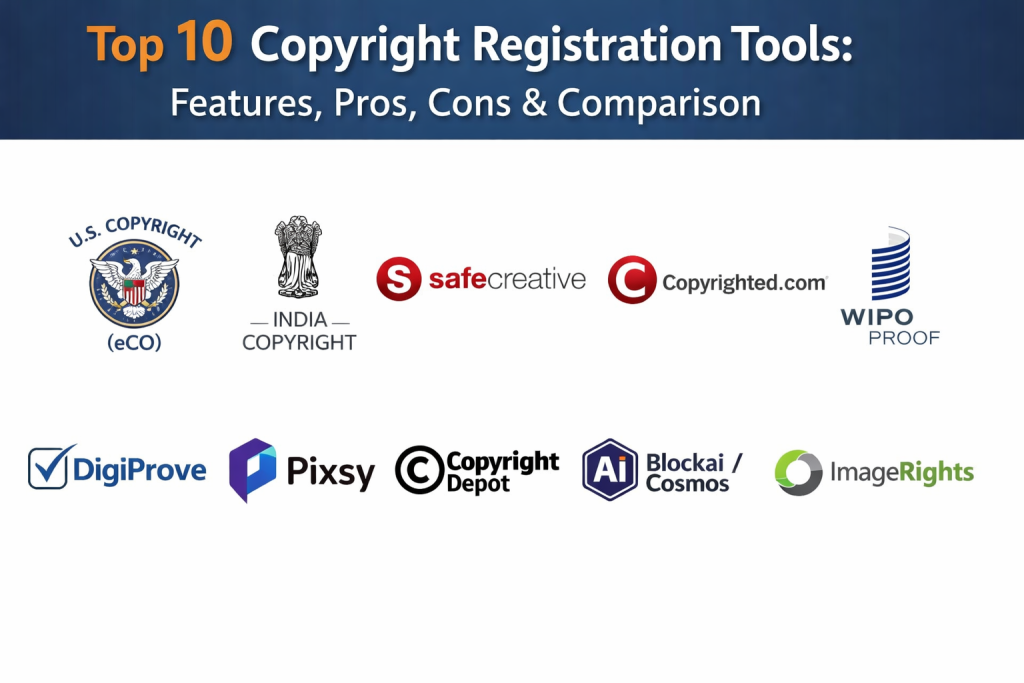
Top 10 Copyright Registration Tools
1. U.S. Copyright Office (eCO)
The eCO system is the official portal for the United States government. Registration here is a mandatory prerequisite for U.S. creators to file a lawsuit and seek statutory damages. It provides the strongest legal protection recognized globally.
Key Features
- Statutory Public Record: Creates a permanent record in the Library of Congress.
- Standard Application: Suitable for a wide variety of works including text, music, and films.
- Group Registration: Special options for unpublished works, photographs, and serials to save on fees.
- Effective Date Security: Protection dates back to the moment the complete application is received.
- Certified Certificates: Provides official paper or digital certificates with federal seals.
Pros
- Highest level of legal protection and enforceability in court.
- Essential for seeking statutory damages and attorney’s fees.
Cons
- The interface is often described as dated and less intuitive than private tools.
- Processing times for certificates can take several months.
Platforms / Deployment
Web — Cloud
Security & Compliance
Federal government standards for data security and record retention.
Integrations & Ecosystem
Primarily a standalone filing portal; works alongside internal legal ops and external counsel workflows.
Support & Community
Extensive official help desk and detailed circulars explaining every aspect of copyright law.
2. India Copyright Office (e-Filing)
The official portal for the Government of India, overseen by the Ministry of Commerce and Industry. It offers a completely digital workflow for registering original literary, artistic, and musical works.
Key Features
- Online Form XIV: A streamlined digital application for various categories of work.
- Source Code Handling: Specialized requirements for software registration (first and last 10 pages).
- Mandatory Waiting Period: A 30-day “objection period” to ensure no conflicting claims exist.
- Diary Number Tracking: Real-time status updates from submission to examination.
- E-Register Access: Allows the public to verify the status of registered works online.
Pros
- Formal government recognition under the Copyright Act of 1957.
- Relatively low filing fees compared to many international registries.
Cons
- Applications can be rejected for minor technical discrepancies in the files.
- Total processing time can range from 6 to 12 months.
Platforms / Deployment
Web — Cloud
Security & Compliance
Government of India digital security protocols.
Integrations & Ecosystem
Connected to the Intellectual Property India ecosystem for managing trademarks and patents.
Support & Community
Official manuals and a dedicated help desk for technical filing issues.
3. Safe Creative
Safe Creative is one of the world’s largest private digital copyright registries. It provides an immediate “proof of creation” using digital signatures and timestamps, making it a favorite for bloggers and digital artists.
Key Features
- Triple Proof System: Uses a digital signature, a timestamp, and a blockchain record.
- Public Registry: Provides a public page where anyone can verify your ownership.
- Custom Licenses: Allows you to specify “All Rights Reserved” or various Creative Commons licenses.
- Registration Badges: Visual icons for your website that link directly to the ownership proof.
- Metadata Rich: Records author names, creation dates, and even GPS data for photos.
Pros
- Immediate registration with instant digital certificates.
- Excellent for proving “proof of existence” in international disputes.
Cons
- A private registry does not replace statutory government registration in some countries.
- Requires a subscription for advanced features like legal support.
Platforms / Deployment
Web — Cloud
Security & Compliance
Standard encryption and blockchain-based transparency.
Integrations & Ecosystem
Integrates with Instagram and Google Drive for automatic asset registration.
Support & Community
Active community of creators and a high-quality blog on digital rights management.
4. Copyrighted.com
Copyrighted.com offers a streamlined approach to protecting digital content. It is designed to be a “set-and-forget” solution for website owners who need to prove when their articles or images were first published.
Key Features
- Instant Certificates: Unique registration numbers generated the moment you upload.
- Website Protection: Scans your site and protects content automatically.
- Visual Deterrents: Provides dynamic banners and badges to warn potential thieves.
- Infringement Monitoring: Basic tools to help you identify if your content appears elsewhere.
- Legal Documentation: Generates professional-looking reports for cease-and-desist letters.
Pros
- Very fast and user-friendly for non-technical creators.
- Affordable pricing model for high-volume bloggers.
Cons
- Limited to digital assets; not ideal for physical or offline works.
- Does not provide the same statutory weight as a government filing.
Platforms / Deployment
Web — Cloud
Security & Compliance
Secure archival storage for all registered files.
Integrations & Ecosystem
Works well with common CMS platforms like WordPress via simple linking.
Support & Community
Good documentation and a community focused on online publishing.
5. WIPO PROOF
Developed by the World Intellectual Property Organization, WIPO PROOF provides a neutral, institutional “proof of existence” for any digital file. It is a highly respected international standard for protecting trade secrets and research data.
Key Features
- Digital Fingerprinting: Creates a hash of your file so the content stays private.
- Institutional Timestamp: Verified by a United Nations agency.
- Date & Time Certainty: Provides a tamper-proof date and time token.
- Long-Term Validity: Designed to be verifiable for decades.
- Universal Recognition: High level of trust across 193 member states.
Pros
- Unmatched neutrality and international credibility.
- Protects data without requiring you to upload the actual content to their servers.
Cons
- It is “proof of existence,” not a formal grant of copyright.
- Does not provide an official “certificate” that acts as property title.
Platforms / Deployment
Web — Cloud
Security & Compliance
Highest levels of global institutional security and data privacy.
Integrations & Ecosystem
Best used as a foundational layer in a professional IP management strategy.
Support & Community
Extensive academic and professional resources on international IP law.
6. Digiprove
Digiprove focuses on the technical “proof of existence.” It allows you to create a digital fingerprint of any file locally on your machine, ensuring that your sensitive intellectual property never leaves your control.
Key Features
- Self-Digiprove: Create proof of a file’s existence without uploading it.
- Unalterable Timestamps: Once a file is “digiproved,” the time record cannot be changed.
- Audit Trails: Clear evidence of the history of a file’s modifications.
- Certification Service: Provides a formal certificate of authenticity for any file.
- Copyright Protection Tool: Specialized workflow for protecting online text and code.
Pros
- Maximum privacy since you don’t have to share your actual work.
- Very fast and efficient for developers protecting source code.
Cons
- The interface is more functional than artistic.
- Requires users to be somewhat tech-savvy to manage the fingerprints.
Platforms / Deployment
Web / Windows — Self-hosted
Security & Compliance
Local hashing ensures data residency and absolute privacy.
Integrations & Ecosystem
Popular with software developers and those in research and development.
Support & Community
Good technical documentation and a focused user base of professionals.
7. Pixsy
Pixsy is a specialized tool for photographers and visual artists. It combines copyright registration with a powerful “reverse image search” engine that finds where your images are being used online.
Key Features
- Automated USCO Filing: Streamlines the process of submitting images to the U.S. Copyright Office.
- Global Monitoring: Scans the web 24/7 for unauthorized use of your work.
- Resolution & Case Management: Built-in tools to send takedown notices or pursue legal damages.
- Expert Legal Network: Access to international lawyers specializing in visual copyright.
- Fair Use Filtering: Uses AI to filter out authorized uses and social media shares.
Pros
- The best all-in-one solution for visual creators.
- Strong focus on actual enforcement and revenue recovery.
Cons
- Specialized for images; not suitable for text or music.
- The “done-for-you” legal services take a percentage of recovered fees.
Platforms / Deployment
Web — Cloud
Security & Compliance
GDPR and SOC 2 compliant storage for professional portfolios.
Integrations & Ecosystem
Deep integration with Adobe Lightroom, Flickr, and Instagram.
Support & Community
Excellent support and a community of high-end professional photographers.
8. Copyright Depot
Copyright Depot is a long-standing registry that focuses on the long-term conservation of works. It is one of the few platforms that provides a 30-year storage guarantee for your registered assets.
Key Features
- Guaranteed Conservation: Works are stored for 30 years to ensure long-term evidence.
- Unalterable Records: Registration cannot be modified once completed.
- Broad Category Support: Handles literary, artistic, and scientific works.
- Confidentiality: All works are encrypted and inaccessible to anyone but the owner.
- Instant Proof: Provides a unique registration number and timestamp immediately.
Pros
- Exceptional for creators who need long-term archival proof.
- Simple, no-nonsense approach to registration.
Cons
- The website design feels quite traditional compared to modern startups.
- Lacks the advanced “web-scanning” features of newer tools.
Platforms / Deployment
Web — Cloud
Security & Compliance
Focuses on encryption and long-term data integrity.
Integrations & Ecosystem
Standard standalone registry used primarily by individual authors and researchers.
Support & Community
Established reputation with over two decades of service.
9. Blockai (now Cosmos)
Blockai uses the Bitcoin blockchain to create a “proof of existence” for digital works. It is the go-to platform for tech-savvy creators and those in the Web3 space who value decentralization.
Key Features
- Blockchain Immutability: Ownership records are etched into a public ledger.
- Public Attribution: Provides a public page where fans can see who the creator is.
- GPS & Metadata Integration: Stores rich data about how and where a work was created.
- Verifiable Ownership Links: Creates a link that can be shared in social media bios.
- Twitter/X Integration: Automatically registers content posted on social platforms.
Pros
- Records are permanent and do not depend on any single company staying in business.
- Highly modern and tailored for the digital-first creator economy.
Cons
- Blockchain proof is still relatively new in traditional courtrooms.
- Does not provide the same legal “presumption of ownership” as government tools.
Platforms / Deployment
Web — Cloud
Security & Compliance
Uses decentralized security protocols.
Integrations & Ecosystem
Strongest ties to the Web3, NFT, and social media creator space.
Support & Community
Active community of digital artists and blockchain enthusiasts.
10. ImageRights
ImageRights provides a professional-grade bridge between photography portfolios and the U.S. Copyright Office. It is designed for professional agencies that manage thousands of visual assets.
Key Features
- Batch USCO Submission: Allows for the registration of hundreds of images in minutes.
- AI Search & Discovery: Finds unauthorized uses of your images across the web.
- Full Enforcement Service: Handles the entire legal process from notice to settlement.
- Copyright Portfolio Management: Organized view of what has been registered and where.
- Direct Attorney Handoff: Seamlessly moves infringing cases to a global network of lawyers.
Pros
- Saves massive amounts of time for high-volume visual artists.
- Professional-grade tool for protecting commercial photography.
Cons
- The pricing is geared toward professionals and agencies rather than casual users.
- Primarily focused on the U.S. legal system and the USCO.
Platforms / Deployment
Web — Cloud
Security & Compliance
Enterprise-grade security; SOC 2 and GDPR compliant.
Integrations & Ecosystem
Deep integration with professional asset management and legal ops tools.
Support & Community
Dedicated account managers for high-volume enterprise users.
Comparison Table (Top 10)
| Tool Name | Best For | Platform(s) Supported | Deployment | Standout Feature | Public Rating |
| 1. U.S. Copyright (eCO) | Official U.S. Rights | Web | Cloud | Statutory Presumption | N/A |
| 2. India Copyright | Official India Rights | Web | Cloud | Formal Gov Certificate | N/A |
| 3. Safe Creative | Digital Proof | Web | Cloud | Blockchain Metadata | 4.6/5 |
| 4. Copyrighted.com | Bloggers & Websites | Web | Cloud | Instant Protection Badges | 4.5/5 |
| 5. WIPO PROOF | International Neutrality | Web | Cloud | UN-backed Timestamp | N/A |
| 6. Digiprove | Privacy-First Code | Web, Windows | Self-hosted | Local Fingerprinting | 4.4/5 |
| 7. Pixsy | Visual Artists | Web | Cloud | Recovery & Enforcement | 4.7/5 |
| 8. Copyright Depot | Long-term Archiving | Web | Cloud | 30-Year Guarantee | 4.4/5 |
| 9. Blockai / Cosmos | Web3 & Tech Savvy | Web | Cloud | Blockchain Immutability | 4.3/5 |
| 10. ImageRights | Professional Agencies | Web | Cloud | Batch USCO Filing | 4.5/5 |
Evaluation & Scoring of Copyright Registration Tools
| Tool Name | Core (25%) | Ease (15%) | Integrations (15%) | Security (10%) | Perf (10%) | Support (10%) | Value (15%) | Total |
| 1. eCO (U.S.) | 10 | 4 | 3 | 9 | 7 | 8 | 8 | 7.5 |
| 2. India Office | 9 | 5 | 3 | 8 | 6 | 8 | 9 | 7.1 |
| 3. Safe Creative | 7 | 9 | 9 | 8 | 9 | 8 | 8 | 8.0 |
| 4. Copyrighted | 6 | 9 | 8 | 8 | 9 | 7 | 9 | 7.6 |
| 5. WIPO PROOF | 8 | 7 | 5 | 10 | 9 | 8 | 7 | 7.6 |
| 6. Digiprove | 7 | 8 | 6 | 10 | 9 | 7 | 8 | 7.4 |
| 7. Pixsy | 8 | 8 | 9 | 8 | 9 | 9 | 6 | 7.8 |
| 8. Copyright Depot | 7 | 6 | 4 | 10 | 8 | 7 | 8 | 6.9 |
| 9. Blockai | 6 | 8 | 8 | 8 | 9 | 7 | 8 | 7.3 |
| 10. ImageRights | 8 | 7 | 9 | 9 | 9 | 9 | 6 | 7.9 |
Scoring is based on professional legal utility. “Core” scores represent the legal weight of the registration. “Value” scores reflect the ROI based on time saved or the likelihood of successful damages recovery. “Ease” scores identify how quickly a non-lawyer can complete a professional-grade filing.
Which Copyright Registration Tool Is Right for You?
Solo / Freelancer
If you are an individual blogger or web creator, Copyrighted.com or Safe Creative are the best starting points. They offer the fastest protection for your daily work and provide visual badges that warn people not to steal your content.
SMB
Small businesses looking to protect their brand and creative assets should prioritize Safe Creative for digital proof or use a guided service like Pixsy if their primary assets are visual. These tools balance cost with a high level of automated protection.
Mid-Market
For growing companies with more complex portfolios, WIPO PROOF provides excellent international neutrality for protecting R&D and trade secrets. This should be combined with official filings in the company’s primary operating region.
Enterprise
Large corporations and agencies must use official government systems like the U.S. Copyright Office (eCO) or India Copyright Office. These organizations should also utilize ImageRights or similar batch-processing tools to manage high volumes of intellectual property.
Budget vs Premium
If the budget is tight, Safe Creative’s free tier or Blender (for 3D) are good options. For those who require the ultimate “premium” legal weight, the official government filing fees are a necessary investment for long-term security.
Feature Depth vs Ease of Use
Government portals like eCO offer the most feature depth in terms of legal categories but are difficult to use. Safe Creative and Copyrighted.com offer the best ease of use, allowing you to protect work in seconds.
Integrations & Scalability
Pixsy and ImageRights are the most scalable for visual artists due to their batch tools and automated web monitoring. For developers, Digiprove offers the best scalability through its local fingerprinting workflow.
Security & Compliance Needs
Organizations with strict data privacy needs should favor WIPO PROOF or Digiprove, as these tools allow you to register “fingerprints” of your work without ever uploading the actual sensitive data to their cloud servers.
Frequently Asked Questions (FAQs)
1. Is copyright registration mandatory?
No, in most countries, copyright is automatic. However, registration is often required to file a lawsuit or collect statutory damages, which can be significantly higher than actual damages.
2. Can I register my work in multiple countries?
Yes, but thanks to the Berne Convention, a registration in one member country (like the U.S. or India) is recognized in over 170 other countries.
3. Does these tools protect my “idea”?
No. Copyright only protects the expression of an idea, not the idea itself. You must fix your idea in a tangible form (like writing it down or recording it) before it can be protected.
4. How long does copyright protection last?
In many countries, including the U.S. and India, it lasts for the life of the author plus 60 or 70 years after their death.
5. Can AI-generated work be copyrighted?
Currently, most registries require significant human creative input. Purely AI-generated work often lacks the “human authorship” required for copyright, but this is a rapidly evolving legal area.
6. What is the difference between a trademark and a copyright?
Trademarks protect brand names and logos used in trade. Copyright protects original creative works like books, music, and software.
7. Can I use these tools for my software code?
Yes. Software is generally protected as a “literary work.” Tools like Digiprove or the India Copyright Office have specific workflows for source code.
8. What should I do if someone steals my registered work?
You should first issue a formal cease-and-desist letter or a DMCA takedown notice using your registration certificate as proof of ownership.
9. Can I transfer my copyright to someone else?
Yes. Copyright is an asset that can be sold, licensed, or inherited. Most tools provide the documentation needed to record these transfers.
10. Is blockchain registration legally valid?
It is increasingly accepted as “proof of existence,” but it does not yet carry the same statutory weight as a government-issued registration in most jurisdictions.
Conclusion
Navigating the world of copyright registration is no longer a luxury reserved for large publishing houses; it is a fundamental requirement for the modern digital creator. By selecting the right combination of statutory government filings and high-speed digital registries, you can build a robust shield around your intellectual property. Each of the ten tools analyzed offers a distinct advantage—from the unassailable legal weight of the U.S. Copyright Office to the innovative blockchain records of Safe Creative. The key is to act early, ensuring that your work is protected from the moment it is finished. Effective rights management is not just about stopping theft; it is about building a professional foundation for your creative career. A well-maintained copyright portfolio increases your credibility with partners, simplifies the licensing process, and ensures you are the one who profits from your hard work. As technology continues to blur the lines of authorship, having clear, timestamped proof of your original expression will remain your most valuable asset in the digital marketplace.

Best Cardiac Hospitals Near You
Discover top heart hospitals, cardiology centers & cardiac care services by city.
Advanced Heart Care • Trusted Hospitals • Expert Teams
View Best Hospitals