Introduction
In the fast-paced world of modern software, Configure, Price, Quote (CPQ) systems have evolved from simple calculators into the operational brain of the revenue engine. For a SaaS company, CPQ is the specialized bridge that connects a complex product catalog to a clean, legally binding contract. Unlike traditional manufacturing where a quote might involve physical parts, SaaS quoting deals with the abstractions of seats, consumption tokens, tiered subscriptions, and multi-year ramps. These tools automate the “math” of a deal, ensuring that what a sales rep promises is exactly what the billing system can execute and what the finance team can recognize as revenue.
The complexity of the go-to-market motion has reached a tipping point. Hybrid pricing models—combining flat fees with usage-based charges—have made manual spreadsheets a liability. In this environment, a CPQ is no longer just a luxury for the enterprise; it is a fundamental requirement for any scale-up looking to maintain data integrity and deal velocity. By centralizing pricing logic, these platforms prevent “rogue” discounting and ensure that every contract follows the guardrails set by leadership, allowing sales teams to focus on closing rather than data entry.
Best for: B2B SaaS companies with multi-tiered subscription models, hybrid usage-based pricing, and complex approval hierarchies that require seamless integration between CRM and billing.
Not ideal for: Early-stage startups with a single flat-price product, B2C mobile apps with simple in-app purchases, or businesses that do not use a centralized CRM to manage their sales pipeline.
Key Trends in CPQ for SaaS
- Rise of Agentic AI: Modern systems are moving beyond basic suggestions to autonomous agents that can identify supply chain shifts or competitor pricing moves and proactively suggest quote adjustments.
- The Consumption Pivot: There is a massive trend toward supporting “tokenized” and usage-based billing directly within the quoting interface, allowing reps to model complex credit-based deals.
- Unified Quote-to-Cash: The boundaries between CPQ, Billing, and Revenue Recognition are blurring, with platforms offering a single data model that follows a customer from the first quote to the final invoice.
- Guided Selling 2.0: AI-driven prompts now act as a “virtual coach,” suggesting the optimal product bundles and discount levels based on the specific industry and historical win rates of the prospect.
- Self-Service Quoting: More SaaS companies are embedding CPQ logic into their customer portals, allowing buyers to configure their own upgrades and expansions without needing a sales rep.
- Hyper-Personalization at Scale: Systems now allow for “dynamic bundling” where the software automatically creates a custom package based on a customer’s unique usage patterns or stated needs.
- Expansion Management: A major focus has shifted toward “Day 2” operations—automating the complex math of mid-term amendments, co-term renewals, and subscription swaps.
- Zero-Touch Approvals: Automated workflows now handle 80% of standard deals instantly, only escalating “non-standard” terms to the deal desk, significantly reducing friction in the sales cycle.
How We Selected These Tools
- SaaS Logic Proficiency: We prioritized tools that natively handle subscription nuances like prorations, ramps, and co-terminations without requiring custom code.
- Integration Ecosystem: Each selection was evaluated on its ability to sync perfectly with major CRMs and downstream billing engines like Stripe, NetSuite, or Zuora.
- Implementation Agility: Preference was given to platforms that allow RevOps teams to update pricing and packaging in hours, not weeks.
- User Adoption Signals: We looked for intuitive interfaces that sales reps actually enjoy using, reducing the “shadow quoting” that often occurs with clunky legacy systems.
- Scalability & Performance: The list includes tools capable of handling everything from a five-person sales team to global enterprises with thousands of users.
- Security & Governance: Every tool was vetted for enterprise-ready features like role-based access control, audit trails, and compliance with global data standards.
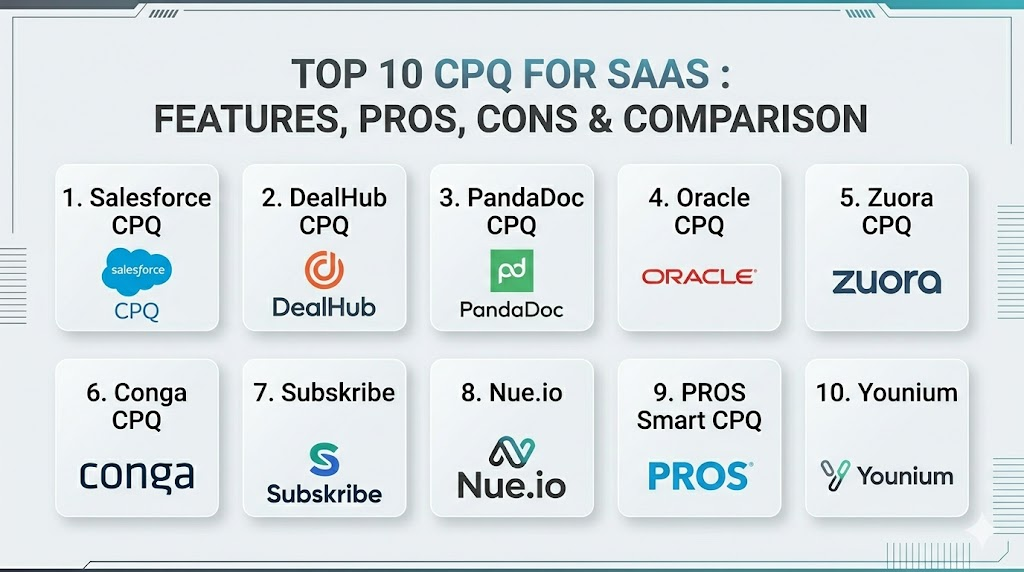
Top 10 CPQ for SaaS Tools
1. Salesforce CPQ (Revenue Cloud)
The dominant force in the market, built natively on the world’s most popular CRM. It is designed for organizations that need deep, complex customization and a unified data model for their entire revenue lifecycle.
Key Features
- Advanced product bundling with nested dependencies and constraint-based logic.
- Flexible pricing engines that support multi-year ramps and complex subscription math.
- Unified quote-to-cash workflow that connects quoting directly to billing and revenue recognition.
- Guided selling interface that prompts reps with qualifying questions to build the right deal.
- Automated renewal and amendment processing for the entire subscription lifecycle.
Pros
- No data syncing required; all information lives natively within the Salesforce environment.
- Unrivaled ecosystem of certified consultants and third-party integrations.
Cons
- Often requires a specialized admin or consultant for initial setup and ongoing maintenance.
- The user interface can feel clunky and “legacy” compared to modern, browser-native startups.
Platforms / Deployment
Web / iOS / Android
Cloud
Security & Compliance
SOC 2 Type II, ISO 27001, HIPAA, and GDPR compliant.
SSO/SAML, MFA, and comprehensive audit logs.
Integrations & Ecosystem
As a cornerstone of the Salesforce platform, it integrates seamlessly with any AppExchange tool, including Slack, DocuSign, and various ERP connectors like FinancialForce or NetSuite.
Support & Community
Unmatched resources via Trailhead, a global network of user groups, and 24/7 premium support options for enterprise customers.
2. DealHub CPQ
A mid-market favorite that emphasizes speed and ease of use. It replaces the traditional PDF quote with a “DealRoom”—an interactive web page where buyers and sellers can collaborate.
Key Features
- Interactive DealRooms that act as a centralized hub for all deal-related documents and chat.
- No-code configuration engine that allows RevOps teams to change pricing in minutes.
- Built-in contract management and e-signature functionality within the quoting flow.
- Subscription management features that handle renewals and expansions automatically.
- Real-time buyer engagement analytics to see when prospects are reviewing the quote.
Pros
- Extremely fast implementation compared to traditional enterprise systems.
- Highly intuitive for sales reps, leading to rapid adoption across the team.
Cons
- May lack some of the “edge case” logic required by massive, global conglomerates.
- Customization options for the DealRoom UI are somewhat limited to preset templates.
Platforms / Deployment
Web
Cloud
Security & Compliance
SOC 2 Type II and GDPR compliant.
Secure SSO and encrypted data storage at rest and in transit.
Integrations & Ecosystem
Strong, native-like integrations with Salesforce, Microsoft Dynamics 365, and HubSpot, as well as downstream billing connectors.
Support & Community
High-touch onboarding experience and highly rated responsive technical support for mid-market customers.
3. PandaDoc CPQ
A document-centric solution that excels for SMBs and scale-ups that prioritize the visual presentation of their proposals and the speed of the electronic signature process.
Key Features
- Robust document editor with a library of professional, interactive proposal templates.
- Smart pricing tables that allow buyers to select optional add-ons or adjust quantities.
- Automated approval workflows to ensure all discounts are vetted by management.
- Direct payment integration, allowing customers to pay as soon as they sign the quote.
- Native subscription components that handle recurring line items and basic tiers.
Pros
- Very low barrier to entry and affordable pricing for smaller sales teams.
- Superior aesthetic control over the final proposal document sent to the buyer.
Cons
- Lacks the deep “constraint logic” needed for highly technical product configurations.
- Not ideal for enterprises with thousands of product SKUs and complex dependencies.
Platforms / Deployment
Web / iOS / Android
Cloud
Security & Compliance
SOC 2 and GDPR compliant.
SSO support and advanced encryption protocols for all stored documents.
Integrations & Ecosystem
Deeply integrated with HubSpot, Pipedrive, and Salesforce, making it a natural extension of most popular CRMs.
Support & Community
Excellent library of help videos, 24/7 chat support, and a very active community of small business owners.
4. Oracle CPQ
An enterprise-grade platform designed for extreme complexity. It is built to handle the world’s most sophisticated configuration and pricing rules across global markets and multiple currencies.
Key Features
- Master-level configuration engine that can manage millions of possible product combinations.
- Multi-channel support, allowing for consistent quoting across direct sales and partners.
- Deep integration with ERP systems for real-time inventory and fulfillment checks.
- Advanced deal management tools that provide margin analysis and discount recommendations.
- Robust API for headless CPQ deployments in custom e-commerce environments.
Pros
- Unbeatable for massive organizations with highly technical or engineered products.
- Handles extreme scale and high-volume quoting without performance degradation.
Cons
- Implementation cycles are long, often spanning six months to a year.
- Requires significant technical expertise to manage and modify the system rules.
Platforms / Deployment
Web
Cloud / Hybrid
Security & Compliance
ISO 27001, SOC 1/2, and HIPAA compliant.
Enterprise-grade identity management and global data sovereignty support.
Integrations & Ecosystem
Native integration with the Oracle ecosystem (ERP/CX) and robust connectors for Salesforce and other major enterprise tech stacks.
Support & Community
Global professional services and a deep library of technical documentation for enterprise architects.
5. Zuora CPQ
Specifically architected for the “Subscription Economy,” this tool focuses entirely on the lifecycle of a recurring relationship, from initial sign-up to complex mid-term amendments.
Key Features
- Subscription-first architecture that natively understands “The SaaS Math” of MRR and ARR.
- Guided selling for complex subscription bundles and tiered pricing models.
- Seamless amendment processing that handles partial-period credits and proration automatically.
- Direct connection to Zuora Billing for automated invoice generation from approved quotes.
- Renewals automation that triggers workflows based on contract end dates.
Pros
- The best choice for businesses where the subscription lifecycle is the core complexity.
- Ensures that the finance team never has to “fix” a quote before it becomes an invoice.
Cons
- Primarily valuable if you are already using or planning to use the Zuora billing engine.
- The UI for sales reps can be less flexible for non-subscription line items.
Platforms / Deployment
Web
Cloud
Security & Compliance
PCI DSS, SOC 1/2, and GDPR compliant.
Advanced role-based access controls and secure licensing.
Integrations & Ecosystem
Strongest integration is with its own billing suite, but it also offers a dedicated app for the Salesforce platform.
Support & Community
Professional support focused on finance and RevOps leaders, with a growing community of subscription experts.
6. Conga CPQ
Formerly known as Apttus, this platform is a “Revenue Lifecycle” veteran. It is ideal for large enterprises that need to tightly couple their CPQ process with deep legal and contract management (CLM).
Key Features
- Industrial-strength rules engine capable of handling virtually any pricing logic.
- Deep integration with Conga CLM for automated contract generation based on quote data.
- Max AI assistant for guided selling and discount optimization.
- E-commerce and partner portal capabilities for omnichannel sales consistency.
- Robust modeling for long-term “ramp” deals and complex professional service add-ons.
Pros
- Offers one of the most comprehensive end-to-end revenue management suites.
- Excellent at managing the legal “fine print” that often accompanies large enterprise quotes.
Cons
- The system complexity requires a dedicated administrative team to keep it optimized.
- Upgrades and changes can be slow due to the deeply interconnected nature of the platform.
Platforms / Deployment
Web
Cloud
Security & Compliance
ISO 27001, SOC 2, and HIPAA compliant.
Global security monitoring and advanced encryption.
Integrations & Ecosystem
Deeply rooted in the Salesforce ecosystem but also offers a standalone version that integrates with other major CRMs.
Support & Community
Extensive training programs through Conga University and global support infrastructure for 24/7 assistance.
7. Subskribe
A modern, “Adaptive” CPQ built from the ground up for the next generation of SaaS companies. It aims to eliminate the friction of legacy systems with a clean, fast, and unified architecture.
Key Features
- Unified quoting, billing, and revenue recognition engine to prevent data silos.
- Native support for “Ramp” deals—where pricing changes automatically over a 3-year term.
- Easy handling of mid-contract amendments and co-term additions without manual math.
- Clean, browser-native UI that looks and feels like modern consumer software.
- Automated order orchestration that updates downstream systems instantly upon signing.
Pros
- Built specifically for SaaS logic, eliminating the need for expensive “workarounds.”
- Implementation is significantly faster and cheaper than traditional enterprise suites.
Cons
- A newer player in the market with a smaller community and fewer third-party consultants.
- May not yet have the niche features required by non-SaaS industries like heavy manufacturing.
Platforms / Deployment
Web
Cloud
Security & Compliance
SOC 2 Type II and GDPR compliant.
Modern SSO support and secure API-first architecture.
Integrations & Ecosystem
Direct, deep integrations with Salesforce CRM and various accounting platforms like NetSuite and Sage Intacct.
Support & Community
High-touch customer success engineering and a growing library of digital resources for RevOps teams.
8. Nue.io
A “Revenue Operating System” that specializes in complex, hybrid pricing models. It is built to bridge the gap between sales, finance, and product teams in a single workspace.
Key Features
- Unified quote-to-revenue platform that manages the entire customer lifecycle.
- Native support for usage-based, consumption, and tiered subscription models.
- “Deal Modeling” capabilities that allow reps to simulate different pricing scenarios for buyers.
- Automated billing and invoicing based directly on the live contract state.
- Real-time analytics on customer lifetime value and expansion potential.
Pros
- Outstanding for SaaS companies moving toward consumption or hybrid pricing.
- Reduces the need for multiple disparate tools by combining CPQ and Billing.
Cons
- The comprehensive approach may be “too much” for teams that only need a simple quote tool.
- Requires a strategic shift in how sales and finance teams work together.
Platforms / Deployment
Web
Cloud
Security & Compliance
SOC 2 compliant and GDPR ready.
Secure authentication and data isolation for all customers.
Integrations & Ecosystem
Deeply integrated with Salesforce and HubSpot, serving as the “revenue brain” on top of the CRM.
Support & Community
Direct access to product experts and a focus on high-growth SaaS community knowledge sharing.
9. PROS Smart CPQ
This tool is the leader in AI-driven price optimization. It uses machine learning to analyze market trends and suggest the “winning price” for every quote, maximizing both revenue and margin.
Key Features
- AI-powered price recommendations based on historical data and real-time market shifts.
- High-performance configuration engine that can handle quotes with 100,000+ line items.
- Self-service quoting for B2B e-commerce and partner channels.
- Dynamic discount thresholds that change based on deal size and customer health.
- Cross-sell and upsell recommendations embedded directly in the quoting flow.
Pros
- The most sophisticated pricing intelligence in the CPQ market.
- Proven to increase win rates and margins through data-driven guidance.
Cons
- The AI models require a large amount of historical data to be truly effective.
- Can be overkill for companies with simple, non-negotiable pricing.
Platforms / Deployment
Web
Cloud
Security & Compliance
ISO 27001 and SOC 2 compliant.
Global security infrastructure and advanced encryption.
Integrations & Ecosystem
CRM-agnostic but offers premier connectors for Salesforce, Microsoft Dynamics, and SAP.
Support & Community
Enterprise-grade support with a focus on data science and revenue management expertise.
10. Younium
A specialized tool for B2B SaaS companies that focuses on the harmony between the sales quote and the long-term financial reporting of the subscription.
Key Features
- Full subscription management suite including billing, renewals, and financial metrics.
- Standardized pricing rules that ensure every quote follows the approved corporate logic.
- Built-in approval workflows that route deals based on ARR or specific contract terms.
- Seamless handling of upgrades, downgrades, and contract “splits.”
- Comprehensive reporting on SaaS-specific metrics like churn, LTV, and CAC.
Pros
- Excellent for finance-led organizations that prioritize reporting accuracy.
- Provides a “single source of truth” for the entire subscription lifecycle.
Cons
- The quoting interface is more functional than creative; less focus on proposal design.
- Mainly targeted at B2B SaaS, so it may lack flexibility for other business models.
Platforms / Deployment
Web
Cloud
Security & Compliance
SOC 2 compliant and GDPR ready.
Secure SSO and role-based access management.
Integrations & Ecosystem
Strong integrations with Salesforce, HubSpot, and various ERP/accounting systems across the US and Europe.
Support & Community
Dedicated success managers and a focus on helping customers understand their subscription financial data.
Comparison Table
| Tool Name | Best For | Platform(s) Supported | Deployment | Standout Feature | Public Rating |
| 1. Salesforce CPQ | Enterprise Ecosystem | Windows, macOS, Mobile | Cloud | CRM-Native Workflow | N/A |
| 2. DealHub CPQ | Mid-Market Velocity | Windows, macOS | Cloud | Interactive DealRoom | N/A |
| 3. PandaDoc CPQ | SMB / Visual Proposals | Windows, macOS, Mobile | Cloud | Template Editor | N/A |
| 4. Oracle CPQ | Global Complexity | Windows, macOS | Cloud/Hybrid | Configuration Depth | N/A |
| 5. Zuora CPQ | Finance-First SaaS | Windows, macOS | Cloud | Subscription Logic | N/A |
| 6. Conga CPQ | Legal/CLM Focus | Windows, macOS | Cloud | Lifecycle Management | N/A |
| 7. Subskribe | Modern Adaptive SaaS | Windows, macOS | Cloud | Unified SaaS Math | N/A |
| 8. Nue.io | Usage-Based Pricing | Windows, macOS | Cloud | Quote-to-Revenue | N/A |
| 9. PROS Smart CPQ | Price Optimization | Windows, macOS | Cloud | AI-Powered Pricing | N/A |
| 10. Younium | B2B Subscription Ops | Windows, macOS | Cloud | Financial Metrics | N/A |
Evaluation & Scoring
| Tool Name | Core (25%) | Ease (15%) | Integrations (15%) | Security (10%) | Perf (10%) | Support (10%) | Value (15%) | Total |
| 1. Salesforce CPQ | 9 | 5 | 10 | 9 | 8 | 9 | 6 | 7.95 |
| 2. DealHub CPQ | 8 | 9 | 8 | 8 | 9 | 9 | 8 | 8.45 |
| 3. PandaDoc CPQ | 6 | 10 | 7 | 8 | 9 | 8 | 9 | 7.75 |
| 4. Oracle CPQ | 10 | 3 | 9 | 9 | 10 | 8 | 5 | 7.60 |
| 5. Zuora CPQ | 8 | 6 | 9 | 9 | 8 | 8 | 7 | 7.65 |
| 6. Conga CPQ | 9 | 4 | 9 | 9 | 8 | 8 | 6 | 7.40 |
| 7. Subskribe | 8 | 8 | 8 | 8 | 9 | 9 | 9 | 8.40 |
| 8. Nue.io | 9 | 7 | 8 | 8 | 9 | 9 | 8 | 8.30 |
| 9. PROS Smart CPQ | 8 | 6 | 9 | 9 | 10 | 8 | 7 | 7.80 |
| 10. Younium | 7 | 7 | 8 | 8 | 9 | 8 | 8 | 7.65 |
The scoring provided above evaluates how these tools meet the unique demands of the SaaS sector. A high total score often identifies tools like DealHub or Subskribe that have optimized for the “speed-to-value” and user experience that modern tech companies prioritize. In contrast, while platforms like Oracle or Conga may have slightly lower overall scores due to their complexity, they remain the dominant choice for global enterprises where that complexity is a requirement rather than a hindrance.
Which CPQ for SaaS Tool Is Right for You?
Solo / Freelancer
If you are an individual consultant or a tiny team, a dedicated CPQ is likely unnecessary. However, if you want professional-looking quotes with e-signatures, PandaDoc is the most accessible entry point that provides immediate value without a complex setup.
SMB
For small businesses with a manageable product list, PandaDoc or DealHub are excellent choices. They offer a “human” interface and allow you to get quotes out the door in minutes, ensuring you don’t lose deal momentum to administrative bottlenecks.
Mid-Market
SaaS companies in the $10M–$100M ARR range should look at Subskribe or DealHub. These tools provide the perfect balance of “SaaS math” proficiency and implementation speed, allowing you to scale your revenue operations without hiring a small army of developers.
Enterprise
For global corporations with deep pockets and extreme technical requirements, Salesforce CPQ, Oracle, or Conga are the standard. These systems are built to handle the rigorous security, auditing, and complex international trade rules that multi-billion dollar companies face.
Budget vs Premium
If budget is the primary driver, starting with a document-centric tool like PandaDoc is wise. If you have a complex GTM motion where one mistake can cost thousands in revenue leakage, investing in a premium tool like Salesforce CPQ or Subskribe is a necessary operational insurance policy.
Feature Depth vs Ease of Use
If your pricing logic is simple but your volume is high, prioritize Ease of Use (DealHub). If your pricing is a math puzzle that changes based on 50 different variables, prioritize Feature Depth (Houdini-style engines like Oracle or Conga).
Integrations & Scalability
Always choose a tool that integrates natively with your existing CRM. If you are a “Salesforce Shop,” staying within that ecosystem via Salesforce CPQ provides a long-term scalability advantage that is hard to beat as your data needs grow.
Security & Compliance Needs
Companies handling sensitive healthcare or financial data should never compromise. Prioritize tools like Salesforce CPQ, Adobe/Conga, or Oracle, which have decades of experience maintaining the highest levels of global security certifications and audit trails.
Frequently Asked Questions (FAQs)
1. Why can’t we just use Excel for our SaaS quotes?
While Excel is powerful, it lacks a central “source of truth.” It leads to version control issues, human error in math, and “rogue” discounting that can severely damage your margins and financial reporting accuracy.
2. How long does a typical CPQ implementation take?
For modern SaaS-first tools like DealHub or Subskribe, you can be live in 4–8 weeks. For enterprise legacy systems like Salesforce or Oracle, expect 4–9 months depending on your complexity.
3. Will our sales reps actually use a CPQ?
Adoption depends on the user interface. If the tool makes their job easier—by automating math and generating professional documents instantly—reps will embrace it. If it’s just another “data entry chore,” they will resist.
4. What is the difference between a quote and a contract?
A quote is a proposal of terms and pricing. A contract is the legally binding agreement. Many modern CPQs handle both, turning an approved quote into a signed contract in a single seamless flow.
5. How does CPQ help with subscription renewals?
CPQ tracks the end dates of your contracts and can automatically generate “renewal quotes” months in advance, allowing your customer success team to focus on the relationship rather than the paperwork.
6. Can a CPQ handle usage-based pricing?
Modern SaaS CPQs are built for this. They allow reps to set a “floor” price and then define the rates for consumption tokens, which are then passed to the billing engine to calculate the actual invoice.
7. Is CPQ only for large sales teams?
No. Even a team of five can benefit from CPQ if their product bundling is complex. It ensures consistency so that every customer gets a fair and accurate price, regardless of which rep they speak to.
8. What is “Guided Selling”?
Guided selling is a series of questions within the software that leads a sales rep to the best product recommendation for a customer, preventing them from quoting incompatible or sub-optimal packages.
9. Does CPQ integrate with our billing system?
Most professional CPQs are designed to talk directly to tools like Stripe, NetSuite, or Zuora. This ensures that the “Deal” and the “Invoice” always match perfectly.
10. What is the biggest mistake companies make with CPQ?
The biggest mistake is over-complicating the logic on day one. It is better to start with your most common 80% of deals and then add complexity over time as the team gets comfortable with the system.
Conclusion
Navigating the transition from manual quoting to a professional CPQ system is one of the most significant milestones for a growing SaaS organization. The right platform does more than just calculate prices; it enforces corporate strategy, protects profit margins, and provides a level of data integrity that is essential for accurate financial forecasting. Whether you prioritize the deep ecosystem of a legacy giant or the agile, SaaS-centric logic of a modern startup, the goal remains the same: to create a frictionless path from a customer’s initial interest to a signed contract. By choosing a tool that aligns with your current complexity and future growth plans, you are building a foundation for a truly scalable and predictable revenue engine.

Best Cardiac Hospitals Near You
Discover top heart hospitals, cardiology centers & cardiac care services by city.
Advanced Heart Care • Trusted Hospitals • Expert Teams
View Best Hospitals