Introduction
Customer journey mapping tools help teams visualize how customers experience a product or service across stages like discovery, onboarding, usage, support, renewal, and advocacy. Instead of relying on assumptions, these tools make the journey tangible by capturing touchpoints, channels, user goals, emotions, pain points, and moments that matter. A strong journey map becomes a shared artifact that aligns product, marketing, sales, and support around the same customer reality.
These tools matter now because customer experiences span many channels and handoffs: website, mobile app, email, chat, phone, social messaging, in-product prompts, and human support. Journey work is no longer a one-time workshop deliverable; it’s often an ongoing practice that connects research and data to prioritization and execution. The best journey mapping tools support collaboration, governance, and repeatable workflows so maps remain current and useful.
Real-world use cases:
- Mapping onboarding journeys to reduce confusion, drop-offs, and early churn.
- Mapping support journeys to improve self-service, routing, and resolution time.
- Mapping purchase and checkout journeys to increase conversion and reduce abandonment.
- Mapping renewal and expansion journeys to improve retention and upsell outcomes.
- Mapping cross-channel journeys to uncover handoff gaps between teams and systems.
What buyers should evaluate:
- Mapping depth (personas, stages, lanes, channels, metrics, emotions, ownership).
- Collaboration (co-editing, comments, workshops, facilitation support).
- Governance (permissions, templates, standards, repositories, versioning).
- Data friendliness (ability to tie insights to analytics, feedback, and outcomes).
- Output quality (exports, stakeholder-ready views, presentation workflows).
- Integrations and ecosystem (product, CX, analytics, and work management tools).
- Scalability (ability to manage many journeys across segments and products).
- Security posture and admin controls (SSO, access control, auditability).
- Price and value (licensing model, seat limits, enterprise needs).
Mandatory paragraph
Best for: CX leaders, UX teams, service designers, product managers, marketers, and operations teams who need a consistent way to understand journeys, prioritize improvements, and coordinate execution across departments.
Not ideal for: very small teams creating a single, one-off map. If you just need a quick visual, a basic whiteboard or diagram tool may be enough until journey mapping becomes a recurring program.
Key Trends in Customer Journey Mapping Tools for Now and Beyond
- Journey work is shifting from static diagrams to living journey management with repositories, ownership, and review cycles.
- AI assistance is being used for summarizing research notes, clustering feedback themes, and suggesting likely friction points (still requires human validation).
- More tools are blending mapping with execution, connecting maps to tasks, projects, and operational workflows.
- Data-backed journeys are gaining traction, where behavioral analytics and feedback signals inform what the “real journey” looks like.
- Cross-functional collaboration is becoming the default: mapping is done with product, marketing, sales, support, and operations together.
- Standardization matters more as organizations scale to many personas, regions, and product lines.
- Stronger governance is emerging as a requirement, including access control, structured templates, and controlled publishing of “official” journeys.
- Integration depth is becoming a differentiator, especially for teams that want to connect maps to customer data platforms, analytics, and CX tools.
How We Selected These Tools (Methodology)
- Included tools commonly used specifically for customer journey mapping and journey management.
- Balanced specialized journey platforms with general-purpose collaboration tools that teams use in real workshops.
- Chose tools that cover different maturity levels: from quick workshop mapping to enterprise journey governance.
- Prioritized products that support cross-functional collaboration and stakeholder-ready outputs.
- Considered data capabilities where relevant (analytics, feedback signals, journey measurement).
- Considered ecosystem fit (integrations with work management, CX platforms, and analytics).
- Treated security and compliance conservatively: if a detail is unclear, it is stated as “Not publicly stated.”
- Ensured the final list contains exactly 10 tools as requested.
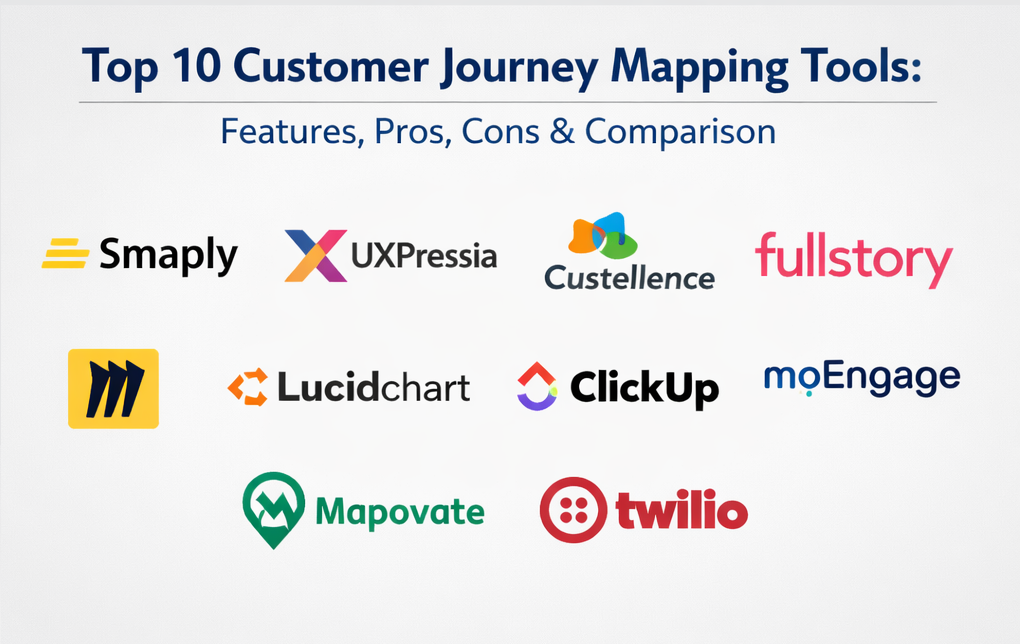
Top 10 Customer Journey Mapping Tools
Tool 1 — Smaply
Smaply is a dedicated journey mapping and journey management tool designed for teams that want structured, reusable maps at scale. It is typically used by CX and service design teams that need more organization than a generic whiteboard.
Key Features
- Journey maps with structured lanes (touchpoints, channels, ownership, emotions, pain points).
- Persona creation and management alongside journey work.
- Repository-style organization for multiple journeys and variants.
- Collaboration for teams working on shared journey assets.
- Support for consistent templates and standards across maps.
- Stakeholder-friendly exports and presentation workflows.
- Portfolio-style approach to managing multiple journeys.
Pros
- Purpose-built for journey work, which helps maintain structure over time.
- Good fit when you want a “system” for journeys, not just a canvas.
Cons
- Less flexible for non-journey diagramming compared to broad whiteboards.
- Specialized structure can feel heavier for casual or occasional use.
Platforms / Deployment
Web; Cloud.
Security & Compliance
Not publicly stated.
Integrations & Ecosystem
Smaply typically fits alongside your research, analytics, and work management stack, with journeys acting as the “shared truth” layer.
- Export workflows for sharing with stakeholders and teams.
- Collaboration tool alignment (presentations, documents) via common file-based outputs.
- APIs or direct connectors: Not publicly stated.
- Marketplace or ecosystem depth: Not publicly stated.
Support & Community
Documentation and onboarding experience varies by plan; community strength is Not publicly stated.
Tool 2 — UXPressia
UXPressia is a journey mapping platform used for creating journey maps and personas with a focus on clear visualization and team collaboration. It is often used by UX and CX teams that want structured maps plus flexibility.
Key Features
- Journey mapping with multiple lanes and stage structures.
- Persona creation that can be tied directly to maps.
- Templates to standardize journey work across teams.
- Collaboration features for co-editing and review.
- Presentation-friendly views for stakeholder alignment.
- Support for linking insights and evidence to journey steps.
- Export options for sharing across the organization.
Pros
- Strong combination of structured mapping and presentation clarity.
- Useful for teams building a repeatable journey mapping practice.
Cons
- May require time to build internal standards (taxonomy, templates, ownership).
- Deep data integration capabilities vary by plan (Varies / N/A).
Platforms / Deployment
Web; Cloud.
Security & Compliance
Not publicly stated.
Integrations & Ecosystem
UXPressia is commonly used alongside UX research tools and analytics platforms, with maps serving as the synthesis layer.
- Import/export to share artifacts with other systems.
- Integration specifics and APIs: Not publicly stated.
- Extensions and ecosystem depth: Not publicly stated.
- Collaboration workflows through common formats.
Support & Community
Support tiers and community programs are Varies / Not publicly stated.
Tool 3 — Custellence
Custellence is a journey mapping tool designed to help teams create practical journey maps and use them to drive action. It is used by organizations that want collaborative mapping with a focus on outcomes.
Key Features
- Journey map creation with structured stages and lanes.
- Collaboration for cross-functional journey workshops.
- Ability to manage multiple journeys and map variants.
- Tagging of pain points, opportunities, and improvement ideas.
- Stakeholder-ready sharing and export options.
- Support for consistent map structure across teams.
- Repository-style organization (Varies / N/A).
Pros
- Good fit for teams that want mapping tied to improvement planning.
- Supports collaborative working styles across departments.
Cons
- Integration and ecosystem details are less transparent publicly.
- Security/compliance details require verification.
Platforms / Deployment
Web; Cloud.
Security & Compliance
Not publicly stated.
Integrations & Ecosystem
Custellence typically connects to broader CX work through exports and shared processes.
- Sharing/export workflows for alignment and reporting.
- Connections to analytics, VoC, or work tools: Not publicly stated.
- API availability: Not publicly stated.
- Partner ecosystem: Not publicly stated.
Support & Community
Varies / Not publicly stated.
Tool 4 — Fullstory
Fullstory is a digital experience analytics platform often used to understand real user paths through web and app experiences. It can support journey analysis by showing what users actually do, where they struggle, and where they drop off.
Key Features
- Behavior-based journey views for digital experiences.
- Session replay to understand friction and confusion.
- Funnels and path analysis to quantify drop-offs.
- Event-based analysis to connect actions to outcomes.
- Collaboration through shared insights and reports.
- Ability to segment journeys by user attributes and behaviors.
- Support for identifying issues that static maps miss.
Pros
- Strong for data-driven journey understanding in digital products.
- Helps teams validate or challenge assumptions from workshop maps.
Cons
- Focused primarily on digital journeys, not full omnichannel service journeys.
- Requires instrumentation and strong data governance to be effective.
Platforms / Deployment
Web; Cloud.
Security & Compliance
Not publicly stated.
Integrations & Ecosystem
Fullstory typically integrates with product analytics, incident tracking, and collaboration tools to move from insight to action.
- Data export and integration patterns: Varies / N/A.
- APIs and connectors: Varies / N/A.
- Connections to work management tools: Varies / N/A.
Support & Community
Varies / Not publicly stated.
Tool 5 — MoEngage (Journeys / Flows)
MoEngage is primarily a customer engagement platform, and its journey capabilities help teams design and orchestrate engagement journeys across channels. It is often used by marketing and product growth teams that want mapping closely tied to execution.
Key Features
- Visual journey builder for engagement flows.
- Event-driven triggers based on customer actions.
- Segmentation and personalization for journey paths.
- Cross-channel orchestration (channels vary by plan).
- Journey analytics to measure performance and outcomes.
- Experimentation support (Varies / N/A).
- Operational controls for managing journey versions and rules.
Pros
- Strong when you want to act on journeys, not just document them.
- Aligns well with lifecycle marketing and product-led engagement.
Cons
- Less suited for classic service design maps focused on emotions and ownership lanes.
- Requires a solid data/event foundation to perform well.
Platforms / Deployment
Web; Cloud.
Security & Compliance
Not publicly stated.
Integrations & Ecosystem
MoEngage journeys typically rely on data connections and channel integrations to execute flows.
- Data source integrations: Varies / N/A.
- Messaging and channel connectors: Varies / N/A.
- APIs/webhooks: Varies / N/A.
- Export patterns for analytics stacks: Varies / N/A.
Support & Community
Varies / Not publicly stated.
Tool 6 — Miro
Miro is a collaborative whiteboard commonly used for journey mapping workshops and cross-functional alignment. It suits teams that want maximum flexibility and strong real-time collaboration.
Key Features
- Infinite canvas for mapping complex journeys and variants.
- Templates for journey mapping and related frameworks.
- Real-time collaboration with comments and facilitation features.
- Workshop tools for co-creation (timers, voting, frames).
- Integration with common work and collaboration tools (Varies / N/A).
- Easy sharing for stakeholder reviews.
- Useful for discovery, ideation, and alignment beyond journeys.
Pros
- Excellent for workshops and cross-functional mapping sessions.
- Flexible enough to support many mapping styles and frameworks.
Cons
- Governance and repository management require manual discipline.
- Not a purpose-built journey management system by default.
Platforms / Deployment
Web / Windows / macOS / iOS / Android; Cloud.
Security & Compliance
Not publicly stated.
Integrations & Ecosystem
Miro typically serves as the collaboration layer that connects to project and documentation tools.
- Integrations with work tools (Varies / N/A).
- Embedding and sharing workflows for broader adoption.
- API availability: Varies / N/A.
- Marketplace depth: Varies / N/A.
Support & Community
Strong community presence and templates exist; formal support tiers vary by plan and are Not publicly stated here.
Tool 7 — Lucidchart
Lucidchart is a diagramming tool that many teams use for journey maps, process flows, and service blueprints. It is useful when you want structured diagrams that are clean, shareable, and consistent.
Key Features
- Diagramming tools suitable for journey maps and service blueprints.
- Structured shapes, lanes, and connectors for consistent mapping.
- Collaboration features for shared editing and review.
- Template support for repeatability and standardization.
- Ability to create related artifacts (flows, org charts, process maps).
- Embedding and sharing options for stakeholders.
- Data-driven diagram features (Varies / N/A).
Pros
- Produces polished, structured visuals suitable for executive communication.
- Useful beyond journey mapping for many operational diagrams.
Cons
- Not specialized for journey governance or journey repositories.
- Workshop facilitation is less natural than whiteboard-first tools.
Platforms / Deployment
Web; Cloud.
Security & Compliance
Not publicly stated.
Integrations & Ecosystem
Lucidchart commonly integrates with productivity and collaboration tools for documentation workflows.
- Integrations with collaboration suites (Varies / N/A).
- Embedding into documentation systems (Varies / N/A).
- APIs and extensions: Varies / N/A.
Support & Community
Varies / Not publicly stated.
Tool 8 — ClickUp (Whiteboards / Mind Maps)
ClickUp is a work management platform that includes whiteboards and mind maps that can be used for journey mapping. It is a good fit when you want to connect journey insights directly to tasks and execution.
Key Features
- Whiteboards and mind maps for visual journey mapping.
- Direct linkage from map elements to tasks and projects.
- Collaboration features inside shared workspaces.
- Templates to standardize team workflows (Varies / N/A).
- Dashboards to track execution progress tied to journey initiatives.
- Ownership assignment for improvements and milestones.
- Documentation features that can sit next to maps (Varies / N/A).
Pros
- Strong alignment between journey mapping and delivery execution.
- Useful when ClickUp is already your primary system for work tracking.
Cons
- Dedicated journey mapping depth is typically less than specialized tools.
- Visual mapping features may be “good enough” rather than best-in-class for CX design.
Platforms / Deployment
Web / Windows / macOS / iOS / Android; Cloud.
Security & Compliance
Not publicly stated.
Integrations & Ecosystem
ClickUp integrates with many productivity and development tools to support end-to-end delivery.
- Integrations with communication and dev tools (Varies / N/A).
- Automation and APIs (Varies / N/A).
- Export and reporting workflows (Varies / N/A).
Support & Community
Varies / Not publicly stated.
Tool 9 — Mapovate
Mapovate is positioned around journey mapping with a stronger tie to feedback signals and monitoring. It can fit teams that want journeys to be actively tracked, not only documented.
Key Features
- Journey map creation with structured stages and touchpoints.
- Ability to link feedback and experience signals to journey points (Varies / N/A).
- Dashboards and reporting for monitoring journey performance (Varies / N/A).
- Alerts and action workflows when experience degrades (Varies / N/A).
- Collaboration for CX teams and stakeholders.
- Support for identifying friction patterns over time.
- Export and sharing for leadership and operational teams.
Pros
- Helpful when you want mapping plus ongoing monitoring behaviors.
- Encourages operational ownership of journey quality.
Cons
- Ecosystem and integration details may be less mature than large platforms.
- Security and compliance details require verification.
Platforms / Deployment
Web; Cloud.
Security & Compliance
Not publicly stated.
Integrations & Ecosystem
Mapovate typically fits as a layer between VoC signals and CX decision-making.
- Integrations: Varies / Not publicly stated.
- APIs: Not publicly stated.
- Export patterns: Varies / N/A.
Support & Community
Varies / Not publicly stated.
Tool 10 — Twilio (Journey-related capabilities)
Twilio’s ecosystem supports event-driven customer engagement, and journey-oriented capabilities can be built or orchestrated using customer profiles, events, and communication channels. It is best suited to engineering-friendly teams that want journeys tightly connected to real-time data and execution.
Key Features
- Event-based triggers for journey steps and branching paths.
- Use of customer profile data and behavioral signals.
- Cross-channel engagement possibilities (Varies / N/A).
- Real-time orchestration patterns for journeys.
- Extensibility for custom journey logic.
- Integration into broader communication workflows.
- Measurement patterns through event analytics (Varies / N/A).
Pros
- Strong fit for data-first, engineering-enabled journey orchestration.
- Useful when you want journeys to directly drive messaging and interactions.
Cons
- More oriented to building and executing journeys than classic workshop mapping.
- Requires technical ownership and a mature data/event model.
Platforms / Deployment
Web; Cloud.
Security & Compliance
Not publicly stated.
Integrations & Ecosystem
Twilio is typically chosen for extensibility and integration into a broader product stack.
- APIs for custom orchestration and data flows: Varies / N/A.
- Channel integrations: Varies / N/A.
- Data integrations: Varies / N/A.
Support & Community
Developer documentation is typically strong; support tiers vary by plan and are Not publicly stated here.
Comparison Table (Top 10)
| Tool Name | Best For | Platform(s) Supported | Deployment (Cloud/Self-hosted/Hybrid) | Standout Feature | Public Rating |
|---|---|---|---|---|---|
| Smaply | Dedicated journey management at scale | Web | Cloud | Structured journey repository and standards | N/A |
| UXPressia | CX and UX teams mapping journeys and personas | Web | Cloud | Strong mapping plus persona workflows | N/A |
| Custellence | Practical mapping with collaboration focus | Web | Cloud | Outcome-oriented journey mapping | N/A |
| Fullstory | Data-first digital journey analysis | Web | Cloud | Behavioral journey understanding with replay | N/A |
| MoEngage (Journeys/Flows) | Engagement-led journey orchestration | Web | Cloud | Journey design tied to execution | N/A |
| Miro | Workshops and flexible mapping | Web, desktop, mobile | Cloud | Best-in-class collaboration canvas | N/A |
| Lucidchart | Structured, polished journey diagrams | Web | Cloud | Clean diagramming for stakeholder-ready maps | N/A |
| ClickUp (Whiteboards) | Linking mapping to execution | Web, desktop, mobile | Cloud | Maps connected to tasks and delivery | N/A |
| Mapovate | Mapping plus monitoring orientation | Web | Cloud | Journey mapping tied to signals and tracking | N/A |
| Twilio (Journey capabilities) | Engineering-led data-driven journeys | Web | Cloud | Event-driven extensibility and orchestration | N/A |
Evaluation & Scoring of Customer Journey Mapping Tools
Scoring below is comparative guidance to help you shortlist, not a formal benchmark. Use it to start discussions, then run a pilot with one journey and one persona to validate collaboration, governance, and fit.
Weights:
- Core features – 25%
- Ease of use – 15%
- Integrations and ecosystem – 15%
- Security and compliance – 10%
- Performance and reliability – 10%
- Support and community – 10%
- Price and value – 15%
| Tool Name | Core (25%) | Ease (15%) | Integrations (15%) | Security (10%) | Performance (10%) | Support (10%) | Value (15%) | Weighted Total (0–10) |
|---|---|---|---|---|---|---|---|---|
| Smaply | 9 | 8 | 7 | 6 | 8 | 7 | 7 | 7.60 |
| UXPressia | 9 | 7 | 7 | 6 | 8 | 7 | 7 | 7.35 |
| Custellence | 8 | 8 | 6 | 6 | 8 | 7 | 7 | 7.20 |
| Fullstory | 8 | 7 | 8 | 6 | 9 | 7 | 6 | 7.35 |
| MoEngage (Journeys/Flows) | 8 | 7 | 8 | 6 | 8 | 7 | 7 | 7.30 |
| Miro | 7 | 9 | 8 | 6 | 8 | 8 | 8 | 7.75 |
| Lucidchart | 7 | 8 | 8 | 6 | 8 | 7 | 7 | 7.25 |
| ClickUp (Whiteboards) | 7 | 8 | 7 | 6 | 8 | 7 | 8 | 7.30 |
| Mapovate | 8 | 7 | 6 | 6 | 7 | 6 | 7 | 6.85 |
| Twilio (Journey capabilities) | 8 | 6 | 9 | 6 | 8 | 7 | 6 | 7.10 |
How to interpret the scores:
- Higher totals suggest a more balanced fit for typical journey mapping programs.
- If you want workshop facilitation, ease of use may matter more than “core features,” pushing Miro higher.
- If you want journeys tied tightly to digital behavior, Fullstory may outperform general mapping tools.
- If you want execution and orchestration, MoEngage or Twilio-style approaches can be stronger than pure mapping tools.
- Adjust weights to match your organization’s priorities before making a decision.
Which Customer Journey Mapping Tool Is Right for You?
Solo / Freelancer
Choose a tool that makes it easy to run workshops and produce stakeholder-ready outputs without heavy setup. A flexible whiteboard or diagram tool often works best, especially if you only create a few maps and don’t need a formal repository.
SMB
SMBs typically benefit from tools that are quick to adopt and easy to maintain. Start with a whiteboard or diagram tool if your goal is alignment and quick insight, then move to a specialized journey platform when you need standardization and scale across multiple personas or product lines.
Mid-Market
Mid-market teams often need both mapping and execution alignment. Consider pairing a mapping tool (for cross-functional clarity) with a work management system (to turn insights into initiatives), or choose a tool that supports both mapping and follow-through workflows.
Enterprise
Enterprises usually need governance, repositories, permissions, and a consistent mapping taxonomy. Specialized journey management tools can reduce chaos when multiple teams create many journeys, while analytics and orchestration systems add the data and execution layer for operational impact.
Budget vs Premium
If budget is limited, prioritize tools that cover multiple needs (workshops, documentation, mapping) and rely on internal standards for governance. If budget allows, invest in tools that reduce long-term friction: structured repositories, standardized templates, and scalable collaboration.
Feature Depth vs Ease of Use
Specialized journey tools often provide deeper structure and governance but can feel heavier at first. General-purpose tools are easier to start with, but they rely on strong internal discipline to avoid inconsistency and map sprawl.
Integrations & Scalability
If your goal is to connect journey mapping to measurable outcomes, prioritize integration patterns: analytics, feedback, engagement, and work tracking. If your goal is scaling mapping across departments, prioritize repositories, permissions, and standard templates.
Security & Compliance Needs
If your maps contain sensitive information (customer data, regulated workflows, incident patterns), verify security controls early. When security certifications or controls are not clearly stated, treat them as Not publicly stated and require vendor documentation during evaluation.
Frequently Asked Questions (FAQs)
What is a customer journey map in practical terms?
It is a structured view of how a customer moves through stages and touchpoints, including goals, friction, emotions, and outcomes. The goal is to identify what to improve and why it matters.
Should journey maps be based on research or opinions?
They should be anchored in research and data whenever possible. Workshop input is useful, but validating with interviews, support logs, analytics, and feedback reduces bias.
How often should we update journey maps?
Update maps when you change the product or process in meaningful ways, or when performance shifts. High-impact journeys should be reviewed regularly as part of CX or product rituals.
Do these tools replace analytics platforms?
No. Analytics platforms measure behavior and outcomes; journey mapping tools help teams interpret and design improvements. The best approach combines both.
What is the difference between journey mapping and service blueprinting?
Journey maps focus on the customer perspective. Service blueprints add the behind-the-scenes processes, systems, and teams required to deliver that experience.
How do we avoid creating too many journey maps?
Start with the few journeys that matter most to business outcomes. Create standards, naming conventions, and ownership so maps remain coherent and reusable.
What is the most common reason journey mapping fails?
Teams treat the map as the final output instead of a decision tool. Without prioritization, ownership, and follow-through, maps become documentation rather than impact.
Can we map journeys for existing customers, not just new users?
Yes. Renewal, expansion, support, and advocacy journeys often drive retention and revenue and are excellent candidates for mapping.
How do we pick the right tool for cross-functional collaboration?
Prioritize real-time collaboration, easy sharing, and governance features. Run a pilot workshop and see whether stakeholders can contribute without friction.
Are there lightweight alternatives for teams just starting?
Yes. A basic whiteboard or diagram tool plus a small set of templates can work well until you prove the value and need a dedicated journey repository.
Conclusion
Customer journey mapping tools range from flexible whiteboards to specialized journey management platforms and data-driven analytics systems. The right choice depends on whether your primary goal is workshop collaboration, organizational governance, data-backed journey insight, or execution and orchestration. A practical next step is to shortlist two or three tools, run a pilot on one high-impact journey, and validate collaboration, governance, exports, and integration fit before rolling out broadly.

Best Cardiac Hospitals Near You
Discover top heart hospitals, cardiology centers & cardiac care services by city.
Advanced Heart Care • Trusted Hospitals • Expert Teams
View Best Hospitals