Introduction
Data encryption tools protect sensitive information by converting it into unreadable ciphertext that can only be accessed with the right key. They reduce the impact of data breaches, help meet privacy and compliance expectations, and support secure operations across cloud, endpoints, databases, and backups. In practical terms, encryption is how you keep customer data, financial records, intellectual property, and credentials safe when stored or transmitted.
Real world use cases include encrypting laptops and endpoints to prevent data loss, protecting cloud storage and databases, securing backup archives for ransomware resilience, encrypting files shared between teams, and enabling secure communications between applications. When selecting encryption tools, buyers should evaluate algorithm strength, key management, ease of deployment, coverage across platforms, performance impact, centralized policy control, audit logging, integration with identity systems, support for hardware security modules, and recovery processes.
Best for
IT leaders, security teams, DevOps teams, compliance teams, and data owners who need to protect data at rest and in transit across endpoints, servers, cloud services, and enterprise applications.
Not ideal for
Teams looking for access control only without cryptography, organizations that cannot manage keys responsibly, or environments where encryption is already fully handled by a platform and no additional encryption layer is needed.
Key Trends in Data Encryption Tools
- Wider adoption of centralized key management to reduce key sprawl and mistakes
- More default encryption in cloud platforms, with stronger customer controlled keys
- Increased focus on ransomware resilience through immutable and encrypted backups
- More integration between encryption, identity, and access governance tools
- Growth of transparent encryption that reduces application changes
- More hardware backed keys using trusted platform modules and HSM integrations
- Stronger automation for key rotation, certificate lifecycle, and policy enforcement
- Increased demand for format preserving and field level encryption for databases
- Better monitoring and audit readiness for cryptographic operations
- More use of envelope encryption patterns for scalable cloud architectures
How We Selected These Tools (Methodology)
- Included widely used tools that cover endpoint, file, disk, and key management needs
- Balanced enterprise and open source options for different budgets and environments
- Considered operational maturity, reliability, and security track record expectations
- Focused on tools with strong policy control, auditing, and recovery workflows
- Prioritized tools that integrate well with cloud, identity, and DevOps pipelines
- Looked for practical deployment paths across Windows, macOS, Linux, and cloud
- Avoided claiming certifications, ratings, or capabilities not clearly known
- Chose tools that remain relevant across modern hybrid and cloud first stacks
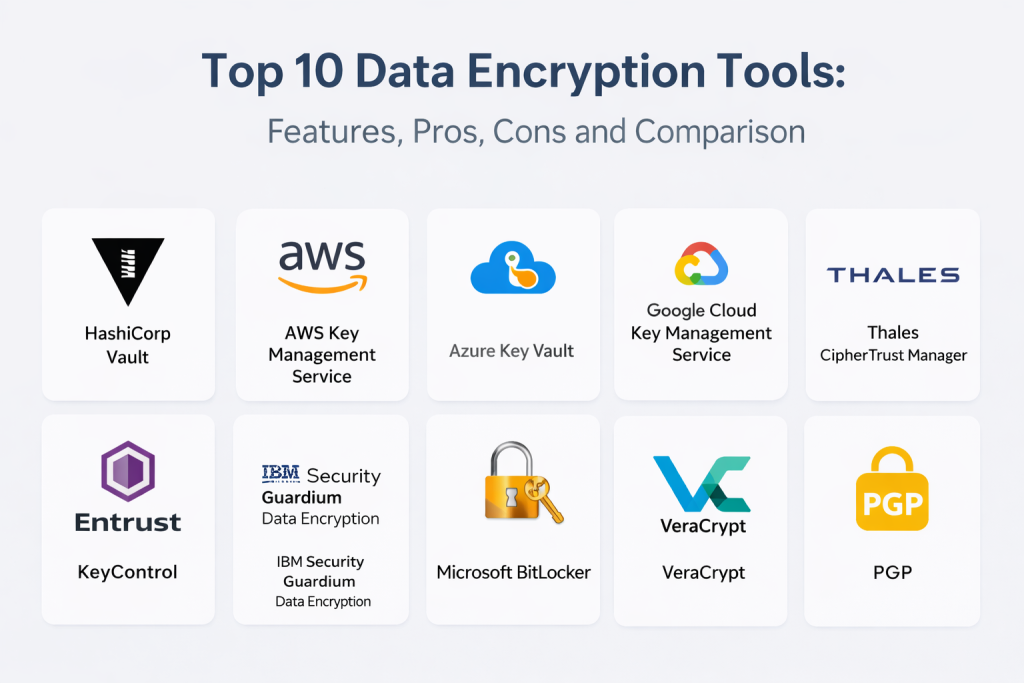
Top 10 Data Encryption Tools
1 — HashiCorp Vault
A centralized secrets and encryption service used to protect sensitive data, manage keys, and control access to secrets for applications and infrastructure. Commonly used by DevOps and security teams building secure cloud and hybrid environments.
Key Features
- Centralized secrets storage with access policies
- Encryption services for applications and data workflows
- Key generation and lifecycle management patterns
- Dynamic secrets for databases and cloud services
- Audit logging for cryptographic and access events
- Integration with identity providers and access control
- Automation support through APIs and infrastructure tooling
Pros
- Strong fit for modern application security and DevOps automation
- Reduces secret sprawl and improves access governance
- Flexible integration across cloud and on premises stacks
Cons
- Requires careful operations and policy design
- Can be complex for small teams without dedicated owners
- Scaling and HA setup depends on architecture and expertise
Platforms and Deployment
Windows, macOS, Linux, Cloud, Self hosted, Hybrid
Security and Compliance
Encryption, audit logs, RBAC style controls, and token based access are common; certifications: Not publicly stated.
Integrations and Ecosystem
Vault is often the center of secrets and encryption workflows, connected to CI pipelines, Kubernetes, cloud IAM, and application runtimes. It can also integrate with hardware backed key systems depending on architecture.
- APIs for secrets and encryption operations
- Integrations with cloud identity and access systems
- Works with containers, orchestration, and CI pipelines
- Connects to databases, messaging, and internal services
Support and Community
Strong community and documentation in many environments. Enterprise support tiers: Varies / Not publicly stated.
2 — AWS Key Management Service
Managed key management service used to create and control encryption keys for cloud services and applications. Frequently used to protect data stored in cloud storage, databases, and application workloads.
Key Features
- Managed encryption keys with centralized control
- Integration with many cloud storage and compute services
- Key rotation and lifecycle management options
- Access control using cloud identity policies
- Logging and audit visibility for key usage events
- Support for customer controlled keys across services
- API support for application level encryption patterns
Pros
- Easy to adopt when running workloads in AWS
- Strong integration coverage across AWS services
- Reduces operational overhead for key management
Cons
- Tied to AWS ecosystem for best value
- Cross cloud strategies need additional planning
- Some advanced patterns require architecture expertise
Platforms and Deployment
Web, Cloud
Security and Compliance
Access policies, encryption, and audit logs are standard expectations; certifications: Not publicly stated.
Integrations and Ecosystem
Typically integrated across cloud storage, database encryption, and application services, with keys used for envelope encryption and customer managed key patterns.
- Integrations with cloud storage and database services
- API usage for application encryption
- Works with identity and access governance policies
- Feeds logs into monitoring and audit pipelines
Support and Community
Cloud support depends on subscription and support plan. Documentation is generally strong. Exact support details: Varies / Not publicly stated.
3 — Azure Key Vault
Key and secret management service used to protect encryption keys, certificates, and secrets in Azure environments. Commonly used to centralize key access and support secure application deployments.
Key Features
- Managed keys, secrets, and certificate storage
- Role based access and policy driven controls
- Key rotation and lifecycle management options
- Integration with Azure services for data encryption
- Audit and logging support for access events
- Supports application level encryption patterns
- Helps standardize secret handling across teams
Pros
- Strong fit for Azure based architectures
- Centralized access control for keys and secrets
- Reduces risks from hard coded secrets
Cons
- Best value within Azure ecosystem
- Multi cloud usage requires extra integration work
- Policy design and governance are critical for success
Platforms and Deployment
Web, Cloud
Security and Compliance
Access control, encryption, and auditing are expected; certifications: Not publicly stated.
Integrations and Ecosystem
Often used with Azure storage, databases, container platforms, and CI pipelines, with keys applied for customer managed encryption scenarios.
- Integration across Azure data and compute services
- APIs for app encryption and secrets retrieval
- Identity integration through Azure access policies
- Logging integration into monitoring and SIEM pipelines
Support and Community
Documentation is broad and commonly used. Support depends on enterprise agreements: Varies / Not publicly stated.
4 — Google Cloud Key Management Service
Managed key management service for Google Cloud, used to create, manage, and audit encryption keys. Supports encryption across cloud data services and custom applications.
Key Features
- Centralized key creation and management
- Access control through cloud IAM policies
- Audit visibility into key usage events
- Integration with cloud storage and database services
- Key rotation and lifecycle management capabilities
- Supports envelope encryption style architectures
- Helps enforce consistent encryption policies
Pros
- Good integration with Google Cloud services
- Strong audit and policy model through IAM
- Reduces operational burden for key management
Cons
- Primarily for Google Cloud deployments
- Cross environment encryption needs extra architecture planning
- Advanced governance depends on your policy maturity
Platforms and Deployment
Web, Cloud
Security and Compliance
Encryption, IAM access controls, and audit logs are standard expectations; certifications: Not publicly stated.
Integrations and Ecosystem
Commonly used for storage encryption, database encryption, and application level key usage through APIs.
- Integrations across Google Cloud data services
- API access for custom application encryption
- IAM policies for centralized key governance
- Logs feeding into monitoring and compliance workflows
Support and Community
Support depends on cloud subscription plans. Documentation is extensive: Varies / Not publicly stated.
5 — Thales CipherTrust Manager
Enterprise key management platform used to centralize key control and policy enforcement across databases, file systems, cloud services, and applications. Often used by organizations with strong compliance and governance needs.
Key Features
- Centralized enterprise key management and policy control
- Support for encryption key lifecycle and rotation
- Integration with databases and storage encryption systems
- Support for hardware backed key models and HSM options
- Audit logging and governance workflows
- Multi environment support across cloud and on premises
- Role based administration and segregation of duties
Pros
- Strong fit for regulated enterprise environments
- Centralizes keys across multiple systems and platforms
- Helps enforce governance and audit controls consistently
Cons
- Typically heavier to deploy than cloud native services
- Requires strong governance and operational ownership
- Cost and packaging can vary by enterprise needs
Platforms and Deployment
Windows, Linux, Cloud, Self hosted, Hybrid
Security and Compliance
Common enterprise controls expected; certifications: Not publicly stated.
Integrations and Ecosystem
Often integrated with database encryption, storage encryption, backup systems, and security operations workflows to provide centralized key control and reporting.
- Integrations with enterprise storage and database platforms
- Supports HSM aligned architectures depending on setup
- Connects to identity systems for admin access control
- Feeds logs into SIEM and audit reporting pipelines
Support and Community
Enterprise support is typical. Implementation assistance often available. Exact details: Varies / Not publicly stated.
6 — Entrust KeyControl
Key management platform often used for centralized key control across multiple environments. Supports governance, key lifecycle, and access policies aligned to enterprise encryption programs.
Key Features
- Centralized key management and policy enforcement
- Key lifecycle management with rotation controls
- Integration with encryption systems and applications
- Governance focused access management and admin roles
- Audit logging for key operations and access events
- Multi environment support across hybrid architectures
- Support for stronger separation of duties
Pros
- Useful for enterprise key governance and central control
- Helps standardize encryption policies across teams
- Aligns well with regulated operational requirements
Cons
- Implementation can be complex without clear program ownership
- Integration effort varies by the systems you need to cover
- Feature scope depends on selected modules
Platforms and Deployment
Windows, Linux, Cloud, Self hosted, Hybrid
Security and Compliance
Expected controls include RBAC and audit logs; certifications: Not publicly stated.
Integrations and Ecosystem
KeyControl is typically integrated with enterprise encryption layers, databases, and storage systems, acting as the control point for key lifecycle and access governance.
- Integrations with encryption platforms and applications
- Support for hybrid environments and key policy enforcement
- Connections to identity systems for admin controls
- Logs exported into monitoring and audit workflows
Support and Community
Enterprise oriented support model. Documentation and services: Varies / Not publicly stated.
7 — IBM Security Guardium Data Encryption
Enterprise encryption solution designed to protect data across databases and files with centralized management and policy controls. Often considered where structured governance and enterprise reporting are required.
Key Features
- Transparent data encryption for supported systems
- Centralized management for encryption policies
- Key lifecycle management and governance workflows
- Audit logging and reporting for encryption operations
- Support for database and file oriented use cases
- Integration options for enterprise security operations
- Helps reduce application changes through transparent methods
Pros
- Strong for enterprise governance and reporting needs
- Helps protect databases and files without heavy app changes
- Fits organizations with mature security programs
Cons
- Scope and complexity can be high for small teams
- Deployment and tuning depend on environment and coverage goals
- Feature availability varies by supported platforms
Platforms and Deployment
Windows, Linux, Cloud, Self hosted, Hybrid
Security and Compliance
Enterprise controls expected; certifications: Not publicly stated.
Integrations and Ecosystem
Often integrated with enterprise databases, file systems, and security reporting workflows to provide encryption coverage and audit visibility.
- Integrations with database platforms and data stores
- Central reporting into security operations pipelines
- Key governance integration with enterprise policies
- Supports hybrid and multi environment deployments
Support and Community
Enterprise support model. Exact details: Varies / Not publicly stated.
8 — Microsoft BitLocker
Full disk encryption capability designed to protect data on Windows devices, especially laptops and desktops. Commonly used to reduce data loss risks from stolen or lost endpoints.
Key Features
- Full disk encryption for Windows endpoints
- Integration with device management and policy controls
- Recovery key mechanisms for device recovery
- Hardware backed encryption support depending on device
- Central policy enforcement in managed environments
- Helps meet baseline endpoint data protection requirements
- Minimal user friction after deployment
Pros
- Strong built in option for Windows endpoint encryption
- Widely used for enterprise laptop protection
- Good balance of security and user experience
Cons
- Primarily focused on Windows devices
- Does not replace file level encryption needs for sharing
- Central management depends on your broader Windows management stack
Platforms and Deployment
Windows, Self hosted, Hybrid
Security and Compliance
Disk encryption and recovery controls are core; certifications: Not publicly stated.
Integrations and Ecosystem
BitLocker is typically managed through enterprise device management and integrated into endpoint security baselines and recovery workflows.
- Integrates with enterprise device management policies
- Works with endpoint security monitoring systems
- Supports recovery key management workflows
- Fits into compliance reporting for endpoint controls
Support and Community
Broad enterprise familiarity and documentation availability. Support depends on Microsoft agreements: Varies / Not publicly stated.
9 — VeraCrypt
Open source disk and volume encryption tool used to create encrypted containers and encrypt entire drives. Often used by individuals and teams that need strong local encryption controls.
Key Features
- Encrypted containers for files and folders
- Full disk encryption for supported systems
- Strong encryption algorithm options and configurations
- Hidden volume and advanced protection features
- Cross platform use in many setups
- Portable usage patterns for secure storage
- Flexible configuration for advanced users
Pros
- Strong control and transparency for local encryption
- Useful for secure containers and removable storage
- Good option when you need offline encryption workflows
Cons
- Requires user discipline for key management and backups
- Not designed as a centralized enterprise key platform
- User experience may be complex for non technical teams
Platforms and Deployment
Windows, macOS, Linux, Self hosted
Security and Compliance
Encryption features are core; certifications: Not publicly stated.
Integrations and Ecosystem
VeraCrypt is typically used as a local encryption layer rather than integrated into enterprise automation. It fits best in workflows where users manage encrypted volumes and follow strict handling procedures.
- Works with local storage and removable drives
- Supports secure container sharing with careful procedures
- Can be paired with secure backup practices
- Limited centralized integration by design
Support and Community
Community driven documentation and support. Enterprise support: Varies / Not publicly stated.
10 — PGP
Encryption approach commonly used for file encryption and secure email workflows using public key cryptography. Often applied for protecting files in transit and ensuring only intended recipients can decrypt content.
Key Features
- Public key encryption for files and messages
- Supports signing for authenticity and integrity checks
- Works well for secure file exchange workflows
- Key pair management concepts for teams and organizations
- Can be integrated into automated workflows in some setups
- Suitable for protecting sensitive exports and archives
- Supports layered security in secure communication processes
Pros
- Strong for secure file exchange and encryption at rest in archives
- Supports signing for authenticity verification
- Widely understood concept in security operations
Cons
- Key management can be complex for large teams
- User experience can be difficult without training
- Does not provide centralized policy control by default
Platforms and Deployment
Windows, macOS, Linux, Self hosted
Security and Compliance
Encryption and signing are core; certifications: Not publicly stated.
Integrations and Ecosystem
PGP is often used in workflows where files must be encrypted before transfer or stored in encrypted form. It can be integrated into scripts and pipelines for secure exports, backups, and data exchanges.
- Integrates into automated export and transfer workflows
- Can be used with secure file exchange processes
- Supports signing for integrity verification
- Often paired with secure key storage practices
Support and Community
Support varies by implementation and distribution. Community support is common. Exact details: Varies / Not publicly stated.
Comparison Table
| Tool Name | Best For | Platform(s) Supported | Deployment | Standout Feature | Public Rating |
|---|---|---|---|---|---|
| HashiCorp Vault | Central secrets and encryption workflows | Windows, macOS, Linux | Cloud, Self hosted, Hybrid | Strong secrets management and encryption services | N/A |
| AWS Key Management Service | Key management in AWS | Web | Cloud | Deep integration with AWS services | N/A |
| Azure Key Vault | Key and secret management in Azure | Web | Cloud | Central control for keys, secrets, certificates | N/A |
| Google Cloud Key Management Service | Key management in Google Cloud | Web | Cloud | IAM driven policies and audit visibility | N/A |
| Thales CipherTrust Manager | Enterprise key governance | Windows, Linux | Cloud, Self hosted, Hybrid | Centralized keys across environments and systems | N/A |
| Entrust KeyControl | Enterprise key lifecycle control | Windows, Linux | Cloud, Self hosted, Hybrid | Governance focused key management policies | N/A |
| IBM Security Guardium Data Encryption | Enterprise database and file encryption | Windows, Linux | Cloud, Self hosted, Hybrid | Transparent encryption with centralized management | N/A |
| Microsoft BitLocker | Windows endpoint full disk encryption | Windows | Self hosted, Hybrid | Built in disk encryption for endpoints | N/A |
| VeraCrypt | Local disk and container encryption | Windows, macOS, Linux | Self hosted | Open source encrypted containers and disks | N/A |
| PGP | File encryption and secure exchange | Windows, macOS, Linux | Self hosted | Public key encryption and signing | N/A |
Evaluation and Scoring of Data Encryption Tools
The scores below help compare tools across common criteria for data encryption programs. A higher weighted total suggests a stronger overall balance, but the best choice depends on your environment, compliance needs, and whether you prioritize endpoint encryption, cloud key management, application level encryption, or enterprise governance. Use these scores to narrow down options, then validate with a pilot and a key management review. Scoring is comparative and should be interpreted alongside your real operational requirements.
Weights used: Core 25 percent, Ease 15 percent, Integrations 15 percent, Security 10 percent, Performance 10 percent, Support 10 percent, Value 15 percent.
| Tool Name | Core (25%) | Ease (15%) | Integrations (15%) | Security (10%) | Performance (10%) | Support (10%) | Value (15%) | Weighted Total |
|---|---|---|---|---|---|---|---|---|
| HashiCorp Vault | 9 | 7 | 9 | 8 | 8 | 7 | 7 | 8.05 |
| AWS Key Management Service | 8 | 9 | 9 | 8 | 8 | 7 | 8 | 8.35 |
| Azure Key Vault | 8 | 9 | 9 | 8 | 8 | 7 | 8 | 8.35 |
| Google Cloud Key Management Service | 8 | 9 | 8 | 8 | 8 | 7 | 8 | 8.20 |
| Thales CipherTrust Manager | 9 | 6 | 8 | 8 | 8 | 7 | 6 | 7.60 |
| Entrust KeyControl | 8 | 6 | 7 | 8 | 7 | 7 | 6 | 7.15 |
| IBM Security Guardium Data Encryption | 8 | 6 | 7 | 8 | 7 | 7 | 6 | 7.15 |
| Microsoft BitLocker | 7 | 9 | 6 | 7 | 8 | 7 | 9 | 7.65 |
| VeraCrypt | 7 | 6 | 4 | 7 | 7 | 6 | 9 | 6.55 |
| PGP | 7 | 5 | 5 | 7 | 7 | 6 | 8 | 6.45 |
Which Data Encryption Tool Is Right for You
Solo / Freelancer
If you are working alone, prioritize tools that are easy to operate and do not require enterprise key governance. VeraCrypt can help protect local drives and sensitive project files, while PGP is useful when you need to securely share files with clients. If you are building applications, HashiCorp Vault can be valuable, but only if you are ready to manage operational complexity and key policies carefully.
SMB
SMBs should focus on practical protection that reduces breach impact without creating heavy overhead. Microsoft BitLocker is a strong baseline for Windows endpoints. If you run workloads in a single cloud, a cloud key service such as AWS Key Management Service, Azure Key Vault, or Google Cloud Key Management Service is typically a practical choice for key control and audit visibility. HashiCorp Vault becomes attractive when you have multiple apps and need consistent secrets handling.
Mid Market
Mid market environments often need centralized control, strong audit trails, and consistent policy enforcement. HashiCorp Vault can reduce secrets sprawl and support application encryption workflows. Cloud key services remain strong choices for cloud native encryption. If you have hybrid environments or strict governance, an enterprise key management platform such as Thales CipherTrust Manager or Entrust KeyControl can help centralize keys across systems.
Enterprise
Enterprises typically require formal governance, separation of duties, audit readiness, and coverage across many platforms. Thales CipherTrust Manager and Entrust KeyControl are commonly aligned to enterprise key governance programs. IBM Security Guardium Data Encryption can fit when you need managed encryption coverage across databases and files. Cloud key services still matter, but enterprises often combine them with centralized governance to prevent policy fragmentation.
Budget vs Premium
Budget choices often focus on built in platform encryption and open source tools, such as Microsoft BitLocker for endpoints and cloud key services for workloads. Premium solutions focus on governance, centralized control, advanced audit, and broad platform coverage, where enterprise key management platforms become more compelling.
Feature Depth vs Ease of Use
If ease of use is critical, use cloud managed key services and built in endpoint encryption. If you need deeper control, auditing, separation of duties, and consistent policy enforcement across many systems, enterprise platforms and Vault style approaches provide more depth, but require stronger operational maturity.
Integrations and Scalability
Integration matters when encryption must connect with identity systems, CI pipelines, databases, and data platforms. HashiCorp Vault is strong for app integration and secrets automation. Cloud key services integrate deeply within their cloud ecosystems. Enterprise key management tools help unify governance across many platforms, especially in hybrid architectures.
Security and Compliance Needs
For strict compliance, focus on strong key ownership practices, rotation, access reviews, audit logs, and recovery controls. Avoid treating encryption as only a checkbox. The most common encryption failures come from weak key handling, unclear ownership, missing rotation, and poor recovery procedures rather than weak algorithms.
Frequently Asked Questions
1. What is the difference between encryption and access control?
Encryption protects data by making it unreadable without a key, while access control limits who can access systems and files. You usually need both, because encryption helps even when access controls fail.
2. Should we encrypt everything or only sensitive data?
Encrypting everything is a strong default when performance allows, but some environments focus on sensitive data for cost and complexity reasons. A good approach is to prioritize customer data, credentials, financial records, and backups first.
3. What is key management and why is it important?
Key management is how you create, store, rotate, and control access to encryption keys. Poor key management can break encryption security, even if the encryption algorithm is strong.
4. Do cloud platforms already encrypt data by default?
Many cloud services provide default encryption, but you still need to control keys, access policies, logging, and rotation. Customer controlled keys and proper governance are often the real differentiator.
5. How does encryption help against ransomware?
Encryption helps protect backups and archives so attackers cannot easily read stolen data. It also supports secure, immutable backup strategies that reduce recovery risk when systems are compromised.
6. What is the performance impact of encryption?
Modern encryption is usually efficient, but performance can be affected by storage type, workload, and key operations. Testing on real workloads is the best way to validate performance impact.
7. What is envelope encryption and when should we use it?
Envelope encryption uses a data key to encrypt data and a separate master key to encrypt the data key. It is widely used in cloud architectures because it scales well and supports centralized key control.
8. Can we lose data if we lose encryption keys?
Yes. If keys are lost and no recovery mechanism exists, data can become permanently unreadable. That is why backup, rotation planning, and recovery processes are essential parts of encryption programs.
9. Is full disk encryption enough for data protection?
Full disk encryption protects lost or stolen devices, but it does not fully cover data sharing, cloud storage, or application level encryption needs. Many organizations combine disk encryption with key management and application encryption.
10. How should we choose the right encryption tool?
Start by identifying what you need to protect, where the data lives, and who should control keys. Then shortlist tools that match your platform and maturity, run a pilot, validate key workflows, and confirm recovery and audit requirements.
Conclusion
Data encryption tools are essential for protecting sensitive information, but the best option depends on where your data lives and how your organization manages keys. Endpoint focused teams often start with disk encryption to protect laptops and desktops, while cloud native teams rely on cloud key services for storage and database encryption. Application teams benefit from centralized secrets and encryption services that reduce key sprawl and support automation. Enterprises often require broader governance, separation of duties, and unified policies across hybrid environments. A simple next step is to shortlist two or three tools that match your environment, pilot them on a real workload, validate key rotation and recovery processes, and confirm audit visibility before scaling across the organization.

Best Cardiac Hospitals Near You
Discover top heart hospitals, cardiology centers & cardiac care services by city.
Advanced Heart Care • Trusted Hospitals • Expert Teams
View Best Hospitals