Introduction
Database security tools protect sensitive data stored in databases by preventing unauthorized access, detecting suspicious activity, enforcing policies, and helping teams prove compliance. Modern databases power customer apps, finance systems, analytics platforms, and internal operations, so a single weak configuration, leaked credential, or missed patch can expose large amounts of data. These tools reduce risk by adding visibility, controls, monitoring, and automated enforcement around how databases are accessed and how data is used.
Real world use cases include monitoring privileged user activity, detecting abnormal queries that indicate data theft, masking sensitive fields in non production environments, encrypting data and managing keys, enforcing access rules and least privilege, and producing audit reports for regulated industries. When selecting database security tools, evaluate coverage across database types, activity monitoring depth, alert quality, data discovery and classification, vulnerability detection, access controls, support for encryption and masking, integration with identity and SIEM tools, performance impact, and ease of rollout.
Best for
Security teams, database administrators, DevOps teams, and compliance teams managing sensitive data in relational and NoSQL databases across cloud, hybrid, and on premises environments.
Not ideal for
Teams with very small, low risk databases where built in controls are sufficient, or organizations that cannot allocate owners to act on alerts, manage policies, and maintain security baselines.
Key Trends in Database Security Tools
- More emphasis on database activity monitoring to detect insider threats and stolen credentials
- Growth of data discovery and classification to find sensitive columns and risky copies
- Increased adoption of dynamic data masking to protect non production environments
- More automated posture management for managed cloud databases
- Integration with identity governance to enforce least privilege access
- Better alert tuning and context to reduce noise and false positives
- Increased use of encryption with customer controlled keys and centralized key governance
- Stronger support for audit ready reporting and evidence packaging
- Expanded coverage for cloud native data warehouses and analytics platforms
- More detection of misconfigurations that lead to public exposure or weak authentication
How We Selected These Tools (Methodology)
- Chose tools widely used for database activity monitoring, data protection, and compliance
- Balanced enterprise platforms with cloud native and security focused options
- Considered coverage across common databases and modern data platforms
- Prioritized tools with strong monitoring, policy enforcement, and reporting
- Looked for integration readiness with SIEM, identity, and ticketing workflows
- Considered performance impact and ability to deploy without breaking workloads
- Avoided claiming certifications and ratings not clearly known
- Focused on tools relevant to both hybrid and cloud first database environments
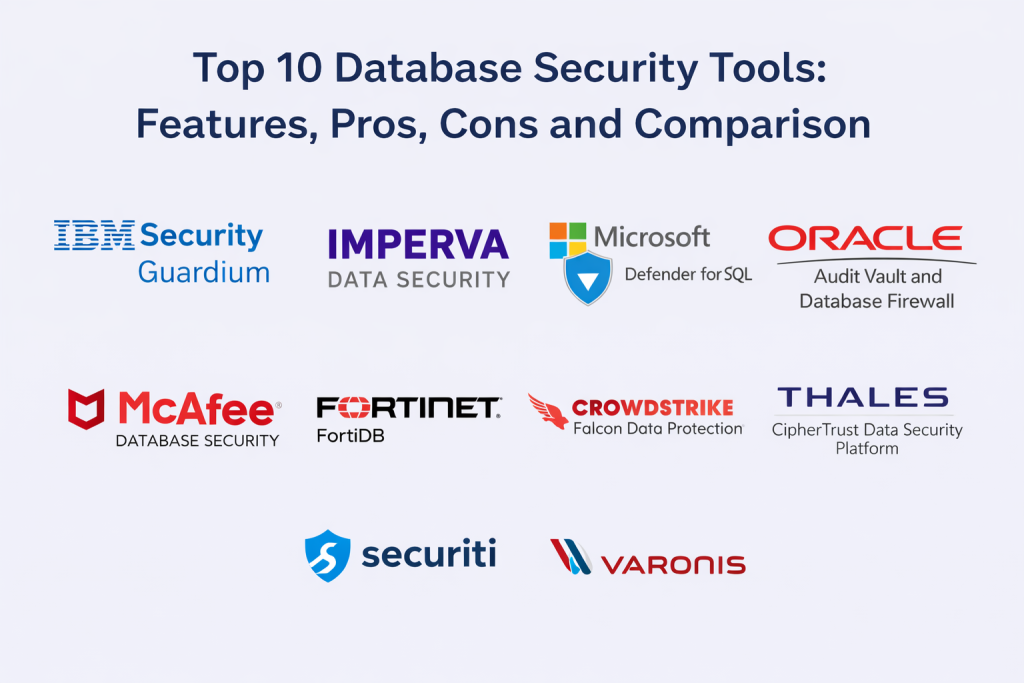
Top 10 Database Security Tools
1 — IBM Security Guardium
Database security platform focused on database activity monitoring, vulnerability assessment, and compliance reporting. Often used by large organizations managing sensitive regulated data.
Key Features
- Database activity monitoring with detailed audit trails
- Policy based alerting for risky queries and access patterns
- Vulnerability assessment for database configurations
- Data discovery and classification capabilities depending on setup
- Support for privileged user monitoring and separation of duties
- Compliance reporting workflows for audits
- Broad coverage across many database platforms
Pros
- Strong monitoring and audit depth for enterprise environments
- Useful for compliance and investigations
- Scales for large database estates
Cons
- Can be complex to deploy and tune at scale
- Requires ownership to manage alerts and policies
- Cost and scope can be high for small teams
Platforms and Deployment
Windows, Linux, Cloud, Self hosted, Hybrid
Security and Compliance
Audit logs, RBAC, encryption support, and governance controls are expected; certifications: Not publicly stated.
Integrations and Ecosystem
Guardium commonly integrates with SIEM tools, ticketing workflows, and identity systems to route alerts and support investigations across database fleets.
- Integrations with SIEM and security monitoring systems
- Supports ticketing and incident response workflows
- Works with identity and access governance processes
- Exports reports for compliance and audit evidence
Support and Community
Enterprise support model. Documentation and services: Varies / Not publicly stated.
2 — Imperva Data Security
Database security solution focused on monitoring, protection, and risk reduction across databases and data platforms. Often used for activity monitoring, risk policies, and compliance reporting.
Key Features
- Database activity monitoring for access visibility
- Policy based alerting for abnormal queries and access
- Blocking and protection capabilities depending on setup
- Data risk analytics and reporting
- Support for compliance oriented audit reporting
- Coverage across multiple database types
- Workflow support for investigations and exceptions
Pros
- Strong focus on activity monitoring and protection
- Useful for identifying risky access patterns
- Supports compliance reporting needs
Cons
- Deployment and tuning can be resource intensive
- Coverage varies by database and environment
- Some capabilities depend on licensing and modules
Platforms and Deployment
Windows, Linux, Cloud, Self hosted, Hybrid
Security and Compliance
RBAC and audit capabilities expected; certifications: Not publicly stated.
Integrations and Ecosystem
Imperva Data Security typically integrates with SIEM platforms and security operations workflows to correlate database events with broader threats.
- Integrations with SIEM and SOC tooling
- Works with incident response workflows
- Supports exports to analytics and reporting platforms
- Integrates with identity and governance systems depending on setup
Support and Community
Enterprise support model. Exact details: Varies / Not publicly stated.
3 — Microsoft Defender for SQL
Database security capability designed to protect SQL databases through threat detection, vulnerability insights, and security recommendations. Commonly used by organizations running SQL workloads in Microsoft environments.
Key Features
- Threat detection alerts for suspicious database activity
- Vulnerability assessment and security recommendations
- Alerts for anomalous access and risky patterns
- Integration with broader Microsoft security tooling
- Visibility into security posture for SQL environments
- Helps enforce secure configuration practices
- Reporting support for security monitoring
Pros
- Strong fit for Microsoft SQL ecosystems
- Integrates well with Microsoft security stack
- Useful guidance for improving database posture
Cons
- Primarily focused on SQL environments in Microsoft ecosystems
- Advanced cross database coverage may require other tools
- Alert tuning and coverage depend on workload and setup
Platforms and Deployment
Web, Cloud, Hybrid
Security and Compliance
Security posture controls and alerting expected; certifications: Not publicly stated.
Integrations and Ecosystem
Often integrates with Microsoft security operations and monitoring, enabling teams to correlate database alerts with endpoint and identity signals.
- Integrates with Microsoft security monitoring tools
- Links alerts to incident response workflows
- Supports posture reporting and remediation guidance
- Works with identity policies in Microsoft ecosystems
Support and Community
Support varies by Microsoft plan. Documentation is broad: Varies / Not publicly stated.
4 — Oracle Audit Vault and Database Firewall
Oracle focused toolset designed to collect audit data, monitor database activity, and help protect Oracle database environments. Often used by enterprises with large Oracle estates.
Key Features
- Centralized audit data collection for databases
- Monitoring of database activity and privileged access
- Database firewall style policy enforcement capabilities
- Reporting and evidence for compliance requirements
- Alerting for risky queries and access anomalies
- Supports governance across multiple Oracle databases
- Helps standardize audit retention and review workflows
Pros
- Strong fit for Oracle heavy environments
- Centralizes audit evidence for compliance teams
- Supports governance over privileged access
Cons
- Primarily oriented to Oracle ecosystems
- Setup and tuning can be complex
- Cross platform coverage may require additional tools
Platforms and Deployment
Linux, Self hosted, Hybrid
Security and Compliance
Audit evidence and governance controls expected; certifications: Not publicly stated.
Integrations and Ecosystem
Typically integrated with Oracle databases and audit workflows, feeding data into security monitoring and compliance reporting processes.
- Integrates with Oracle database audit sources
- Supports centralized audit retention and reporting
- Connects to incident response and compliance workflows
- Exports data for security analytics and monitoring
Support and Community
Support depends on Oracle agreements. Documentation: Varies / Not publicly stated.
5 — Thales CipherTrust Data Security Platform
Data security platform that supports encryption, key governance, and data protection controls across environments. Often used where encryption and centralized key control are required for database security programs.
Key Features
- Centralized key management and encryption governance
- Support for database encryption and policy enforcement
- Data protection controls for sensitive information
- Audit visibility for cryptographic operations
- Integrations with enterprise data platforms
- Supports hybrid and multi environment deployments
- Helps enforce separation of duties for key access
Pros
- Strong for encryption centered database security strategies
- Centralizes key governance across multiple systems
- Useful for compliance programs requiring strong controls
Cons
- Implementation complexity depends on environment scope
- Not a full replacement for activity monitoring tools
- Costs and modules vary by enterprise needs
Platforms and Deployment
Windows, Linux, Cloud, Self hosted, Hybrid
Security and Compliance
RBAC and audit logs expected; certifications: Not publicly stated.
Integrations and Ecosystem
Often integrated with databases, storage, and key workflows to enforce consistent encryption and centralized governance across environments.
- Integrations with database encryption systems
- Supports HSM aligned architectures depending on setup
- Connects to identity systems for admin governance
- Logs exported to monitoring and compliance workflows
Support and Community
Enterprise support model. Exact details: Varies / Not publicly stated.
6 — McAfee Database Security
Database security solution designed to monitor activity, assess vulnerabilities, and support compliance needs. Often used in environments that want centralized visibility over database risk.
Key Features
- Database activity monitoring capabilities
- Vulnerability assessment and configuration checks
- Policy based alerts for risky actions
- Reporting outputs for compliance workflows
- Support for monitoring privileged users
- Central console for managing database security policies
- Coverage across multiple database platforms depending on setup
Pros
- Useful for centralized visibility over database risk
- Supports compliance reporting needs
- Helps monitor privileged access patterns
Cons
- Feature scope and platform coverage vary by environment
- Tuning alerts can take time to reduce noise
- Implementation effort depends on database diversity
Platforms and Deployment
Windows, Linux, Cloud, Self hosted, Hybrid
Security and Compliance
Monitoring and audit controls expected; certifications: Not publicly stated.
Integrations and Ecosystem
Often integrates with SIEM and incident workflows to correlate database events with broader security signals and investigations.
- Integrations with SIEM platforms
- Supports incident response and ticketing workflows
- Exports reports for compliance audits
- Works with identity governance processes depending on setup
Support and Community
Support depends on enterprise contracts. Exact details: Varies / Not publicly stated.
7 — Fortinet FortiDB
Database security tool focused on vulnerability assessment and activity monitoring, often used in environments that need database protection integrated into a broader network security program.
Key Features
- Database vulnerability scanning and assessment
- Database activity monitoring for suspicious behavior
- Policy based alerts and risk scoring outputs
- Database firewall style controls depending on configuration
- Centralized management for database security posture
- Reporting for audit and compliance requirements
- Integrations aligned to security operations workflows
Pros
- Strong fit when aligned with broader Fortinet ecosystems
- Useful vulnerability and posture visibility for databases
- Supports centralized security monitoring workflows
Cons
- Best fit may depend on existing Fortinet stack usage
- Alert tuning and policy setup require effort
- Coverage can vary across database platforms
Platforms and Deployment
Windows, Linux, Cloud, Self hosted, Hybrid
Security and Compliance
Audit visibility and policy controls expected; certifications: Not publicly stated.
Integrations and Ecosystem
FortiDB is often integrated into security monitoring and network security workflows, allowing correlation between database risks and network events.
- Integrates with SIEM and SOC processes
- Supports policy enforcement and security reporting
- Works with incident response workflows
- Can align with broader Fortinet security tooling
Support and Community
Support depends on enterprise agreements. Exact details: Varies / Not publicly stated.
8 — CrowdStrike Falcon Data Protection
Data protection capability focused on reducing exposure and controlling sensitive data usage. Often used by security teams that want unified protection approaches across endpoints and data workflows.
Key Features
- Sensitive data discovery and policy enforcement concepts
- Controls to reduce unauthorized data access and movement
- Alerting on risky activity involving sensitive data
- Integration with broader security monitoring workflows
- Helps enforce protection policies for high risk data
- Visibility into data access patterns for investigations
- Supports security operations and incident response processes
Pros
- Useful when aligned with endpoint and security operations programs
- Helps reduce data exposure and risky movement
- Fits teams looking for unified data protection visibility
Cons
- Database specific monitoring depth can vary by environment
- Some features depend on selected modules and setup
- Best results require clear policy and classification rules
Platforms and Deployment
Windows, macOS, Linux, Cloud, Hybrid
Security and Compliance
Standard enterprise controls expected; certifications: Not publicly stated.
Integrations and Ecosystem
Often integrated into security operations workflows and used alongside identity and endpoint signals to provide context for sensitive data events.
- Integrates with SOC monitoring and incident workflows
- Works with classification and policy enforcement processes
- Can export events into reporting pipelines
- Aligns with broader threat detection and response programs
Support and Community
Support tiers vary by agreement. Exact details: Varies / Not publicly stated.
9 — Securiti
Data security and privacy platform focused on data discovery, classification, and governance. Often used to find sensitive data in databases and reduce risk through policy and governance controls.
Key Features
- Data discovery and classification across data stores
- Sensitive data mapping and governance workflows
- Policy enforcement for data handling rules
- Reporting outputs for privacy and compliance needs
- Risk insights for sensitive data exposure
- Integrations across databases and data platforms
- Supports automated workflows for governance and requests
Pros
- Strong for finding and classifying sensitive data in databases
- Useful for privacy, compliance, and governance programs
- Helps reduce risk from unknown data copies and sprawl
Cons
- Not a replacement for deep activity monitoring tools
- Success depends on accurate classification and ownership
- Integrations vary by data platform and environment
Platforms and Deployment
Web, Cloud, Hybrid
Security and Compliance
Governance and access controls expected; certifications: Not publicly stated.
Integrations and Ecosystem
Securiti often connects to databases and data platforms to discover sensitive fields and support governance policies and reporting workflows.
- Integrates with common databases and data stores
- Supports data catalog and governance style workflows
- Exports reporting for compliance and audits
- Connects with security and privacy operations processes
Support and Community
Support varies by plan. Exact details: Varies / Not publicly stated.
10 — Varonis
Data security platform focused on visibility and protection for sensitive data, often used to monitor access and reduce exposure. While known for file and collaboration data, it can support database related governance in broader programs depending on deployments.
Key Features
- Visibility into data access patterns and usage
- Risk insights and policy driven alerts
- Support for sensitive data discovery in some environments
- Helps reduce permission sprawl and overexposure
- Investigation workflows for suspicious activity
- Reporting for audit readiness and compliance support
- Integrations into security operations workflows
Pros
- Useful for visibility and reducing data exposure risks
- Strong investigation and risk insight workflows
- Helps improve governance and access discipline
Cons
- Database specific capabilities depend on environment and setup
- Coverage is broader than databases and needs scoping
- Requires ownership to turn insights into policy improvements
Platforms and Deployment
Windows, Cloud, Hybrid
Security and Compliance
Access monitoring and audit reporting expected; certifications: Not publicly stated.
Integrations and Ecosystem
Varonis is often integrated with identity and security operations workflows to provide data access visibility and support investigations and governance improvements.
- Integrates with identity and access workflows
- Supports SIEM and incident response integrations
- Provides reporting for audits and compliance programs
- Fits broader data security and governance strategies
Support and Community
Support varies by agreement. Exact details: Varies / Not publicly stated.
Comparison Table
| Tool Name | Best For | Platform(s) Supported | Deployment | Standout Feature | Public Rating |
|---|---|---|---|---|---|
| IBM Security Guardium | Enterprise database activity monitoring | Windows, Linux | Cloud, Self hosted, Hybrid | Deep audit trails and compliance reporting | N/A |
| Imperva Data Security | Monitoring and protection across databases | Windows, Linux | Cloud, Self hosted, Hybrid | Strong activity monitoring and policy controls | N/A |
| Microsoft Defender for SQL | SQL security in Microsoft ecosystems | Web | Cloud, Hybrid | Threat detection and security recommendations | N/A |
| Oracle Audit Vault and Database Firewall | Oracle audit and monitoring governance | Linux | Self hosted, Hybrid | Centralized Oracle audit collection and firewall controls | N/A |
| Thales CipherTrust Data Security Platform | Encryption and key governance for databases | Windows, Linux | Cloud, Self hosted, Hybrid | Centralized key control and encryption governance | N/A |
| McAfee Database Security | Central visibility and monitoring | Windows, Linux | Cloud, Self hosted, Hybrid | Monitoring with vulnerability insights | N/A |
| Fortinet FortiDB | Vulnerability and monitoring aligned to network security | Windows, Linux | Cloud, Self hosted, Hybrid | Database posture and scanning with monitoring | N/A |
| CrowdStrike Falcon Data Protection | Unified data protection and visibility | Windows, macOS, Linux | Cloud, Hybrid | Sensitive data protection with SOC alignment | N/A |
| Securiti | Data discovery and classification in databases | Web | Cloud, Hybrid | Sensitive data discovery and governance workflows | N/A |
| Varonis | Data access visibility and governance | Windows | Cloud, Hybrid | Strong investigation and exposure reduction workflows | N/A |
Evaluation and Scoring of Database Security Tools
The scores below compare database security tools across common selection criteria. A higher weighted total suggests a stronger overall balance, but the right choice depends on whether you need deep activity monitoring, encryption and key governance, data discovery and classification, or security posture management for cloud databases. Use this table to shortlist candidates, then run a pilot with real workloads to validate alert quality, performance impact, and integration fit. Scoring is comparative and should be interpreted alongside your environment and risk profile.
Weights used: Core 25 percent, Ease 15 percent, Integrations 15 percent, Security 10 percent, Performance 10 percent, Support 10 percent, Value 15 percent.
| Tool Name | Core (25%) | Ease (15%) | Integrations (15%) | Security (10%) | Performance (10%) | Support (10%) | Value (15%) | Weighted Total |
|---|---|---|---|---|---|---|---|---|
| IBM Security Guardium | 9 | 6 | 8 | 8 | 8 | 7 | 6 | 7.55 |
| Imperva Data Security | 9 | 6 | 8 | 8 | 8 | 7 | 6 | 7.55 |
| Microsoft Defender for SQL | 7 | 9 | 8 | 7 | 8 | 7 | 8 | 7.85 |
| Oracle Audit Vault and Database Firewall | 8 | 6 | 7 | 8 | 8 | 7 | 6 | 7.15 |
| Thales CipherTrust Data Security Platform | 8 | 6 | 7 | 8 | 7 | 7 | 6 | 7.05 |
| McAfee Database Security | 7 | 6 | 7 | 7 | 7 | 6 | 6 | 6.65 |
| Fortinet FortiDB | 7 | 7 | 7 | 7 | 7 | 6 | 7 | 7.00 |
| CrowdStrike Falcon Data Protection | 7 | 8 | 8 | 7 | 8 | 7 | 6 | 7.35 |
| Securiti | 7 | 7 | 7 | 7 | 7 | 7 | 6 | 6.95 |
| Varonis | 7 | 7 | 7 | 7 | 7 | 7 | 6 | 6.95 |
Which Database Security Tool Is Right for You
Solo / Freelancer
If you are a solo developer or consultant, start with database hardening, strong access controls, and encrypted backups before buying heavy tools. If you need a tool, focus on lightweight posture and monitoring in your existing ecosystem, such as Microsoft Defender for SQL if your databases live in Microsoft environments. Full enterprise monitoring tools are often too heavy for a small setup.
SMB
SMBs typically need practical monitoring, basic vulnerability insights, and clear alerts without heavy operational overhead. Microsoft Defender for SQL is a strong fit for SQL workloads in Microsoft ecosystems. Fortinet FortiDB can be useful if you already use Fortinet security tools and want database posture plus monitoring. If sensitive data discovery is your main challenge, Securiti can help identify where high risk fields exist.
Mid Market
Mid market teams often need stronger database activity monitoring and better incident response readiness. Imperva Data Security and IBM Security Guardium are commonly aligned to activity monitoring and audit needs, but they require tuning and ownership. If you need data exposure visibility and investigation workflows across multiple data stores, Varonis can support broader governance efforts alongside database monitoring tools.
Enterprise
Enterprises usually need deep audit trails, privileged user monitoring, policy enforcement, and strong compliance reporting. IBM Security Guardium and Imperva Data Security are common choices for these requirements. Oracle Audit Vault and Database Firewall fits best for Oracle heavy estates where centralized audit collection is required. For encryption and key governance programs, Thales CipherTrust Data Security Platform can strengthen key control, but it is best combined with monitoring for full coverage.
Budget vs Premium
Budget programs often start with cloud native security features, strong IAM policies, and targeted monitoring. Premium platforms provide deeper activity monitoring, broader coverage, and stronger audit reporting across large environments, but they require a mature operational model to reduce noise and act on alerts.
Feature Depth vs Ease of Use
If ease of use is a priority, choose tools that integrate tightly with your existing database and cloud ecosystem, such as Microsoft Defender for SQL. If you need deep monitoring and compliance evidence, enterprise platforms deliver more depth but require tuning and operational discipline.
Integrations and Scalability
Database security becomes far more effective when alerts flow into your SIEM and incident workflows, and when identity policies are tied to least privilege controls. Imperva and Guardium often fit enterprise SOC integration patterns, while cloud native tools can integrate easily into existing cloud monitoring. Consider how evidence and logs are retained and how easily reviewers can investigate suspicious activity.
Security and Compliance Needs
For regulated data, you need strong controls and provable evidence. Focus on privileged access monitoring, consistent audit logs, encryption where appropriate, and controls to prevent sensitive data from being copied into unsafe environments. The most common failures come from misconfigurations, over privileged accounts, and lack of monitoring rather than lack of tooling.
Frequently Asked Questions
1. What is a database security tool used for?
It helps protect databases by monitoring access, detecting suspicious queries, enforcing policies, and supporting audits. Many tools also help find sensitive data and highlight risky configurations.
2. Do database security tools slow down databases?
They can, depending on deployment method and monitoring depth. A pilot is important to measure performance impact and tune what is collected versus what is ignored.
3. What is database activity monitoring and why does it matter?
Database activity monitoring tracks database actions such as logins, queries, and admin events. It matters because it detects misuse by insiders or attackers using stolen credentials.
4. How do we reduce false positives in alerts?
Start with a baseline of normal behavior, tune policies gradually, and group alerts by risk. Make sure reviewers have context like user identity, IP, and application source.
5. What is the difference between data discovery and activity monitoring?
Data discovery finds where sensitive data is stored, while activity monitoring tracks how data is accessed. You often need both to reduce exposure and detect misuse.
6. Should we encrypt the database or use masking?
Encryption protects data at rest and backups, while masking reduces exposure in non production and reporting environments. Many teams use both, based on sensitivity and access needs.
7. How do these tools support compliance audits?
They provide audit logs, reports, and evidence showing who accessed data, what actions occurred, and whether policies were enforced. This helps prove control and detect violations.
8. Can these tools help stop SQL injection?
They can detect abnormal query patterns and risky access, but application security controls and secure coding remain essential. Database security tools complement, not replace, application defenses.
9. What databases are usually supported?
Support varies by vendor and version, including common relational databases and some NoSQL platforms. Always validate support for your exact database types and deployment models.
10. How do we choose the right database security tool?
Map your top risks first, such as insider threats, misconfiguration, or compliance reporting. Then shortlist tools that match your database platforms, run a pilot, validate alert quality and integrations, and confirm operational ownership.
Conclusion
Database security tools help reduce the real risks that cause breaches, such as misconfigurations, over privileged access, missing audits, and weak monitoring of database activity. The best tool depends on your environment and the type of risk you are trying to reduce. Some organizations need deep activity monitoring and compliance evidence across many databases, while others need cloud native posture guidance, encryption and key governance, or sensitive data discovery and classification to reduce exposure. A practical next step is to shortlist two or three tools, pilot them on representative databases, measure performance impact, tune alert policies, and validate how well they integrate with your SIEM and incident workflows. Once operations are stable, expand coverage gradually to protect the most sensitive databases first.

Best Cardiac Hospitals Near You
Discover top heart hospitals, cardiology centers & cardiac care services by city.
Advanced Heart Care • Trusted Hospitals • Expert Teams
View Best Hospitals