Introduction
DDI stands for DNS, DHCP, and IPAM, which together form a crucial part of modern network management. These three components work together to ensure that network services are secure, efficient, and easily managed. DNS (Domain Name System) handles the translation of domain names to IP addresses, DHCP (Dynamic Host Configuration Protocol) automates the allocation of IP addresses to devices on a network, and IPAM (IP Address Management) tracks and manages IP address usage across an entire network.
Managing these three elements together is critical for network administrators, especially in large-scale, dynamic, or hybrid network environments. DDI platforms streamline and automate the process, reducing the risk of conflicts, ensuring proper security configurations, and improving overall network performance. By centralizing DNS, DHCP, and IPAM management, these platforms simplify the complexity of managing network resources across diverse environments.
Real-world use cases for DDI platforms include:
- Automating IP address assignment and allocation for a growing number of devices
- Ensuring DNS and DHCP configurations are secure and in compliance
- Centralizing visibility and control of network configurations
- Preventing IP address conflicts and ensuring high availability
- Supporting multi-cloud and hybrid network environments
- Simplifying reporting and auditing for DNS, DHCP, and IP address usage
What buyers should evaluate:
- Comprehensive DNS, DHCP, and IPAM management capabilities
- Integration with existing network and security tools
- High availability and redundancy for critical network services
- Real-time monitoring, reporting, and alerting for DNS and IP management
- Advanced security features such as DNSSEC, DHCP protection, and IP address tracking
- Scalability to support hybrid, multi-site, and cloud environments
- Automation capabilities to reduce manual configurations and errors
- User-friendly interface for simplified management
- Licensing and cost-effectiveness, especially for larger organizations
- Customer support, training resources, and community engagement
Best for: Network administrators, IT operations teams, and MSPs that need centralized and scalable solutions for managing DNS, DHCP, and IPAM across dynamic, multi-site, or hybrid networks.
Not ideal for: Small businesses or organizations with limited network complexity that don’t require advanced DDI capabilities.
Key Trends in DDI Platforms
- Increased integration with cloud and hybrid environments for seamless multi-cloud DNS and IP management
- Growing use of automation and AI to predict and allocate IP addresses more efficiently
- Advanced security features such as DNSSEC, DDoS protection, and IP address tracking for compliance
- More robust API support for integration with other network management and security platforms
- Enhanced reporting and analytics for proactive network management
- Adoption of multi-tenant capabilities for managed service providers (MSPs)
- Integration with SD-WAN and network automation tools for more cohesive network management
- Improved scalability and performance optimization for large, distributed networks
- Greater focus on reducing downtime with real-time DNS and DHCP failover mechanisms
- Support for IPv6 alongside IPv4 as the adoption of IoT and cloud services continues to grow
How We Selected These Tools
- Broad support for DNS, DHCP, and IPAM management in a single solution
- Scalability and flexibility to handle both small and large-scale networks
- Strong security and compliance features to ensure network safety
- Integration with cloud platforms, SD-WAN solutions, and third-party network management tools
- Real-time monitoring and reporting capabilities for proactive issue detection
- Automation and policy-driven configurations to reduce manual intervention
- High availability and redundancy features to ensure network resilience
- User-friendly interface and ease of setup for both small and large teams
- Vendor support, documentation, and community resources
- Competitive pricing models that fit a range of network sizes and budgets
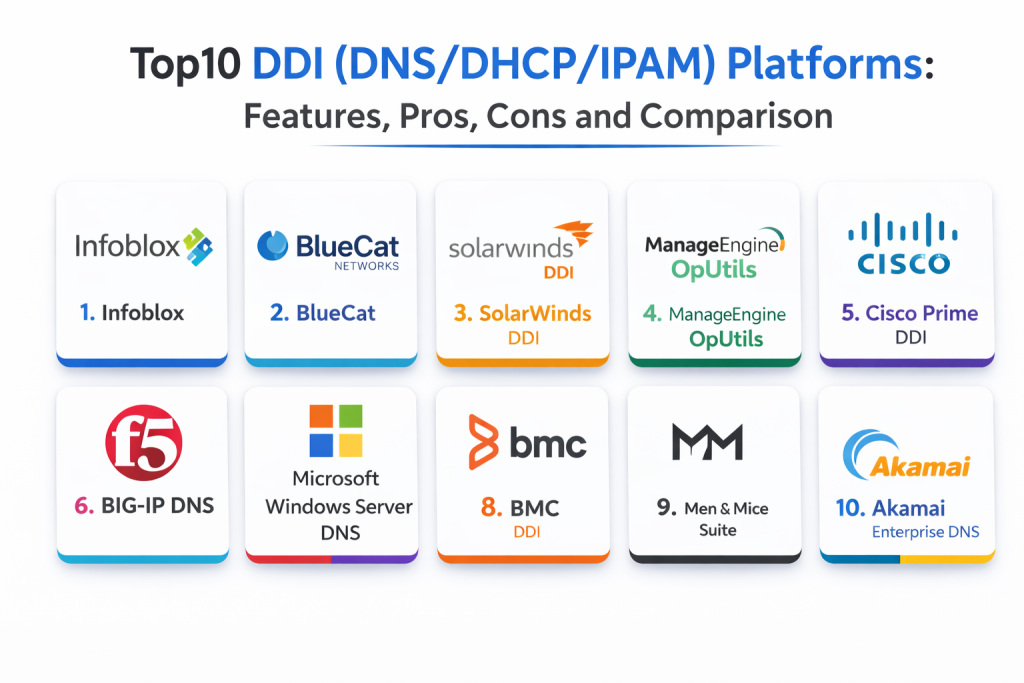
Top 10 DDI (DNS/DHCP/IPAM) Platforms
1 — Infoblox
Infoblox is a leading enterprise-grade DDI platform that provides DNS, DHCP, and IPAM services with a strong focus on automation, security, and scalability. It is widely used for large, complex network environments requiring high availability and advanced reporting features.
Key Features
- Centralized management of DNS, DHCP, and IPAM
- DNSSEC support for enhanced security
- Multi-cloud and hybrid network support
- High availability with automated failover and load balancing
- Real-time reporting and analytics for IP address usage
- Integration with security tools and network management platforms
- Role-based access control (RBAC) for improved security
Pros
- Robust security features including DNSSEC and DDoS protection
- Highly scalable for large, distributed networks
- Strong reporting and auditing for compliance and monitoring
Cons
- Can be expensive for small to medium-sized businesses
- Complex setup and management require specialized knowledge
- Advanced features may be overkill for smaller networks
Platforms / Deployment
- Web
- Cloud / Hybrid
Security & Compliance
- DNSSEC, DDoS protection, encryption: Varies / Not publicly stated
- Compliance certifications: Not publicly stated
Integrations & Ecosystem
- Seamlessly integrates with security and network management tools
- API support for automation and reporting
Support & Community
- Extensive support and resources for enterprise customers
2 — BlueCat Networks
BlueCat Networks offers a comprehensive DDI platform that integrates DNS, DHCP, and IPAM in a centralized solution. It provides network automation, real-time monitoring, and powerful analytics features, making it a popular choice for enterprises.
Key Features
- Real-time monitoring of DNS and DHCP services
- Centralized configuration and policy management
- DNSSEC and DDoS protection for secure resolution
- Cloud-native integration and hybrid network support
- Automated IP address allocation and conflict resolution
- Reporting and audit trails for compliance and security
Pros
- Scalable and robust for enterprise environments
- Strong security and compliance features
- Integration with cloud platforms and other network tools
Cons
- Higher cost for small businesses or SMBs
- Complex setup and configuration for advanced features
- Requires technical expertise for full utilization
Platforms / Deployment
- Web
- Cloud / Hybrid
Security & Compliance
- DNSSEC, DDoS protection, encryption: Varies / Not publicly stated
- Compliance certifications: Not publicly stated
Integrations & Ecosystem
- Integrates with cloud services and enterprise network management tools
- API for advanced configuration and integration
Support & Community
- Extensive enterprise support with training and documentation
3 — SolarWinds DDI
SolarWinds offers a robust DDI solution with a focus on ease of use and affordability. Its platform includes DNS, DHCP, and IPAM management with a user-friendly interface and strong reporting features, making it ideal for mid-sized businesses and SMBs.
Key Features
- Integrated DNS, DHCP, and IPAM management
- Real-time DNS and DHCP performance monitoring
- Customizable alerts and notifications
- Centralized management for improved network visibility
- Reporting and logging for auditing and compliance
Pros
- Easy-to-use interface and setup process
- Affordable pricing for SMBs
- Strong monitoring and alerting capabilities
Cons
- Lacks some advanced features offered by larger platforms
- May not scale well for very large or complex networks
- Security features may require additional configuration for full protection
Platforms / Deployment
- Web
- Self-hosted
Security & Compliance
- Not publicly stated
Integrations & Ecosystem
- Integrates with SolarWinds network management and monitoring tools
- Supports SNMP and API for integration
Support & Community
- Strong support from SolarWinds with active user forums
4 — ManageEngine OpUtils
ManageEngine OpUtils is a comprehensive IP address management and network monitoring tool. It integrates DNS and DHCP management with real-time network monitoring, making it suitable for small to medium-sized businesses.
Key Features
- IP address and subnet management with real-time monitoring
- DNS and DHCP configuration management
- SNMP-based monitoring for network devices
- Advanced reporting for network usage and trends
- Role-based access for user permissions
Pros
- Simple and intuitive user interface
- Strong integration with network monitoring tools
- Affordable for SMBs and mid-market businesses
Cons
- Lacks some advanced DDI features found in larger platforms
- Limited scalability for large enterprise environments
- Requires additional network monitoring tools for full visibility
Platforms / Deployment
- Web
- Self-hosted
Security & Compliance
- Not publicly stated
Integrations & Ecosystem
- Integrates with other ManageEngine network management tools
- SNMP and API support
Support & Community
- Excellent support with comprehensive documentation
5 — Cisco Prime DDI
Cisco Prime DDI is a highly scalable DDI solution designed for large enterprises. It integrates DNS, DHCP, and IPAM with centralized management, providing visibility, control, and security across global networks.
Key Features
- Centralized management of DNS, DHCP, and IPAM
- Advanced security features including DNSSEC and DDoS protection
- Real-time DNS and IP address monitoring
- Cloud and hybrid environment support
- Role-based access control and logging for compliance
Pros
- Seamless integration with Cisco’s network management tools
- Strong security and compliance features
- Scalable and reliable for large enterprises
Cons
- High cost for small to mid-sized businesses
- Requires expertise to configure and manage
- Best suited for Cisco-heavy environments
Platforms / Deployment
- Web
- Cloud / Hybrid
Security & Compliance
- DNSSEC, DDoS protection, encryption: Varies / Not publicly stated
- Compliance certifications: Not publicly stated
Integrations & Ecosystem
- Integrates with Cisco’s broader network management suite
- API support for extended configuration and integration
Support & Community
- Excellent support from Cisco with comprehensive resources
6 — F5 BIG-IP DNS
F5 BIG-IP DNS is a robust DNS management solution that focuses on performance, scalability, and security. It is designed for large enterprises that need to manage high-traffic domains with optimized routing and failover capabilities.
Key Features
- Application-aware DNS traffic management
- DNSSEC and DDoS protection
- Advanced monitoring and reporting for DNS health
- Real-time visibility into DNS queries and traffic patterns
- Multi-cloud and hybrid environment support
Pros
- Excellent scalability and performance for high-traffic environments
- Strong security with DDoS protection and DNSSEC
- Flexible deployment across on-premises and cloud networks
Cons
- High cost for small businesses
- Requires expertise for setup and maintenance
- Primarily focused on DNS, lacks full DDI features
Platforms / Deployment
- Web
- Cloud / Hybrid
Security & Compliance
- DNSSEC, DDoS protection: Varies / Not publicly stated
- Compliance certifications: Not publicly stated
Integrations & Ecosystem
- Integrates with F5’s network security and application delivery tools
- Supports cloud platforms and hybrid configurations
Support & Community
- Excellent enterprise-level support with comprehensive documentation
7 — Microsoft Windows Server DNS
Microsoft Windows Server DNS is a built-in DNS service that provides DNS management and basic DHCP support. It is ideal for businesses already using Windows Server environments and seeking a simple, integrated DNS solution.
Key Features
- Built-in DNS and DHCP management for Windows Server environments
- Easy-to-use interface and integration with Active Directory
- Basic DNS security features such as DNSSEC support
- Customizable forwarding and caching settings
- Integration with Windows-based network services
Pros
- Seamless integration with Microsoft environments
- Simple and easy to manage for small to medium-sized businesses
- Affordable for businesses already using Windows Server
Cons
- Lacks advanced features for larger or more complex networks
- Limited scalability for global or multi-site networks
- Best for small to mid-sized Windows Server environments
Platforms / Deployment
- Windows Server
- Self-hosted
Security & Compliance
- DNSSEC, encryption: Varies / Not publicly stated
- Compliance certifications: Not publicly stated
Integrations & Ecosystem
- Works well within Microsoft-based IT infrastructures
- Limited integrations outside of the Windows ecosystem
Support & Community
- Extensive Microsoft support and community forums
8 — BMC DDI
BMC DDI provides comprehensive DNS, DHCP, and IPAM management with advanced automation and security features. It is designed for large enterprises with complex IT environments and hybrid cloud infrastructures.
Key Features
- Full lifecycle management for DNS, DHCP, and IP addresses
- High availability and disaster recovery for critical services
- Integrated security features including DNSSEC and DDoS protection
- Advanced monitoring, reporting, and analytics
- Cloud and hybrid network support
Pros
- Strong automation for IP address management
- Enterprise-grade security and compliance features
- Scalable for large and hybrid environments
Cons
- High cost for smaller organizations
- Requires technical expertise for full deployment
- May have more features than needed for smaller setups
Platforms / Deployment
- Web
- Cloud / Hybrid
Security & Compliance
- DNSSEC, DDoS protection, encryption: Varies / Not publicly stated
- Compliance certifications: Not publicly stated
Integrations & Ecosystem
- Integrates with other BMC network and security management tools
- API for custom automation and reporting
Support & Community
- Enterprise-level support with comprehensive resources
9 — Men & Mice Suite
Men & Mice Suite offers a flexible and scalable solution for DNS, DHCP, and IPAM management. It is well-suited for large organizations requiring multi-vendor support and complex network configurations.
Key Features
- Multi-vendor support for DNS, DHCP, and IPAM management
- Centralized configuration and policy control
- Real-time monitoring, reporting, and analytics
- Automated IP address allocation and conflict resolution
- DNSSEC and DDoS protection for enhanced security
Pros
- Strong multi-vendor support and flexibility
- Scalable for complex network environments
- Excellent reporting and analytics features
Cons
- Complex setup and configuration for large environments
- May be costly for small to medium-sized businesses
- Some advanced features may require additional configuration
Platforms / Deployment
- Web
- Cloud / Hybrid
Security & Compliance
- DNSSEC, DDoS protection, encryption: Varies / Not publicly stated
- Compliance certifications: Not publicly stated
Integrations & Ecosystem
- Works well across multi-vendor environments
- Supports API-driven automation and policy management
Support & Community
- Strong support for large-scale networks with comprehensive documentation
10 — Akamai Enterprise DNS
Akamai Enterprise DNS offers a secure, scalable, and high-performance DNS management platform with integrated security features such as DDoS protection, DNSSEC, and global traffic routing optimization.
Key Features
- High-performance DNS resolution and routing optimization
- DNSSEC and DDoS protection for secure DNS management
- Real-time monitoring and traffic analysis
- Seamless integration with cloud-based services
- API access for integration with existing infrastructure
Pros
- Excellent performance and scalability for global networks
- Strong security features including DDoS mitigation
- Seamless integration with cloud platforms and services
Cons
- Higher cost compared to entry-level DNS tools
- May be complex to configure for small networks
- Primarily focused on large enterprises and global deployments
Platforms / Deployment
- Web
- Cloud-based
Security & Compliance
- DNSSEC, DDoS protection, encryption: Varies / Not publicly stated
- Compliance certifications: Not publicly stated
Integrations & Ecosystem
- Integrates with cloud environments and third-party security tools
- Supports API integration for automation
Support & Community
- Excellent enterprise support and resources
Comparison Table
| Tool Name | Best For | Platform(s) Supported | Deployment | Standout Feature | Public Rating |
|---|---|---|---|---|---|
| Infoblox | Enterprise-grade DDI | Web / Hybrid | Cloud / Hybrid | Full DDI management | N/A |
| BlueCat Networks | Advanced DNS, DHCP, IPAM | Web / Hybrid | Cloud / Hybrid | Multi-cloud IPAM and security | N/A |
| SolarWinds DDI | SMBs and mid-sized networks | Web | Self-hosted | Easy-to-use DNS and DHCP integration | N/A |
| ManageEngine OpUtils | Real-time IP address tracking | Web | Self-hosted | User-friendly with real-time monitoring | N/A |
| Cisco Prime DDI | Cisco-centric networks | Web / Hybrid | Hybrid | Integration with Cisco networking | N/A |
| F5 BIG-IP DNS | Enterprise-grade DNS | Web | Cloud / Hybrid | High-performance DNS and DDoS protection | N/A |
| Microsoft Windows Server DNS | Windows environments | Windows Server | Self-hosted | Simple DNS management | N/A |
| BMC DDI | Enterprise DDI solution | Web / Hybrid | Cloud / Hybrid | Full DDI lifecycle management | N/A |
| Men & Mice Suite | Multi-vendor DDI management | Web / Hybrid | Cloud / Hybrid | Multi-vendor support | N/A |
| Akamai Enterprise DNS | High-performance DNS | Web | Cloud | Global traffic optimization | N/A |
Evaluation & Scoring of DDI Platforms
Weights: Core features 25%, Ease of use 15%, Integrations & ecosystem 15%, Security & compliance 10%, Performance & reliability 10%, Support & community 10%, Value (price) 15%.
| Tool Name | Core (25%) | Ease (15%) | Integrations (15%) | Security (10%) | Performance (10%) | Support (10%) | Value (15%) | Weighted Total |
|---|---|---|---|---|---|---|---|---|
| Infoblox | 9 | 8 | 9 | 9 | 9 | 9 | 7 | 8.25 |
| BlueCat Networks | 9 | 7 | 9 | 9 | 8 | 8 | 6 | 8.05 |
| SolarWinds DDI | 8 | 8 | 7 | 7 | 8 | 7 | 7 | 7.75 |
| ManageEngine OpUtils | 8 | 9 | 7 | 6 | 7 | 7 | 8 | 7.75 |
| Cisco Prime DDI | 9 | 7 | 8 | 8 | 8 | 8 | 6 | 7.85 |
| F5 BIG-IP DNS | 9 | 6 | 8 | 9 | 9 | 7 | 6 | 8.00 |
| Microsoft Windows Server DNS | 7 | 9 | 6 | 6 | 7 | 6 | 8 | 7.15 |
| BMC DDI | 9 | 7 | 8 | 9 | 8 | 9 | 7 | 8.10 |
| Men & Mice Suite | 9 | 7 | 9 | 8 | 8 | 7 | 6 | 8.05 |
| Akamai Enterprise DNS | 9 | 6 | 8 | 9 | 9 | 7 | 6 | 8.00 |
Which DDI Platform Is Right for You
Solo / Freelancer
For smaller environments with minimal DNS or IP address management needs, Microsoft Windows Server DNS or ManageEngine OpUtils offer affordable and simple solutions.
SMB
For small to medium-sized businesses, SolarWinds DDI or F5 BIG-IP DNS provide strong functionality with easy deployment and real-time monitoring.
Mid-Market
For mid-sized businesses, Cisco Prime DDI and BMC DDI are ideal for more complex network environments with multi-site requirements.
Enterprise
Enterprises with extensive networks and global reach should consider Infoblox and BlueCat Networks, which offer scalability, advanced security features, and robust reporting.
Budget vs Premium
Microsoft Windows Server DNS and SolarWinds DDI are great cost-effective solutions, while Infoblox and BlueCat Networks are premium options for enterprises requiring advanced DDI management and security.
Feature Depth vs Ease of Use
For ease of use, ManageEngine OpUtils and SolarWinds DDI offer user-friendly interfaces. For deeper functionality, Infoblox and Cisco Prime DDI provide comprehensive DDI solutions.
Integrations & Scalability
If you need seamless integration and scalability, Infoblox and Men & Mice Suite offer excellent support for multi-cloud, hybrid, and large-scale enterprise environments.
Security & Compliance Needs
Infoblox and F5 BIG-IP DNS provide strong security features such as DNSSEC, DDoS protection, and encryption, making them ideal for highly regulated environments.
Frequently Asked Questions
- What is DDI?
DDI stands for DNS, DHCP, and IP Address Management. It integrates these three network services into a unified platform to streamline management, enhance security, and improve network efficiency. - Why do I need a DDI platform?
A DDI platform simplifies DNS, DHCP, and IP address management, reduces configuration errors, improves network visibility, and enhances security, making it essential for growing networks. - How do DDI platforms enhance network security?
DDI platforms help prevent DNS attacks, enforce DNSSEC, and provide segmentation and monitoring to secure network configurations and access. - Do DDI tools integrate with cloud networks?
Yes, many DDI tools, including Infoblox and BlueCat Networks, integrate seamlessly with cloud environments, enabling hybrid and multi-cloud network management. - Can DDI tools automate IP address allocation?
Yes, DDI platforms automatically allocate IP addresses based on predefined policies, reducing manual errors and optimizing network resources. - What is DNSSEC?
DNSSEC (Domain Name System Security Extensions) is a security protocol that protects against DNS attacks by ensuring that the data received from a DNS query has not been tampered with. - Are there any open-source DDI tools?
Yes, there are open-source solutions like GestióIP and phpIPAM, which are ideal for smaller networks with limited IP address management needs. - How do I choose the right DDI platform?
Consider factors like scalability, security features, cloud integration, ease of use, and cost when selecting a DDI platform for your network. - Can DDI platforms improve network performance?
Yes, DDI platforms optimize DNS and DHCP traffic, reduce downtime, and enhance performance by ensuring IP address utilization is efficient. - Are these tools suitable for large-scale enterprises?
Yes, platforms like Infoblox and Cisco Prime DDI are specifically designed to scale with large, complex networks, offering robust features for enterprise use.
Conclusion
DDI platforms are essential for managing the critical network services of DNS, DHCP, and IPAM at scale. Whether you’re managing a small network or a global enterprise, the right platform can significantly improve performance, enhance security, and simplify network management. By evaluating the scalability, security features, ease of use, and integration capabilities of these tools, you can select the best solution to meet your organization’s needs and ensure a reliable, efficient network infrastructure. Effective management of DNS, DHCP, and IP addresses is essential for any organization, and DDI (DNS, DHCP, IPAM) platforms provide a unified, streamlined solution to handle these complex tasks. From large enterprises requiring high scalability and security features to SMBs seeking ease of use and cost-effectiveness, there are DDI tools suited for every need. Solutions like Infoblox and BlueCat Networks provide comprehensive capabilities for managing large, multi-site environments, while tools like SolarWinds DDI and ManageEngine OpUtils offer more straightforward options for smaller networks.

Best Cardiac Hospitals Near You
Discover top heart hospitals, cardiology centers & cardiac care services by city.
Advanced Heart Care • Trusted Hospitals • Expert Teams
View Best Hospitals