Introduction
Decentralized Identity (DID) is a transformative approach to digital identity that returns ownership of personal data to the individual. In the traditional digital landscape, our identities are fragmented across hundreds of centralized databases owned by social media giants, banks, and government agencies. This centralized model creates massive honeypots for hackers and forces users to rely on third parties to “prove” who they are. Decentralized Identity, often built on blockchain or distributed ledger technology, allows users to generate and control their own unique identifiers and share only the specific data necessary for a transaction without a middleman.
As we navigate the complexities of the modern web, the demand for privacy-preserving and self-sovereign identity solutions has reached a critical point. DID platforms provide the infrastructure to issue, hold, and verify digital credentials—such as a driver’s license, a university degree, or an employment record—in a way that is cryptographically secure and globally interoperable. This technology is becoming the foundation for a more secure internet where trust is established through mathematics rather than corporate permission.
Best for: Security engineers, blockchain developers, enterprise architects, and compliance officers in finance, healthcare, and government who need to implement high-trust, privacy-first authentication systems.
Not ideal for: Simple applications where traditional social login (OAuth) provides sufficient security and user convenience without the need for blockchain infrastructure.
Key Trends in Decentralized Identity Platforms
- Verifiable Credentials (VCs): The shift toward standardized digital “cards” that can be instantly verified by any party without contacting the original issuer.
- Zero-Knowledge Proofs (ZKP): Allowing users to prove a fact (like being over 21) without revealing the actual underlying data (like a birth date).
- Mobile-First Wallets: A massive push toward “Identity Wallets” on smartphones that act as a digital pocket for all personal credentials and private keys.
- Interoperability Standards: Broad adoption of W3C standards to ensure that an identity created on one platform can be recognized and used across different ecosystems.
- Biometric Integration: Combining decentralized identifiers with hardware-based biometrics (like FaceID) to ensure that only the true owner can authorize a credential share.
- Enterprise Adoption in Supply Chain: Using DIDs to verify the credentials and certifications of suppliers and individual products in real-time.
- Governance Frameworks: The development of legal and technical rules that define who can issue certain types of high-stakes credentials.
- Selective Disclosure: Giving users the ability to choose exactly which attributes of their identity are shared during a digital “handshake.”
How We Selected These Tools
- Adherence to Standards: We prioritized platforms that strictly follow the W3C Decentralized Identifier and Verifiable Credential specifications.
- Ecosystem Maturity: Each tool was evaluated based on the number of active projects, developers, and real-world implementations currently in production.
- Security Architecture: We looked for platforms that utilize robust cryptographic methods and offer secure key management solutions.
- Ease of Integration: Priority was given to platforms that provide comprehensive SDKs and APIs for developers to add DID functionality to existing apps.
- Blockchain Agnostic Options: We selected tools that can work across multiple blockchains or even in “keri” (key event receipt infrastructure) environments.
- User Experience Focus: The selection includes platforms that provide intuitive wallet interfaces for end-users.
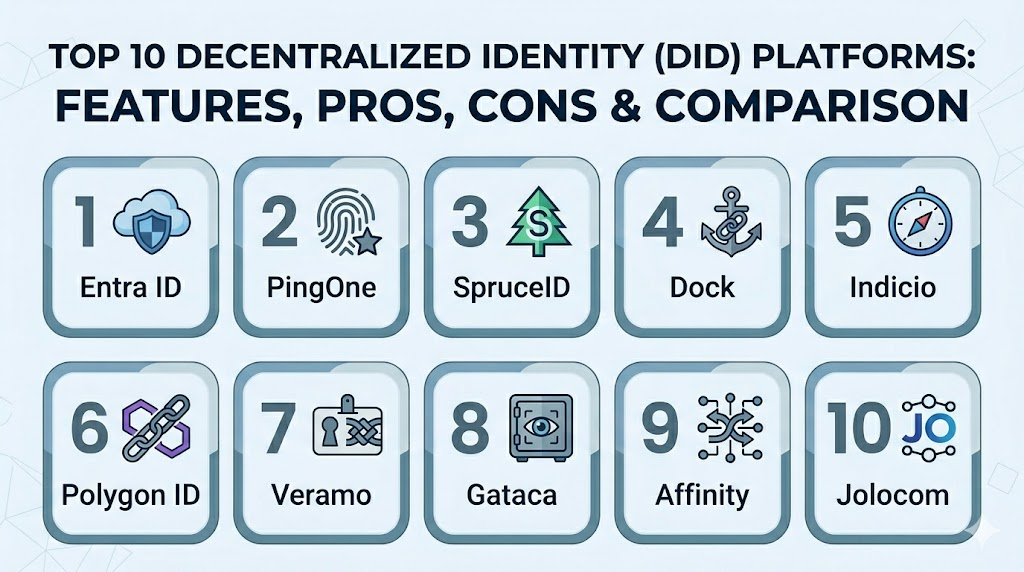
Top 10 Decentralized Identity (DID) Platforms
1. Microsoft Entra Verified ID
Part of the broader Microsoft Entra family, this platform allows organizations to issue and verify digital identity credentials based on open standards. It leverages the ION network, a Layer 2 decentralized identity network built on top of the Bitcoin blockchain.
Key Features
- Easy-to-use wizard for creating and issuing custom verifiable credentials.
- Integration with the Microsoft Authenticator app for secure credential storage.
- Automated verification workflows that can be embedded into business applications.
- Support for the Sidetree protocol for scalable decentralized identifiers.
- Deep integration with Azure Active Directory for enterprise user management.
Pros
- Seamlessly connects with the existing Microsoft 365 and Azure environments.
- High level of enterprise support and comprehensive documentation.
Cons
- Requires an Azure subscription for full management capabilities.
- Best suited for Microsoft-centric organizations rather than pure open-source projects.
Platforms / Deployment
Windows / macOS / Linux / iOS / Android
Cloud
Security & Compliance
Integration with Azure Key Vault and MFA.
SOC 2 / ISO 27001 compliant.
Integrations & Ecosystem
Integrates perfectly with Microsoft Intune, Azure AD, and the broader Microsoft security stack.
Support & Community
Extensive enterprise support through Microsoft’s global network of engineers and partners.
2. Ping Identity (PingOne DaVinci)
Ping Identity has invested heavily in decentralized identity through the acquisition of ShoCard. Their platform focuses on bringing self-sovereign identity to the enterprise workforce and customer base.
Key Features
- No-code orchestration engine (DaVinci) for designing identity journeys.
- Digital wallet SDK for building custom branded identity wallets.
- Privacy-first credential exchange that minimizes data exposure.
- Support for a wide range of decentralized identity standards.
- Capability to issue “Personal Identity” cards to employees and customers.
Pros
- Excellent for large enterprises looking to modernize their customer identity management.
- Very strong focus on the user journey and visual workflow design.
Cons
- Can be an expensive “premium” solution for smaller startups.
- The orchestration layer adds complexity that may not be needed for simple projects.
Platforms / Deployment
Windows / macOS / Linux / Mobile SDKs
Cloud / Hybrid
Security & Compliance
FIPS 140-2 compliant hardware security modules support.
ISO 27001 / SOC 2 Type 2 compliant.
Integrations & Ecosystem
Integrates with hundreds of SaaS applications and existing identity providers.
Support & Community
Professional enterprise support and a large community of identity experts.
3. SpruceID
Spruce provides a suite of open-source tools that allow users to control their data across the web. They are well-known for “Sign-In with Ethereum” and their work on cross-chain identity.
Key Features
- Kepler for decentralized storage of user-controlled data.
- SpruceKit SDK for implementing decentralized identity in any application.
- Support for “Sign-In with Ethereum” (EIP-4361) for web3 authentication.
- Cross-platform verifiable credential issuing and verification.
- DIDkit for building identity functionality into Rust, WASM, and mobile apps.
Pros
- Entirely open-source and built on a foundation of user privacy.
- Excellent for developers working in the Ethereum and web3 ecosystems.
Cons
- Requires more technical knowledge to implement than “turnkey” enterprise solutions.
- The decentralized storage components are still evolving.
Platforms / Deployment
Windows / macOS / Linux / Mobile
Local / Cloud / Edge
Security & Compliance
Uses industry-standard cryptographic libraries and decentralized protocols.
Not publicly stated.
Integrations & Ecosystem
Deeply integrated with the Ethereum community and various decentralized file systems.
Support & Community
Very active developer community on Discord and GitHub.
4. Dock
Dock is a specialized blockchain platform designed specifically for high-performance decentralized identity and verifiable credentials. It provides a simple API for companies to issue and verify credentials.
Key Features
- Dedicated Substrate-based blockchain for identity records.
- Dock Certs API for issuing credentials without managing blockchain infrastructure.
- Support for specialized credential types like degrees and professional licenses.
- Built-in tools for credential revocation and expiration.
- Mobile wallet app for users to manage their digital certificates.
Pros
- Focuses specifically on the “Credential Lifecycle,” making it very easy to use.
- Lower transaction costs compared to general-purpose blockchains.
Cons
- Relies on the Dock-specific blockchain for its core functionality.
- Smaller overall developer ecosystem compared to Microsoft or Ping.
Platforms / Deployment
Linux / macOS
Cloud / Hybrid
Security & Compliance
Blockchain-based immutability and cryptographic proof systems.
Not publicly stated.
Integrations & Ecosystem
Provides libraries for various programming languages to connect to their API.
Support & Community
Growing community of educators and professional credential issuers.
5. Indicio
Indicio focuses on providing “Hyperledger Indy” based infrastructure. They offer a comprehensive suite of tools for building and deploying decentralized identity networks for the enterprise.
Key Features
- Indicio Proven for fast deployment of identity ecosystems.
- Support for the Aries and Indy open-source protocols.
- Professional network monitoring and governance tools.
- Interoperable with other networks using the same open standards.
- Mobile wallet development kits for rapid prototyping.
Pros
- Highly specialized in the “Hyperledger” stack, which is the enterprise standard.
- Excellent for government and highly regulated industrial projects.
Cons
- The Hyperledger Indy stack is powerful but very complex to manage.
- Requires significant understanding of the “Trust Over IP” stack.
Platforms / Deployment
Linux
Local / Cloud / Hybrid
Security & Compliance
High-grade cryptographic security and specialized network governance.
Not publicly stated.
Integrations & Ecosystem
Strong ties to the Linux Foundation and the Hyperledger project.
Support & Community
Professional consulting and support services for large-scale implementations.
6. Polygon ID
Leveraging the power of zero-knowledge proofs, Polygon ID allows for secure and private identity verification. It is built to be a core component of the Polygon and broader Ethereum ecosystem.
Key Features
- Powered by Iden3 protocol and Circom zero-knowledge circuits.
- Allows for “Private Proofs” where the user doesn’t reveal their personal data.
- Developer-friendly SDKs for mobile and web integration.
- On-chain verification for decentralized finance (DeFi) applications.
- Mobile wallet for managing private identity claims.
Pros
- The leader in using Zero-Knowledge technology for privacy-first identity.
- Very low cost and high speed due to Polygon’s Layer 2 scaling.
Cons
- Focused primarily on the blockchain and web3 space.
- The zero-knowledge aspect can be difficult for non-technical teams to grasp.
Platforms / Deployment
Linux / macOS / Mobile SDKs
Cloud / Edge
Security & Compliance
Cryptographic zero-knowledge proofs for data privacy.
Not publicly stated.
Integrations & Ecosystem
Deeply integrated with the Polygon network and various DeFi protocols.
Support & Community
Massive community of web3 developers and active support through Polygon’s channels.
7. Veramo
Veramo is a flexible and highly modular JavaScript/TypeScript framework for decentralized identity. It is designed to act as a “mediator” between different DID methods and blockchains.
Key Features
- Plugin-based architecture that allows you to swap out blockchains easily.
- Support for multiple DID methods (Ethr, Web, Key, Ion).
- Built-in database for storing messages and credentials locally.
- Capability to act as a server, a CLI, or a mobile agent.
- Strong focus on developer experience and modern web standards.
Pros
- The most flexible framework for building custom identity apps.
- Allows developers to avoid “vendor lock-in” by supporting multiple networks.
Cons
- It is a framework, not a “finished product,” requiring development work.
- No built-in enterprise “management console” out of the box.
Platforms / Deployment
Windows / macOS / Linux / Mobile
Local / Cloud / Edge
Security & Compliance
Security depends on the specific plugins and environment used.
Not publicly stated.
Integrations & Ecosystem
Compatible with any JavaScript environment, making it ideal for web developers.
Support & Community
Active open-source community with high engagement on GitHub.
8. Gataca
Gataca is a European-based identity platform that provides an end-to-end solution for issuing and verifying digital credentials, with a strong focus on GDPR compliance.
Key Features
- Gataca Studio for managing the credential issuing lifecycle.
- Gataca Wallet for a user-friendly mobile identity experience.
- Single-sign-on (SSO) integration for decentralized identity.
- Support for the EBSI (European Blockchain Services Infrastructure) standards.
- Focus on “one-click” onboarding for corporate and government services.
Pros
- Strongest adherence to European data privacy and identity standards.
- Very clean and professional user interface for the digital wallet.
Cons
- Less market presence in the North American enterprise sector.
- May not be as flexible for “pure” web3/DeFi projects as other platforms.
Platforms / Deployment
Windows / macOS / Linux / Mobile
Cloud / Hybrid
Security & Compliance
Strict GDPR compliance and European security standards.
ISO 27001 / SOC 2 (Not publicly stated but follows guidelines).
Integrations & Ecosystem
Integrates with standard enterprise identity systems via OIDC and SAML.
Support & Community
Professional support for European public sector and private enterprise.
9. Affinity (by Affinidi)
Affinity provides a comprehensive suite of tools for decentralized identity, including a specialized focus on the travel and healthcare sectors.
Key Features
- Affinidi Login for a passwordless, decentralized login experience.
- Verifiable Credential Manager for large-scale credential programs.
- Support for high-trust environments like airport and hospital data checks.
- Developer-friendly SDKs for web and mobile integration.
- Strong focus on “data portability” between different services.
Pros
- Proven at scale in challenging real-world environments like international travel.
- Excellent balance between enterprise features and decentralized principles.
Cons
- Can feel complex for small, simple web applications.
- Pricing for high-volume credential issuing can scale quickly.
Platforms / Deployment
Windows / macOS / Linux / Mobile
Cloud / Hybrid
Security & Compliance
High-grade encryption and secure data handling for sensitive records.
Not publicly stated.
Integrations & Ecosystem
Strong partnerships in the aviation, healthcare, and education sectors.
Support & Community
Professional enterprise support and a dedicated developer portal.
10. Jolocom
Jolocom is a Berlin-based pioneer in decentralized identity, offering a completely open-source and modular approach to building digital identity solutions.
Key Features
- Jolocom SDK for building self-sovereign identity into any app.
- The Jolocom SmartWallet for a simple user experience.
- Support for a wide variety of DID methods and storage options.
- Strong focus on interoperability and W3C standards.
- Capability to build completely offline identity verification systems.
Pros
- Extremely transparent and dedicated to pure decentralized principles.
- Small, lightweight footprint ideal for edge devices and IoT.
Cons
- Smaller corporate team compared to giants like Microsoft or Ping.
- Limited built-in enterprise analytics and reporting.
Platforms / Deployment
Windows / macOS / Linux / Mobile
Local / Cloud / Edge
Security & Compliance
Security-audited open-source libraries.
Not publicly stated.
Integrations & Ecosystem
Active participant in the DIF (Decentralized Identity Foundation) and W3C groups.
Support & Community
Community support via GitHub and a passionate group of privacy advocates.
Comparison Table
| Tool Name | Best For | Platform(s) Supported | Deployment | Standout Feature | Public Rating |
| 1. Entra ID | Microsoft Enterprises | Win, Mac, Linux, Mobile | Cloud | ION / Bitcoin Layer 2 | N/A |
| 2. PingOne | Customer Identity | Win, Mac, Linux, Mobile | Cloud | No-code Orchestration | N/A |
| 3. SpruceID | Web3 / Ethereum | Win, Mac, Linux, Mobile | Local/Cloud | Sign-In with Ethereum | N/A |
| 4. Dock | Education/Certs | Linux, Mac | Hybrid | Identity Blockchain | N/A |
| 5. Indicio | Hyperledger Projects | Linux | Local/Cloud | Professional Governance | N/A |
| 6. Polygon ID | Private Web3 | Linux, Mac, Mobile | Cloud/Edge | Zero-Knowledge Proofs | N/A |
| 7. Veramo | Custom Devs | Win, Mac, Linux, Mobile | Local/Cloud | Modular Plugin Architecture | N/A |
| 8. Gataca | EU Compliance | Win, Mac, Linux, Mobile | Cloud | EBSI Standards | N/A |
| 9. Affinity | Travel/Healthcare | Win, Mac, Linux, Mobile | Cloud | Data Portability | N/A |
| 10. Jolocom | Open Source Purists | Win, Mac, Linux, Mobile | Local/Edge | Lightweight Footprint | N/A |
Evaluation & Scoring
| Tool Name | Core (25%) | Ease (15%) | Integrations (15%) | Security (10%) | Perf (10%) | Support (10%) | Value (15%) | Total |
| 1. Entra ID | 10 | 8 | 10 | 9 | 8 | 10 | 8 | 8.95 |
| 2. PingOne | 9 | 9 | 9 | 9 | 8 | 9 | 7 | 8.45 |
| 3. SpruceID | 10 | 5 | 8 | 10 | 9 | 8 | 10 | 8.35 |
| 4. Dock | 8 | 8 | 7 | 8 | 8 | 7 | 9 | 7.85 |
| 5. Indicio | 9 | 5 | 8 | 9 | 8 | 9 | 7 | 7.75 |
| 6. Polygon ID | 9 | 6 | 7 | 10 | 9 | 7 | 9 | 8.05 |
| 7. Veramo | 10 | 6 | 9 | 9 | 9 | 7 | 10 | 8.60 |
| 8. Gataca | 8 | 8 | 8 | 9 | 8 | 8 | 8 | 8.15 |
| 9. Affinity | 9 | 7 | 8 | 9 | 8 | 8 | 7 | 7.90 |
| 10. Jolocom | 8 | 7 | 7 | 8 | 9 | 7 | 9 | 7.80 |
The scoring above reflects a balance between enterprise readiness and technical innovation. Microsoft Entra ID and PingOne score highly due to their incredible ease of use and ability to scale within existing corporate environments. Veramo and SpruceID score exceptionally well for developers because of their modularity and lack of vendor lock-in. Meanwhile, Polygon ID leads the way in “Security” and privacy through its advanced use of Zero-Knowledge Proofs, which is becoming the gold standard for decentralized verification.
Which Decentralized Identity Platform Is Right for You?
Solo / Freelancer
For a developer looking to build a privacy-first side project, Veramo or Jolocom are excellent choices. They are free, open-source, and give you complete control over how you want to handle identity without being tied to a specific corporate cloud.
SMB
Small businesses should look at Dock or Gataca. These platforms provide a more “ready-made” solution that doesn’t require a massive engineering team to implement, allowing you to issue digital certificates or verify user IDs with minimal friction.
Mid-Market
Organizations looking to implement decentralized identity across a specific sector (like healthcare or travel) should consider Affinity or Polygon ID. These platforms provide a mix of high-security tools and sector-specific knowledge that can speed up development.
Enterprise
For large-scale corporations already using the Microsoft stack, Microsoft Entra Verified ID is the logical choice. If your organization uses a diverse set of identity tools and needs a high-level orchestration layer, PingOne is the superior enterprise alternative.
Budget vs Premium
Veramo, SpruceID, and Polygon ID are the leaders for budget-conscious projects, as they are largely open-source and free to develop on. Ping Identity and Microsoft are premium solutions that charge for the convenience of management and enterprise support.
Feature Depth vs Ease of Use
Microsoft Entra and PingOne are the easiest to use but are more “closed” ecosystems. Veramo and Indicio offer incredible depth and customization but require a dedicated team of engineers to navigate the complexity of the identity protocols.
Integrations & Scalability
Microsoft and Polygon ID offer the best scalability for millions of users. If you need to integrate with legacy enterprise systems, the Ping Identity and Gataca platforms provide the most seamless transition.
Security & Compliance Needs
For the highest level of data privacy, Polygon ID is the winner due to Zero-Knowledge Proofs. For organizations that need to meet strict European regulations, Gataca and Indicio are the most compliant-ready platforms.
Frequently Asked Questions (FAQs)
1. What is a DID?
A Decentralized Identifier (DID) is a new type of globally unique identifier that does not require a centralized registration authority because it is cryptographically generated and stored on a distributed network.
2. Is decentralized identity more secure than traditional login?
Yes, because it eliminates central databases (honeypots) that hackers target and gives the user control over their private keys, meaning no one can “log in” as them without their physical device.
3. Does DID use a blockchain?
Most platforms use a blockchain to store the public key and status of an identity, but the actual personal data of the user is almost never stored on the blockchain itself for privacy reasons.
4. What are Verifiable Credentials?
They are digital versions of physical documents (like a passport) that are cryptographically signed by an issuer so that a third party can instantly verify they are authentic and haven’t been tampered with.
5. Can I lose my identity if I lose my phone?
Identity platforms use “Recovery Phrases” or “Social Recovery” methods that allow you to move your identity to a new device if your original one is lost or stolen.
6. Is DID only for individuals?
No, decentralized identifiers can be created for organizations, IoT devices, and even physical products to verify their origin and ownership history.
7. How does Zero-Knowledge Proof (ZKP) work?
ZKP is a mathematical method where one party can prove to another that they know a specific piece of information without actually revealing that information itself.
8. Can DID replace my physical passport?
While the technology exists, it requires governments to officially issue and recognize these digital credentials at border crossings, which is a process that is currently in pilot stages in many countries.
9. Is this technology compliant with GDPR?
Yes, decentralized identity is actually more GDPR-friendly than centralized systems because it follows the “data minimization” principle and gives users the “right to be forgotten” by keeping data in their own hands.
10. Do users need to pay “gas fees” to use their identity?
It depends on the platform. Some use Layer 2 networks (like ION or Polygon) to make costs negligible or free for the end-user, while others are entirely off-chain for daily use.
Conclusion
Decentralized Identity is the key to unlocking a more private, secure, and user-centric digital world. By removing the middleman from our digital interactions, we can eliminate the constant threat of data breaches and regain control over our personal narratives. The platforms listed here represent the absolute cutting edge of this movement, ranging from massive enterprise ecosystems to modular open-source frameworks. The right choice for your organization depends on your current technical stack, your budget, and the specific level of privacy your users require. As we move toward a decentralized future, implementing a DID strategy today is the best way to prepare for the security challenges of tomorrow.

Best Cardiac Hospitals Near You
Discover top heart hospitals, cardiology centers & cardiac care services by city.
Advanced Heart Care • Trusted Hospitals • Expert Teams
View Best Hospitals