Introduction
Device fingerprinting has become a critical layer in the modern cybersecurity and fraud prevention stack. Unlike traditional tracking methods like cookies, which are easily cleared or blocked, device fingerprinting collects a diverse set of signals—such as browser version, operating system, screen resolution, installed fonts, and hardware configurations—to create a unique digital “identifier” for a specific device. In an era where sophisticated bot attacks and account takeovers are rampant, the ability to recognize a returning device with high precision, even when the user is attempting to hide their identity, is essential for maintaining the integrity of digital platforms.
The shift toward privacy-first browsing and the decline of third-party cookies have pushed fingerprinting technology to become more advanced. Modern tools now utilize artificial intelligence and machine learning to account for “fingerprint drift,” where small updates to a user’s software might otherwise change their digital ID. This technology is now a standard requirement for financial services, e-commerce retailers, and any organization that must balance a frictionless user experience with the need to detect high-risk anomalies in real-time.
Best for: Fraud prevention teams, security engineers, and digital marketers who need to distinguish between legitimate users and malicious bots or multi-accounting attackers.
Not ideal for: Simple personal blogs or basic informational websites where user identity verification is not a security or business requirement.
Key Trends in Device Fingerprinting Tools
- Server-Side Fingerprinting: A move toward collecting device signals on the server rather than the client to bypass browser-based privacy protections and ad-blockers.
- AI-Driven ID Persistence: Using machine learning to link evolving device attributes back to a single stable ID, even after software updates or setting changes.
- Behavioral Biometrics Integration: Combining hardware signals with user behavior patterns—like typing speed or mouse movements—to increase identification accuracy.
- Privacy-Safe Identification: Developing methods that identify devices for security purposes without infringing on personal privacy regulations like GDPR or CCPA.
- Anti-Spoofing Detection: Advanced detection of virtual machines, emulators, and “headless” browsers used by attackers to mask their true hardware.
- Network Signal Analysis: Incorporating deep packet inspection and TCP/IP stack fingerprinting to identify the underlying network origin of a request.
- Cross-Platform Linking: The ability to associate a user’s mobile app fingerprint with their desktop browser fingerprint for a unified security view.
- Frictionless Authentication: Using a trusted device fingerprint as a “possession factor” to reduce the need for intrusive multi-factor authentication prompts.
How We Selected These Tools
- Accuracy and Stability: We prioritized tools known for maintaining a high “stickiness” of IDs over long periods and through device updates.
- Resistance to Tampering: Each tool was evaluated on its ability to detect and bypass common spoofing techniques like VPNs, proxies, and incognito modes.
- Ease of Integration: We looked for platforms that offer simple SDKs and APIs that can be integrated into existing web and mobile applications quickly.
- Real-Time Processing: Priority was given to tools that can generate a fingerprint and return a risk score in milliseconds to avoid slowing down the user experience.
- Global Infrastructure: We selected tools backed by global networks that can handle high-velocity traffic and provide low-latency responses worldwide.
- Compliance Alignment: The selection includes tools that provide the transparency needed to remain compliant with evolving global data privacy laws.
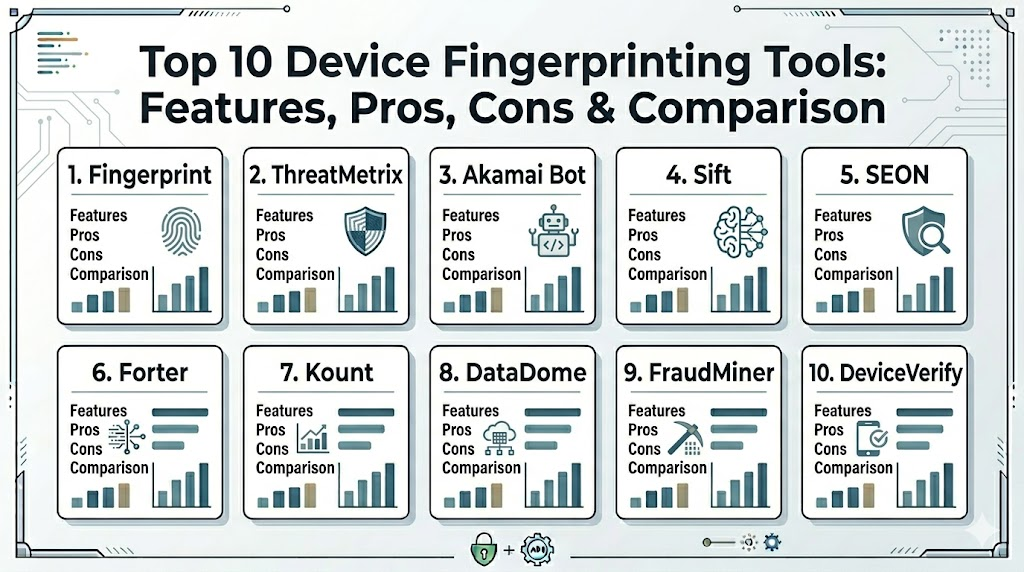
Top 10 Device Fingerprinting Tools
1. Fingerprint (formerly FingerprintJS)
Fingerprint is widely considered the industry leader in high-accuracy device identification. It combines browser signals, hardware attributes, and server-side analysis to provide a 99.5% accurate visitor identifier that persists even when users clear their cache.
Key Features
- High-accuracy identification that works in incognito and private browsing modes.
- Server-side API that prevents client-side tampering or blocking.
- Bot detection capabilities to identify automated scripts and scrapers.
- Smart signals that detect VPNs, browser spoofing, and virtual machines.
- Support for web, Android, and iOS platforms with unified IDs.
Pros
- Extremely high accuracy and stability compared to open-source alternatives.
- Easy-to-use dashboard for analyzing visitor patterns and risk.
Cons
- The pro version can become expensive for high-traffic websites.
- Open-source version lacks the advanced anti-spoofing features of the enterprise tier.
Platforms / Deployment
Web / iOS / Android
Cloud
Security & Compliance
SOC 2 Type II, GDPR, and CCPA compliant.
MFA and RBAC support for dashboard access.
Integrations & Ecosystem
Integrates with major web frameworks like React, Vue, and Angular, as well as backend languages like Python, Go, and Node.js.
Support & Community
Professional enterprise support with dedicated slack channels and a very active open-source community.
2. ThreatMetrix (LexisNexis Risk Solutions)
ThreatMetrix is an enterprise-grade solution that uses a global “Digital Identity Network” to identify devices and assess risk across billions of transactions. It is a staple in the banking and insurance sectors.
Key Features
- Access to a massive global network of anonymized digital identities.
- Deep analysis of connection speed, proxy usage, and location anomalies.
- Behavioral biometrics that analyze how a user interacts with their device.
- Real-time policy engine for automated decision-making.
- Detection of “low and slow” attacks and botnets.
Pros
- Unrivaled global data pool for recognizing known fraudulent devices.
- Highly customizable risk scoring based on specific industry needs.
Cons
- Complex implementation process that requires significant technical resources.
- Interface and reporting can feel dated compared to modern SaaS tools.
Platforms / Deployment
Web / Mobile (iOS & Android)
Hybrid
Security & Compliance
ISO 27001 and SOC 2 compliant.
Global data residency support.
Integrations & Ecosystem
Deeply integrated with the LexisNexis Risk Solutions suite and enterprise ERP/CRM systems.
Support & Community
Full enterprise support with dedicated account managers and technical consultants.
3. Akamai Bot Manager
Part of Akamai’s broader security suite, Bot Manager uses advanced fingerprinting to distinguish between “good” bots (like search engines) and malicious bots trying to perform credential stuffing or scraping.
Key Features
- Advanced telemetry collection from the edge of the network.
- Detection of headless browsers and browser automation tools.
- Machine learning models that adapt to changing bot behaviors.
- Integration with Akamai’s global CDN for low-latency detection.
- Granular control over how different categories of bots are handled.
Pros
- Exceptional at stopping high-volume automated attacks at the network edge.
- Detailed visibility into the types of automated traffic hitting your site.
Cons
- Only available to customers already using or moving to Akamai’s platform.
- Configuration requires specialized knowledge of the Akamai ecosystem.
Platforms / Deployment
Web / Mobile
Cloud (Edge)
Security & Compliance
Enterprise-grade security certifications and global compliance standards.
Not publicly stated.
Integrations & Ecosystem
Works seamlessly with Akamai’s Web Application Firewall (WAF) and Image Manager.
Support & Community
24/7 global SOC support and extensive technical documentation.
4. Sift (formerly Sift Science)
Sift is a modern fraud prevention platform that uses device fingerprinting as a core component of its Digital Trust & Safety suite. It is popular among fast-growing e-commerce and fintech companies.
Key Features
- Real-time device ID generation and cross-customer linking.
- Detection of multiple accounts being used on a single device.
- Automated workflows that trigger based on device risk scores.
- Visual “Explorer” tool to investigate connections between fraudulent users.
- Support for mobile app-specific signals like battery level and accelerometer data.
Pros
- Very intuitive and user-friendly administrative console.
- Excellent at detecting complex account takeover (ATO) patterns.
Cons
- Pricing is based on volume, which can scale rapidly.
- Some advanced features require the full Sift suite subscription.
Platforms / Deployment
Web / iOS / Android
Cloud
Security & Compliance
SOC 2 compliant and focused on consumer privacy standards.
Not publicly stated.
Integrations & Ecosystem
Strong integrations with Shopify, Salesforce, and various payment gateways.
Support & Community
Good technical documentation and a responsive support team for enterprise clients.
5. SEON
SEON provides a modular fraud detection tool that includes a powerful device fingerprinting module. It is known for its “data enrichment” capabilities, checking social media and email signals alongside hardware.
Key Features
- Collection of over 500 parameters to create a unique device profile.
- Detection of browser toolbars, plugins, and incognito mode.
- Canvas and Audio fingerprinting to bypass standard blocking.
- Real-time lookup of IP reputation and proxy/VPN status.
- Modular API that allows you to use only the fingerprinting component.
Pros
- Very fast integration with simple, modern REST APIs.
- Affordable pricing tiers for mid-market and growing companies.
Cons
- Fingerprint stability is good but may not reach the 99%+ levels of Fingerprint.
- Reporting is less detailed than some high-end enterprise competitors.
Platforms / Deployment
Web / iOS / Android
Cloud
Security & Compliance
GDPR compliant with a strong focus on data minimization.
Not publicly stated.
Integrations & Ecosystem
Integrates with popular platforms like Zapier, Magento, and various CRM tools.
Support & Community
Active community and direct access to developers for technical support.
6. Forter
Forter is an automated fraud prevention platform for e-commerce that uses device fingerprinting to guarantee transactions. They are unique in offering “chargeback protection” based on their identity analysis.
Key Features
- Fully automated decisioning—no manual review required.
- Identity linking across a vast network of global retailers.
- Detection of sophisticated bot-driven checkout attacks.
- Deep analysis of mobile device hardware and software versions.
- Real-time monitoring of account creation and login attempts.
Pros
- Removes the burden of fraud review from your internal team.
- High accuracy in identifying legitimate customers to reduce false declines.
Cons
- Can be expensive as they often take a percentage of transaction volume.
- “Black box” decision-making can be frustrating for some security teams.
Platforms / Deployment
Web / Mobile
Cloud
Security & Compliance
PCI DSS Level 1 and SOC 2 compliant.
Not publicly stated.
Integrations & Ecosystem
Standard integrations with high-end e-commerce platforms and payment processors.
Support & Community
Premium support with a focus on maximizing approval rates for retailers.
7. Kount (An Equifax Company)
Kount provides an AI-driven fraud protection platform that uses “Identity Trust Global Network” to analyze device signals and historical data to prevent fraud.
Key Features
- Device-specific identifiers that track behavior over time.
- Detection of location spoofing and proxy/VPN usage.
- Integration with Equifax’s massive financial data pool.
- Customizable rules engine for different business risk appetites.
- Support for omni-channel identification (in-store and online).
Pros
- Very strong at connecting digital identities with real-world financial data.
- Reliable performance for high-volume enterprise retailers.
Cons
- Implementation can be slower due to the complexity of the rules engine.
- Dashboard feels less modern than newer SaaS competitors.
Platforms / Deployment
Web / Mobile
Hybrid
Security & Compliance
Full enterprise security compliance and data protection.
Not publicly stated.
Integrations & Ecosystem
Strong ties to the Equifax data ecosystem and traditional banking software.
Support & Community
Professional enterprise support and extensive user training programs.
8. DataDome
DataDome is a specialized bot protection solution that uses heavy device fingerprinting to protect websites, mobile apps, and APIs from automated threats.
Key Features
- Real-time fingerprinting that takes less than 2 milliseconds.
- Detection of advanced “Gen 4” bots that mimic human behavior.
- Seamless integration with existing web servers and CDNs.
- Protection of vulnerable endpoints like login and checkout pages.
- Detailed analytics on bot origins and attack patterns.
Pros
- One of the most effective tools for stopping automated scrapers.
- Very low latency with almost zero impact on user experience.
Cons
- Focused almost entirely on bot detection, not broader identity fraud.
- Can be complex to tune for very niche or custom web applications.
Platforms / Deployment
Web / Mobile / API
Cloud (Edge)
Security & Compliance
GDPR and CCPA compliant with 24/7 SOC monitoring.
Not publicly stated.
Integrations & Ecosystem
Integrates with AWS, Cloudflare, F5, and major web servers like Nginx.
Support & Community
High-quality technical support and a strong focus on enterprise reliability.
9. FraudMiner
FraudMiner is a niche tool focused on deep device analytics and fingerprinting for risk management. It is often used by smaller fintechs and gambling platforms.
Key Features
- Deep collection of browser environment and hardware signals.
- Detection of browser “fingerprint randomization” tools.
- Real-time risk scoring for every new session.
- Simple API for checking device reputation.
- Customizable alerts for high-risk device patterns.
Pros
- Very straightforward and focused solely on device identification.
- Affordable for smaller organizations with lower transaction volumes.
Cons
- Smaller data pool for cross-customer identity linking.
- Limited mobile app support compared to larger competitors.
Platforms / Deployment
Web
Cloud
Security & Compliance
Basic data protection and secure API access.
Not publicly stated.
Integrations & Ecosystem
Standard REST API that can be integrated into most web stacks.
Support & Community
Responsive email support and basic technical documentation.
10. DeviceVerify
DeviceVerify offers a lightweight but effective fingerprinting solution designed for quick deployment in web applications to stop basic account sharing and multi-accounting.
Key Features
- Rapid ID generation using unique browser and OS combinations.
- Detection of “incognito” and “private” browsing sessions.
- Simple dashboard for viewing device lists and associated users.
- Low-impact client-side script for easy installation.
- Basic risk scoring based on device frequency and geography.
Pros
- The easiest tool to get running in a simple web environment.
- Great for stopping basic “gaming” of promotional offers.
Cons
- Easier for advanced attackers to bypass than enterprise tools.
- Lacks advanced server-side verification and deep hardware analysis.
Platforms / Deployment
Web
Cloud
Security & Compliance
Basic privacy compliance for session tracking.
Not publicly stated.
Integrations & Ecosystem
Easy integration with JavaScript-heavy web applications.
Support & Community
Standard support via tickets and basic online help guides.
Comparison Table
| Tool Name | Best For | Platform(s) Supported | Deployment | Standout Feature | Public Rating |
| 1. Fingerprint | Highest Accuracy | Web, iOS, Android | Cloud | 99.5% ID Stability | N/A |
| 2. ThreatMetrix | Banking / Finance | Web, Mobile | Hybrid | Identity Network | N/A |
| 3. Akamai Bot | Edge Protection | Web, Mobile | Cloud | Network-wide Intel | N/A |
| 4. Sift | E-commerce ATO | Web, iOS, Android | Cloud | Account Linking | N/A |
| 5. SEON | Mid-Market | Web, iOS, Android | Cloud | Modular Data | N/A |
| 6. Forter | Transaction Trust | Web, Mobile | Cloud | Chargeback Guarantee | N/A |
| 7. Kount | Equifax Integration | Web, Mobile | Hybrid | Financial Data Link | N/A |
| 8. DataDome | Scraper Blocking | Web, Mobile, API | Cloud | <2ms Detection | N/A |
| 9. FraudMiner | Risk Mgmt Niche | Web | Cloud | Environment Analysis | N/A |
| 10. DeviceVerify | Basic Web Apps | Web | Cloud | Fast Setup | N/A |
Evaluation & Scoring
| Tool Name | Core (25%) | Ease (15%) | Integrations (15%) | Security (10%) | Perf (10%) | Support (10%) | Value (15%) | Total |
| 1. Fingerprint | 10 | 9 | 10 | 9 | 10 | 9 | 8 | 9.30 |
| 2. ThreatMetrix | 10 | 5 | 8 | 10 | 8 | 9 | 6 | 7.95 |
| 3. Akamai Bot | 9 | 6 | 9 | 10 | 10 | 9 | 6 | 8.15 |
| 4. Sift | 9 | 8 | 9 | 9 | 9 | 8 | 7 | 8.40 |
| 5. SEON | 8 | 9 | 9 | 8 | 9 | 8 | 9 | 8.55 |
| 6. Forter | 9 | 7 | 8 | 9 | 9 | 8 | 7 | 8.05 |
| 7. Kount | 9 | 6 | 8 | 9 | 8 | 8 | 7 | 7.75 |
| 8. DataDome | 8 | 8 | 9 | 10 | 10 | 9 | 7 | 8.40 |
| 9. FraudMiner | 7 | 7 | 7 | 7 | 8 | 6 | 8 | 7.15 |
| 10. DeviceVerify | 6 | 10 | 7 | 6 | 9 | 6 | 9 | 7.35 |
The scoring above demonstrates that for modern, high-accuracy needs, Fingerprint and SEON lead the way due to their balance of ease and performance. Enterprise giants like ThreatMetrix and Akamai score lower on “Ease” and “Value” but are unbeatable in “Security” and “Core” features for large-scale, mission-critical infrastructure. For companies prioritizing speed and specific bot protection, DataDome remains a top-tier choice.
Which Device Fingerprinting Tool Is Right for You?
Solo / Freelancer
For small projects or freelancers, the open-source version of Fingerprint or the simple DeviceVerify are the most appropriate. They provide enough protection to stop basic abuse without the high monthly cost of enterprise suites.
SMB
Growing small-to-medium businesses should consider SEON or the pro tier of Fingerprint. These tools provide a high level of accuracy and anti-fraud signals while remaining easy to integrate into a standard web stack.
Mid-Market
Mid-market companies, especially in e-commerce or fintech, will see the most value from Sift or DataDome. These tools offer more automated workflows and specialized protection against account takeovers and automated scrapers.
Enterprise
For large financial institutions or global retailers, ThreatMetrix or Akamai Bot Manager are the necessary choices. The ability to tap into global identity networks and stop attacks at the network edge is essential for these organizations.
Budget vs Premium
DeviceVerify and SEON represent the best “budget” options for those who need modular protection. Forter and ThreatMetrix are premium, high-cost solutions that provide the deepest level of identity assurance.
Feature Depth vs Ease of Use
Fingerprint offers incredible depth while maintaining a very easy integration process. Kount and ThreatMetrix offer more depth in terms of historical data but require much more effort to manage.
Integrations & Scalability
Akamai and DataDome are the most scalable for high-velocity traffic because they operate at the CDN level. Sift and Fingerprint offer the most modern, developer-friendly APIs for integration.
Security & Compliance Needs
If you handle highly regulated data, ThreatMetrix and Forter provide the highest levels of enterprise compliance and data residency support. For privacy-focused organizations, Brave or SEON offer more transparency in data handling.
Frequently Asked Questions (FAQs)
1. How is device fingerprinting different from a cookie?
A cookie is a file stored on the user’s computer that can be easily deleted. A fingerprint is an identifier generated based on the device’s unique hardware and software settings, which cannot be “deleted” by the user.
2. Can device fingerprinting identify me in Incognito Mode?
Yes, most professional tools like Fingerprint can still generate a unique ID in incognito or private browsing modes by analyzing hardware-level signals that remain the same.
3. Is device fingerprinting legal under GDPR?
Yes, but it must be used for a legitimate purpose like fraud prevention or security. You must still be transparent about its use in your privacy policy.
4. Can users block device fingerprinting?
It is much harder to block than cookies. While some privacy-focused browsers attempt to “randomize” signals, advanced tools can often see through these techniques using server-side analysis.
5. Does fingerprinting work on mobile apps?
Yes, mobile fingerprinting is highly accurate because it can access unique hardware signals like the device model, OS version, and even accelerometer data that are harder to change.
6. What is “Fingerprint Drift”?
This occurs when a user updates their browser or OS, causing the fingerprint to change. Modern tools use AI to recognize that it is still the same device despite these small changes.
7. Does it slow down my website?
Professional tools are designed to run asynchronously or at the network edge, meaning they have almost no impact on the time it takes for a page to load for the user.
8. Can fingerprinting prevent bot attacks?
Yes, it is one of the most effective ways to stop bots because most automated scripts use “headless” browsers that have very distinct, identifiable fingerprints compared to real human users.
9. Is it possible for two devices to have the same fingerprint?
While possible with very basic tools, professional tools use hundreds of parameters to ensure the collision rate is extremely low—often less than one in millions.
10. How long does a device ID last?
A high-quality device ID can last for months or even years, persisting through browser restarts and cache clearings, as long as the underlying hardware remains the same.
Conclusion
Device fingerprinting has transitioned from a niche tracking technique into an indispensable component of the modern security architecture. As attackers become more sophisticated in their use of automation and identity masking, the ability to accurately identify a device becomes the first line of defense against fraud and abuse. Whether you are a small developer looking to stop account sharing or a global bank preventing millions in fraudulent transactions, there is a tool on this list that fits your technical and budgetary needs. The key to a successful implementation lies in balancing the depth of the identification with the privacy expectations of your users, ensuring that security remains an invisible but powerful protector of your digital platform.

Best Cardiac Hospitals Near You
Discover top heart hospitals, cardiology centers & cardiac care services by city.
Advanced Heart Care • Trusted Hospitals • Expert Teams
View Best Hospitals