Introduction
Differential privacy has emerged as the mathematical gold standard for protecting individual privacy within large datasets. As organizations increasingly rely on data-driven insights, the risk of “re-identification” attacks—where an individual’s identity is pieced together from anonymized data—has become a significant legal and ethical liability. Differential privacy toolkits solve this by injecting a calculated amount of statistical noise into datasets or query results. This ensures that the output of an analysis remains accurate enough for business utility while making it mathematically impossible to determine whether any single individual’s data was included in the set.
The shift toward privacy-preserving computation is no longer optional. Regulatory frameworks are tightening, and consumers are demanding higher transparency regarding their data. These toolkits allow data scientists and engineers to build “privacy-by-design” into their machine learning models and analytical pipelines. By using these frameworks, a company can share insights with partners or the public without ever exposing the underlying sensitive records that belong to their customers.
Best for: Data scientists, machine learning engineers, and privacy officers in healthcare, finance, and technology sectors who need to share aggregate insights while maintaining strict compliance with global privacy laws.
Not ideal for: Small projects with very limited data samples, where the addition of statistical noise would render the results inaccurate, or for simple internal reporting where data is already restricted to a few trusted administrators.
Key Trends in Differential Privacy Toolkits
- Integration with Machine Learning: Modern toolkits are now built directly into popular AI frameworks, allowing for “Privacy-Preserving Machine Learning” where models are trained on noisy data.
- The Concept of the Privacy Budget: Tools are introducing more intuitive ways to manage the “Epsilon” ($\epsilon$) value, which measures the total amount of privacy loss allowed across multiple queries.
- Hybrid Privacy Models: A growing trend involves combining differential privacy with other technologies like Secure Multi-Party Computation or Trusted Execution Environments for layered defense.
- Synthetic Data Generation: Instead of just querying real data, toolkits are now creating entire fake datasets that mirror the statistical properties of the original without containing any real user info.
- Edge-Based Differential Privacy: Moving the “noise injection” to the user’s device (Local Differential Privacy) before the data even reaches the company servers.
- Simplified Parameter Tuning: New frameworks are using automation to help non-experts choose the right balance between data utility and privacy protection.
- Standardization of Privacy Accounting: Developing universal ways to track how much of a user’s privacy has been “spent” over the lifecycle of a dataset.
- Real-Time Stream Processing: Expanding differential privacy from static databases to real-time data streams, such as live traffic updates or server logs.
How We Selected These Tools
- Mathematical Rigor: We prioritized toolkits built on proven, peer-reviewed differential privacy algorithms that provide quantifiable guarantees.
- Framework Compatibility: Selection focused on tools that integrate seamlessly with industry standards like Python, R, TensorFlow, and PyTorch.
- Ease of Implementation: We looked for libraries that allow developers to apply privacy protections with minimal changes to their existing code.
- Community and Academic Backing: Priority was given to projects supported by major tech entities or respected academic institutions to ensure long-term viability.
- Scalability for Large Datasets: Each tool was evaluated on its ability to handle big data environments without causing significant processing delays.
- Versatility of Mechanisms: We chose toolkits that offer various noise-injection techniques, such as Laplace, Gaussian, and Exponential mechanisms.
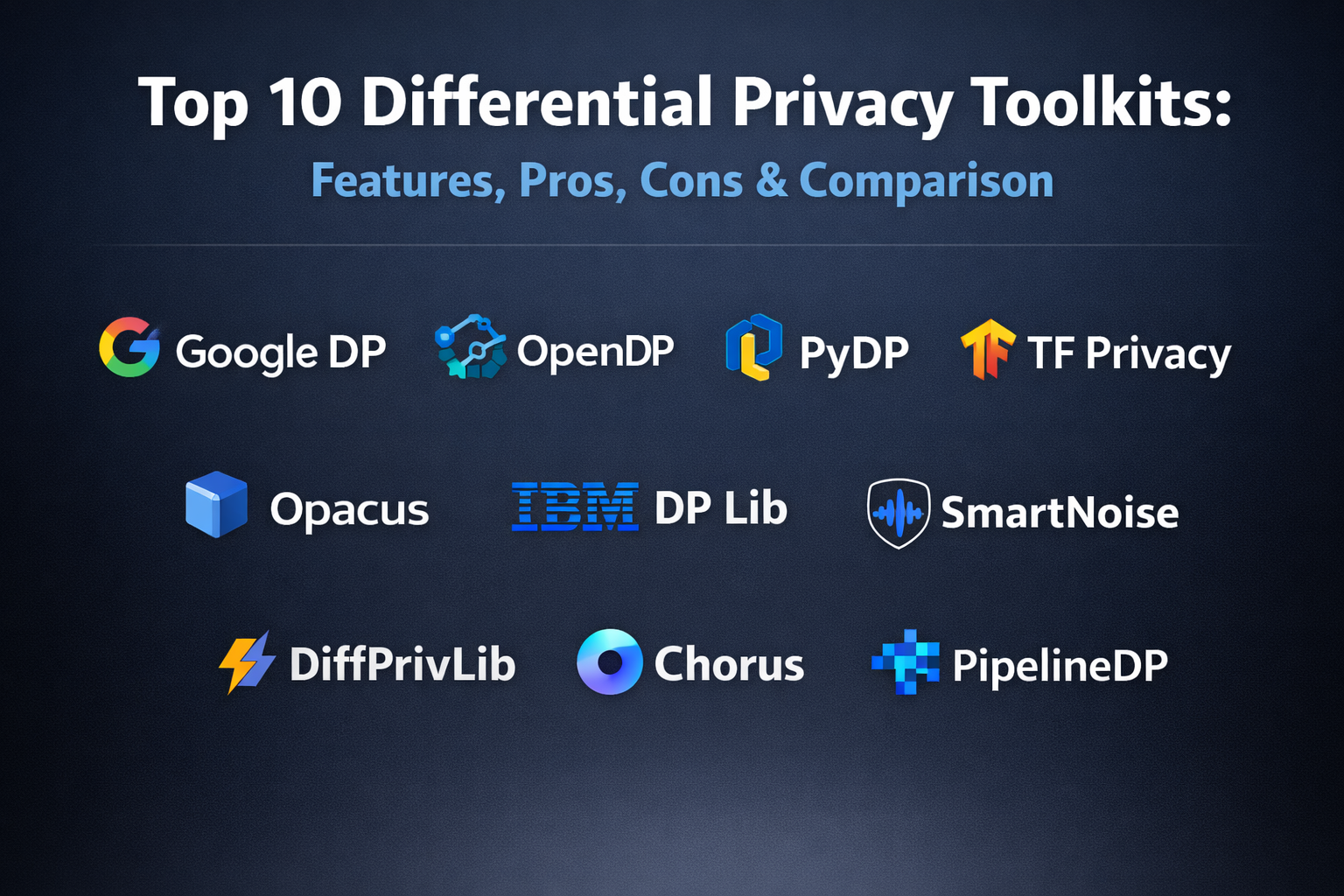
Top 10 Differential Privacy Toolkits
1. Google Differential Privacy Library
This is a high-performance library written in C++, with wrappers for Go and Java. It powers many of Google’s internal products and provides a robust set of algorithms for calculating common statistics like sum, average, and count with privacy guarantees.
Key Features
- Support for a wide range of aggregation functions including variance and standard deviation.
- Built-in “Privacy Budget” tracker to prevent excessive data exposure over time.
- Robust error handling and testing utilities specifically for privacy verification.
- High-performance C++ core suitable for large-scale data processing.
- Integration with the Apache Beam pipeline for distributed computing.
Pros
- Extremely reliable and tested at a massive global scale.
- Excellent documentation for developers moving from standard analytics to private ones.
Cons
- The Python integration is not as deep as some other specialized ML libraries.
- Can be complex to set up for smaller, non-distributed projects.
Platforms / Deployment
Windows / macOS / Linux
Local / Cloud
Security & Compliance
Uses mathematically proven Epsilon-Delta privacy definitions.
Not publicly stated.
Integrations & Ecosystem
Integrates with Google Cloud Platform and Apache Beam. It is often used as a backend for more specialized privacy applications.
Support & Community
Strong corporate backing from Google and an active open-source contributor base on GitHub.
2. OpenDP (Harvard & Microsoft)
OpenDP is a community-driven project that aims to create a trustworthy and open-source suite of differential privacy tools. It is built to be a reliable “library of libraries” that researchers and practitioners can trust.
Key Features
- A modular design that allows for custom privacy “measurements” and “transformations.”
- Strong focus on the “Accuracy-Privacy” trade-off visualization.
- Built using Rust for high memory safety and performance.
- Comprehensive support for complex data types beyond simple integers.
- Extensive library of mathematical proofs backing every included algorithm.
Pros
- Developed by the leading academic minds in the field of privacy.
- Highly extensible for researchers who want to build their own privacy mechanisms.
Cons
- The library is still evolving, so API changes can happen.
- Has a steeper learning curve for those unfamiliar with formal privacy definitions.
Platforms / Deployment
Windows / macOS / Linux
Local
Security & Compliance
Focuses on formal verification and verifiable privacy guarantees.
Not publicly stated.
Integrations & Ecosystem
Connects well with Python-based data science stacks and is often used in academic research settings.
Support & Community
Backed by Harvard’s Institute for Quantitative Social Science and Microsoft Research.
3. PyDP (OpenMined)
PyDP is a Python wrapper for the Google Differential Privacy C++ library. It brings Google’s high-performance privacy tools to the Python ecosystem, making them accessible to the vast majority of data scientists.
Key Features
- Provides easy-to-use Python APIs for complex C++ privacy algorithms.
- Supports standard aggregate functions like mean, median, and percentiles.
- Low-overhead integration into existing Jupyter Notebook workflows.
- Ability to handle “outlier” data points that could compromise privacy.
- Clear reporting on the amount of “noise” added to each result.
Pros
- Combines Google’s performance with Python’s ease of use.
- Highly active community support through the OpenMined ecosystem.
Cons
- Limited to the features available in the underlying C++ library.
- Requires some knowledge of Python package management to handle the C++ dependencies.
Platforms / Deployment
Windows / macOS / Linux
Local / Cloud
Security & Compliance
Inherits the mathematical rigor of the Google DP library.
Not publicly stated.
Integrations & Ecosystem
Works seamlessly with NumPy and Pandas, making it a natural fit for traditional data science.
Support & Community
Supported by OpenMined, a massive community dedicated to privacy-preserving technology.
4. TensorFlow Privacy
Built specifically for the TensorFlow machine learning framework, this library allows developers to train AI models with differential privacy. It focuses on ensuring that the model doesn’t “memorize” specific training examples.
Key Features
- Differentially private versions of standard optimizers (like DP-SGD).
- Tools for calculating the “privacy loss” of a trained model.
- Support for a wide variety of neural network architectures.
- Built-in tests to check if a model is vulnerable to membership inference attacks.
- Tutorials and templates for common deep learning tasks.
Pros
- The best choice for teams already using the TensorFlow ecosystem.
- Essential for preventing AI models from leaking sensitive training data.
Cons
- Training with differential privacy can significantly increase computation time.
- It often requires careful tuning of hyperparameters to maintain model accuracy.
Platforms / Deployment
Windows / macOS / Linux
Cloud / Hybrid
Security & Compliance
Focuses on protecting training data from “extraction” attacks.
Not publicly stated.
Integrations & Ecosystem
Deeply integrated with TensorFlow, Keras, and Google Cloud AI tools.
Support & Community
Strongly supported by the Google Brain team and the global AI research community.
5. Opacus (PyTorch)
Opacus is the PyTorch equivalent of TensorFlow Privacy. Developed by Meta (Facebook), it is designed to be fast, flexible, and easy for AI researchers to integrate into their existing PyTorch pipelines.
Key Features
- Efficiently computes per-sample gradients for privacy-preserving training.
- Minimal code changes required to make a standard PyTorch model “private.”
- High performance through optimized GPU kernels.
- Integrated privacy “accounting” to track the total privacy budget used.
- Support for a wide range of pre-trained models.
Pros
- Very popular in the academic community due to its flexibility.
- Significantly faster than many other DP-ML implementations.
Cons
- Limited primarily to PyTorch users.
- Accuracy can drop if the privacy budget is set too strictly.
Platforms / Deployment
Windows / macOS / Linux
Cloud / Hybrid
Security & Compliance
Implements RDP (Rényi Differential Privacy) for efficient accounting.
Not publicly stated.
Integrations & Ecosystem
Integrates with the full PyTorch Lightning and TorchVision ecosystem.
Support & Community
Maintained by Meta’s AI Research (FAIR) team with a large user base in academia.
6. IBM Differential Privacy Library
IBM’s offering is a comprehensive Python library that provides tools for both data analytics and machine learning. It is designed with enterprise-grade stability and versatility in mind.
Key Features
- Includes differentially private versions of common ML models like Logistic Regression and K-Means.
- Tools for “Private Data Synthesis” to create shareable fake datasets.
- Mechanisms for protecting data at the local, global, and “shuffled” levels.
- Support for a wide variety of noise distributions (Laplace, Gaussian, etc.).
- Extensive documentation focused on enterprise use cases.
Pros
- Offers a “one-stop shop” for both simple analytics and complex ML.
- Very stable and well-suited for corporate production environments.
Cons
- Some of the more advanced features have a learning curve.
- Not as specialized for deep learning as Opacus or TensorFlow Privacy.
Platforms / Deployment
Windows / macOS / Linux
Local / Cloud
Security & Compliance
Focuses on providing quantifiable privacy for enterprise data assets.
Not publicly stated.
Integrations & Ecosystem
Works well with the IBM Watson platform and standard Python data tools.
Support & Community
Professional backing from IBM Research with a focus on enterprise security.
7. SmartNoise (Microsoft & Harvard)
SmartNoise is a key part of the OpenDP initiative. It provides a user-friendly layer on top of complex privacy algorithms, allowing developers to query databases using “Private SQL.”
Key Features
- Allows for standard SQL queries that return differentially private results.
- Built-in protection against common database “side-channel” attacks.
- Integration with Azure Machine Learning and other cloud data tools.
- Tools for visualizing the accuracy loss caused by privacy settings.
- Support for diverse data sources, including Spark and SQL Server.
Pros
- The most accessible tool for SQL developers and database administrators.
- Provides a very bridgeable path from standard BI to private BI.
Cons
- Performance can lag on extremely complex SQL joins.
- Currently more optimized for the Azure ecosystem than others.
Platforms / Deployment
Windows / macOS / Linux
Cloud (Azure) / Hybrid
Security & Compliance
Complies with rigorous differential privacy standards.
Not publicly stated.
Integrations & Ecosystem
Strongest in the Microsoft Azure and Spark environments.
Support & Community
Co-developed by Microsoft and Harvard, ensuring high-quality support and research.
8. DiffPrivLib (IBM)
This is IBM’s primary library for general-purpose differential privacy in Python. It is designed to be a “drop-in” replacement for many functions in the popular Scikit-Learn library.
Key Features
- Simple interface for common tasks like classification and clustering.
- Built-in tools for choosing the optimal “Epsilon” value.
- Support for data pre-processing and scaling with privacy protections.
- Includes a “Privacy Meta-Estimator” to make any Scikit-Learn model private.
- Lightweight with minimal external dependencies.
Pros
- Excellent for data scientists who are already comfortable with Scikit-Learn.
- Very easy to integrate into existing “classical” machine learning pipelines.
Cons
- Not designed for modern deep learning (neural networks).
- The “Value” score is high, but the “Core” features are focused on traditional ML.
Platforms / Deployment
Windows / macOS / Linux
Local
Security & Compliance
Provides standard differential privacy guarantees for all included models.
Not publicly stated.
Integrations & Ecosystem
Native integration with the Scikit-Learn and Pandas ecosystem.
Support & Community
Supported by IBM Research and the broader open-source community.
9. Chorus
Chorus is a specialized tool designed to provide differential privacy for large-scale SQL databases. It acts as a “privacy proxy” between the user and the database, rewriting queries to include privacy protections.
Key Features
- Works with existing databases like PostgreSQL and MySQL without modification.
- Rewrites SQL queries to inject noise automatically.
- Supports complex analytical queries, including joins and group-bys.
- Provides a centralized “Privacy Budget” management system for the whole team.
- Minimizes the need for analysts to learn new privacy-specific code.
Pros
- Best-in-class for protecting existing legacy databases.
- Very low barrier to entry for teams that already use SQL-based BI tools.
Cons
- The project is more niche and has a smaller community than Google or Microsoft tools.
- Some complex queries may be rejected if they pose a high privacy risk.
Platforms / Deployment
Linux / Docker
Hybrid
Security & Compliance
Specifically targets “Linkage Attacks” and re-identification risks.
Not publicly stated.
Integrations & Ecosystem
Works with any database that supports standard SQL interfaces.
Support & Community
Mainly driven by academic researchers and specialized privacy startups.
10. PipelineDP
PipelineDP is a framework for applying differential privacy to large-scale data processing pipelines. It is a collaborative project between Google and OpenMined, designed specifically for big data environments.
Key Features
- Specifically built for frameworks like Apache Spark and Apache Beam.
- Handles massive datasets that don’t fit on a single machine.
- Simplifies the process of “grouping” data for private aggregation.
- Provides a clear API for defining “privacy partitions” in your data.
- Optimized for high throughput in production environments.
Pros
- The undisputed leader for “Big Data” differential privacy.
- Collaborative development ensures it stays up to date with the latest research.
Cons
- Requires a big data infrastructure (like Spark) to be truly useful.
- The API is more complex than simple desktop libraries.
Platforms / Deployment
Linux / Cloud
Hybrid / Cloud
Security & Compliance
Built on the proven Google DP backend for maximum rigor.
Not publicly stated.
Integrations & Ecosystem
Primary integrations with Apache Spark, Apache Beam, and Google Cloud Dataflow.
Support & Community
Jointly supported by Google and the OpenMined community.
Comparison Table
| Tool Name | Best For | Platform(s) Supported | Deployment | Standout Feature | Public Rating |
| 1. Google DP | High Performance | Win, Mac, Linux | Cloud | C++/Go/Java Support | N/A |
| 2. OpenDP | Research/Modular | Win, Mac, Linux | Local | Rust-Based Safety | N/A |
| 3. PyDP | Python Data Sci | Win, Mac, Linux | Local/Cloud | Google Wrapper | N/A |
| 4. TF Privacy | Deep Learning (TF) | Win, Mac, Linux | Cloud | DP-SGD Optimizer | N/A |
| 5. Opacus | Deep Learning (PT) | Win, Mac, Linux | Cloud | Per-Sample Gradients | N/A |
| 6. IBM DP Lib | Enterprise ML | Win, Mac, Linux | Local/Cloud | Data Synthesis | N/A |
| 7. SmartNoise | SQL Queries | Win, Mac, Linux | Cloud (Azure) | Private SQL Engine | N/A |
| 8. DiffPrivLib | Scikit-Learn Users | Win, Mac, Linux | Local | Meta-Estimator | N/A |
| 9. Chorus | Database Proxy | Linux / Docker | Hybrid | SQL Query Rewriting | N/A |
| 10. PipelineDP | Big Data (Spark) | Linux / Cloud | Hybrid/Cloud | Spark/Beam Support | N/A |
Evaluation & Scoring
| Tool Name | Core (25%) | Ease (15%) | Integrations (15%) | Security (10%) | Perf (10%) | Support (10%) | Value (15%) | Total |
| 1. Google DP | 10 | 6 | 9 | 10 | 10 | 9 | 8 | 8.85 |
| 2. OpenDP | 9 | 5 | 8 | 10 | 9 | 8 | 8 | 8.05 |
| 3. PyDP | 8 | 9 | 9 | 9 | 8 | 8 | 10 | 8.70 |
| 4. TF Privacy | 10 | 6 | 10 | 10 | 7 | 9 | 9 | 8.60 |
| 5. Opacus | 10 | 7 | 10 | 10 | 9 | 9 | 9 | 9.00 |
| 6. IBM DP Lib | 9 | 7 | 9 | 9 | 8 | 8 | 8 | 8.30 |
| 7. SmartNoise | 8 | 9 | 10 | 9 | 7 | 8 | 8 | 8.35 |
| 8. DiffPrivLib | 7 | 10 | 9 | 8 | 8 | 7 | 9 | 8.20 |
| 9. Chorus | 7 | 7 | 8 | 9 | 8 | 6 | 7 | 7.30 |
| 10. PipelineDP | 9 | 5 | 10 | 10 | 10 | 8 | 8 | 8.50 |
The evaluation highlights that different tools excel in different areas. For example, Opacus and TensorFlow Privacy score perfectly in “Core” features and “Integrations” for AI teams, but their performance score is slightly lower due to the unavoidable overhead of private training. PyDP and SmartNoise score exceptionally high in “Ease of Use,” making them the best starting point for general analysts. For massive production environments, Google DP and PipelineDP provide the high “Performance” and “Security” required for global-scale operations.
Which Differential Privacy Toolkit Is Right for You?
Solo / Freelancer
If you are an individual data scientist, PyDP or DiffPrivLib are your best options. They fit into the tools you likely already use (Pandas, Scikit-Learn) and don’t require a complex server setup to start protecting your data.
SMB
Small to medium businesses should look at SmartNoise. Its ability to run private SQL queries means your existing team can start generating private reports without having to relearn their entire workflow or hire a specialized privacy engineer.
Mid-Market
For companies with established AI teams, Opacus (if using PyTorch) or TensorFlow Privacy (if using TF) are essential. They allow you to scale your AI offerings while ensuring you don’t accidentally leak your training data to the public.
Enterprise
Large-scale enterprises should prioritize Google Differential Privacy or IBM Differential Privacy Library. These tools are built for the stability and high-performance requirements of production-level cloud applications.
Budget vs Premium
All of the tools listed here are open-source and free to use. The “cost” comes in the form of the specialized talent required to implement them and the potential increase in cloud computing costs due to the overhead of privacy-preserving math.
Feature Depth vs Ease of Use
OpenDP offers the most depth for researchers who need to verify every mathematical proof. PyDP and SmartNoise offer the best ease of use for developers who just want to get the job done quickly.
Integrations & Scalability
If your data lives in a massive Spark or Beam cluster, PipelineDP is the only logical choice. For those working within a specific cloud provider, SmartNoise (Azure) or TensorFlow Privacy (Google Cloud) offer the most seamless experience.
Security & Compliance Needs
If you are working in a highly regulated field like medical research, OpenDP and Google DP provide the highest level of transparency and mathematical rigor, which is crucial for passing a formal privacy audit.
Frequently Asked Questions (FAQs)
1. What exactly is “noise” in differential privacy?
Noise is random mathematical data added to a result (like a sum or average). It’s just enough to hide any single person’s contribution but small enough that the overall total remains accurate.
2. Does differential privacy make my data less accurate?
Yes, there is a “utility trade-off.” The more privacy you want (higher noise), the less accurate the result will be. The goal of these toolkits is to find the perfect balance.
3. What is “Epsilon” ($\epsilon$)?
Epsilon is a number that represents the “privacy budget.” A lower Epsilon means more privacy (more noise), while a higher Epsilon means less privacy (less noise) and more accuracy.
4. Can I use these tools with existing databases?
Yes, tools like Chorus and SmartNoise are designed to act as proxies or engines that can query standard databases like PostgreSQL or SQL Server privately.
5. Is differential privacy the same as data masking?
No. Masking just hides names or IDs. Differential privacy uses math to ensure that even if an attacker has outside information, they still can’t identify anyone in your dataset.
6. Which language is best for learning differential privacy?
Python is the most common language for this field, as most of the popular libraries (PyDP, Opacus, IBM DP) are built for the Python data science ecosystem.
7. Does using these tools slow down my software?
Usually, yes. Calculating privacy-preserving math is more complex than standard math. However, toolkits like Google DP and Opacus are highly optimized to minimize this delay.
8. Can I use differential privacy for small datasets?
It is difficult. In small datasets, the noise needed for privacy can easily overwhelm the actual data, leading to very inaccurate results. It works best on large populations.
9. What is the difference between Local and Global DP?
Local DP adds noise on the user’s phone or computer before it’s sent to you. Global DP adds noise at the central server after the data has been collected.
10. Do I need a Ph.D. to use these toolkits?
No. While the math is complex, tools like SmartNoise and DiffPrivLib are designed so that any software engineer or data analyst can use them with a bit of study.
Conclusion
Differential privacy is no longer a theoretical academic concept; it has become a practical necessity for any organization handling sensitive human data. The toolkits available today, ranging from Google’s high-performance libraries to Microsoft and Harvard’s SQL-friendly engines, have significantly lowered the barrier to entry. By integrating these frameworks into your data pipelines, you can transform privacy from a restrictive compliance hurdle into a competitive advantage. The future of data belongs to those who can extract value while maintaining the absolute trust of their users, and these ten toolkits are the essential building blocks for that future.

Best Cardiac Hospitals Near You
Discover top heart hospitals, cardiology centers & cardiac care services by city.
Advanced Heart Care • Trusted Hospitals • Expert Teams
View Best Hospitals