Introduction
In the current industrial landscape, Digital Twin Platforms have transitioned from visionary concepts to essential operational tools. A Digital Twin is a high-fidelity virtual representation of a physical object, process, or system that is updated via real-time data from its physical counterpart. Unlike static 3D models used in traditional CAD, digital twins are dynamic, living entities that leverage IoT (Internet of Things) sensors, physics-based simulations, and artificial intelligence to mirror and predict real-world behavior.
The modern necessity for these platforms stems from the increasing complexity of global supply chains and the urgent need for operational efficiency. Enterprises now use digital twins to synchronize virtual and physical worlds, allowing engineers to test “what-if” scenarios without risking physical assets. This capability is the backbone of the Industrial Metaverse, where photorealistic environments and physics-grounded AI converge to optimize everything from a single turbine to an entire smart city.
Real-World Use Cases
- Predictive Maintenance: Monitoring the thermal and vibration signatures of heavy machinery to predict mechanical failure before it occurs.
- Urban Infrastructure Management: Simulating traffic flow and utility consumption to optimize city planning and emergency response times.
- Manufacturing Throughput: Recreating factory floors to validate robot paths and operator ergonomics, identifying bottlenecks before a facility is built.
- Sustainability Tracking: Creating carbon twins to monitor and reduce the energy footprint across the entire product lifecycle.
What Buyers Should Evaluate
- Modeling Language Support: Availability of standards like Digital Twins Definition Language (DTDL) or OpenUSD.
- Data Integration Latency: The speed at which sensor data reflects in the virtual environment.
- Simulation Fidelity: The ability to simulate real-world physics (gravity, fluid dynamics, thermodynamics).
- Scalability: Capacity to manage thousands of interrelated twins across different geographical locations.
- AI & Machine Learning Support: Built-in capability for training autonomous agents or anomaly detection models.
- Security Posture: Support for zero-trust architectures, end-to-end encryption, and role-based access.
- Interoperability: The ease of connecting to existing ERP, PLM, and CRM systems.
Best for: Large-scale industrial enterprises, infrastructure managers, R&D departments, and facility operators requiring real-time visibility and predictive simulation.
Not ideal for: Organizations without a robust IoT sensor strategy or small businesses with simple, low-risk physical assets that do not require continuous monitoring.
Key Trends in Digital Twin Platforms
- Integration of Agentic AI: Platforms are increasingly embedding AI agents that can “read” telemetry data and autonomously suggest or execute operational adjustments.
- The Rise of the Industrial Metaverse: A shift toward immersive, collaborative 3D environments where multiple stakeholders can interact with a twin in a photorealistic space.
- Edge-to-Twin Synchronization: Processing data at the “edge” (close to the physical asset) to provide near-instantaneous twin updates for safety-critical applications.
- Open Standards Dominance: The widespread adoption of OpenUSD (Universal Scene Description) and JSON-LD based modeling to prevent vendor lock-in.
- Digital Product Passports: Digital twins acting as the permanent record for a product’s materials, carbon footprint, and circularity data.
- Physics-Grounded Simulation: Moving beyond simple data charts to simulations that obey the laws of physics, essential for aerospace and medical applications.
- Blockchain for Data Provenance: Using distributed ledgers to verify the authenticity and “chain of custody” of the data feeding a digital twin.
- No-Code Twin Authoring: Tools that allow non-engineers to create functional twins using drag-and-drop components and pre-built industry ontologies.
How We Selected These Tools (Methodology)
To identify the leading Digital Twin platforms, we utilized a multi-dimensional evaluation framework:
- Market Share and Enterprise Adoption: We prioritized platforms currently used by global leaders in manufacturing, energy, and aerospace.
- Technological Maturity: Evaluation of the platform’s ability to handle complex simulation, high-velocity data, and AI workloads.
- Ecosystem Connectivity: Analysis of the depth and breadth of pre-built connectors for standard industrial protocols (PLC, SCADA, ERP).
- Visual and Physics Fidelity: Assessing the quality of 3D rendering and the robustness of the underlying physics engine.
- Security and Compliance Readiness: Review of built-in security features such as MFA, RBAC, and adherence to international standards.
- Developer Experience: Availability of robust APIs, documentation, and a supportive community for building custom applications.
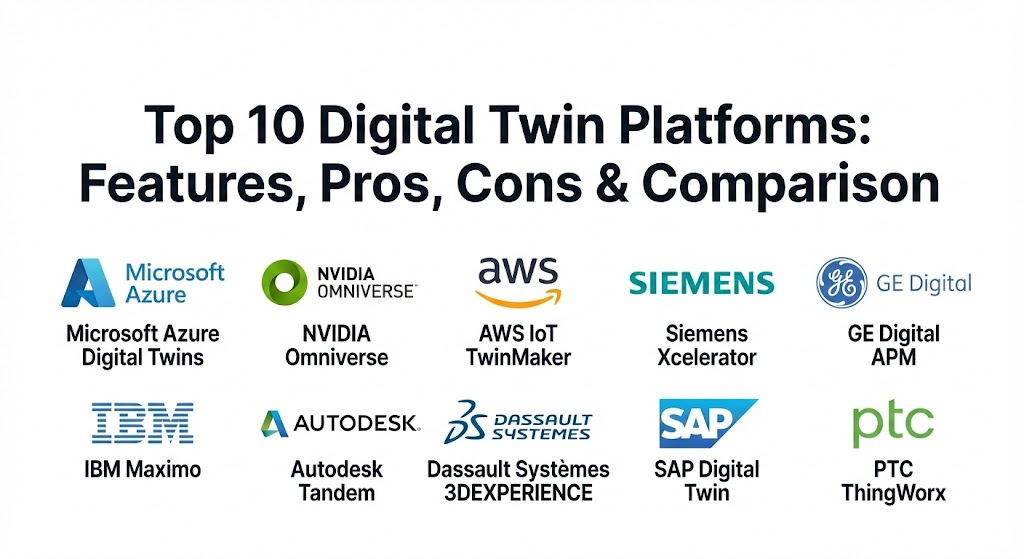
Top 10 Digital Twin Platforms Tools
1.Microsoft Azure Digital Twins
A developer-focused platform designed to create knowledge graphs of entire environments. It is highly effective for modeling complex relationships in smart buildings, factories, and energy networks.
Key Features
- Digital Twins Definition Language (DTDL): Uses a JSON-LD based language to define models with properties, telemetry, and relationships.
- Live Execution Environment: A dynamic graph representation that visualizes how twins interact within a larger ecosystem.
- Azure IoT Hub Integration: Seamlessly ingests data from millions of devices with enterprise-grade connectivity.
- Input/Output Event Routes: Easily triggers external compute, such as Azure Functions, based on changes in a twin’s state.
- Spatial Intelligence: Specialized tools for mapping 3D spaces and analyzing data in a geographical context.
Pros
- Exceptional scalability and flexibility for modeling heterogeneous environments.
- Deeply integrated with the broader Microsoft AI and analytics stack.
Cons
- Requires a high level of developer expertise to build and maintain.
- Lack of native, high-fidelity 3D visualization out-of-the-box (requires third-party tools like Unity).
Platforms / Deployment
- Web / Cloud (Azure)
- Hybrid (via Azure IoT Edge)
Security & Compliance
- Role-Based Access Control (RBAC).
- Managed Identities for secure resource access.
- SOC 2, ISO 27001, and HIPAA compliant.
Integrations & Ecosystem
Azure Digital Twins is part of a massive industrial cloud ecosystem:
- Microsoft Power BI for dashboarding.
- Azure OpenAI for intelligent twin analysis.
- Azure Data Explorer for historical data querying.
- Microsoft Fabric for end-to-end data management.
Support & Community
Extensive technical documentation, GitHub samples, and a global network of Microsoft certified partners and developers.
2.NVIDIA Omniverse
A computing platform for developing Universal Scene Description (USD) based applications. It is the gold standard for photorealistic, physics-accurate industrial simulation and the metaverse.
Key Features
- Universal Scene Description (OpenUSD): An open standard that enables seamless collaboration across diverse 3D design and engineering tools.
- Real-time RTX Rendering: Physically accurate lighting and materials for photorealistic visualizations.
- Physics-Grounded AI: Ensures that virtual simulations adhere strictly to real-world physical laws like mass and friction.
- Isaac Sim Integration: Specialized tools for training and testing AI-driven robotics in a risk-free virtual environment.
- Live Sync Collaboration: Multiple users can edit the same virtual scene simultaneously across different geographical locations.
Pros
- Unmatched visual fidelity and simulation accuracy.
- Ideal for complex manufacturing and robotics use cases where physical realism is critical.
Cons
- High hardware requirements (specifically high-end NVIDIA GPUs).
- Can be excessively complex for simple data-monitoring tasks.
Platforms / Deployment
- Windows / Linux
- Cloud (NVIDIA Graphics Delivery Network) / On-premises (OVX Servers)
Security & Compliance
- Enterprise security through NVIDIA BlueField DPUs.
- Secure multi-tenant data isolation.
- Specific compliance varies by cloud provider (e.g., Azure or AWS hosting).
Integrations & Ecosystem
NVIDIA acts as a central hub for the 3D industry:
- Autodesk Revit and 3ds Max.
- Siemens Xcelerator.
- Adobe Creative Cloud.
- Epic Games Unreal Engine.
Support & Community
Robust developer forums, specialized training through the NVIDIA Deep Learning Institute, and a rapidly growing library of OpenUSD assets.
3.AWS IoT TwinMaker
A managed service that allows organizations to create digital twins of buildings, factories, and industrial equipment by unifying data from multiple sources into a single 3D view.
Key Features
- Data Connectors: Pre-built connectors for AWS IoT SiteWise, Amazon S3, and Snowflake.
- Scene Composer: A 3D editing tool to place models and bind them to real-time data sources.
- Unified Data API: Allows developers to access twin data from disparate sources via a single endpoint.
- Knowledge Graph: Organizes metadata and relationships between physical assets to simplify complex queries.
- Grafana Plugin: Native integration for visualizing digital twin data within standard industrial dashboards.
Pros
- Reduces the complexity of unifying data from siloed industrial systems.
- Fast deployment for companies already utilizing the AWS cloud infrastructure.
Cons
- 3D visualization tools are less advanced compared to gaming-engine based platforms.
- Strongly dependent on the AWS ecosystem for full functionality.
Platforms / Deployment
- Web / Cloud (AWS)
Security & Compliance
- AWS Identity and Access Management (IAM).
- Encryption at rest and in transit via AWS KMS.
- SOC 1/2/3 and ISO 27001 compliant.
Integrations & Ecosystem
Integrates with the full breadth of Amazon’s industrial offerings:
- Amazon Managed Grafana.
- AWS IoT SiteWise.
- Amazon Kinesis Video Streams for camera integration.
- Amazon Bedrock for AI-driven insights.
Support & Community
High-level enterprise support tiers, detailed reference architectures, and extensive training modules within AWS Skill Builder.
4.Siemens Xcelerator
An integrated portfolio of software and services that bridges the gap between engineering and operations, focusing on the entire product lifecycle.
Key Features
- Digital Twin Composer: A specialized tool for building photorealistic industrial metaverse environments.
- Teamcenter Integration: Directly links digital twins to Product Lifecycle Management (PLM) data.
- Industrial Copilots: AI-driven assistants that help automate regulatory compliance and streamline design navigation.
- Physics-Level Accuracy: Leverages engineering-grade simulation to model machine logic and operator paths.
- Time Machine Navigation: Allows users to scrub through historical data and visualize past states in a 3D context.
Pros
- The most comprehensive platform for combining mechanical engineering with operational IoT data.
- Proven to increase throughput and reduce capital expenditure in manufacturing.
Cons
- Very high cost of entry and significant implementation complexity.
- Steep learning curve for non-engineering staff.
Platforms / Deployment
- Windows / Web
- Cloud / Hybrid / On-premises
Security & Compliance
- Certified to ISO 27001 standards.
- Embedded security copilots for real-time compliance monitoring.
Integrations & Ecosystem
A massive marketplace of industrial applications:
- NVIDIA Omniverse.
- Microsoft Azure.
- SAP ERP systems.
- Mendix for low-code application development.
Support & Community
Global consulting services, a dedicated learning center, and a mature user community through the Siemens Xcelerator Marketplace.
5.GE Digital APM
A platform focused on Asset Performance Management (APM), using digital twins to optimize the reliability and health of critical industrial assets.
Key Features
- Reliability Management: Advanced analytics to predict and prevent asset failures.
- Asset Strategy Optimization: Uses AI to determine the most cost-effective maintenance schedules.
- Integrity Management: Specialized modules for tracking the structural health of assets in high-risk environments.
- Edge Connectivity: Connects directly to industrial historians and SCADA systems for real-time data ingestion.
- Standard Compliance: Built-in support for OSHA and ISO maintenance standards.
Pros
- Excellent for high-stakes industries like energy, aviation, and oil and gas.
- Focuses heavily on ROI by extending the useful life of expensive machinery.
Cons
- Visualization is dashboard-heavy and lacks the 3D immersion of newer platforms.
- User interface can feel less modern than cloud-native competitors.
Platforms / Deployment
- Web / Windows
- Cloud / Hybrid / On-premises
Security & Compliance
- Aligns with NIST cybersecurity frameworks.
- SOC 2 Type II compliant.
Integrations & Ecosystem
Focuses on enterprise asset management (EAM) connectivity:
- SAP EAM.
- IBM Maximo.
- Oracle.
- ServiceNow.
Support & Community
Deep expertise in industrial reliability; GE provides specialized consulting and a massive library of maintenance whitepapers.
6.IBM Maximo
An enterprise asset management leader that leverages digital twins to drive maintenance, reliability, and facility resilience.
Key Features
- Operational Twins: Uses real-time data to monitor asset health and predict maintenance needs.
- GIS and BIM Fusion: Combines geographical information with building models for a unified spatial twin.
- Watson AI Integration: Leverages AI to detect anomalies in sensor data that indicate imminent equipment failure.
- Mobile Asset Management: Field apps that allow technicians to interact with twin data on-site.
- Asset Lifecycle Tracking: Maintains a complete history of an asset from installation to decommissioning.
Pros
- Unrivaled for managing large-scale infrastructure and facility campuses.
- Seamlessly connects twin insights to automated maintenance work orders.
Cons
- Modular pricing can become expensive as more twin features are added.
- Integration with non-IBM AI stacks can be challenging.
Platforms / Deployment
- Web / iOS / Android
- Cloud / Hybrid
Security & Compliance
- High-level security intelligence via IBM Security.
- ISO 27001 and GDPR compliant.
Integrations & Ecosystem
Strong emphasis on spatial data and enterprise workflows:
- Esri ArcGIS.
- Autodesk Tandem.
- FME for data integration.
- SAP.
Support & Community
Extensive global support network, annual “Think” conferences, and a long-standing user community in the EAM space.
7.Autodesk Tandem
A cloud-based platform specifically for the AEC (Architecture, Engineering, Construction) industry, turning BIM data into operational digital twins for building owners.
Key Features
- Asset Information Model: Structures building data into a searchable, categorized virtual replica.
- Handover Automation: Streamlines the transition of data from the construction phase to facility operations.
- Facility Templates: Allows for repeatable twin creation across a portfolio of similar buildings.
- Space Usage Visualization: Analyzes environmental sensor data (CO2, temperature) within the 3D building context.
- Audit History: Tracks every change made to the facility model over its entire lifecycle.
Pros
- Specifically built for building owners who want to capitalize on their BIM (Building Information Modeling) investment.
- Extremely intuitive and easy to use compared to industrial simulation platforms.
Cons
- Not designed for complex industrial manufacturing logic or machine-level control.
- Value is highly dependent on having high-quality “as-built” BIM data.
Platforms / Deployment
- Web / Cloud (Autodesk Cloud)
Security & Compliance
- SOC 2 and ISO 27001 compliant.
- Granular user permissions for viewing sensitive facility layouts.
Integrations & Ecosystem
Native integration with the Autodesk Construction Cloud:
- Autodesk Revit.
- BIM Collaborate Pro.
- Autodesk Forge APIs.
- Microsoft Power BI.
Support & Community
Active user forums, specialized training through Autodesk University, and a growing ecosystem of facility management partners.
8.Dassault Systèmes 3 DEXPERIENCE
A scientific and engineering powerhouse that provides “Virtual Twin Experiences” for aerospace, automotive, and life sciences.
Key Features
- Science-Validated Models: Uses deep physics and biology models to simulate systems at the molecular or structural level.
- Virtual Twin Factories: Advanced production system modeling with autonomous control logic.
- Sovereign Cloud Options: High-security deployments for government and defense projects through OUTSCALE.
- Virtual Companions: AI-based agents that assist engineers with design synthesis and compliance.
- Multi-Domain Simulation: Models the interaction between fluids, structures, and electronics in a single environment.
Pros
- The most scientifically rigorous platform available; used for simulating everything from airplanes to human organs.
- Exceptional intellectual property (IP) protection for R&D-heavy industries.
Cons
- Extremely high licensing costs.
- Requires highly specialized staff to operate effectively.
Platforms / Deployment
- Windows / Web
- Cloud (Public/Sovereign) / On-premises
Security & Compliance
- ISO 27001:2022 certified.
- Rigorous data sovereignty controls for regulated industries.
Integrations & Ecosystem
A self-contained but extensible engineering ecosystem:
- NVIDIA Omniverse.
- CATIA for design.
- SIMULIA for simulation.
- DELMIA for manufacturing operations.
Support & Community
World-class global support, dedicated trust centers, and the annual 3DEXPERIENCE World event for professional networking.
9.SAP Digital Twin
A business-centric platform that connects the physical status of assets directly to the enterprise supply chain and financial data.
Key Features
- Connected Supply Chain Twin: Visualizes how asset downtime affects global logistics and order fulfillment.
- Asset Intelligence Network: A cloud-based collaborative platform for manufacturers and operators to share twin data.
- Predictive Maintenance: Uses machine learning to calculate the remaining useful life of machinery.
- S/4HANA Integration: Directly links twin telemetry to financial and inventory impact.
- Sustainability Footprint Management: Tracks real-time carbon emissions as part of the asset’s digital profile.
Pros
- The best choice for executives who need to understand the financial impact of physical asset behavior.
- Excellent for multi-company collaboration in a shared digital ecosystem.
Cons
- Not a leader in 3D simulation fidelity; more focused on data logic.
- Requires an existing SAP landscape to realize its full potential.
Platforms / Deployment
- Web / Cloud (SAP BTP)
- Hybrid (RISE with SAP)
Security & Compliance
- SOC 1, SOC 2, and ISO 27001 compliant.
- Strict data privacy controls within the SAP Business Technology Platform.
Integrations & Ecosystem
Deeply embedded in the SAP business stack:
- SAP S/4HANA.
- SAP EAM.
- Microsoft Azure and AWS.
Support & Community
Massive global consultant network, SAP Community forums, and extensive vertical-specific expertise.
10.PTC ThingWorx
A high-speed industrial IoT platform that excels at connecting legacy equipment and providing Augmented Reality (AR) visualizations.
Key Features
- Bidirectional Control: Allows the digital twin to send commands back to the physical machine.
- Kepware Connectivity: Built-in drivers for nearly every industrial protocol (OPC, Modbus, etc.).
- Vuforia AR Integration: Projects digital twin data onto real machinery via AR glasses or mobile devices.
- Rapid App Development: Low-code tools for creating custom operator dashboards and alerts.
- Asset Groups: Simplifies the management of permissions and visibility for thousands of twins.
Pros
- Unbeatable for connecting “brownfield” (legacy) factories to the digital world.
- Best-in-class Augmented Reality capabilities for field maintenance.
Cons
- Visualization is less photorealistic compared to NVIDIA or Siemens.
- Pricing structure can be complex as “Thing” counts scale.
Platforms / Deployment
- Web / Windows / Linux
- Cloud / On-premises / Hybrid
Security & Compliance
- Granular visibility permissions.
- Supports ISO 27001 security standards.
Integrations & Ecosystem
Open and highly extensible:
- Microsoft Azure IoT.
- AWS IoT.
- Ansys for simulation.
- Rockwell Automation.
Support & Community
Strong industrial presence with dedicated “Success Paths” and a robust developer portal for industrial automation.
Comparison Table
| Tool Name | Best For | Platform(s) Supported | Deployment | Standout Feature | Public Rating |
| Azure Digital Twins | Developers & Cities | Web / Cloud | Cloud / Hybrid | Spatial Graph Modeling | N/A |
| NVIDIA Omniverse | Photorealism & AI | Windows / Linux | Cloud / On-prem | Physics-Grounded AI | N/A |
| AWS IoT TwinMaker | Fast Cloud Setup | Web | Cloud | Unified Data Access API | N/A |
| Siemens Xcelerator | Industrial Metaverse | Windows / Web | All | Time Machine Visualization | N/A |
| GE Digital APM | Critical Reliability | Web / Windows | All | Reliability Management | N/A |
| IBM Maximo | Facility Maintenance | Web / Mobile | Cloud / Hybrid | GIS-BIM Fusion | N/A |
| Autodesk Tandem | Building Owners | Web | Cloud | AEC-to-O&M Handover | N/A |
| Dassault Systèmes | Scientific R&D | Windows / Web | All | Science-Validated Models | N/A |
| SAP Digital Twin | Supply Chain Logic | Web | Cloud | Connected ERP Integration | N/A |
| PTC ThingWorx | AR & Legacy Connect | Web / Win / Linux | All | Bidirectional AR Control | N/A |
Evaluation & Scoring of Digital Twin Platforms
The scoring below is based on a comparative analysis of each platform’s readiness for modern industrial requirements. A score of 10 represents industry-leading performance in that specific category.
| Tool Name | Core (25%) | Ease (15%) | Integrations (15%) | Security (10%) | Performance (10%) | Support (10%) | Value (15%) | Weighted Total |
| Azure Digital Twins | 9 | 6 | 10 | 9 | 10 | 9 | 8 | 8.65 |
| NVIDIA Omniverse | 10 | 5 | 9 | 8 | 10 | 8 | 7 | 8.20 |
| AWS IoT TwinMaker | 8 | 8 | 10 | 9 | 9 | 9 | 9 | 8.70 |
| Siemens Xcelerator | 10 | 6 | 9 | 9 | 10 | 10 | 7 | 8.70 |
| GE Digital APM | 9 | 6 | 8 | 9 | 9 | 8 | 8 | 8.15 |
| IBM Maximo | 8 | 7 | 9 | 9 | 8 | 9 | 7 | 8.10 |
| Autodesk Tandem | 7 | 9 | 8 | 9 | 8 | 8 | 9 | 8.15 |
| Dassault Systèmes | 10 | 4 | 7 | 10 | 10 | 9 | 6 | 7.95 |
| SAP Digital Twin | 8 | 7 | 10 | 8 | 8 | 9 | 7 | 8.10 |
| PTC ThingWorx | 9 | 7 | 9 | 8 | 9 | 9 | 8 | 8.55 |
How to Interpret the Scores:
- Core (25%): The strength of the modeling, simulation, and 3D engine.
- Ease (15%): Time to initial deployment and user interface quality.
- Integrations (15%): Pre-built connectors and API robustness.
- Weighted Total: A comparative measure of overall platform strength. A score above 8.0 indicates a market-leading tool capable of enterprise-wide deployment.
Which Digital Twin Platform Is Right for You?
Solo / Freelancer
If you are an independent consultant building digital twin proof-of-concepts (PoCs), you need accessibility and low starting costs.
- Recommendation: Autodesk Tandem (for buildings) or AWS IoT TwinMaker. These platforms offer intuitive web interfaces and pay-as-you-go pricing that won’t overwhelm a single user.
SMB
Small-to-medium businesses often have limited developer resources but need to connect to existing factory equipment.
- Recommendation: PTC ThingWorx. Its “low-code” approach and the powerful Kepware connectivity library allow a small team to build functional industrial twins quickly without deep coding knowledge.
Mid-Market
Companies with growing asset fleets need a balance of deep analytics and manageable complexity.
- Recommendation: IBM Maximo or GE Digital. These tools are built specifically to scale maintenance operations and provide an immediate ROI by reducing downtime on critical equipment.
Enterprise
Global organizations requiring photorealistic “Industrial Metaverses” or scientifically accurate R&D models.
- Recommendation: Siemens Xcelerator or NVIDIA Omniverse. These platforms offer the depth required to synchronize global operations and simulate complex physical interactions at scale.
Budget vs Premium
- Budget: AWS and Azure offer the lowest entry costs through consumption-based billing.
- Premium: Dassault Systèmes and Siemens are high-investment platforms that deliver unmatched engineering and scientific rigor.
Frequently Asked Questions (FAQs)
1.What is the primary difference between a digital twin and a 3D model?
A 3D model is a static visual representation. A Digital Twin is dynamic, connected to real-time data from physical sensors that update the model to reflect current real-world conditions.
2.Can I build a digital twin without an IoT strategy?
No. A digital twin requires a continuous stream of data to remain accurate. Without sensors and an IoT ingestion layer, you simply have a static simulation.
3.How do Digital Twin platforms handle security?
Modern platforms utilize Zero-Trust architecture, encryption of data in transit and at rest, Multi-Factor Authentication (MFA), and granular Role-Based Access Control (RBAC).
4.Is specialized hardware required?
For high-fidelity 3D visualization and physics simulation (e.g., NVIDIA), enterprise-grade GPUs are required. For data-driven twins (e.g., SAP), standard cloud compute is sufficient.
5.What is DTDL?
Digital Twins Definition Language (DTDL) is a standard used to describe the capabilities of a digital twin, allowing different services and applications to understand its telemetry, properties, and relationships.
6.Can a digital twin help with ESG and sustainability?
Yes. By tracking real-time energy use and material circularity, digital twins allow companies to accurately report and reduce their carbon footprint across their operations.
7.How long does a typical implementation take?
A pilot project for a single asset can take 4–8 weeks. A full enterprise-wide rollout for a complex factory typically takes 6–12 months.
8.What is OpenUSD?
Universal Scene Description (OpenUSD) is an extensible, open-source 3D data interchange framework that allows diverse creative and engineering tools to collaborate in a single virtual scene.
9.Can I control a machine through its digital twin?
Yes, platforms like PTC ThingWorx and Siemens Xcelerator support bidirectional communication, allowing you to adjust machine parameters through the virtual interface.
10.What is an “Industrial Metaverse”?
It is a persistent, collaborative virtual environment where digital twins are integrated at scale, allowing global teams to design, simulate, and operate physical systems in real-time.
Conclusion
The selection of a Digital Twin platform is no longer just an IT decision—it is a strategic choice that defines an organization’s operational agility. For those prioritizing visual fidelity and robotics, NVIDIA Omniverse is the undisputed leader. For organizations focused on engineering precision and the industrial metaverse, Siemens Xcelerator provides the most comprehensive stack. Meanwhile, those needing financial and supply chain integration will find the best fit in SAP.

Best Cardiac Hospitals Near You
Discover top heart hospitals, cardiology centers & cardiac care services by city.
Advanced Heart Care • Trusted Hospitals • Expert Teams
View Best Hospitals