Introduction
Domain Name System (DNS) management is critical for any organization relying on the internet for business operations. DNS translates human-readable domain into machine-readable IP addresses that enable communication between devices. Managing DNS efficiently ensures network reliability, fast website loading, secure email delivery, and fault tolerance for critical services. DNS management tools help businesses maintain control over domain configurations, DNS records, and other vital settings, making it easier to update, secure, and monitor domain data.
In today’s fast-paced business environment, DNS management is more than just assigning domain names; it includes managing configurations for web applications, email systems, and even cloud services. Automated management, DNS security features, reporting, and integration with other network services have become crucial elements in modern DNS platforms.
Real-world use cases:
- Managing and securing internal and external DNS configurations
- Handling DNS records for high-availability services
- Enabling DNS failover for critical applications
- Monitoring DNS performance and uptime
- Securing DNS traffic from DDoS attacks and DNS spoofing
- Integrating DNS services with other network tools for enhanced functionality
What buyers should evaluate:
- Comprehensive DNS record management and configuration options
- DNS security features such as DNSSEC, DDoS protection, and encryption
- High availability and failover capabilities for mission-critical domains
- Scalability and multi-site management for larger enterprises
- User-friendly interface and ease of setup
- Reporting and auditing for DNS changes and performance monitoring
- Integration with other network and cloud services
- Real-time DNS traffic monitoring and alerting
- Backup and restoration features for DNS configurations
- Cost-effectiveness for small businesses to enterprise-scale environments
Best for: Network administrators, IT operations teams, DevOps professionals, and enterprises that require robust control over DNS configurations, security, and performance.
Not ideal for: Small-scale operations or environments where DNS management is handled by an external service or provider.
Key Trends in DNS Management Tools
- Increasing adoption of DNSSEC (DNS Security Extensions) for secure communication
- Greater use of DNS management automation for configuration and updates
- Multi-cloud support for managing DNS across hybrid environments
- Enhanced DDoS protection and mitigation integrated into DNS management tools
- Real-time traffic monitoring and analysis for DNS performance
- Improved scalability and redundancy for DNS failover and high availability
- Focus on integration with network and security monitoring platforms
- Rise in DNS firewalling to prevent access to malicious domains
- Support for IPv6 alongside IPv4 in DNS configurations
- Greater emphasis on self-healing DNS systems to reduce downtime
How We Selected These Tools
- Comprehensive DNS record management features
- Integration with DNS security services and tools
- Reliability and performance for high-availability environments
- Support for both internal and external DNS configurations
- Scalability to accommodate growing networks and cloud environments
- Reporting, auditing, and alerting capabilities
- Usability for teams of all sizes, from SMBs to large enterprises
- Proven security features such as DNSSEC and DDoS mitigation
- Customer support, documentation, and user community resources
- Cost-effectiveness and flexible licensing options
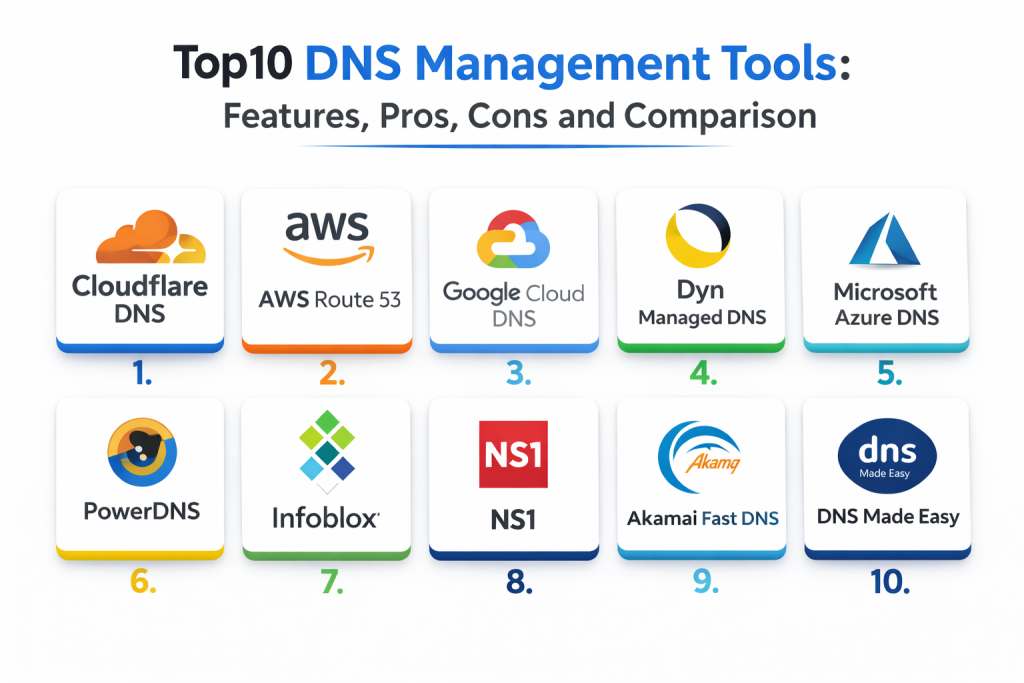
Top 10 DNS Management Tools
1 — Cloudflare DNS
Cloudflare DNS is one of the most popular managed DNS services, offering fast, secure, and highly available DNS resolution and management. It’s particularly well-suited for businesses seeking high performance and strong DDoS protection.
Key Features
- Fast DNS resolution with low-latency performance
- Built-in DDoS protection and DNSSEC support
- Global network with 200+ data centers for high availability
- Easy-to-use dashboard for managing DNS records
- Automatic DNS failover for service continuity
- Analytics and performance monitoring for DNS queries
- API for programmatic DNS record management
Pros
- Excellent DDoS protection and security features
- High availability and performance across global data centers
- Easy to set up and use, especially for small to medium-sized businesses
Cons
- Advanced features require higher-tier plans
- Limited integration with non-Cloudflare services
- Some users report limited support on lower plans
Platforms / Deployment
- Web
- Cloud-based
Security & Compliance
- DNSSEC, DDoS protection: Varies / Not publicly stated
- Compliance certifications: Not publicly stated
Integrations & Ecosystem
- Integrates well with Cloudflare’s other security and performance services
- Supports integration with third-party monitoring and security tools
Support & Community
- Excellent community resources and 24/7 enterprise-level support options
2 — AWS Route 53
AWS Route 53 is a highly scalable and reliable DNS management service from Amazon Web Services (AWS). It provides domain registration, DNS routing, and health checking, ideal for businesses operating in the AWS ecosystem.
Key Features
- DNS routing with multiple routing policies (simple, weighted, geolocation, etc.)
- Domain registration and management
- Health checks and automatic failover for high availability
- Integration with AWS services for easy scalability
- DNSSEC support for secure DNS resolution
- CloudWatch integration for monitoring and alerting
- API access for programmatic DNS management
Pros
- Seamless integration with AWS services and infrastructure
- Highly scalable and reliable for large networks
- Flexible routing policies for advanced use cases
Cons
- Best suited for AWS-centric environments
- Some features, such as health checks, incur additional charges
- Complex to configure for those not familiar with AWS
Platforms / Deployment
- Web
- Cloud-based
Security & Compliance
- DNSSEC: Varies / Not publicly stated
- Compliance certifications: Not publicly stated
Integrations & Ecosystem
- Integrates seamlessly with AWS Cloud infrastructure
- Supports integration with third-party network and security monitoring services
Support & Community
- Strong AWS support and documentation for DNS management
3 — Google Cloud DNS
Google Cloud DNS is a fully-managed DNS service that provides scalable, reliable, and low-latency DNS for applications running in Google Cloud. It is ideal for businesses already leveraging Google Cloud services.
Key Features
- High-performance DNS resolution with low-latency performance
- Fully integrated with Google Cloud services
- Easy-to-use interface for managing DNS records
- DNSSEC support for secure resolution
- Global anycast network for redundancy and availability
- API access for automation and integration
- Integration with Google Cloud Monitoring and Logging for DNS analytics
Pros
- Excellent for Google Cloud users looking for native DNS management
- Easy integration with Google Cloud infrastructure
- High performance and availability globally
Cons
- Limited to Google Cloud, less suitable for multi-cloud environments
- DNSSEC features are somewhat basic compared to other services
- Pricing can become complicated with high query volumes
Platforms / Deployment
- Web
- Cloud-based
Security & Compliance
- DNSSEC: Varies / Not publicly stated
- Compliance certifications: Not publicly stated
Integrations & Ecosystem
- Seamless integration with Google Cloud services
- Supports integration with Google Cloud Monitoring and Logging
Support & Community
- Strong support through Google Cloud services and extensive documentation
4 — Dyn Managed DNS
Dyn Managed DNS offers high-performance DNS services with features that include real-time monitoring, advanced routing, and DDoS protection, making it a top choice for large-scale, mission-critical DNS management.
Key Features
- High-performance DNS with advanced routing options
- DDoS protection and DNSSEC for security
- Real-time monitoring and analytics for DNS queries
- API for automation and DNS record management
- Geo-distribution of DNS traffic for optimized routing
- 24/7 support and service level agreements (SLAs)
Pros
- Excellent DDoS protection and uptime reliability
- Comprehensive reporting and real-time monitoring
- Flexible routing policies for traffic optimization
Cons
- Higher pricing compared to basic DNS services
- May be overkill for small organizations or non-critical applications
- Interface can be complex for users new to DNS management
Platforms / Deployment
- Web
- Cloud-based
Security & Compliance
- DNSSEC, DDoS protection: Varies / Not publicly stated
- Compliance certifications: Not publicly stated
Integrations & Ecosystem
- Integrates with cloud platforms, monitoring, and security tools
- Provides a comprehensive API for integration and automation
Support & Community
- Premium support options with strong enterprise-level service
5 — Microsoft Azure DNS
Microsoft Azure DNS is a cloud-based DNS hosting service that enables organizations to host their DNS records on Azure. It integrates natively with other Microsoft Azure services, making it a solid option for users already in the Azure ecosystem.
Key Features
- DNS hosting with Azure integration
- High availability and low-latency DNS resolution
- DNSSEC for security
- Integration with Azure Traffic Manager for load balancing
- Global DNS network with redundancy and failover support
- API access for programmatic DNS management
- Built-in monitoring through Azure Monitor
Pros
- Ideal for businesses already using Microsoft Azure
- High availability and low latency globally
- Simple to configure and integrate with Azure services
Cons
- Best suited for Azure-centric environments
- Limited to cloud-based DNS; not as flexible for hybrid environments
- Basic DNS analytics compared to other specialized platforms
Platforms / Deployment
- Web
- Cloud-based
Security & Compliance
- DNSSEC: Varies / Not publicly stated
- Compliance certifications: Not publicly stated
Integrations & Ecosystem
- Seamless integration with Microsoft Azure services
- Supports Azure Traffic Manager for load balancing
Support & Community
- Excellent support through Microsoft’s Azure platform
6 — PowerDNS
PowerDNS is an open-source DNS management platform that offers both authoritative DNS and recursive DNS services. It is widely used by large organizations and service providers for its flexibility and scalability.
Key Features
- Fully customizable DNS management platform
- Authoritative and recursive DNS services
- DNSSEC support for secure DNS resolution
- Real-time logging and reporting for performance analysis
- Multi-platform support for various server environments
- API access for automation and integration with other systems
Pros
- Open-source with strong community support
- Highly customizable and flexible for large-scale environments
- Suitable for both authoritative and recursive DNS management
Cons
- Requires technical expertise for setup and maintenance
- Basic UI compared to commercial alternatives
- Needs custom development for advanced use cases
Platforms / Deployment
- Linux / Windows
- Self-hosted
Security & Compliance
- DNSSEC: Varies / Not publicly stated
- Compliance certifications: Not publicly stated
Integrations & Ecosystem
- Flexible integrations with other tools and platforms via API
- Supports custom configurations and extensions
Support & Community
- Strong community support with extensive open-source documentation
7 — NS1
NS1 is an intelligent DNS and traffic management platform designed for modern applications and hybrid cloud environments. It helps organizations automate DNS routing decisions to optimize application performance.
Key Features
- Intelligent DNS traffic management
- Real-time monitoring and performance analytics
- API-driven automation for DNS configuration
- DNSSEC for security
- Load balancing and geolocation-based traffic routing
- Seamless integration with cloud and hybrid environments
Pros
- Excellent performance optimization for cloud-native applications
- Advanced traffic management and routing capabilities
- API-first platform with robust integration options
Cons
- Pricing can be high for smaller businesses
- Advanced features may require additional configuration expertise
- Complex setup for users new to DNS management
Platforms / Deployment
- Web
- Cloud-based
Security & Compliance
- DNSSEC: Varies / Not publicly stated
- Compliance certifications: Not publicly stated
Integrations & Ecosystem
- Integrates seamlessly with cloud providers and hybrid network environments
- Robust API support for automation and orchestration
Support & Community
- Enterprise-level support and a strong user community
8 — Akamai Fast DNS
Akamai Fast DNS is a highly reliable DNS management platform, designed for fast and secure DNS resolution at scale. It is best known for its resilience and is used by enterprises for mission-critical DNS services.
Key Features
- Fast DNS resolution with a globally distributed network
- DDoS protection and DNSSEC support
- High availability and redundancy across multiple locations
- Real-time DNS query monitoring and traffic analytics
- API support for programmatic management
- Automated failover and disaster recovery
Pros
- Fast DNS resolution and high availability
- Robust DDoS protection and security features
- Ideal for large-scale, high-traffic environments
Cons
- Pricing may be expensive for small to medium-sized businesses
- Limited configuration options compared to other platforms
- Primarily focused on large enterprise deployments
Platforms / Deployment
- Web
- Cloud-based
Security & Compliance
- DNSSEC, DDoS protection: Varies / Not publicly stated
- Compliance certifications: Not publicly stated
Integrations & Ecosystem
- Integrates well with enterprise-level security tools
- API support for automation and integration with other platforms
Support & Community
- Strong enterprise-level support with extensive resources
9 — DNS Made Easy
DNS Made Easy is a reliable DNS management platform that provides fast and secure DNS resolution, advanced failover, and automatic DNS traffic routing.
Key Features
- Global DNS network with low-latency performance
- DNSSEC support for secure DNS resolution
- Real-time monitoring and alerting for DNS performance
- Automatic failover for high-availability configurations
- Geolocation-based traffic routing and load balancing
- Easy-to-use interface for managing DNS records
Pros
- Affordable pricing for businesses of all sizes
- Fast DNS resolution and load balancing
- Strong failover capabilities for mission-critical domains
Cons
- Limited advanced features compared to premium alternatives
- Customer support may require a higher-tier plan
- Best suited for small to medium-sized businesses
Platforms / Deployment
- Web
- Cloud-based
Security & Compliance
- DNSSEC: Varies / Not publicly stated
- Compliance certifications: Not publicly stated
Integrations & Ecosystem
- Supports integrations with network and security tools
- Simple API for DNS record management
Support & Community
- Good customer support and resources for basic DNS management
10 — Infoblox
Infoblox provides enterprise-grade DNS, DHCP, and IPAM (DDI) services with advanced security, automation, and visibility capabilities. It is widely used for large-scale enterprise environments.
Key Features
- DNS, DHCP, and IP address management (DDI) in a unified platform
- High availability and resilience across network environments
- DNSSEC and DDoS protection for secure DNS resolution
- Centralized management for both DNS and IPAM
- Real-time monitoring and reporting on DNS traffic
- Automation for DNS updates and changes
Pros
- Comprehensive DDI management with robust security features
- Excellent for enterprise and large-scale network environments
- Reliable reporting and analytics for DNS performance
Cons
- Pricing is suited for large enterprises, not SMBs
- Complex deployment and maintenance for smaller teams
- Requires expertise for full setup and optimization
Platforms / Deployment
- Web
- Cloud / Hybrid
Security & Compliance
- DNSSEC, DDoS protection: Varies / Not publicly stated
- Compliance certifications: Not publicly stated
Integrations & Ecosystem
- Integrates with network, security, and IP management tools
- API support for automation and reporting
Support & Community
- Comprehensive enterprise support and strong community resources
Comparison Table
| Tool Name | Best For | Platform(s) Supported | Deployment | Standout Feature | Public Rating |
|---|---|---|---|---|---|
| Cloudflare DNS | High-performance DNS | Web | Cloud | DDoS protection and fast resolution | N/A |
| AWS Route 53 | Cloud-based DNS management | Web | Cloud | Seamless integration with AWS services | N/A |
| Google Cloud DNS | Cloud-native DNS management | Web | Cloud | High availability and low latency | N/A |
| Dyn Managed DNS | High-availability DNS | Web | Cloud | Real-time monitoring and failover | N/A |
| Microsoft Azure DNS | Azure-centric DNS management | Web | Cloud | Seamless Azure integration | N/A |
| PowerDNS | Open-source DNS management | Web / Linux | Self-hosted | Highly customizable and open-source | N/A |
| NS1 | Intelligent DNS management | Web | Cloud | Advanced traffic management and routing | N/A |
| Akamai Fast DNS | Enterprise-grade DNS | Web | Cloud | High-performance DNS and DDoS protection | N/A |
| DNS Made Easy | Reliable DNS for SMBs | Web | Cloud | Affordable pricing and failover support | N/A |
| Infoblox | Enterprise DNS, IPAM, DDI | Web / Linux | Cloud / Hybrid | Complete DDI management with security | N/A |
Evaluation & Scoring of DNS Management Tools
Weights: Core features 25%, Ease of use 15%, Integrations & ecosystem 15%, Security & compliance 10%, Performance & reliability 10%, Support & community 10%, Value (price) 15%.
Comparison Table
| Tool Name | Best For | Platform(s) Supported | Deployment | Standout Feature | Public Rating |
|---|---|---|---|---|---|
| Cloudflare DNS | High-performance DNS | Web | Cloud | DDoS protection and fast resolution | N/A |
| AWS Route 53 | Cloud-based DNS management | Web | Cloud | Seamless integration with AWS services | N/A |
| Google Cloud DNS | Cloud-native DNS management | Web | Cloud | High availability and low latency | N/A |
| Dyn Managed DNS | High-availability DNS | Web | Cloud | Real-time monitoring and failover | N/A |
| Microsoft Azure DNS | Azure-centric DNS management | Web | Cloud | Seamless Azure integration | N/A |
| PowerDNS | Open-source DNS management | Web / Linux | Self-hosted | Highly customizable and open-source | N/A |
| NS1 | Intelligent DNS management | Web | Cloud | Advanced traffic management and routing | N/A |
| Akamai Fast DNS | Enterprise-grade DNS | Web | Cloud | High-performance DNS and DDoS protection | N/A |
| DNS Made Easy | Reliable DNS for SMBs | Web | Cloud | Affordable pricing and failover support | N/A |
| Infoblox | Enterprise DNS, IPAM, DDI | Web / Linux | Cloud / Hybrid | Complete DDI management with security | N/A |
Which DNS Management Tool Is Right for You
Solo / Freelancer
For small environments, DNS Made Easy and PowerDNS provide affordable, easy-to-use DNS management with essential features. Cloudflare DNS is also a great option for performance and security with minimal setup.
SMB
Small and medium-sized businesses should consider Akamai Fast DNS or Google Cloud DNS for reliable performance and easy-to-manage DNS configurations. These tools offer good security features without complex configurations.
Mid-Market
For businesses with multi-site needs, Dyn Managed DNS and NS1 provide intelligent routing, performance optimization, and enhanced security features for scalable environments. They integrate well with cloud and hybrid infrastructures.
Enterprise
Enterprises should consider Infoblox and Cisco Umbrella for advanced DNS, IPAM, and DDI management across large-scale networks. These tools offer full-stack visibility, security, and compliance features, ideal for high-availability and mission-critical environments.
Budget vs Premium
DNS Made Easy and PowerDNS offer budget-friendly options for SMBs, while NS1, Akamai, and Infoblox are premium tools with advanced capabilities suited for larger, more complex networks.
Feature Depth vs Ease of Use
For simple and straightforward DNS management, Google Cloud DNS and DNS Made Easy are excellent choices. For teams needing deeper analytics and intelligent routing, NS1 and Akamai Fast DNS are better suited.
Integrations & Scalability
AWS Route 53 and Microsoft Azure DNS are excellent choices for teams already embedded in their respective cloud ecosystems. Infoblox and NS1 provide scalable, multi-cloud support with advanced security features.
Security & Compliance Needs
For organizations requiring strong security and compliance features, Infoblox and Cloudflare DNS provide robust DNSSEC, DDoS protection, and threat mitigation features.
Frequently Asked Questions
- What is DNS management?
DNS management involves handling DNS records, domain configurations, and network settings to ensure efficient and secure domain resolution. - Why is DNSSEC important?
DNSSEC provides security to DNS queries by preventing data tampering, DNS spoofing, and man-in-the-middle attacks. - How do I secure my DNS?
Securing DNS involves using DNSSEC, DDoS protection, and monitoring for unusual traffic patterns. - Can DNS management tools help with performance optimization?
Yes, many tools offer traffic routing, load balancing, and performance monitoring to optimize DNS query resolution times. - What is DNS failover?
DNS failover ensures that if one DNS server goes down, another takes over, maintaining availability for your domain. - What is the difference between authoritative and recursive DNS?
Authoritative DNS stores domain records, while recursive DNS resolves those records to the end user’s device. - How do I choose the best DNS management tool?
Consider factors like the number of domains, security features, integration options, performance needs, and ease of use when selecting a tool. - Can these tools manage both internal and external DNS?
Yes, most tools support both internal and external DNS, providing a unified view of your network’s DNS health. - Do these tools support cloud environments?
Yes, many DNS management tools integrate seamlessly with cloud providers, offering hybrid and multi-cloud support. - What is the cost of DNS management tools?
Costs vary based on features, scale, and licensing. Some platforms offer free tiers for small businesses, while enterprise-level tools may require custom pricing.
Conclusion
DNS management tools are essential for maintaining the performance, reliability, and security of any organization’s network infrastructure. Whether you’re managing a small network or a large enterprise, the right DNS management platform helps ensure your DNS records are secure, your network is available, and your applications perform optimally. By evaluating your needs, considering factors like security, scalability, and ease of use, you can choose the best DNS management tool to support your organization’s network operations.

Best Cardiac Hospitals Near You
Discover top heart hospitals, cardiology centers & cardiac care services by city.
Advanced Heart Care • Trusted Hospitals • Expert Teams
View Best Hospitals