Introduction
Enterprise Risk Management (ERM) tools are sophisticated software platforms designed to help organizations identify, assess, manage, and monitor risks across the entire business. Unlike traditional spreadsheets or siloed risk tracking, these tools provide a centralized “single source of truth” that connects strategic, operational, financial, and compliance risks. In the current global environment, where threats range from cyberattacks and supply chain disruptions to rapid regulatory shifts, ERM software serves as a critical radar system for leadership, enabling them to make data-driven decisions while protecting organizational value.
Modern ERM solutions have transitioned from reactive repositories to proactive intelligence hubs. They utilize advanced data models to map the interdependencies between different risk categories, ensuring that a failure in one department is immediately understood for its impact on the rest of the firm. By automating the collection of evidence and the triggering of mitigation workflows, these platforms move risk management from an annual administrative task to a continuous, value-generating business process.
Best for: Large corporations, financial institutions, healthcare providers, and government entities that require a high-level view of risk across multiple departments and complex regulatory environments.
Not ideal for: Small startups with very simple operations, or organizations looking for basic task management without the need for deep risk quantification and cross-functional reporting.
Key Trends in Enterprise Risk Management Software
- Agentic AI and Predictive Intelligence: AI has evolved into autonomous agents capable of independent risk planning, identifying potential threats by analyzing vast datasets before they manifest as incidents.
- Continuous Monitoring and Real-Time Alerts: Periodic risk assessments are being replaced by continuous control monitoring that provides instant alerts when risk thresholds are breached.
- Consolidation of GRC Ecosystems: Organizations are moving away from fragmented point solutions toward unified Governance, Risk, and Compliance (GRC) platforms to eliminate data silos.
- Quantification of Non-Financial Risk: Tools are increasingly using Monte Carlo simulations and other mathematical models to put a financial value on operational and reputational risks.
- Supply Chain Resilience and Ethical Sourcing: Enhanced focus on multi-tier third-party risk management, ensuring that vendors not only meet security standards but also ethical and ESG requirements.
- Executive Accountability Features: New modules designed specifically for board members and C-suite executives to track their personal liability and certification obligations.
- Interoperability via Universal Formats: Support for standardized data exchange formats allows ERM tools to pull real-time risk data directly from ERP, CRM, and HR systems.
- Geopolitical and Macroeconomic Modeling: Integration of external data feeds to simulate the impact of regional conflicts, trade volatility, and economic shifts on the business.
How We Selected These Tools
- Market Leadership and Proven Track Record: We prioritized platforms that are recognized as leaders by major research firms and widely adopted by the Global 2000.
- Full-Spectrum Risk Coverage: Only tools capable of managing strategic, operational, IT, and financial risks within a single integrated environment were considered.
- Automation and Workflow Sophistication: Evaluation centered on the ability to automate risk assessments, evidence collection, and remediation tracking.
- Scalability and Customization: We selected tools that can adapt to the unique taxonomies and methodologies of various industries without requiring custom coding.
- Enterprise-Grade Security: A high weight was placed on platforms offering robust security certifications and multi-tenant or dedicated cloud deployment options.
- Reporting and Executive Dashboards: The ability to translate raw risk data into board-ready visual narratives was a primary requirement for this list.
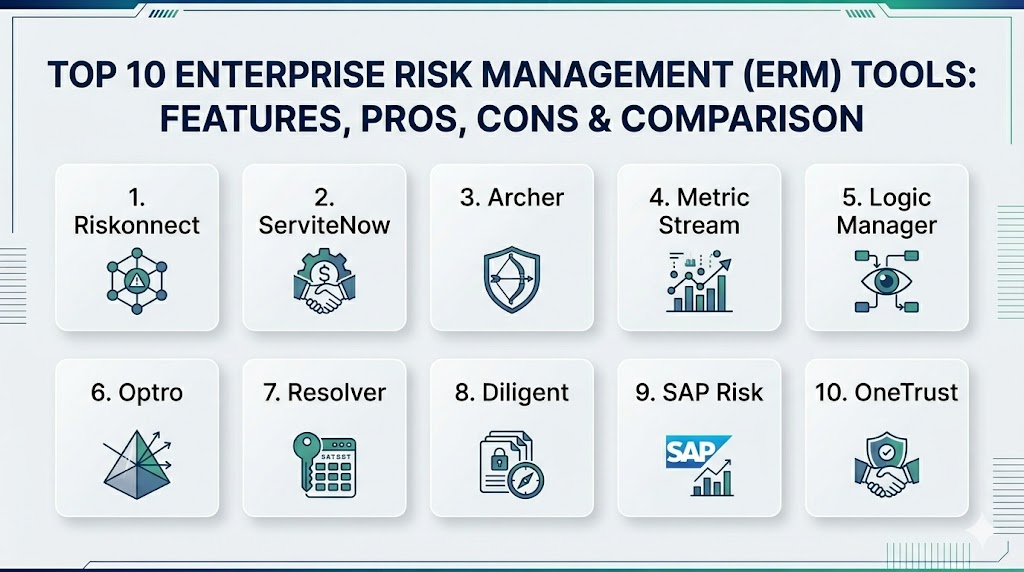
Top 10 Enterprise Risk Management (ERM) Tools
1. Riskonnect
As a highly integrated platform built on the Salesforce architecture, this tool is known for its ability to connect risk data across every function of the organization. It is a preferred choice for firms that need to bridge the gap between insurable risk, claims, and broader enterprise governance.
Key Features
- Integrated risk repository that links operational, IT, and strategic risks.
- Advanced claims and insurance management modules for financial risk tracking.
- Real-time risk analytics with customizable heat maps and dashboards.
- Robust business continuity and disaster recovery planning tools.
- Automated workflow engine for incident reporting and remediation.
Pros
- Exceptional depth in operational risk and insurance-related data.
- Highly scalable environment that grows with the organization’s maturity.
Cons
- Setup and initial alignment with business needs can be time-consuming.
- Licensing costs are positioned at the premium end of the market.
Platforms / Deployment
Web / Windows / macOS / iOS / Android
Cloud
Security & Compliance
SSO, MFA, and full audit trails via the Salesforce platform.
SOC 2, ISO 27001, and HIPAA compliant.
Integrations & Ecosystem
Leverages the massive Salesforce ecosystem for easy integration with CRM and financial data. It offers a wide range of pre-built connectors for standard enterprise applications.
Support & Community
Comprehensive support including a dedicated customer success portal, global user groups, and extensive technical documentation.
2. ServiceNow Integrated Risk Management (IRM)
This tool excels by embedding risk and compliance directly into the existing digital workflows of an organization. It is the natural choice for enterprises already using the platform for IT service management and operations.
Key Features
- Automated continuous monitoring tied directly to the enterprise configuration database.
- AI-powered actionable insights that detect anomalies in operational data.
- Unified data model that eliminates silos between risk, audit, and IT teams.
- No-code playbooks for managing cross-functional risk workflows.
- Dynamic risk scoring that updates automatically as the underlying environment changes.
Pros
- Unbeatable for organizations that want to automate risk through their IT infrastructure.
- Strong cross-functional collaboration capabilities within a single interface.
Cons
- Implementation can be complex in large, non-standard environments.
- Requires a mature platform ecosystem to unlock its full potential.
Platforms / Deployment
Web / Windows / macOS / iOS / Android
Cloud / Hybrid
Security & Compliance
SSO, MFA, RBAC, and zero-trust access controls.
SOC 2, ISO 27001, FedRAMP, and GDPR compliant.
Integrations & Ecosystem
Offers seamless data sharing across all products on the platform, including ITSM, HR, and SecOps. It features an extensive library of third-party store apps.
Support & Community
Massive global community of developers and administrators. Professional support is available through a tiered service model.
3. Archer (formerly RSA Archer)
A long-standing leader in the space, this platform is known for its incredible depth and configurability. it is often the standard for large, complex organizations with highly mature risk programs.
Key Features
- Modular design allowing organizations to start small and expand as needed.
- Advanced risk quantification and scenario modeling capabilities.
- Comprehensive regulatory intelligence feeds that update compliance requirements.
- Deep third-party and vendor risk management modules.
- Enterprise-wide risk cataloging with highly customizable scoring models.
Pros
- The most flexible and configurable platform for complex enterprise needs.
- Decades of proven track record in highly regulated industries.
Cons
- Steeper learning curve for non-technical users and administrators.
- Often requires dedicated internal resources for platform management.
Platforms / Deployment
Web / Windows / macOS
Cloud / Self-hosted / Hybrid
Security & Compliance
Enterprise identity management and advanced encryption at rest.
SOC 2 and ISO 27001 compliant.
Integrations & Ecosystem
Integrates with a wide range of enterprise data sources including SAP, Oracle, and major cybersecurity tools.
Support & Community
Well-established user community and a professional services network for custom implementations.
4. MetricStream
This tool is a market-leading platform that integrates cyber, IT, operational, and third-party risk into a single AI-driven system. It is specifically designed to handle the scale and complexity of Fortune 500 companies.
Key Features
- AI-first risk management that predicts threats and automates assessments.
- Unified risk data repository for centralizing all enterprise assets and threats.
- Framework-aligned controls for ISO, NIST, and other global standards.
- Quantified cyber risk insights with financial impact estimations.
- Automated threat management and vulnerability scanning integration.
Pros
- Significant reduction in the time required to complete risk assessments.
- Excellent at managing complex, cross-departmental risk programs at scale.
Cons
- High implementation and licensing costs compared to mid-market tools.
- The interface can be overwhelming for teams with lower risk maturity.
Platforms / Deployment
Web / Windows / macOS
Cloud
Security & Compliance
SSO, SAML, and advanced audit-level logging.
SOC 2 and ISO 27001 compliant.
Integrations & Ecosystem
Offers deep integration with major ERP and financial systems. Its AI engine connects to external regulatory and threat intelligence feeds.
Support & Community
Provides professional training certifications and a global support network for enterprise clients.
5. LogicManager
Known for its accessibility and rapid time-to-value, this platform provides an all-in-one GRC solution that is particularly effective for mid-market and growing enterprise organizations.
Key Features
- Centralized risk library with pre-built templates and scoring methods.
- Logic-based workflow automation that routes approvals and remediations.
- Integrated privacy and cybersecurity risk management modules.
- One-click compliance reporting for regulators and senior management.
- Root cause analysis tools to prevent recurring risk incidents.
Pros
- Intuitive user interface that encourages high adoption across the company.
- Faster implementation cycle than many traditional enterprise platforms.
Cons
- Advanced custom use cases may require more manual configuration than expected.
- Support for on-premises deployment is limited.
Platforms / Deployment
Web / iOS / Android
Cloud
Security & Compliance
RBAC, MFA, and encrypted data storage.
SOC 2, ISO 27001, and HIPAA compliant.
Integrations & Ecosystem
Connects seamlessly to common business tools and offers an API for custom data ingestion from internal systems.
Support & Community
Highly rated for customer support and provides a wealth of educational resources through its online academy.
6. Optro (formerly AuditBoard)
This platform has evolved from an audit-focused tool into a comprehensive connected risk platform. It is praised for its modern interface and its ability to link audit, risk, and compliance data seamlessly.
Key Features
- Integrated workflows that connect controls, tests, and issues across the firm.
- Automated evidence collection to reduce the administrative burden on teams.
- Real-time executive reporting and board-level risk dashboards.
- ESG and sustainability risk tracking modules.
- Collaborative workspace for internal and external auditors.
Pros
- Extremely clean and modern user experience that feels familiar to most users.
- High marks for customer satisfaction and responsive technical support.
Cons
- Traditionally stronger in audit, though its ERM capabilities are expanding rapidly.
- Pricing can be higher than other modern, cloud-native competitors.
Platforms / Deployment
Web / Windows / macOS
Cloud
Security & Compliance
SSO, MFA, and advanced encryption protocols.
SOC 2 Type II and ISO 27001 compliant.
Integrations & Ecosystem
Integrates with a vast array of cloud applications and offers over 400 pre-built connectors for automated evidence gathering.
Support & Community
Consistently rated as a leader in user satisfaction with a very strong online presence and support portal.
7. Resolver
This software focuses on “risk intelligence,” providing a cloud-based platform that links incidents directly to enterprise risks. It is a powerful choice for organizations that need to understand how small daily events impact strategic goals.
Key Features
- Incident and investigation tracking that feeds directly into the risk register.
- Visual data visualizations and heat maps for trend analysis.
- Configurable approvals and automated remediation workflows.
- Risk appetite modeling and scenario planning tools.
- Centralized reporting across risk, compliance, and audit domains.
Pros
- Excellent at bridging the gap between operational incidents and enterprise risk.
- Quick out-of-the-box setup for standard risk and incident management.
Cons
- Advanced customization options are more limited than the highest-tier enterprise suites.
- Some users find the deep analytical reporting requires a learning curve.
Platforms / Deployment
Web / Windows / iOS / Android
Cloud
Security & Compliance
Role-based access controls and encrypted data transmission.
SOC 2 compliant.
Integrations & Ecosystem
Strong capabilities for integrating with security and incident detection systems to automate data entry.
Support & Community
Active professional community and solid documentation for administrators and end-users.
8. Diligent ERM
Diligent provides a specialized platform that emphasizes governance and executive-level oversight. It is the leading choice for organizations that want to ensure their risk data is board-ready and aligned with strategic governance.
Key Features
- Strategic risk oversight modules designed specifically for boards.
- Real-time risk intelligence feeds for C-suite decision-making.
- Automated meeting preparation and secure board portal integration.
- AI-powered insights that highlight emerging risks in corporate data.
- Compliance and audit management linked to executive accountability.
Pros
- The best solution for high-level governance and board communication.
- Intuitive dashboards that provide a clear view of strategic risk posture.
Cons
- Functional depth for deep operational risk management may be less than specialized tools.
- Targeted primarily at the executive level, which may feel restrictive for some teams.
Platforms / Deployment
Web / Windows / macOS / iOS / Android
Cloud / Hybrid
Security & Compliance
Highest-tier security for sensitive board-level data.
SOC 2, ISO 27001, and HIPAA compliant.
Integrations & Ecosystem
Integrates with major financial and governance platforms, plus its own suite of board management tools.
Support & Community
Premium support model with high availability for executive and administrative users.
9. SAP Risk Management
For organizations deeply invested in the SAP ecosystem, this tool provides a native way to monitor key risk indicators directly within the core business processes.
Key Features
- Real-time risk identification and response within SAP workflows.
- Continuous monitoring of key risk indicators (KRIs) across the ERP.
- Opportunity heat maps for analyzing risk alongside business growth.
- Guided remediation workflows that link directly to financial controls.
- Deep integration with SAP Analytics Cloud for advanced reporting.
Pros
- The most natural choice for firms already running their operations on SAP.
- Powerful ability to correlate risk with real-time transactional data.
Cons
- Extremely complex and costly to implement for those outside the SAP environment.
- UI can feel more traditional and less intuitive than modern cloud-native apps.
Platforms / Deployment
Web / Windows / iOS / Android
Cloud / Self-hosted / Hybrid
Security & Compliance
Uses the robust SAP security framework for access and data protection.
SOC 2 and ISO 27001 compliant.
Integrations & Ecosystem
Perfectly integrated with all other SAP GRC and ERP modules, providing a unified enterprise view.
Support & Community
Backed by the massive SAP global support infrastructure and professional services network.
10. OneTrust GRC
While originally focused on privacy, OneTrust has expanded into a powerful risk and compliance platform. It is particularly strong for organizations prioritizing data rights, vendor risk, and global regulatory compliance.
Key Features
- Shared evidence framework that reuses data across multiple regulations.
- Advanced vendor and third-party risk scoring and assessments.
- Real-time risk mapping and scoring based on data flow and privacy.
- Automated regulatory monitoring and control mapping.
- Integrated ethics and whistleblower hotline modules.
Pros
- Leading capability in data privacy and digital risk management.
- Clean, modern interface with a focus on ease of evidence collection.
Cons
- Broad enterprise risk modules are still maturing compared to its privacy features.
- Can be expensive as additional modules are added to the platform.
Platforms / Deployment
Web / Windows / macOS
Cloud
Security & Compliance
SSO, MFA, and extensive data governance controls.
SOC 2, ISO 27001, and GDPR compliant.
Integrations & Ecosystem
Features one of the largest integration libraries for cloud-first organizations, specifically around data and IT systems.
Support & Community
Very strong community support and extensive training resources focused on global compliance and risk.
Comparison Table
| Tool Name | Best For | Platform(s) Supported | Deployment | Standout Feature | Public Rating |
| 1. Riskonnect | Insurance & Ops | Web, Mobile | Cloud | Claims Integration | N/A |
| 2. ServiceNow | IT-Driven Risk | Web, Mobile | Hybrid | CMDB Integration | N/A |
| 3. Archer | Complex Enterprise | Web, Windows | Hybrid | High Configurability | N/A |
| 4. MetricStream | Fortune 500 | Web, Windows | Cloud | AI Risk Prediction | N/A |
| 5. LogicManager | Rapid Adoption | Web, Mobile | Cloud | Intuitive Workflows | N/A |
| 6. Optro | Audit-Led Risk | Web, Windows | Cloud | Evidence Automation | N/A |
| 7. Resolver | Incident Tracking | Web, Mobile | Cloud | Risk Intelligence | N/A |
| 8. Diligent | Board Governance | Web, Mobile | Hybrid | Board Integration | N/A |
| 9. SAP Risk | SAP Ecosystem | Web, Mobile | Hybrid | KRI Monitoring | N/A |
| 10. OneTrust | Privacy & Digital | Web, Windows | Cloud | Evidence Reuse | N/A |
Evaluation & Scoring
| Tool Name | Core (25%) | Ease (15%) | Integrations (15%) | Security (10%) | Perf (10%) | Support (10%) | Value (15%) | Total |
| 1. Riskonnect | 9 | 7 | 9 | 9 | 9 | 8 | 7 | 8.25 |
| 2. ServiceNow | 9 | 6 | 10 | 9 | 10 | 9 | 7 | 8.40 |
| 3. Archer | 10 | 4 | 9 | 9 | 9 | 8 | 6 | 7.75 |
| 4. MetricStream | 10 | 5 | 9 | 9 | 10 | 8 | 6 | 8.00 |
| 5. LogicManager | 8 | 9 | 8 | 8 | 8 | 9 | 9 | 8.40 |
| 6. Optro | 8 | 9 | 9 | 9 | 9 | 9 | 8 | 8.60 |
| 7. Resolver | 8 | 8 | 8 | 8 | 9 | 8 | 8 | 8.10 |
| 8. Diligent | 7 | 9 | 8 | 9 | 9 | 9 | 7 | 8.15 |
| 9. SAP Risk | 9 | 4 | 10 | 9 | 10 | 8 | 6 | 7.75 |
| 10. OneTrust | 8 | 8 | 10 | 9 | 9 | 8 | 8 | 8.40 |
The scoring model above provides a comparative view based on typical enterprise requirements. High scores in the “Core” category represent tools with the deepest functional maturity, such as Archer or MetricStream. Conversely, tools like Optro and LogicManager score higher in “Ease of Use,” making them ideal for organizations that prioritize rapid deployment and user adoption. The “Integrations” score is highest for ServiceNow and SAP due to their ability to natively connect with operational data at the source.
Which Enterprise Risk Management (ERM) Tool Is Right for You?
Solo / Freelancer
For individual consultants or very small firms, a full enterprise suite is usually unnecessary. Focus on compliance-first tools like OneTrust if you are handling data privacy, or look for lightweight SaaS options that prioritize task tracking over complex risk modeling.
SMB
Small to medium businesses should prioritize ease of setup and out-of-the-box functionality. LogicManager and Resolver are excellent choices here, as they provide powerful risk intelligence without the massive implementation overhead of larger suites.
Mid-Market
Growing companies need a balance of depth and accessibility. Optro is often the winner in this segment, offering a clean user interface that is easy to train across departments while providing the sophisticated audit and risk linkage required by maturing firms.
Enterprise
For global organizations with thousands of employees, the focus must be on scalability and infrastructure integration. ServiceNow and Riskonnect are the top contenders, as they allow risk to be embedded into the actual daily operations of the business.
Budget vs Premium
If budget is the primary constraint, cloud-native platforms like LogicManager provide the most value per dollar. For those where cost is secondary to the need for extreme configurability and specialized modules, premium platforms like Archer or MetricStream are the industry standards.
Feature Depth vs Ease of Use
Highly technical teams in finance or energy may require the deep procedural nodes and math-based modeling of Archer. However, most corporate risk teams find that the user-friendly interface of Diligent or OneTrust results in higher data quality because employees actually use the tool.
Integrations & Scalability
If your goal is to automate risk based on real-time IT data, ServiceNow is essentially unrivaled. For those who need to scale risk management across complex supply chains and hundreds of global vendors, MetricStream provides the most robust architecture.
Security & Compliance Needs
For firms in healthcare or government contracting, the compliance history and security framework of Archer and SAP provide the highest level of assurance. Organizations focused on the latest digital privacy laws will find the best support within the OneTrust ecosystem.
Frequently Asked Questions (FAQs)
1. What is an Enterprise Risk Management (ERM) tool?
It is a centralized platform that helps businesses identify, evaluate, and mitigate risks across all departments, providing a unified view of the organization’s total risk posture.
2. How do ERM tools differ from standard GRC software?
While often used interchangeably, ERM tools focus specifically on the identification and mitigation of business risks, whereas GRC is a broader category that includes governance and regulatory compliance workflows.
3. Do these tools support automated regulatory updates?
Yes, most top-tier ERM tools include or integrate with regulatory intelligence feeds that automatically alert teams to changes in laws and standards across different jurisdictions.
4. Can I use these tools to calculate the financial impact of a risk?
Modern platforms like MetricStream and Archer include risk quantification modules that use mathematical models to estimate the potential monetary loss of an incident.
5. How long does a typical ERM software implementation take?
Cloud-native tools can be set up in 3–6 months, while complex enterprise-wide deployments for tools like SAP or Archer can take a year or longer to fully integrate.
6. Are these platforms secure enough for sensitive board data?
Yes, leading providers like Diligent and Riskonnect offer specialized encryption, multi-factor authentication, and SOC 2 certifications designed to protect high-level corporate data.
7. Is it possible to integrate these tools with our existing ERP?
Most enterprise ERM tools offer APIs or pre-built connectors to integrate with major ERP systems like SAP, Oracle, and Microsoft Dynamics for real-time data ingestion.
8. Why is AI becoming a standard feature in risk software?
AI helps teams move from reactive to predictive risk management by identifying patterns in massive datasets that human analysts might miss, allowing for earlier intervention.
9. Can I manage third-party or vendor risk in these tools?
Yes, vendor risk management is a core module for most of these platforms, allowing you to send assessments to third parties and track their security and compliance levels.
10. What is the most common mistake when choosing an ERM tool?
Over-complicating the requirements. Many firms buy the most complex tool available but fail to implement it effectively because the interface is too difficult for the average employee to use.
Conclusion
Selecting an Enterprise Risk Management tool is a strategic investment that determines how resilient an organization will be in the face of uncertainty. The current market offers a clear choice between deep, highly configurable legacy systems and agile, cloud-native platforms that prioritize user adoption and real-time automation. Successful implementation requires more than just picking a top-rated tool; it demands a clear understanding of your organizational risk maturity and the specific data silos you need to break down. By choosing a platform that aligns with your operational culture and security requirements, you transform risk management from a compliance checkbox into a powerful competitive advantage that supports long-term growth and stability.

Best Cardiac Hospitals Near You
Discover top heart hospitals, cardiology centers & cardiac care services by city.
Advanced Heart Care • Trusted Hospitals • Expert Teams
View Best Hospitals