Introduction
Environmental, Social, and Governance reporting platforms are specialized enterprise software solutions designed to collect, manage, and disclose sustainability data. These systems have moved beyond simple spreadsheet replacements to become mission-critical infrastructure for the modern C-suite. They allow organizations to track their carbon footprint, social impact, and corporate governance metrics with the same level of rigor applied to financial accounting. In the current regulatory environment, these platforms serve as a bridge between operational activities and investor-grade disclosures, ensuring that sustainability claims are backed by verifiable data.
The urgency for these tools is driven by a global shift toward mandatory disclosure. Organizations now face intense pressure from regulators, institutional investors, and consumers to prove their sustainability performance. These platforms help navigate a complex web of frameworks while identifying operational efficiencies that reduce costs and carbon simultaneously. By centralizing disparate data points—from utility bills and HR records to supplier surveys—they provide a “single source of truth” that is essential for both compliance and strategic decision-making.
Best for: Large multi-national corporations, financial institutions managing diverse portfolios, and publicly traded companies that require audit-ready data for regulatory filings and investor relations.
Not ideal for: Very small businesses with minimal environmental footprints, or organizations looking for simple marketing tools without the need for rigorous data validation and complex carbon accounting.
Key Trends in ESG Reporting Platforms
- AI-Driven Data Ingestion: Automated systems are now using machine learning to scan thousands of utility bills, invoices, and PDF documents to extract relevant ESG data points without manual entry.
- Audit-Grade Assurance: Platforms are incorporating blockchain-like immutability and detailed audit trails to ensure data is “assurance-ready” for third-party auditors and regulators.
- Double Materiality Workflows: New features help companies assess not just how ESG issues affect their business, but also how their business impacts the environment and society.
- Real-Time Carbon Accounting: Moving from annual reporting to real-time dashboards that track Scope 1, 2, and 3 emissions as they happen, allowing for faster corrective actions.
- Supply Chain Transparency: Deep integration with procurement systems to collect primary data from thousands of global suppliers rather than relying on industry averages.
- Framework Mapping Automation: Software can now automatically “cross-map” a single data point to multiple international frameworks, reducing the burden of repetitive reporting.
- Predictive Analytics and Modeling: Advanced scenario planning tools that allow executives to model the financial and environmental impact of different decarbonization strategies.
- Natural Language Generation (NLG): AI assistants help draft the narrative sections of sustainability reports based on the underlying quantitative data.
How We Selected These Tools
- Regulatory Alignment: We prioritized platforms that have deep support for mandatory standards like CSRD, ESRS, and the SEC climate disclosure rules.
- Technical Scalability: The selection includes tools capable of handling massive datasets across global business units with thousands of data contributors.
- Interoperability: We focused on platforms with robust API ecosystems that connect seamlessly to ERP, HRIS, and financial systems.
- Security and Governance: Each tool was evaluated for its ability to provide role-based access control, secure data storage, and comprehensive audit logs.
- Carbon Accounting Depth: Preference was given to platforms with scientifically grounded emissions factor libraries and advanced Scope 3 calculation capabilities.
- Market Trust and Momentum: We selected platforms that are widely recognized by independent analysts and used by a significant portion of the Fortune Global 500.
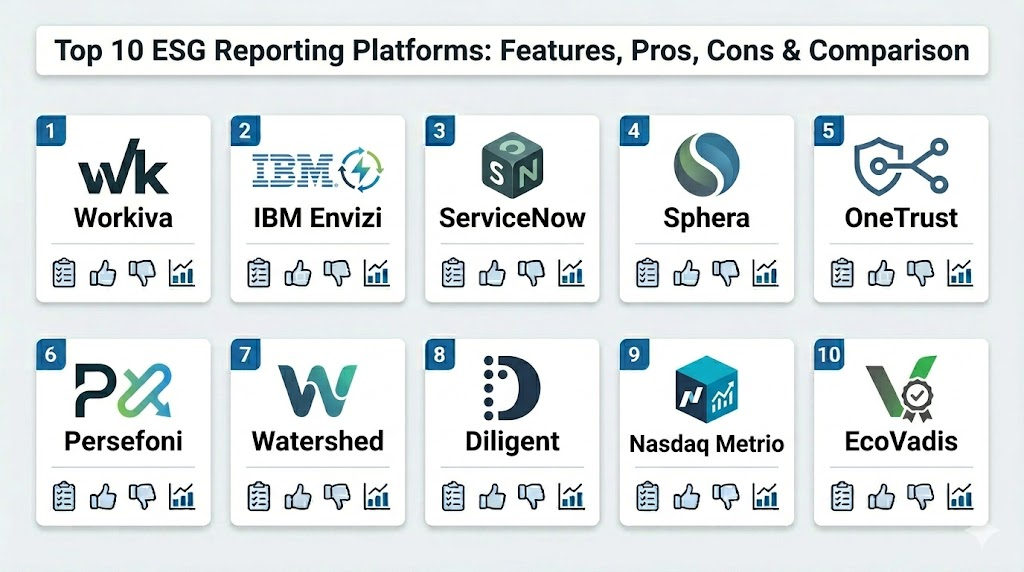
Top 10 ESG Reporting Platforms
1. Workiva
Workiva is widely recognized for its “connected reporting” approach, bringing together finance, ESG, and audit teams into a single collaborative cloud environment. It excels at linking data points directly from their source to the final disclosure, ensuring that any change in data is reflected throughout the entire report instantly.
Key Features
- Direct connectivity to ERP and financial systems for seamless data flow.
- Advanced collaborative drafting tools with full version control and audit history.
- Integrated framework explorer covering GRI, SASB, and TCFD standards.
- Automated certification workflows to ensure data accuracy before publication.
- Carbon accounting capabilities integrated directly with financial reporting.
Pros
- Unbeatable for teams that need to align ESG data with financial filings.
- Excellent collaboration features for large, cross-functional teams.
Cons
- The platform’s broad functionality can be complex for small teams to set up.
- Higher price point reflecting its enterprise-grade compliance focus.
Platforms / Deployment
Web / Windows / macOS
Cloud
Security & Compliance
SSO/SAML, MFA, and SOC 2 Type II compliant.
ISO 27001 and GDPR compliant.
Integrations & Ecosystem
Workiva connects to hundreds of data sources including SAP, Oracle, and Workday. It acts as a central orchestrator for all corporate reporting data.
Support & Community
Professional enterprise support with dedicated customer success managers and an active user community focused on compliance and reporting.
2. IBM Envizi
IBM Envizi focuses on turning raw data into actionable insights through a powerful data management foundation. It is particularly strong in emissions management and decarbonization planning for organizations with large physical footprints.
Key Features
- Automated capture of utility, energy, and waste data from across a global portfolio.
- Comprehensive GHG emissions engine supporting Scope 1, 2, and 3 calculations.
- AI-infused forecasting and planning tools for net-zero pathway modeling.
- Customizable dashboards for internal performance tracking and benchmarking.
- Centralized document storage for audit evidence and third-party assurance.
Pros
- Deep expertise in energy and environmental data management.
- Highly scalable for organizations with thousands of individual facilities.
Cons
- User interface can feel more technical than some modern competitors.
- Requires a structured implementation process for maximum value.
Platforms / Deployment
Web
Cloud
Security & Compliance
Enterprise-grade security backed by IBM’s infrastructure standards.
ISO 27001 and SOC 2 compliant.
Integrations & Ecosystem
Strong integration with building management systems and IBM’s broader Maximo asset management suite. It also supports standard API-based data ingestion.
Support & Community
Global support network with extensive documentation and a strong partner ecosystem for implementation services.
3. ServiceNow ESG Management
ServiceNow leverages its existing enterprise workflow platform to treat ESG as a cross-departmental business process. It is ideal for companies already using the platform for IT or HR service management.
Key Features
- Materiality assessment tools that help visualize and prioritize key ESG topics.
- Integrated goal tracking that links daily activities to long-term ESG targets.
- Automated data collection workflows that trigger tasks for data owners.
- Direct integration with Microsoft Office for narrative report drafting.
- Comprehensive carbon calculation engine based on the GHG Protocol.
Pros
- Leverages existing internal workflows to reduce reporting friction.
- Excellent for managing the “S” and “G” aspects of ESG alongside environmental data.
Cons
- Most effective when used by organizations already invested in the ServiceNow ecosystem.
- Can require significant configuration to match unique organizational structures.
Platforms / Deployment
Web / iOS / Android
Cloud
Security & Compliance
Built on the highly secure ServiceNow platform with extensive certifications.
ISO 27001, SOC 2, and FedRAMP compliant (varies by region).
Integrations & Ecosystem
Integrates natively with HR, IT, and risk management modules within the platform, as well as external systems like Workday.
Support & Community
Massive global community of developers and partners, supported by ServiceNow’s professional services and extensive training portal.
4. Sphera
Sphera provides specialized software and data for environmental, health, safety, and sustainability (EHS&S). It is renowned for its scientifically rigorous databases and focus on industrial operational intelligence.
Key Features
- Access to Managed LCA Content databases for high-precision emissions calculations.
- Integrated EHS management for a holistic view of operational risk.
- Automated regulatory monitoring to ensure compliance with changing laws.
- Advanced product sustainability tools for Life Cycle Assessments (LCAs).
- Corporate sustainability reporting modules tailored to complex industries.
Pros
- The industry standard for scientifically accurate carbon and material data.
- Combines EHS risk with sustainability for industrial enterprises.
Cons
- Interface is geared toward technical specialists rather than general business users.
- Complexity may be higher than needed for pure reporting tasks.
Platforms / Deployment
Windows / Web
Cloud / Hybrid
Security & Compliance
Strict enterprise security protocols for sensitive industrial data.
Not publicly stated.
Integrations & Ecosystem
Connects deeply to operational systems in the manufacturing and chemical sectors. Its data often feeds other third-party ESG tools.
Support & Community
Highly specialized support team with deep domain expertise in environmental science and engineering.
5. OneTrust ESG
OneTrust is a leader in trust and privacy management, expanding its platform to provide a unified approach to ethics, risk, and sustainability. It is designed for the modern compliance officer.
Key Features
- Double materiality assessment workflows with stakeholder engagement tools.
- Supplier risk management that integrates ESG ratings with security and privacy.
- Automated carbon accounting covering all three scopes of emissions.
- Pre-built templates for major regulatory disclosures like CSRD and SEC.
- Integrated ethics and whistleblower management for strong governance.
Pros
- Centralizes privacy, ethics, and ESG into a single “Trust” platform.
- Strong focus on supplier due diligence and value chain transparency.
Cons
- Can feel like a collection of different modules rather than a single unified tool.
- Rapidly evolving feature set means frequent UI updates.
Platforms / Deployment
Web
Cloud
Security & Compliance
Gold standard for privacy and data security compliance.
ISO 27001, SOC 2, and GDPR compliant.
Integrations & Ecosystem
Strong API library and integration with thousands of external vendor systems. It also connects well to legal and risk management tools.
Support & Community
Large community of compliance professionals and extensive online learning through OneTrust University.
6. Persefoni
Persefoni is a climate-first platform focused specifically on carbon accounting. It is particularly favored by financial institutions and large enterprises requiring high-precision carbon footprints.
Key Features
- Financed emissions tracking specifically for private equity and banking.
- Climate risk modeling and scenario analysis for financial resilience.
- Audit-grade carbon accounting workflows with traceable data sources.
- Integration with global emissions factor libraries for rapid calculation.
- Specialized tools for TCFD and ISSB climate-related disclosures.
Pros
- The most specialized tool for financial carbon accounting and “financed emissions.”
- Clean, modern interface designed for finance and sustainability professionals.
Cons
- Less focused on the “Social” and “Governance” pillars of ESG.
- Targeted primarily at carbon-heavy or finance-focused organizations.
Platforms / Deployment
Web
Cloud
Security & Compliance
Financial-grade security and data encryption standards.
SOC 2 compliant.
Integrations & Ecosystem
Integrates with major accounting and financial data platforms to track carbon as if it were currency.
Support & Community
Professional support with a high level of expertise in climate science and carbon accounting standards.
7. Watershed
Watershed is an AI-powered sustainability platform that emphasizes speed and action. It is the preferred choice for fast-growing technology companies and consumer brands looking to move quickly on climate action.
Key Features
- AI-driven data ingestion for rapid carbon footprinting from spending data.
- A marketplace for high-quality carbon offsets and renewable energy credits.
- Detailed Scope 3 visibility through advanced supply chain modeling.
- Automated regulatory reporting for CSRD and other emerging standards.
- Integrated dashboard for tracking decarbonization progress against targets.
Pros
- Very fast time-to-value with automated data collection.
- Focuses heavily on actual carbon reduction rather than just reporting.
Cons
- May offer less granular control for heavy industrial engineering tasks.
- Pricing model can be steep for mid-sized organizations.
Platforms / Deployment
Web
Cloud
Security & Compliance
Modern cloud security standards with focus on data privacy.
Not publicly stated.
Integrations & Ecosystem
Strong integrations with modern tech stacks like NetSuite, Expensify, and AWS.
Support & Community
Highly engaged support team that acts as a partner in climate strategy.
8. Diligent ESG
Diligent provides a comprehensive platform for governance, risk, and compliance (GRC), with its ESG module focusing on board-level oversight and transparency.
Key Features
- Executive-level dashboards for board reporting and oversight.
- Integrated benchmarking against thousands of public peers on ESG performance.
- Robotic process automation for collecting and validating ESG metrics.
- Direct link between ESG performance and executive compensation modeling.
- Global regulatory monitoring to keep boards informed of new mandates.
Pros
- Best tool for ensuring ESG is integrated into high-level corporate governance.
- Strongest benchmarking data for comparing performance against competitors.
Cons
- Can be overkill for teams focused solely on operational data collection.
- Interface is designed more for executives and board members than entry-level analysts.
Platforms / Deployment
Web / iOS
Cloud
Security & Compliance
World-class security for sensitive board-level communications.
SOC 2 and ISO 27001 compliant.
Integrations & Ecosystem
Natively connects to Diligent’s broader GRC and Board Portal solutions.
Support & Community
Premium support for executives and a professional community of corporate secretaries and board directors.
9. Nasdaq Metrio
Nasdaq Metrio is a centralized sustainability data platform designed to simplify the complexity of global reporting standards for publicly traded and private companies.
Key Features
- Multi-channel data collection including AI-enabled invoice processing.
- Automated mapping of data points to major global ESG frameworks.
- Collaboration tools for remote teams and global business units.
- Interactive microsite builder for publishing digital sustainability reports.
- Real-time anomaly detection to flag data entry errors before they are reported.
Pros
- Excellent for building branded, interactive digital ESG reports.
- Backed by Nasdaq’s deep expertise in investor relations and disclosures.
Cons
- Carbon accounting depth may be less than specialized tools like Persefoni.
- Primarily focused on reporting and disclosure rather than operational EHS.
Platforms / Deployment
Web
Cloud
Security & Compliance
Enterprise-grade data security with full activity logging.
Not publicly stated.
Integrations & Ecosystem
Strong connections to investor relation platforms and financial data feeds.
Support & Community
Professional support with a focus on helping companies meet investor expectations and regulatory requirements.
10. EcoVadis
While primarily a rating platform, EcoVadis has expanded into a comprehensive supplier sustainability management system. It is the global standard for managing the “Social” and “Governance” aspects of the value chain.
Key Features
- Globally recognized sustainability ratings for over 100,000 companies.
- Detailed scorecards for suppliers across environmental and labor rights.
- AI-powered risk mapping to identify hotspots in the global supply chain.
- Carbon Action Module for engaging suppliers on climate disclosures.
- Corrective action plans to help suppliers improve their performance.
Pros
- The most trusted platform for supplier ESG ratings and risk management.
- Massive existing database of rated companies simplifies supplier onboarding.
Cons
- Primarily focused on the supply chain rather than internal operational reporting.
- Requires active engagement from suppliers to be fully effective.
Platforms / Deployment
Web
Cloud
Security & Compliance
Strong data privacy controls for shared supplier information.
ISO 27001 and GDPR compliant.
Integrations & Ecosystem
Integrates with all major procurement systems like SAP Ariba, Coupa, and Jaggaer.
Support & Community
Unrivaled community of procurement and sustainability professionals focusing on sustainable sourcing.
Comparison Table
| Tool Name | Best For | Platform(s) Supported | Deployment | Standout Feature | Public Rating |
| 1. Workiva | Financial Alignment | Win, macOS, Web | Cloud | Connected Reporting | N/A |
| 2. IBM Envizi | Industrial Portfolios | Web | Cloud | AI Data Capture | N/A |
| 3. ServiceNow | Operational Workflows | Web, iOS, Android | Cloud | Materiality Matrix | N/A |
| 4. Sphera | Industrial Science | Win, Web | Hybrid | LCA Databases | N/A |
| 5. OneTrust | Compliance & Risk | Web | Cloud | Double Materiality | N/A |
| 6. Persefoni | Carbon Accounting | Web | Cloud | Financed Emissions | N/A |
| 7. Watershed | Fast-Growth Tech | Web | Cloud | Climate Marketplace | N/A |
| 8. Diligent | Board Oversight | Web, iOS | Cloud | Peer Benchmarking | N/A |
| 9. Nasdaq Metrio | Investor Relations | Web | Cloud | Interactive Reports | N/A |
| 10. EcoVadis | Supply Chain Risk | Web | Cloud | Supplier Scorecards | N/A |
Evaluation & Scoring
| Tool Name | Core (25%) | Ease (15%) | Integrations (15%) | Security (10%) | Perf (10%) | Support (10%) | Value (15%) | Total |
| 1. Workiva | 9 | 7 | 10 | 10 | 9 | 9 | 7 | 8.65 |
| 2. IBM Envizi | 10 | 6 | 9 | 9 | 9 | 8 | 8 | 8.55 |
| 3. ServiceNow | 8 | 8 | 10 | 9 | 9 | 9 | 8 | 8.45 |
| 4. Sphera | 10 | 4 | 7 | 9 | 10 | 8 | 6 | 7.75 |
| 5. OneTrust | 9 | 7 | 9 | 10 | 8 | 8 | 8 | 8.40 |
| 6. Persefoni | 9 | 8 | 8 | 9 | 9 | 8 | 7 | 8.20 |
| 7. Watershed | 8 | 9 | 8 | 8 | 10 | 8 | 8 | 8.35 |
| 8. Diligent | 8 | 7 | 8 | 10 | 8 | 9 | 7 | 8.05 |
| 9. Nasdaq Metrio | 8 | 8 | 8 | 9 | 9 | 8 | 8 | 8.20 |
| 10. EcoVadis | 9 | 9 | 9 | 9 | 9 | 8 | 9 | 8.90 |
The scoring metrics above highlight the diversity in the ESG platform market. A tool like Workiva scores highly in integrations and security because it is built for financial-grade compliance. EcoVadis has the highest value score because its rating system is a near-universal standard in procurement, providing immense value to both buyers and suppliers. Meanwhile, tools like Sphera may have lower ease-of-use scores but are unparalleled in the “Core” technical strength of their environmental data.
Which ESG Reporting Platform Tool Is Right for You?
Solo / Freelancer
Individual consultants should focus on Watershed or Blender-style manual reporting tools if they are managing small clients. The goal is speed and visual clarity without the overhead of enterprise infrastructure.
SMB
Small businesses should prioritize ease of use and cost-effectiveness. Watershed or Persefoni offer modern interfaces that can get a program up and running quickly without needing a dedicated internal IT team.
Mid-Market
Growing companies that are beginning to face regulatory mandates should look toward OneTrust or Nasdaq Metrio. These tools provide the necessary compliance framework without the extreme complexity of a full industrial system.
Enterprise
Large corporations with complex global operations should choose Workiva for financial alignment or IBM Envizi for technical emissions depth. The ability to handle multi-language, multi-currency, and multi-framework data is non-negotiable at this level.
Budget vs Premium
Budget-conscious teams may start with modular platforms like ServiceNow if they already own the base licenses. Premium choices like Sphera or Workiva represent a significant investment but offer the highest level of regulatory protection.
Feature Depth vs Ease of Use
If your team consists of environmental engineers, Sphera offers the most depth. If your team is made up of finance and sustainability managers, the cleaner interfaces of Workiva or Persefoni will likely be more effective.
Integrations & Scalability
For companies with thousands of data sources, the API robustness of ServiceNow or Workiva is critical. These tools grow with your organization and adapt to new business units effortlessly.
Security & Compliance Needs
If you operate in highly regulated sectors like banking or defense, the security pedigree of IBM, Workiva, or Diligent is mandatory. Never sacrifice data integrity for a flashy user interface.
Frequently Asked Questions (FAQs)
1. Why is ESG reporting becoming mandatory?
Governments and regulators are requiring disclosures to prevent “greenwashing” and to ensure that investors have clear, comparable data on how climate change affects financial stability.
2. What is the difference between Scope 1, 2, and 3 emissions?
Scope 1 are direct emissions from sources you own. Scope 2 are indirect emissions from purchased electricity. Scope 3 are all other indirect emissions in your value chain, which are often the hardest to track.
3. How long does it take to implement an ESG platform?
For a mid-sized company, a basic implementation can take 3 to 6 months. Large enterprise rollouts involving thousands of sites can take a year or more to fully integrate.
4. Can these platforms help with carbon offsets?
Many platforms like Watershed include a marketplace where you can purchase pre-vetted carbon credits once you have calculated your remaining footprint.
5. Do I need an external auditor if I use an ESG platform?
Yes, while the platform prepares the data and provides an audit trail, most regulations require a third-party assurance firm to verify the report before publication.
6. What is the CSRD?
The Corporate Sustainability Reporting Directive is a major EU regulation that significantly expands the reporting requirements for thousands of companies operating in Europe.
7. Can these platforms track social metrics like diversity?
Yes, most enterprise ESG tools have modules for the “Social” pillar, allowing you to track labor rights, gender pay gaps, and employee safety.
8. What is double materiality?
It is a reporting principle where a company discloses both how it is affected by sustainability issues and how its own operations impact the environment and society.
9. Why is supply chain data so difficult to collect?
Suppliers are often at different levels of sustainability maturity and may not have the data you need, requiring platforms like EcoVadis to help with engagement.
10. Do these platforms support AI-based forecasting?
Yes, advanced tools like IBM Envizi use AI to model future emissions based on different business growth scenarios and decarbonization efforts.
Conclusion
In an era of unprecedented transparency, selecting the right ESG reporting platform is no longer just a technical choice but a strategic imperative. The ideal tool must bridge the gap between complex operational data and clear executive-level insights, all while meeting the rigorous demands of global regulators. By centralizing data, automating calculations, and providing a clear audit trail, these platforms allow organizations to move beyond mere compliance toward genuine sustainability leadership. As you evaluate your options, focus on finding a solution that fits your organizational complexity today while offering the scalability to meet the even stricter disclosure requirements of the future.

Best Cardiac Hospitals Near You
Discover top heart hospitals, cardiology centers & cardiac care services by city.
Advanced Heart Care • Trusted Hospitals • Expert Teams
View Best Hospitals