Introduction
Event venue management software is a specialized category of digital tools designed to centralize the complex operations of physical spaces—ranging from small meeting rooms to massive convention centers and stadiums. These platforms act as a single source of truth for venue owners and managers, integrating sales, booking calendars, resource allocation, and client communications into one cohesive workflow. Landscape, the role of these tools has shifted from simple scheduling to sophisticated operational engines that utilize real-time data to maximize space utilization and revenue.
As the industry moves toward hyper-flexible event formats and higher security expectations, venue managers are looking for solutions that do more than just manage dates. Modern platforms now incorporate visual diagramming, automated contract generation, and deep financial reporting to provide a 360-degree view of the business. By automating the mundane administrative tasks, these tools allow venue staff to focus on high-touch service and the creative execution of events, ensuring every square foot of the facility is driving value.
Best for: Venue owners, hotel sales teams, stadium operators, and facility managers who need to oversee multiple spaces, coordinate catering and AV logistics, and manage high-volume booking pipelines with precision.
Not ideal for: Individual event planners who do not own or manage a physical facility, or small social groups looking for basic RSVP management without the need for inventory or space tracking.
Key Trends in Event Venue Management Software
- Embedded Artificial Intelligence: AI is now a standard co-pilot for venue managers, automating shift scheduling based on predicted guest counts and assisting in real-time crowd flow monitoring.
- Predictive Revenue Analytics: Modern tools analyze historical booking data to forecast peak periods and suggest dynamic pricing strategies to maximize occupancy.
- Unified Space Visualization: 3D floor plan rendering and real-time digital twins allow clients to walk through a venue virtually, significantly speeding up the sales cycle.
- Sustainability Tracking: Venues are increasingly required to report on their carbon footprint, leading to integrated tools that track energy usage and waste management per event.
- Touchless Check-in and Access: Integration with smart building technology allows for automated door access and contactless attendee entry via mobile credentials.
- Hyper-Flexible Modular Scheduling: Software now supports the rapid reconfiguration of spaces, allowing a single room to be booked for multiple distinct setups in a single day.
- Mobile-First Staff Coordination: On-site teams use mobile apps for real-time task updates, ensuring that setup crews and catering staff are perfectly aligned with the event timeline.
- Enhanced Data Integrity: Advanced validation tools automatically identify duplicate records and outdated client info, ensuring that reporting and billing remain accurate at scale.
How We Selected These Tools
- Operational Depth: We prioritized tools that offer end-to-end management of the venue lifecycle, from initial lead inquiry to final billing and post-event reporting.
- Hospitality Focus: Selection was weighted toward platforms that understand the specific nuances of venue operations, such as catering menus, room turns, and AV inventory.
- Real-Time Capabilities: We looked for software that provides live updates to calendars and diagrams, preventing double-bookings and communication gaps.
- Security and Compliance: Evaluation included a review of enterprise-grade security features like single sign-on (SSO) and data encryption protocols.
- Ecosystem Connectivity: Tools were chosen based on their ability to integrate with the wider hospitality tech stack, including CRMs, accounting systems, and marketing platforms.
- Market Reliability: We focused on established platforms with a proven track record of stability in high-pressure production environments.
Top 10 Event Venue Management Software Tools
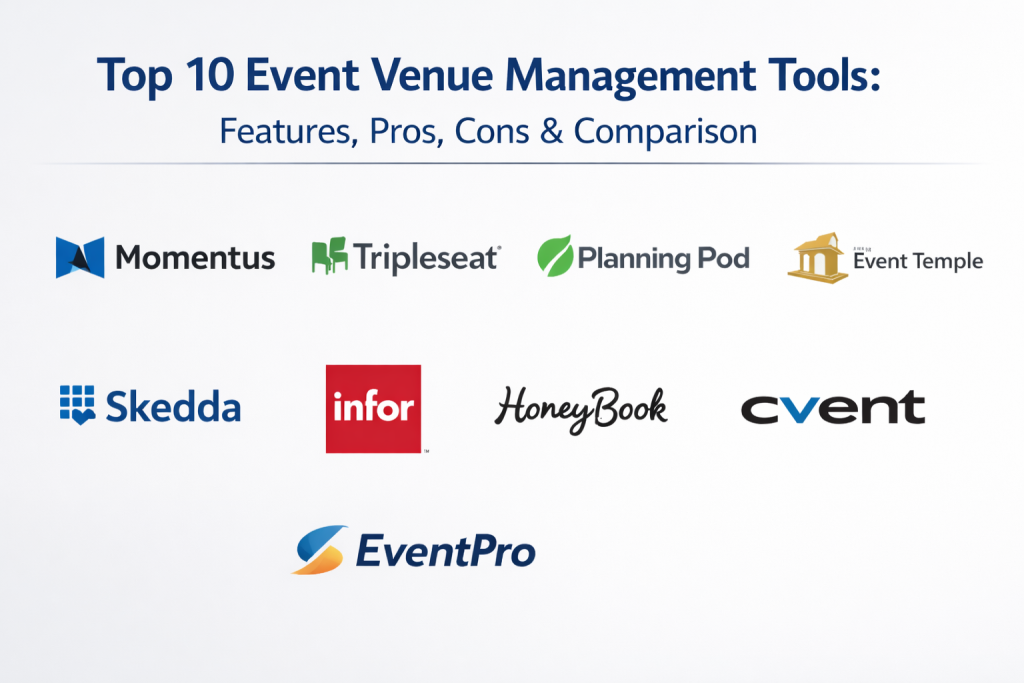
1. Momentus Technologies
This platform is a comprehensive powerhouse designed for large-scale venues such as stadiums, convention centers, and university campuses. It excels at managing complex, multi-day events with massive logistical requirements.
Key Features
- End-to-end event lifecycle management including space, staff, and resource scheduling.
- Integrated CRM specifically built for high-volume venue sales and lead tracking.
- Advanced financial module for detailed billing, accounting, and revenue forecasting.
- Collaborative event diagramming for real-time floor plan adjustments.
- Modular reporting dashboards providing deep insights into space utilization.
Pros
- Unmatched scalability for the world’s largest and most complex venues.
- Incredible depth in financial reporting and operational transparency.
Cons
- The technical complexity requires a dedicated team to manage effectively.
- Implementation and training cycles are significantly longer than simpler tools.
Platforms / Deployment
Windows / macOS / Web
Cloud / Hybrid
Security & Compliance
ISO 27001 certified, SOC 2 Type II compliant, and fully GDPR ready.
PCI-DSS compliant for secure payment handling.
Integrations & Ecosystem
Designed to be the central hub for enterprise operations, it connects deeply with leading accounting software, CRMs like Salesforce, and building management systems.
Support & Community
Offers 24/7 global support and a dedicated success team for enterprise clients, backed by a massive library of technical documentation.
2. Tripleseat
A leading sales and event management platform that focuses heavily on streamlining the booking process for restaurants, hotels, and unique event spaces.
Key Features
- Centralized lead management system that captures inquiries from multiple online sources.
- Automated document generation for contracts, proposals, and banquet event orders.
- Real-time booking calendar accessible to the entire sales and operations team.
- Integrated payment processing for secure and fast deposit collection.
- Detailed sales reporting to track team performance and lead conversion rates.
Pros
- Highly intuitive interface that sales teams can master in a very short time.
- Exceptional at automating the repetitive paperwork involved in event sales.
Cons
- Less focused on the granular “back-of-house” operations like detailed inventory tracking.
- Mobile experience is primarily web-based rather than a dedicated native app.
Platforms / Deployment
Web / iOS / Android
Cloud
Security & Compliance
GDPR compliant with encrypted data storage.
Standard identity protection and secure authentication protocols.
Integrations & Ecosystem
Strong connectivity with the hospitality ecosystem, including OpenTable, SevenRooms, and various email marketing platforms.
Support & Community
Known for a highly responsive support team and a strong community of users in the hospitality and dining industry.
3. Planning Pod
An all-in-one venue management solution that offers a massive suite of integrated tools for everything from floor plans to attendee management.
Key Features
- Visual floor plan builder with drag-and-drop furniture and equipment placement.
- Comprehensive task and checklist management for coordinating venue staff.
- Client portal for collaborative planning and document sharing.
- Integrated CRM and lead tracking for a streamlined sales pipeline.
- Budgeting and expense tracking tools for detailed event financial management.
Pros
- Offers a vast number of integrated tools, reducing the need for multiple separate apps.
- The client portal significantly improves the professional experience for venue customers.
Cons
- The sheer volume of features can be overwhelming for small, simple venues.
- Advanced customization options can take time to configure correctly.
Platforms / Deployment
Web / Windows / macOS
Cloud
Security & Compliance
SOC 2 compliant and utilizes high-level data encryption.
Not publicly stated for all regional certifications.
Integrations & Ecosystem
Connects with major calendar apps, accounting tools like QuickBooks, and payment gateways like Stripe and Square.
Support & Community
Provides extensive online training videos, a deep knowledge base, and responsive email and chat support.
4. Event Temple
A sales-focused venue management system that is particularly popular among hotels and hospitality groups looking to modernize their sales process.
Key Features
- Sales automation tools that handle lead follow-ups and task reminders.
- Branded, mobile-friendly proposals and contracts that can be signed digitally.
- Pipeline management that provides a clear visual of all active deals.
- Multi-property management capabilities for venue groups and hotel chains.
- Real-time revenue reporting and performance tracking for sales reps.
Pros
- Exceptional at improving lead response times and overall sales conversion.
- The interface is clean, modern, and very easy for new staff to learn.
Cons
- Focuses primarily on the sales side; operations teams may need additional tools for execution.
- Some advanced reporting features require higher-tier subscriptions.
Platforms / Deployment
Web / iOS / Android
Cloud
Security & Compliance
GDPR compliant and follows modern SaaS security best practices.
Data is encrypted both in transit and at rest.
Integrations & Ecosystem
Deeply integrated with property management systems (PMS) used in the hotel industry, as well as Google and Microsoft ecosystems.
Support & Community
Highly rated for customer service, with a focus on helping venues build more efficient sales cultures.
5. iVvy
A global platform that aims to modernize venue distribution, making it as easy to book an event space as it is to book a hotel room or flight.
Key Features
- Real-time online booking engine for live space availability and pricing.
- Venue management suite including catering, AV, and function diary.
- Marketplace integration that exposes venue inventory to a global network of planners.
- Automated invoicing and payment reconciliation tools.
- Detailed analytics on lead sources and space yield.
Pros
- Leading the industry in providing a truly “live” booking experience for clients.
- Excellent for multi-venue operators who need a centralized view of all inventory.
Cons
- Initial setup of the real-time engine requires detailed inventory and pricing input.
- The interface can feel a bit technical for users coming from manual systems.
Platforms / Deployment
Web / Windows / macOS
Cloud
Security & Compliance
ISO 27001 certified and PCI-DSS compliant.
Adheres to strict global privacy standards including GDPR.
Integrations & Ecosystem
Extensive API and pre-built integrations with major hotel PMS, accounting software, and digital marketing tools.
Support & Community
Provides 24/7 global support and a dedicated onboarding program for new venues.
6. Skedda
A specialized tool for space and room scheduling, perfect for co-working spaces, sports facilities, and smaller community venues.
Key Features
- Highly visual and interactive booking calendar for staff and clients.
- Automated booking rules and conditions based on user type or time of day.
- Integrated online payments and automated deposit handling.
- Mobile-friendly interface for on-the-go bookings and management.
- Usage analytics to track which spaces are most in demand.
Pros
- Incredibly fast to set up and start using for basic space management.
- The “set and forget” automation for booking rules saves massive amounts of time.
Cons
- Lacks the deep “event” features like catering menus or complex floor plans.
- Not designed for large convention centers with multi-day logistical needs.
Platforms / Deployment
Web / iOS / Android
Cloud
Security & Compliance
GDPR compliant and uses secure, encrypted payment processors.
Not publicly stated for enterprise-specific SOC certifications.
Integrations & Ecosystem
Integrates smoothly with the Microsoft and Google ecosystems, as well as automation tools like Zapier.
Support & Community
Strong online documentation and a responsive support team that focuses on self-service and quick resolutions.
7. Infor Sales & Event Management
An enterprise-grade hospitality solution designed for large hotels and venue groups that need to manage complex sales and operations at scale.
Key Features
- Deep integration with core hotel property management systems.
- Detailed catering and menu management with inventory tracking.
- Comprehensive sales pipeline and account management tools.
- Advanced reporting for revenue per square foot and labor costs.
- Scalable architecture for managing dozens of properties in one system.
Pros
- Unbeatable for venues that are part of a larger hotel or resort ecosystem.
- Handles the complexities of large-scale catering and logistics with ease.
Cons
- Can be quite expensive and complex to implement for stand-alone venues.
- The interface can feel more “corporate” and less intuitive than modern startups.
Platforms / Deployment
Windows / Web
Cloud / Hybrid
Security & Compliance
Enterprise-grade security with SSO and full audit trails.
Compliant with all major global hospitality security standards.
Integrations & Ecosystem
Built to live inside the Infor hospitality stack, it connects natively with their PMS and financial modules.
Support & Community
Professional enterprise support with dedicated account managers for large hospitality groups.
8. HoneyBook
While often used by freelancers, its venue-specific features make it a powerful tool for small, high-end boutique venues and studios.
Key Features
- Aesthetic, branded proposals and contracts that look great on mobile devices.
- Automated workflows for lead follow-up and client onboarding.
- Integrated payment processing and automated recurring billing.
- Simple task management and client communication history.
- Online scheduling and availability calendars.
Pros
- The most visually appealing client-facing documents in the industry.
- Very effective at managing the “client experience” for boutique events.
Cons
- Lacks the heavy-duty space and inventory management of a convention center tool.
- Reporting is focused more on simple finances than on space utilization data.
Platforms / Deployment
Web / iOS / Android
Cloud
Security & Compliance
Secure payment handling via proprietary encrypted processors.
Not publicly stated for enterprise-level compliance certifications.
Integrations & Ecosystem
Connects with creative tools and major email providers, as well as accounting software like QuickBooks.
Support & Community
Huge community of creative entrepreneurs and a very active support and education portal.
9. Cvent Event Diagramming
Specifically focused on the layout and operational planning of the physical space, this tool is the standard for professional venue diagramming.
Key Features
- Accurate 2D and 3D floor plan creation for any event layout.
- Real-time collaboration where planners and venues can work together on a layout.
- Integration with the Cvent Venue Network to source new leads directly.
- Seating and table management with attendee check-in capabilities.
- Mobile-optimized diagramming for making on-site adjustments during setup.
Pros
- The “industry language” for floor plans; most professional planners already know it.
- Unbeatable for ensuring that an event setup is physically accurate and safe.
Cons
- Focuses purely on the space and diagram; requires other tools for billing and CRM.
- Can be expensive if purchased as a standalone tool without the larger Cvent suite.
Platforms / Deployment
Web / iOS
Cloud
Security & Compliance
SSO/SAML support and ISO 27001 certified.
Part of the highly secure Cvent global infrastructure.
Integrations & Ecosystem
Integrates natively with the entire Cvent platform and most major hotel CRM systems.
Support & Community
Comprehensive global support and a massive user base of professional event planners and venue managers.
10. EventPro
A modular venue management system that allows users to pay only for the features they need, making it a flexible choice for diverse venue types.
Key Features
- Modular architecture covering booking, catering, and equipment inventory.
- Detailed room configuration and setup tracking.
- Automated invoicing and financial reporting.
- User-defined fields and highly customizable workflows.
- Centralized calendar for managing multiple locations and spaces.
Pros
- The modular approach is excellent for venues with very specific or unusual needs.
- Strong focus on the “logistics” and inventory side of venue management.
Cons
- The interface can look a bit dated compared to newer, web-only platforms.
- Mastering all the modules requires a significant time investment in training.
Platforms / Deployment
Windows / Web
Cloud / Self-hosted
Security & Compliance
Offers robust audit logs and granular user permissions.
Fully GDPR compliant with secure data handling.
Integrations & Ecosystem
Connects with major accounting software and has a flexible API for custom integrations.
Support & Community
Provides an excellent onboarding process and dedicated technical support staff for implementation.
Comparison Table
| Tool Name | Best For | Platform(s) Supported | Deployment | Standout Feature | Public Rating |
| 1. Momentus | Convention Centers | Windows, macOS, Web | Hybrid | Enterprise Logistics | N/A |
| 2. Tripleseat | Restaurants / Hotels | Web, iOS, Android | Cloud | Sales Automation | N/A |
| 3. Planning Pod | Mixed-use Venues | Web, Windows, macOS | Cloud | All-in-one Planning | N/A |
| 4. Event Temple | Hotel Sales Teams | Web, iOS, Android | Cloud | Lead Conversion | N/A |
| 5. iVvy | Real-time Booking | Web, Windows, macOS | Cloud | Live Distribution | N/A |
| 6. Skedda | Shared Spaces | Web, iOS, Android | Cloud | Simple Scheduling | N/A |
| 7. Infor | Hotel Groups | Windows, Web | Hybrid | Hospitality Stack | N/A |
| 8. HoneyBook | Boutique Venues | Web, iOS, Android | Cloud | Branded Experience | N/A |
| 9. Cvent | Space Diagramming | Web, iOS | Cloud | 3D Floor Plans | N/A |
| 10. EventPro | Modular Workflows | Windows, Web | Hybrid | Modular Customization | N/A |
Evaluation & Scoring
| Tool Name | Core (25%) | Ease (15%) | Integrations (15%) | Security (10%) | Perf (10%) | Support (10%) | Value (15%) | Total |
| 1. Momentus | 10 | 3 | 9 | 10 | 10 | 9 | 6 | 7.95 |
| 2. Tripleseat | 8 | 9 | 8 | 7 | 9 | 8 | 7 | 7.90 |
| 3. Planning Pod | 9 | 7 | 8 | 8 | 8 | 8 | 8 | 8.05 |
| 4. Event Temple | 7 | 9 | 9 | 8 | 9 | 9 | 8 | 8.30 |
| 5. iVvy | 8 | 6 | 10 | 9 | 9 | 8 | 7 | 8.00 |
| 6. Skedda | 6 | 10 | 7 | 6 | 10 | 7 | 9 | 7.50 |
| 7. Infor | 9 | 4 | 10 | 9 | 9 | 8 | 5 | 7.45 |
| 8. HoneyBook | 5 | 10 | 7 | 6 | 9 | 8 | 8 | 7.20 |
| 9. Cvent | 7 | 6 | 10 | 10 | 9 | 9 | 6 | 7.65 |
| 10. EventPro | 9 | 5 | 7 | 8 | 8 | 8 | 7 | 7.30 |
The scoring model above provides a comparative view of how these platforms perform in a professional environment. A high total score usually reflects a tool that balances deep technical features with a modern, user-friendly interface and strong security. For instance, Event Temple scores highly due to its incredible ease of use and focus on high-value sales tasks, while Momentus scores lower in ease of use but is the only option for truly massive venues. Understanding your venue’s primary goal—whether it’s maximizing sales or managing complex logistics—is the key to interpreting these numbers correctly.
Which Event Venue Management Tool Is Right for You?
Solo / Freelancer
If you manage a small studio or a single unique space on your own, look for tools that prioritize the client experience and simple scheduling. The goal is to spend less time on paperwork and more time on the creative aspects of your business.
SMB
Small businesses with a small team should focus on platforms that offer high levels of automation for sales and contracts. Reducing the time spent on lead follow-up can significantly increase your overall revenue.
Mid-Market
For venues with multiple rooms and a dedicated sales staff, a more robust all-in-one platform is often the best choice. This ensures that everyone is looking at the same live data and prevents costly communication errors.
Enterprise
Massive facilities with high-concurrency events must prioritize scalability and security. These venues need a system that can handle thousands of data points and integrate with complex building and financial systems.
Budget vs Premium
Choosing between a low-cost scheduler and a premium enterprise suite often comes down to the complexity of your operations. If you handle catering, equipment rental, and multi-day bookings, the “premium” tools usually pay for themselves in efficiency.
Feature Depth vs Ease of Use
Some platforms allow you to track every single fork and knife in your inventory but require a lot of training. Others are simple enough to learn in an afternoon but have less depth. Choose based on your team’s technical comfort level.
Integrations & Scalability
Your software must grow with you. Ensure that the tool you choose can connect to the other software you already use and that it can handle an increase in booking volume as your business expands.
Security & Compliance Needs
For venues that work with government clients or large corporations, having certified security standards is a non-negotiable requirement. Ensure your software provider can prove their commitment to data protection.
Frequently Asked Questions (FAQs)
1. What is the primary benefit of using venue management software?
The main advantage is centralization; it moves your calendar, sales, and operations out of scattered spreadsheets and into a single system where everyone can see the same live information.
2. Can these tools prevent double-bookings automatically?
Yes, most professional platforms have a real-time conflict-checking engine that will alert you if you try to book the same room or piece of equipment for two overlapping events.
3. Is it possible to manage multiple locations in one account?
Many of the tools listed, such as Event Temple and iVvy, are specifically designed for multi-property management, providing a unified view of all your venues in one dashboard.
4. Do I need a specific computer to run these programs?
Most modern venue management tools are cloud-based and run in any modern web browser, meaning they can be accessed from almost any computer, tablet, or smartphone.
5. How does the software help with lead conversion?
By automating follow-up tasks and providing mobile-friendly, digital contracts, these tools help you respond to inquiries faster and make it easier for clients to sign and pay immediately.
6. What is a Banquet Event Order (BEO)?
A BEO is a critical document that outlines every detail of an event, from the room setup to the menu and AV needs. Most venue software can generate these automatically from the booking data.
7. Is my data secure in the cloud?
Professional providers use advanced encryption and follow global security standards like SOC 2 and GDPR to ensure that your business and client data is protected from unauthorized access.
8. Can I track catering and equipment inventory with these tools?
Yes, tools like Momentus and EventPro have deep inventory modules that allow you to manage food costs, kitchen prep lists, and AV equipment availability in real-time.
9. How long does it typically take to set up the software?
For simpler scheduling tools, you can be up and running in a few days. For comprehensive enterprise suites, the process of configuration and training can take several weeks or months.
10. Do these platforms integrate with accounting software?
Most leading venue management tools offer integrations with popular accounting packages like QuickBooks or Xero to ensure that your event finances and invoices stay in sync.
Conclusion
Navigating the landscape of event venue management strategic focus on data centralization and operational efficiency. The right tool acts as the digital nervous system of your facility, ensuring that sales teams, operations staff, and clients are all perfectly aligned. Whether you are maximizing the yield of a small creative studio or managing the high-stakes logistics of a global convention center, choosing a platform that balances technical depth with ease of use is the most important step toward sustainable growth. As real-time booking and AI-driven automation become the industry standard, staying ahead of these trends will define the success of modern venues in an increasingly competitive market.

Best Cardiac Hospitals Near You
Discover top heart hospitals, cardiology centers & cardiac care services by city.
Advanced Heart Care • Trusted Hospitals • Expert Teams
View Best Hospitals