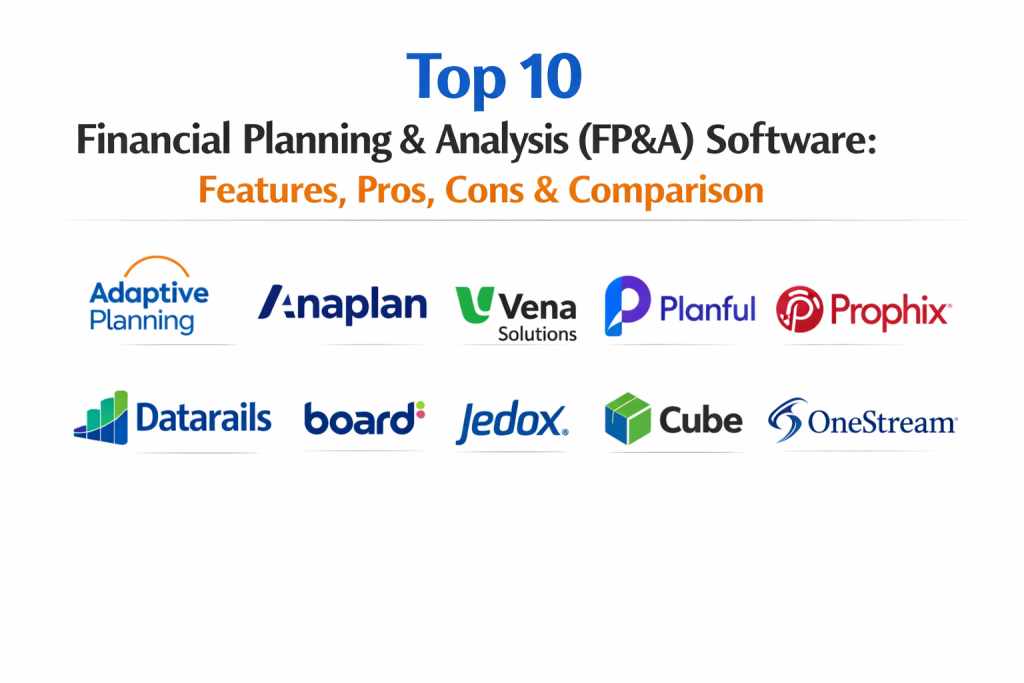
Introduction
Financial Planning & Analysis (FP&A) software represents a sophisticated class of enterprise tools designed to help organizations perform budgeting, forecasting, and financial modeling. Unlike basic bookkeeping or accounting software which focuses on historical records, FP&A platforms are forward-looking. they allow finance teams to consolidate data from various departments, perform complex “what-if” scenario analysis, and generate the strategic insights necessary for long-term growth. These tools act as a bridge between raw financial data and corporate strategy, enabling leaders to make informed decisions based on real-time projections rather than intuition.
The primary value of modern FP&A software lies in its ability to break down departmental silos and eliminate “spreadsheet chaos.” By centralizing financial data in a single source of truth, these platforms reduce the time spent on manual data consolidation and error-checking. Features such as rolling forecasts, variance analysis, and driver-based modeling allow businesses to remain agile in a volatile market. In the contemporary business landscape, having a robust FP&A system is essential for maintaining a competitive edge, managing risk, and ensuring that capital is allocated efficiently across the enterprise.
Real-World Use Cases
- Strategic Growth Modeling: A retail chain uses FP&A software to model the financial impact of opening twenty new locations, considering variables like local labor costs, shipping logistics, and projected foot traffic.
- Rolling Forecasts: A SaaS company moves away from annual budgets to monthly rolling forecasts, allowing them to adjust their marketing spend instantly based on the previous month’s churn rate and customer acquisition costs.
- Scenario Planning: An airline uses “what-if” analysis to determine how a significant spike in fuel prices or a sudden decrease in international travel would affect their cash reserves and debt covenants.
- Workforce Planning: A manufacturing firm integrates HR data with financial models to plan for seasonal hiring needs and calculate the long-term cost of pension and benefit adjustments.
- Consolidated Reporting: A multinational corporation with entities in several countries uses FP&A software to automatically handle currency conversions and inter-company eliminations for its quarterly board reports.
Evaluation Criteria for Buyers
- Modeling Flexibility: Can the software handle complex, multi-dimensional formulas and driver-based calculations without breaking?
- Data Integration: How easily does the platform connect to existing ERP, CRM, and HRIS systems to pull live data?
- Collaboration Features: Does the tool allow department heads to enter their own budget numbers and leave comments for the finance team?
- User Interface: Is the platform intuitive enough for non-finance managers to use, or does it require extensive technical training?
- Reporting & Visualization: Does it offer robust dashboarding and “drag-and-drop” report builders for executive presentations?
- Scalability: Can the system handle increasing volumes of data and more complex organizational structures as the company grows?
- Cloud Performance: How quickly does the system recalculate large models when a single variable is changed?
Best for: Mid-sized to large enterprises, high-growth startups, and finance teams looking to automate their budgeting and strategic planning cycles.
Not ideal for: Micro-businesses with simple cash-in/cash-out needs or organizations that do not yet have a formal budgeting process.
Key Trends in FP&A Software
- Artificial Intelligence & Machine Learning: Using predictive algorithms to identify trends and anomalies that human analysts might miss.
- Extended Planning & Analysis (xP&A): Breaking out of the finance department to include operational, sales, and HR planning in a single unified platform.
- Real-Time Data Streams: Moving from monthly data batches to live integrations that update forecasts the moment a sale is closed in the CRM.
- Self-Service Analytics: Empowering non-financial managers to generate their own reports and visualizations without waiting for the finance team.
- Natural Language Processing: The ability to ask the software questions like “What was our highest margin product last quarter?” and receive an instant answer.
- Advanced Scenario Management: Allowing users to run thousands of Monte Carlo simulations to determine the statistical probability of various financial outcomes.
- Zero-Based Budgeting Tools: Features specifically designed to help companies build budgets from scratch based on necessity rather than historical spend.
- Mobile Executive Dashboards: Highly condensed, visual-first mobile apps for CEOs to monitor key performance indicators on the go.
- Enhanced Security & Governance: Robust audit trails that show exactly who changed a formula or a budget figure and when.
- Collaboration Hubs: Integration with communication tools like Slack and Teams to discuss financial variances in real-time.
How We Selected These Tools (Methodology)
The selection of these top FP&A platforms is based on a comprehensive evaluation of the corporate performance management market:
- Analysis of the platform’s ability to handle high-volume data sets and complex calculations.
- Assessment of the “Excel-familiarity” of the interface to ensure ease of adoption for finance professionals.
- Review of the strength and variety of native integrations with popular ERP and CRM systems.
- Evaluation of the vendor’s reputation for customer success and implementation support.
- Analysis of the reporting engine’s flexibility and the quality of built-in data visualization tools.
- Consideration of the software’s ability to support multi-currency, multi-entity, and global tax structures.
- Verification of the platform’s uptime, security certifications, and cloud infrastructure reliability.
Top 10 FP&A Software
1.Pigment
Pigment is an enterprise Integrated Business Planning (IBP) and EPM platform built for FP&A and cross-functional planning. It connects finance, HR, sales, and operations in a single real-time environment. The platform combines flexible multidimensional modeling with embedded AI for faster, smarter forecasting. It is designed for large and fast-scaling enterprises. Pigment supports collaborative planning with strong governance controls and helps organizations move from reactive reporting to proactive strategy.
Key Features:
• Real-time scenario planning
• Multidimensional modeling
• Embedded AI and ML forecasting
• Cross-functional planning across finance, HR, sales, and operations
• Native collaboration and workflow governance
• ERP, CRM, HRIS, and data warehouse integrations
Pros:
• Highly scalable for enterprise-wide planning.
• AI capabilities built directly into workflows.
Cons:
• Onboarding is required to maximize modeling and AI features.
• Less spreadsheet-centric than Excel-native tools.
Platforms / Deployment:
• Cloud
Security & Compliance:
• SOC 1 Type II, SOC 2 Type II, GDPR, and CCPA compliant
• AES-256 and TLS 1.3 encryption
• Role-based access controls (RBAC)
• Full audit trails
Integrations & Ecosystem:
• ERP systems
• CRM platforms
• HRIS tools
• Data warehouses
Support & Community:
• Dedicated customer success teams
• Pigment Academy
• Structured onboarding programs
• Active global user community
2.Anaplan
Anaplan is an enterprise-grade platform designed for complex, large-scale planning across the entire organization.
Key Features
- Honeycomb Technology: A patented calculation engine that manages massive data sets with high speed.
- Multi-Dimensional Modeling: Handle complex hierarchies and relationships across different business units.
- Connected Planning: Link finance, sales, supply chain, and HR plans in a single ecosystem.
- App Hub: Access a library of pre-built models and templates for various industries.
- Granular Security: Highly detailed permissions to control exactly who can see and edit specific data points.
- API First Approach: Robust integration capabilities for custom data sources.
Pros
- Unmatched scalability for the world’s largest and most complex organizations.
- Highly flexible; if you can model it in a spreadsheet, you can build it in Anaplan.
Cons
- Steeper learning curve compared to more “plug-and-play” FP&A tools.
- Implementation can be a lengthy and costly process involving specialized partners.
Platforms / Deployment
- Web-based
- Cloud
Security & Compliance
- SOC 1/2/3, ISO 27001
- GDPR, FedRAMP
Integrations & Ecosystem
Strong focus on enterprise-level data connectors.
- SAP
- MuleSoft
- Informatica
- Tableau
Support & Community
Extensive “Anaplan Community” and a professional certification program for modelers.
3.Vena Solutions
Vena Solutions offers a unique “Excel-native” approach that combines the familiarity of spreadsheets with the power of a cloud database.
Key Features
- Excel Interface: Users work directly within the desktop version of Excel while data is saved to a secure cloud.
- Workflow Automation: Manage the budget submission process with automated reminders and approvals.
- Version Control: Track every change made to a cell, including who changed it and when.
- Audit Trails: Comprehensive logs for compliance and internal control purposes.
- Ad-hoc Analysis: Quickly pull data into a spreadsheet for custom, one-off calculations.
- Centralized Database: Ensures that everyone is working with the same “single source of truth.”
Pros
- Very high user adoption because finance teams don’t have to give up the Excel environment they love.
- Fast implementation times compared to non-Excel based enterprise systems.
Cons
- Because it relies on Excel, it can occasionally inherit some of the formatting quirks of spreadsheets.
- Not as well-suited for non-finance users who aren’t comfortable in a spreadsheet environment.
Platforms / Deployment
- Excel Desktop + Cloud Backend
- Cloud
Security & Compliance
- SOC 2 Type II
- GDPR, Encrypted Data at Rest
Integrations & Ecosystem
Strong focus on mid-market ERP systems.
- Microsoft Dynamics 365
- NetSuite
- Sage Intacct
- QuickBooks
Support & Community
Highly rated customer support and a focused user group for finance professionals.
4.Planful
Planful (formerly Host Analytics) provides a comprehensive suite for financial planning, consolidation, and reporting.
Key Features
- Structured Planning: Tools for rigid annual budgeting and high-level strategic planning.
- Dynamic Planning: A sandbox environment for ad-hoc modeling and scenario testing.
- Financial Consolidation: Automate the closing process and handle multi-currency eliminations.
- Predictive Forecasting: AI-powered insights to help improve the accuracy of future projections.
- Automated Reporting: Schedule and distribute board-ready reports automatically.
- Visual Dashboards: Built-in tools for creating high-impact executive summaries.
Pros
- A strong balance between structured corporate budgeting and flexible, agile modeling.
- The consolidation engine is particularly robust for companies with many subsidiaries.
Cons
- The interface can feel slightly more complex than modern “SaaS-native” competitors.
- Some users report that the reporting module has a learning curve.
Platforms / Deployment
- Web-based
- Cloud
Security & Compliance
- SOC 1/2, ISO 27001
- GDPR, 256-bit Encryption
Integrations & Ecosystem
Connects well with both legacy on-premise and modern cloud systems.
- Oracle
- SAP
- NetSuite
- Microsoft SQL Server
Support & Community
Consistent high marks for customer satisfaction and professional services.
5.Prophix
Prophix focuses on providing a mid-market solution that is easy to implement and manage without a large IT team.
Key Features
- Visual Modeler: Build financial models using a graphical interface rather than just code or formulas.
- Task Assistant: An AI-powered virtual assistant that helps automate repetitive tasks.
- Self-Service Dashboards: Easily customizable views for different department heads.
- Detailed Personnel Planning: Specialized modules for managing headcount and labor costs.
- Workflow Management: Visual tracking of the entire budgeting cycle status.
- Automated Distribution: Email reports to stakeholders based on predefined schedules.
Pros
- Great value for mid-sized companies that need enterprise features without enterprise complexity.
- Strong “out-of-the-box” functionality that requires less customization than Anaplan.
Cons
- May lack the extreme “infinite” scalability required by the absolute largest global conglomerates.
- The web interface, while functional, is less “sleek” than some of the newest market entrants.
Platforms / Deployment
- Web-based / On-premise available
- Cloud / Hybrid
Security & Compliance
- SOC 2, ISAE 3402
- GDPR, Data Privacy Shield
Integrations & Ecosystem
Excellent support for mid-market accounting and ERP software.
- Sage
- Microsoft Dynamics GP/NAV/SL
- SYSPRO
- Epicor
Support & Community
Known for a very personal approach to customer service and implementation.
6.Datarails
Datarails is an FP&A platform specifically designed for Excel users in small-to-mid-sized businesses.
Key Features
- Excel Integration: Enhances your existing spreadsheets with a cloud database and version control.
- Automated Data Aggregation: Pulls data from disparate spreadsheets and systems automatically.
- Dashboarding: Turns Excel data into professional, web-based visualizations.
- Variance Analysis: Instantly compare actuals against budgets or previous forecasts.
- Cell-Level Audit: See the history and source of every single data point in your models.
- Executive Portals: Secure areas for leadership to view high-level summaries.
Pros
- The lowest barrier to entry for teams that want to keep their current Excel models but add power.
- Rapid setup; businesses can often be up and running in a matter of weeks.
Cons
- Not intended for organizations that want to move entirely away from a spreadsheet-based workflow.
- Advanced multi-dimensional modeling is not as deep as Anaplan or Adaptive.
Platforms / Deployment
- Excel Add-in + Web App
- Cloud
Security & Compliance
- SOC 2 Type II
- GDPR, Data Encryption
Integrations & Ecosystem
Focuses on the most common tools used by SMB and Mid-Market companies.
- QuickBooks
- Xero
- NetSuite
- Salesforce
Support & Community
Strong focus on customer success and helping users automate their specific existing models.
7.Board
Board is a unified decision-making platform that combines FP&A with Business Intelligence (BI) and Predictive Analytics.
Key Features
- All-in-One Platform: Planning, reporting, and analysis in a single, unified environment.
- No-Code Environment: Build complex applications and models without writing a single line of code.
- Simulation Capabilities: Advanced “what-if” and Monte Carlo simulations built-in.
- Time-Series Forecasting: Automated predictive models based on historical data patterns.
- Drag-and-Drop Analysis: Highly interactive data exploration for non-technical users.
- Multi-User Collaboration: Simultaneous data entry and planning across large teams.
Pros
- Eliminates the need for separate BI and FP&A tools, reducing the total software stack.
- The visual, no-code approach makes it very accessible for business analysts.
Cons
- The breadth of features can be overwhelming for teams only looking for simple budgeting.
- Licensing costs can be higher due to the inclusion of full BI capabilities.
Platforms / Deployment
- Web-based / Desktop
- Cloud / On-premise
Security & Compliance
- ISO 27001, SOC 1/2
- GDPR, Secure Multi-tenant Architecture
Integrations & Ecosystem
Native connectors for almost any enterprise data source.
- Microsoft Power BI
- SAP HANA
- IBM DB2
- Amazon Redshift
Support & Community
Global presence with a strong network of implementation partners.
8.Jedox
Jedox is a flexible, high-performance platform that excels at integrating financial and operational planning.
Key Features
- GPU-Powered Engine: Utilizes graphics processors for lightning-fast calculations on massive models.
- Excel-Plus: Use Excel as a front-end while leveraging a powerful, multi-dimensional database.
- AI-Assisted Planning: Automatically suggests forecasts based on underlying data trends.
- Global Planning: Supports complex multi-language and multi-currency requirements.
- Operational Modules: Specific tools for sales, HR, and procurement planning.
- Mobile Access: Fully functional mobile app for reviewing and approving plans.
Pros
- Extremely fast calculation speeds, even with very large and complex data sets.
- Highly flexible deployment options, including on-premise, cloud, or hybrid.
Cons
- Can require a more technical skill set to manage the backend compared to simpler tools.
- The user interface has a more traditional “software” feel compared to newer SaaS apps.
Platforms / Deployment
- Web / Excel / Mobile
- Cloud / On-premise / Hybrid
Security & Compliance
- SOC 1/2, ISO 27001
- GDPR, Encrypted Communication
Integrations & Ecosystem
Strong focus on the SAP and Microsoft ecosystems.
- SAP S/4HANA
- Microsoft Power BI
- Salesforce
- Qlik
Support & Community
Strong European presence with growing global support and a dedicated academy.
9.Cube
Cube is a “lean” FP&A platform that focuses on speed and simplicity for fast-growing companies.
Key Features
- Spreadsheet Agnostic: Works equally well with both Microsoft Excel and Google Sheets.
- Quick-Sync Data: Push and pull data from your source systems in seconds.
- Multi-Scenario Planning: Easily toggle between “best case,” “worst case,” and “likely” scenarios.
- Drill-Through: Click on any number to see the underlying transactions and source data.
- Automated Consolidation: Combine data from multiple entities with ease.
- Custom Dashboards: Build visual reports tailored to different stakeholders.
Pros
- One of the fastest implementation times in the industry.
- Perfect for startups that need more power than a spreadsheet but aren’t ready for Workday or Anaplan.
Cons
- Lacks some of the deep “enterprise-only” features like complex inter-company eliminations.
- Focuses primarily on the North American market for integrations and support.
Platforms / Deployment
- Google Sheets / Excel / Web
- Cloud
Security & Compliance
- SOC 2 Type II
- GDPR, Data Privacy Standards
Integrations & Ecosystem
Deeply integrated with the “modern” cloud tech stack.
- NetSuite
- QuickBooks Online
- Sage Intacct
- Salesforce
Support & Community
Highly responsive support team known for working closely with startup finance leaders.
10.OneStream
OneStream is a unified platform designed to replace multiple legacy CPM (Corporate Performance Management) applications.
Key Features
- Extensible Dimensionality: Allows different business units to have their own detail while reporting to a corporate standard.
- Financial Signaling: Daily and weekly data updates for proactive decision-making.
- Built-in Quality: Validation rules ensure that data is accurate before it is even submitted.
- MarketPlace: Download pre-built solutions like “Lease Accounting” or “Tax Provision” for free.
- Direct Integration: “Drill-back” capabilities that take you all the way to the original ERP transaction.
- Unified SmartCPMS: Handles planning, consolidation, and reporting in a single metadata layer.
Pros
- Eliminates the “patchwork” of different tools often found in large corporations.
- Extremely powerful for complex financial consolidations and regulatory reporting.
Cons
- Very expensive and intended only for large enterprise customers.
- Requires a dedicated team of administrators to manage the platform’s complexity.
Platforms / Deployment
- Web-based / Desktop
- Cloud / On-premise
Security & Compliance
- SOC 1/2, ISO 27001, FedRAMP
- GDPR, HIPAA
Integrations & Ecosystem
Designed to be the central hub for all corporate data.
- SAP
- Oracle
- Microsoft Dynamics
- IBM
Support & Community
Premium support services and a highly dedicated user community (Splash).
Comparison Table
| Tool Name | Best For | Platform(s) Supported | Deployment | Standout Feature | Public Rating |
|---|---|---|---|---|---|
| Adaptive | Mid-Large Enterprise | Web | Cloud | Elastic Hypercube Engine | 4.8/5 |
| Anaplan | Global Enterprises | Web | Cloud | Connected Planning Logic | 4.7/5 |
| Vena | Excel-First Teams | Excel, Web | Cloud | Native Excel Environment | 4.6/5 |
| Planful | Consolidation | Web | Cloud | Structured + Dynamic Planning | 4.5/5 |
| Prophix | Mid-Market | Web | Cloud/Hybrid | Virtual Task Assistant | 4.4/5 |
| Datarails | SMB Excel Users | Excel, Web | Cloud | Automated Excel Consolidation | 4.6/5 |
| Board | FP&A + BI | Web, Desktop | Cloud/On-prem | Unified Decision Platform | 4.5/5 |
| Jedox | High Performance | Web, Excel | Cloud/On-prem | GPU-Powered Calculations | 4.4/5 |
| Cube | High-Growth Startups | Google/Excel | Cloud | Cross-Spreadsheet Support | 4.7/5 |
| OneStream | Large-Scale ERP Sync | Web, Desktop | Cloud/On-prem | MarketPlace Solutions | 4.8/5 |
Evaluation & Scoring of FP&A Software
| Tool Name | Core (25%) | Ease (15%) | Integrations (15%) | Security (10%) | Performance (10%) | Support (10%) | Value (15%) | Weighted Total |
|---|---|---|---|---|---|---|---|---|
| Adaptive | 10 | 9 | 9 | 10 | 9 | 9 | 8 | 9.15 |
| Anaplan | 10 | 7 | 10 | 10 | 10 | 8 | 7 | 8.85 |
| Vena | 8 | 10 | 8 | 9 | 8 | 9 | 9 | 8.65 |
| Planful | 9 | 8 | 9 | 9 | 9 | 8 | 8 | 8.60 |
| Prophix | 8 | 9 | 8 | 9 | 8 | 10 | 9 | 8.55 |
| Datarails | 7 | 10 | 8 | 9 | 8 | 9 | 10 | 8.50 |
| Board | 9 | 8 | 9 | 9 | 9 | 8 | 8 | 8.60 |
| Jedox | 9 | 7 | 9 | 9 | 10 | 8 | 8 | 8.50 |
| Cube | 8 | 10 | 8 | 9 | 8 | 9 | 9 | 8.65 |
| OneStream | 10 | 6 | 10 | 10 | 10 | 9 | 6 | 8.65 |
How to Interpret These Scores
- Weighted Totals: A score above 9.0 represents the absolute “gold standard” in the market, balancing deep power with modern user expectations.
- Ease vs. Core Power: Tools like Datarails and Cube score high on “Ease” but lower on “Core” compared to giants like Anaplan or OneStream, which offer nearly infinite power but require a technical trade-off.
- Value: This metric considers the ROI for the target audience. A tool like Vena offers high value for a mid-market team, while OneStream’s value is realized in the massive complexity it eliminates for a global conglomerate.
Which FP&A Software Is Right for You?
The “Excel Forever” Finance Team
If your team is highly proficient in Excel and you don’t want to force them to learn a new, proprietary formula language.
- Recommendation: Vena Solutions or Datarails.
- Why: These tools allow you to keep the spreadsheet front-end you already use but add the security, version control, and database power that spreadsheets lack.
The Massive Global Conglomerate
If you have thousands of employees, dozens of subsidiaries, and a need for complex inter-company eliminations and regulatory compliance.
- Recommendation: Anaplan or OneStream.
- Why: These are the only tools with the sheer computational muscle and structural flexibility to handle a “Fortune 500” level of complexity.
The Fast-Growing SaaS Startup
If you are a Series B or C startup that has outgrown basic spreadsheets and needs to start doing serious rolling forecasts and board reporting.
- Recommendation: Cube or Adaptive Planning.
- Why: Cube is lightweight and fast to implement, while Adaptive Planning provides a pathway to full enterprise maturity within the Workday ecosystem.
The Team Needing Better Dashboards
If your main pain point is that your executives can’t understand your spreadsheets and you need high-end visual storytelling.
- Recommendation: Board or Prophix.
- Why: Board includes a full Business Intelligence engine, and Prophix specializes in making financial data accessible to non-financial managers through visual tools.
Budget vs Premium
If budget is tight, look at Cube or Datarails for high ROI. If you have a significant budget and want to transform the entire organization’s planning culture, Anaplan is the premium choice.
Implementation Speed
For teams that need a solution “yesterday,” Cube and Datarails can be live in weeks. For Anaplan or OneStream, you should plan for a project lasting six months to a year.
Frequently Asked Questions
What is the difference between FP&A and an ERP?
An ERP (Enterprise Resource Planning) is a system of record for actual transactions. FP&A software is a system of analysis that uses ERP data to create plans and forecasts for the future.
Can FP&A software work with Google Sheets?
Yes, tools like Cube and Datarails have specific integrations for Google Sheets, while others are primarily focused on Microsoft Excel or their own web interfaces.
What is “Driver-Based Modeling”?
It is a planning method where you forecast based on operational “drivers” (like number of sales calls, web traffic, or headcount) rather than just guessing at a total dollar amount.
How secure is my financial data in the cloud?
FP&A vendors use bank-level encryption, multi-factor authentication, and undergo rigorous SOC 2 audits to ensure your data is more secure in the cloud than it would be on a local spreadsheet.
Do I need a consultant to implement these tools?
For smaller tools like Cube, you can often do it yourself. For mid-market and enterprise tools, a 3rd party implementation partner is usually required to ensure the models are built correctly.
What is “Rolling Forecasting”?
Instead of a fixed 12-month budget, a rolling forecast adds a new month to the projection as each current month ends, maintaining a constant forward-looking horizon.
Can these tools handle multiple currencies?
Yes, most FP&A tools have built-in currency conversion engines that can handle various exchange rates and report in a single “functional” currency.
What is “What-If” Analysis?
The ability to change one variable (like a 10% increase in raw material costs) and see how that change ripples through the entire profit and loss statement and balance sheet.
Does FP&A software replace Excel?
Rarely. Most tools either integrate with Excel or provide an interface that looks and feels like it. They replace the “manual” part of Excel, not the flexibility.
What is a “Single Source of Truth”?
It means that every person in the company is looking at the same data, coming from the same database, eliminating arguments about whose spreadsheet is “correct.”
Conclusion
Selecting the right FP&A software is a strategic decision that can redefine how your organization plans for the future. Whether you choose the massive scalability of Anaplan, the Excel-native comfort of Vena, or the agile simplicity of Cube, the goal is the same: moving from reactive accounting to proactive strategy. By investing in a dedicated planning platform, you empower your finance team to spend less time on data entry and more time on the high-value analysis that drives the business forward.

Best Cardiac Hospitals Near You
Discover top heart hospitals, cardiology centers & cardiac care services by city.
Advanced Heart Care • Trusted Hospitals • Expert Teams
View Best Hospitals