Introduction
Financial stress testing platforms are specialized analytical tools used by banks, asset managers, and insurance companies to evaluate how their portfolios and balance sheets would perform under extreme economic conditions. Unlike standard financial modeling, stress testing pushes variables—such as interest rates, unemployment, and market volatility—to plausible “worst-case” limits. In the current global economy, these platforms are vital for maintaining capital adequacy and ensuring that institutions can survive systemic shocks. They transform complex regulatory requirements into actionable insights, helping leaders protect assets and maintain public trust during times of crisis.
Selecting the right platform requires a deep understanding of your institution’s specific risk profile and regulatory landscape. A global tier-one bank will require a system capable of petabyte-scale data processing and complex macroeconomic modeling, whereas a mid-sized insurance firm might prioritize liquidity analysis and solvency compliance. Key factors for evaluation include the platform’s ability to integrate with existing core banking systems, the transparency of its underlying models, and its capacity to run “what-if” scenarios in real-time. As the financial sector moves toward more integrated risk management, the ability to break down data silos between risk, finance, and treasury is a primary differentiator for top-tier tools.
Best for: Global systemic banks (G-SIBs), regional financial institutions, large-scale asset managers, and insurance companies that must adhere to rigorous capital and liquidity stress testing mandates.
Not ideal for: Small credit unions with basic lending portfolios, independent financial advisors, or retail-only firms that do not have complex balance sheet risks or specific regulatory stress testing requirements.
Key Trends in Financial Stress Testing Platforms
- Generative AI for Scenario Design: Modern platforms are using AI to create more diverse and non-linear stress scenarios, moving beyond historical precedents to identify “hidden” systemic risks.
- Real-Time Stress Analysis: The shift from quarterly “batch” processing to real-time stress testing allows risk managers to see the impact of market movements immediately on their capital ratios.
- Unified Risk and Finance Data: There is a significant move toward single “data lakes” that serve both financial reporting and risk modeling, ensuring consistency across all regulatory filings.
- Cloud-Native Scalability: Most top-tier providers now offer cloud-based engines that can spin up thousands of processing nodes to handle massive Monte Carlo simulations in minutes rather than days.
- Focus on Climate Risk Stress Testing: New frameworks are being integrated to test the long-term impact of environmental changes and the transition to a low-carbon economy on credit portfolios.
- Reverse Stress Testing Automation: Platforms are increasingly capable of automatically identifying the exact combination of failures required to break an institution’s capital, helping firms find their structural weak points.
- Regulatory Reporting Integration: Direct API connections to central bank portals are becoming standard, reducing the manual effort required for submissions.
- Explainable Model Governance: As models become more complex, there is a rising demand for “white-box” systems where every step of the calculation is auditable and transparent to regulators.
How We Selected These Tools
- Regulatory Alignment: We prioritized platforms that are pre-configured to meet global standards such as Basel IV, CCAR, and IFRS 9.
- Computational Power: Each tool was evaluated on its ability to handle high-concurrency simulations and massive datasets with high performance.
- Market Presence: The selection includes the most trusted names used by major central banks and top-tier financial institutions globally.
- Innovation in AI and Cloud: We looked for providers that have successfully transitioned from legacy on-premises systems to modern, AI-integrated cloud architectures.
- User Experience for Risk Professionals: Preference was given to platforms that balance deep technical power with accessible dashboards for executive decision-making.
- Depth of Integration: The tools were chosen based on their ability to connect seamlessly with diverse core banking and treasury systems.
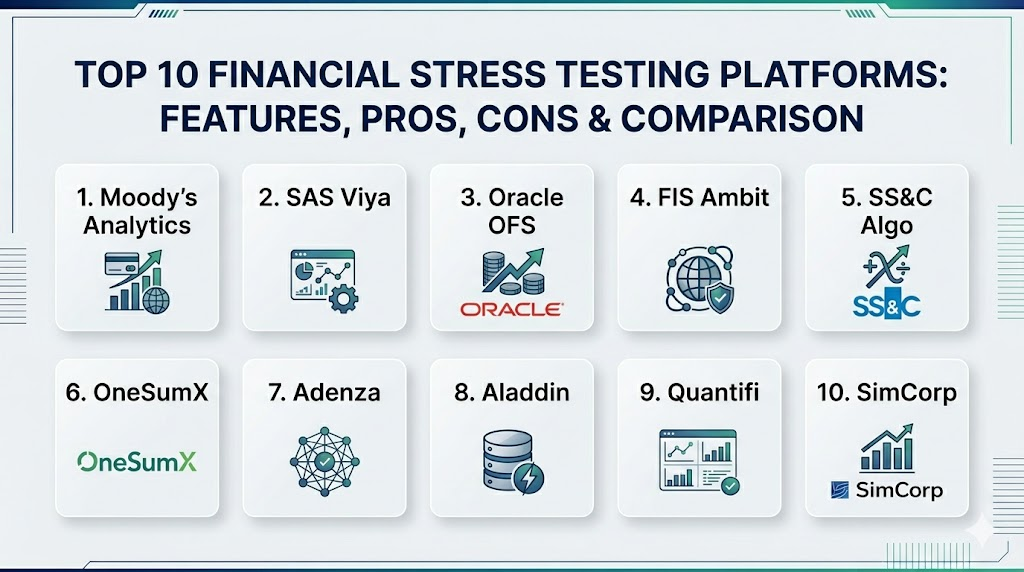
Top 10 Financial Stress Testing Platforms Tools
1. Moody’s Analytics (RiskIntegrity)
This platform is a global benchmark for risk management, providing a comprehensive suite for capital adequacy and liquidity stress testing. It is backed by one of the world’s most extensive credit and economic databases.
Key Features
- Advanced macroeconomic scenario generation covering thousands of global variables.
- Integrated credit, market, and liquidity risk modeling in a single framework.
- Pre-built templates for major global regulatory exercises.
- High-performance calculation engine for portfolio-level sensitivity analysis.
- Strong audit trail and version control for model governance.
Pros
- Unmatched depth in economic data and historical credit performance.
- Widely recognized and trusted by regulators worldwide.
Cons
- Higher total cost of ownership compared to niche competitors.
- Can be complex to configure for smaller, less-complex institutions.
Platforms / Deployment
Windows / Linux
Cloud / Hybrid
Security & Compliance
ISO 27001 and SOC 2 Type II compliant.
Meets all major global banking security standards.
Integrations & Ecosystem
Integrates deeply with broad financial data providers and accounting systems. It acts as a central hub for institution-wide risk reporting and strategic planning.
Support & Community
Provides world-class professional support with dedicated risk consultants and extensive global training programs.
2. SAS (Stress Testing on Viya)
The Viya platform by SAS is a high-performance, AI-driven engine designed for massive computational tasks. It excels in delivering speed and transparency for institutions with highly complex quantitative needs.
Key Features
- Cloud-native architecture with parallel processing for ultra-fast simulations.
- Integrated AI and machine learning for predictive risk modeling.
- End-to-end stress testing workflow management from data to reporting.
- Visual analytics dashboards for real-time risk monitoring.
- Open environment that supports Python, R, and SAS coding.
Pros
- Exceptional processing speed for petabyte-scale financial datasets.
- High degree of flexibility for custom quantitative model development.
Cons
- Requires a high level of technical expertise to manage and maintain.
- Transitioning from legacy SAS versions can be a significant project.
Platforms / Deployment
Windows / Linux
Cloud / Hybrid
Security & Compliance
FIPS 140-2, SOC 2, and GDPR compliant.
Strict data governance and encryption standards.
Integrations & Ecosystem
Strong connectivity with major data lakes and BI tools. It is designed to sit at the center of a modern, data-driven enterprise risk architecture.
Support & Community
Extensive documentation and a large global community of SAS-certified risk professionals.
3. Oracle Financial Services (OFS)
Oracle provides a unified platform that bridges the gap between risk management and financial reporting. It is built for giant global banks that need a single “source of truth” for their entire operation.
Key Features
- Unified data architecture that eliminates silos between risk and finance teams.
- Integrated Asset Liability Management and Funds Transfer Pricing.
- Large library of pre-configured scenarios for common market shocks.
- Highly scalable for multi-entity, multi-currency global organizations.
- Automated regulatory reporting for a wide range of international jurisdictions.
Pros
- Unparalleled ability to handle global multi-entity complexity.
- Strong consistency between risk results and financial statements.
Cons
- Implementation timelines can be lengthy for large-scale deployments.
- User interface can feel dense due to the massive feature set.
Platforms / Deployment
Windows / Linux
Cloud / On-premises
Security & Compliance
Meets highest global standards including ISO 27001 and federal banking mandates.
Comprehensive RBAC and audit logging.
Integrations & Ecosystem
Naturally integrates with the broader Oracle enterprise stack and major core banking systems.
Support & Community
Global enterprise support with specialized teams for financial services.
4. FIS (Ambit Risk & Performance)
FIS offers a specialized suite focused on balance sheet management and liquidity risk. It is highly valued by banks and treasury departments for its depth in interest rate and liquidity stress testing.
Key Features
- Dynamic balance sheet and liquidity stress testing capabilities.
- Detailed scenario-based forecasting for capital and earnings.
- Integrated market and credit risk analysis for treasury operations.
- Real-time risk monitoring with drill-down capabilities to the transaction level.
- Robust regulatory compliance modules for global liquidity standards.
Pros
- Deep expertise in liquidity and interest rate risk management.
- Strong integration with FIS’s broad suite of banking and payment tools.
Cons
- Less focus on broader macroeconomic modeling compared to Moody’s.
- May require multiple modules to achieve a full enterprise risk view.
Platforms / Deployment
Windows / Linux
Cloud / Hybrid
Security & Compliance
Enterprise-grade security with regular third-party audits.
Not publicly stated.
Integrations & Ecosystem
Integrates smoothly with core banking and treasury management systems, particularly within the FIS product family.
Support & Community
Professional services and consulting teams with deep industry knowledge in banking and treasury.
5. SS&C Algorithmics
Algorithmics is renowned for its quantitative accuracy and is a top choice for firms dealing with complex derivatives and market risk. It provides a highly sophisticated engine for risk-based capital calculations.
Key Features
- Advanced Monte Carlo and historical simulation engines.
- High-precision modeling for complex financial instruments and derivatives.
- Integrated market, credit, and counterparty risk analysis.
- Scalable cloud architecture for high-concurrency risk calculations.
- Sophisticated scenario management for global market shocks.
Pros
- Gold standard for quantitative accuracy in market and counterparty risk.
- Highly flexible for firms with unique or exotic asset classes.
Cons
- Very steep learning curve for non-quantitative staff.
- Implementation can be resource-intensive due to the system’s depth.
Platforms / Deployment
Linux / Windows
Cloud / Hybrid
Security & Compliance
Standard SOC 2 and ISO compliance for financial software.
Not publicly stated.
Integrations & Ecosystem
Excellent connectivity with trading systems and market data providers.
Support & Community
Specialized support for quantitative teams and a reputation for handling complex technical queries.
6. Wolters Kluwer (OneSumX)
OneSumX is an integrated solution that ensures a bank’s internal risk management and its official reports to regulators are perfectly aligned. It is highly favored by compliance-driven firms.
Key Features
- Integrated regulatory stress testing and compliance workflows.
- Strong focus on data validation and automated audit trails.
- Regular updates to regulatory content for multiple global jurisdictions.
- Combined view of financial, risk, and regulatory reporting data.
- Scenario modeling specifically aligned with current supervisory mandates.
Pros
- Best-in-class alignment between risk management and regulatory reporting.
- Reduces manual effort in mapping data to official filing templates.
Cons
- More focused on compliance than on advanced AI-driven predictive modeling.
- Interface is professional but less visually modern than newer cloud platforms.
Platforms / Deployment
Windows / Linux
Cloud / Hybrid
Security & Compliance
ISO 27001 certified with strict data segregation and encryption.
Supports multi-factor authentication across all modules.
Integrations & Ecosystem
Integrates with diverse core banking systems and serves as a comprehensive reporting layer.
Support & Community
Strong professional network with a focus on regulatory expertise and compliance.
7. Adenza (AxiomSL + Calypso)
Adenza, which combines the strengths of AxiomSL and Calypso, offers a powerful end-to-end platform for data management and regulatory stress testing, especially for large investment banks.
Key Features
- Specialized in large-scale regulatory data aggregation and lineage.
- High-performance trading and risk management infrastructure.
- End-to-end transparency from raw data to final stress test results.
- Scalable architecture designed for global market participants.
- Robust modules for capital adequacy and liquidity reporting.
Pros
- Exceptional data traceability, which is critical for regulatory audits.
- Combines market-leading data management with high-end risk engines.
Cons
- The scale of the platform can be excessive for smaller regional banks.
- High complexity in managing the combined AxiomSL and Calypso modules.
Platforms / Deployment
Linux / Windows
Cloud / Hybrid
Security & Compliance
Meets rigorous global data security and privacy requirements.
Not publicly stated.
Integrations & Ecosystem
Directly connects to major trading platforms and serves as a foundation for complex regulatory pipelines.
Support & Community
Enterprise-level support with a focus on technical data architecture and global regulation.
8. BlackRock (Aladdin)
While primarily an investment management platform, Aladdin’s risk engine provides world-class stress testing capabilities for asset managers and institutional investors.
Key Features
- Portfolio-level stress testing across all major asset classes.
- Integrated market and macroeconomic scenario modeling.
- Real-time insights into risk exposures and potential vulnerabilities.
- Scalable global infrastructure used to manage trillions in assets.
- Sophisticated risk dashboards for portfolio managers and executives.
Pros
- Unbeatable for asset managers who need to see risk in a portfolio context.
- Provides a shared language for risk between the front and middle office.
Cons
- Primarily targeted at investment firms rather than retail banking operations.
- High cost and significant internal resource commitment required.
Platforms / Deployment
Web / Windows / macOS
Cloud-native
Security & Compliance
Enterprise-grade security with high-level encryption and access controls.
Not publicly stated.
Integrations & Ecosystem
A massive ecosystem that connects directly to global markets, custodians, and fund administrators.
Support & Community
Dedicated relationship managers and a very elite community of global investment professionals.
9. Quantifi
Quantifi provides a modern, modular approach to stress testing, excelling in cross-asset risk modeling and high-performance quantitative calculations.
Key Features
- Modular architecture for market, credit, and counterparty risk.
- Flexible API-driven integrations for modern digital architectures.
- High-performance engines for real-time scenario and sensitivity analysis.
- Sophisticated modeling for credit derivatives and complex fixed income.
- User-friendly interface designed for rapid analysis.
Pros
- Much faster to deploy and more flexible than many legacy enterprise suites.
- Excellent performance for high-concurrency quantitative tasks.
Cons
- Smaller global footprint than the “Big Three” providers (Oracle, SAS, Moody’s).
- Not a complete core banking replacement; focused specifically on risk.
Platforms / Deployment
Windows / Linux
Cloud / Hybrid
Security & Compliance
SOC 2 compliant with modern encryption and role-based permissions.
Not publicly stated.
Integrations & Ecosystem
Open API architecture makes it highly extensible and easy to integrate with custom scripts and tools.
Support & Community
Dedicated implementation teams known for fast response times and deep risk expertise.
10. SimCorp
SimCorp provides an integrated platform that connects investment management with risk and performance, focused on maintaining a single “Integrated Investment Book of Record.”
Key Features
- Single data source for all investment, risk, and accounting functions.
- Portfolio-level stress testing and sensitivity analysis.
- Comprehensive risk reporting dashboards for institutional investors.
- Scalable architecture that ensures data consistency across global offices.
- Integrated modules for performance measurement and attribution.
Pros
- Eliminates the risk of data discrepancies between different departments.
- Very strong for large pension funds, insurers, and sovereign wealth funds.
Cons
- More focused on the “buy-side” (investments) than the “sell-side” (banking).
- Broad scope means it is a major commitment to replace existing systems.
Platforms / Deployment
Windows / Linux
Hybrid
Security & Compliance
ISO 27001 and SOC 2 compliant.
Meets all major global investment security regulations.
Integrations & Ecosystem
Provides a complete front-to-back solution, reducing the need for many third-party integrations.
Support & Community
Strong training through official academies and a global network of expert consultants.
Comparison Table
| Tool Name | Best For | Platform(s) Supported | Deployment | Standout Feature | Public Rating |
| 1. Moody’s Analytics | Economic Depth | Windows, Linux | Hybrid | Macro Scenarios | N/A |
| 2. SAS Viya | AI-Driven Speed | Windows, Linux | Cloud | Parallel Engine | N/A |
| 3. Oracle OFS | Global Banking | Windows, Linux | On-prem/Cloud | Unified Data | N/A |
| 4. FIS Ambit | Liquidity Risk | Windows, Linux | Hybrid | Treasury Focus | N/A |
| 5. SS&C Algo | Quant Accuracy | Linux, Windows | Cloud | Derivatives Tech | N/A |
| 6. OneSumX | Regulatory Alignment | Windows, Linux | Hybrid | Compliance Sync | N/A |
| 7. Adenza | Data Traceability | Linux, Windows | Cloud | End-to-End Audit | N/A |
| 8. Aladdin | Asset Management | Web, Win, macOS | Cloud | Portfolio Risk | N/A |
| 9. Quantifi | Cross-Asset Risk | Windows, Linux | Hybrid | Modular API | N/A |
| 10. SimCorp | Buy-Side Firms | Windows, Linux | Hybrid | Integrated IBOR | N/A |
Evaluation & Scoring
| Tool Name | Core (25%) | Ease (15%) | Integrations (15%) | Security (10%) | Perf (10%) | Support (10%) | Value (15%) | Total |
| 1. Moody’s | 10 | 5 | 9 | 10 | 9 | 10 | 5 | 8.20 |
| 2. SAS Viya | 10 | 4 | 9 | 9 | 10 | 9 | 6 | 8.05 |
| 3. Oracle OFS | 9 | 6 | 10 | 10 | 8 | 9 | 6 | 8.05 |
| 4. FIS Ambit | 8 | 8 | 9 | 8 | 8 | 8 | 7 | 7.95 |
| 5. SS&C Algo | 10 | 3 | 8 | 8 | 10 | 8 | 6 | 7.45 |
| 6. OneSumX | 8 | 7 | 9 | 10 | 8 | 9 | 7 | 8.05 |
| 7. Adenza | 9 | 5 | 9 | 9 | 9 | 8 | 6 | 7.75 |
| 8. Aladdin | 10 | 6 | 8 | 9 | 9 | 9 | 6 | 8.10 |
| 9. Quantifi | 8 | 8 | 10 | 8 | 9 | 8 | 8 | 8.30 |
| 10. SimCorp | 9 | 6 | 9 | 9 | 8 | 8 | 6 | 7.65 |
The results in the table above provide a comparative snapshot of the leading platforms. Total scores often favor tools that have successfully modernized their architecture while maintaining high levels of security and integration. For instance, Quantifi scores highly for its balance of modern API flexibility and performance, making it attractive for agile firms. Meanwhile, industry staples like Moody’s and Oracle remain dominant because their depth in data and regulatory compliance is difficult to replicate, even if their interfaces are more traditional.
Which Financial Stress Testing Platform Tool Is Right for You?
Solo / Freelancer
Independent risk consultants rarely need a full enterprise platform. Instead, they should focus on specialized, lightweight tools or open-source libraries that allow for custom model building without the overhead of a massive server infrastructure.
SMB
Smaller financial institutions should prioritize platforms that are easier to implement and maintain. A focus on “out-of-the-box” regulatory templates and lower-maintenance cloud deployments will provide the best return on investment.
Mid-Market
For regional banks and insurers, the best choice is often a platform that excels in a specific area—such as liquidity or credit risk—while offering strong automated reporting to keep compliance costs manageable.
Enterprise
Global financial organizations require a comprehensive, unified platform. The ability to manage thousands of legal entities and run complex simulations across all asset classes with a single “source of truth” is the most critical requirement for this group.
Budget vs Premium
Lower-cost options often provide excellent quantitative engines but may lack the deep historical data sets and integrated reporting modules of premium suites. The choice depends on whether your team has the internal capacity to bridge those gaps manually.
Feature Depth vs Ease of Use
Quantitative-heavy firms will lean toward platforms like SAS or Algorithmics for their mathematical depth, while business-focused teams may prefer the intuitive dashboards and pre-built workflows found in Oracle or FIS.
Integrations & Scalability
If your institution is moving toward a modern, microservices-based architecture, an API-first platform like Quantifi is ideal. For legacy-heavy environments, a platform with a long history of connecting to traditional mainframes and core systems is essential.
Security & Compliance Needs
In a highly regulated environment, the most “secure” choice is often a platform with a long-standing reputation with local and international regulators. High marks in data lineage and auditability are non-negotiable for firms under strict supervisory scrutiny.
Frequently Asked Questions (FAQs)
1. What is the main goal of financial stress testing?
The primary objective is to ensure that a financial institution has enough capital and liquidity to continue operating during a severe economic crisis or a sudden market shock.
2. How often do banks perform these stress tests?
Major banks typically perform large-scale regulatory stress tests annually, though many now run smaller internal tests monthly or even daily to monitor their risk appetite.
3. What is the difference between stress testing and scenario analysis?
Scenario analysis explores a wide range of possible futures, while stress testing specifically focuses on “tail risks”—extreme events that have a low probability but a very high impact.
4. Can these platforms predict the next financial crisis?
No tool can predict exactly when a crisis will happen, but they help institutions understand their specific vulnerabilities so they can build enough buffers to survive when one does occur.
5. What is a “Reverse Stress Test”?
It is a process where a firm starts by defining a scenario where it would completely fail and then works backward to see what economic conditions would cause that failure to happen.
6. Do these tools handle climate-related risks?
Yes, most modern platforms have added modules that simulate how rising sea levels, extreme weather events, or new carbon taxes would impact the value of loans and investments.
7. Is a cloud deployment secure enough for a bank?
Most modern financial platforms use specialized, highly secure cloud environments that meet or exceed the security standards found in traditional on-premises bank data centers.
8. How long does it take to set up one of these platforms?
A basic setup can take several months, but a full enterprise-wide deployment that integrates with all internal systems often takes one to two years to complete.
9. What kind of data is needed for stress testing?
It requires granular data on every loan, investment, and deposit the bank holds, combined with thousands of external macroeconomic indicators like GDP growth and inflation rates.
10. Do I need to be a programmer to use this software?
While many platforms offer no-code dashboards for executives, the technical teams who build and maintain the models usually need a strong background in finance, math, and sometimes coding.
Conclusion
Navigating the complexities of modern financial risk requires more than just spreadsheets; it demands a robust, enterprise-grade stress testing platform. The shift toward real-time analysis, AI-driven scenario generation, and unified data architectures has turned these tools into strategic assets for any forward-thinking institution. While the choice between an established industry giant and a modern, modular challenger depends on your specific needs, the ultimate goal remains the same: building resilience. By selecting a platform that aligns with your institutional complexity and regulatory burdens, you ensure that your firm is not just compliant, but truly prepared for the uncertainties of the global market.

Best Cardiac Hospitals Near You
Discover top heart hospitals, cardiology centers & cardiac care services by city.
Advanced Heart Care • Trusted Hospitals • Expert Teams
View Best Hospitals