Introduction
Fraud detection platforms help organizations spot and stop suspicious activity across digital channels such as payments, account logins, sign-ups, refunds, promotions, and account takeovers. In simple terms, these platforms collect signals from user behavior, device fingerprints, identity data, network patterns, transaction details, and historical outcomes to decide whether an event looks legitimate or risky. They can block, challenge, or allow activity in real time, and they also help teams investigate incidents and tune rules over time.
These platforms matter because fraud changes fast. Attackers automate account creation, rotate devices and identities, exploit weak onboarding checks, and test stolen payment methods at scale. If you rely only on basic rules, you either let fraud through or you block too many good customers, which hurts conversion and revenue. A strong platform balances prevention and customer experience by using smarter detection, adaptive risk scoring, and flexible workflows. It also improves auditability and operational control by giving teams clear case trails, reason codes, and measurable outcomes.
Common use cases include:
- Payment fraud prevention and chargeback reduction
- Account takeover detection and session risk scoring
- New account fraud and fake sign-up prevention
- Promo abuse, refund abuse, and loyalty abuse detection
- Marketplace fraud and seller or buyer risk management
What buyers should evaluate:
- Detection depth for your fraud types (payments, ATO, onboarding, refunds)
- Signal quality (device, identity, behavior, network, velocity patterns)
- Decisioning options (block, allow, step-up, manual review routing)
- False positive control (customer experience and conversion impact)
- Case management and investigation workflow strength
- Model tuning and explainability (reason codes, evidence, transparency)
- Integration effort and time-to-value for your stack
- Scalability and latency for high-traffic real-time decisioning
- Reporting for trends, loss prevention, and operational performance
- Commercial model and support for your industry and region
Best for: Payments teams, fraud and risk teams, ecommerce and marketplace operators, fintechs, banks, and any product with online accounts or transactions that faces fraud at scale.
Not ideal for: Very small businesses with low transaction volume and minimal online exposure, where basic payment processor protections may be sufficient temporarily, though fraud risk often grows quickly with scale.
Key Trends in Fraud Detection Platforms
- More behavior-based detection to reduce reliance on static rules
- Better device and session intelligence to catch automation and bots
- Stronger identity verification workflows tied to fraud signals
- Increased use of adaptive step-up challenges instead of hard blocks
- More focus on account takeover and credential abuse patterns
- Improved explainability so teams can trust decisions and tune faster
- More automation for case triage, queues, and investigator workflows
- Better support for marketplace fraud, refunds, and promotion abuse
- Increased emphasis on balancing conversion and loss prevention
- More integrations with payment stacks, customer data, and support tools
How We Selected These Tools
- Strong recognition and adoption across fraud and risk programs
- Coverage across detection, decisioning, case management, and reporting
- Evidence of scalability for real-time scoring and high-volume use
- Practical usability for analysts and investigators
- Flexibility to support different fraud types and customer journeys
- Integration readiness with common payments and identity ecosystems
- Ability to tune outcomes and reduce false positives over time
- Clear value for businesses across ecommerce, fintech, and banking
- Support maturity and onboarding quality
- Balanced mix of ecommerce-focused, fintech-focused, and enterprise-grade options
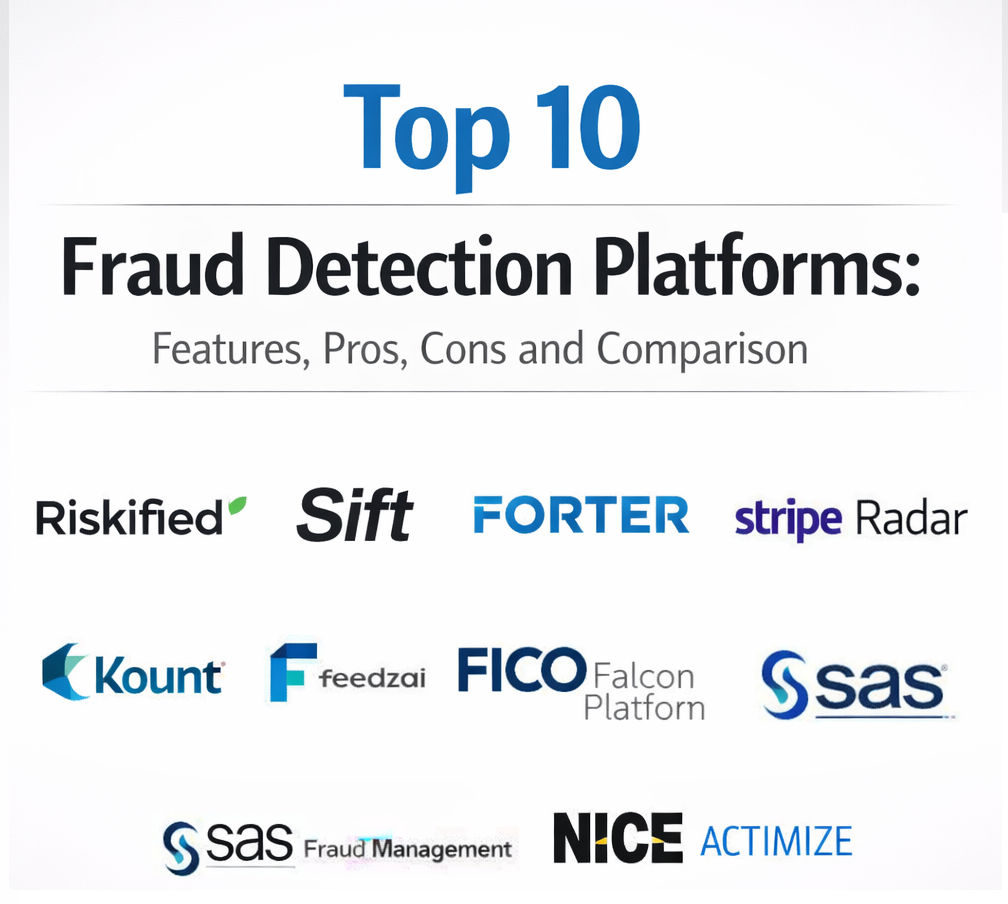
Top 10 Fraud Detection Platforms
1 — Riskified
Riskified is commonly used by ecommerce and digital commerce businesses to reduce chargebacks and manage payment fraud using risk scoring and decisioning workflows. It fits teams that want to protect revenue while keeping checkout friction low.
Key Features
- Transaction risk scoring for payment fraud detection
- Decisioning workflows to approve, decline, or review
- Chargeback and dispute workflows depending on setup
- Analytics for fraud trends and operational performance
- Policy controls for different risk tolerances by market or segment
- Tools to help reduce false positives and improve approvals
Pros
- Strong fit for ecommerce checkout protection
- Practical analytics for loss tracking and optimization
Cons
- Best fit is strongest in commerce-centric use cases
- Integration and tuning effort varies by stack complexity
Platforms / Deployment
Web
Cloud
Security & Compliance
Not publicly stated
Integrations & Ecosystem
Built to connect into commerce payment flows and decisioning points.
- Integrations with payment gateways and commerce platforms
- Data feeds to support decisioning and outcome learning
- APIs for routing decisions and passing reason codes
- Reporting outputs for operations and finance teams
Support & Community
Strong vendor-led support and onboarding; documentation quality varies by plan; community is vendor-driven.
2 — Sift
Sift supports fraud detection across account creation, login, account takeover, and transaction risk. It fits digital products that want behavior-based detection and flexible workflows.
Key Features
- Real-time risk scoring for multiple event types
- Behavior analytics to spot abnormal patterns
- Account takeover detection and session-level risk indicators
- Workflow controls for allow, block, and step-up actions
- Case management and investigation support
- Reporting for trends, rules, and model outcomes
Pros
- Good coverage across account and transaction fraud patterns
- Flexible workflows for step-up and review routing
Cons
- Tuning is needed to match your traffic and fraud mix
- Operational success depends on strong feedback loops
Platforms / Deployment
Web
Cloud
Security & Compliance
Not publicly stated
Integrations & Ecosystem
Designed for event streaming and risk decisioning across product journeys.
- APIs and SDK-style integration patterns
- Integrations with identity, support, and data platforms
- Routing to case queues and analyst workflows
- Exports for analytics and reporting pipelines
Support & Community
Support is generally strong; documentation is practical; community presence is moderate.
3 — Forter
Forter is widely used for commerce fraud prevention with emphasis on real-time decisions and reducing checkout friction. It fits businesses optimizing conversion while controlling fraud losses.
Key Features
- Real-time transaction fraud decisioning
- Account and identity risk signals depending on setup
- Policies to tune approvals and declines by segment
- Case workflows and exception handling support
- Analytics for fraud losses and approval performance
- Tools to support returns and abuse prevention in some setups
Pros
- Strong focus on reducing false declines and improving approvals
- Practical fit for high-volume ecommerce environments
Cons
- Best value is highest in mature commerce programs
- Implementation depth can vary based on desired coverage
Platforms / Deployment
Web
Cloud
Security & Compliance
Not publicly stated
Integrations & Ecosystem
Built for checkout flows and commerce operational workflows.
- Integrations with payment stacks and commerce platforms
- APIs for scoring, decisioning, and reason codes
- Connections to dispute and operational reporting workflows
- Supports segmentation for global commerce operations
Support & Community
Enterprise-focused support; onboarding is vendor-led; documentation is generally solid.
4 — Stripe Radar
Stripe Radar provides fraud detection and risk controls closely connected to Stripe payment flows. It fits businesses already using Stripe that want fast activation and practical controls.
Key Features
- Risk scoring for payments and chargeback reduction workflows
- Rule controls for custom risk policies
- Adaptive models that learn from outcomes in Stripe flows
- Reporting and analytics for fraud and disputes
- Review workflows depending on setup
- Controls to tune acceptance rates versus fraud losses
Pros
- Fast time-to-value for Stripe-based payment stacks
- Simple rule controls paired with automated detection
Cons
- Best fit depends on using Stripe for payments
- Deep customization may be limited compared to specialized platforms
Platforms / Deployment
Web
Cloud
Security & Compliance
Not publicly stated
Integrations & Ecosystem
Strongest inside Stripe payment and dispute workflows.
- Native fit for Stripe payments and dispute handling
- Rule and policy controls for payments
- Reporting aligned to payment operations
- APIs and webhooks for workflow automation depending on setup
Support & Community
Strong documentation and broad community due to Stripe ecosystem; support depends on service level.
5 — Kount
Kount is used for digital fraud detection, often across ecommerce and omnichannel environments. It fits teams that want risk scoring and decisioning with operational workflows.
Key Features
- Risk scoring for transactions and digital interactions
- Device intelligence and behavioral signals depending on setup
- Decisioning controls for approve, decline, and review
- Case management and investigation workflows
- Reporting for fraud trends and performance metrics
- Controls to tune false positives and policy thresholds
Pros
- Practical coverage for commerce-related fraud patterns
- Useful case workflows for investigator teams
Cons
- Setup and tuning can take time for complex environments
- Feature depth depends on selected modules and configuration
Platforms / Deployment
Web
Cloud
Security & Compliance
Not publicly stated
Integrations & Ecosystem
Designed for risk scoring in transaction and account workflows.
- Integrations with payment gateways and commerce platforms
- APIs for risk decisions and event ingestion
- Exports for reporting and operations
- Works with review queues and investigator workflows
Support & Community
Enterprise support is common; documentation is established; community footprint is moderate.
6 — Feedzai
Feedzai is commonly used in financial services and large digital payment environments to detect fraud across transactions and customer behavior. It fits teams needing advanced analytics and operational scale.
Key Features
- Real-time scoring for transactions and customer behavior
- Analytics to detect patterns across channels and accounts
- Case management and investigation workflows
- Policy controls and tuning support for fraud strategies
- Reporting for fraud loss, performance, and productivity
- Support for complex, large-scale financial environments
Pros
- Strong fit for financial-grade fraud environments
- Good operational workflows for analyst teams
Cons
- Implementation and tuning can be significant
- Best suited for mature programs with dedicated teams
Platforms / Deployment
Web
Cloud, Hybrid
Security & Compliance
Not publicly stated
Integrations & Ecosystem
Designed for connecting to banking, payments, and data environments.
- Integrations with core transaction systems and event streams
- APIs for decisioning and case routing
- Exports for analytics and compliance reporting
- Supports complex workflows across business units
Support & Community
Strong enterprise support; onboarding is structured; documentation is professional.
7 — Featurespace
Featurespace is used for behavior-based fraud detection, often in banking and payments contexts where customer behavior modeling helps reduce false positives. It fits teams prioritizing adaptive behavior analytics.
Key Features
- Behavior analytics for customer and transaction patterns
- Real-time scoring and decision workflows
- Controls for step-up challenges and review routing
- Investigation and case workflows depending on setup
- Reporting dashboards for fraud trends and performance
- Support for multi-channel fraud scenarios
Pros
- Strong behavior-based approach that can reduce false positives
- Good fit for complex fraud patterns across channels
Cons
- Requires strong data inputs to deliver best outcomes
- Implementation complexity depends on environment architecture
Platforms / Deployment
Web
Cloud, Hybrid
Security & Compliance
Not publicly stated
Integrations & Ecosystem
Designed for event and transaction data integration at scale.
- Integrations with transaction systems and data pipelines
- APIs for scoring and decision actions
- Export workflows for reporting and audit evidence
- Supports multi-channel detection strategies
Support & Community
Enterprise support is common; documentation is solid; community footprint is smaller than mass-market tools.
8 — FICO Falcon Platform
FICO Falcon Platform is recognized in financial fraud detection, especially for card and transaction fraud programs. It fits organizations needing proven approaches and structured operational workflows.
Key Features
- Transaction fraud detection and risk scoring
- Strategy controls for decision policies and thresholds
- Analytics for fraud trends and performance measurement
- Case management support depending on setup
- Support for large-scale and regulated environments
- Reporting workflows for operations and governance needs
Pros
- Strong fit for financial transaction fraud programs
- Mature operational approach for fraud strategy management
Cons
- Best suited for larger environments with dedicated fraud teams
- Integration and rollout can be complex depending on systems
Platforms / Deployment
Web
Cloud, Hybrid
Security & Compliance
Not publicly stated
Integrations & Ecosystem
Designed to integrate with financial transaction flows and operations.
- Integrations with transaction processing systems
- APIs for decisioning and strategy execution
- Exports for performance reporting and governance
- Works with fraud operations and investigation workflows
Support & Community
Enterprise-grade support; documentation is professional; community is largely enterprise-driven.
9 — SAS Fraud Management
SAS Fraud Management supports fraud detection and investigation workflows often used by large organizations needing strong analytics and governance. It fits teams that value analytics depth and operational control.
Key Features
- Fraud detection analytics for transaction and behavior patterns
- Real-time scoring and decision workflows
- Case management and investigation support
- Reporting dashboards and operational analytics
- Strategy tuning workflows and governance controls
- Support for large-scale, complex environments
Pros
- Strong analytics and governance capabilities
- Good fit for complex, regulated environments
Cons
- Implementation can be significant for complex programs
- Requires skilled teams to maximize value from analytics
Platforms / Deployment
Web
Cloud, Self-hosted, Hybrid
Security & Compliance
Not publicly stated
Integrations & Ecosystem
Designed to connect analytics, scoring, and investigation workflows.
- Integrations with enterprise data environments and event streams
- APIs for scoring and workflow automation
- Export workflows for reporting and compliance needs
- Supports multi-team operational structures
Support & Community
Strong enterprise support; documentation is detailed; community footprint is established in analytics circles.
10 — NICE Actimize
NICE Actimize is often used in financial crime programs that combine fraud detection with broader investigation and case workflows. It fits organizations needing strong case management and operational governance.
Key Features
- Fraud detection workflows for transactions and account activity
- Case management and investigation routing at scale
- Alerts, triage workflows, and investigator productivity features
- Reporting and dashboards for governance visibility
- Workflow controls for escalation, approvals, and evidence trails
- Support for complex operational environments
Pros
- Strong case management and investigation workflows
- Good fit for large financial crime operations
Cons
- Complexity can be high for smaller teams
- Best outcomes require strong process design and tuning
Platforms / Deployment
Web
Cloud, Self-hosted, Hybrid
Security & Compliance
Not publicly stated
Integrations & Ecosystem
Designed for integration into large operational and governance stacks.
- Integrations with transaction systems and alert sources
- APIs for workflow automation and case routing
- Export workflows for reporting and oversight
- Fits multi-team investigation and governance operations
Support & Community
Enterprise-grade support; documentation is detailed; community is largely enterprise-focused.
Comparison Table
| Tool Name | Best For | Platform(s) Supported | Deployment | Standout Feature | Public Rating |
|---|---|---|---|---|---|
| Riskified | Ecommerce payment fraud and chargeback reduction | Web | Cloud | Commerce-focused decisioning and optimization | N/A |
| Sift | Multi-event fraud detection across accounts and transactions | Web | Cloud | Behavior-based scoring across journeys | N/A |
| Forter | High-volume commerce fraud with conversion protection | Web | Cloud | Real-time approvals with friction control | N/A |
| Stripe Radar | Stripe-based payment fraud controls | Web | Cloud | Native fit inside Stripe payment flows | N/A |
| Kount | Digital commerce fraud scoring and review workflows | Web | Cloud | Practical scoring plus case workflows | N/A |
| Feedzai | Financial services fraud detection at scale | Web | Cloud, Hybrid | Advanced analytics with operations workflows | N/A |
| Featurespace | Behavior analytics for multi-channel fraud patterns | Web | Cloud, Hybrid | Adaptive behavior modeling to reduce false positives | N/A |
| FICO Falcon Platform | Financial transaction fraud programs | Web | Cloud, Hybrid | Mature fraud strategy and scoring approach | N/A |
| SAS Fraud Management | Analytics-driven fraud detection and governance | Web | Cloud, Self-hosted, Hybrid | Strong analytics and governance depth | N/A |
| NICE Actimize | Large-scale fraud operations and investigation workflows | Web | Cloud, Self-hosted, Hybrid | Strong case management and alert operations | N/A |
Evaluation and Scoring of Fraud Detection Platforms
Weights used: Core features (25%), Ease of use (15%), Integrations and ecosystem (15%), Security and compliance (10%), Performance and reliability (10%), Support and community (10%), Price and value (15%).
| Tool Name | Core (25%) | Ease (15%) | Integrations (15%) | Security (10%) | Performance (10%) | Support (10%) | Value (15%) | Weighted Total |
|---|---|---|---|---|---|---|---|---|
| Riskified | 8 | 7 | 7 | 6 | 8 | 7 | 6 | 7.15 |
| Sift | 8 | 7 | 7 | 6 | 7 | 7 | 6 | 6.95 |
| Forter | 8 | 6 | 7 | 6 | 8 | 7 | 5 | 6.75 |
| Stripe Radar | 7 | 8 | 7 | 6 | 7 | 7 | 8 | 7.35 |
| Kount | 7 | 6 | 6 | 6 | 7 | 7 | 6 | 6.45 |
| Feedzai | 9 | 5 | 7 | 6 | 8 | 7 | 5 | 6.90 |
| Featurespace | 8 | 5 | 7 | 6 | 8 | 6 | 5 | 6.55 |
| FICO Falcon Platform | 9 | 5 | 6 | 6 | 8 | 7 | 5 | 6.85 |
| SAS Fraud Management | 9 | 4 | 6 | 6 | 8 | 7 | 4 | 6.50 |
| NICE Actimize | 8 | 4 | 6 | 6 | 8 | 7 | 4 | 6.25 |
How to interpret the scores:
- Scores are comparative within this list and help shortlist platforms based on your fraud mix and operating model.
- Core reflects signal coverage, real-time decisioning, case workflows, reporting, and tuning capability.
- Ease reflects integration effort, day-to-day admin work, and analyst usability.
- Run a pilot with real traffic and outcomes so you can measure false positives, fraud loss reduction, latency, and operational effort.
Which Fraud Detection Platform Is Right for You?
Solo / Freelancer
Most solo operators should start with built-in protections from their payment provider and basic velocity controls. If fraud becomes frequent, choose a tool with fast setup, clear rule controls, and simple reporting.
SMB
SMBs should prioritize quick integration, strong default models, and clear dashboards. Platforms that reduce chargebacks while keeping approval rates healthy typically deliver the most value.
Mid-Market
Mid-market teams need segmentation, better case workflows, and clearer tuning controls. Choose a platform that supports step-up actions and integrates smoothly with your payment stack, identity stack, and support workflows.
Enterprise
Enterprises should prioritize multi-channel coverage, strong case management, governance controls, and scalable real-time performance. Validate multi-entity support, advanced reporting, and how easily you can run parallel strategies.
Budget vs Premium
Budget-friendly options work well when your fraud types are narrow and your stack is simple. Premium platforms typically support deeper signals, more advanced workflows, and better operational scale, which becomes critical at high volume.
Feature Depth vs Ease of Use
If your team is small, prioritize ease and strong defaults. If you run a dedicated fraud operations team, feature depth matters more, especially for strategy management, case workflows, and explainability.
Integrations and Scalability
Confirm how the platform connects to your payments, login flows, data pipeline, customer support tooling, and analytics. Scalability is not only traffic volume, but also how many event types and business units you can support cleanly.
Security and Compliance Needs
Prioritize role-based access, audit trails, evidence retention, and controlled workflows. For vendor security claims, request official documentation during procurement rather than relying on marketing summaries.
Frequently Asked Questions
1) What does a fraud detection platform actually do?
It scores events such as payments, logins, sign-ups, and refunds using signals and patterns, then triggers actions like allow, block, step-up checks, or manual review.
2) What is the difference between rules and risk models?
Rules are human-defined conditions like velocity limits, while models detect patterns across many signals. Most teams use both to balance speed and accuracy.
3) How do we reduce false positives?
Use step-up challenges instead of hard blocks, tune thresholds by segment, review reason codes, and maintain a feedback loop from chargebacks and investigations.
4) How long does implementation usually take?
It depends on integration points and event coverage. Start with one high-impact flow, measure outcomes, then expand to more event types once stable.
5) Do we need case management inside the fraud tool?
If you have investigators, yes. Strong case workflows reduce time spent chasing evidence and improve consistency across decisions.
6) Can these tools help with account takeover?
Many can, especially those focused on behavior and session risk. Validate login, device, and credential abuse coverage during evaluation.
7) How should we run a pilot?
Run parallel scoring on real traffic, compare decision outcomes, measure latency, track fraud loss reduction, and monitor approval and conversion impact.
8) What metrics should leadership care about?
Fraud loss rate, chargeback rate, false positive rate, approval rate, conversion impact, investigator productivity, and time-to-resolution for cases.
9) When should we switch platforms?
When false positives remain high, fraud adapts faster than your tooling, integrations are too limited, or operational workflows cannot scale with volume.
10) What is the most common mistake teams make?
Treating fraud as a one-time setup. Fraud prevention needs ongoing tuning, feedback loops, and regular strategy reviews as attackers evolve.
Conclusion
Fraud detection platforms help you protect revenue, customers, and brand trust by spotting suspicious activity early and taking the right action without adding unnecessary friction. The best platform depends on your fraud types, traffic volume, industry, and how mature your fraud operations team is. Start by identifying your highest-loss areas, such as chargebacks, account takeover, or refund abuse. Then shortlist two or three platforms that fit your stack and run a controlled pilot on real traffic. Measure fraud loss reduction, false positives, approval rate, latency, and analyst workload. Choose the platform that gives you clear reason codes, flexible decision options, and strong reporting. After rollout, keep a regular tuning cadence and maintain a strong feedback loop so the system keeps improving as fraud tactics change.

Best Cardiac Hospitals Near You
Discover top heart hospitals, cardiology centers & cardiac care services by city.
Advanced Heart Care • Trusted Hospitals • Expert Teams
View Best Hospitals