Introduction
A Freelance Management System (FMS) is a cloud-based platform designed to help organizations manage their entire relationship with independent contractors, freelancers, and consultants. Unlike general HR software meant for full-time employees, an FMS is built specifically for the unique legal and operational needs of the contingent workforce. These systems handle the complete lifecycle of a freelancer—from initial onboarding and contract signing to project tracking, compliance verification, and global payments.
In the current professional landscape, the “liquid workforce” has become a strategic asset for companies of all sizes. As we move further into a decentralized work era, businesses are increasingly relying on specialized talent for short-term projects. An FMS matters because it eliminates the manual chaos of spreadsheets and disparate email chains, providing a centralized hub that ensures legal compliance and financial transparency. It allows companies to scale their talent pool instantly without increasing the administrative burden on their internal teams.
Real-World Use Cases
- Global Talent Onboarding: Automatically collecting tax forms (W-9, W-8BEN) and signed NDAs from contractors in different countries.
- Project & Milestone Tracking: Setting clear deliverables and approving work before payments are automatically triggered.
- Compliance Management: Ensuring that freelancers are correctly classified to avoid the legal risks associated with employee misclassification.
- Budget Oversight: Tracking total spend across multiple freelance projects and departments to ensure alignment with company financial goals.
- Centralized Communication: Maintaining a single record of all project-related discussions, file transfers, and contract amendments.
Evaluation Criteria for Buyers
- Global Payment Capabilities: The ability to pay freelancers in their local currencies via multiple methods (Wire, ACH, PayPal).
- Automated Onboarding: Workflows that handle contract signing and identity verification without manual intervention.
- Tax & Legal Compliance: Built-in tools for collecting required tax documentation and managing regional labor law requirements.
- Integration Depth: How well the system connects with existing accounting software (QuickBooks, Xero) and project management tools.
- User Interface (UI): A simple, intuitive experience for both the internal team and the freelancers themselves.
- Reporting & Analytics: The quality of data insights regarding project costs, time-to-hire, and contractor performance.
- Scalability: The platform’s ability to manage ten freelancers as easily as one thousand.
Best for: Mid-market and enterprise companies scaling their creative or technical teams, agencies managing multiple client projects, and startups with a heavy reliance on remote independent talent.
Not ideal for: Very small businesses with only one or two local contractors, or companies that only hire full-time employees and have no plans to use external talent.
Key Trends in Freelance Management Systems
- AI-Powered Talent Matching: Systems are using machine learning to suggest the best-fit freelancer from an internal database based on project requirements and past performance.
- Direct Sourcing Portals: Companies are building their own private “talent clouds” to bypass traditional marketplaces and re-hire proven contractors directly.
- Automated Compliance Audits: Real-time monitoring of contractor relationships to ensure they remain compliant with evolving “gig economy” laws globally.
- Instant Global Payments: A shift toward real-time payment rails and digital wallets to ensure freelancers receive funds immediately upon work approval.
- Integrated Workflows: Deeper connections between FMS platforms and tools like Slack, Microsoft Teams, and Jira to manage work where it happens.
- Unified Workforce Visibility: Organizations are demanding a “single pane of glass” that shows both full-time and freelance headcount in one view.
- Enhanced Contractor Experience: Platforms are adding features for freelancers, such as automated invoicing and professional insurance options, to attract top talent.
- ESG and Diversity Tracking: New tools to help companies monitor and report on the diversity of their external contractor spend.
How We Selected These Tools
Our selection process for the top ten freelance management systems involved a detailed review of the current vendor landscape, focusing on platforms that offer comprehensive end-to-end management. We prioritized systems that balance robust compliance features with high ease of use. Our methodology evaluated market adoption within the enterprise sector, the reliability of payment processing, and the strength of the security infrastructure. We specifically looked for tools that provide “talent cloud” capabilities, allowing companies to build a sustainable network of experts. Reliability signals such as system uptime and the quality of customer support were also key factors in determining the final list of top-performing platforms.
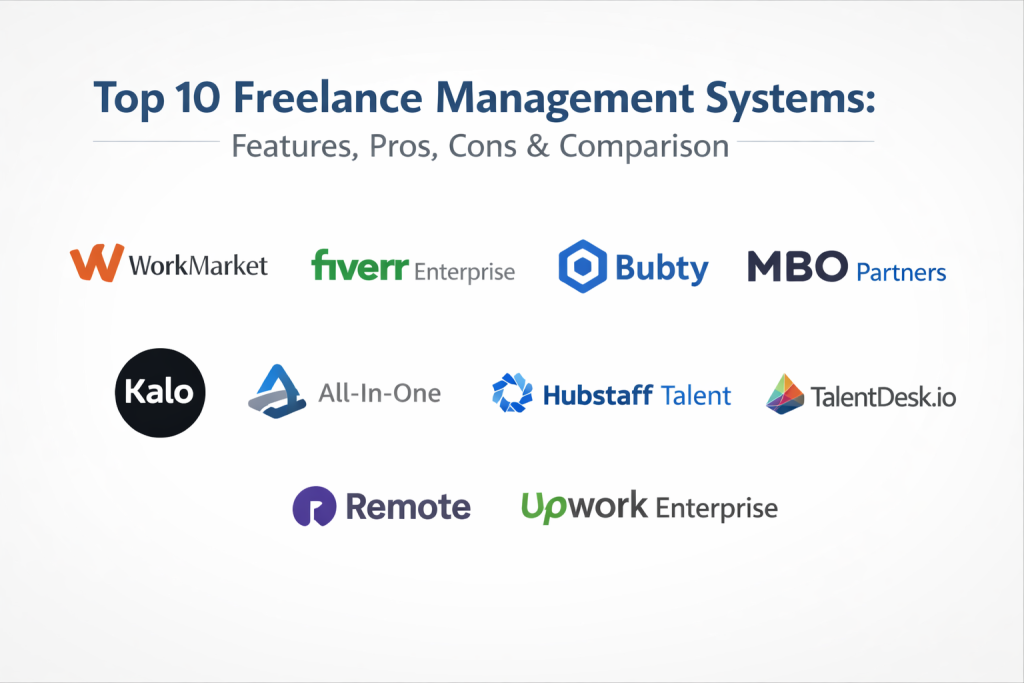
Top 10 Freelance Management Systems
1. WorkMarket (an ADP company)
WorkMarket is a heavy- hitter in the enterprise space, providing a robust platform for managing large-scale freelance workforces. Since its acquisition by ADP, it has integrated deep payroll and compliance expertise into its specialized freelance tools.
Key Features
- Labor Clouds: Organize freelancers into specific groups based on skills, location, or background checks.
- Automated Onboarding: Customizable workflows that ensure every contractor signs the necessary legal documents.
- Performance Tracking: Detailed ratings and history for every contractor in your network.
- Mass Payments: Ability to pay hundreds of contractors across multiple projects with a single click.
- Deep Compliance Engine: Built-in checks to ensure workers are properly classified according to local laws.
Pros
- Enterprise-grade security and reliability backed by ADP.
- Exceptional reporting tools for tracking budget and workforce efficiency.
Cons
- Can be overly complex for smaller companies with simple needs.
- The setup process requires a significant time investment to customize workflows.
Platforms / Deployment
Web / iOS / Android — Cloud-based
Security & Compliance
SOC 2 compliant, ISO 27001, and backed by ADP’s global compliance framework.
Integrations & Ecosystem
Integrates seamlessly with ADP’s payroll suite, as well as various ERP and accounting systems via a robust API.
Support & Community
Dedicated account management for enterprise clients and extensive professional documentation.
2. Fiverr Enterprise (formerly Stoke)
Fiverr Enterprise focuses on giving companies a high-speed, intuitive way to hire, manage, and pay their freelance talent without the usual overhead. It is designed to be a “plug-and-play” solution for departments that need to move fast.
Key Features
- Talent Directory: A centralized, searchable database of all your existing and past freelancers.
- One-Click Onboarding: Send contracts and tax forms instantly with pre-built templates.
- Automated Invoicing: Generates invoices automatically so freelancers don’t have to manually submit them.
- Budget Controls: Set spend limits for specific departments or individual managers.
- Legal & Tax Guardrails: Built-in logic to handle W-9/W-8BEN collection and storage.
Pros
- Extremely user-friendly interface that requires zero training.
- Fastest setup time for companies needing a quick FMS solution.
Cons
- Less focus on heavy workforce analytics compared to WorkMarket.
- Primarily focused on digital/white-collar freelancers rather than field services.
Platforms / Deployment
Web — Cloud-based
Security & Compliance
SOC 2 Type II compliant and GDPR ready.
Integrations & Ecosystem
Strong integrations with Slack, Zoom, Google Drive, and major accounting software.
Support & Community
Responsive customer support and a growing knowledge base for modern HR teams.
3. Bubty
Bubty is a specialized FMS that emphasizes “Internal Talent Clouds.” It allows companies to move away from expensive third-party marketplaces by building their own private database of trusted experts.
Key Features
- Private Talent Pools: Create your own branded marketplace of pre-vetted freelancers.
- Global Payment Engine: Pay contractors in over 190 countries using local payment methods.
- Contract Management: End-to-end handling of NDAs, IP agreements, and service contracts.
- Work Approval Flows: Multi-step approval cycles to ensure work meets quality standards before payment.
- Compliance Dashboard: Real-time visibility into the status of every contractor’s legal documents.
Pros
- Excellent for companies that want to white-label their freelancer portal.
- Strong focus on reducing the “middleman” fees of traditional freelance sites.
Cons
- Smaller ecosystem of third-party integrations than larger competitors.
- The reporting interface is clean but less granular than enterprise-level ERPs.
Platforms / Deployment
Web — Cloud-based
Security & Compliance
Fully GDPR compliant with robust data encryption and privacy controls.
Integrations & Ecosystem
Integrates with popular project management and communication tools via Zapier and native APIs.
Support & Community
Highly personalized support and a focus on long-term partnership with clients.
4. MBO Partners
MBO Partners is a premium enterprise solution that focuses heavily on the “Contractor of Record” (CoR) model. They specialize in high-stakes compliance and managing the relationships between large corporations and independent professionals.
Key Features
- Direct Sourcing: Tools to find and engage high-level independent consultants directly.
- IC Compliance: Rigorous vetting process to ensure independent contractors are correctly classified.
- Enterprise Payments: Sophisticated financial engine for managing large-scale, complex payment schedules.
- Benefits for Freelancers: Offers access to portable benefits, which helps attract top-tier professional talent.
- Strategic Insights: Consulting-level reporting on workforce trends and spend optimization.
Pros
- The industry leader for high-level compliance and risk mitigation.
- Attracts high-quality professional talent due to its freelancer-friendly features.
Cons
- Higher price point suited for larger organizations.
- The platform can feel more “corporate” and less “agile” for creative teams.
Platforms / Deployment
Web — Cloud-based
Security & Compliance
Highest enterprise standards, including SOC 2 and specialized federal compliance.
Integrations & Ecosystem
Deeply integrated with enterprise VMS (Vendor Management Systems) and ERPs like SAP Fieldglass.
Support & Community
A massive network of independent professionals and elite-level enterprise support.
5. TalentDesk.io
TalentDesk.io is an all-in-one platform that combines project management with freelance management. It is designed to help agencies and project-heavy companies manage work and payments in one place.
Key Features
- Unified Workspace: Manage project tasks and freelancer payments in the same interface.
- Automatic Payments: Pay all your freelancers globally with a single monthly consolidated invoice.
- Compliance Workflows: Automated collection of tax and legal documentation.
- Resource Planning: See who is available for a project and at what rate.
- Customizable Onboarding: Tailor the experience for different types of contractors.
Pros
- Reduces the number of tools needed by combining work and payment management.
- Highly transparent pricing and a clean, modern interface.
Cons
- Project management features may be redundant if you already use Jira or Monday.com.
- Scaling to thousands of workers may feel less robust than WorkMarket.
Platforms / Deployment
Web — Cloud-based
Security & Compliance
SOC 2 compliant and follows strict international data protection laws.
Integrations & Ecosystem
Good connectivity with Google Workspace, Slack, and common accounting platforms.
Support & Community
Known for being very responsive to user feedback and feature requests.
6. Kalo
Kalo is a sleek, design-forward FMS that gained popularity among creative agencies and media companies. It focuses on the “creative” side of the gig economy, making it easy to manage portfolios and creative projects.
Key Features
- Portfolio Management: View the actual work of your freelancers within the platform.
- Project Assignment: Fast, visual way to assign tasks to your talent cloud.
- Budget Tracking: Visual dashboards showing how much of a project’s budget has been consumed.
- Consolidated Invoicing: One simple payment process for your entire creative network.
- Task Management: Simple tracking of deadlines and deliverables.
Pros
- The most visually appealing interface for creative directors and marketers.
- Great for managing high volumes of small, creative tasks.
Cons
- Lacks the deep “Contractor of Record” compliance depth of MBO Partners.
- Has faced some stability challenges during platform transitions in the past.
Platforms / Deployment
Web — Cloud-based
Security & Compliance
Standard data encryption and GDPR compliance.
Integrations & Ecosystem
Works well with design-centric tools and standard communication apps.
Support & Community
A strong presence in the creative community and good online help resources.
7. All-In-One (formerly Shortlist)
Shortlist focuses on “Talent Relationship Management.” It acts as a hybrid between a CRM and an FMS, helping companies nurture long-term relationships with their best external talent.
Key Features
- Relationship Tracking: Detailed logs of every interaction with a freelancer.
- Custom Onboarding: Build your own multi-step onboarding journey for new talent.
- Global Payouts: Support for payments in local currencies across the globe.
- Compliance Vault: Secure storage for all legal and tax documentation.
- Vetting Workflows: Custom tests or approval steps before a freelancer is “active.”
Pros
- Excellent for companies that prioritize talent retention and “re-hiring.”
- Very flexible and can be customized to fit unique business rules.
Cons
- The interface can become cluttered with too many custom fields.
- Requires a more hands-on approach to set up than “plug-and-play” tools.
Platforms / Deployment
Web — Cloud-based
Security & Compliance
SOC 2 compliant and prioritized for enterprise data security.
Integrations & Ecosystem
Broad integration capabilities with HRIS and accounting systems.
Support & Community
Strong customer success teams and detailed onboarding support.
8. Hubstaff Talent
While Hubstaff is famous for time tracking, their FMS platform focuses on the “direct hire” and monitoring aspect. It is a favorite for remote-first companies that need to verify hours worked on technical projects.
Key Features
- Automatic Time Tracking: High-accuracy tracking that feeds directly into the payment system.
- Proof of Work: Optional screenshots and activity levels to ensure project progress.
- Payroll Automation: Automatically calculates and sends payments based on hours tracked.
- Shift Management: Schedule and manage remote contractor shifts.
- Budget Alerts: Notifications when a freelancer is approaching their project limit.
Pros
- The best tool for companies that pay freelancers on an hourly basis.
- Very transparent for both the employer and the contractor.
Cons
- The “monitoring” features can be a deterrent for high-level creative talent.
- Compliance features for tax and legal are lighter than specialized FMS tools.
Platforms / Deployment
Web / Windows / macOS / Linux / Mobile — Cloud-based
Security & Compliance
Standard data protection and secure payment processing.
Integrations & Ecosystem
Integrates with nearly every project management tool, from Jira to Trello and Asana.
Support & Community
Massive user base and a wealth of blog posts and tutorials for remote management.
9. Remote
Remote is primarily an Employer of Record (EOR), but they have built a powerful, free-to-start Freelancer Management tool. It is ideal for companies that manage both full-time employees and freelancers internationally.
Key Features
- Unified Workforce View: See all your employees and contractors in one dashboard.
- Contract Creation: Localized contract templates for various countries.
- Global Payouts: Pay freelancers in dozens of local currencies with zero exchange markups.
- Compliance Guardrails: Helps ensure you are meeting local requirements for contractor engagement.
- Document Management: Securely store and manage IDs and tax forms globally.
Pros
- The freelancer management portion is exceptionally cost-effective (often free for management).
- The most modern and “clean” platform for global teams.
Cons
- Less focused on “project management” or “milestone tracking” than TalentDesk.
- Primarily designed as a gateway to their EOR service.
Platforms / Deployment
Web / Mobile — Cloud-based
Security & Compliance
SOC 2 Type II compliant and a leader in international labor law compliance.
Integrations & Ecosystem
Strong integrations with modern HRIS platforms like BambooHR and HiBob.
Support & Community
Top-tier customer support and a massive global knowledge base of labor laws.
10. Upwork Enterprise
Upwork is the world’s largest marketplace, and their Enterprise FMS allows companies to manage their own talent while also having instant access to Upwork’s massive public talent pool.
Key Features
- Hybrid Talent Clouds: Manage your private talent alongside millions of Upwork freelancers.
- Compliance Services: Upwork handles the classification and risk management for you.
- Custom Reporting: Deep insights into how different teams are using freelance talent.
- Managed Services: Option for Upwork experts to help find and vet talent for you.
- Consolidated Billing: One single invoice for all freelance work, regardless of where the talent was sourced.
Pros
- The fastest way to fill a skill gap by tapping into the public marketplace.
- Robust compliance protection for companies worried about misclassification.
Cons
- Transaction fees can be higher than specialized “private-only” FMS tools.
- The platform can feel massive and less “personal” than smaller boutique systems.
Platforms / Deployment
Web / iOS / Android — Cloud-based
Security & Compliance
Enterprise-grade security and a focus on IC compliance services.
Integrations & Ecosystem
Integrates with major VMS platforms and standard enterprise software suites.
Support & Community
A global community of millions and dedicated enterprise support teams.
Comparison Table (Top 10)
| Tool Name | Best For | Platform(s) Supported | Deployment | Standout Feature | Public Rating |
| 1. WorkMarket | Large Enterprise | Web, Mobile | Cloud | Labor Clouds | 4.4/5 |
| 2. Fiverr Enterprise | Fast-Moving Depts | Web | Cloud | Automated Invoicing | 4.6/5 |
| 3. Bubty | Internal Talent Clouds | Web | Cloud | White-label Portal | 4.7/5 |
| 4. MBO Partners | High-Risk Compliance | Web | Cloud | Contractor of Record | 4.5/5 |
| 5. TalentDesk.io | Agencies / Projects | Web | Cloud | Unified Work & Pay | 4.5/5 |
| 6. Kalo | Creative Teams | Web | Cloud | Portfolio Views | 4.3/5 |
| 7. All-In-One | Relationship Mgmt | Web | Cloud | Custom Onboarding | 4.4/5 |
| 8. Hubstaff Talent | Hourly Monitoring | Web, Desktop | Cloud | Time-to-Pay Automation | 4.5/5 |
| 9. Remote | Modern Global Teams | Web, Mobile | Cloud | Global Currency Pay | 4.8/5 |
| 10. Upwork Enterprise | Marketplace Access | Web, Mobile | Cloud | Hybrid Talent Clouds | 4.4/5 |
Evaluation & Scoring of Freelance Management Systems
| Tool Name | Core (25%) | Ease (15%) | Integrations (15%) | Security (10%) | Perf (10%) | Support (10%) | Value (15%) | Total |
| 1. WorkMarket | 10 | 5 | 10 | 10 | 9 | 9 | 6 | 8.4 |
| 2. Fiverr Ent. | 8 | 10 | 9 | 8 | 9 | 9 | 8 | 8.6 |
| 3. Bubty | 8 | 9 | 7 | 8 | 9 | 10 | 8 | 8.3 |
| 4. MBO Partners | 10 | 6 | 9 | 10 | 9 | 9 | 6 | 8.4 |
| 5. TalentDesk | 9 | 8 | 8 | 8 | 8 | 9 | 8 | 8.3 |
| 6. Kalo | 7 | 9 | 7 | 8 | 7 | 8 | 7 | 7.5 |
| 7. All-In-One | 8 | 7 | 8 | 8 | 8 | 9 | 7 | 7.6 |
| 8. Hubstaff | 7 | 9 | 9 | 7 | 9 | 8 | 9 | 8.1 |
| 9. Remote | 8 | 9 | 8 | 10 | 9 | 9 | 10 | 8.9 |
| 10. Upwork Ent. | 9 | 7 | 9 | 9 | 9 | 8 | 7 | 8.2 |
Scoring follows professional production standards. A high “Core” score indicates a deep feature set for enterprise-level management. “Value” scores prioritize platforms that offer the best return on investment for small-to-medium budgets. “Ease” scores identify tools that allow for a faster internal rollout with minimal training.
Which Freelance Management System Is Right for You?
Solo / Freelancer
If you are an individual contractor looking to be managed by others, you don’t usually choose the FMS—the client does. However, having a profile on Remote or Upwork makes you much easier for modern companies to hire and pay.
SMB
For small teams that need to organize their first “talent cloud,” Remote or Fiverr Enterprise are the best starting points. They offer the lowest entry barrier and focus on the basics: onboarding, compliance, and payments.
Mid-Market
Organizations with a steady stream of creative or technical projects should consider TalentDesk.io or Bubty. These platforms allow you to scale your talent pool while maintaining a very professional, branded experience for your contractors.
Enterprise
Large corporations with significant legal and financial risk must look toward WorkMarket or MBO Partners. These systems are built to handle the rigorous security and compliance audits required by fortune 500 companies.
Budget vs Premium
If budget is the primary driver, Remote’s contractor management tool is virtually unbeatable. For premium needs where risk mitigation is the top priority, MBO Partners is the standard, even at a higher price point.
Feature Depth vs Ease of Use
WorkMarket offers the most depth but requires significant training. Fiverr Enterprise is designed so that a manager can start hiring in under ten minutes with almost no learning curve.
Integrations & Scalability
If you need to scale to thousands of workers globally, WorkMarket and Upwork Enterprise have the most robust infrastructures to support that volume. Hubstaff is the choice for those who need deep time-tracking integration.
Security & Compliance Needs
Enterprises in highly regulated industries like finance or healthcare should stick with the industry leaders—ADP/WorkMarket or MBO Partners—as they offer the most comprehensive and verified compliance frameworks.
Frequently Asked Questions (FAQs)
1. What is the difference between an FMS and a VMS?
An FMS is designed for managing individual freelancers and small LLCs directly. A VMS (Vendor Management System) is typically used for managing large staffing agencies and third-party vendors.
2. Does an FMS help with tax compliance?
Yes. Most systems automatically collect tax forms like W-9s or W-8BENs and some even generate 1099-NEC forms at the end of the year in the US.
3. What is worker misclassification?
This is a legal risk where a freelancer is treated like an employee but is not given employee benefits. An FMS provides guardrails and “Contractor of Record” services to prevent this.
4. Can I pay international freelancers through these systems?
Yes. Platforms like Remote, Bubty, and WorkMarket allow you to pay contractors in multiple currencies, often through local bank transfers to avoid high wire fees.
5. Is a Freelance Management System expensive?
Pricing varies. Some platforms charge a flat monthly fee, while others take a small percentage of each transaction. Many, like Remote, offer free tiers for basic management.
6. Can I build my own “private” talent cloud?
Yes, that is a core feature of platforms like Bubty and Fiverr Enterprise. It allows you to invite your trusted freelancers to a private portal so you don’t have to search for them every time.
7. Do I still need an accounting tool like QuickBooks?
Yes, but most FMS platforms sync directly with QuickBooks or Xero, so your freelance payments automatically appear in your accounting records.
8. Can freelancers use these tools to track their time?
Some systems, like Hubstaff, have deep time tracking built-in. Others focus more on “milestone” payments where the freelancer gets paid upon completion of a task.
9. How do these tools handle NDAs and contracts?
They usually have a digital signature feature (like DocuSign) built directly into the onboarding flow, so a freelancer cannot start work until they have signed the necessary legal documents.
10. How long does it take to implement an FMS?
Simple tools like Fiverr Enterprise can be set up in a day. Enterprise systems like WorkMarket may take several weeks to fully integrate with your company’s existing financial systems.
Conclusion
The implementation of a Freelance Management System is no longer a luxury but a necessity for any organization looking to thrive in a talent-on-demand economy. By centralizing the management of external talent, businesses can reduce legal risks, cut administrative costs, and build a more agile workforce. Whether you are a small agency or a global enterprise, choosing a platform that balances ease of use with robust compliance will ensure that your freelance relationships are productive and scalable. As the workforce continues to evolve, the organizations that master the “Ops” of freelance management will be the ones that lead their industries in innovation and growth. I recommend auditing your current freelance spend and management process. If you find yourself losing time on manual invoicing or worrying about tax compliance, shortlist two or three platforms from this list—starting with a modern, simple tool like Remote or Fiverr Enterprise—to run a small-scale pilot.

Best Cardiac Hospitals Near You
Discover top heart hospitals, cardiology centers & cardiac care services by city.
Advanced Heart Care • Trusted Hospitals • Expert Teams
View Best Hospitals