Introduction
GraphQL tooling is the set of products and libraries that help teams design GraphQL schemas, build GraphQL servers, query APIs from web and mobile apps, test and debug requests, and operate GraphQL safely in production. GraphQL itself is only the query language and runtime idea. The real success comes from good tooling around schema governance, performance, caching, developer experience, observability, and integrations.
This category matters because GraphQL can reduce over-fetching, speed up frontend delivery, and make APIs easier to evolve. At the same time, GraphQL can introduce new risks like expensive queries, schema sprawl, inconsistent naming, and complex caching strategies. Strong tooling makes GraphQL predictable and production-friendly, especially when multiple teams ship features in parallel.
Real-world use cases:
- Building a single API layer that serves web, iOS, and Android clients with consistent data shapes
- Creating a backend-for-frontend pattern where frontend teams move faster with fewer API changes
- Federating multiple services into one graph while keeping ownership boundaries clear
- Generating typed clients to reduce runtime bugs and speed up development
- Running API governance so schema changes do not break consumers unexpectedly
What buyers should evaluate before choosing:
- Schema design support: validation, linting patterns, naming conventions, breaking change detection
- Server runtime maturity: performance, extensibility, plugin ecosystem, auth patterns
- Caching strategy: client caching, edge caching, response normalization (varies)
- Federation and composition: multi-service graphs, ownership boundaries, rollout safety (varies)
- Observability: tracing hooks, query analysis, error visibility, performance signals
- Developer experience: playgrounds, debugging tools, documentation generation
- Type safety: code generation, schema-first workflows, typed hooks and client helpers
- Integrations: CI/CD, service catalogs, auth providers, monitoring stacks
- Security controls: auth, RBAC patterns, query limits, introspection control (varies)
- Operational fit: cloud-managed vs self-hosted vs hybrid requirements
Best for: product teams, platform teams, and API teams building multi-client applications, developer platforms, or integration-heavy systems where schema evolution and client velocity matter.
Not ideal for: very small APIs with simple REST needs, or systems where caching and request patterns must stay extremely simple. In those cases, GraphQL can be more complexity than value unless you truly need it.
Key Trends in GraphQL Tooling
- More focus on schema governance: change safety, versioning discipline, and breaking change detection
- Federation and composition patterns becoming common for multi-team graphs
- Stronger developer experience tooling for fast onboarding and safe experimentation
- Type-safe client generation becoming a baseline expectation, not a bonus
- Query performance controls becoming a must-have: complexity limits, persisted queries, allow-lists (varies)
- Better observability integration with logs, metrics, and tracing pipelines
- More emphasis on security boundaries: auth rules, field-level protection patterns, and introspection control (varies)
- Growing use of GraphQL as an orchestration layer across REST, gRPC, and legacy APIs
- Increased demand for unified API catalogs and contract clarity across teams
- More teams standardizing on a smaller set of tooling to reduce fragmentation and maintenance costs
How We Selected These Tools
- Strong mindshare and credibility across real GraphQL implementations
- Coverage across the core lifecycle: server runtime, client libraries, schema tooling, debugging, and data layer
- Practical capability for production use, not only demos
- Ecosystem strength: plugins, integrations, community learning resources
- Fit across team sizes: solo developers, SMBs, mid-market, and enterprise programs
- Maintainability signals: typed workflows, governance features, and structured architecture patterns
- Balance across developer-first and platform-first tooling choices
- Clear role in a GraphQL stack so teams can combine them into a working system
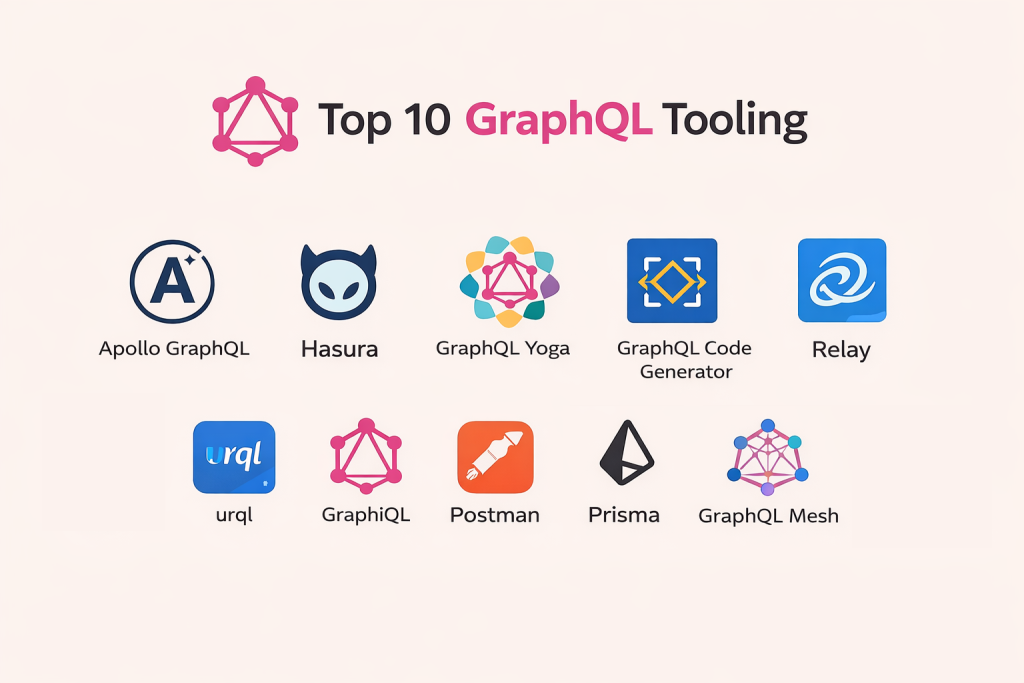
Top 10 GraphQL Tooling
1 — Apollo GraphQL
A broad GraphQL ecosystem covering client-side querying, server patterns, and operational tooling. It is widely used when teams want strong client caching patterns and a structured path to operating GraphQL at scale.
Key Features
- Client-side query workflows with normalization and caching patterns (varies by setup)
- Server-side patterns for production GraphQL APIs (varies by architecture)
- Schema and operation visibility patterns (varies)
- Developer experience features for exploring and testing queries (varies)
- Integrations for monitoring and workflow automation (varies)
- Supports common enterprise graph patterns (varies)
Pros
- Strong end-to-end ecosystem across client and server concerns
- Excellent developer experience and documentation depth
- Useful for teams scaling a graph across many clients
Cons
- Can feel heavy if you only need a minimal server or minimal client
- Some capabilities depend on plan and chosen components
- Requires discipline to avoid schema sprawl and policy drift
Platforms / Deployment
Web, Cloud, Self-hosted, Hybrid (varies)
Security and Compliance
SSO/SAML, RBAC, audit visibility: Varies / Not publicly stated
Integrations and Ecosystem
Works well in stacks that include monitoring, CI/CD, and typed client pipelines.
- Monitoring and error visibility integrations (varies)
- CI/CD schema checks and governance workflows (varies)
- Authentication provider integration patterns (varies)
- Tooling for developer onboarding and docs workflows (varies)
Support and Community
Very strong community and learning ecosystem; support tiers vary.
2 — Hasura
A GraphQL engine that can generate GraphQL APIs over data sources and supports event-driven patterns and permissions workflows depending on configuration. It is often used for rapid backend delivery.
Key Features
- Fast GraphQL API creation over connected data sources (varies)
- Permission and access rule patterns for role-based APIs (varies)
- Event and trigger patterns for workflows (varies)
- Metadata-driven configuration management (varies)
- Integrations with auth providers and external logic (varies)
- Operational tooling for running GraphQL APIs (varies)
Pros
- Very fast time-to-first-API for many use cases
- Strong fit for CRUD-heavy applications and internal tools
- Reduces backend workload when patterns match well
Cons
- Fit depends heavily on your data model and access rules
- Complex business logic may need additional services
- Governance requires discipline as the graph grows
Platforms / Deployment
Cloud, Self-hosted, Hybrid (varies)
Security and Compliance
RBAC patterns: Varies / Not publicly stated
Integrations and Ecosystem
Often used with external auth, serverless functions, and data platforms.
- Auth provider integration patterns (varies)
- Event workflows and automation hooks (varies)
- Data platform connectivity (varies)
- CI/CD-friendly config management patterns (varies)
Support and Community
Strong community in product and startup environments; support tiers vary.
3 — GraphQL Yoga
A server framework focused on a clean developer experience and extensible server setup. It fits teams that want a modern GraphQL server foundation without over-committing to a full platform suite.
Key Features
- Lightweight server setup with extensibility (varies)
- Plugin patterns for auth, logging, and performance controls (varies)
- Good fit for modern JavaScript and TypeScript stacks
- Works well with common GraphQL schema approaches
- Supports common deployment targets (varies)
- Developer-friendly defaults and ergonomics
Pros
- Good flexibility without feeling overly heavy
- Strong fit for teams that want control over architecture
- Clean setup and readable patterns
Cons
- Full platform governance needs external tools
- Some advanced enterprise needs require more integration work
- Performance depends on architecture choices and plugins
Platforms / Deployment
Web, Cloud, Self-hosted (varies)
Security and Compliance
Not publicly stated
Integrations and Ecosystem
Often combined with typed tooling, logging pipelines, and auth integration.
- Auth middleware patterns (varies)
- Observability integrations (varies)
- Code generation workflows (varies)
- CI/CD integration patterns (varies)
Support and Community
Good documentation and a growing community; support depends on ecosystem choices.
4 — GraphQL Code Generator
A tooling layer that generates types and helpers from a GraphQL schema and operations. It is commonly used to make frontend and backend development safer and faster with strong type guarantees.
Key Features
- Generates typed client code from schema and operations (varies by config)
- Supports multiple frontend patterns and frameworks (varies)
- Helps prevent runtime bugs through compile-time type checks
- Enables consistent operation naming and query organization
- Can generate SDK-style wrappers (varies)
- Works well in CI pipelines for validation (varies)
Pros
- Major improvement in developer speed and confidence
- Reduces runtime API mismatches
- Encourages disciplined GraphQL operation management
Cons
- Requires consistent operation organization to avoid chaos
- Adds build pipeline complexity if not standardized
- Output quality depends on configuration discipline
Platforms / Deployment
Web, Windows, macOS, Linux
Security and Compliance
Not publicly stated
Integrations and Ecosystem
Fits well with TypeScript stacks and client libraries that benefit from generated types.
- Works with common GraphQL clients (varies)
- Fits CI workflows for schema validation (varies)
- Enables typed hooks and SDK generation (varies)
- Complements schema governance tooling (varies)
Support and Community
Strong community usage and many examples; documentation is widely referenced.
5 — Relay
A client framework that emphasizes performance and predictable data management patterns. It is often chosen for large applications where consistent patterns and strong caching behavior matter.
Key Features
- Strong client caching and normalization patterns
- Fragment-driven data dependencies for components
- Predictable client data management workflows
- Supports large-scale application organization patterns
- Encourages disciplined GraphQL schema usage
- Useful for performance-sensitive client applications
Pros
- Excellent for large, complex frontend applications
- Strong consistency patterns reduce long-term drift
- Good performance focus for client-side data usage
Cons
- Higher learning curve than simpler clients
- Requires disciplined schema and fragment patterns
- Fit is best for teams that commit to its approach
Platforms / Deployment
Web
Security and Compliance
Not publicly stated
Integrations and Ecosystem
Commonly paired with typed generation workflows and structured component architecture.
- Works with schema-based development patterns (varies)
- Fits strongly typed client pipelines (varies)
- Benefits from stable schema governance practices
- Integrates through standard build tooling (varies)
Support and Community
Strong in larger engineering teams; community learning exists but the approach requires commitment.
6 — urql
A GraphQL client library designed for flexibility and composable exchanges. It fits teams that want a client that is lighter than heavy frameworks while still supporting serious app patterns.
Key Features
- Flexible client architecture with composable middleware patterns
- Caching approaches that can be tuned to the app needs (varies)
- Good fit for modern frontend stacks
- Supports subscriptions and advanced workflows (varies)
- Developer-friendly API design
- Integrates well with typed tooling (varies)
Pros
- Good balance of simplicity and capability
- Flexible architecture for custom needs
- Often easier to adopt than heavier client frameworks
Cons
- Some advanced caching patterns require careful design
- Best results require disciplined exchange configuration
- Observability depends on integrations you add
Platforms / Deployment
Web
Security and Compliance
Not publicly stated
Integrations and Ecosystem
Often combined with type generation and standard frontend build pipelines.
- Type generation integration (varies)
- Framework integration patterns (varies)
- Testing and mocking support via ecosystem tools (varies)
- Works well in modular frontend architectures
Support and Community
Healthy community and good docs; support is community-driven.
7 — GraphiQL
A GraphQL IDE used to explore schemas, test queries, and debug requests. It is frequently used as a developer tool for learning and daily API work.
Key Features
- Interactive query editor and explorer
- Schema introspection and documentation browsing (varies)
- Query history and saved snippets (varies)
- Variable editing and request testing workflows
- Useful for debugging errors and response shapes
- Supports developer onboarding and quick validation
Pros
- Great for exploration and debugging
- Helps teams learn schema structure quickly
- Simple tool that improves daily developer productivity
Cons
- Not a governance solution by itself
- Security depends on how you expose it in environments
- Limited operational features beyond exploration
Platforms / Deployment
Web
Security and Compliance
Not publicly stated
Integrations and Ecosystem
Often used alongside server frameworks and API gateways for daily testing.
- Works with standard GraphQL endpoints
- Complements docs and onboarding flows
- Fits local and team-based debugging workflows
- Can be embedded depending on setup (varies)
Support and Community
Very widely known and used; community knowledge is strong.
8 — Postman
A broad API tool used for testing and collaboration. While not GraphQL-only, it is commonly used to test GraphQL operations, manage environments, and share request collections across teams.
Key Features
- GraphQL request building and response inspection (varies)
- Environments and variables for repeatable testing workflows
- Collaboration features for shared API testing
- Automation patterns for basic API checks (varies)
- API documentation collaboration workflows (varies)
- Useful for onboarding and cross-team validation
Pros
- Very common tool across many teams and orgs
- Easy to standardize testing workflows
- Helps non-GraphQL experts validate requests quickly
Cons
- Not specialized for advanced GraphQL governance
- Complex GraphQL workflows may need additional tooling
- Best used as part of a wider GraphQL toolchain
Platforms / Deployment
Web, Windows, macOS, Linux
Security and Compliance
Not publicly stated
Integrations and Ecosystem
Fits well with CI workflows, team collaboration, and API testing patterns.
- CI pipeline integration patterns (varies)
- Team collaboration workflows (varies)
- Environment management patterns for testing
- Complements schema and client tooling
Support and Community
Very large community and broad training content; support varies by plan.
9 — Prisma
A data layer tool often used in GraphQL servers to simplify database access and maintain type-safe data models. It is frequently used when teams want clean data access patterns under GraphQL resolvers.
Key Features
- Type-safe database access patterns (varies by setup)
- Clear data modeling workflows
- Migration and schema management patterns (varies)
- Good fit for resolver development and service layers
- Improves maintainability of data access code
- Works well in modern TypeScript stacks
Pros
- Improves developer productivity on data access
- Encourages clean and maintainable resolver code
- Strong type safety reduces runtime data bugs
Cons
- Not a GraphQL runtime or governance tool by itself
- Fit depends on database and architecture choices
- Performance tuning requires understanding query patterns
Platforms / Deployment
Windows, macOS, Linux
Security and Compliance
Not publicly stated
Integrations and Ecosystem
Often used with server frameworks and typed tooling.
- Works with GraphQL server frameworks (varies)
- Complements typed generation pipelines (varies)
- Fits common backend architecture patterns
- Integrates with CI workflows for migrations (varies)
Support and Community
Strong developer community and documentation; widely adopted in modern stacks.
10 — GraphQL Mesh
A tooling approach that can unify multiple APIs into a single GraphQL layer. It is used when teams want GraphQL as an orchestration and aggregation layer across different backend types.
Key Features
- Unifies multiple backends behind one GraphQL schema (varies)
- Useful for building a single API surface for multiple clients
- Supports composition and aggregation patterns (varies)
- Enables gradual adoption of GraphQL over existing services (varies)
- Helps standardize access rules at the gateway layer (varies)
- Integrates with existing API ecosystems (varies)
Pros
- Strong for bridging legacy APIs into a unified graph
- Speeds up frontend work by standardizing API access
- Useful stepping stone toward a more structured API platform
Cons
- Adds a new layer to operate and govern
- Performance depends on backend latency and caching strategies
- Requires discipline to avoid a “mega gateway” anti-pattern
Platforms / Deployment
Cloud, Self-hosted, Hybrid (varies)
Security and Compliance
Not publicly stated
Integrations and Ecosystem
Often used with existing REST services, auth layers, and observability pipelines.
- Integrates with existing APIs and services (varies)
- Auth and policy integration patterns (varies)
- Logging and monitoring integrations (varies)
- Complements schema governance tooling (varies)
Support and Community
Good community usage in orchestration-style GraphQL adoption; support depends on ecosystem.
Comparison Table
| Tool Name | Best For | Platform(s) Supported | Deployment | Standout Feature | Public Rating |
|---|---|---|---|---|---|
| Apollo GraphQL | End-to-end GraphQL stack and operations | Web | Cloud, Self-hosted, Hybrid (varies) | Broad ecosystem across client and server | N/A |
| Hasura | Fast GraphQL APIs over data sources | Web | Cloud, Self-hosted, Hybrid (varies) | Rapid API generation and permissions patterns | N/A |
| GraphQL Yoga | Flexible GraphQL server foundation | Web | Cloud, Self-hosted (varies) | Clean server setup with extensibility | N/A |
| GraphQL Code Generator | Type-safe client and SDK generation | Windows, macOS, Linux | N/A | Typed code generation for operations | N/A |
| Relay | Large-scale client data consistency | Web | N/A | Fragment-driven client architecture | N/A |
| urql | Flexible GraphQL client with composable design | Web | N/A | Composable exchanges for customization | N/A |
| GraphiQL | Query exploration and debugging | Web | N/A | IDE-style schema exploration and testing | N/A |
| Postman | Team testing and collaboration for GraphQL ops | Windows, macOS, Linux, Web | Cloud, Self-hosted (varies) | Collaboration and environment-based testing | N/A |
| Prisma | Clean data access layer for resolvers | Windows, macOS, Linux | N/A | Type-safe database access patterns | N/A |
| GraphQL Mesh | Unifying many APIs into one graph | Web | Cloud, Self-hosted, Hybrid (varies) | GraphQL as an orchestration layer | N/A |
Evaluation and Scoring of GraphQL Tooling
Scoring model:
- Each criterion is scored from 1 to 10.
- Weighted total is calculated using the weights below.
- Scores are comparative to support shortlisting, not absolute truth.
- Use hard requirements like deployment constraints, federation needs, and type-safety expectations as filters before relying on totals.
Weights:
- Core features – 25 percent
- Ease of use – 15 percent
- Integrations and ecosystem – 15 percent
- Security and compliance – 10 percent
- Performance and reliability – 10 percent
- Support and community – 10 percent
- Price and value – 15 percent
| Tool Name | Core (25%) | Ease (15%) | Integrations (15%) | Security (10%) | Performance (10%) | Support (10%) | Value (15%) | Weighted Total (0–10) |
|---|---|---|---|---|---|---|---|---|
| Apollo GraphQL | 9 | 7 | 9 | 6 | 8 | 9 | 6 | 7.80 |
| Hasura | 8 | 8 | 7 | 6 | 7 | 8 | 7 | 7.45 |
| GraphQL Yoga | 7 | 8 | 7 | 5 | 7 | 7 | 8 | 7.15 |
| GraphQL Code Generator | 8 | 7 | 8 | 4 | 7 | 8 | 9 | 7.55 |
| Relay | 8 | 5 | 7 | 4 | 8 | 7 | 7 | 6.85 |
| urql | 7 | 8 | 7 | 4 | 7 | 7 | 9 | 7.25 |
| GraphiQL | 5 | 9 | 6 | 3 | 6 | 8 | 9 | 6.55 |
| Postman | 6 | 8 | 8 | 4 | 6 | 9 | 7 | 6.95 |
| Prisma | 7 | 7 | 7 | 4 | 7 | 8 | 8 | 7.05 |
| GraphQL Mesh | 7 | 6 | 7 | 4 | 6 | 7 | 7 | 6.55 |
How to interpret the scores:
- Higher Core usually means the tool covers more of the GraphQL lifecycle or provides deeper capability.
- Higher Ease means faster onboarding and fewer “sharp edges” for day-to-day developers.
- Higher Integrations means the tool plugs into real production workflows like CI/CD, monitoring, and identity patterns.
- If your main risk is performance, validate with a pilot using real queries and real latency budgets.
Which GraphQL Tooling Is Right for You?
Solo / Freelancer
If you build alone, you want fast setup and fewer moving parts.
- Use GraphQL Yoga for a clean server base, then add Prisma if you need a strong data access layer.
- Use GraphQL Code Generator early if you are writing TypeScript clients.
- Use Postman and GraphiQL for testing and debugging.
Try to keep your stack small so you do not spend time operating tooling instead of shipping product.
SMB
SMBs need speed plus maintainability.
- Apollo GraphQL can help if you want a strong client plus a structured ecosystem.
- Hasura can reduce backend work for CRUD-heavy apps if your data model fits well.
- GraphQL Code Generator is a strong investment to reduce bugs as the product grows.
Standardize naming, conventions, and operation patterns early to avoid painful cleanup later.
Mid-Market
Mid-market teams need cross-team consistency and safe changes.
- Apollo GraphQL is useful when multiple clients depend on the same graph and you need visibility patterns.
- GraphQL Mesh can help unify multiple backends when you cannot rewrite everything at once.
- Code generation plus a disciplined client strategy prevents hidden breaking changes.
Make schema governance a real process, not a suggestion.
Enterprise
Enterprise teams need governance, safety, and long-term scalability.
- Build a clear platform model: ownership, schema review, operational standards, and rollout controls.
- Apollo GraphQL often fits structured programs that need consistency and visibility across many teams.
- Use orchestration tools carefully to avoid building a fragile “mega gateway.”
Invest in consistent auth patterns, query limits, and observability hooks early.
Budget vs Premium
- Budget success is usually about choosing fewer tools and using them well.
- Premium stacks can pay off when many teams and many clients share the same graph.
- If your organization is not ready for governance, expensive tooling will not fix the root problem.
Spend first on type safety, standards, and testing discipline.
Feature Depth vs Ease of Use
- If you want maximum control, choose a flexible server base plus a small set of add-ons.
- If you want fast delivery, choose tools that reduce setup time and encourage good defaults.
- Deep client frameworks can be powerful, but only if the team commits to consistent patterns.
Choose the approach your team can operate confidently for the long term.
Integrations and Scalability
- If you need strong CI/CD, type pipelines, and observability integrations, prioritize ecosystem maturity.
- If you serve many clients, focus on caching patterns and predictable schema evolution.
- If you aggregate many backends, validate performance and failure behavior early.
Scaling GraphQL is as much about operational discipline as it is about tooling.
Security and Compliance Needs
- Validate auth boundaries: which roles can see which fields, and how that is enforced.
- Add query limits and persisted query strategies if you expose APIs publicly (varies by stack).
- Treat introspection and playground exposure as an environment-specific decision.
- Do not assume compliance claims; if you cannot verify, treat as Not publicly stated.
Frequently Asked Questions
- What is the minimum GraphQL tooling stack to ship safely
A stable server framework, a testing tool, and type generation for clients is a strong minimum. Add observability and governance as the graph grows. - How do I prevent expensive queries from hurting performance
Use query limits, caching strategies, and clear schema design. Also monitor real query patterns and block abusive operations when needed. - Do I need a specialized GraphQL client library
Not always. For small apps, simple patterns may be enough. For larger apps, a dedicated client can improve caching, consistency, and maintainability. - Why does schema governance matter so much
Because many clients depend on the schema. Without governance, small changes can silently break apps or force emergency rollbacks. - When should I use code generation
As early as possible in typed environments. It reduces runtime bugs, speeds development, and makes refactors safer. - Is GraphQL better than REST
It depends. GraphQL is great for flexible client-driven queries and evolving schemas. REST can be simpler for stable endpoints and caching patterns. - What are the most common GraphQL tooling mistakes
Too many tools, inconsistent schema naming, weak type discipline, and ignoring performance controls. Another mistake is skipping monitoring until incidents happen. - Can I adopt GraphQL gradually
Yes. Many teams start by wrapping existing APIs and services behind a GraphQL layer, then migrate functionality over time. - How do I keep the developer experience strong
Provide a reliable playground in safe environments, keep docs accurate, standardize operations, and use type generation so errors are caught early. - What should a GraphQL tooling pilot include
One real schema, real auth rules, a typed client workflow, a few representative queries, and performance checks under realistic load.
Conclusion
GraphQL tooling is what turns GraphQL from a good idea into a reliable production system.
The best stack depends on your team size, client complexity, and how strongly you need governance and observability. Start with a small, maintainable set of tools, then add federation, orchestration, and governance as you scale.
Run a pilot with real queries, real auth rules, and real performance budgets before committing long-term.
Shortlist two or three tooling combinations, test end-to-end workflows, and choose the one your team can operate confidently.

Best Cardiac Hospitals Near You
Discover top heart hospitals, cardiology centers & cardiac care services by city.
Advanced Heart Care • Trusted Hospitals • Expert Teams
View Best Hospitals