Introduction
Healthcare interoperability APIs are the digital bridges that allow different medical information systems to “speak” to one another. In the past, patient data was often trapped in isolated silos—one hospital’s record system could not easily share information with a specialist’s office or a pharmacy. Today, standards like HL7 (Health Level Seven) and FHIR (Fast Healthcare Interoperability Resources) provide a universal language for this data. These APIs ensure that when a patient moves through the healthcare system, their vital records, lab results, and medication history follow them securely and in real-time.
In the current landscape, interoperability is no longer a luxury but a regulatory requirement. Governments and healthcare mandates now demand that patient data be accessible via standardized APIs to improve care coordination and reduce administrative waste. These tools are used to power everything from mobile health apps and patient portals to advanced clinical research and hospital-wide data dashboards. They turn fragmented snippets of information into a cohesive, longitudinal health record that can be analyzed to save lives.
Best for: Hospital systems, health tech startups, insurance payers, and clinical researchers who need to aggregate disparate medical data into a standardized format for better care delivery and compliance.
Not ideal for: Small independent clinics with no IT infrastructure, or generic data projects that do not involve sensitive clinical information or strict healthcare regulatory standards.
Key Trends in Healthcare Interoperability APIs
- FHIR R4 and R5 Adoption: The industry has moved toward the latest versions of FHIR, which offer more mature resources and better support for complex clinical scenarios.
- Bulk Data Access: APIs now support the secure export of massive datasets, allowing researchers and payers to analyze population health trends without querying records one by one.
- SMART on FHIR Integration: This standard allows third-party applications to run seamlessly inside existing Electronic Health Record (EHR) systems like a “plugin.”
- AI-Driven Data Normalization: Modern APIs use machine learning to “clean” inconsistent data from legacy systems, ensuring that a “blood pressure” reading from one source matches another.
- Patient-Mediated Exchange: New regulations empower patients to authorize the sharing of their own data directly with apps of their choice via secure API connections.
- Cloud-Native FHIR Stores: Major cloud providers now offer managed FHIR repositories, eliminating the need for organizations to maintain their own complex database infrastructure.
- Real-Time Webhooks: APIs now use event-driven architectures to “push” updates to clinicians the moment a lab result is ready or a patient is admitted.
- Enhanced Semantic Interoperability: Tools are increasingly incorporating standardized terminologies like SNOMED CT and LOINC to ensure that medical concepts have the same meaning everywhere.
How We Selected These Tools
- Compliance with Modern Standards: We prioritized tools that offer native, deep support for FHIR R4 and HL7 v2, ensuring long-term relevance.
- EHR Network Connectivity: Selection was based on the tool’s ability to connect with major systems like Epic, Cerner, and Meditech.
- Security and Data Privacy: We looked for platforms with high-end encryption, identity management, and proven track records in handling protected health information.
- Developer Experience: We evaluated the quality of the API documentation, the availability of sandboxes, and the ease of implementation for technical teams.
- Scalability for Large Systems: The list includes tools capable of handling millions of patient records and high-frequency data transactions.
- Market Presence and Reliability: We focused on established leaders and innovators who are actively shaping the future of healthcare data exchange.
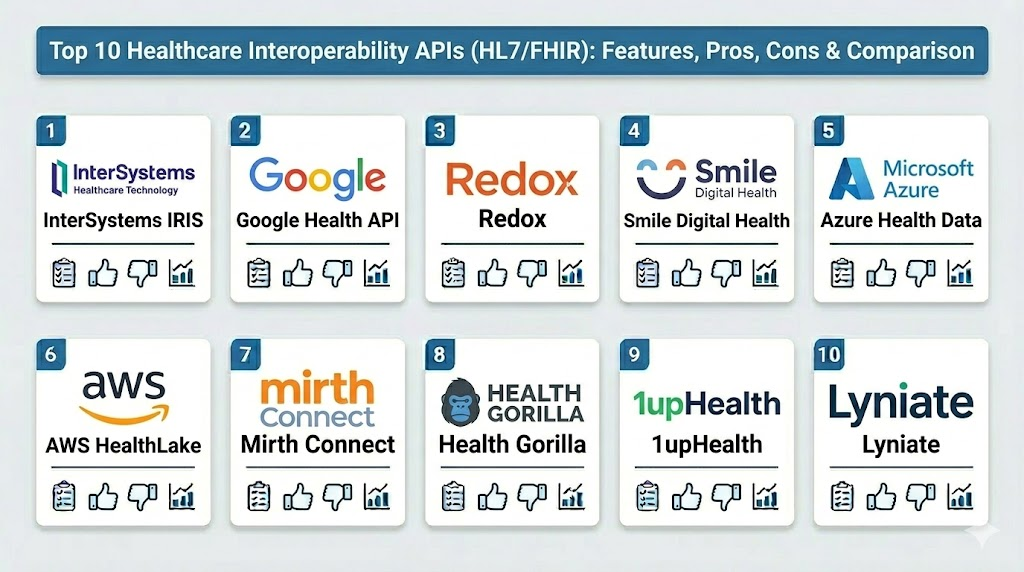
Top 10 Healthcare Interoperability APIs (HL7/FHIR)
1. InterSystems IRIS for Health
This is a massive, high-performance data platform designed specifically for the healthcare sector. It unifies data management, interoperability, and analytics into a single engine, making it a favorite for large health systems.
Key Features
- Native support for HL7 v2, FHIR, and DICOM imaging standards.
- Advanced FHIR repository with high-speed search and retrieval capabilities.
- Built-in tools for clinical data normalization and deduplication.
- Support for high-availability and disaster recovery in mission-critical environments.
- Integrated machine learning capabilities for predictive health analytics.
Pros
- Proven to handle the world’s most complex healthcare data workloads.
- Deeply experienced in bridging the gap between legacy systems and modern APIs.
Cons
- Higher cost and complexity compared to lightweight cloud-only APIs.
- Requires specialized training to utilize the full power of the platform.
Platforms / Deployment
Windows / Linux / macOS
Cloud / Self-hosted / Hybrid
Security & Compliance
HIPAA, GDPR, SOC 2 Type II, and HITRUST certified.
Encryption at rest and in transit.
Integrations & Ecosystem
It acts as a central hub for national health exchanges and is used by the world’s largest EHR vendors to power their own internal data sharing.
Support & Community
Exceptional enterprise-level support with a global reach and a highly professional user community of integration engineers.
2. Google Cloud Healthcare API
A managed service that allows for the standardized exchange of healthcare data. It is particularly strong for organizations that want to use Google’s advanced AI and BigQuery tools for medical research.
Key Features
- Managed FHIR, HL7 v2, and DICOM stores with automatic scaling.
- Integrated de-identification tools to remove sensitive patient info for research.
- Direct connection to BigQuery for massive-scale healthcare data analytics.
- Support for the latest FHIR implementation guides and profiles.
- Use of Google’s high-speed global fiber network for low-latency transfers.
Pros
- Incredible ease of use for teams already comfortable with Google Cloud.
- Unbeatable for projects requiring heavy machine learning on clinical data.
Cons
- Requires moving data into the Google Cloud environment.
- Ecosystem is more “developer-heavy” than some traditional healthcare platforms.
Platforms / Deployment
Web / Cloud
Managed Service
Security & Compliance
HIPAA compliant, ISO/IEC 27001, and SOC 2.
Identity and Access Management (IAM) based security.
Integrations & Ecosystem
Integrates natively with the full Google Cloud suite, including Vertex AI and Looker, for advanced visualization and modeling.
Support & Community
Strong technical documentation and access to Google’s massive developer ecosystem and specialized healthcare partners.
3. Redox
Redox acts as a single integration point that connects digital health applications to thousands of different healthcare organizations. It abstracts the complexity of individual EHR connections.
Key Features
- A single API that talks to over 10,000 healthcare sites.
- Automatic translation between HL7, FHIR, and proprietary EHR formats.
- Real-time event notifications for clinical workflows.
- Managed “engine” that handles all maintenance and connection monitoring.
- High-speed onboarding for digital health startups.
Pros
- Drastically reduces the time to market for new healthcare apps.
- No need to build custom interfaces for every single hospital system.
Cons
- You are reliant on Redox as a middleman for all data flow.
- Can become expensive as your volume of connected sites grows.
Platforms / Deployment
Web / Cloud
Managed API Gateway
Security & Compliance
SOC 2 Type II, HIPAA compliant, and HITRUST certified.
Continuous monitoring and secure data tunneling.
Integrations & Ecosystem
It is the most popular choice for startups needing to connect to Epic, Cerner, and Athenahealth without writing custom code.
Support & Community
Very high-quality technical support with a focus on helping developers navigate the complexities of hospital IT.
4. Smile Digital Health
Built by the core team behind the HAPI FHIR open-source project, this is a “FHIR-native” data platform. It is designed to be the ultimate repository for modern, standards-based clinical data.
Key Features
- 100% FHIR-native architecture from the ground up.
- Support for all FHIR versions and complex implementation guides.
- Advanced terminology services to ensure data consistency.
- Identity management tools to prevent duplicate patient records.
- Bulk data export capabilities for population health management.
Pros
- Unmatched expertise in the FHIR standard.
- Highly flexible deployment options, from local servers to any cloud.
Cons
- Less focus on legacy HL7 v2 routing compared to traditional engines.
- Interface can be very technical for non-developers.
Platforms / Deployment
Windows / Linux / Cloud
Self-hosted / Hybrid / Managed
Security & Compliance
HITRUST R2, ISO 27001, SOC 2 Type II, and GDPR compliant.
Role-based access control (RBAC).
Integrations & Ecosystem
It is widely used for government health projects and large-scale data repositories that want to be “future-proof.”
Support & Community
Deep technical support from the experts who literally wrote the FHIR implementation code used by millions.
5. Azure Health Data Services
Microsoft’s evolved platform for health data. It offers a unified set of APIs for clinical, imaging, and medical device data, designed for large enterprises.
Key Features
- Managed FHIR service with built-in SMART on FHIR support.
- Specialized DICOM service for medical imaging data in the cloud.
- IoT Connector to bring in data from wearable medical devices.
- Native integration with Power BI for clinical dashboards.
- Use of Azure Active Directory for secure, enterprise-wide login.
Pros
- Seamless integration for organizations already using Microsoft 365.
- Strong built-in security features that are easy to configure.
Cons
- Works best within the Microsoft ecosystem; can feel restrictive for open-source purists.
- Some services are less mature than the equivalent offerings on AWS.
Platforms / Deployment
Web / Cloud
Managed Service
Security & Compliance
HITRUST CSF, HIPAA, GDPR, and SOC 2 compliant.
Integrated with Microsoft Defender for Cloud.
Integrations & Ecosystem
Perfectly suited for teams using Microsoft Synapse for analytics and Teams for clinical collaboration.
Support & Community
Extensive enterprise support and a large network of Microsoft-certified healthcare partners.
6. AWS HealthLake
A managed service that uses specialized machine learning to transform unstructured medical text into searchable, FHIR-compliant data.
Key Features
- Built-in Natural Language Processing (NLP) to extract medical concepts from notes.
- High-performance FHIR R4 storage with sub-millisecond latency.
- “Zero-ETL” analytics integration with Amazon Bedrock and SageMaker.
- Automatic data mapping from disparate sources into the FHIR standard.
- Support for large-scale “Bulk FHIR” exports.
Pros
- Exceptional for unlocking data hidden in unstructured physician notes.
- Benefit from the massive scale and reliability of the AWS global infrastructure.
Cons
- Pricing can be difficult to predict for high-volume unstructured data processing.
- Learning curve for managing the various AWS security layers.
Platforms / Deployment
Web / Cloud
Managed Service
Security & Compliance
HIPAA eligible, SOC 2, and AWS IAM security.
VPC support for isolated networking.
Integrations & Ecosystem
Connects seamlessly with the entire AWS data and AI portfolio, making it a powerful foundation for population health.
Support & Community
Backed by the world’s largest cloud community and specialized AWS Professional Services for healthcare.
7. Mirth Connect (by NextGen Healthcare)
The “Swiss Army Knife” of healthcare integration. It is an open-source engine used to route and transform messages across virtually any protocol.
Key Features
- Drag-and-drop visual interface for building data workflows.
- Support for HL7 v2, v3, FHIR, XML, and custom database formats.
- Powerful JavaScript-based scripting for complex message transformations.
- On-premise deployment for hospitals that want to keep data local.
- Broad protocol compatibility including TCP, HTTP, and SFTP.
Pros
- Extremely flexible and capable of “fixing” broken data from old systems.
- Massive open-source community provides thousands of free scripts and tips.
Cons
- Commercial support and advanced security features require a paid version.
- Requires manual server management unless using a third-party host.
Platforms / Deployment
Windows / Linux / macOS
Self-hosted / Cloud
Security & Compliance
Varies by deployment; the commercial version includes SSL/TLS and audit tools.
Depends on local infrastructure setup.
Integrations & Ecosystem
Used by almost every major hospital system to handle the “dirty work” of moving data between internal departments.
Support & Community
One of the largest user communities in healthcare IT, with deep forums and a professional certification program.
8. Health Gorilla
A platform focused on providing clinical data as a service. It specializes in providing nationwide access to patient records from labs and health networks.
Key Features
- Access to a massive nationwide network of clinical data sources.
- Built-in “Patient 360” view that aggregates data from multiple EHRs.
- Automated lab ordering and result retrieval via API.
- Support for Admissions, Discharges, and Transfers (ADT) notifications.
- FHIR-based API for easy portal integration.
Pros
- Great for apps that need to “pull” data from across the entire country.
- Simplifies the legal and technical hurdles of joining national data exchanges.
Cons
- Pricing is often based on the number of patient records accessed.
- Less focused on internal hospital routing than tools like Mirth.
Platforms / Deployment
Web / Cloud
Managed API
Security & Compliance
SOC 2 Type II, HIPAA compliant, and HITRUST certified.
Rigorous identity verification for all users.
Integrations & Ecosystem
A leader in the TEFCA and QHIN movement, ensuring long-term connectivity to national frameworks.
Support & Community
Responsive technical support team and high-quality API documentation for rapid building.
9. 1upHealth
Specializes in “patient-mediated” interoperability, helping organizations meet federal mandates while giving patients control over their records.
Key Features
- Simple API to connect to over 10,000 clinical facilities and 1,000 payers.
- Leader in meeting CMS Interoperability and Patient Access rules.
- Tools for building apps where patients “bring their own data.”
- Automated data cleaning and deduplication across multiple sources.
- Developer sandbox with high-quality mock data for testing.
Pros
- The best choice for compliance-driven payer and patient portal projects.
- Very developer-friendly with modern RESTful patterns.
Cons
- Pricing is geared toward enterprise-level compliance needs.
- Focus is primarily on the US healthcare market and regulations.
Platforms / Deployment
Web / Cloud
Managed Platform
Security & Compliance
HIPAA compliant and SOC 2 Type II certified.
Built for high-stakes regulatory compliance.
Integrations & Ecosystem
Deeply integrated with the world of insurance payers and patient-facing mobile health apps.
Support & Community
Regular developer webinars and a proactive support team that understands the latest healthcare laws.
10. Lyniate (Rhapsody / Corepoint)
An enterprise-grade integration suite known for its extreme reliability in the largest hospitals. It is designed for high-speed message routing and complex data logic.
Key Features
- Intelligent message routing with high-speed transformation engines.
- Visual workflow designers for monitoring data health in real-time.
- Deep support for both modern FHIR and legacy HL7 standards.
- Powerful “lookup” tables to translate codes between different hospitals.
- Enterprise-level monitoring with proactive alerting for failed messages.
Pros
- Exceptional reliability; it rarely crashes even under massive load.
- Professional services team can help build the world’s most complex integrations.
Cons
- One of the more expensive options on the market.
- Requires a high level of expertise to manage effectively.
Platforms / Deployment
Windows / Linux
Self-hosted / Managed Cloud
Security & Compliance
Full HIPAA and GDPR compliance with strong audit capabilities.
Enterprise-grade encryption and access controls.
Integrations & Ecosystem
Trusted by global health ministries and the largest hospital chains to power their backbone infrastructure.
Support & Community
Highly rated professional services and technical support with deep industry knowledge.
Comparison Table
| Tool Name | Best For | Platform(s) Supported | Deployment | Standout Feature | Public Rating |
| 1. InterSystems IRIS | Large Health Systems | Win, Linux, Cloud | Hybrid | Smart Data Fabric | N/A |
| 2. Google Health API | AI & Machine Learning | Web, Cloud | Managed | NLP Note Extraction | N/A |
| 3. Redox | Rapid App Deployment | Web, Cloud | Managed | Network of 10k+ Sites | N/A |
| 4. Smile Digital Health | FHIR-Native Projects | Win, Linux, Cloud | Hybrid | HAPI FHIR Core | N/A |
| 5. Azure Health Data | Microsoft Enterprises | Web, Cloud | Managed | IoT Connector | N/A |
| 6. AWS HealthLake | Population Analytics | Web, Cloud | Managed | Zero-ETL Analytics | N/A |
| 7. Mirth Connect | Custom Routing | Win, Linux, macOS | Local/Cloud | Visual Workflow | N/A |
| 8. Health Gorilla | Nationwide Data Access | Web, Cloud | Managed | Patient 360 View | N/A |
| 9. 1upHealth | Patient Access Rules | Web, Cloud | Managed | Compliance Tools | N/A |
| 10. Lyniate | Mission-Critical Routing | Windows, Linux | Local/Cloud | High-Speed Logic | N/A |
Evaluation & Scoring
| Tool Name | Core (25%) | Ease (15%) | Integrations (15%) | Security (10%) | Perf (10%) | Support (10%) | Value (15%) | Total |
| 1. InterSystems IRIS | 10 | 5 | 10 | 10 | 10 | 9 | 6 | 8.60 |
| 2. Google Health API | 9 | 7 | 9 | 9 | 10 | 8 | 8 | 8.55 |
| 3. Redox | 8 | 10 | 10 | 9 | 9 | 9 | 7 | 8.65 |
| 4. Smile Digital Health | 10 | 6 | 8 | 9 | 9 | 9 | 7 | 8.25 |
| 5. Azure Health Data | 8 | 8 | 9 | 9 | 9 | 8 | 8 | 8.40 |
| 6. AWS HealthLake | 9 | 7 | 9 | 9 | 10 | 8 | 8 | 8.55 |
| 7. Mirth Connect | 8 | 7 | 8 | 6 | 8 | 7 | 10 | 7.55 |
| 8. Health Gorilla | 7 | 8 | 10 | 9 | 8 | 8 | 7 | 7.95 |
| 9. 1upHealth | 8 | 9 | 9 | 9 | 8 | 8 | 7 | 8.15 |
| 10. Lyniate | 10 | 5 | 9 | 10 | 10 | 10 | 5 | 8.30 |
The weights above help determine which tool fits a specific project profile. Redox and Google Cloud score high on “Ease of Use” and “Integrations,” making them ideal for modern web-based apps. InterSystems IRIS and Lyniate achieve top marks in “Performance” and “Security,” reflecting their role in mission-critical hospital environments where downtime is not an option. Mirth Connect represents the best “Value” for custom-built, local projects where a high-cost subscription is not feasible.
Which Healthcare Interoperability Tool Is Right for You?
Solo / Freelancer
If you are a lone developer building a prototype, Mirth Connect (Open Source) is the best way to learn the ropes without a financial commitment. For quickly connecting to live data, Redox offers the fastest path to a working demo.
SMB
Digital health startups should prioritize Redox or 1upHealth. These tools handle the “boring” parts of hospital connectivity and legal compliance, allowing your small team to focus entirely on your app’s unique features.
Mid-Market
For regional hospital groups or medium-sized tech firms, Smile Digital Health or Google Cloud Healthcare API offer a great balance. They provide a modern, scalable foundation that can grow with your data needs without requiring a massive IT department.
Enterprise
Large health systems and national labs should look at InterSystems IRIS for Health or Lyniate. These platforms are built for the heavy lifting of million-record datasets and offer the level of support and reliability required by enterprise leaders.
Budget vs Premium
Mirth Connect is the budget champion, while the Cloud Managed Services (Google, AWS, Azure) offer a mid-range, pay-as-you-go model. InterSystems and Lyniate are premium investments for those who need absolute reliability.
Feature Depth vs Ease of Use
Redox and 1upHealth are the easiest to use but hide the underlying complexity. Houdini-style logic in Mirth or InterSystems provides much deeper control but requires a significant technical investment to learn.
Integrations & Scalability
If your primary goal is population-level research, AWS HealthLake and Google Cloud offer the most scalable analytics environment. For connecting to the most possible clinical sites, Redox is the winner.
Security & Compliance Needs
All tools on this list are HIPAA-compliant, but for those with the most stringent requirements (government contracts, etc.), InterSystems and Azure offer some of the most robust, enterprise-grade identity and audit controls available.
Frequently Asked Questions (FAQs)
1. What is the main difference between HL7 and FHIR?
HL7 v2 is an older, message-based standard used for simple data triggers like “patient admission.” FHIR is a modern, API-based standard that uses web technologies like JSON and REST to allow for more flexible data access.
2. Is FHIR mandatory for healthcare organizations?
In many regions, including the US under the CMS and ONC rules, it is now mandatory for certain healthcare providers and payers to provide data via FHIR APIs to improve patient access.
3. Can these APIs connect to “old” hospital systems?
Yes, most of these tools (especially Redox, InterSystems, and Mirth) are designed specifically to take data from legacy EHRs and convert it into modern FHIR formats.
4. What is “SMART on FHIR”?
It is a standard framework that allows healthcare apps to launch securely within an EHR system, using the EHR’s own security and patient context to display relevant information.
5. How do these tools handle patient privacy?
They use enterprise-grade encryption, secure tunnels (VPNs), and strict identity management to ensure that only authorized personnel or applications can access protected health information.
6. Do I need my own server to run a FHIR API?
Not necessarily. Managed services like Google Cloud Healthcare API or Azure Health Data Services host the infrastructure for you, so you only have to worry about the data itself.
7. What is “Bulk FHIR”?
It is a specialized way to export large volumes of data (like all patients with a specific condition) in a single operation, which is much more efficient than querying each patient individually.
8. Can I use these APIs to build a mobile app for patients?
Absolutely. Many of these tools, especially 1upHealth and Health Gorilla, are designed to power patient portals and mobile health apps by aggregating data from many sources into one view.
9. Do these tools work with Epic and Cerner?
Yes, connecting to the “Big Two” EHR vendors is a core requirement for almost all the tools on this list, often through pre-built connectors or national networks.
10. What are the common mistakes when choosing an interoperability tool?
The most common mistake is choosing a tool based on price alone without considering the cost of the specialized engineering talent required to maintain complex, custom-coded integrations.
Conclusion
Navigating the world of healthcare interoperability requires a strategic choice that balances regulatory compliance with technical flexibility. The right API can transform a fragmented healthcare experience into a seamless, data-driven journey for both providers and patients. As the industry moves toward a FHIR-first future, selecting a platform that not only supports modern standards but also simplifies the connection to legacy systems is essential. Whether you choose a cloud-native managed service or a deep enterprise integration engine, the ultimate goal remains the same: ensuring that life-saving data is available exactly when and where it is needed most.

Best Cardiac Hospitals Near You
Discover top heart hospitals, cardiology centers & cardiac care services by city.
Advanced Heart Care • Trusted Hospitals • Expert Teams
View Best Hospitals