Introduction
Influencer marketing platforms help brands find creators, manage relationships, run campaigns, track performance, and measure ROI in one place. In simple words: they make it easier to discover the right influencers, collaborate smoothly, pay them properly, and report results without messy spreadsheets and manual follow-ups.
These platforms matter because influencer marketing has shifted from “one-off posts” to a repeatable growth channel. Brands now run always-on creator programs, product seeding, affiliate-style partnerships, and performance-driven collaborations. At the same time, fraud risks, fake followers, and unclear reporting can waste budget. The best platforms combine smart discovery, workflow automation, content approvals, tracking, and brand safety controls—so marketing teams can scale creator partnerships with confidence.
Common real-world use cases:
- Discovering creators for a niche product launch and building a shortlist fast
- Managing an always-on creator program with contracts, briefs, and deliverables
- Running affiliate and commission-based influencer programs for performance
- Tracking earned media value, conversions, and campaign lift across platforms
- Handling creator payments, approvals, and compliance at scale
What buyers should evaluate before choosing:
- Discovery quality (search filters, audience fit, creator authenticity signals)
- Campaign workflow (briefs, deliverables, approvals, reminders, asset storage)
- Tracking approach (promo codes, links, pixels, affiliate tracking, attribution options)
- Fraud detection and brand safety (fake followers, suspicious engagement, risky content)
- Relationship management (CRM-style notes, pipelines, tagging, outreach automation)
- Reporting depth (reach, engagement, conversions, incremental lift, benchmarks)
- Integrations (ecommerce, affiliate networks, analytics, social management, CRM)
- Payment and contracting support (invoicing, tax forms, compliance workflows vary)
- Team collaboration (roles, approvals, multi-brand workflows, audit trails)
- Pricing clarity (seats, creator limits, campaign limits, add-ons, service tiers)
Best for: ecommerce brands, DTC marketers, agencies, consumer apps, and brand teams who run repeatable creator partnerships and need workflow + measurement.
Not ideal for: teams doing rare one-off influencer posts, brands with very small budgets that can manage manually, or teams that only need affiliate tracking without creator discovery.
Key Trends in Influencer Marketing Platforms
- More performance focus: creators are measured like paid media, with stronger conversion tracking and ROI reporting.
- Affiliate-style partnerships grow: commission programs and creator storefront workflows become common.
- Better fraud and authenticity controls: suspicious engagement detection is now expected, not optional.
- More creator relationship management: platforms behave like CRMs with pipelines, notes, and segmentation.
- AI support for speed: creator recommendations, outreach drafting, and campaign summaries (capability varies).
- Content rights and usage governance: brands want clear permissions for reuse in ads, websites, and email.
- Always-on programs replace one-off campaigns: brands build stable creator communities and ambassador programs.
- Better multi-market execution: brands manage creators across regions, languages, and compliance requirements.
- More brand safety needs: filtering for risky content, alignment checks, and approval workflows tighten.
How These Tools Were Selected
- Chosen for strong recognition in influencer marketing operations and measurement
- Balanced mix of enterprise platforms, ecommerce-first tools, and agency-friendly options
- Considered discovery quality, workflow depth, reporting clarity, and scalability
- Looked for real operational features: approvals, payments workflows, creator CRM, and governance
- Considered integration patterns with ecommerce and affiliate-style tracking
- Avoided guessing certifications, ratings, and pricing details; used “Not publicly stated” or “Varies / N/A” where needed
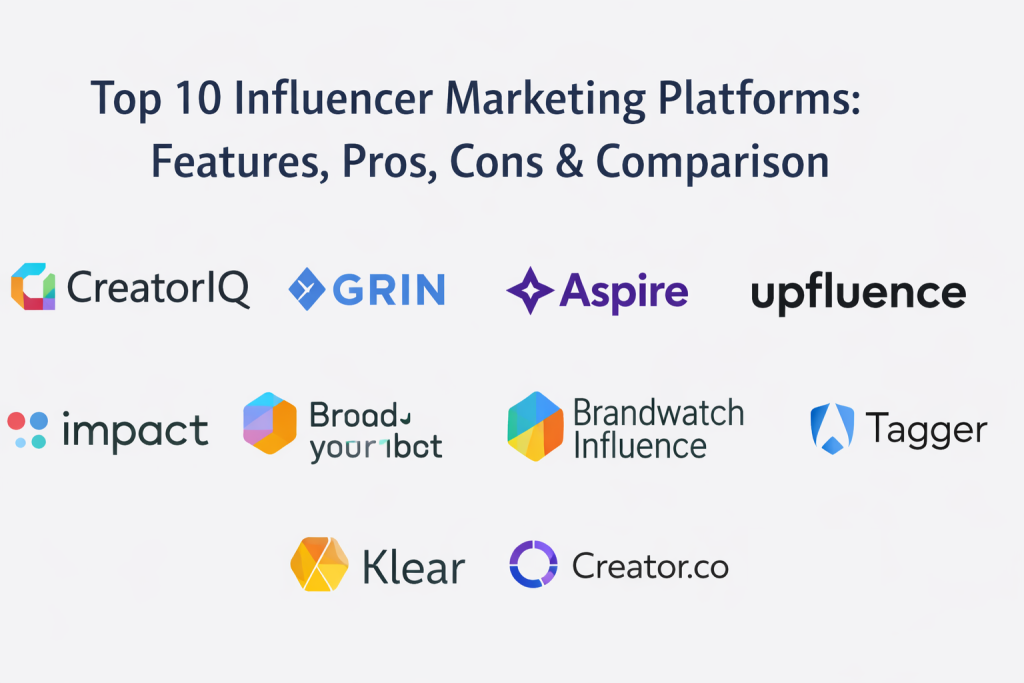
Top 10 Tools
1 — CreatorIQ
A widely used influencer marketing platform built for enterprise-scale creator programs, relationship management, and advanced reporting. Best for large brands running complex, multi-team campaigns.
Key Features
- Creator discovery with audience and performance filters (varies)
- Creator relationship management with pipelines and tagging
- Campaign workflow for briefs, approvals, and deliverables (varies)
- Reporting dashboards for campaign performance and benchmarks (varies)
- Fraud detection and authenticity signals (varies)
- Team governance for multi-brand operations (varies)
Pros
- Strong for large-scale, multi-team influencer programs
- Robust workflows and reporting for stakeholders
- Good fit for enterprise governance needs
Cons
- Can be complex for small teams
- Onboarding requires process discipline
- Pricing and packaging vary by contract
Platforms / Deployment
- Web
- Cloud
Security & Compliance
Not publicly stated. Confirm role controls and identity features during evaluation.
Integrations & Ecosystem
Commonly connects with ecommerce, analytics, and reporting stacks.
- Ecommerce and analytics integrations (varies)
- Export workflows for BI (varies)
- API details vary / not publicly stated
Support & Community
Enterprise onboarding is common; support tiers vary by contract.
2 — Grin
An ecommerce-focused influencer platform known for creator relationship management and workflow features that help brands run repeatable creator programs.
Key Features
- Creator discovery and recruitment workflows (varies)
- CRM-style creator management with notes and segmentation
- Product seeding workflows (varies)
- Content approvals and campaign deliverable tracking
- Reporting for program performance (varies)
- Affiliate-style tracking patterns (varies)
Pros
- Strong for ecommerce brands building long-term creator programs
- Practical CRM workflow for daily operations
- Good for product seeding and ambassador programs
Cons
- Depth for enterprise governance depends on tier
- Discovery coverage can vary by region
- Reporting depth varies by plan
Platforms / Deployment
- Web
- Cloud
Security & Compliance
Not publicly stated.
Integrations & Ecosystem
Often used with ecommerce and affiliate workflows.
- Ecommerce integrations (varies)
- Affiliate tracking patterns (varies)
- Exports and reporting workflows (varies)
Support & Community
Strong ecommerce adoption; support tiers vary by plan.
3 — Aspire
A platform designed for influencer and creator marketing with workflows for discovery, relationship management, and campaign execution. Often used by brands and agencies running structured creator programs.
Key Features
- Creator discovery and outreach workflows (varies)
- CRM-style relationship management with pipelines
- Campaign briefs, approvals, and deliverables tracking
- Content management and collaboration features (varies)
- Reporting for campaign outcomes (varies)
- Community and ambassador program workflows (varies)
Pros
- Strong balance of discovery and workflow execution
- Good for ambassador-style programs
- Practical for teams scaling creator operations
Cons
- Advanced reporting may be tier-dependent
- Some integrations depend on plan
- Pricing varies by contract
Platforms / Deployment
- Web
- Cloud
Security & Compliance
Not publicly stated.
Integrations & Ecosystem
Often connects into ecommerce, social reporting, and analytics workflows.
- Ecommerce and marketing integrations (varies)
- Export and reporting pipelines (varies)
- API availability varies / not publicly stated
Support & Community
Onboarding support varies by plan; documentation typically available.
4 — Upfluence
An influencer marketing platform used for discovery, campaign management, and performance tracking. Often chosen by brands looking for structured creator sourcing and campaign operations.
Key Features
- Creator discovery with filters and search tools (varies)
- Outreach and relationship management workflows (varies)
- Campaign management for briefs and deliverables
- Performance tracking and reporting dashboards (varies)
- Influencer payments or invoicing workflows (varies)
- Fraud and authenticity signals (varies)
Pros
- Solid end-to-end workflow for many influencer programs
- Useful discovery and outreach tooling
- Reporting supports campaign review cycles
Cons
- Depth of features depends on plan
- Implementation needs process discipline
- Data coverage varies by market
Platforms / Deployment
- Web
- Cloud
Security & Compliance
Not publicly stated.
Integrations & Ecosystem
Common integration needs include ecommerce and affiliate-style tracking.
- Ecommerce integrations (varies)
- Reporting exports (varies)
- API details vary / not publicly stated
Support & Community
Support is typically structured; experience varies by contract.
5 — Traackr
A platform known for influencer relationship management and measurement, often used by larger teams that need governance, benchmarking, and long-term creator strategy.
Key Features
- Creator discovery and relationship management workflows (varies)
- Benchmarking and performance measurement (varies)
- Campaign tracking with structured reporting outputs (varies)
- Spend management and program analysis patterns (varies)
- Brand safety and authenticity indicators (varies)
- Team workflows and governance features (varies)
Pros
- Strong for strategy, benchmarking, and long-term programs
- Useful measurement features for stakeholder reporting
- Good fit for structured, multi-campaign operations
Cons
- May be heavier than needed for small brands
- Setup requires consistent taxonomy and process
- Commercial terms vary by contract
Platforms / Deployment
- Web
- Cloud
Security & Compliance
Not publicly stated.
Integrations & Ecosystem
Often used alongside analytics and BI reporting.
- Reporting exports and dashboards (varies)
- Integration options vary by plan
- API availability varies / not publicly stated
Support & Community
Enterprise onboarding is common; support varies by contract.
6 — Impact
A partnership platform often used for affiliate and creator partnerships, especially when performance tracking, payouts, and partner operations are a priority.
Key Features
- Partner discovery and onboarding workflows (varies)
- Tracking and attribution for partner performance (varies)
- Commission and payout management patterns (varies)
- Contracting and compliance workflows (varies)
- Reporting for revenue and partner contribution (varies)
- Workflow automation for partner operations (varies)
Pros
- Strong for performance-based creator and affiliate programs
- Good operational control for payouts and partner management
- Useful when ROI measurement is the core goal
Cons
- Not a pure influencer discovery-first platform
- Campaign creative workflow may require add-ons
- Setup can be complex for small teams
Platforms / Deployment
- Web
- Cloud
Security & Compliance
Not publicly stated.
Integrations & Ecosystem
Often connects deeply with ecommerce, analytics, and conversion tracking.
- Ecommerce tracking integrations (varies)
- Reporting exports and partner analytics (varies)
- API details vary / not publicly stated
Support & Community
Structured support for partnership ops; varies by contract.
7 — Brandwatch Influence
An influencer-focused offering aligned with broader listening and analytics workflows. Often used by teams who want creator programs connected to brand insights and monitoring.
Key Features
- Influencer discovery and creator database workflows (varies)
- Relationship management features (varies)
- Campaign tracking and reporting (varies)
- Authenticity and audience insights (varies)
- Workflow fit with broader monitoring and insights (varies)
- Reporting exports and dashboards (varies)
Pros
- Strong when you want influencer work connected to broader brand insights
- Useful for teams already focused on monitoring and measurement
- Practical reporting workflows for campaigns
Cons
- Feature depth depends on plan and configuration
- Not always the simplest option for small teams
- Pricing varies by contract
Platforms / Deployment
- Web
- Cloud
Security & Compliance
Not publicly stated.
Integrations & Ecosystem
Often used with reporting stacks and analytics workflows.
- Export and reporting pipelines (varies)
- Integration options vary by plan
- API details vary / not publicly stated
Support & Community
Support varies by contract; documentation typically available.
8 — Tagger
An influencer marketing platform focused on discovery and campaign management with reporting workflows. Often used by agencies and brands that need structured creator sourcing and measurement.
Key Features
- Creator discovery and search filters (varies)
- Campaign workflow for outreach and deliverables tracking (varies)
- Audience insights and performance analysis (varies)
- Reporting dashboards and exports (varies)
- Collaboration workflows for teams (varies)
- Fraud or authenticity indicators (varies)
Pros
- Strong discovery and campaign execution balance
- Useful for agencies managing multiple campaigns
- Good reporting outputs for client updates
Cons
- Feature depth varies by plan
- Coverage varies by market and data sources
- Advanced governance may be limited compared to enterprise suites
Platforms / Deployment
- Web
- Cloud
Security & Compliance
Not publicly stated.
Integrations & Ecosystem
Often used with reporting and content workflows.
- Export workflows (varies)
- Integration options vary by plan
- API details vary / not publicly stated
Support & Community
Support experience varies; onboarding options depend on plan.
9 — Klear
An influencer platform that supports discovery, campaign workflows, and reporting. Often used for finding creators and managing collaborations in a structured way.
Key Features
- Creator discovery with audience and niche filters (varies)
- Outreach and collaboration workflows (varies)
- Campaign tracking and deliverables management
- Reporting dashboards for performance (varies)
- Influencer lists and segmentation workflows (varies)
- Authenticity indicators (varies)
Pros
- Practical for creator sourcing and campaign execution
- Useful segmentation and list-building workflows
- Reporting supports campaign evaluation cycles
Cons
- Advanced analytics may be tier-dependent
- Integration depth varies by plan
- Data coverage varies by market
Platforms / Deployment
- Web
- Cloud
Security & Compliance
Not publicly stated.
Integrations & Ecosystem
Commonly used with marketing and reporting workflows.
- Export and reporting pipelines (varies)
- Integration options vary by plan
- API availability varies / not publicly stated
Support & Community
Documentation is typically available; support tiers vary.
10 — Creator.co
A platform designed to help brands connect with creators and run campaigns, often positioned as accessible for smaller teams and growing brands.
Key Features
- Creator discovery and campaign participation workflows (varies)
- Campaign setup, briefs, and collaboration tools (varies)
- Content submission and approval workflows (varies)
- Reporting on campaign performance (varies)
- Community-style creator activation (varies)
- Payment workflows may vary / not publicly stated
Pros
- Accessible for growing brands starting influencer programs
- Helpful for creator activation and campaign execution
- Easier onboarding for smaller teams
Cons
- Enterprise governance and deep integrations may be limited
- Advanced measurement depends on setup
- Feature depth varies by plan
Platforms / Deployment
- Web
- Cloud
Security & Compliance
Not publicly stated.
Integrations & Ecosystem
Often used with lightweight campaign workflows.
- Export workflows (varies)
- Integration options vary by plan
- API details vary / not publicly stated
Support & Community
Community-style positioning; support tiers vary.
Comparison Table
| Tool Name | Best For | Platform(s) Supported | Deployment | Standout Feature | Public Rating |
|---|---|---|---|---|---|
| CreatorIQ | Enterprise creator programs and governance | Web | Cloud | Large-scale workflow and reporting (varies) | N/A |
| Grin | Ecommerce influencer CRM and seeding | Web | Cloud | Creator relationship management for ecommerce (varies) | N/A |
| Aspire | Balanced discovery and campaign workflows | Web | Cloud | Ambassador and community workflows (varies) | N/A |
| Upfluence | Structured discovery and campaign execution | Web | Cloud | End-to-end campaign management (varies) | N/A |
| Traackr | Benchmarking and long-term measurement | Web | Cloud | Program measurement and strategy reporting (varies) | N/A |
| Impact | Performance-based creator partnerships | Web | Cloud | Tracking and payouts for partner ops (varies) | N/A |
| Brandwatch Influence | Influencer workflows tied to insights | Web | Cloud | Influencer plus monitoring alignment (varies) | N/A |
| Tagger | Discovery plus campaign measurement | Web | Cloud | Campaign reporting and creator sourcing (varies) | N/A |
| Klear | Creator sourcing and collaboration workflows | Web | Cloud | List building and campaign tracking (varies) | N/A |
| Creator.co | Accessible platform for growing brands | Web | Cloud | Creator activation and campaign execution (varies) | N/A |
Evaluation and Scoring
Scoring model:
- Each criterion is scored from 1 to 10 (higher is better).
- The weighted total is calculated on a 0 to 10 scale using the weights below.
- These scores are comparative estimates to support shortlisting; validate using a pilot.
Weights:
- Core features – 25%
- Ease of use – 15%
- Integrations and ecosystem – 15%
- Security and compliance – 10%
- Performance and reliability – 10%
- Support and community – 10%
- Price and value – 15%
| Tool Name | Core (25%) | Ease (15%) | Integrations (15%) | Security (10%) | Performance (10%) | Support (10%) | Value (15%) | Weighted Total (0–10) |
|---|---|---|---|---|---|---|---|---|
| CreatorIQ | 9 | 7 | 8 | 8 | 8 | 8 | 5 | 7.70 |
| Grin | 8 | 8 | 7 | 7 | 7 | 7 | 7 | 7.45 |
| Aspire | 8 | 8 | 7 | 7 | 7 | 7 | 7 | 7.45 |
| Upfluence | 8 | 8 | 7 | 7 | 7 | 7 | 6 | 7.30 |
| Traackr | 8 | 7 | 7 | 7 | 7 | 7 | 5 | 6.95 |
| Impact | 7 | 7 | 8 | 7 | 8 | 7 | 6 | 7.10 |
| Brandwatch Influence | 7 | 7 | 7 | 7 | 7 | 7 | 5 | 6.80 |
| Tagger | 7 | 8 | 6 | 6 | 7 | 7 | 7 | 6.95 |
| Klear | 7 | 8 | 6 | 6 | 7 | 7 | 7 | 6.95 |
| Creator.co | 6 | 8 | 5 | 6 | 6 | 6 | 8 | 6.40 |
How to interpret the scores:
- Use the weighted total for shortlisting, not as a final verdict.
- If ROI tracking is the main goal, prioritize integrations and value over pure discovery.
- If you run complex global programs, prioritize governance and core features.
- Always validate creator authenticity checks and reporting accuracy with real campaigns.
Which Tool Is Right for You?
Solo or Freelancer
- Choose Creator.co if you need a simple platform to activate creators without heavy operations.
- Choose Tagger or Klear if you want discovery plus structured campaign reporting.
- If your work is mostly affiliate-style, consider Impact for performance tracking operations.
SMB
- Choose Grin if ecommerce seeding and creator CRM are central.
- Choose Aspire for balanced discovery and campaign workflows.
- Choose Upfluence if you want a structured end-to-end platform for campaigns.
Mid-Market
- Choose Grin or Aspire for repeatable creator programs with manageable complexity.
- Choose Traackr if benchmarking and long-term strategy measurement are key.
- Choose Impact if performance partnerships and payouts matter most.
Enterprise
- Choose CreatorIQ for enterprise governance, multi-team workflows, and large-scale programs.
- Choose Traackr for benchmarking and program measurement across multiple markets.
- Choose Brandwatch Influence if influencer work must connect with broader monitoring and insight workflows.
Budget versus Premium
- Budget-leaning: Creator.co, Tagger, Klear (varies by plan and scale)
- Premium: CreatorIQ, Traackr (contract-driven)
Feature Depth versus Ease of Use
- Ease-first: Creator.co, Aspire, Grin
- Depth-first: CreatorIQ, Traackr
- Performance-first: Impact
Integrations and Scalability
- Strong for performance tracking: Impact
- Strong for enterprise workflows and reporting: CreatorIQ
- Strong for ecommerce creator operations: Grin, Aspire
Security and Compliance Needs
- If you require strict governance, validate role depth, audit trails, and identity support in writing.
- For agencies and multi-brand operations, prioritize approval workflows and access discipline.
Frequently Asked Questions
- What does an influencer marketing platform replace?
It replaces spreadsheets for discovery, outreach, tracking deliverables, and reporting. Many teams still use a CRM or project tool, but platforms reduce manual work. - How do these platforms track conversions?
Common methods include promo codes, tracked links, affiliate tracking, and platform reporting signals. The exact method depends on your stack and setup. - Are follower counts a reliable way to choose creators?
Not alone. Audience fit, engagement quality, authenticity signals, and past performance matter more than raw follower size. - How do I reduce influencer fraud risk?
Use authenticity checks, review engagement patterns, look for sudden follower spikes, and prioritize creators with proven conversion results. - Can agencies use these tools for multiple clients?
Yes, many support multi-brand workflows, but account structure and approvals vary. Test client approvals and reporting exports during a pilot. - What is the biggest mistake when starting influencer marketing?
Running one-off campaigns without a repeatable system. A stable program with clear briefs, fast approvals, and measured outcomes performs better. - Should I focus on micro-influencers or big creators?
It depends on goals. Micro-influencers often deliver stronger trust and engagement; big creators provide reach. Many brands mix both. - Do platforms handle payments automatically?
Some support payment workflows, but capabilities vary by plan and region. Confirm invoicing, payout, and compliance needs during evaluation. - How long should a pilot campaign run?
Long enough to measure real outcomes, usually several weeks. Include at least one conversion goal and compare results across a few creator segments. - What should I validate before signing a contract?
Validate creator discovery quality for your niche, workflow fit for your team, conversion tracking accuracy, and reporting outputs your stakeholders trust.
Conclusion
Influencer marketing platforms help you scale creator partnerships without losing control of quality, budget, and measurement. The best platform depends on whether you prioritize discovery, long-term relationship management, enterprise governance, or performance-based tracking and payouts.
A practical next step is to shortlist two or three platforms, run a pilot with real creators in your niche, test outreach and approvals, confirm conversion tracking accuracy, and choose the tool that your team can operate consistently every week.

Best Cardiac Hospitals Near You
Discover top heart hospitals, cardiology centers & cardiac care services by city.
Advanced Heart Care • Trusted Hospitals • Expert Teams
View Best Hospitals