Introduction
IT Asset Management tools help you track, govern, and optimize the full lifecycle of technology assets, from purchase to retirement. “Assets” include hardware devices, software licenses, cloud subscriptions, virtual infrastructure, and sometimes even contracts and warranties. In simple terms, ITAM software tells you what you own, where it is, who is using it, whether it is compliant, what it costs, and what risk it creates.
This matters because modern IT environments are messy by default: remote devices, hybrid cloud, fast-moving subscriptions, and frequent vendor audits. Without ITAM, organizations overpay for unused software, fail audits, lose track of devices, and struggle to forecast budgets. Real-world use cases include hardware inventory and warranty tracking, software license compliance, SaaS subscription optimization, employee onboarding and offboarding asset workflows, security risk reduction by finding unknown devices, and cost control by identifying shelfware. When choosing an ITAM tool, evaluate discovery coverage, normalization accuracy, license management depth, contract handling, workflow automation, reporting quality, integrations, security controls, scalability, and total cost.
Best for: IT operations, IT finance, procurement, security teams, compliance owners, and managed service providers that need accurate inventory, licensing control, and measurable cost savings.
Not ideal for: very small teams with a handful of devices and simple purchasing. If you only need a basic inventory list, a spreadsheet or lightweight asset tracker may be enough, but it will not handle discovery, licensing, audits, or cost optimization well.
Key Trends in IT Asset Management Tools
- More SaaS and subscription spend optimization, not just device inventory
- Stronger software license management for complex vendor rules and audits
- Better discovery across remote endpoints and hybrid environments
- Improved data normalization to reduce duplicates and naming chaos
- More integration with service desks so tickets and assets stay connected
- Increased security use cases, such as unknown device detection and risk visibility
- Wider focus on financial governance: chargeback, showback, and forecasting support
- More automation for onboarding, offboarding, refresh cycles, and disposals
- Greater demand for evidence-ready reporting for audits and compliance reviews
- Rising expectation for role-based access and audit trails around asset changes
How We Selected These Tools
- Strong credibility and adoption in IT asset inventory, discovery, and lifecycle tracking
- Practical capability for software license management and audit preparation
- Data quality features such as normalization, reconciliation, and de-duplication
- Integrations with service desk, identity, endpoint management, and procurement workflows
- Fit across different sizes: SMB, mid-market, and enterprise
- Governance features for approvals, roles, and reporting
- Balanced list across dedicated ITAM vendors and broader ITSM platforms with ITAM depth
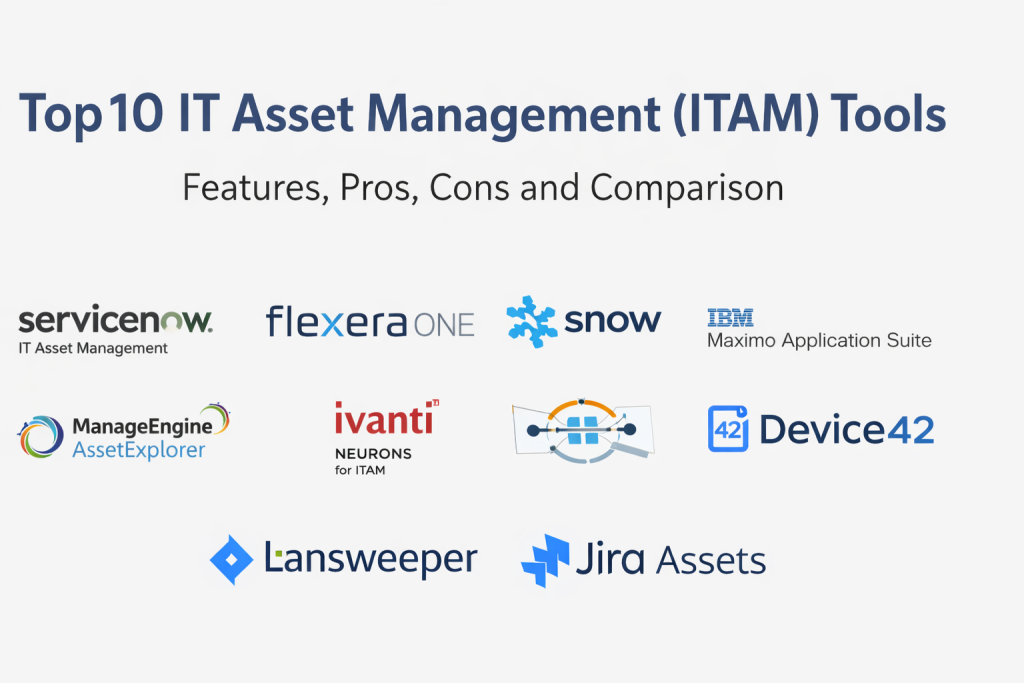
Top 10 IT Asset Management Tool
1 — ServiceNow IT Asset Management
ServiceNow IT Asset Management is commonly used in large organizations that want asset lifecycle, procurement workflows, and service management in one governed platform. It fits teams that need strong process control and cross-department collaboration.
Key Features
- Hardware asset lifecycle workflows from procurement to retirement
- Software asset and license workflows (Varies / Not publicly stated)
- Contract and renewal tracking patterns (Varies / Not publicly stated)
- Asset-to-ticket linkage for faster support resolution
- Reporting dashboards for compliance and cost visibility
- Role-based workflows for approvals and governance
Pros
- Strong governance for large environments
- Works well when ITSM and ITAM must be tightly connected
- Scales to multi-team, multi-location operations
Cons
- Can be heavy for smaller teams
- Requires process maturity and admin ownership
- Total cost can increase with modules and scale
Platforms / Deployment
- Platforms: Web
- Deployment: Cloud (Varies / Not publicly stated for other modes)
Security and Compliance
Not publicly stated
Integrations and Ecosystem
ServiceNow IT Asset Management often integrates with identity, endpoint tools, procurement systems, and service desk workflows so asset records stay accurate.
- Identity integration patterns for user-to-asset assignment
- Endpoint and inventory data integrations (Varies / Not publicly stated)
- Procurement and finance workflow integrations (Varies / Not publicly stated)
- APIs for custom automation and reporting exports
Support and Community
Strong enterprise support options and a large partner ecosystem. Documentation is extensive; rollout quality depends on internal ownership and partner involvement.
2 — Flexera One
Flexera One is widely recognized for software asset management and IT spend optimization, especially when licensing complexity and vendor audits are a major concern. It fits teams focused on cost control, compliance, and strong normalization.
Key Features
- Software license management and entitlement tracking
- Discovery and inventory reconciliation (Varies / Not publicly stated)
- SaaS subscription visibility and optimization patterns (Varies / Not publicly stated)
- Normalization and application recognition capabilities (Varies / Not publicly stated)
- Audit readiness reporting and compliance workflows
- Spend visibility and optimization reporting (Varies / Not publicly stated)
Pros
- Strong for license compliance and audit preparation
- Useful insights for cost optimization and shelfware reduction
- Good fit for IT finance and procurement collaboration
Cons
- Implementation requires clean data and consistent processes
- Full value depends on integration scope and discovery coverage
- Packaging can be complex depending on needs
Platforms / Deployment
- Platforms: Web
- Deployment: Cloud
Security and Compliance
Not publicly stated
Integrations and Ecosystem
Flexera One commonly integrates with discovery tools, procurement systems, and IT service workflows to reconcile deployments with entitlements.
- Inventory source integrations (Varies / Not publicly stated)
- Procurement and contract data alignment patterns
- APIs for data enrichment and automation
- Reporting exports for governance and audit use
Support and Community
Enterprise-oriented support is common. Documentation is available; success often improves with strong internal ITAM ownership and partner guidance.
3 — Snow Software
Snow Software is well known for software asset management and technology intelligence, used to understand usage, compliance, and optimization opportunities. It fits organizations that need strong usage analysis and governance reporting.
Key Features
- Software inventory, usage tracking, and reconciliation
- License compliance workflows and audit reporting
- SaaS visibility and usage insights (Varies / Not publicly stated)
- Application recognition and normalization (Varies / Not publicly stated)
- Hardware inventory and lifecycle reporting (Varies / Not publicly stated)
- Dashboards for compliance, usage, and cost opportunities
Pros
- Strong focus on usage-based optimization
- Useful for audit readiness and compliance evidence
- Works well when software governance is the priority
Cons
- Value depends on accurate discovery inputs
- Implementation requires process consistency
- Some capabilities depend on edition and scope
Platforms / Deployment
- Platforms: Web
- Deployment: Cloud (Varies / Not publicly stated for other modes)
Security and Compliance
Not publicly stated
Integrations and Ecosystem
Snow Software often connects to discovery sources, directory systems, and procurement data to maintain accurate reconciliation.
- Discovery and inventory integrations (Varies / Not publicly stated)
- Procurement and contract data synchronization patterns
- APIs for data enrichment and automation
- Exports to reporting and BI workflows (Varies / Not publicly stated)
Support and Community
Support quality varies by plan. Many organizations rely on best-practice playbooks and partners to build a sustainable data and governance model.
4 — IBM Maximo Application Suite
IBM Maximo Application Suite is widely used for enterprise asset management, often in asset-heavy industries. It can support IT-related asset governance in organizations that already use Maximo for broader asset programs.
Key Features
- Asset lifecycle management and maintenance workflows (Varies / Not publicly stated)
- Inventory and asset record governance patterns
- Reporting and analytics for asset performance (Varies / Not publicly stated)
- Workflow controls for approvals and changes (Varies / Not publicly stated)
- Integration patterns for enterprise systems (Varies / Not publicly stated)
- Scalable administration for large environments
Pros
- Strong for organizations with broad asset governance needs
- Works well in complex enterprise operations
- Mature workflow and reporting patterns
Cons
- May be heavier than needed for pure ITAM-only teams
- Implementation scope can be significant
- IT license management depth depends on configuration and use case
Platforms / Deployment
- Platforms: Web
- Deployment: Cloud (Varies / Not publicly stated for other modes)
Security and Compliance
Not publicly stated
Integrations and Ecosystem
Maximo commonly integrates with enterprise systems and data sources to keep asset records accurate and actionable.
- ERP and procurement integration patterns (Varies / Not publicly stated)
- APIs for data synchronization and workflow automation
- Reporting exports for governance and audits (Varies / Not publicly stated)
Support and Community
Enterprise support is common. Documentation exists; partner involvement often helps for complex deployments and integrations.
5 — Ivanti Neurons for ITAM
Ivanti Neurons for ITAM is used by organizations that want discovery, asset governance, and optimization insights connected to endpoint and service workflows. It fits teams aiming to reduce risk and improve lifecycle visibility.
Key Features
- Asset inventory and lifecycle tracking
- Discovery and reconciliation patterns (Varies / Not publicly stated)
- Contract and warranty tracking workflows (Varies / Not publicly stated)
- Integration with service workflows for asset-to-ticket visibility
- Reporting for compliance and lifecycle governance
- Automation patterns for refresh and disposal workflows (Varies / Not publicly stated)
Pros
- Useful for lifecycle governance and operational visibility
- Works well when connected to service workflows
- Practical reporting for asset status and exceptions
Cons
- Feature depth varies by edition and configuration
- Implementation value depends on discovery coverage
- Integration planning is important for best results
Platforms / Deployment
- Platforms: Web
- Deployment: Cloud (Varies / Not publicly stated for other modes)
Security and Compliance
Not publicly stated
Integrations and Ecosystem
Ivanti Neurons for ITAM often integrates with directory services, endpoint tools, and service management workflows.
- Directory-based user and ownership mapping patterns
- Endpoint data and inventory integrations (Varies / Not publicly stated)
- APIs for workflow automation and data enrichment
- Reporting exports (Varies / Not publicly stated)
Support and Community
Support varies by contract. Documentation is available; larger rollouts often benefit from partner services and internal governance discipline.
6 — ManageEngine AssetExplorer
ManageEngine AssetExplorer is often chosen by SMB and mid-market teams that want practical hardware and software inventory management with clear reporting and manageable administration.
Key Features
- Hardware inventory and asset lifecycle tracking
- Software inventory and license tracking (Varies / Not publicly stated)
- Purchase order, contract, and warranty tracking patterns (Varies / Not publicly stated)
- Reporting for compliance and asset utilization
- Role-based access patterns for asset governance (Varies / Not publicly stated)
- Integrations with related IT operations tools (Varies / Not publicly stated)
Pros
- Practical coverage for common ITAM needs
- Often easier to deploy for mid-size environments
- Useful reporting for audits and renewals
Cons
- Enterprise-scale governance may be limited
- Advanced SaaS optimization depth varies
- Integration depth depends on your overall stack
Platforms / Deployment
- Platforms: Web
- Deployment: Cloud / Self-hosted (Varies / Not publicly stated)
Security and Compliance
Not publicly stated
Integrations and Ecosystem
AssetExplorer commonly integrates with discovery sources and related IT operations tools to enrich inventory.
- Inventory import and reconciliation patterns (Varies / Not publicly stated)
- APIs for custom asset workflows (Varies / Not publicly stated)
- Exports for reporting and finance visibility (Varies / Not publicly stated)
Support and Community
Documentation is practical and accessible. Support tiers vary; many teams can implement with limited external help for standard ITAM coverage.
7 — Lansweeper
Lansweeper is widely used for asset discovery and inventory visibility, especially when teams need fast scanning, device identification, and practical reporting. It fits organizations that want strong discovery without heavy process overhead.
Key Features
- Network and endpoint discovery with inventory capture
- Hardware and software visibility across environments
- Reporting for device coverage, changes, and exceptions
- Asset tagging and ownership tracking patterns (Varies / Not publicly stated)
- Integrations and export patterns for service workflows (Varies / Not publicly stated)
- Scalable scanning options for distributed networks (Varies / Not publicly stated)
Pros
- Strong discovery and inventory visibility
- Useful reporting for device and software coverage
- Good for quickly finding unknown or unmanaged assets
Cons
- Full license compliance workflows may be limited compared to SAM-first tools
- Data governance depends on how you maintain ownership and lifecycle updates
- SaaS optimization capabilities vary by approach
Platforms / Deployment
- Platforms: Web, Windows (Varies / N/A)
- Deployment: Cloud / Self-hosted (Varies / Not publicly stated)
Security and Compliance
Not publicly stated
Integrations and Ecosystem
Lansweeper commonly integrates with service desks, reporting tools, and data pipelines for broader governance.
- Service desk integration patterns (Varies / Not publicly stated)
- Exports for BI and reporting workflows
- APIs for asset enrichment and automation (Varies / Not publicly stated)
Support and Community
Support varies by plan. Community usage is strong, especially for discovery best practices and reporting templates.
8 — Device42
Device42 is used for discovery, dependency mapping, and infrastructure asset visibility, often in complex environments. It fits teams that need strong infrastructure inventory and relationship context.
Key Features
- Discovery for devices, virtual environments, and infrastructure components
- Relationship and dependency mapping patterns (Varies / Not publicly stated)
- Asset inventory with detailed attributes and lifecycle fields
- Reporting for infrastructure visibility and audit support
- Integration patterns for IT operations and service workflows (Varies / Not publicly stated)
- Data reconciliation and normalization support (Varies / Not publicly stated)
Pros
- Strong infrastructure visibility and mapping
- Useful for data center and hybrid environments
- Helps reduce blind spots in asset relationships
Cons
- License management depth may be less than SAM-first platforms
- Implementation scope depends on discovery and mapping goals
- Requires process ownership to keep data accurate
Platforms / Deployment
- Platforms: Web
- Deployment: Cloud / Self-hosted (Varies / Not publicly stated)
Security and Compliance
Not publicly stated
Integrations and Ecosystem
Device42 often integrates with service desk tools, monitoring systems, and data sources for richer context.
- Service workflow integrations (Varies / Not publicly stated)
- Monitoring and discovery source alignment patterns
- APIs for data enrichment and automation (Varies / Not publicly stated)
Support and Community
Support is typically enterprise-oriented. Documentation exists; complex mapping projects often benefit from guided rollout.
9 — Jira Assets
Jira Assets is commonly used by organizations that want asset records tightly connected to service request workflows, especially when teams already use Jira Service Management for ticketing.
Key Features
- Asset records connected to service workflows
- Relationship modeling between users, devices, and services (Varies / Not publicly stated)
- Custom attributes and schema design for asset governance
- Workflow-based updates through service requests (Varies / Not publicly stated)
- Reporting and filters for asset visibility (Varies / Not publicly stated)
- Integration options through marketplace apps and APIs (Varies / Not publicly stated)
Pros
- Strong fit when asset data must connect to tickets and workflows
- Flexible modeling for different asset types
- Useful for internal IT governance in Jira-centered environments
Cons
- Discovery depth depends on integrations and data sources
- License compliance depth may be limited versus SAM-first tools
- Requires discipline to keep schemas clean and maintainable
Platforms / Deployment
- Platforms: Web
- Deployment: Cloud (Varies / Not publicly stated for other modes)
Security and Compliance
Not publicly stated
Integrations and Ecosystem
Jira Assets typically relies on integrations to populate and reconcile data at scale.
- Integrations for discovery and inventory feeds (Varies / Not publicly stated)
- APIs for automation and data enrichment
- Marketplace apps for extended workflows (Varies / Not publicly stated)
Support and Community
Large community, strong documentation, and broad ecosystem. Support tiers vary by plan; partners often help with schema design and integration rollouts.
10 — Snipe-IT
Snipe-IT is widely recognized as a practical asset tracking solution, often used when teams want straightforward hardware assignment, check-in and check-out workflows, and controlled inventory records.
Key Features
- Hardware inventory and assignment tracking
- Check-in and check-out workflows for devices
- Asset history logs for accountability and audits
- Custom fields and categories for inventory governance
- Reporting for inventory status and ownership
- Integration options through APIs (Varies / Not publicly stated)
Pros
- Practical, straightforward asset tracking
- Useful for device assignment and lifecycle visibility
- Strong fit for teams that want simplicity and control
Cons
- Advanced discovery and reconciliation require additional tooling
- License compliance and SaaS optimization depth is limited
- Governance depends on consistent processes and updates
Platforms / Deployment
- Platforms: Web
- Deployment: Self-hosted (Varies / Not publicly stated)
Security and Compliance
Not publicly stated
Integrations and Ecosystem
Snipe-IT often connects to directory systems or scripts to improve ownership tracking and automation.
- APIs for automation and inventory updates (Varies / Not publicly stated)
- Import workflows from discovery sources (Varies / Not publicly stated)
- Exports for reporting and audits (Varies / Not publicly stated)
Support and Community
Community resources are strong. Support options vary depending on how you deploy and maintain the platform.
Comparison Table
| Tool Name | Best For | Platform(s) Supported | Deployment | Standout Feature | Public Rating |
|---|---|---|---|---|---|
| ServiceNow IT Asset Management | Enterprise governance with ITSM linkage | Web | Cloud (Varies / Not publicly stated) | Deep lifecycle workflows across departments | N/A |
| Flexera One | License compliance and cost optimization | Web | Cloud | Strong SAM and audit readiness focus | N/A |
| Snow Software | Usage-based software optimization | Web | Cloud (Varies / Not publicly stated) | Strong usage insights and reconciliation | N/A |
| IBM Maximo Application Suite | Broad enterprise asset programs | Web | Cloud (Varies / Not publicly stated) | Mature enterprise asset lifecycle governance | N/A |
| Ivanti Neurons for ITAM | Lifecycle visibility tied to service workflows | Web | Cloud (Varies / Not publicly stated) | Practical governance and operational reporting | N/A |
| ManageEngine AssetExplorer | Practical ITAM for SMB and mid-market | Web | Cloud / Self-hosted (Varies / Not publicly stated) | Hardware, software, contracts, renewals coverage | N/A |
| Lansweeper | Fast discovery and inventory visibility | Web, Windows (Varies / N/A) | Cloud / Self-hosted (Varies / Not publicly stated) | Strong scanning and reporting for unknown assets | N/A |
| Device42 | Infrastructure inventory and dependency context | Web | Cloud / Self-hosted (Varies / Not publicly stated) | Relationship and dependency mapping patterns | N/A |
| Jira Assets | Asset data connected to service workflows | Web | Cloud (Varies / Not publicly stated) | Flexible asset modeling inside Jira ecosystem | N/A |
| Snipe-IT | Straightforward hardware assignment tracking | Web | Self-hosted (Varies / Not publicly stated) | Simple check-in and check-out lifecycle tracking | N/A |
Evaluation and Scoring of IT Asset Management Tools
Scoring model
- Each criterion uses a 1–10 score
- Weighted total is a comparative score from 0–10
- Scores reflect typical positioning and capability breadth
- Your best outcome depends on discovery coverage, data quality, and governance discipline
Weights used
- Core features – 25%
- Ease of use – 15%
- Integrations and ecosystem – 15%
- Security and compliance – 10%
- Performance and reliability – 10%
- Support and community – 10%
- Price and value – 15%
| Tool Name | Core (25%) | Ease (15%) | Integrations (15%) | Security (10%) | Performance (10%) | Support (10%) | Value (15%) | Weighted Total (0–10) |
|---|---|---|---|---|---|---|---|---|
| ServiceNow IT Asset Management | 10 | 6 | 9 | 8 | 9 | 8 | 5 | 7.85 |
| Flexera One | 9 | 6 | 8 | 7 | 8 | 7 | 6 | 7.35 |
| Snow Software | 8 | 7 | 7 | 7 | 7 | 7 | 7 | 7.20 |
| IBM Maximo Application Suite | 8 | 6 | 7 | 7 | 8 | 7 | 5 | 6.85 |
| Ivanti Neurons for ITAM | 8 | 7 | 7 | 7 | 7 | 7 | 7 | 7.20 |
| ManageEngine AssetExplorer | 7 | 8 | 6 | 6 | 7 | 7 | 9 | 7.35 |
| Lansweeper | 7 | 8 | 7 | 6 | 8 | 7 | 8 | 7.35 |
| Device42 | 7 | 7 | 7 | 6 | 7 | 6 | 6 | 6.70 |
| Jira Assets | 7 | 8 | 7 | 7 | 7 | 8 | 7 | 7.30 |
| Snipe-IT | 6 | 7 | 5 | 6 | 6 | 7 | 9 | 6.85 |
How to interpret the scores
- Use the weighted total to shortlist tools, not to declare a universal winner
- If vendor audits are your biggest pain, prioritize Core features plus Integrations
- If adoption is the main risk, prioritize Ease plus Support
- If spend control is critical, prioritize Value and validate optimization capabilities
Which IT Asset Management Tool Is Right for You?
Solo / Freelancer
If you manage a small device pool, prioritize simplicity and quick tracking of ownership. Snipe-IT can work well for straightforward assignment and inventory. If you need better discovery visibility, consider a discovery-first approach like Lansweeper and keep governance lightweight.
SMB
SMBs often need practical inventory, warranty tracking, and basic license visibility without heavy complexity. ManageEngine AssetExplorer is a strong option when you want device plus contract visibility. Lansweeper can help quickly discover what exists across the network and reduce unknown-device risk.
Mid-Market
Mid-market teams usually need stronger governance, better reporting, and clean workflows for onboarding and offboarding. Jira Assets can be strong if your ticketing and service workflows already live in the Jira ecosystem. Ivanti Neurons for ITAM can be a strong fit when lifecycle governance and service workflow connection matter.
Enterprise
Enterprises typically need deep process control, audit-ready reporting, and strong integration with procurement and identity systems. ServiceNow IT Asset Management is a common fit for broad enterprise governance, especially when ITSM must be tightly linked. Flexera One and Snow Software are strong choices when license compliance, usage optimization, and vendor audits are central priorities. IBM Maximo Application Suite can fit when the organization already runs broad enterprise asset programs and wants alignment across asset categories.
Budget vs Premium
If budget is tight, prioritize tools that deliver accurate inventory and strong basics without heavy add-ons. Snipe-IT and Lansweeper can be cost-effective depending on your environment and operational model. Premium platforms become valuable when the cost of non-compliance, failed audits, or uncontrolled SaaS spend is high.
Feature Depth vs Ease of Use
ServiceNow IT Asset Management and Flexera One can deliver deep control, but require maturity and ownership. ManageEngine AssetExplorer and Jira Assets are often easier to adopt for practical IT governance. Choose the tool you can run well with your current team, not the one with the longest feature list.
Integrations and Scalability
Discovery and data ingestion determine success. Validate how inventory is collected, how duplicates are merged, how ownership is assigned, and how contract data is maintained. If your organization depends on procurement and identity systems, integrations should be part of the pilot, not an afterthought.
Security and Compliance Needs
Asset systems contain sensitive operational data. Confirm role-based access, audit trails, and segregation between teams. If audits are a core driver, test evidence workflows and reporting outputs during a pilot so you do not discover gaps during a real audit.
Frequently Asked Questions
- What is the difference between ITAM and software asset management?
ITAM covers the full lifecycle of hardware and software assets, including ownership, costs, and disposal. Software asset management focuses more on software licenses, entitlements, usage, and audit compliance. - What should I implement first to get quick value?
Start with accurate inventory and ownership mapping. Then add warranty and contract tracking, and finally add license compliance and usage optimization once data quality is stable. - Why do ITAM projects fail even with a good tool?
Most failures come from poor discovery coverage and weak governance. If ownership, naming, and lifecycle updates are not maintained, the tool becomes a stale database. - How do I prepare for software vendor audits?
Maintain clean entitlement records, reconcile installations against licenses, document exceptions, and keep evidence-ready reports. Use a repeatable monthly reconciliation process to avoid panic later. - How do ITAM tools discover devices and software?
Most rely on agents, network scans, integrations with endpoint management platforms, or imports from inventory sources. The best approach depends on your environment and security policies. - Can ITAM tools reduce SaaS spend?
Yes, if they provide visibility into subscriptions, usage, and overlaps. The real savings come when procurement and IT collaborate and act on the insights. - Do I need a CMDB for ITAM?
Not always. A CMDB helps when you need relationships between services and infrastructure. ITAM can succeed without a full CMDB if you focus on accurate inventory and lifecycle governance first. - How often should asset data be reviewed?
At minimum, review inventory coverage and ownership changes monthly. For fast-moving organizations, weekly exception reporting helps catch drift early. - What data fields matter most for hardware assets?
Owner, location, device type, serial identifiers, purchase date, warranty status, lifecycle stage, and retirement status. Consistency matters more than having too many optional fields. - How do I run a pilot before selecting a tool?
Pick a representative device set, run discovery, test ownership mapping, track one onboarding and offboarding flow, and produce an audit-style report. Validate integrations and reporting outputs before committing.
Conclusion
IT Asset Management tools deliver the most value when they improve data accuracy, reduce audit risk, and stop waste from uncontrolled hardware and software spend. ServiceNow IT Asset Management is strong for enterprise governance and deep workflow linkage with service operations. Flexera One and Snow Software stand out when software license compliance and optimization are the biggest priorities. Lansweeper and Device42 are valuable when discovery visibility and infrastructure context drive your ITAM goals. ManageEngine AssetExplorer and Jira Assets fit teams that want practical IT governance connected to daily service workflows. Snipe-IT can work well for straightforward hardware assignment tracking when simplicity is key. A smart next step is to shortlist two or three tools, run a pilot with real discovery inputs, validate ownership and reporting, and then expand in phases once data quality is reliable.

Best Cardiac Hospitals Near You
Discover top heart hospitals, cardiology centers & cardiac care services by city.
Advanced Heart Care • Trusted Hospitals • Expert Teams
View Best Hospitals