Introduction
Interactive Voice Response (IVR) and Voice Bot platforms are automated telephony systems that interact with callers, gather information, and route calls to the appropriate recipients or provide self-service solutions. While traditional IVR systems rely on keypad inputs (DTMF), modern Voice Bots utilize Natural Language Understanding (NLU) and Artificial Intelligence to conduct human-like conversations. These systems serve as the digital front door for customer service, allowing organizations to handle high call volumes without increasing headcount.
In the current landscape, these platforms have evolved from simple “press one for sales” menus into sophisticated conversational interfaces. The shift toward automation is driven by the need for 24/7 availability and the rising expectation for instant resolution. Modern platforms prioritize voice biometrics for security, sentiment analysis to detect frustrated callers, and seamless handoffs to live agents when complexity exceeds bot capabilities.
Real-world use cases include:
- Self-Service Banking: Allowing customers to check balances, transfer funds, or report lost cards via voice commands.
- Appointment Scheduling: Automating the booking, rescheduling, and confirmation of medical or service appointments.
- Order Tracking: Providing real-time updates on shipping status and delivery windows through automated lookups.
- Lead Qualification: Filtering inbound marketing calls by asking preliminary questions before routing to a sales representative.
Key Evaluation Criteria:
- Natural Language Understanding: The ability to accurately interpret intent, accents, and complex sentences.
- Integration Depth: How easily the platform connects with CRM, Helpdesk, and ERP systems.
- Telephony Connectivity: Support for SIP trunking, PSTN, and cloud-based communication providers.
- Latency and Performance: The speed of voice processing to ensure there are no awkward silences in conversation.
- Analytics and Reporting: Tools for tracking containment rates, drop-off points, and customer satisfaction.
- Security Features: Presence of data masking, PII protection, and multi-factor authentication.
Best for: Enterprise contact centers, financial institutions, healthcare providers, and retail giants looking to automate high-volume voice interactions.
Not ideal for: Very small businesses with low call volumes where a simple mobile phone or basic auto-attendant suffices.
Key Trends in IVR & Voice Bot Platforms
- Generative AI Adaptation: Integration of Large Language Models (LLMs) to make bot responses more fluid, context-aware, and less robotic.
- Emotional Intelligence: Software can now analyze the pitch and tone of a caller to identify agitation and prioritize those calls for human intervention.
- Voice Biometrics: Replacing traditional security questions with unique voiceprint identification for faster and more secure authentication.
- Omnichannel Continuity: The ability for a customer to start a conversation on a web chat and continue it via a voice bot without losing context.
- Low-Code Design: A shift toward visual drag-and-drop builders that allow non-technical managers to design complex call flows.
- Proactive Outbound Voice: Bots that initiate calls for payment reminders or service alerts using personalized, interactive scripts.
- Localized Dialects: Advanced support for regional accents and multiple languages within a single interaction.
How We Selected These Tools (Methodology)
To identify the top platforms, we employed a rigorous selection process based on the following factors:
- Market Presence: We prioritized platforms with high industry adoption rates across global contact centers and enterprise environments.
- Technological Innovation: Inclusion was granted to tools that have successfully integrated features like real-time sentiment analysis and NLU.
- Community and Ecosystem: We evaluated the strength of the developer community and the availability of pre-built integrations.
- Reliability Signals: Preference was given to tools known for high uptime and low latency in voice processing.
- Cross-Platform Availability: We favored tools that support diverse deployment models including cloud and hybrid setups.
- Security Maturity: Tools were assessed on their ability to protect sensitive caller data through encryption and compliance standards.
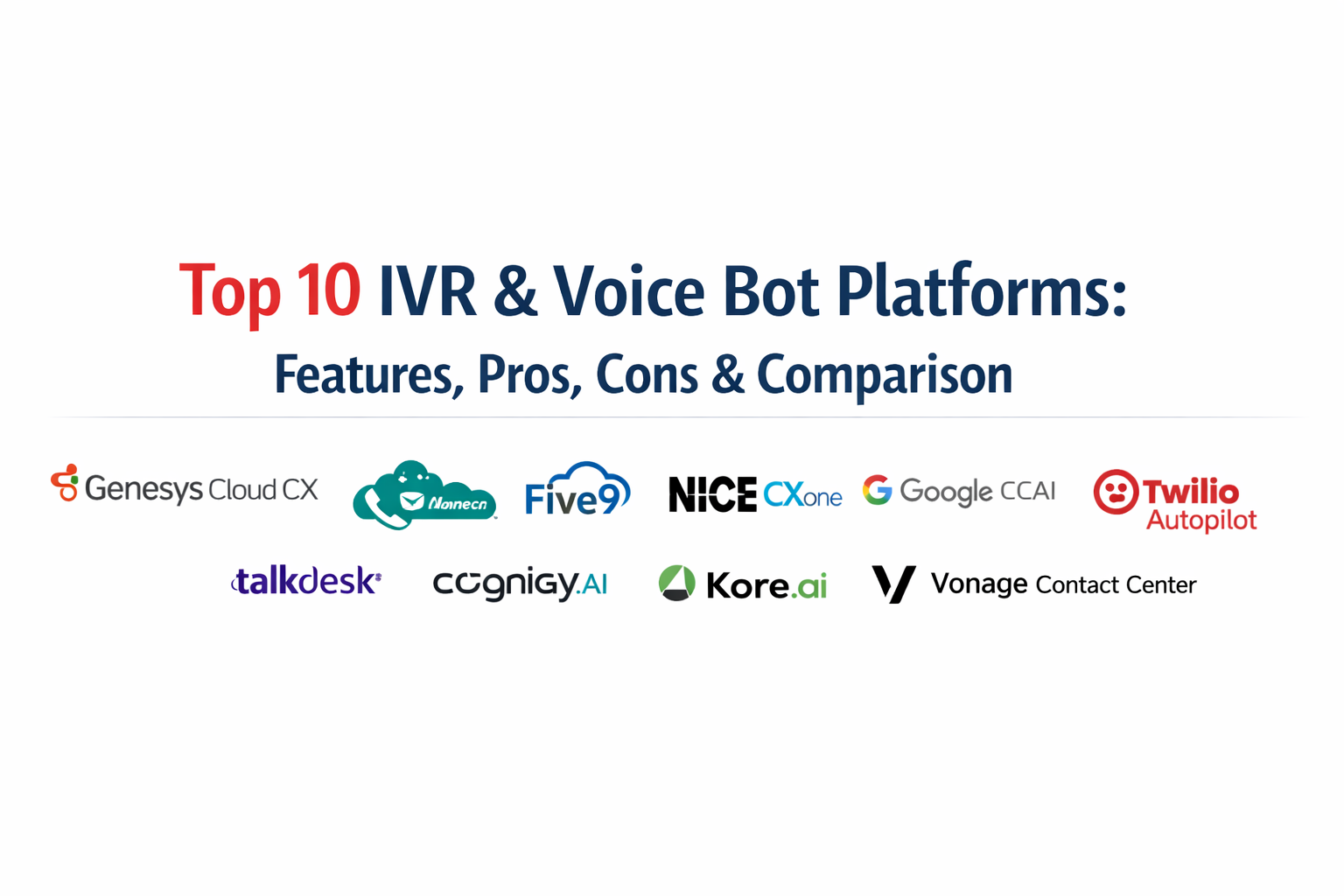
Top 10 IVR & Voice Bot Platforms
1.Genesys Cloud CX
This platform is a leader in the contact center space, offering a highly scalable cloud environment that combines traditional IVR with advanced AI-driven voice bots for global enterprises.
Key Features
- Architect Flow Builder: A visual drag-and-drop tool for creating sophisticated IVR and bot sequences.
- Predictive Routing: Uses AI to match callers with the best available resource based on historical data.
- Native Voice Bots: Integrated conversational AI that understands intent without requiring external plugins.
- Speech-to-Text: High-accuracy transcription services for real-time analysis of caller needs.
- Workforce Engagement: Tools for managing agent schedules and performance alongside automated systems.
Pros
- Exceptional scalability for organizations handling millions of calls per month.
- Deeply integrated analytics that provide a holistic view of the customer journey.
Cons
- The vast feature set can make the initial configuration complex for smaller teams.
- Pricing is on the higher end of the spectrum for premium enterprise features.
Platforms / Deployment
- Web / Windows / macOS
- Cloud / Hybrid
Security & Compliance
- Data encryption at rest and in transit.
- Support for HIPAA and PCI-DSS compliance standards.
Integrations & Ecosystem
Genesys maintains one of the largest marketplaces for third-party integrations in the communications industry.
- Salesforce
- Microsoft Teams
- Zendesk
- ServiceNow
Support & Community
Comprehensive professional services, a dedicated customer success manager for large accounts, and an extensive knowledge base.
2.Amazon Connect
As a self-service, cloud-based contact center service from AWS, this platform allows businesses to build highly customized IVR experiences using the same technology that powers Alexa.
Key Features
- Amazon Lex Integration: Uses the same NLU technology as Alexa to power conversational voice bots.
- Contact Lens: Real-time analytics and sentiment analysis powered by machine learning.
- Pay-as-you-go: A flexible pricing model where you only pay for the minutes you actually use.
- Polly Text-to-Speech: Provides dozens of lifelike voices in multiple languages and dialects.
- Custom Control Creator: Allows for the building of unique agent interfaces and IVR prompts.
Pros
- Rapid deployment capability; a basic IVR can be set up in minutes.
- No upfront costs or long-term contracts, making it ideal for scaling startups.
Cons
- Requires familiarity with the broader AWS ecosystem for advanced customizations.
- Support costs can scale quickly if you require 24/7 technical assistance.
Platforms / Deployment
- Web
- Cloud
Security & Compliance
- Built on the AWS security framework.
- Support for SOC, ISO, and GDPR.
Integrations & Ecosystem
Leverages the massive AWS ecosystem to connect with almost any database or compute resource.
- AWS Lambda
- Amazon S3
- Salesforce
- Kinesis
Support & Community
Standard AWS support tiers and a massive global network of certified developers and consultants.
3.Five9
This platform focuses on the “Intelligent Contact Center,” providing a robust suite of IVR and Intelligent Virtual Assistant tools designed to improve agent productivity.
Key Features
- Intelligent Virtual Assistant: A conversational AI that handles routine inquiries and gathers data before agent handoff.
- Visual IVR: Extends the voice experience to a visual interface on the caller’s smartphone.
- Workflow Automation: Connects voice interactions with back-office tasks to automate end-to-end processes.
- Agent Assist: Provides real-time suggestions and knowledge base articles to agents during live calls.
- Global Voice Exchange: High-quality voice connectivity across multiple international regions.
Pros
- Strong focus on ease of use for contact center supervisors and managers.
- Excellent reputation for professional service and onboarding support.
Cons
- Some legacy interface components may feel less modern than newer cloud-native tools.
- Advanced AI features often require additional licensing tiers.
Platforms / Deployment
- Web / Windows / macOS
- Cloud
Security & Compliance
- SSAE 16 Type II and SOC 2 compliance.
- PCI-DSS Level 1 certified.
Integrations & Ecosystem
Offers a wide array of pre-built connectors for popular business applications.
- Oracle Service Cloud
- Microsoft Dynamics
- ServiceNow
- NetSuite
Support & Community
Known for a high-touch support model with dedicated implementation managers for new clients.
4.NICE CXone
A comprehensive platform that excels in heavy-duty enterprise environments, providing deep analytical insights and a sophisticated IVR design engine.
Key Features
- CXone SmartReach: An AI-powered engine that optimizes how and when to interact with customers.
- Self-Service Analytics: Detailed reporting on where callers drop off in the IVR flow.
- Voice as a Service: High-reliability telephony infrastructure built into the platform.
- Interaction Channels: Supports seamless transitions between voice, SMS, and chat.
- Enlighten AI: Specialized AI that analyzes 100% of interactions for quality and compliance.
Pros
- One of the most mature and feature-rich platforms available for large-scale operations.
- Superior tools for quality management and compliance monitoring.
Cons
- The sheer density of features can result in a steep learning curve for new administrators.
- Implementation projects can be long and require significant technical resources.
Platforms / Deployment
- Web / Windows
- Cloud
Security & Compliance
- FedRAMP authorized for government use.
- Support for GDPR and HIPAA.
Integrations & Ecosystem
Integrates deeply with enterprise-grade CRMs and specialized vertical applications.
- SAP
- Salesforce
- Bullhorn
- Microsoft Dynamics
Support & Community
Extensive corporate training programs and global 24/7 technical support.
5.Google Cloud Contact Center AI (CCAI)
Google leverages its world-class speech and search technology to provide a “bot-first” approach to customer service, focusing on high-accuracy voice interactions.
Key Features
- Dialogflow CX: A powerful development suite for building conversational, multi-turn voice bots.
- Agent Assist: Uses Google Search technology to provide real-time information to agents during calls.
- Insights: Analyzes call data to identify trends and improve bot responses over time.
- Speech-to-Text & Text-to-Speech: Industry-leading accuracy in voice recognition and synthesis.
- AutoML: Allows organizations to train custom models specifically for their industry jargon.
Pros
- Unmatched NLU performance, particularly in understanding diverse accents and intent.
- Highly flexible for developers who want to build bespoke voice experiences.
Cons
- It is a platform of building blocks rather than a “ready-to-use” contact center.
- Requires significant development expertise to implement effectively.
Platforms / Deployment
- Web / API-driven
- Cloud
Security & Compliance
- Google Cloud security standards.
- Support for ISO 27001 and SOC 3.
Integrations & Ecosystem
Designed to be embedded into existing telephony systems and contact center platforms.
- Genesys Cloud
- Avaya
- Mitel
- Cisco
Support & Community
Extensive developer documentation and a large community of AI and machine learning experts.
6.Twilio Autopilot
Twilio provides a developer-centric platform that allows for the creation of voice bots that can be deployed across various communication channels using simple APIs.
Key Features
- Natural Language Processing: Built-in engine that identifies intent and extracts data from voice.
- Programmable Voice: Granular control over call routing, recording, and global connectivity.
- Task-Based Logic: Structures conversations into “tasks” that the bot can perform or hand off.
- Style Sheets: Allows developers to control the voice, pitch, and speed of the bot responses.
- Simulator: A testing environment to debug voice conversations before going live.
Pros
- Complete creative control for developers to build exactly what they need.
- Excellent documentation and a straightforward API structure.
Cons
- Not suitable for non-technical users; requires coding knowledge (Node.js, Python, etc.).
- No native “out-of-the-box” contact center interface for agents.
Platforms / Deployment
- Web / API-driven
- Cloud
Security & Compliance
- Multi-factor authentication and data encryption.
- GDPR and ISO 27001 support.
Integrations & Ecosystem
Can be connected to virtually any web service via webhooks and REST APIs.
- Segment
- SendGrid
- CRM webhooks
- Custom SQL databases
Support & Community
Massive developer community and a tiered support model ranging from free to enterprise.
7.Talkdesk
A cloud-native platform that prioritizes “AI for every day,” making advanced voice bot technology accessible to mid-market and enterprise companies.
Key Features
- Talkdesk IQ: An AI layer that powers voice bots, sentiment analysis, and call transcription.
- Studio: A visual flow designer that makes it easy to create and modify IVR paths.
- AppConnect: A marketplace that allows users to add new features with a single click.
- Voice Biometrics: Integrated identity verification for improved security.
- Mobile Agent: Allows staff to handle calls and monitor bots from mobile devices.
Pros
- Very clean and modern user interface that is easy for agents to learn.
- Rapid innovation cycle with frequent updates and new feature releases.
Cons
- Some users report that the reporting tools are not as deep as older legacy systems.
- Heavy reliance on high-speed internet connectivity due to its cloud-first nature.
Platforms / Deployment
- Web / Windows / macOS / iOS / Android
- Cloud
Security & Compliance
- SOC 2 Type II and ISO 27001.
- Support for HIPAA and PCI.
Integrations & Ecosystem
Offers one of the easiest integration setups in the industry for common business tools.
- Slack
- Salesforce
- Shopify
- Kustomer
Support & Community
Strong focus on customer success and a very active online user community.
8.Cognigy.AI
This platform is a specialized conversational AI suite that focuses on enterprise automation and high-end voice bot development for complex requirements.
Key Features
- Cognigy Voice Gateway: Connects conversational AI directly to telephony networks via SIP/RTP.
- Graphical Flow Editor: A sophisticated environment for designing complex, logic-heavy conversations.
- Live Agent Handoff: Seamless transition with full chat/voice history provided to the human agent.
- Context Management: Remembers information across different parts of the conversation.
- Analytics & Insights: Real-time dashboards showing bot performance and intent accuracy.
Pros
- Highly specialized in automation, making it more powerful for complex bot logic than general contact center tools.
- Can be deployed in cloud or on-premises environments for maximum control.
Cons
- Requires a focused strategy on AI; not a general-purpose phone system.
- Smaller global support footprint compared to giants like AWS or Google.
Platforms / Deployment
- Windows / Linux
- Cloud / Self-hosted
Security & Compliance
- GDPR compliant.
- Support for air-gapped on-premises installations.
Integrations & Ecosystem
Excellent support for backend enterprise systems and telephony providers.
- SAP
- Microsoft Power Automate
- AudioCodes
- Twilio
Support & Community
High-quality technical support and a growing community of conversational AI designers.
9.Kore.ai
Kore.ai offers an enterprise-grade platform specifically for building virtual assistants that are highly secure and capable of handling complex multi-turn dialogues.
Key Features
- Experience Optimization (XO): A platform for designing, building, and managing voice bots.
- Dual NLP Engine: Uses both machine learning and fundamental meaning approaches for higher accuracy.
- Voice Gateway: Built-in connectivity to telephony systems without requiring third-party middleware.
- Knowledge Graph: Allows bots to answer questions based on structured data and FAQs.
- Smart Co-Pilot: Assists human agents by providing context and suggested responses.
Pros
- Exceptional at handling “digressions” where a caller changes the subject mid-conversation.
- Very strong security and administrative controls for large organizations.
Cons
- The administrative interface can be overwhelming due to the number of configuration options.
- Licensing can be complex depending on the number of bots and interactions.
Platforms / Deployment
- Web / Windows / Linux
- Cloud / Self-hosted / Hybrid
Security & Compliance
- SOC 2 Type II, HIPAA, and ISO certified.
- Strong data redaction and masking features.
Integrations & Ecosystem
Integrates with nearly all major enterprise applications and telephony stacks.
- Oracle
- ServiceNow
- Cisco
- Avaya
Support & Community
Dedicated enterprise support and specialized training programs for bot developers.
10.Vonage Contact Center
Built on a powerful global network, Vonage offers a voice-first platform that integrates deeply with CRM systems to provide personalized IVR experiences.
Key Features
- Conversational AI: Voice bots that leverage NLU to resolve queries without agent involvement.
- Dynamic Routing: Changes call flows based on CRM data (e.g., routing VIP customers differently).
- Screen Pop: Delivers caller data and bot transcriptions to agents as they answer.
- Visual Voice Composer: A tool for building voice interactions without writing code.
- Global Presence: Local numbers and high-quality voice termination in over 100 countries.
Pros
- Unmatched integration with Salesforce, providing a “single pane of glass” experience.
- Very reliable global voice network with excellent call quality.
Cons
- Best features are locked behind higher-tier plans.
- Some customization requires a deeper understanding of their proprietary logic.
Platforms / Deployment
- Web / Windows / macOS
- Cloud
Security & Compliance
- TRUSTe and ISO 27001 certified.
- Support for GDPR and PCI-DSS.
Integrations & Ecosystem
Specializes in CRM-centric workflows, particularly within the Salesforce ecosystem.
- Salesforce (Native)
- Microsoft Dynamics
- Bullhorn
- Microsoft Teams
Support & Community
Reliable global support teams and a wealth of documentation for CRM integrations.
Comparison Table
| Tool Name | Best For | Platform(s) Supported | Deployment | Standout Feature | Public Rating |
| Genesys Cloud CX | Enterprise CX | Win, macOS, Web | Hybrid | Architect Flow Builder | N/A |
| Amazon Connect | AWS Ecosystem | Web | Cloud | Pay-as-you-go Pricing | N/A |
| Five9 | Intelligent IVA | Win, macOS, Web | Cloud | Intelligent Virtual Assistant | N/A |
| NICE CXone | Massive Scalability | Win, Web | Cloud | Enlighten AI Analytics | N/A |
| Google CCAI | High Accuracy NLU | API-driven | Cloud | Dialogflow CX | N/A |
| Twilio Autopilot | Developer Control | API-driven | Cloud | Programmable Voice APIs | N/A |
| Talkdesk | Ease of Use | Win, macOS, Mobile | Cloud | Talkdesk Studio Builder | N/A |
| Cognigy.AI | Complex Automation | Win, Linux | Hybrid | Voice Gateway Technology | N/A |
| Kore.ai | Multi-turn Dialogue | Win, Linux, Web | Hybrid | Dual NLP Engine | N/A |
| Vonage Contact Center | CRM Integration | Win, macOS, Web | Cloud | Salesforce Native Experience | N/A |
Evaluation & Scoring of IVR & Voice Bot Platforms
The following scores represent a comparative analysis based on performance against modern industry standards.
| Tool Name | Core (25%) | Ease (15%) | Integrations (15%) | Security (10%) | Performance (10%) | Support (10%) | Value (15%) | Weighted Total |
| Genesys Cloud CX | 10 | 6 | 9 | 9 | 9 | 9 | 7 | 8.60 |
| Amazon Connect | 8 | 7 | 10 | 9 | 10 | 7 | 10 | 8.65 |
| Five9 | 9 | 8 | 8 | 9 | 8 | 9 | 8 | 8.45 |
| NICE CXone | 10 | 5 | 9 | 10 | 9 | 8 | 6 | 8.15 |
| Google CCAI | 10 | 4 | 9 | 9 | 10 | 7 | 8 | 8.15 |
| Twilio Autopilot | 8 | 3 | 10 | 8 | 10 | 7 | 9 | 7.70 |
| Talkdesk | 8 | 10 | 9 | 9 | 8 | 9 | 7 | 8.45 |
| Cognigy.AI | 9 | 6 | 8 | 9 | 9 | 8 | 8 | 8.15 |
| Kore.ai | 9 | 5 | 8 | 10 | 9 | 8 | 7 | 7.95 |
| Vonage | 8 | 8 | 10 | 9 | 9 | 8 | 8 | 8.45 |
How to Interpret These Scores:
- Weighted Total: A comparative score balancing technical power with usability and cost efficiency.
- Core Score: Reflects the depth of IVR capabilities and Voice Bot intelligence.
- Integrations Score: Indicates how easily the tool connects to external business systems without heavy coding.
Which IVR & Voice Bot Platform Is Right for You?
Solo / Freelancer
Small independent consultants or solopreneurs should look at Twilio or Amazon Connect. These platforms have no monthly minimums for basic usage, allowing you to pay only for the calls you receive as you grow your business.
SMB
Small to medium businesses benefit most from Talkdesk or Vonage. These tools offer a user-friendly interface that doesn’t require a dedicated IT team to manage, while still providing advanced features like CRM screen pops and sentiment analysis.
Mid-Market
Companies in the mid-market range often find Five9 or Talkdesk to be the best fit. They offer a strong balance of “out-of-the-box” functionality and professional onboarding support to ensure the system is optimized for their specific workflow.
Enterprise
For large-scale global operations, Genesys Cloud CX and NICE CXone are the dominant choices. They provide the extreme scalability, high-level security certifications, and complex routing logic required to manage thousands of agents across multiple time zones.
Budget vs Premium
- Budget: Amazon Connect and Twilio offer the lowest entry costs with their consumption-based pricing.
- Premium: Genesys, NICE, and Kore.ai are premium investments for organizations that require absolute reliability and the most advanced AI.
Feature Depth vs Ease of Use
- Feature Depth: Google CCAI and Kore.ai offer the most sophisticated AI and dialogue management.
- Ease of Use: Talkdesk and Five9 provide the most intuitive dashboards and flow designers.
Integrations & Scalability
If your organization revolves around Salesforce, Vonage is arguably the best choice. If you are already built on AWS, Amazon Connect offers unmatched scalability and infrastructure integration.
Security & Compliance Needs
Organizations in healthcare or government should prioritize NICE CXone or Kore.ai, as they hold extensive federal and healthcare-specific security authorizations.
Frequently Asked Questions (FAQs)
1.What is the difference between IVR and a Voice Bot?
IVR is traditionally a rule-based system that uses keypad inputs or simple voice commands to route calls. A Voice Bot uses AI and NLU to understand intent and hold natural, conversational interactions with the caller.
2.How do Voice Bots handle accents and different languages?
Modern platforms use neural speech models trained on millions of hours of diverse data. This allows them to recognize various regional accents and switch between dozens of languages automatically based on the caller’s speech.
3.Can these platforms be used to replace human agents?
While they can handle 70% to 80% of routine inquiries like balance checks or status updates, they are designed to complement human agents. They free up humans to handle complex, emotional, or high-value tasks.
4.What is a “latency” problem in voice bots?
Latency is the delay between a human speaking and the bot responding. High latency leads to an unnatural conversation. Top-tier platforms aim for sub-second response times to keep the flow feeling human.
5.Are these platforms secure for taking credit card payments?
Yes, many are PCI-DSS compliant and use “DTMF masking” or secure voice sessions where the payment data is encrypted and never recorded or heard by the system or any listening agents.
6.How much do these platforms typically cost?
Costs vary from a few cents per minute on consumption-based plans like AWS to monthly per-user subscriptions ranging from $75 to $200+ for enterprise contact center suites.
7.Do I need to be a programmer to build a voice bot?
Not necessarily. Tools like Talkdesk Studio and Genesys Architect use visual builders. However, connecting these bots to your specific company database often requires some API knowledge or technical assistance.
8.What is “Sentiment Analysis” in a voice call?
It is an AI feature that detects the emotional state of a caller by analyzing word choice and vocal characteristics. It can trigger an immediate alert to a supervisor if a caller becomes angry or distressed.
9.How do I transition a call from a bot to a live human?
Platforms use “seamless handoff” logic. When a bot fails to understand a request or detects high frustration, it routes the call to an agent and sends a full transcript of what has already happened to the agent’s screen.
10.Can these systems work with my existing office phone system?
Most modern cloud platforms can connect to legacy on-premises systems via SIP trunking or specialized gateways, allowing for a hybrid environment during a digital transition.
Conclusion
The choice of an IVR or Voice Bot platform is a strategic decision that impacts customer satisfaction and operational efficiency. Whether you need a developer-centric API like Twilio or a full-scale enterprise suite like Genesys, the goal remains the same: to provide a friction-free experience for the caller. As AI continues to advance, the line between bot and human interaction will continue to blur, making the selection of an adaptable, high-performance platform more critical than ever. Next Step: Evaluate your current call volume and the complexity of your most common inquiries. Select two or three platforms from this list for a trial or a proof-of-concept to see which NLU engine best understands your specific customer base.

Best Cardiac Hospitals Near You
Discover top heart hospitals, cardiology centers & cardiac care services by city.
Advanced Heart Care • Trusted Hospitals • Expert Teams
View Best Hospitals