Introduction
Knowledge graph databases have emerged as the premier solution for organizations dealing with highly interconnected, complex datasets that traditional relational databases struggle to manage. Unlike standard databases that store data in rigid rows and columns, a knowledge graph treats the relationships between data points as first-class citizens. By using a graph structure—comprising nodes, edges, and properties—these databases allow businesses to uncover hidden patterns, perform deep path analysis, and build a unified view of information across disparate silos. In the current era of artificial intelligence and machine learning, knowledge graphs serve as the critical “context layer” that provides grounded, structured facts to large language models.
In a modern enterprise environment, the ability to query relationships at scale is no longer a luxury; it is a necessity for fraud detection, recommendation engines, and supply chain visibility. Knowledge graph databases differ from simple graph databases by incorporating a semantic layer, often using ontologies to define the meaning and rules of the data. This allows the system to infer new facts from existing data, creating a dynamic and evolving intelligence base. As organizations move toward data-driven decision-making, these tools provide the structural integrity required to turn raw information into actionable knowledge.
Best for: Data scientists, enterprise architects, and AI researchers who need to manage complex relationships, perform semantic reasoning, or provide structured context for generative AI applications.
Not ideal for: Simple transactional applications like basic accounting or CRUD-based websites where data is isolated and does not require complex relationship traversal.
Key Trends in Knowledge Graph Databases
- Graph-RAG Integration: The most significant trend is the use of knowledge graphs to power Retrieval-Augmented Generation, providing LLMs with factual, structured data to eliminate “hallucinations.”
- Serverless Graph Computing: Cloud-native graph databases are moving toward serverless models, allowing teams to scale storage and compute independently based on query complexity.
- Vector-Graph Hybridization: Modern databases are now combining vector search capabilities with graph traversals, allowing for both “semantic similarity” and “structural relationship” queries in a single step.
- Automated Graph Construction: Using NLP and machine learning to automatically extract entities and relationships from unstructured text to build graphs at scale.
- Standardization of Query Languages: The industry is consolidating around standardized languages like GQL (Graph Query Language) and SPARQL to ensure better interoperability between tools.
- Real-Time Analytics: A shift toward “Active Metadata” where knowledge graphs are updated in real-time to reflect changes in the underlying business environment.
- Hardware Acceleration: Increased use of specialized hardware like GPUs and TPUs to speed up massive graph algorithms and high-depth pathfinding.
- Democratic Graph Access: The rise of low-code and natural language interfaces that allow non-technical users to query complex knowledge graphs without knowing specific query languages.
How We Selected These Tools
- Semantic Reasoning Power: We prioritized databases that support ontologies and the ability to infer new relationships based on logical rules.
- Scalability and Performance: Evaluation focused on the database’s ability to handle billions of triples or nodes while maintaining low-latency query responses.
- Ecosystem Maturity: We selected tools with robust libraries, active developer communities, and deep integration with data science workflows.
- Storage and Deployment Flexibility: Priority was given to tools offering various deployment models, including on-premises, multi-cloud, and managed service options.
- Query Language Support: We looked for support for industry standards like Cypher, Gremlin, or SPARQL to ensure long-term viability.
- Security and Enterprise Readiness: Each tool was checked for high-availability features, encryption, and granular access control suitable for sensitive data.
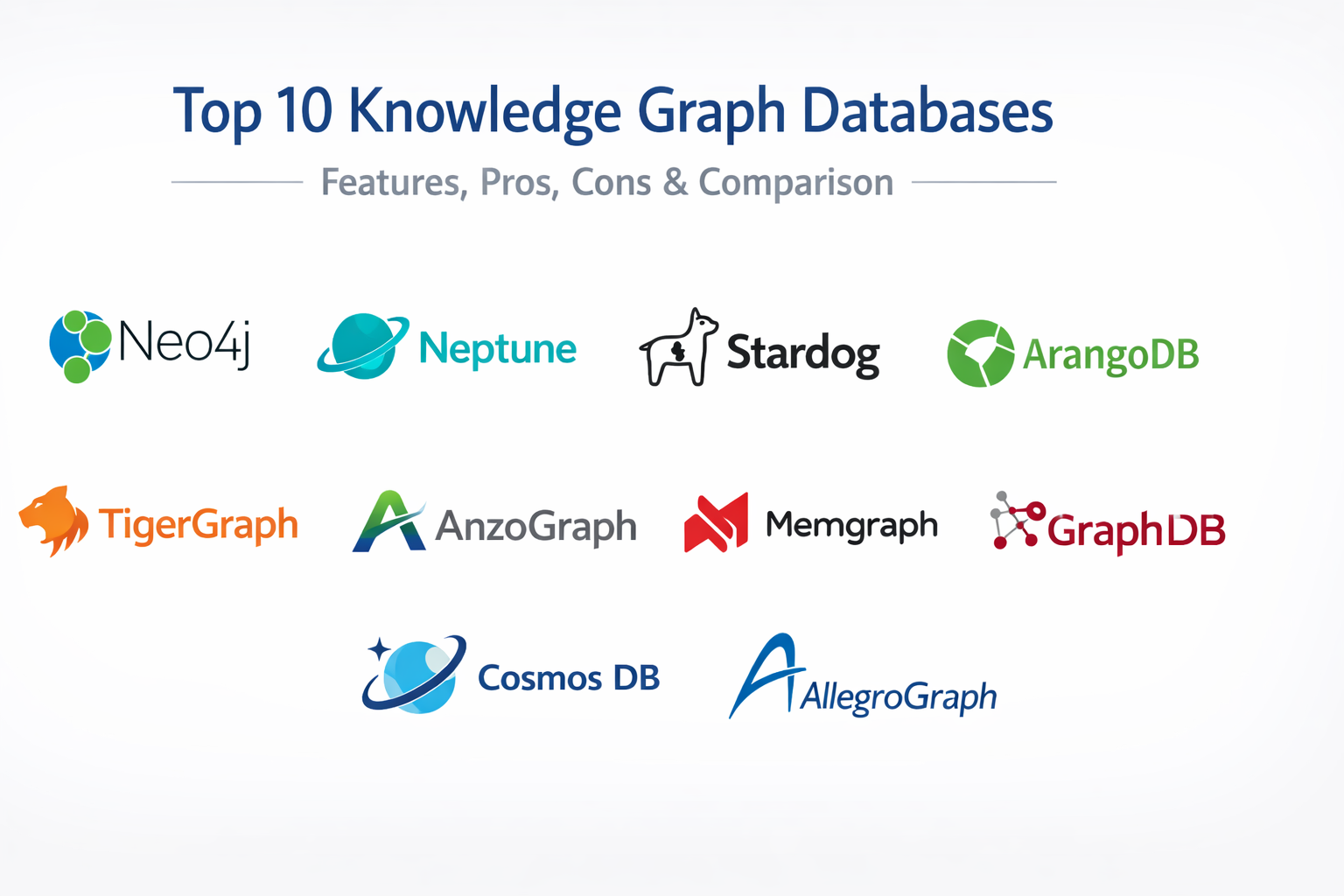
Top 10 Knowledge Graph Databases
1. Neo4j
Widely recognized as the leader in the graph database space, Neo4j provides a native graph store that excels at high-performance traversals. Its specialized focus on the property graph model makes it a favorite for developers building real-time recommendation engines and fraud detection systems.
Key Features
- Native graph storage and processing engine for maximum performance.
- Cypher query language, which is highly intuitive and widely adopted in the industry.
- Graph Data Science library for running advanced algorithms like PageRank directly on the graph.
- Causal Clustering for high availability and horizontal read scaling.
- Deep integration with modern AI stacks for powering Knowledge Graph-RAG.
Pros
- Largest community and ecosystem of any graph database in the world.
- Extremely fast for deep relationship queries spanning many levels.
Cons
- The licensing model can become expensive as clusters grow in size.
- Requires a specific mindset shift away from relational data modeling.
Platforms / Deployment
Windows / Linux / macOS
Cloud / Self-hosted / Hybrid
Security & Compliance
Role-based access control, encryption at rest, and audit logging.
SOC 2 / HIPAA compliant.
Integrations & Ecosystem
Neo4j integrates with virtually every major data tool, including Spark, Kafka, and BI tools like Tableau. It also offers a dedicated cloud service called AuraDB.
Support & Community
Unbeatable community support, extensive documentation, and a massive library of third-party training courses and certifications.
2. Amazon Neptune
A fully managed graph database service from AWS that supports both the Property Graph and RDF models. It is designed for high availability and durability, making it an excellent choice for organizations already built on the AWS infrastructure.
Key Features
- Support for both Gremlin and SPARQL query languages in a single instance.
- Automated backups and point-in-time recovery for data durability.
- Multi-AZ high availability with up to 15 low-latency read replicas.
- Integration with Amazon SageMaker for graph-based machine learning.
- Serverless scaling options to handle unpredictable workloads.
Pros
- Zero administrative overhead due to its fully managed nature.
- Seamless integration with the broader AWS security and monitoring stack.
Cons
- Locked into the AWS ecosystem; not available for on-premises deployment.
- Can be complex to tune for specific high-performance graph algorithms.
Platforms / Deployment
AWS Only
Cloud (Managed)
Security & Compliance
IAM-based authentication, VPC isolation, and encryption via KMS.
SOC 1/2/3, ISO, and PCI DSS compliant.
Integrations & Ecosystem
Integrates natively with AWS Lambda, S3, and CloudWatch. It is a core component of many AWS-native AI and data pipelines.
Support & Community
Standard AWS enterprise support tiers apply. The community is large, though often focused on general AWS architectural patterns.
3. Stardog
Stardog is a leading enterprise knowledge graph platform that focuses heavily on the semantic layer. It allows organizations to unify data without moving it, using a unique “virtual graph” approach that links data in place.
Key Features
- Advanced reasoning engine for inferring new relationships from existing data.
- Virtual Graph technology for querying external SQL or NoSQL databases as a graph.
- Support for the full semantic web stack, including RDF, OWL, and SPARQL.
- Integrated data quality and constraint checking through SHACL.
- Specialized tools for building enterprise ontologies and data schemas.
Pros
- Exceptional at data unification across disparate legacy silos.
- Strongest reasoning and inference capabilities in the enterprise market.
Cons
- Highly technical interface that requires knowledge of semantic web standards.
- The learning curve for ontology modeling is steeper than simple property graphs.
Platforms / Deployment
Windows / Linux / macOS
Cloud / Self-hosted
Security & Compliance
Granular security at the individual node or relationship level.
Not publicly stated.
Integrations & Ecosystem
Stardog connects to almost any data source, including Oracle, Snowflake, and MongoDB, allowing for a “unified data fabric.”
Support & Community
Professional support for enterprise clients and an active community forum for developers and ontologists.
4. ArangoDB
A multi-model database that supports graphs, documents, and key-value pairs in a single engine. This versatility makes it a unique choice for teams that need graph capabilities but also want the flexibility of a document store.
Key Features
- AQL (ArangoDB Query Language) for querying documents and graphs together.
- SmartGraphs for scaling large graph datasets across multiple nodes.
- Integrated full-text search engine for combining text and graph queries.
- Microservices-friendly architecture with native JSON support.
- Satellite Collections for optimizing join performance in distributed clusters.
Pros
- Reduces complexity by eliminating the need for multiple different databases.
- Very easy for developers familiar with JSON and document-oriented data.
Cons
- Not a “native” graph-first engine, which can affect performance at extreme scale.
- AQL is a proprietary language that requires specific learning.
Platforms / Deployment
Windows / Linux / macOS / Docker
Cloud / Self-hosted
Security & Compliance
Standard encryption, LDAP integration, and audit logging.
Not publicly stated.
Integrations & Ecosystem
Strong support for Kubernetes and modern DevOps pipelines. It integrates well with JavaScript and Python ecosystems.
Support & Community
Active open-source community and professional support available through ArangoDB Oasis (their cloud platform).
5. GraphDB (by Ontotext)
GraphDB is an enterprise-grade RDF database (Triplestore) that is built for semantic data publishing and knowledge graph creation. It is highly optimized for heavy reasoning and metadata management.
Key Features
- Full support for RDF, SPARQL, and OWL standards.
- High-performance reasoning with custom rule sets for data inference.
- Automated indexing of text and metadata for semantic search.
- Cluster architecture for high availability and read scalability.
- Support for large-scale data loading and synchronization.
Pros
- Extremely reliable for massive-scale semantic data projects.
- Best-in-class performance for complex SPARQL queries and reasoning.
Cons
- Interface is more academic/technical than modern property graph tools.
- Licensing can be restrictive for smaller, non-enterprise projects.
Platforms / Deployment
Windows / Linux / macOS
Cloud / Self-hosted
Security & Compliance
Fine-grained access control and integration with enterprise identity providers.
Not publicly stated.
Integrations & Ecosystem
Strong ties to the publishing, life sciences, and government sectors where semantic standards are mandatory.
Support & Community
Expert-level support from Ontotext and a long-standing community of semantic web professionals.
6. TigerGraph
TigerGraph is designed specifically for massive-scale graph analytics. It uses a unique “native parallel” architecture that allows it to perform complex traversals across billions of vertices in real-time.
Key Features
- GSQL query language, which is Turing-complete and designed for parallel execution.
- Massive Parallel Processing (MPP) for high-speed graph analytics.
- Support for high-depth queries (10+ hops) at sub-second speeds.
- Automated data sharding and distribution for horizontal scaling.
- Integrated Graph Studio for visual data modeling and exploration.
Pros
- Fastest performance for deep-link analysis and complex graph math.
- Scales more efficiently for massive enterprise datasets than many competitors.
Cons
- GSQL has a steeper learning curve compared to Cypher.
- Management and configuration of large clusters can be technical.
Platforms / Deployment
Linux
Cloud / Self-hosted
Security & Compliance
RBAC, encryption at rest/transit, and Active Directory integration.
Not publicly stated.
Integrations & Ecosystem
Strong integration with Big Data tools like Spark and Kafka, making it a favorite for real-time fraud detection.
Support & Community
Professional support for enterprise users and a growing community of performance-focused graph developers.
7. AnzoGraph (by Cambridge Semantics)
AnzoGraph is a massively parallel processing (MPP) distributed graph database designed for high-performance analytics and data warehousing. It focuses on the intersection of graph and traditional BI.
Key Features
- Distributed architecture designed to run on commodity hardware or cloud instances.
- Support for over 50 built-in graph algorithms and data science functions.
- Unique ability to perform “Graph OLAP” for complex analytical queries.
- Standard SPARQL and OpenCypher support for flexible querying.
- Direct integration with the Anzo data fabric for enterprise data management.
Pros
- Built for high-speed analytical workloads rather than simple transactions.
- Can join graph data with traditional relational data in a single query.
Cons
- Less focused on small-scale application development.
- Requires a sophisticated infrastructure to realize its full performance potential.
Platforms / Deployment
Linux / Kubernetes
Cloud / Self-hosted
Security & Compliance
Enterprise-grade security features integrated with the Anzo platform.
Not publicly stated.
Integrations & Ecosystem
Part of the larger Anzo ecosystem, which includes data ingestion and governance tools.
Support & Community
Focused primarily on enterprise-level professional support and consulting.
8. Memgraph
Memgraph is an in-memory graph database designed for streaming data and real-time performance. It is particularly well-suited for applications that need to process graph data as it arrives.
Key Features
- In-memory storage engine for sub-millisecond query latency.
- Native support for the Cypher query language.
- Deep integration with streaming platforms like Kafka and Redpanda.
- MAGE (Memgraph Advanced Graph Extensions) for real-time graph algorithms.
- Lightweight footprint, making it suitable for edge computing or small instances.
Pros
- Incredible speed for real-time applications and streaming analytics.
- Very easy for Neo4j users to adopt due to Cypher compatibility.
Cons
- Limited by the amount of RAM available on the host machine.
- Not designed for massive, multi-terabyte cold storage datasets.
Platforms / Deployment
Linux / Docker
Cloud / Self-hosted
Security & Compliance
Standard user authentication and SSL/TLS encryption.
Not publicly stated.
Integrations & Ecosystem
Strongest performance when used alongside real-time data streaming and event-processing tools.
Support & Community
Growing community of developers focused on real-time systems and high-speed data.
9. Azure Cosmos DB (Graph API)
Microsoft’s multi-model database service offers a Graph API based on the Apache TinkerPop Gremlin standard. It provides global distribution and horizontal scaling within the Azure cloud.
Key Features
- Turnkey global distribution across any number of Azure regions.
- Guaranteed low latency for both reads and writes at the 99th percentile.
- Automatic and instantaneous scaling of throughput and storage.
- Multi-model capabilities, allowing graph data to coexist with document data.
- Integration with the full Azure security and identity stack.
Pros
- Easiest choice for organizations already committed to the Azure ecosystem.
- Provides massive global scale without the need to manage infrastructure.
Cons
- Gremlin support is sometimes limited compared to native graph engines.
- Pricing can be difficult to predict due to the “Request Unit” (RU) model.
Platforms / Deployment
Azure Only
Cloud (Managed)
Security & Compliance
Azure Active Directory, encryption, and comprehensive compliance certifications.
SOC, ISO, HIPAA, and GDPR compliant.
Integrations & Ecosystem
Natively integrated with Azure Functions, Data Factory, and Power BI.
Support & Community
Full Microsoft enterprise support and a large community of Azure cloud architects.
10. AllegroGraph
One of the pioneers in the semantic graph space, AllegroGraph is a multi-model knowledge graph database that specializes in “Neuro-Symbolic AI,” combining graph data with machine learning.
Key Features
- Specialized support for temporal and geospatial data within the graph.
- “Gruff” tool for visual graph query building and data exploration.
- Support for RDF, SPARQL, and advanced reasoning capabilities.
- Integrated document-store features for handling unstructured data.
- Advanced “FedShard” technology for scaling across distributed environments.
Pros
- Deeply rooted in artificial intelligence research and complex reasoning.
- Unique capabilities for handling time-series and location-based graph data.
Cons
- The user interface and documentation can feel academic.
- Smaller community compared to mainstream property graph databases.
Platforms / Deployment
Linux / Windows / macOS
Cloud / Self-hosted
Security & Compliance
Triple-level security for high-security government and research projects.
Not publicly stated.
Integrations & Ecosystem
Strong presence in high-security government, defense, and pharmaceutical research.
Support & Community
High-level professional support from Franz Inc. and an expert academic community.
Comparison Table
| Tool Name | Best For | Platform(s) Supported | Deployment | Standout Feature | Public Rating |
| 1. Neo4j | Real-time Apps | Win, Mac, Linux | Hybrid | Native Graph Engine | N/A |
| 2. Neptune | AWS Ecosystem | AWS Only | Cloud | Managed Scalability | N/A |
| 3. Stardog | Data Unification | Win, Mac, Linux | Hybrid | Virtual Graph/Reasoning | N/A |
| 4. ArangoDB | Multi-model Needs | Win, Mac, Linux | Hybrid | Document + Graph | N/A |
| 5. GraphDB | Semantic Web | Win, Mac, Linux | Hybrid | High-speed SPARQL | N/A |
| 6. TigerGraph | Large-scale Analytics | Linux | Hybrid | Parallel Processing | N/A |
| 7. AnzoGraph | Graph BI | Linux | Hybrid | Distributed OLAP | N/A |
| 8. Memgraph | Streaming Data | Linux, Docker | Hybrid | In-memory Speed | N/A |
| 9. Cosmos DB | Global Azure Apps | Azure Only | Cloud | Global Distribution | N/A |
| 10. AllegroGraph | Research / AI | Win, Mac, Linux | Hybrid | Neuro-Symbolic AI | N/A |
Evaluation & Scoring
| Tool Name | Core (25%) | Ease (15%) | Integrations (15%) | Security (10%) | Perf (10%) | Support (10%) | Value (15%) | Total |
| 1. Neo4j | 10 | 9 | 10 | 9 | 9 | 10 | 7 | 9.10 |
| 2. Neptune | 9 | 9 | 10 | 10 | 8 | 9 | 8 | 8.85 |
| 3. Stardog | 10 | 6 | 9 | 9 | 8 | 8 | 7 | 8.15 |
| 4. ArangoDB | 8 | 9 | 9 | 8 | 8 | 8 | 9 | 8.35 |
| 5. GraphDB | 10 | 6 | 8 | 8 | 9 | 8 | 7 | 8.10 |
| 6. TigerGraph | 10 | 5 | 9 | 9 | 10 | 8 | 7 | 8.20 |
| 7. AnzoGraph | 9 | 5 | 8 | 8 | 9 | 7 | 7 | 7.60 |
| 8. Memgraph | 8 | 8 | 8 | 7 | 10 | 7 | 8 | 8.00 |
| 9. Cosmos DB | 7 | 9 | 10 | 10 | 8 | 9 | 8 | 8.35 |
| 10. AllegroGraph | 9 | 5 | 7 | 9 | 8 | 8 | 7 | 7.45 |
The evaluation scores highlight a clear distinction between “Developer-Friendly” and “Scientist-Friendly” tools. Neo4j and Amazon Neptune lead the scoring due to their massive integration ecosystems and ease of deployment for standard business applications. TigerGraph and Memgraph score exceptionally high in performance, making them the choice for high-speed analysis. Stardog and GraphDB remain the top choices for complex semantic modeling, though they require more specialized expertise to operate effectively.
Which Knowledge Graph Database Tool Is Right for You?
Solo / Freelancer
If you are just starting, Neo4j Desktop or Blender (for visualization) is the best entry point. The community support is so vast that you can solve almost any problem with a simple search. Memgraph is also a great lightweight choice if you are working with real-time data on a single machine.
SMB
For small to medium businesses, ArangoDB offers incredible value because it can serve as both your document and graph database, reducing your infrastructure management load. If you are already in the cloud, Amazon Neptune or Azure Cosmos DB allows you to scale without needing a dedicated Database Administrator.
Mid-Market
Growing companies with specific data unification needs should look at Stardog. Its ability to query data where it lives (Virtual Graphs) saves months of ETL (Extract, Transform, Load) work. If high-speed analytics is the goal, TigerGraph provides a scalable path forward.
Enterprise
Large enterprises requiring global distribution should prioritize Azure Cosmos DB or Neo4j Aura Enterprise. For those in highly regulated or research-heavy sectors like pharma or defense, GraphDB or AllegroGraph provide the rigorous semantic standards required for complex knowledge modeling.
Budget vs Premium
Neo4j and TigerGraph offer powerful free tiers or community editions that are perfect for getting started. On the premium side, managed services like Amazon Neptune or Stardog Cloud offer a “worry-free” experience at a higher monthly cost.
Feature Depth vs Ease of Use
Neo4j and ArangoDB are built for ease of use and developer productivity. If you need extreme feature depth in terms of logical reasoning and data inference, Stardog and GraphDB are the necessary, albeit more complex, choices.
Integrations & Scalability
Neo4j has the most integrations across the entire data stack. For cloud-native scalability that requires almost zero configuration, Amazon Neptune and Azure Cosmos DB are the industry leaders.
Security & Compliance Needs
For organizations with high security requirements, native cloud offerings like Azure Cosmos DB provide the most comprehensive compliance certifications out of the box. For on-premises security, Neo4j and GraphDB offer the granular controls required for multi-tenant environments.
Frequently Asked Questions (FAQs)
1. What is the difference between a graph database and a knowledge graph?
A graph database is the storage technology, while a knowledge graph is the actual data and the semantic rules (ontology) that give that data meaning and context.
2. Can I use SQL to query a graph database?
Generally, no. Most graph databases use specialized languages like Cypher or SPARQL, though some multi-model databases like ArangoDB offer SQL-like syntax for graph queries.
3. Why are knowledge graphs important for AI?
They provide a “source of truth” for AI models. By feeding a knowledge graph into an LLM via RAG, you can ensure the AI provides answers based on real facts rather than patterns.
4. Do graph databases replace traditional SQL databases?
Not usually. They are best used alongside SQL databases to handle the highly connected parts of your data, such as social relationships, fraud patterns, or complex hierarchies.
5. What are “triples” in a knowledge graph?
A triple is a basic data unit consisting of a Subject, Predicate, and Object (e.g., “Paris” – “is capital of” – “France”). Semantic databases store data in this format.
6. Is Neo4j better than Amazon Neptune?
It depends on your needs. Neo4j is a “native” graph database with better traversal performance, while Neptune is a managed service that is easier to operate if you are already on AWS.
7. Can knowledge graphs handle unstructured data?
The graph itself is structured, but you can use NLP tools to extract information from unstructured documents (like PDFs or emails) and then store that information in the graph.
8. What is reasoning in a knowledge graph?
Reasoning is the ability of the database to automatically create new links. For example, if “A is father of B” and “B is father of C,” the reasoner can infer that “A is grandfather of C.”
9. Do I need a high-end server to run a graph database?
For small projects, a standard laptop is enough. However, for massive graphs, you need high RAM for in-memory processing or specialized parallel architectures like TigerGraph.
10. How do I start building a knowledge graph?
The best way is to start small by defining your core entities and how they relate. Use a tool like Neo4j Desktop or Stardog Designer to visually map out your first few nodes.
Conclusion
Navigating the world of knowledge graph databases requires a strategic focus on how your data is connected rather than just how it is stored. As we move further into the age of AI, the ability to provide structured, semantic context will distinguish successful organizations from those drowning in disconnected data. Whether you choose a developer-friendly property graph like Neo4j or a deeply semantic RDF store like Stardog, the goal is the same: unlocking the value of relationships. By selecting a tool that aligns with your team’s technical skills and your organization’s scaling needs, you can build a foundation for long-term intelligence and innovation.

Best Cardiac Hospitals Near You
Discover top heart hospitals, cardiology centers & cardiac care services by city.
Advanced Heart Care • Trusted Hospitals • Expert Teams
View Best Hospitals