Introduction
Lab safety management tools are specialized digital platforms designed to centralize and automate the complex safety protocols required in modern scientific environments. These systems move beyond simple spreadsheets to provide a dynamic framework for tracking hazardous materials, managing safety data sheets (SDS), and ensuring that all personnel are properly trained and compliant with regional regulations. In today’s high-stakes research and industrial landscape, a digital safety foundation is no longer optional; it is a critical requirement for mitigating risk, protecting human life, and maintaining the integrity of scientific results. These tools act as the “command center” for safety officers, providing real-time visibility into every fume hood, chemical cabinet, and training record across an organization.
In the current era, the definition of lab safety has expanded to include sophisticated data governance and predictive analytics. Modern buyers are looking for systems that don’t just record incidents after they happen, but actively prevent them through automated alerts and intelligent risk assessments. Whether in a high-security pharmaceutical lab or a multi-disciplinary university research center, these tools ensure that safety remains a seamless part of the workflow rather than a bureaucratic hurdle. By integrating mobile inspections and IoT-connected sensors, organizations can now maintain a proactive safety posture that adapts to the fast-paced nature of modern experimentation.
Best for: Research universities, biotechnology startups, pharmaceutical enterprises, and industrial testing facilities that handle hazardous biological or chemical agents and must adhere to strict OSHA, CLIA, or ISO safety standards.
Not ideal for: Small office-based businesses with no physical laboratory footprint or hobbyist environments where the volume of hazardous materials does not justify the cost and administrative overhead of a professional management suite.
Key Trends in Lab Safety Management Tools
- Predictive Safety Analytics: Modern platforms now use historical data to identify high-risk patterns and predict potential incidents before they occur in the lab.
- Mobile-First Inspections: Safety officers are moving away from paper checklists toward mobile apps that allow for instant photo evidence, geo-tagging, and real-time deficiency reporting.
- IoT Integration for Storage: Sensors are increasingly used to monitor chemical storage conditions, such as temperature and humidity, sending instant alerts to safety software if thresholds are breached.
- Automated SDS Workflows: Systems can now automatically pull the latest Safety Data Sheets from global databases, ensuring researchers always have the most current hazard information at their fingertips.
- Augmented Reality Training: Virtual and augmented reality modules are being integrated to provide immersive safety drills for high-risk procedures without exposing staff to actual hazards.
- Blockchain for Audit Trails: To ensure absolute data integrity during regulatory audits, some high-end systems use immutable ledgers to track every change made to safety records.
- GHS Labeling Automation: Direct integration with specialized printers allows for the rapid creation of globally harmonized system labels for secondary containers, reducing human error.
- Centralized Chemical Lifecycles: Tools are focusing on the entire “cradle-to-grave” journey of a chemical, from procurement and inventory to usage and final hazardous waste disposal.
How We Selected These Tools
- Regulatory Compliance Depth: We prioritized tools that offer built-in frameworks for global safety standards such as OSHA, HIPAA, and ISO 45001.
- Chemical Intelligence: Only platforms with robust chemical databases and automated hazard classification capabilities were considered for the top spots.
- Ease of Deployment: Special attention was given to tools that offer cloud-based accessibility and user-friendly interfaces to encourage widespread adoption among scientists.
- Incident Management Capabilities: We evaluated how effectively each tool handles the lifecycle of a safety incident, from initial reporting to root-cause analysis and corrective actions.
- Ecosystem Connectivity: Tools were selected based on their ability to integrate with existing lab equipment and enterprise resource planning systems.
- Scalability Across Sites: We looked for platforms that can manage complex safety protocols across multiple geographic locations and varied research disciplines.
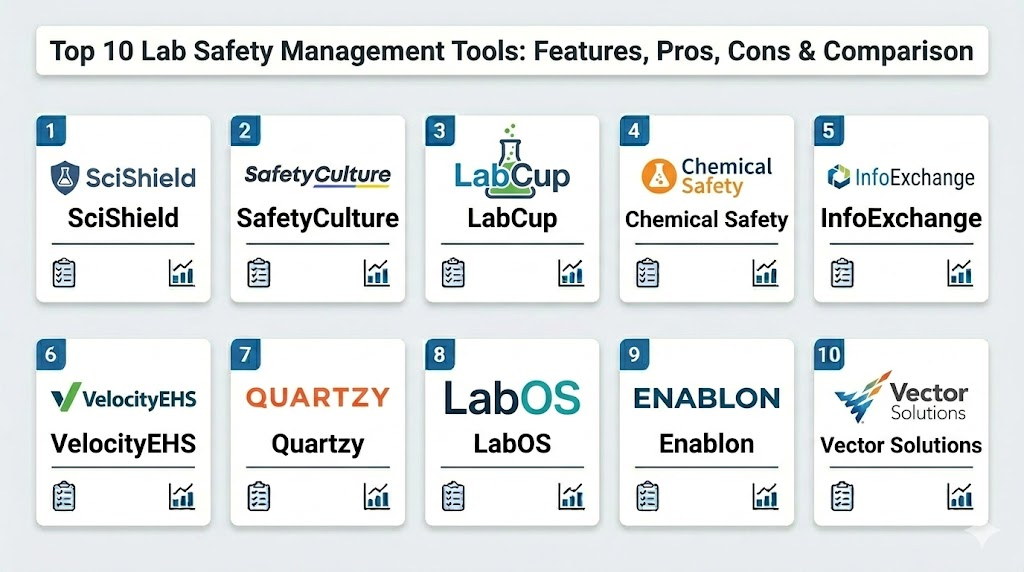
Top 10 Lab Safety Management Tools
1. SciShield (formerly BioRAFT)
SciShield is a comprehensive safety and compliance platform built specifically for the unique needs of research institutions. It focuses on centralizing investigator data, training records, and chemical inventories into a single, cohesive dashboard that simplifies the administrative burden on safety offices.
Key Features
- Advanced ChemTracker module for real-time hazardous material inventory.
- Automated training management that links specific lab hazards to required safety courses.
- Robust inspection and audit tools with mobile-friendly checklists and automated follow-ups.
- Incident reporting module with detailed tracking of corrective and preventive actions.
- Centralized dashboard for managing biological, chemical, and radiological safety.
Pros
- Exceptional specialized focus on the academic and high-end research sector.
- Highly effective at automating the “people-to-hazard” relationship.
Cons
- The interface can feel complex due to the sheer volume of available modules.
- Initial configuration requires a significant time investment from the safety team.
Platforms / Deployment
Web / Mobile
Cloud
Security & Compliance
SSO/SAML, MFA, and comprehensive audit logs.
SOC 2 compliant.
Integrations & Ecosystem
SciShield integrates with most enterprise identity management systems and can pull data from purchasing systems to automate inventory updates. It serves as a central hub for environmental health and safety data.
Support & Community
Strong professional support with dedicated implementation specialists. The community is highly active in the university EHS space, often sharing best practices and templates.
2. SafetyCulture
SafetyCulture is a versatile inspection and checklist tool that has been widely adopted by laboratories for its mobile-first design and extreme ease of use. It allows lab managers to digitize safety audits and incident reports in minutes, making it a favorite for teams focused on operational speed.
Key Features
- Intuitive drag-and-drop template builder for custom lab safety checklists.
- Real-time incident reporting with the ability to attach photos and voice notes.
- Automated scheduling for routine equipment calibrations and safety inspections.
- Dynamic “Heads Up” feature for broadcasting safety alerts to all lab personnel.
- Integration with IoT sensors for monitoring lab environment variables like temperature.
Pros
- The fastest deployment time of any tool on this list.
- Highly engaging mobile interface that encourages staff participation in safety tasks.
Cons
- Lacks the deep chemical-specific intelligence of dedicated lab suites.
- Some enterprise features require moving to a higher pricing tier.
Platforms / Deployment
iOS / Android / Web
Cloud
Security & Compliance
SSO, MFA, and data encryption at rest and in transit.
ISO 27001 compliant.
Integrations & Ecosystem
SafetyCulture offers a robust API and integrates seamlessly with common business tools like Slack, Microsoft Teams, and various business intelligence platforms for advanced reporting.
Support & Community
Extensive online help center, 24/7 customer support, and a massive library of thousands of pre-made safety templates contributed by the community.
3. LabCup
LabCup is an intelligent lab management system that excels in the lifecycle management of chemicals and biological samples. It is designed to act as a smart assistant, helping researchers navigate safety requirements without slowing down their experimental work.
Key Features
- Intelligent chemical search that provides instant hazard information and storage warnings.
- Automated SDS management that keeps a central digital repository up to date.
- Advanced floorplan mapping to visualize the location of hazardous materials in real-time.
- Integrated waste management module for tracking the disposal of toxic substances.
- Regulatory reporting tools that simplify the creation of annual safety summaries.
Pros
- Excellent visualization tools for locating specific hazards within a facility.
- Strong focus on the researcher’s daily workflow, making it very user-friendly.
Cons
- May require additional custom work for very large-scale, multi-site global enterprises.
- The feature set is heavily focused on materials, with less depth in administrative HR tasks.
Platforms / Deployment
Web / Mobile
Cloud
Security & Compliance
SSO, encryption, and detailed user access controls.
Not publicly stated.
Integrations & Ecosystem
Integrates with major chemical suppliers and procurement platforms to ensure that new hazardous materials are automatically logged into the safety system upon arrival.
Support & Community
Responsive technical support and a growing user base in Europe and North America, particularly within the biotech and chemical industries.
4. Chemical Safety Software (EMS)
Environmental Management Systems (EMS) by Chemical Safety Software is a veteran platform known for its deep regulatory expertise. It is one of the most comprehensive systems for organizations that need to manage high volumes of hazardous waste and maintain strict federal compliance.
Key Features
- Comprehensive GHS-compliant chemical inventory with automated labeling.
- Advanced hazardous waste tracking from the point of generation to final disposal.
- Integrated SDS database with millions of entries and automated updates.
- Facility safety module for managing fire life safety and facility audits.
- Employee health and medical surveillance tracking for long-term exposure monitoring.
Pros
- Unmatched depth in hazardous waste management and environmental compliance.
- Highly customizable reporting engine for complex regulatory filings.
Cons
- The user interface is more traditional and may have a steeper learning curve for new users.
- Deployment can be complex for organizations without a dedicated EHS department.
Platforms / Deployment
Windows / Web / Mobile
Cloud / Self-hosted
Security & Compliance
SSO/SAML, MFA, and detailed audit trails.
HIPAA support for medical surveillance data.
Integrations & Ecosystem
EMS integrates deeply with procurement, financial systems, and shipping platforms to ensure that chemical data flows seamlessly through the organization’s supply chain.
Support & Community
Extensive training programs, on-site implementation options, and a long-standing reputation for reliable technical expertise in the chemical sector.
5. Alcumus InfoExchange
Alcumus InfoExchange is an enterprise-level risk management platform that helps large organizations centralize their health and safety data. It is designed to provide a “single version of the truth” for safety performance across global laboratory networks.
Key Features
- Centralized risk management framework for identifying and assessing lab hazards.
- Integrated incident and accident management with detailed root-cause workflows.
- Contractor management module to ensure external visitors adhere to lab safety protocols.
- Real-time safety dashboards for senior leadership and department heads.
- Comprehensive audit and inspection module with automated corrective action tracking.
Pros
- Powerful analytics engine that provides deep insights into safety trends.
- Extremely scalable for massive organizations with hundreds of laboratory sites.
Cons
- The pricing model is geared toward large enterprise clients.
- Can be overkill for small, single-site research laboratories.
Platforms / Deployment
Web / Mobile
Cloud
Security & Compliance
SSO, MFA, and enterprise-grade encryption.
ISO 27001 and SOC 2 compliant.
Integrations & Ecosystem
InfoExchange is built to act as the central safety record for an enterprise, integrating with HR systems, ERPs, and external compliance databases to ensure data consistency.
Support & Community
Dedicated account managers for enterprise clients and a professional consulting arm that helps organizations build out their safety frameworks.
6. VelocityEHS
VelocityEHS offers a suite of safety management tools designed for speed and simplicity. Their chemical management module (formerly MSDSonline) is one of the world’s most widely used databases for safety data sheets and hazard communication.
Key Features
- Access to a massive, multi-million document SDS database with automated updates.
- Easy chemical inventory scanning using mobile devices and barcodes.
- Simplified incident reporting and investigation tools with built-in best practices.
- Integrated training management with a library of pre-made safety courses.
- Industrial hygiene module for tracking workplace air quality and noise exposure.
Pros
- The SDS management system is considered the industry benchmark for reliability.
- Very “clean” and modern user experience that requires minimal training for end-users.
Cons
- The broad focus on general industry safety means some niche lab features may be less deep.
- Higher-level modules like industrial hygiene can be expensive add-ons.
Platforms / Deployment
Web / iOS / Android
Cloud
Security & Compliance
SSO/SAML, MFA, and secure data storage.
Not publicly stated.
Integrations & Ecosystem
VelocityEHS offers extensive API support and integrates well with corporate HR and procurement systems to keep safety data synced with the broader business.
Support & Community
Excellent customer success programs and a very high-quality blog and webinar series focused on evolving safety regulations.
7. Quartzy
Quartzy is primarily known as a lab supply ordering platform, but its built-in safety and inventory features make it essential for small-to-mid-sized labs. It bridges the gap between procurement and safety by ensuring every item ordered is properly documented.
Key Features
- Automated safety data sheet retrieval for every chemical ordered through the platform.
- Simplified chemical inventory management with location and quantity tracking.
- Shared lab calendar for managing equipment maintenance and safety drills.
- Integrated request and approval workflows that include safety reviews.
- Bulk import tools for quickly digitizing existing chemical collections.
Pros
- Extremely simple to use, with a focus on the scientist’s everyday needs.
- Excellent value proposition as the core inventory features are highly accessible.
Cons
- Lacks advanced incident investigation and risk assessment modules.
- Not designed for complex enterprise-level EHS management across large campuses.
Platforms / Deployment
Web / Mobile
Cloud
Security & Compliance
Standard identity protection and secure data handling.
Not publicly stated.
Integrations & Ecosystem
Quartzy connects directly with hundreds of scientific suppliers, ensuring that safety information flows in as soon as a purchase is made.
Support & Community
Highly responsive support team and a large community of academic researchers who rely on the platform for daily lab operations.
8. LabOS
LabOS is a next-generation laboratory management platform that integrates safety directly into the operational workflow. It uses intelligent automation to ensure that safety checks are performed as part of every experimental procedure.
Key Features
- Integrated workflow builder that inserts safety checks into lab protocols.
- Real-time monitoring of lab equipment status and calibration needs.
- Automated regulatory compliance tracking for medical and clinical labs.
- Advanced sample tracking with full chain-of-custody documentation.
- Comprehensive audit trails for all data access and modifications.
Pros
- Unbeatable for clinical and medical laboratories where safety is tied to patient data.
- Modern, intuitive interface that feels like a “command center” for the lab.
Cons
- Pricing and features are heavily optimized for high-volume clinical settings.
- May be more complex than necessary for purely academic research groups.
Platforms / Deployment
Web / Mobile
Cloud
Security & Compliance
SSO, MFA, and HIPAA compliance for sensitive medical data.
SOC 2 compliant.
Integrations & Ecosystem
LabOS is designed to be highly interoperable, connecting with diagnostic instruments, electronic health records, and billing systems.
Support & Community
Strong enterprise-level support with a focus on high-reliability clinical environments.
9. Enablon
Enablon is a high-end platform for operational risk and environmental, social, and governance (ESG) management. It is used by global pharmaceutical and chemical giants to manage safety on a massive scale.
Key Features
- Advanced risk management with predictive safety analytics and trend detection.
- Global compliance tracking for managing international laboratory networks.
- Integrated environmental footprint tracking for hazardous waste and emissions.
- Mobile tools for field audits and complex on-site inspections.
- Root-cause analysis tools for investigating major safety incidents.
Pros
- The most powerful analytical and reporting capabilities on the market.
- Essential for organizations focusing on global sustainability and ESG goals.
Cons
- Requires a significant financial and technical commitment.
- The interface can be overwhelming for users who only need basic safety features.
Platforms / Deployment
Web / Mobile
Cloud / Hybrid
Security & Compliance
Enterprise-grade security, identity management, and audit trails.
ISO 27001 and SOC 2 compliant.
Integrations & Ecosystem
Acts as the central safety system for global enterprises, integrating with almost all major ERP and HR software packages.
Support & Community
Professional service teams and a massive global network of partners and consultants.
10. Vector Solutions
Vector Solutions focuses heavily on the “people” side of lab safety. It is the premier platform for delivering specialized laboratory safety training and maintaining the competency records of a diverse scientific workforce.
Key Features
- Enormous library of specialized lab safety courses (e.g., BSL-2, Radiation, Laser Safety).
- Automated training assignment and renewal tracking based on job role.
- Integrated incident management and inspection tools to complement training.
- Credential management for tracking professional licenses and certifications.
- Mobile-friendly interface for completing safety training on the go.
Pros
- The strongest training content library specifically for laboratory environments.
- Excellent for ensuring a large, rotating population (like students) remains compliant.
Cons
- Inventory and material management features are secondary to training.
- May need to be paired with a dedicated chemical management tool for full coverage.
Platforms / Deployment
Web / iOS / Android
Cloud
Security & Compliance
SSO, MFA, and secure record-keeping.
Not publicly stated.
Integrations & Ecosystem
Vector Solutions integrates with HR and student management systems to automate the onboarding and safety training of new personnel.
Support & Community
Solid customer service and an extensive knowledge base focused on health and safety education.
Comparison Table
| Tool Name | Best For | Platform(s) Supported | Deployment | Standout Feature | Public Rating |
| 1. SciShield | Academic Research | Web, Mobile | Cloud | People-Hazard Link | N/A |
| 2. SafetyCulture | Rapid Inspections | iOS, Android, Web | Cloud | Template Builder | N/A |
| 3. LabCup | Material Lifecycle | Web, Mobile | Cloud | Floorplan Mapping | N/A |
| 4. Chemical Safety | Waste Compliance | Windows, Web | Hybrid | Cradle-to-Grave | N/A |
| 5. InfoExchange | Global Enterprise | Web, Mobile | Cloud | Risk Dashboards | N/A |
| 6. VelocityEHS | SDS Management | Web, iOS, Android | Cloud | Global SDS Database | N/A |
| 7. Quartzy | Small/Medium Labs | Web, Mobile | Cloud | Procurement Sync | N/A |
| 8. LabOS | Clinical Safety | Web, Mobile | Cloud | Clinical Workflows | N/A |
| 9. Enablon | ESG & Risk | Web, Mobile | Hybrid | Predictive Analytics | N/A |
| 10. Vector Solutions | Safety Training | Web, iOS, Android | Cloud | Course Library | N/A |
Evaluation & Scoring
| Tool Name | Core (25%) | Ease (15%) | Integrations (15%) | Security (10%) | Perf (10%) | Support (10%) | Value (15%) | Total |
| 1. SciShield | 10 | 6 | 9 | 9 | 9 | 9 | 7 | 8.45 |
| 2. SafetyCulture | 7 | 10 | 9 | 8 | 10 | 8 | 9 | 8.40 |
| 3. LabCup | 9 | 8 | 8 | 7 | 9 | 8 | 8 | 8.20 |
| 4. Chemical Safety | 10 | 5 | 8 | 8 | 8 | 9 | 7 | 7.85 |
| 5. InfoExchange | 8 | 7 | 10 | 10 | 9 | 9 | 6 | 8.15 |
| 6. VelocityEHS | 9 | 9 | 8 | 8 | 9 | 9 | 7 | 8.45 |
| 7. Quartzy | 6 | 10 | 7 | 7 | 9 | 8 | 10 | 7.70 |
| 8. LabOS | 9 | 7 | 9 | 10 | 9 | 8 | 6 | 8.20 |
| 9. Enablon | 10 | 4 | 10 | 10 | 10 | 9 | 5 | 8.05 |
| 10. Vector Solutions | 7 | 9 | 8 | 8 | 9 | 9 | 8 | 7.95 |
These scores represent the performance of each tool within its primary domain. A tool like SciShield scores high because it offers a perfect balance of deep laboratory expertise and professional support, while SafetyCulture excels in speed and accessibility. Organizations should look at the specific weighted total to determine which tool aligns best with their priority—for example, a team that values “Ease of Use” above all else would naturally lean toward Quartzy or SafetyCulture, even if they lack the “Core Feature” depth of a more technical system like Enablon.
Which Lab Safety Management Tool Is Right for You?
Solo / Freelancer
If you are an independent researcher or running a single-person startup, Quartzy is the most practical choice. It offers core inventory and safety data sheet features without the high cost or complexity of an enterprise EHS suite, allowing you to focus on your experiments while staying basic-level compliant.
SMB
Small to mid-sized biotech or industrial labs should consider SafetyCulture or LabCup. These tools provide a higher level of professional safety management and mobile inspection capabilities that help a growing team maintain a strong safety culture without requiring a full-time EHS professional to manage the software.
Mid-Market
Organizations with multiple labs and a dedicated safety officer should prioritize SciShield or VelocityEHS. These platforms are deep enough to handle complex chemical inventories and varied research disciplines while remaining intuitive enough for researchers to use daily without resistance.
Enterprise
Global pharmaceutical and chemical enterprises require the horsepower of Enablon or Alcumus InfoExchange. These systems are built for the heavy data lifting of multi-site compliance, risk forecasting, and environmental reporting that is required at the highest levels of corporate governance.
Budget vs Premium
- Budget: Quartzy or the basic tier of SafetyCulture provide excellent entry-level features for a minimal investment.
- Premium: SciShield, Enablon, and LabOS represent the top-tier investment for organizations that cannot afford even a single safety or compliance failure.
Feature Depth vs Ease of Use
- Depth: Chemical Safety Software and Houdini (in its procedural domain) offer extreme control but require specialized knowledge.
- Ease of Use: SafetyCulture and Quartzy can be picked up by any lab tech with zero training.
Integrations & Scalability
If your goal is to build a safety system that grows with your lab, SciShield and VelocityEHS offer the best integration paths, connecting easily to the purchasing and HR tools that mid-to-large organizations already use.
Security & Compliance Needs
Clinical laboratories must prioritize LabOS or SciShield to ensure they meet the specific technical and administrative safeguards required by medical regulations like HIPAA and CLIA.
Frequently Asked Questions (FAQs)
1. Why should we switch from spreadsheets to safety software?
Spreadsheets lack real-time updates, automated alerts, and audit trails. Dedicated software ensures that safety data is always current, searchable, and compliant with regulatory standards.
2. How long does it take to implement a new safety management tool?
Simple tools like SafetyCulture can be ready in days, while enterprise systems like SciShield or Enablon typically take three to six months to fully configure and roll out.
3. Does the software include a database of chemicals?
Most leading tools, such as VelocityEHS and Chemical Safety Software, include massive databases of millions of chemicals with pre-populated hazard data and safety data sheets.
4. Can these tools help during an unannounced inspection?
Yes. Digital systems allow you to pull up training records, chemical inventories, and inspection histories instantly, demonstrating a high level of preparedness and compliance to auditors.
5. Is my data secure in a cloud-based safety system?
Professional tools use enterprise-grade encryption and secure identity management. Many are SOC 2 or ISO 27001 compliant, providing higher security than most local server setups.
6. Can we use mobile phones to perform safety audits?
Most modern tools are mobile-first, allowing staff to perform inspections, take photos of hazards, and submit reports directly from their smartphones or tablets.
7. How does safety software handle hazardous waste?
Specialized tools track waste from its creation through storage and pick-up, ensuring all manifests are correct and the organization meets environmental disposal regulations.
8. Can the software automate safety training for new employees?
Yes. Platforms like Vector Solutions and SciShield can automatically assign specific training modules based on an employee’s job role or the specific hazards they work with.
9. What happens if our lab loses internet access?
Many mobile safety apps offer offline functionality, allowing you to complete inspections and reports that will automatically sync to the cloud once a connection is restored.
10. Is it expensive to maintain these systems?
While there is a subscription cost, the ROI comes from preventing expensive incidents, avoiding regulatory fines, and significantly reducing the administrative hours spent on manual record-keeping.
Conclusion
Effective lab safety management is an integrated, data-driven discipline that protects both personnel and research outcomes. The transition from manual logs to automated platforms like SciShield, SafetyCulture, or VelocityEHS is a strategic step that moves an organization from a reactive to a proactive safety posture. By centralizing hazard data, training records, and environmental monitoring, these tools ensure that safety is a constant presence in the lab. Choosing the right platform requires a clear understanding of your specific regulatory environment and team size, but the investment in a digital safety foundation is the ultimate safeguard for a modern laboratory’s future.

Best Cardiac Hospitals Near You
Discover top heart hospitals, cardiology centers & cardiac care services by city.
Advanced Heart Care • Trusted Hospitals • Expert Teams
View Best Hospitals