Introduction
Land Records and GIS Cadastral Systems are integrated digital frameworks designed to manage, visualize, and secure information regarding land ownership, boundaries, and use. A “cadastre” is essentially a comprehensive land registry that provides a legal and spatial description of parcels within a jurisdiction. By combining this administrative data with Geographic Information Systems (GIS), governments and enterprises can transform static paper records into dynamic, intelligent maps. These systems enable high-precision boundary tracking, valuation for taxation, and the legal safeguarding of property rights.
Landscape, the importance of these systems has shifted toward creating “Digital Twins” of entire territories. This evolution is driven by the need for transparency in land transactions and the rapid urbanization of global regions. Modern systems now incorporate 3D cadastral models, which are essential for managing multi-level property rights in high-rise urban environments. For policymakers and developers, a robust cadastral system is the foundational layer for infrastructure planning, environmental protection, and social stability.
Real-World Use Cases
- National Land Registries: Automating the issuance of land titles and deeds to ensure legal transparency and reduce property disputes.
- Municipal Property Taxation: Linking spatial parcel data with valuation models to automate tax assessments and billing cycles.
- Urban Development: Managing the complex “vertical” ownership of residential and commercial units in dense metropolitan areas.
- Infrastructure Right-of-Way: Planning utility corridors, highways, and rail lines by identifying affected land parcels and coordinating compensation.
- Environmental Conservation: Monitoring land-use changes, such as deforestation or encroachment on protected wetlands, through satellite integration.
Evaluation Criteria for Buyers
- Parcel Fabric Support: The ability to handle continuous, rule-based topology for parcel boundaries.
- Legal and Historical Tracking: Maintaining a full “lineage” of a land plot through subdivisions and transfers.
- Interoperability: Support for Open Geospatial Consortium (OGC) standards and Land Administration Domain Models (LADM).
- High-Precision Survey Integration: Direct ingestion of data from GNSS, LiDAR, and total station surveys.
- Workflow Automation: Support for administrative workflows such as approval queues and public-facing portals.
- Security and Data Integrity: Implementation of role-based access controls and tamper-proof audit trails.
Best for: National and local government land agencies, municipal tax offices, large-scale utility companies, and urban planning departments requiring legally defensible spatial records.
Not ideal for: Individual homeowners, small real estate agencies, or basic map-making tasks that do not require legal land tenure management or rigorous survey accuracy.
Key Trends in Land Records & GIS Cadastral Systems
- Transition to 3D and 4D Cadastre: Moving beyond 2D maps to represent vertical property rights (condominiums) and time-based ownership changes.
- AI-Driven Feature Extraction: Using machine learning to automatically detect boundary changes or encroachment from high-resolution satellite imagery.
- Blockchain-Enabled Registries: Exploring decentralized ledgers to provide immutable records of land titles and prevent fraudulent transfers.
- Cloud-Native Collaborative Platforms: Moving land data to the cloud to allow real-time updates from field surveyors directly to a central database.
- Digital Twin Synchronization: Integrating cadastral data with BIM (Building Information Modeling) for a holistic view of urban infrastructure.
- Mobile First Field Surveys: Deploying field applications that allow surveyors to verify parcel boundaries using real-time GNSS corrections.
- Citizen Engagement Portals: Providing transparent, self-service web interfaces for the public to verify titles, pay taxes, and track land claims.
- Automated Valuation Models (AVM): Integrating GIS with market data to perform real-time property appraisals based on spatial factors.
How We Selected These Tools
- Proven Production Record: We focused on systems that have successfully managed national or regional land registries for years.
- Cadastral Specificity: Tools were selected based on their specific features for land administration rather than general-purpose mapping.
- Standardization Compliance: Priority was given to software following international standards like LADM (ISO 19152).
- Scale and Performance: Evaluation included the system’s ability to manage millions of parcel geometries without performance degradation.
- Security Posture: Preference for enterprise-grade tools with robust encryption, audit logs, and identity management.
- Future-Ready Roadmap: Selection favored vendors actively investing in AI, 3D cadastre, and cloud-native workflows.
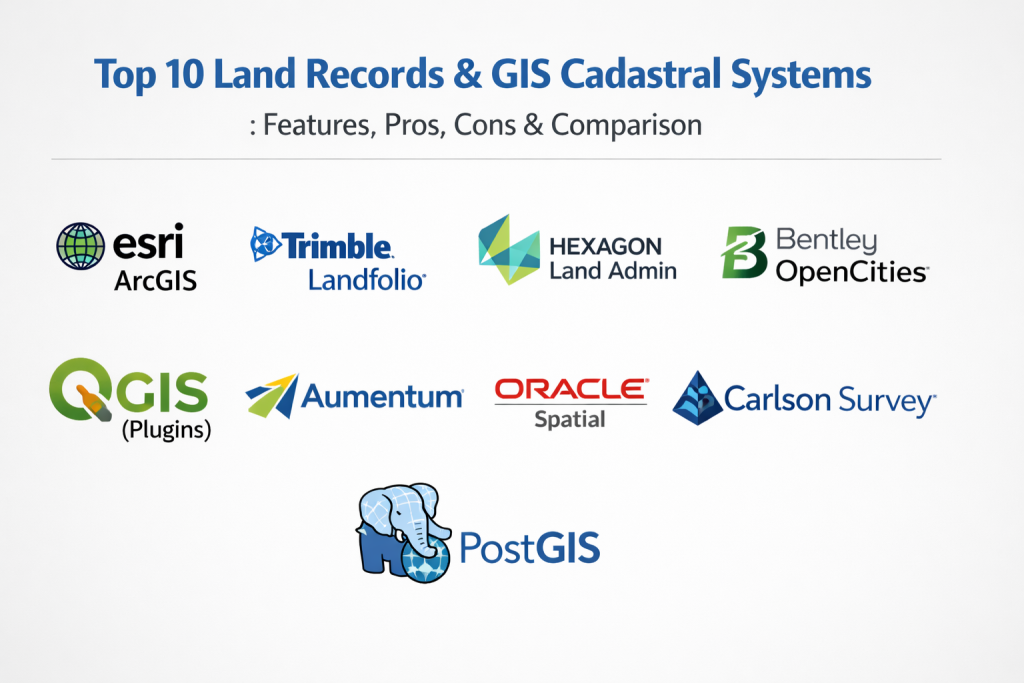
Top 10 Land Records & GIS Cadastral Systems
1. Esri ArcGIS Parcel Fabric
ArcGIS Parcel Fabric is a purpose-built framework within the ArcGIS Pro environment designed specifically for the management and maintenance of parcel data. It is widely considered the industry benchmark for modern land administration.
Key Features
- Rule-based topology to ensure parcel boundaries are mathematically and spatially consistent.
- Comprehensive historical tracking that allows users to see the entire lineage of a parcel.
- High-precision COGO (Coordinate Geometry) tools for manual entry of legal descriptions.
- Integration with field applications for real-time mobile parcel verification.
- Advanced spatial analysis for land-use zoning and tax assessment.
Pros
- Deepest feature set for managing complex parcel legal histories.
- Massive ecosystem of third-party training and implementation partners.
Cons
- High licensing costs and hardware requirements for full desktop implementation.
- Steeper learning curve compared to basic mapping tools.
Platforms / Deployment
Windows / Web / Cloud
Hybrid
Security & Compliance
Enterprise-grade SSO, MFA, and comprehensive audit logs.
Not publicly stated.
Integrations & Ecosystem
Integrates with nearly every major government ERP and tax system. It connects directly to Unreal Engine for 3D visualization and Python for automation.
Support & Community
Unmatched documentation, global training centers, and a massive community of government GIS professionals.
2. Trimble Landfolio
Landfolio is a specialized land administration platform that focuses on the entire lifecycle of land rights, including tenure, valuation, and taxation. It is heavily used in national land reform projects.
Key Features
- End-to-end workflow management for land registration and legal transfers.
- Integrated modules for land valuation and property tax billing.
- Support for large-scale national land administration domain models.
- Direct connection to Trimble survey hardware for high-accuracy field data.
- Web-based portal for citizen services and document submission.
Pros
- Excellent for managing the administrative and legal aspects of land ownership.
- Highly effective at automating complex government approval workflows.
Cons
- Generally requires professional services for initial setup and configuration.
- Less focus on general-purpose spatial analysis compared to Esri.
Platforms / Deployment
Web / Windows / Cloud
Hybrid
Security & Compliance
Secure role-based access controls and encrypted database storage.
Not publicly stated.
Integrations & Ecosystem
Tightly coupled with Trimble’s GNSS and total station hardware. Integrates with regional government databases and financial systems.
Support & Community
Professional enterprise support with dedicated account managers for national governments.
3. Hexagon Land Administration (Intergraph)
Hexagon provides a high-performance geospatial framework specifically designed for national cadastral and land information systems. It focuses on massive data handling and speed.
Key Features
- Specialized G/Technology framework for managing multi-user parcel databases.
- High-speed rendering for viewing millions of parcels simultaneously.
- Advanced spatial querying for complex land-use and tax analysis.
- Native support for ERDAS IMAGINE for integrating satellite and aerial imagery.
- Open standard support for cross-border land data interoperability.
Pros
- Exceptional performance when dealing with national-scale parcel fabrics.
- Very strong image processing integration for change detection.
Cons
- The interface is highly technical and aimed at expert GIS analysts.
- Implementation can be complex and time-consuming.
Platforms / Deployment
Windows / Web / Linux
Enterprise (On-prem / Hybrid)
Security & Compliance
Advanced audit trails and enterprise security protocols.
Not publicly stated.
Integrations & Ecosystem
Strong ties to the broader Hexagon ecosystem, including metrology and manufacturing tools.
Support & Community
Elite-level professional support for large-scale government contracts.
4. Bentley OpenCities Map (Cadastral Edition)
Bentley’s solution bridges the gap between high-precision CAD drafting and powerful GIS analysis, making it ideal for urban cadastral systems.
Key Features
- Seamless integration of engineering-grade CAD data with GIS spatial databases.
- High-precision editing tools for creating 2D and 3D cadastral maps.
- Advanced topology and data validation tools to ensure boundary accuracy.
- Native support for Oracle Spatial and SQL Server databases.
- 3D modeling tools for urban environments and digital twin creation.
Pros
- Best-in-class precision for drafting parcel boundaries.
- Excellent for cities that need to manage land and utilities in one platform.
Cons
- Learning curve is high for those not familiar with CAD-based workflows.
- Primarily Windows-centric for desktop operations.
Platforms / Deployment
Windows / Server
Hybrid
Security & Compliance
Standard enterprise security through Bentley’s managed services.
Not publicly stated.
Integrations & Ecosystem
Deep integration with BIM and engineering software used in city infrastructure.
Support & Community
Professional support with a focus on civil engineering and urban planning industries.
5. AutoCAD Map 3D
Autodesk’s GIS-centric CAD tool is a staple for many land surveyors and local government departments who rely on DWG-based workflows.
Key Features
- Direct editing of GIS data using industry-standard CAD tools.
- Built-in tools for topology creation and parcel validation.
- Connection to external databases like Oracle and SQL Server without conversion.
- Advanced COGO (Coordinate Geometry) tools for survey data entry.
- Surface modeling and LiDAR point cloud management.
Pros
- Native support for the world’s most common design file format (DWG).
- Familiar interface for millions of CAD users worldwide.
Cons
- Lacks the deep administrative workflow tools of a dedicated registry system.
- 3D cadastral tools are less automated than specialized platforms.
Platforms / Deployment
Windows
Local / Cloud (Licensing)
Security & Compliance
Autodesk Account security with MFA and team management.
Not publicly stated.
Integrations & Ecosystem
Part of the massive Autodesk ecosystem, including Revit and Civil 3D.
Support & Community
Extensive online resources, local reseller support, and global user forums.
6. QGIS (with Cadastral Plugins)
QGIS is the premier open-source GIS platform. With specialized plugins, it serves as a powerful and free alternative for managing land records.
Key Features
- Powerful cadastral editing plugins like “Cadastre” for specialized land tasks.
- Full support for PostGIS for multi-user database management.
- Advanced cartography tools for generating professional land maps.
- Python scripting for automating parcel subdivisions and reports.
- Native support for nearly all spatial file formats without licensing fees.
Pros
- Completely free with no annual licensing costs.
- Extremely flexible and customizable for local government needs.
Cons
- Professional support is community-driven rather than vendor-managed.
- Enterprise security features must be configured manually.
Platforms / Deployment
Windows / macOS / Linux / Android
Local (Self-hosted)
Security & Compliance
Security depends on the implementation of the underlying spatial database.
Not publicly stated.
Integrations & Ecosystem
Vast library of community-built plugins and integration with the wider FOSS4G ecosystem.
Support & Community
One of the most active and helpful global communities in the geospatial sector.
7. Thomson Reuters Aumentum
Aumentum is a highly specialized platform for government agencies that manages the entire lifecycle of land and property taxation.
Key Features
- Unified database for land registry and property valuation.
- Automated compliance alerts for lease expirations and ownership changes.
- Comprehensive audit trails for every transaction in the land registry.
- Integrated GIS viewer for visualizing tax assessments on a map.
- Citizen portals for public land record searches and payment processing.
Pros
- Built specifically for the legal and financial side of land management.
- Excellent transparency and auditability for government transparency.
Cons
- Not a general-purpose GIS; focuses heavily on the “record” side.
- Can be very expensive for small municipalities.
Platforms / Deployment
Web / Windows
Enterprise (Hybrid)
Security & Compliance
Robust security designed for sensitive government financial data.
Not publicly stated.
Integrations & Ecosystem
Integrates with major financial, ERP, and tax administration platforms.
Support & Community
Enterprise-grade support with a focus on legislative and tax compliance.
8. Oracle Spatial & Graph (Land Records Edition)
Oracle provides the heavy-duty backend for many national cadastral systems, offering unmatched database power and spatial indexing.
Key Features
- Enterprise-grade storage for millions of parcel geometries and legal records.
- Native spatial operators for checking overlaps, boundaries, and proximity.
- High availability and disaster recovery features for critical government data.
- Advanced 3D spatial data handling for modern cadastral models.
- Integration with Oracle’s full suite of government and financial tools.
Pros
- The most powerful and scalable database for large-scale land records.
- Industry-leading security and transaction integrity.
Cons
- Requires expert database administration (DBA) skills to maintain.
- High cost of ownership for small-to-mid-sized departments.
Platforms / Deployment
Linux / Windows / Cloud
Enterprise / Cloud
Security & Compliance
Highest-tier enterprise security and compliance certifications.
Not publicly stated.
Integrations & Ecosystem
Acts as the central “source of truth” for many other GIS and ERP applications.
Support & Community
Professional Oracle support and a global network of enterprise developers.
9. Carlson Survey / SurvPC
Carlson is a specialist in land surveying and civil engineering, providing tools that connect the field surveyor directly to the cadastral map.
Key Features
- Deep integration between field survey data and desktop mapping.
- Specialized parcel drafting tools based on survey-grade accuracy.
- Advanced COGO and boundary adjustment features.
- Support for a wide range of hardware from different survey manufacturers.
- Integrated GIS tools for attribute management and thematic mapping.
Pros
- Built by surveyors for surveyors, prioritizing accuracy.
- Excellent at bridging the gap between field measurements and office maps.
Cons
- The interface is traditional and focused on engineering rather than web-GIS.
- Lacks broader administrative registry features.
Platforms / Deployment
Windows / Android
Local
Security & Compliance
Local data management security.
Not publicly stated.
Integrations & Ecosystem
Strong integration with Esri products and all major survey hardware brands.
Support & Community
Dedicated professional support for the surveying and civil engineering community.
10. PostGIS (Advanced Database Implementations)
PostGIS is the spatial extension for PostgreSQL. While not a standalone app, it is the engine behind many of the world’s custom cadastral systems.
Key Features
- Open-source spatial database capable of handling massive parcel fabrics.
- Supports complex spatial queries like “Find all plots within a specific buffer.”
- Excellent performance for spatial indexing and multi-user editing.
- Highly customizable data models to fit local land laws and regulations.
- Fully compatible with ArcGIS, QGIS, and nearly all other GIS software.
Pros
- No licensing fees for the core database engine.
- Unmatched flexibility for developers building custom land systems.
Cons
- Requires specialized database development knowledge to implement.
- No out-of-the-box user interface; requires a frontend tool.
Platforms / Deployment
Windows / macOS / Linux / Cloud
Local / Cloud
Security & Compliance
Security is as strong as the PostgreSQL implementation and user environment.
Not publicly stated.
Integrations & Ecosystem
The “universal connector” of the spatial world, supported by almost every GIS tool.
Support & Community
Extensive community documentation and professional support from specialized vendors.
Comparison Table
| Tool Name | Best For | Platform(s) Supported | Deployment | Standout Feature | Public Rating |
| 1. Esri ArcGIS | National Agencies | Windows, Web | Hybrid | Parcel Fabric Engine | N/A |
| 2. Trimble Landfolio | Governance / Tax | Web, Windows | Hybrid | Workflow Automation | N/A |
| 3. Hexagon Land Admin | Large-Scale Cadastre | Windows, Web | Enterprise | High-Speed Rendering | N/A |
| 4. Bentley OpenCities | Urban 3D Cadastre | Windows | Hybrid | CAD-GIS Bridge | N/A |
| 5. AutoCAD Map 3D | Local Surveyors | Windows | Local | Native DWG Support | N/A |
| 6. QGIS (Plugins) | Budget-Conscious | All OS | Local | Free/Open Source | N/A |
| 7. Aumentum | Valuation / Registry | Web, Windows | Hybrid | Integrated Tax Mod | N/A |
| 8. Oracle Spatial | Enterprise Backend | Linux, Windows | Cloud | Massive Scalability | N/A |
| 9. Carlson Survey | Field-to-Office | Windows, Android | Local | Survey-Grade Precision | N/A |
| 10. PostGIS | Custom Development | Linux, Windows | Cloud | Spatial Querying | N/A |
Evaluation & Scoring
| Tool Name | Core (25%) | Ease (15%) | Integrations (15%) | Security (10%) | Perf (10%) | Support (10%) | Value (15%) | Total |
| 1. Esri ArcGIS | 10 | 5 | 10 | 9 | 8 | 10 | 6 | 8.40 |
| 2. Trimble Landfolio | 9 | 7 | 8 | 8 | 8 | 8 | 7 | 7.95 |
| 3. Hexagon Land Admin | 9 | 5 | 9 | 9 | 10 | 8 | 6 | 7.90 |
| 4. Bentley OpenCities | 8 | 6 | 9 | 8 | 9 | 8 | 7 | 7.75 |
| 5. AutoCAD Map 3D | 7 | 8 | 9 | 7 | 8 | 8 | 8 | 7.80 |
| 6. QGIS (Plugins) | 8 | 6 | 10 | 5 | 8 | 6 | 10 | 7.70 |
| 7. Aumentum | 9 | 6 | 7 | 9 | 8 | 8 | 6 | 7.55 |
| 8. Oracle Spatial | 7 | 3 | 10 | 10 | 10 | 8 | 6 | 7.20 |
| 9. Carlson Survey | 7 | 7 | 8 | 6 | 8 | 7 | 8 | 7.30 |
| 10. PostGIS | 6 | 4 | 10 | 8 | 10 | 7 | 9 | 7.50 |
The evaluation demonstrates that no single tool is perfect for every situation. Tools like Esri and Trimble lead in “Core” functionality because they are built specifically for the administrative complexities of land. High performance and scalability are the hallmarks of Oracle and Hexagon, though they sacrifice ease of use. Value-focused organizations often find QGIS and PostGIS to be the best investment, provided they have the technical talent to manage the setup.
Which Land Records & GIS Cadastral System Is Right for You?
Solo / Freelancer
For individual surveyors or small firms, the priority is drafting speed and accuracy. AutoCAD Map 3D or Carlson Survey are the standard choices because they speak the language of engineering and survey data entry. If budget is a concern, QGIS provides professional results without the license fees.
SMB
Small municipalities or regional land offices need a balance between mapping and record-keeping. Trimble Landfolio or a mid-tier Esri ArcGIS setup provides the necessary workflow tools to manage subdivisions and title transfers without requiring a massive IT department.
Mid-Market
Growing cities and large utility companies require tools that can bridge the gap between GIS and other city departments. Bentley OpenCities Map is excellent for urban centers managing both land parcels and complex utility infrastructure in a unified environment.
Enterprise
For national governments or massive corporations, the choice revolves around data integrity and scalability. Oracle Spatial provides the most secure database backend, while Hexagon Land Administration offers the rendering speed required for country-wide parcel management.
Budget vs Premium
- Budget: QGIS and PostGIS are unbeatable for organizations that want to avoid vendor lock-in and annual fees.
- Premium: Esri ArcGIS and Aumentum provide the highest level of specialized “out-of-the-box” features for high-stakes government operations.
Feature Depth vs Ease of Use
If you need high-end topology and legal lineage, Esri is the clear leader despite its complexity. If you need a simple, user-friendly interface for non-technical office staff to look up records, Trimble Landfolio or Aumentum are more accessible.
Integrations & Scalability
When a system needs to connect to property tax, public records, and urban planning simultaneously, Esri and Hexagon offer the most robust API and integration ecosystems.
Security & Compliance Needs
For national land registries where data loss or fraud could have catastrophic social consequences, the enterprise security models of Oracle, Esri, and Thomson Reuters provide the necessary peace of mind.
Frequently Asked Questions (FAQs)
1. What is a cadastral system exactly?
A cadastral system is a comprehensive digital registry that records the boundaries, ownership, and legal rights of land parcels within a specific jurisdiction.
2. How does GIS improve land records management?
GIS adds a spatial layer to text records, allowing users to visualize boundaries, detect overlaps, and perform complex analysis that isn’t possible with a standard database.
3. What is the difference between a land registry and a cadastre?
A land registry focus on the “who” and “legal rights” (titles/deeds), while a cadastre focuses on the “where” and “what” (boundaries/parcel maps).
4. Can these systems help reduce property disputes?
Yes, by providing high-precision digital boundaries and a transparent history of ownership, these systems significantly reduce the ambiguity that leads to disputes.
5. Are these tools useful for 3D city modeling?
Most modern cadastral systems, especially Bentley and Esri, now support 3D layers, which are vital for representing ownership in high-rise buildings.
6. Do I need to be a surveyor to use these programs?
While anyone can learn the basics, managing a legal cadastral system usually requires knowledge of land laws, geodesy, and high-precision mapping standards.
7. Is cloud-native land management secure?
Yes, modern cloud platforms offer higher levels of encryption and disaster recovery than most local government server rooms, making them highly secure for land data.
8. What is a parcel fabric?
A parcel fabric is a specialized data structure that maintains a continuous, logically connected network of parcels where boundaries are shared between adjacent plots.
9. Why is interoperability important in land records?
Land data often needs to be shared between different government agencies (tax, planning, environment), so the software must support open standards to communicate.
10. How long does it take to digitize a national land record system?
National-scale projects are complex and can take several years, involving data cleaning, legal verification, and the migration of millions of physical records.
Conclusion
The modernization of land records through GIS and cadastral systems is a transformative step for any jurisdiction seeking transparency and economic stability. By moving away from fragmented paper records to integrated digital platforms, organizations can ensure that property rights are protected and land is managed sustainably. Whether you prioritize the drafting precision of CAD-based tools or the administrative depth of enterprise registry systems, the “best” choice depends on your specific legal and spatial requirements. As we move further into a 3D-oriented world, adopting these technologies is no longer an option but a necessity for modern land administration.

Best Cardiac Hospitals Near You
Discover top heart hospitals, cardiology centers & cardiac care services by city.
Advanced Heart Care • Trusted Hospitals • Expert Teams
View Best Hospitals