Introduction
Long-term care management systems are comprehensive software platforms designed to coordinate the clinical, financial, and administrative needs of senior living and post-acute care facilities. Unlike general hospital software, these systems are built specifically to handle the “marathon” of care rather than short-term stays. They manage everything from daily activities of living (ADLs) and medication administration to complex insurance billing and regulatory compliance.
In the current healthcare landscape, the demand for efficient long-term care technology has reached a critical point. With an aging population and increasing regulatory scrutiny, facilities can no longer rely on paper records or disconnected spreadsheets. Modern systems now utilize real-time data and automated workflows to ensure resident safety while protecting the financial health of the organization. By centralizing resident information, these platforms allow caregivers to spend less time on documentation and more time on direct human interaction.
Real-World Use Cases
- Managing daily medication passes and vitals tracking in skilled nursing facilities (SNFs).
- Coordinating resident social activities and wellness programs in assisted living communities.
- Automating the complex billing cycles for Medicare, Medicaid, and private pay residents.
- Tracking caregiver shifts and staffing ratios to meet state-mandated safety requirements.
- Providing a secure portal for family members to monitor the health and engagement of their loved ones.
Evaluation Criteria for Buyers
- The depth of clinical documentation and its ability to handle long-term health trends.
- Ease of use for floor staff and nurses who need to document care quickly on the move.
- Integration with pharmacies and diagnostic labs for seamless medication and test ordering.
- Robustness of the billing engine and its ability to handle multiple payer sources accurately.
- Compliance features that automatically update in response to changing state and federal laws.
- Scalability for organizations managing multiple buildings or diverse care models.
- Quality of reporting and analytics for both clinical outcomes and operational efficiency.
Best for: Skilled nursing facilities, assisted living communities, memory care units, and multi-site senior living organizations seeking a unified clinical and financial record.
Not ideal for: Short-term outpatient clinics, general practitioners, or emergency medical services that require rapid-fire, episodic documentation rather than long-term monitoring.
Key Trends in Long-Term Care Management Systems
- The integration of ambient AI scribing to help nurses document resident encounters without manual typing.
- A shift toward predictive analytics that can flag residents at high risk for falls or infections before they occur.
- Increased use of mobile-first applications that allow caregivers to document care at the bedside using tablets or smartphones.
- Enhanced interoperability through standardized data exchange, allowing records to follow residents from hospitals to care homes.
- The growth of resident engagement platforms that include social feeds and video calling for family connectivity.
- Automation of the revenue cycle to identify billing errors and prevent insurance claim denials in real-time.
- Inclusion of telehealth modules directly within the management system for remote physician consultations.
- Expansion of workforce management tools to help administrators handle staffing shortages and optimize shift schedules.
How We Selected These Tools
The selection of these top ten long-term care management systems is based on extensive research into the post-acute care technology market. We prioritized platforms that demonstrate a long history of stability and high adoption rates among professional caregivers. A primary factor in our evaluation was the “all-in-one” capability—the degree to which a system can handle both clinical and financial workflows without requiring external software. We also examined the user experience, specifically looking for interfaces that reduce the administrative burden on nursing staff. Finally, we considered the technical support infrastructure and the frequency of updates to ensure these tools remain compliant with current healthcare regulations.
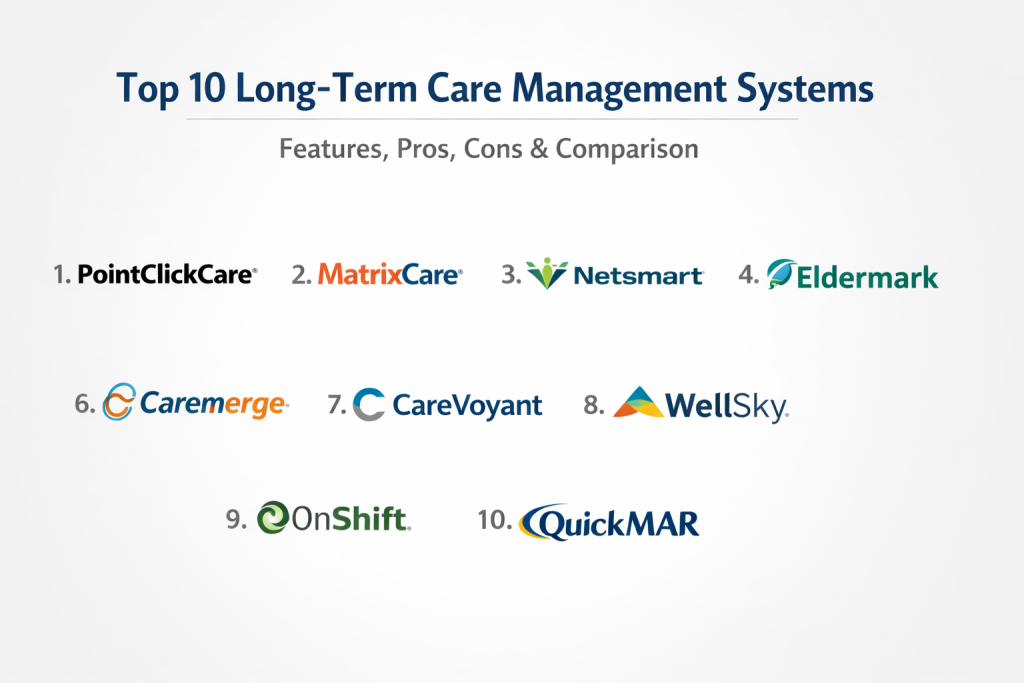
Top 10 Long-Term Care Management Systems
1. PointClickCare
As a dominant leader in the senior care industry, PointClickCare provides an enterprise-grade platform that connects the entire care ecosystem. It is designed to bridge the gap between acute and post-acute care, ensuring that resident data flows smoothly between hospitals and long-term care settings.
Key Features
- A comprehensive electronic health record (EHR) built specifically for senior living and skilled nursing.
- Integrated medication management (eMAR) with direct pharmacy connections.
- Advanced financial modules for managing complex multi-payer billing and collections.
- A robust compliance engine that aligns with CMS and state-specific regulations.
- Real-time insights and dashboards for multi-facility administrative oversight.
Pros
- Highly recognized by staff, which significantly reduces the time needed for new hire training.
- Exceptional depth in regulatory reporting and audit preparation.
Cons
- The cost is at the premium end of the market, which can be difficult for smaller facilities.
- Some users find the interface to be dense and occasionally slow in very large data environments.
Platforms / Deployment
Web / iOS / Android — Cloud
Security & Compliance
HIPAA compliant, SOC 2 Type II certified, with multi-factor authentication and role-based access.
Integrations & Ecosystem
PointClickCare boasts a massive marketplace of integrated partners, ranging from specialized therapy software to advanced diagnostic laboratory links.
Support & Community
It offers an extensive online university, a massive user community, and dedicated customer success managers for enterprise clients.
2. MatrixCare
MatrixCare is known for its “full-spectrum” approach, offering solutions that span from home health and hospice to skilled nursing and senior living. It is highly praised for its mobile capabilities and its focus on improving clinical outcomes through data.
Key Features
- A unified platform for clinical, financial, and operational management.
- High-end mobile documentation tools that allow nurses to record care at the point of service.
- Advanced revenue cycle management (RCM) with automated claim scrubbing.
- Marketing and CRM tools specifically designed to manage facility occupancy.
- Integrated assessments and care plans that follow the resident across different care levels.
Pros
- Excellent mobile experience for floor staff, increasing documentation accuracy.
- Strong focus on person-centered care and social wellness tracking.
Cons
- Implementation can be complex and requires a significant time commitment from staff.
- Reporting features, while powerful, can have a steep learning curve for non-technical users.
Platforms / Deployment
Web / iOS / Android — Cloud
Security & Compliance
HIPAA compliant with redundant data backups and SOC 2 alignment.
Integrations & Ecosystem
Features deep integrations with common pharmacy providers, therapy platforms, and resident engagement tools.
Support & Community
Strong customer support reputation with a comprehensive knowledge base and frequent training webinars.
3. Netsmart (myUnity)
Netsmart provides the myUnity platform, which is designed for organizations that manage a variety of community-based services. It is particularly strong for large providers who need one system to handle long-term care, behavioral health, and home-based services.
Key Features
- A single, person-centered record that tracks residents across various settings.
- Highly configurable workflows that can be tailored to specific facility types.
- Integrated telehealth and secure messaging for coordinated physician care.
- Comprehensive billing for Medicare, Medicaid, and private insurance.
- Interoperability focused, allowing for easy data exchange with external health systems.
Pros
- Ideal for large, diversified organizations that need a “one-stop” software solution.
- Very flexible configuration options for specialized care models.
Cons
- The high level of flexibility can lead to a more complex initial setup process.
- Interface can feel more clinical and less “residential” than some competitors.
Platforms / Deployment
Web / Mobile — Cloud / Hybrid
Security & Compliance
Full HIPAA and HITECH compliance with advanced encryption and audit logging.
Integrations & Ecosystem
Deeply integrated with the Carequality framework and other national data exchange networks.
Support & Community
Large enterprise support infrastructure with dedicated implementation teams and regional user groups.
4. Eldermark
Eldermark is a focused solution for the senior living and assisted living markets. It is designed to be straightforward and efficient, focusing on the core needs of resident care and facility management without unnecessary complexity.
Key Features
- Simplified resident records and automated service tracking for ADLs.
- Integrated billing and invoicing tailored for resident rent and care charges.
- Marketing and lead tracking system to help facilities maintain high occupancy.
- Medication administration (eMAR) with integrated safety checks.
- State-specific compliance reporting and staff task management.
Pros
- Very user-friendly and faster to learn than larger enterprise suites.
- Excellent automation for complex assisted living billing structures.
Cons
- May lack some of the deepest clinical features required by heavy-care skilled nursing facilities.
- Ecosystem of third-party integrations is smaller than PointClickCare or MatrixCare.
Platforms / Deployment
Web / Mobile — Cloud
Security & Compliance
HIPAA compliant with secure hosting and regular security audits.
Integrations & Ecosystem
Focuses on essential integrations like pharmacies, electronic payments, and specific marketing tools.
Support & Community
Known for providing high-touch, personalized support for small to mid-sized facility owners.
5. AL Advantage
AL Advantage is specifically designed for assisted living providers who want an easy-to-use, cloud-based system. It emphasizes reducing the administrative burden on caregivers so they can focus on the residents.
Key Features
- Extremely simplified resident assessments and automated care plan generation.
- Intuitive medication logs and tracking for activities of daily living.
- Census management and basic billing tools for resident invoicing.
- Family notification system for significant health events or changes.
- Task management for floor staff accessible on any connected device.
Pros
- One of the most accessible and least intimidating systems for non-technical staff.
- Highly affordable for smaller care homes and independent facilities.
Cons
- Lacks the advanced financial and clinical depth needed for high-acuity medical care.
- Reporting options are basic compared to the major enterprise platforms.
Platforms / Deployment
Web — Cloud
Security & Compliance
HIPAA compliant with secure data storage and basic user audit trails.
Integrations & Ecosystem
Offers basic export functionality and key pharmacy links but has a limited overall integration library.
Support & Community
Provides personal live demos and direct support contact for its user base.
6. Caremerge (by VoiceFriend)
Caremerge focuses heavily on the social and engagement side of long-term care. While it includes clinical features, its standout capability is how it connects residents, staff, and families through a modern, communication-first interface.
Key Features
- Leading resident and family engagement platform with social “feeds” and calendars.
- Holistic care planning that includes social, emotional, and wellness goals.
- Integrated eMAR and care task tracking for resident safety.
- Community management tools for activities, dining, and transportation.
- Secure messaging and announcement system for staff and families.
Pros
- The best system for improving family satisfaction and community transparency.
- Modern, “app-like” interface that is very easy for both staff and families to use.
Cons
- Facilities with heavy clinical/medical needs may need to pair it with a deeper EHR.
- Not a full-service financial/billing suite for complex medical insurance claims.
Platforms / Deployment
Web / iOS / Android — Cloud
Security & Compliance
HIPAA compliant with encrypted messaging and SOC 2 alignment.
Integrations & Ecosystem
Integrates well with various EHRs and smart home devices for senior living.
Support & Community
Strong focus on “Community Success” with dedicated onboarding for social and wellness staff.
7. CareVoyant
CareVoyant offers a highly configurable system that is well-suited for organizations providing home-based care alongside their long-term care facilities. It is known for its ability to handle complex scheduling and diverse payer requirements.
Key Features
- Integrated clinical, financial, and administrative platform for multi-service providers.
- Sophisticated scheduling and visit tracking for home health and facility care.
- Robust billing engine that handles Medicare, Medicaid, and complex private insurance.
- Advanced reporting and customizable dashboards for operational insights.
- Clinical documentation that adapts to different care models and regulatory needs.
Pros
- Excellent for providers who offer a mix of home care and facility-based care.
- Highly customizable workflows that can be tailored to unique internal processes.
Cons
- The high level of customization can make the system feel complex for basic users.
- User interface is functional but lacks the modern polish of some newer competitors.
Platforms / Deployment
Web — Cloud / On-premise options
Security & Compliance
HIPAA compliant with role-based access and extensive audit logging.
Integrations & Ecosystem
Strong connections to electronic visit verification (EVV) systems and billing clearinghouses.
Support & Community
Provides structured training and technical support for mid-sized to large organizations.
8. WellSky (Rehabilitation & LTC)
WellSky provides a broad range of healthcare technology, and its long-term care modules are particularly strong in clinical coordination and analytics. It is often chosen by facilities that prioritize clinical efficiency and data-driven care.
Key Features
- Comprehensive clinical documentation and care coordination tools.
- Integrated billing and compliance features for post-acute care.
- Advanced analytics platform for tracking resident outcomes and facility performance.
- Secure communication tools for care teams and visiting physicians.
- Mobile-friendly documentation for nurses and therapists.
Pros
- Strong analytical capabilities for identifying trends in resident health.
- Part of a larger health ecosystem, making it easier to connect with hospitals.
Cons
- Some users find the interface to be less intuitive than dedicated senior living tools.
- Customer support response times can vary depending on the specific module.
Platforms / Deployment
Web / Mobile — Cloud
Security & Compliance
Full HIPAA compliance with robust security protocols and data protection.
Integrations & Ecosystem
Excellent integration with the broader WellSky network and common medical software partners.
Support & Community
Offers a professional knowledge base and structured onboarding programs.
9. OnShift
While OnShift is primarily known for workforce management, it has become an essential “management system” component for long-term care by focusing on the most critical resource: the staff. It helps facilities manage their team to ensure the quality of care remains high.
Key Features
- Advanced staff scheduling and shift management to ensure proper care ratios.
- Time and attendance tracking with mobile clock-in/out.
- Employee engagement and rewards system to reduce caregiver turnover.
- Workforce analytics to help administrators control labor costs.
- Integrated hiring and onboarding tools for senior care staffing.
Pros
- The best tool for solving the staffing challenges inherent in long-term care.
- significantly reduces the administrative time spent on schedule management.
Cons
- This is not a clinical EHR; it must be paired with another system for resident medical records.
- Focused strictly on the workforce, so it does not handle resident billing.
Platforms / Deployment
Web / iOS / Android — Cloud
Security & Compliance
Compliant with standard labor and healthcare data protection laws.
Integrations & Ecosystem
Integrates with almost all major long-term care EHRs like PointClickCare and MatrixCare.
Support & Community
Excellent customer success model with a strong focus on workforce optimization strategies.
10. QuickMAR (by PointClickCare)
QuickMAR is a specialized medication management system that is often used by smaller facilities or those that want a “best-of-breed” tool for medication safety without the complexity of a full EHR suite.
Key Features
- Advanced eMAR (Electronic Medication Administration Record) system.
- Real-time pharmacy integration for orders and delivery tracking.
- Barcode scanning for medication verification at the resident’s side.
- Automated medication reminders and error reduction alerts.
- Comprehensive reporting for medication pass times and accuracy.
Pros
- Incredibly focused and effective at reducing medication errors.
- Very easy for nursing staff to learn and use quickly.
Cons
- Lacks broader facility management features like billing or social engagement.
- Best used as a component of a larger system rather than a standalone solution.
Platforms / Deployment
Web / Windows / Mobile — Cloud
Security & Compliance
HIPAA compliant with secure pharmacy data exchange.
Integrations & Ecosystem
Deeply integrated with the PointClickCare ecosystem and hundreds of long-term care pharmacies.
Support & Community
Highly regarded technical support for pharmacy and nursing workflows.
Comparison Table (Top 10)
| Tool Name | Best For | Platform(s) Supported | Deployment | Standout Feature | Public Rating |
| 1. PointClickCare | Enterprise LTC | Web, iOS, Android | Cloud | Deep Regulatory Engine | 4.3/5 |
| 2. MatrixCare | Full Spectrum Care | Web, iOS, Android | Cloud | Mobile Point-of-Care | 4.4/5 |
| 3. Netsmart | Diversified Providers | Web, Mobile | Hybrid | Configurable Workflows | 3.6/5 |
| 4. Eldermark | Assisted Living | Web, Mobile | Cloud | Billing Automation | 4.2/5 |
| 5. AL Advantage | Small Care Homes | Web | Cloud | Extreme Ease of Use | 4.5/5 |
| 6. Caremerge | Family Engagement | Web, iOS, Android | Cloud | Family Portal/Social | 4.4/5 |
| 7. CareVoyant | Home + Facility Care | Web | Hybrid | High Configurability | 4.1/5 |
| 8. WellSky | Clinical Efficiency | Web, Mobile | Cloud | Advanced Outcomes Data | 4.2/5 |
| 9. OnShift | Workforce Teams | Web, iOS, Android | Cloud | Staff Optimization | 4.5/5 |
| 10. QuickMAR | Medication Safety | Web, Windows, Mobile | Cloud | Barcode eMAR | 4.6/5 |
Evaluation & Scoring of Long-Term Care Management Systems
| Tool Name | Core (25%) | Ease (15%) | Integrations (15%) | Security (10%) | Perf (10%) | Support (10%) | Value (15%) | Total |
| 1. PointClickCare | 10 | 6 | 10 | 9 | 8 | 10 | 6 | 8.4 |
| 2. MatrixCare | 9 | 8 | 9 | 9 | 9 | 9 | 7 | 8.5 |
| 3. Netsmart | 9 | 5 | 9 | 8 | 8 | 8 | 6 | 7.5 |
| 4. Eldermark | 7 | 9 | 7 | 8 | 9 | 8 | 8 | 7.8 |
| 5. AL Advantage | 5 | 10 | 5 | 7 | 9 | 9 | 10 | 7.3 |
| 6. Caremerge | 6 | 9 | 8 | 8 | 9 | 9 | 7 | 7.7 |
| 7. CareVoyant | 8 | 6 | 8 | 8 | 7 | 7 | 8 | 7.3 |
| 8. WellSky | 8 | 6 | 8 | 9 | 8 | 7 | 7 | 7.4 |
| 9. OnShift | 4 | 9 | 8 | 8 | 9 | 9 | 8 | 7.0 |
| 10. QuickMAR | 6 | 9 | 8 | 8 | 9 | 8 | 9 | 7.8 |
Interpretation: The total weighted score reflects a tool’s overall effectiveness for its intended audience. MatrixCare and PointClickCare lead for larger organizations due to their deep features. Specialized tools like OnShift or AL Advantage score high in ease of use and value but have lower core scores because they are designed for specific tasks rather than total facility management.
Which Long-Term Care Management System Is Right for You?
Solo / Freelancer (Independent Consultant)
Independent consultants helping families or small homes often prefer AL Advantage for its simplicity and low entry cost. It allows for organized record-keeping without the overwhelming complexity of a hospital-grade system.
SMB (Small to Medium Business)
For small assisted living or residential care homes, Eldermark provides the best balance of clinical documentation and billing automation. If the primary focus is simply on medication safety, QuickMAR is the gold standard for small teams.
Mid-Market
Organizations with a few buildings or several hundred residents should look at MatrixCare. Its mobile-first approach is perfect for teams that need high efficiency without the massive administrative overhead of the largest enterprise systems.
Enterprise
For national providers or multi-state chains, PointClickCare is the standard. Its ability to manage complex regulatory requirements across different jurisdictions and its deep financial reporting make it indispensable for enterprise-level operations.
Budget vs Premium
AL Advantage is the clear choice for tight budgets, providing essential tools at an affordable price. PointClickCare and Netsmart are premium options that require significant investment but offer unmatched depth and integration.
Feature Depth vs Ease of Use
If your team is highly technical and needs deep clinical data, Netsmart offers the most configurability. If your primary goal is to get floor staff to document accurately with minimal training, MatrixCare or Eldermark are much easier to adopt.
Integrations & Scalability
PointClickCare scales the best due to its massive partner marketplace. For providers who manage a diverse portfolio including home health and behavioral health, Netsmart provides the best integration across different service types.
Security & Compliance Needs
Large medical facilities requiring the highest level of audit readiness should prioritize PointClickCare or WellSky, as these systems are built with enterprise-level security and constant regulatory updates as their core focus.
Frequently Asked Questions (FAQs)
1. What exactly is a long-term care management system?
It is a digital platform that combines medical records, financial billing, and daily care tracking into one unified system for senior living facilities.
2. How does this differ from a hospital EHR?
Hospital EHRs are built for quick patient visits, while LTC systems are built for monitoring a resident’s health and daily needs over many months or years.
3. Will these systems help with state inspections?
Yes, most of these tools have built-in compliance modules that automatically generate the reports and audit trails required by state inspectors.
4. Can my staff use these tools on their phones?
Many modern systems like MatrixCare and PointClickCare have mobile apps designed specifically for caregivers to use on tablets or smartphones.
5. Are these systems cloud-based?
Most leading providers have moved to a cloud-based model, which means you can access the data from any computer with an internet connection.
6. Do they integrate with our pharmacy?
Yes, most professional LTC systems have direct links to long-term care pharmacies for electronic ordering and medication tracking.
7. How long does it take to set up a new system?
Implementation typically takes between 3 to 6 months, depending on the size of your facility and the complexity of your data.
8. Is my resident data safe?
Professional systems use high-level encryption and secure servers that meet or exceed HIPAA requirements for data protection.
9. Can family members see what is happening with their loved ones?
Systems like Caremerge include family portals where relatives can view activity logs, social photos, and health updates.
10. What is the cost of these systems?
Pricing varies widely based on the number of residents and the specific features you need, ranging from basic monthly fees to large enterprise contracts.
Conclusion
Selecting the right long-term care management system is a vital step toward ensuring both resident safety and organizational efficiency. Whether you choose an enterprise leader like PointClickCare or a specialized community tool like Caremerge, the key is to find a platform that aligns with your specific care model and team’s technical ability. A well-implemented system does more than just replace paper; it provides the real-time insights and automated checks that allow caregivers to focus on what truly matters: the quality of life for their residents. As the industry continues to evolve with AI and mobile technology, the right software will serve as the foundation for a more connected and compassionate future in long-term care.

Best Cardiac Hospitals Near You
Discover top heart hospitals, cardiology centers & cardiac care services by city.
Advanced Heart Care • Trusted Hospitals • Expert Teams
View Best Hospitals