Introduction
Marketing Automation Platforms help teams plan, launch, personalize, and measure campaigns across channels like email, SMS, push, in-app messages, and web experiences. They connect customer data (profiles, behavior events, purchase history) to automation logic (triggers, journeys, segments) so the right message reaches the right person at the right time.
This category matters because modern marketing is no longer “one campaign for everyone.” Customers expect relevant communication, consistent experiences across touchpoints, and respectful handling of privacy preferences. At the same time, teams need systems that scale, reduce manual effort, and prove impact through clear measurement. A strong platform helps you move from scattered campaigns to repeatable lifecycle programs that improve activation, retention, and revenue.
Common real-world use cases:
- Welcome and onboarding journeys for new leads and new users
- Abandoned cart and browse abandonment recovery
- Lead nurturing for B2B pipelines and long sales cycles
- Customer retention programs: replenishment, win-back, and loyalty flows
- Personalization across email, SMS, push, and in-app messaging based on behavior
What buyers should evaluate (practical checklist):
- Data model: contacts, events, custom attributes, identity resolution
- Segmentation depth: real-time segments, behavioral filters, audience refresh speed
- Journey builder strength: branching logic, delays, conditions, re-entry rules
- Channel coverage: email, SMS, push, in-app, webhooks, ads sync (Varies)
- Deliverability and sending controls: throttling, warm-up help, suppression logic (Varies)
- Personalization features: dynamic content, product recommendations, templating (Varies)
- Testing and measurement: A/B testing, holdouts, conversion tracking, attribution (Varies)
- Integrations: CRM, ecommerce, CDP, analytics, data warehouse, support tools
- Governance: roles, approvals, audit trails, workspace management (Varies)
- Operations: ease of setup, reliability, reporting clarity, ongoing maintenance effort
Best for: growth, lifecycle, CRM, and marketing ops teams in ecommerce, SaaS, B2B, and marketplaces that want repeatable journeys and measurable outcomes across multiple channels.
Not ideal for: very small lists with occasional newsletters only, or teams that do not have stable customer data and cannot commit to tracking events and maintaining segments.
Key Trends in Marketing Automation Platforms
- More event-driven automation, where behavior triggers journeys in real time
- Stronger focus on first-party data and privacy-aware targeting
- AI-assisted workflows for subject lines, send time optimization, and content variants (Varies)
- Deeper omnichannel coordination across email, SMS, push, and in-app messaging
- Better governance for teams: approvals, roles, audit history, and workspace separation (Varies)
- More warehouse and CDP connectivity for better data freshness and activation (Varies)
- Increased emphasis on deliverability, suppression logic, and list hygiene automation (Varies)
- More personalization depth using product catalogs, content blocks, and conditional templates
- Better measurement discipline: holdouts, incremental lift, and lifecycle reporting (Varies)
- Faster iteration with reusable journey templates and modular building blocks (Varies)
How We Selected These Tools
- Chosen platforms are widely adopted and recognized for lifecycle marketing and automation
- Balanced the list across enterprise suites, mid-market leaders, and automation-first tools
- Prioritized strength in segmentation, journeys, and multi-channel execution
- Considered ecosystem fit across CRM-first, ecommerce-first, and product-led stacks
- Considered operational maturity: reporting, governance, reliability, and scaling across teams
- Avoided guessing certifications and public ratings; used Not publicly stated and N/A where uncertain
- Ensured the set covers different buyer needs rather than forcing one “universal winner”
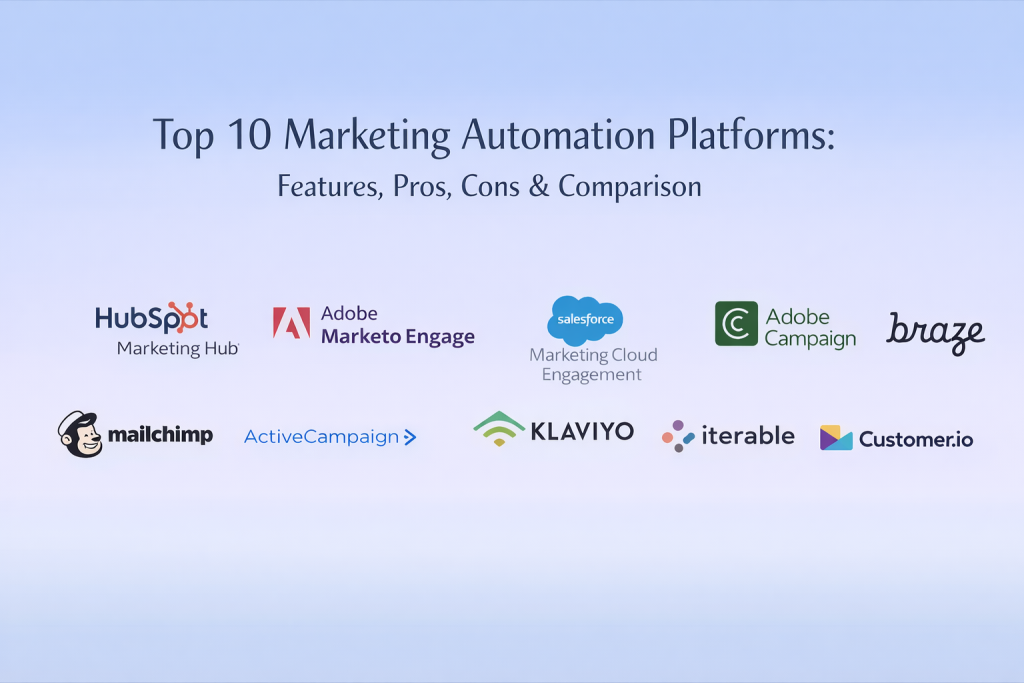
Top 10 Marketing Automation Platforms Tools
1— HubSpot Marketing Hub
A marketing automation suite designed for teams that want marketing, CRM alignment, lead nurturing, and reporting in a single operating model.
Key Features
- Visual automation workflows for lead nurturing and lifecycle programs
- Segmentation and list management tied to CRM-style contact data
- Landing pages, forms, and marketing asset management (Varies by plan)
- Email automation with personalization and performance reporting
- Lead scoring concepts and pipeline alignment workflows (Varies)
- Strong focus on usability and team adoption
Pros
- Great for teams that want one system to run marketing ops and lead nurturing
- Strong usability for non-technical teams with clear workflow building
Cons
- Advanced scale and customization can become plan-dependent
- Deep data warehouse patterns may require additional stack pieces
Platforms / Deployment
- Platform(s): Web (Varies / N/A)
- Deployment: Cloud
Security & Compliance
- Not publicly stated
Integrations & Ecosystem
Often used with CRM workflows, sales enablement tools, and common business systems, with integrations depending on plan and ecosystem choices.
- CRM and sales tooling connections (Varies)
- Website forms and lead capture workflows (Varies)
- Ecommerce and payment integrations (Varies)
- APIs and automation connectors (Varies / Not publicly stated)
Support & Community
Strong documentation footprint and large user community. Support tiers vary by plan. Varies / Not publicly stated.
2 — Adobe Marketo Engage
A B2B-focused automation platform known for lead management, scoring, and nurturing programs, often used by teams with complex sales cycles.
Key Features
- Lead nurturing journeys and multi-step engagement programs
- Lead scoring and lifecycle stage management concepts
- Segmentation and targeting for large lead databases
- Campaign operations tooling built for marketing ops teams
- Reporting patterns for pipeline influence and engagement (Varies)
- Governance-friendly design for large marketing organizations (Varies)
Pros
- Strong for complex B2B nurturing and marketing ops discipline
- Scales well for teams managing many campaigns and segments
Cons
- Can be complex for smaller teams without dedicated operations ownership
- Setup and ongoing maintenance can require strong process discipline
Platforms / Deployment
- Platform(s): Web (Varies / N/A)
- Deployment: Cloud
Security & Compliance
- Not publicly stated
Integrations & Ecosystem
Commonly sits within a B2B revenue stack with CRM integration and analytics alignment.
- CRM integrations for lead and account workflows (Varies)
- Analytics and reporting tooling (Varies)
- Webinar and event tools (Varies)
- APIs and integration middleware (Varies / Not publicly stated)
Support & Community
Strong ecosystem among marketing ops professionals; implementation support often matters. Varies / Not publicly stated.
3 — Salesforce Marketing Cloud Engagement
An enterprise marketing platform for orchestrating campaigns and customer journeys, often adopted by organizations standardized on Salesforce.
Key Features
- Journey orchestration for multi-channel campaigns (Varies by modules)
- Segmentation and audience management aligned to enterprise data models
- Email, mobile messaging, and campaign management patterns (Varies)
- Automation for recurring lifecycle programs (Varies)
- Governance and workspace separation concepts for large teams (Varies)
- Reporting patterns designed for enterprise marketing operations (Varies)
Pros
- Strong fit for Salesforce-centric enterprises
- Suitable for large-scale, multi-team marketing operations
Cons
- Complexity and cost can be high without clear ownership and architecture
- Data model alignment and identity strategy are critical for success
Platforms / Deployment
- Platform(s): Web (Varies / N/A)
- Deployment: Cloud
Security & Compliance
- Not publicly stated
Integrations & Ecosystem
Often benefits from deep ecosystem connectivity, but integration depth depends on modules and architecture choices.
- Salesforce CRM and data ecosystem alignment (Varies)
- Partner connector ecosystem (Varies)
- Data and identity integrations (Varies)
- APIs and extensibility (Varies / Not publicly stated)
Support & Community
Large community and partner network. Support quality depends on contract tier and implementation partner. Varies / Not publicly stated.
4 — Adobe Campaign
A campaign management platform used for orchestrating customer communications, often in environments with enterprise governance needs and complex segmentation.
Key Features
- Campaign orchestration for email and broader messaging workflows (Varies)
- Advanced segmentation and audience management concepts (Varies)
- Automation patterns for recurring lifecycle programs (Varies)
- Template and content handling for large campaign operations (Varies)
- Support for complex data models and enterprise workflows (Varies)
- Reporting concepts for campaign performance (Varies)
Pros
- Useful for large organizations running high-volume campaign operations
- Supports complex segmentation and operational workflows
Cons
- Implementation and operations can be heavy without a skilled team
- Best fit depends on the broader enterprise stack and data readiness
Platforms / Deployment
- Platform(s): Web (Varies / N/A)
- Deployment: Cloud (Varies / Not publicly stated)
Security & Compliance
- Not publicly stated
Integrations & Ecosystem
Typically used with enterprise data sources, identity systems, and content workflows, with integrations varying widely by environment.
- Data sources and identity systems (Varies)
- Content systems and template workflows (Varies)
- Analytics integrations (Varies)
- APIs and connectors (Varies / Not publicly stated)
Support & Community
Vendor support and partner services are common. Community is more enterprise-focused than open tools. Varies / Not publicly stated.
5 — Braze
A customer engagement platform designed for lifecycle messaging across channels, frequently used by product-led and mobile-first teams for real-time personalization.
Key Features
- Journey orchestration for lifecycle campaigns across channels (Varies)
- Real-time segmentation and event-triggered messaging concepts
- Personalization using user attributes, events, and content blocks (Varies)
- Push, in-app messaging, and mobile lifecycle focus (Varies)
- Experimentation patterns for messaging strategies (Varies)
- Strong operational tooling for recurring campaigns and templates (Varies)
Pros
- Strong for real-time engagement and product-led lifecycle messaging
- Good fit when mobile and in-app are core channels
Cons
- Requires disciplined event tracking and taxonomy design
- Pricing and packaging can vary significantly by usage and scope
Platforms / Deployment
- Platform(s): Web; iOS; Android (Varies)
- Deployment: Cloud
Security & Compliance
- Not publicly stated
Integrations & Ecosystem
Typically integrates with CDPs, analytics, and data warehouses, with event-driven activation patterns.
- Event pipelines and analytics tools (Varies)
- CDP connections (Varies)
- Data warehouse patterns (Varies / Not publicly stated)
- APIs and webhooks (Varies / Not publicly stated)
Support & Community
Strong documentation and onboarding patterns for lifecycle teams. Support tiers vary. Varies / Not publicly stated.
6 — Mailchimp
A widely used platform for email marketing and automation, often chosen by small teams that want simple automation and campaign execution without heavy complexity.
Key Features
- Email campaigns with templates and audience management
- Basic automation journeys for onboarding and follow-ups (Varies)
- Segmentation and tagging patterns for list organization
- Reporting dashboards for campaign performance (Varies)
- Signup forms and basic lead capture features (Varies)
- Integrations with many SMB tools and ecommerce platforms (Varies)
Pros
- Easy to start and widely familiar across teams
- Good for newsletters plus basic lifecycle automation
Cons
- Advanced lifecycle orchestration may be limited for complex programs
- Deep data model customization and real-time triggers can be constrained
Platforms / Deployment
- Platform(s): Web (Varies / N/A)
- Deployment: Cloud
Security & Compliance
- Not publicly stated
Integrations & Ecosystem
Often used in SMB stacks with ecommerce platforms and small-business tools.
- Ecommerce and storefront integrations (Varies)
- Form and lead capture workflows (Varies)
- CRM-style contact syncing (Varies)
- APIs and connectors (Varies / Not publicly stated)
Support & Community
Large user community and broad documentation. Support depends on plan level. Varies / Not publicly stated.
7 — ActiveCampaign
An automation-first platform popular with SMB and mid-market teams that need strong email automation, CRM-lite workflows, and practical segmentation.
Key Features
- Visual automation builder for lifecycle and lead nurturing programs
- Segmentation and tagging patterns with behavioral triggers (Varies)
- Email campaign execution with personalization blocks (Varies)
- Sales and pipeline alignment concepts (Varies)
- Integrations with ecommerce and common business tools (Varies)
- Automation templates for faster setup (Varies / Not publicly stated)
Pros
- Strong automation depth for teams that want power without enterprise overhead
- Practical balance of capability and usability
Cons
- Advanced enterprise governance features may be limited
- Deep multi-channel coverage varies by setup and add-ons
Platforms / Deployment
- Platform(s): Web (Varies / N/A)
- Deployment: Cloud
Security & Compliance
- Not publicly stated
Integrations & Ecosystem
Commonly integrates with ecommerce platforms, CRMs, and lead capture tools.
- Ecommerce store integrations (Varies)
- CRM syncing and lead management tools (Varies)
- Forms and landing page tools (Varies)
- APIs and automation connectors (Varies / Not publicly stated)
Support & Community
Strong user community and documentation. Support tiers vary by plan. Varies / Not publicly stated.
8 — Klaviyo
An ecommerce-focused automation platform designed for lifecycle messaging, segmentation, and personalization for online stores.
Key Features
- Ecommerce-oriented segmentation using purchase and browsing behavior
- Automation flows for abandoned cart, replenishment, and win-back
- Email and SMS execution with strong personalization patterns (Varies)
- Product catalog and dynamic product blocks (Varies)
- Reporting tailored to ecommerce performance outcomes (Varies)
- Audience syncing patterns for ecommerce ecosystems (Varies)
Pros
- Strong fit for ecommerce lifecycle programs and revenue-focused messaging
- Practical segmentation based on purchase behavior and store events
Cons
- Primarily ecommerce-focused; less ideal for complex B2B lead nurturing
- Deliverability and growth depend on list hygiene and sending discipline
Platforms / Deployment
- Platform(s): Web (Varies / N/A)
- Deployment: Cloud
Security & Compliance
- Not publicly stated
Integrations & Ecosystem
Built around ecommerce integrations and event-driven activation, with ecosystem strength depending on your storefront stack.
- Ecommerce platform integrations (Varies)
- Catalog and product feed syncing (Varies)
- Analytics and attribution tools (Varies)
- APIs and connectors (Varies / Not publicly stated)
Support & Community
Strong adoption among ecommerce teams. Support depends on plan. Varies / Not publicly stated.
9 — Iterable
A cross-channel customer engagement platform designed for teams running sophisticated lifecycle programs across email, push, SMS, and in-app messaging.
Key Features
- Journey orchestration with branching and event-based triggers (Varies)
- Real-time segmentation and audience updates (Varies)
- Cross-channel execution for coordinated customer messaging (Varies)
- Experimentation patterns for message and journey optimization (Varies)
- Personalization using user profiles and events (Varies)
- Operational tooling for templates, reusable components, and governance (Varies)
Pros
- Strong for multi-channel lifecycle teams that need coordination and scale
- Useful for teams that run continuous testing and iteration cycles
Cons
- Requires strong data taxonomy and event discipline
- Implementation effort can be meaningful for complex programs
Platforms / Deployment
- Platform(s): Web; iOS; Android (Varies)
- Deployment: Cloud
Security & Compliance
- Not publicly stated
Integrations & Ecosystem
Often integrates with CDPs, data warehouses, and analytics stacks to activate event data into messaging.
- CDP integrations and event pipelines (Varies)
- Data warehouse sync patterns (Varies / Not publicly stated)
- Analytics and experimentation tooling (Varies)
- APIs and webhooks (Varies / Not publicly stated)
Support & Community
Vendor documentation is typically strong. Support tiers vary by contract. Community varies. Varies / Not publicly stated.
10 — Customer.io
A messaging automation platform known for event-based triggers and developer-friendly setup, often used by product-led teams that want flexible lifecycle messaging.
Key Features
- Event-triggered messaging for lifecycle automation (Varies)
- Segmentation based on behavioral events and attributes (Varies)
- Journey logic for onboarding, retention, and feature adoption flows (Varies)
- Email and other messaging channel support varies by configuration (Varies)
- Template and personalization capabilities for product messaging (Varies)
- API-first integration patterns for engineering-led teams (Varies)
Pros
- Strong for product-led teams that want event-driven messaging control
- Good balance of flexibility and manageable complexity
Cons
- Requires engineering involvement to get the most value from event modeling
- Some enterprise governance needs may require additional processes
Platforms / Deployment
- Platform(s): Web (Varies / N/A)
- Deployment: Cloud
Security & Compliance
- Not publicly stated
Integrations & Ecosystem
Commonly integrated into product analytics, event pipelines, and backend services for real-time triggers.
- Product event tracking and analytics tools (Varies)
- Data pipelines and warehouse exports (Varies)
- Webhooks and APIs for custom workflows (Varies)
- App and site instrumentation (Varies)
Support & Community
Documentation is generally practical for technical teams. Support depends on plan. Varies / Not publicly stated.
Comparison Table
| Tool Name | Best For | Platform(s) Supported | Deployment | Standout Feature | Public Rating |
|---|---|---|---|---|---|
| HubSpot Marketing Hub | CRM-aligned marketing and lead nurturing | Web (Varies / N/A) | Cloud | Unified marketing and CRM-style workflows | N/A |
| Adobe Marketo Engage | B2B lead nurturing at scale | Web (Varies / N/A) | Cloud | Marketing ops-friendly lead management | N/A |
| Salesforce Marketing Cloud Engagement | Enterprise multi-team journey orchestration | Web (Varies / N/A) | Cloud | Enterprise-grade journeys and governance | N/A |
| Adobe Campaign | Complex enterprise campaign operations | Web (Varies / N/A) | Cloud (Varies / Not publicly stated) | Advanced segmentation and campaign workflows | N/A |
| Braze | Real-time lifecycle engagement for product-led teams | Web; iOS; Android (Varies) | Cloud | Event-driven, cross-channel engagement | N/A |
| Mailchimp | Newsletters and simple automation for small teams | Web (Varies / N/A) | Cloud | Quick setup and familiar email workflows | N/A |
| ActiveCampaign | Automation-first SMB and mid-market programs | Web (Varies / N/A) | Cloud | Strong automation builder for lifecycle flows | N/A |
| Klaviyo | Ecommerce lifecycle automation | Web (Varies / N/A) | Cloud | Purchase-driven segmentation and flows | N/A |
| Iterable | Sophisticated cross-channel lifecycle programs | Web; iOS; Android (Varies) | Cloud | Journey orchestration across channels | N/A |
| Customer.io | Developer-friendly event-based lifecycle messaging | Web (Varies / N/A) | Cloud | Event-triggered automation with API-first patterns | N/A |
Evaluation and Scoring
Weights:
- Core features – 25%
- Ease of use – 15%
- Integrations and ecosystem – 15%
- Security and compliance – 10%
- Performance and reliability – 10%
- Support and community – 10%
- Price and value – 15%
| Tool Name | Core (25%) | Ease (15%) | Integrations (15%) | Security (10%) | Performance (10%) | Support (10%) | Value (15%) | Weighted Total (0–10) |
|---|---|---|---|---|---|---|---|---|
| HubSpot Marketing Hub | 8 | 9 | 8 | 7 | 8 | 8 | 7 | 7.95 |
| Adobe Marketo Engage | 9 | 6 | 8 | 7 | 8 | 8 | 6 | 7.55 |
| Salesforce Marketing Cloud Engagement | 9 | 6 | 9 | 7 | 8 | 8 | 6 | 7.70 |
| Adobe Campaign | 8 | 6 | 7 | 7 | 8 | 7 | 6 | 7.05 |
| Braze | 9 | 7 | 8 | 7 | 9 | 7 | 6 | 7.75 |
| Mailchimp | 6 | 9 | 7 | 6 | 7 | 8 | 9 | 7.55 |
| ActiveCampaign | 7 | 8 | 7 | 6 | 7 | 7 | 8 | 7.30 |
| Klaviyo | 8 | 8 | 8 | 6 | 8 | 7 | 7 | 7.60 |
| Iterable | 9 | 7 | 8 | 7 | 8 | 7 | 6 | 7.55 |
| Customer.io | 8 | 7 | 7 | 6 | 8 | 7 | 7 | 7.25 |
How to interpret the scores:
- These scores are comparative to support shortlisting, not a guarantee of outcomes.
- A tool with lower ease can still be best if you have marketing ops or engineering support.
- Integrations matter most when your data lives across many systems and must stay fresh.
- Security and compliance should be validated in procurement, especially for regulated industries.
- Value depends on your list size, messaging volume, and how much automation replaces manual work.
Which Tool Is Right for You?
Solo or Freelancer
If you need to send newsletters, basic welcome sequences, and simple follow-ups:
- Mailchimp is often enough for simple campaign execution and basic automations.
- ActiveCampaign can fit if you want more automation depth and segmentation logic without stepping into enterprise complexity.
What to prioritize: - Fast setup, templates, list hygiene, basic segmentation, and reporting clarity.
SMB
If you need revenue-focused lifecycle automation but have limited ops bandwidth:
- Klaviyo fits strongly for ecommerce SMBs where purchase behavior drives automation.
- ActiveCampaign works well for service businesses and growing B2B teams that need practical nurturing.
- HubSpot Marketing Hub is a strong fit if you want marketing and CRM alignment without heavy architecture.
What to prioritize: - Simple but powerful journey building, clear segmentation, and reliable sending controls.
Mid-Market
If you have multiple products, multiple audiences, and a steady experimentation cadence:
- HubSpot Marketing Hub works well when CRM alignment and usability matter.
- Iterable is a strong fit when cross-channel orchestration needs to be repeatable.
- Braze is a strong option if product-led engagement and real-time triggers are central to growth.
What to prioritize: - Event-driven automation, template governance, channel coordination, and testing discipline.
Enterprise
If you need governance, multi-brand workspaces, and complex lifecycle programs:
- Salesforce Marketing Cloud Engagement fits when the organization is standardized on Salesforce and needs broad orchestration.
- Adobe Marketo Engage is strong for complex B2B lead nurturing and marketing ops-heavy environments.
- Adobe Campaign can fit when campaign operations and segmentation are complex and enterprise-managed.
What to prioritize: - Data architecture, identity strategy, role-based governance, approvals, and operational SLAs.
Budget vs Premium
- Budget-friendly choices usually succeed when you keep scope focused and measure a small number of core journeys first.
- Premium platforms become worth it when you need cross-channel coordination, advanced governance, and scale across teams and regions.
Practical approach: - Start with what your team can operate consistently, then expand as you gain process maturity.
Feature Depth vs Ease of Use
- If the team is lean, prioritize ease and repeatability over endless configurability.
- If marketing ops is strong, feature depth can unlock better segmentation, better journeys, and tighter governance.
Rule of thumb: - Complexity without ownership creates fragile automation and deliverability risk.
Integrations and Scalability
- If your customer data is split across many systems, prioritize strong integration patterns and stable data refresh.
- If ecommerce is the center, prioritize catalog-aware segmentation and purchase-driven flows.
- If CRM is the center, prioritize lead stages, scoring, and sales alignment.
Scalability check: - Confirm how the platform handles growing event volume, contact growth, and multi-team workflows.
Security and Compliance Needs
- Validate role controls, auditability, encryption expectations, and data retention patterns early.
- Confirm how consent and preferences flow into segments and journeys.
- Treat “Not publicly stated” as a cue to request formal documentation during review.
Frequently Asked Questions
1.What is a marketing automation platform in simple terms?
It is software that uses customer data and triggers to automatically send messages and run journeys across channels like email and mobile messaging.
2.Do I need a CRM to use marketing automation?
Not always. Many platforms can run with contact lists and event data. However, CRM integration helps for lead stages, sales handoffs, and unified reporting.
3.How long does implementation usually take?
It varies. Simple email automation can start quickly, while event-driven, cross-channel programs take longer due to tracking, segmentation, and governance setup.
4.What data do we need to start with automation?
At minimum: contacts, basic attributes, consent preferences, and a few key events such as signup, purchase, and key product actions.
5.How do we avoid spamming users when automation grows?
Use frequency caps, suppression rules, preference centers, and clear exit conditions in journeys. Also monitor complaints and engagement drop-offs.
6.How do we measure whether automation is working?
Track conversions tied to journeys, run controlled tests where possible, and monitor lifecycle metrics such as activation, retention, repeat purchase, and churn.
7.What are common mistakes teams make?
Weak event tracking, messy segmentation, too many overlapping journeys, no ownership for deliverability, and changing multiple variables without a testing plan.
8.Which is better: ecommerce-focused or general platforms?
Ecommerce-focused platforms often win for purchase-driven flows and catalog personalization. General platforms can be better for B2B nurturing and multi-team governance.
9.Can we run email, SMS, push, and in-app from one platform?
Many platforms support multiple channels, but the exact channel depth varies. Confirm channel support, orchestration, and reporting before choosing.
10.How hard is it to switch platforms later?
Switching usually requires migrating templates, segments, suppression logic, tracking events, and reporting baselines. A staged migration plan reduces risk.
Conclusion
Marketing automation platforms can look similar on the surface because most of them offer email campaigns, segments, and journey builders. The real difference shows up after you launch multiple programs and try to scale. That is where data quality, orchestration depth, governance, deliverability controls, and measurement discipline determine whether automation becomes a revenue engine or a noisy messaging machine. The most important mindset shift is this: automation is not a set-and-forget tool. It is an operating system for lifecycle growth. If your events are inconsistent, your segments will be unreliable. If your segments are unreliable, your journeys will send the wrong message to the wrong person. If that happens repeatedly, deliverability suffers, customers disengage, and your team loses trust in the program. A good platform can make automation easier, but it cannot replace the need for clean tracking, clear ownership, and ongoing review.

Best Cardiac Hospitals Near You
Discover top heart hospitals, cardiology centers & cardiac care services by city.
Advanced Heart Care • Trusted Hospitals • Expert Teams
View Best Hospitals