Introduction
Marketplace platforms are specialized software solutions that enable a “many-to-many” commerce model, where multiple third-party vendors sell to multiple customers through a single centralized gateway. In plain English, these tools provide the infrastructure to build the next Amazon, Airbnb, or Upwork. Unlike standard e-commerce software, marketplace platforms must manage complex “multi-vendor” workflows, including vendor onboarding, split payments, commission handling, and two-sided rating systems.
In, these platforms are more critical than ever as the global economy shifts toward “platformization.” Businesses are no longer just selling their own inventory; they are becoming curators of ecosystems. Modern marketplace tech now leverages AI to automate trust and safety, uses headless architecture to power niche mobile experiences, and integrates complex fintech layers to handle global cross-border payouts instantly.
Real-World Use Cases
- Niche Product Marketplaces: A specialized hub for sustainable fashion designers to reach a global audience.
- Service Marketplaces: A platform connecting specialized healthcare consultants with rural clinics for remote sessions.
- B2B Industrial Hubs: A centralized procurement portal where construction firms can buy materials from hundreds of verified local suppliers.
- Digital Asset Exchanges: A marketplace for AI models or specialized datasets where developers trade intellectual property.
Evaluation Criteria for Buyers
- Multi-Vendor Management: Ease of vendor onboarding and self-service portals.
- Commission & Payout Logic: Flexibility in setting split-payment rules and handling global currencies.
- Search & Discovery: AI-driven filtering and recommendation engines for massive catalogs.
- Trust & Safety Tools: Built-in verification, moderation, and dispute resolution systems.
- API & Headless Capabilities: Ability to integrate the marketplace core into custom front-ends.
- Scalability: Performance stability as the number of vendors and SKUs grows into the millions.
- Mobile Experience: High-quality native or progressive web app (PWA) capabilities for buyers and sellers.
- Compliance Management: Native handling of tax nexus, VAT/GST, and KYC (Know Your Customer) regulations.
Mandatory Paragraph
- Best for: Founders, enterprise innovation leads, and digital marketers looking to build scalable ecosystems, aggregate fragmented industries, or launch circular economy initiatives.
- Not ideal for: Single-brand retailers who only sell their own products; standard e-commerce platforms like a basic Shopify store are much more efficient for linear retail models.
Key Trends in Marketplace Platforms and Beyond
- AI-Automated Content Moderation: Using computer vision and NLP to automatically flag prohibited items, fraudulent descriptions, or fake reviews in real-time.
- Fintech-Embedded Payouts: Direct integration of “Buy Now, Pay Later” (BNPL) for B2B marketplaces and instant wallet-to-wallet global transfers.
- Circular Economy Features: Built-in modules for buy-back, trade-in, and resale, allowing marketplaces to facilitate multiple lifecycles for a single product.
- Hyper-Verticalization: A shift away from “everything stores” toward hyper-niche platforms with deep, category-specific attributes (e.g., specific chemical grades for lab supply hubs).
- Headless Infrastructure: Decoupling the marketplace engine from the UI to allow for “invisible” commerce inside IoT devices, smart mirrors, or VR environments.
- Identity-as-a-Service: Integration with decentralized identity protocols to allow vendors to carry their “trust score” across different marketplace platforms.
- Generative AI for Vendors: Tools that allow small sellers to generate high-end product photography and SEO-optimized listings from a single smartphone photo.
- Predictive Inventory for B2B: AI that predicts when a buyer’s stock is low and suggests a multi-vendor cart to replenish the inventory at the best price.
How We Selected These Tools (Methodology)
- Market Adoption: We prioritized platforms that power recognized global marketplaces and have a high mindshare in the developer community.
- Feature Completeness: Evaluation was based on the presence of native multi-vendor logic (commissions, split payments, vendor portals).
- Reliability Signals: We assessed the infrastructure’s ability to maintain high uptime during high-concurrency traffic events.
- Security Posture: Selected tools must demonstrate enterprise-grade security, including data encryption and vendor verification workflows.
- Integration Ecosystem: We looked for “un-siloed” tools that offer robust APIs and connect with major payment processors like Stripe Connect.
- Customer Fit: Our selection ensures a range from “no-code” startup builders to massive enterprise-grade frameworks.
- Innovation Roadmap: Preference was given to platforms aggressively implementing AI and headless commerce patterns.
- Global Readiness: The ability to handle multi-language, multi-currency, and regional tax compliance was a key differentiator.
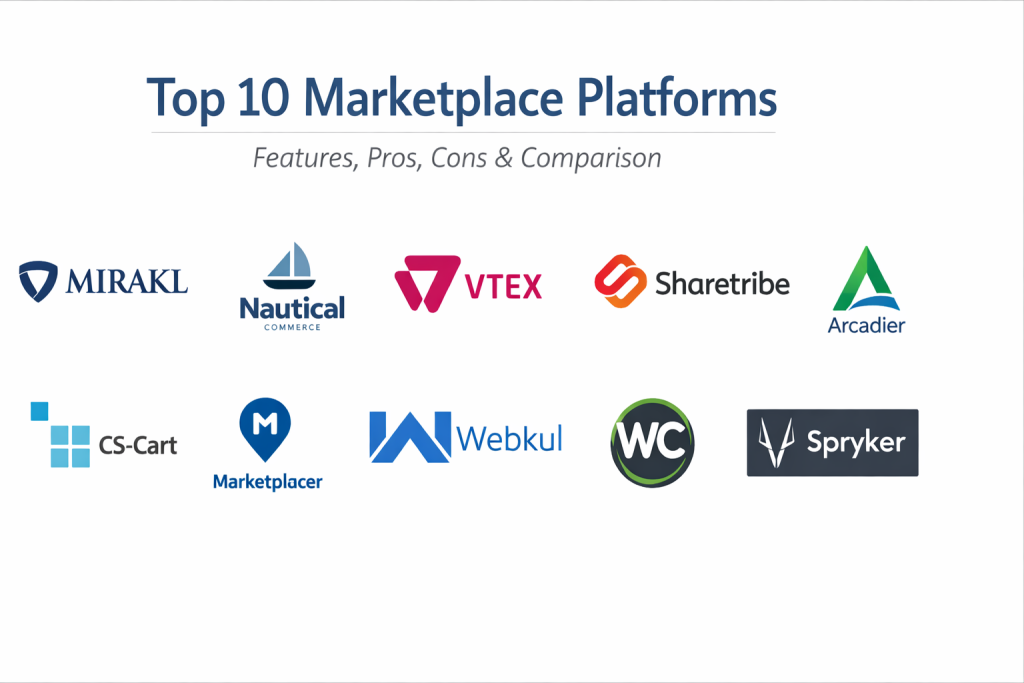
Top 10 Marketplace Platforms Tools
1 — Mirakl
The global leader in enterprise marketplace SaaS. It is designed for large retailers and B2B organizations looking to launch and scale a massive third-party seller ecosystem.
Key Features
- Mirakl Connect: A massive pre-vetted ecosystem of sellers that can be onboarded to new marketplaces rapidly.
- Advanced Catalog Management: Tools to harmonize millions of SKUs from thousands of different vendors.
- Mirakl Ads: An integrated retail media platform that allows sellers to bid for placement within the marketplace.
- AI-Powered Product Mapping: Automatically categorizes vendor data into the marketplace’s taxonomy.
- Financial Velocity: Automated invoicing and split-payment orchestration for complex global transactions.
- B2B specialized features: Support for quotes, volume pricing, and corporate account structures.
Pros
- Enterprise Maturity: Built for scale; can easily handle billions in Gross Merchandise Value (GMV).
- Ecosystem Advantage: Access to the Mirakl Connect seller network drastically reduces time-to-market for inventory.
Cons
- Cost Prohibitive: Licensing fees are significant, making it unsuitable for small startups.
- Implementation Complexity: Usually requires a specialized implementation partner and several months to launch.
Platforms / Deployment
- Web
- Cloud
Security & Compliance
- ISO 27001, SOC 2 Type II, GDPR, HIPAA (Varies by config).
- SSO/SAML, RBAC, MFA.
Integrations & Ecosystem
Mirakl is built to plug into existing enterprise commerce stacks like SAP, Salesforce, and Adobe.
- Salesforce Commerce Cloud
- Adobe Commerce (Magento)
- SAP Commerce Cloud
- Stripe Connect / Adyen
Support & Community
Elite-level enterprise support with dedicated success managers and a global network of certified agencies.
2 — Sharetribe
A developer-friendly marketplace-as-a-service platform that offers both a “no-code” version for startups and a “flex” version for custom-built, headless marketplaces.
Key Features
- Headless Marketplace API: A robust set of APIs that allow developers to build any front-end while Sharetribe handles the back-end.
- Transaction Engine: Native support for various booking models (rentals, services, products).
- Visual Editor: No-code tool for launching a “Minimum Viable Product” (MVP) in days.
- Stripe Connect Integration: Seamless onboarding for sellers with automated commission splits.
- Content Management: Built-in tools for managing landing pages and legal documents.
- Custom Listing Attributes: Highly flexible data models to support any niche (e.g., “kilowatt hours” for energy or “square footage” for space).
Pros
- Speed to Market: One of the fastest ways to go from idea to a functioning marketplace.
- Flexibility: The “Flex” version allows for total UI control, which is rare for SaaS builders.
Cons
- Scaling Ceiling: While great for mid-market, massive enterprises may find some complex logic requires custom middleware.
- Plugin Limitations: Doesn’t have as large a third-party app store as platforms like Shopify.
Platforms / Deployment
- Web / Mobile (PWA)
- Cloud
Security & Compliance
- GDPR compliant, MFA, Encryption.
- Not publicly stated (SOC/ISO).
Integrations & Ecosystem
Focuses on “best-of-breed” integrations via APIs and webhooks.
- Stripe Connect (Primary)
- Zapier
- Google Analytics
- Custom React/Next.js front-ends
Support & Community
Excellent documentation and a very helpful “Marketplace Academy” for founders.
3 — Nautical Commerce
A modern, “headless” marketplace platform that aims to be the “Shopify for marketplaces.” It simplifies the complex fintech and logistics orchestration required for multi-vendor sites.
Key Features
- Automated Vendor Onboarding: Streamlined workflows to get sellers live and selling quickly.
- Fintech Orchestration: Native handling of complex split payments and multi-directional money flow.
- Catalog Synchronization: Real-time inventory syncing across thousands of distributed seller stores.
- Shipping & Logistics Engine: Integrated multi-vendor shipping calculations and tracking.
- API-First Design: Built for headless commerce, allowing for custom mobile apps or VR storefronts.
- Order Management (OMS): Handles orders that contain items from multiple different vendors in one checkout.
Pros
- Unified Logic: Combines e-commerce, marketplace, and fintech into one cohesive system.
- User Experience: Very modern, intuitive admin interface that reduces the learning curve.
Cons
- Newer Market Player: Doesn’t have the decades of history that Mirakl or VTEX possess.
- Documentation: While good, the community-driven resource pool is still growing.
Platforms / Deployment
- Web / API
- Cloud
Security & Compliance
- SSO, MFA, RBAC, Encryption.
- SOC 2 Type II (Confirmed).
Integrations & Ecosystem
Nautical focuses on the “commerce tech stack” integration patterns.
- Stripe / Adyen
- NetSuite / Microsoft Dynamics
- ShipStation
- Contentful (Headless CMS)
Support & Community
Strong emphasis on customer success with dedicated onboarding support and professional services.
4 — VTEX
A “Composed Commerce” platform that includes a powerful native marketplace module. It is a favorite for mid-market and enterprise retailers in the US and Latin America.
Key Features
- Native Marketplace Module: Unlike Shopify, VTEX allows you to be a seller and a marketplace owner in one platform.
- Collaborative Commerce: Enables “seller networks” where VTEX stores can easily sell each other’s products.
- Intelligent Search: AI-driven search that handles complex multi-vendor catalogs and intent.
- SmartCheckout: A secure, password-less checkout experience that increases conversion rates.
- Distributed Order Management: Optimized routing for orders shipped from multiple vendor warehouses.
- VTEX IO: A serverless development platform for building custom marketplace apps.
Pros
- All-in-One: You don’t need to bolt on a marketplace app; it’s part of the core architecture.
- Time-to-Value: Faster implementation than traditional enterprise suites.
Cons
- Complexity: The platform’s flexibility can lead to a steep learning curve for developers.
- Pricing Structure: Can be complex as it often involves GMV-based commissions.
Platforms / Deployment
- Web
- Cloud (Multi-tenant)
Security & Compliance
- PCI DSS Level 1, SOC 1/2, ISO 27001.
- GDPR, LGPD compliant.
Integrations & Ecosystem
VTEX has a robust marketplace of its own for apps and pre-built connectors.
- Amazon / eBay / Walmart
- SAP / Oracle
- Salesforce Marketing Cloud
- Adyen / Stripe
Support & Community
Large global presence with 24/7 support and an extensive developer portal (VTEX Developers).
5 — Arcadier
A highly versatile SaaS marketplace builder that offers specialized templates for retail, rental, and service-based marketplaces.
Key Features
- Template-Based Building: Specific flows for “Space Rental,” “Product Marketplace,” and “Professional Services.”
- No-Code Editor: Allows non-technical founders to launch a marketplace using a visual builder.
- Multi-Lingual & Multi-Currency: Built-in tools for global expansion.
- Custom Javascript/CSS: Allows for front-end tweaks even on the SaaS plans.
- Privileged APIs: The “Enterprise” tier opens up full API access for custom integrations.
- Private Marketplaces: Features specifically for B2B “invite-only” procurement hubs.
Pros
- Niche Specificity: Doesn’t treat a rental marketplace the same as a retail marketplace.
- Affordability: Offers entry-level tiers that are accessible for bootstrapped startups.
Cons
- Design Rigidity: The basic templates can feel a bit “cookie-cutter” without significant custom work.
- App Marketplace: Smaller ecosystem of third-party plugins compared to competitors.
Platforms / Deployment
- Web / Mobile (PWA)
- Cloud
Security & Compliance
- SSL, Encryption, MFA.
- Not publicly stated (SOC/ISO).
Integrations & Ecosystem
Focuses on standard commerce and marketing tool connections.
- Stripe / PayPal
- Google Analytics
- Mailchimp
- Zapier
Support & Community
Offers a help center, email support, and a community forum for marketplace owners.
6 — CS-Cart Multi-Vendor
A powerful, self-hosted marketplace engine that provides total code ownership. It is widely used for niche B2B and B2C hubs that require extreme customization.
Key Features
- Separate Vendor Panels: Highly detailed dashboards for sellers to manage products, shipping, and sales.
- Commission Systems: Flexible rules for flat fees, percentages, or vendor-tier-based commissions.
- Vendor Plans: Allows marketplace owners to charge sellers a monthly subscription fee to sell.
- Real-Time Shipping: Calculates shipping rates from major carriers based on individual vendor locations.
- Total Code Access: The self-hosted version allows developers to change every line of code.
- Built-in Layout Manager: A visual tool to re-arrange marketplace blocks without coding.
Pros
- Ownership: No monthly SaaS fees; you own the license and the data.
- Feature Richness: Out-of-the-box, it has more “marketplace-specific” settings than almost any SaaS.
Cons
- Maintenance: You are responsible for hosting, security updates, and performance optimization.
- Legacy UI: The admin interface feels a bit dated compared to modern SaaS like Nautical.
Platforms / Deployment
- Web / PHP / MySQL
- Self-hosted / Cloud (via AWS/Azure)
Security & Compliance
- Dependent on the host and developer configuration.
- Supports PCI DSS via gateways.
Integrations & Ecosystem
Has a large marketplace of “add-ons” developed over the last 15+ years.
- Stripe Connect
- Amazon S3 (for images)
- QuickBooks
- Various local European/Asian payment gateways
Support & Community
Strong community forum and a paid technical support system provided by the vendor.
7 — Marketplacer
A global SaaS platform designed to help retailers, brands, and communities grow. It is particularly strong in the Australian and US markets for “circular economy” and large-scale retail.
Key Features
- Marketplacer Seller Portal: A high-quality interface for third-party sellers to manage their business.
- Headless Capability: Can be used as a back-end engine for custom mobile apps.
- Curation Tools: Allows marketplace owners to easily approve or reject products and vendors.
- Incentive Engines: Built-in tools for managing promotions and loyalty within a multi-vendor environment.
- Circular Commerce: Specific features for pre-loved, vintage, and resale workflows.
- Deep Analytics: Reporting on vendor performance, GMV, and customer behavior.
Pros
- Strategic Focus: They offer excellent guidance on how to actually grow a marketplace business, not just the tech.
- Circular Ready: One of the best options for brands launching “resale” sites.
Cons
- Enterprise Pricing: Generally targeted at mid-market and above.
- Developer Ecosystem: While growing, it’s not as large as the Magento or Shopify dev communities.
Platforms / Deployment
- Web
- Cloud
Security & Compliance
- SOC 2, GDPR, ISO 27001.
- SSO/SAML, MFA.
Integrations & Ecosystem
Marketplacer is built to be “bolted onto” existing e-commerce sites like Salesforce or Adobe.
- Salesforce Commerce Cloud
- Adobe Commerce
- Shopify (as a seller-source)
- BigCommerce
Support & Community
Professional services and a strong customer success model for enterprise clients.
8 — Webkul (Multivendor Marketplace for Shopify/Magento)
Not a standalone platform, but a series of massive extensions that turn standard stores into full marketplaces. It is the dominant choice for users of Shopify, Adobe Commerce, and BigCommerce.
Key Features
- Vendor Self-Service: Adds a portal for sellers to register and list products within a standard store.
- Admin Controls: Gives the store owner granular control over seller approvals and payouts.
- Shipping Management: Allows vendors to manage their own shipping rates and labels.
- Seller Rating System: Adds the two-sided review logic essential for marketplaces.
- Mobile App Builder: Webkul offers companion apps to give your marketplace a native mobile presence.
- Massive Extension Library: Thousands of “sub-add-ons” for specific features (e.g., booking, auctions).
Pros
- Cost Effective: Much cheaper than moving to a dedicated marketplace platform like Mirakl.
- Ecosystem Leverage: You get to keep using all your favorite Shopify or Magento apps.
Cons
- “Frankenstein” Risk: Layering complex marketplace logic onto a linear store can sometimes lead to performance lag.
- Conflict Potential: Can occasionally clash with other third-party apps on the same store.
Platforms / Deployment
- Web / iOS / Android
- Cloud / Self-hosted (Depends on the base platform)
Security & Compliance
- Dependent on the base platform (Shopify/Magento).
- Standard encryption and RBAC.
Integrations & Ecosystem
Integrates with anything the base platform (Shopify/Magento/BigCommerce) supports.
- Stripe Connect
- PayPal Adaptive Payments
- ShipStation
- All standard ERPs
Support & Community
Massive documentation and a very responsive support ticket system.
9 — Appstractor (Multi-Vendor for WordPress/WooCommerce)
The engine behind many of the world’s WooCommerce-based marketplaces. It is the go-to for WordPress users who want to build a marketplace on a budget.
Key Features
- Frontend Manager: Sellers never see the WordPress back-end; they have a custom, clean front-end dashboard.
- Split Payments: Built-in support for Stripe Connect and PayPal Marketplace.
- Store SEO: Allows each vendor to manage their own SEO metadata for their “storefront.”
- Inquiry System: Direct messaging between buyers and sellers within the platform.
- Auction & Booking: Compatible with major WooCommerce booking and auction plugins.
- Vendor Verification: Integrated system for checking vendor IDs and documents.
Pros
- Unbeatable Price: The software is extremely affordable, and the ecosystem of free themes is huge.
- WordPress Power: Leverage the world’s best blogging and SEO tools alongside your marketplace.
Cons
- Scaling Complexity: Running a marketplace with 5,000+ active vendors on WordPress requires high-end hosting and expert optimization.
- Security Responsibility: More “hands-on” security management than a SaaS solution.
Platforms / Deployment
- Web / Linux
- Self-hosted
Security & Compliance
- Host-dependent. Supports SSL, MFA via plugins, and PCI-compliant gateways.
Integrations & Ecosystem
Utilizes the entire WordPress/WooCommerce plugin universe.
- Stripe Connect
- Elementor / WPBakery
- Yoast SEO
- WPML (for multi-language)
Support & Community
Vast community of WordPress developers and specialized documentation for marketplace owners.
10 — Spryker
A sophisticated “Cloud Commerce OS” designed for complex B2B and B2C marketplaces that require high performance and a custom-tailored tech stack.
Key Features
- Modular “Glue” API: Allows for building headless experiences for voice, IoT, and mobile.
- B2B specialized logic: Deep support for hierarchies, requisition lists, and complex approval workflows.
- PaaS Deployment: Combines the benefits of SaaS with the flexibility of a platform-as-a-service.
- Atomic Front-end: Allows developers to change the UI without touching the back-end logic.
- Infinite Scalability: Built using a “no-legacy” approach that handles massive traffic and SKU counts.
- Business Intelligence: Deep, integrated data layer for real-time marketplace insights.
Pros
- Future-Proof: Designed specifically for the next generation of “composable commerce.”
- B2B Powerhouse: Possibly the strongest B2B marketplace engine for industrial or complex service hubs.
Cons
- Highly Technical: This is not a “click and launch” tool; it requires a high-level engineering team.
- Investment: High TCO (Total Cost of Ownership) due to developer requirements.
Platforms / Deployment
- Web / API
- Cloud (PaaS)
Security & Compliance
- SOC 2, ISO 27001, GDPR.
- Enterprise-grade SSO and RBAC.
Integrations & Ecosystem
Spryker “App Composition Platform” connects with modern enterprise tools.
- Algolia (Search)
- Contentful (CMS)
- Adyen / Stripe
- Akeneo (PIM)
Support & Community
Professional enterprise support, intensive developer training, and a growing partner ecosystem.
Comparison Table (Top 10)
| Tool Name | Best For | Platform(s) Supported | Deployment | Standout Feature | Public Rating |
| Mirakl | Enterprise Scaling | Web | Cloud | Mirakl Connect Seller Network | N/A |
| Sharetribe | Startups & MVPs | Web, Mobile (PWA) | Cloud | Headless Marketplace API | N/A |
| Nautical Commerce | Modern SaaS Scaling | Web, API | Cloud | Fintech & Shipping Orchestration | N/A |
| VTEX | Omnichannel Retail | Web | Cloud | Native Collaborative Commerce | N/A |
| Arcadier | Niche Hubs (Rental) | Web, Mobile (PWA) | Cloud | Category-Specific Templates | N/A |
| CS-Cart | Custom B2B/B2C | Web | Self-hosted | Total Code Ownership | N/A |
| Marketplacer | Resale & Circular | Web | Cloud | Circular Commerce Workflows | N/A |
| Webkul | Shopify/Magento Users | Web, Mobile Apps | Mixed | Largest Extension Library | N/A |
| Appstractor (WC) | WordPress Users | Web | Self-hosted | WordPress/SEO Integration | N/A |
| Spryker | Complex B2B Hubs | Web, API, IoT | Cloud (PaaS) | Modular “Glue” API | N/A |
Evaluation & Scoring of Marketplace Platforms
The following scoring model compares these platforms across the critical vectors required for success in 2026.
| Tool Name | Core (25%) | Ease (15%) | Integrations (15%) | Security (10%) | Performance (10%) | Support (10%) | Value (15%) | Weighted Total |
| Mirakl | 10 | 4 | 9 | 10 | 10 | 9 | 5 | 8.15 |
| Sharetribe | 8 | 10 | 8 | 7 | 8 | 9 | 9 | 8.45 |
| Nautical | 9 | 8 | 8 | 9 | 9 | 8 | 8 | 8.45 |
| VTEX | 9 | 7 | 9 | 10 | 10 | 9 | 7 | 8.55 |
| Arcadier | 7 | 9 | 7 | 7 | 8 | 8 | 9 | 7.75 |
| CS-Cart | 9 | 6 | 8 | 6 | 8 | 7 | 9 | 7.60 |
| Marketplacer | 9 | 7 | 8 | 9 | 9 | 8 | 7 | 8.10 |
| Webkul | 7 | 8 | 10 | 7 | 7 | 8 | 10 | 8.05 |
| Appstractor | 7 | 7 | 10 | 6 | 7 | 6 | 10 | 7.65 |
| Spryker | 10 | 3 | 9 | 10 | 10 | 8 | 5 | 7.60 |
How to Interpret the Scores
- Weighted Total: A higher total score doesn’t mean a tool is “better,” but rather that it offers a balanced mix of features, ease, and value for the average user.
- Core (25%): Mirakl and Spryker lead here because their native marketplace logic is the most sophisticated in the world.
- Ease (15%): Sharetribe and Arcadier score highest here, as they allow non-technical users to launch quickly.
- Integrations (15%): Webkul and Appstractor win here because they piggyback on the massive Shopify and WordPress ecosystems.
Which Marketplace Platforms Tool Is Right for You?
Solo / Freelancer
If you are an individual founder testing a concept, Sharetribe or Arcadier is the right choice. They provide the fastest path from idea to “revenue-positive” without needing a team of developers.
SMB
For small businesses looking to add a marketplace to an existing site, Webkul (for Shopify) or Appstractor (for WooCommerce) are the most cost-effective. They allow you to scale your inventory without a complete platform migration.
Mid-Market
If you are a growing brand with significant volume, Nautical Commerce or Marketplacer offer the best modern SaaS experience. They handle the “boring” parts of marketplace management (taxes, payouts, shipping) so you can focus on seller acquisition.
Enterprise
For global retailers and industrial giants, Mirakl, VTEX, or Spryker are the only serious contenders. These platforms offer the security, reliability, and complex logic required to manage multi-billion dollar ecosystems.
Budget vs Premium
- Budget: Appstractor (WooCommerce) or CS-Cart (one-time license).
- Premium: Mirakl and Spryker represent the high-end, high-investment tier of the market.
Feature Depth vs Ease of Use
If you need deep B2B logic (quotes, sub-accounts), go with Mirakl or Spryker. If you need a simple, beautiful interface for a peer-to-peer rental site, choose Sharetribe.
Integrations & Scalability
If you already use Salesforce or SAP, Mirakl and Marketplacer have the best “native” feel. If you are building a custom-coded, high-performance mobile app, Nautical or Sharetribe Flex provide the best developer experience.
Security & Compliance Needs
Organizations requiring SOC 2 and ISO certifications should prioritize the SaaS enterprise players: Mirakl, VTEX, Nautical, and Marketplacer.
Frequently Asked Questions (FAQs)
What is the difference between an e-commerce platform and a marketplace platform?
A standard e-commerce platform handles one seller to many buyers. A marketplace platform handles many sellers to many buyers, which requires complex split-payment and vendor management logic.
How do marketplaces handle payments?
Most use a “split-payment” gateway like Stripe Connect. When a customer buys from three vendors in one cart, the gateway automatically splits the money, sends the commission to the marketplace owner, and the remainder to each vendor.
Is it hard to migrate from a regular store to a marketplace?
Yes, it is complex because you have to rethink your database. Most people use a “bridge” tool like Webkul to start, or they use a headless engine like Nautical to pull their existing store data into a marketplace core.
How much does it cost to build a marketplace in?
Small SaaS builders start at $100–$500 per month. Mid-market platforms range from $2,000–$5,000 per month, and enterprise solutions like Mirakl can cost $100,000+ per year plus implementation costs.
Do I need to hold inventory to run a marketplace?
No. That is the primary advantage. Your vendors hold the inventory and ship the products; you provide the “trust layer” and the audience in exchange for a commission.
How do I handle taxes for third-party sellers?
Most modern platforms integrate with tools like Avalara or TaxJar. In many regions, the marketplace owner is the “Marketplace Facilitator” and is responsible for collecting and remitting sales tax on behalf of sellers.
Can I build a service-based marketplace (like TaskRabbit)?
Yes, but you need a platform that supports “bookings” or “quotes” rather than just “shipping.” Sharetribe and Arcadier have specific modules designed for service marketplaces.
Is SEO different for marketplaces?
Yes. Marketplaces generate massive amounts of “long-tail” SEO traffic because each vendor creates their own pages. However, you must manage “duplicate content” risks if multiple vendors sell the same item.
How do I verify that sellers are not selling fakes?
Most enterprise platforms have “Vendor Verification” workflows where sellers must upload IDs or business licenses before being approved. Modern tools use AI to scan listings for suspicious patterns.
Can I use Shopify as a marketplace?
Not natively. You must use a third-party app like Webkul or Multi Vendor Marketplace from the Shopify App Store to add vendor portals and commission logic to the Shopify core.
Conclusion
Building a marketplace is one of the most powerful business models of the 21st century, but it is also one of the most technically demanding. For, the trend is clear: move away from “linear retail” and toward “ecosystem commerce.” If you are a founder, start with Sharetribe to prove your concept. If you are an enterprise, look to Mirakl or VTEX to dominate your category. Your best next step is to map your vendor workflow—understand how you want sellers to sign up and how you will handle their money—before you commit to a technology stack.

Best Cardiac Hospitals Near You
Discover top heart hospitals, cardiology centers & cardiac care services by city.
Advanced Heart Care • Trusted Hospitals • Expert Teams
View Best Hospitals