Introduction
Mining operations management software represents a specialized category of enterprise solutions designed to digitize and optimize the complex lifecycle of mineral extraction. These platforms act as a central nervous system for mine sites, integrating fragmented data from geological modeling, fleet dispatch, shift scheduling, and mineral processing into a unified operational view. In the modern era, the shift toward deep-earth mining and lower-grade deposits has made precision management non-negotiable. Software now provides the high-fidelity visibility required to manage rising energy costs and increasingly stringent global safety standards.
The relevance of these tools in the current landscape is driven by the industry’s transition toward “Intelligent Mining.” This involves moving beyond simple data collection to real-time predictive analytics that can forecast equipment failure or optimize haulage routes on the fly. By connecting the office-based engineering teams with the field-based production crews, these systems ensure that the life-of-mine plan is actually executed on the ground, reducing the traditional “planning-to-execution” gap that often leads to significant financial leakage.
Real-World Use Cases
- Fleet Dispatch Optimization: Automatically assigning haul trucks to loaders in real-time to minimize queuing times and maximize tons moved per hour.
- Short-Interval Control: Monitoring production targets every hour rather than at the end of a shift, allowing managers to intervene immediately if targets are slipping.
- Geological Reconciliation: Comparing the actual mineral grades extracted against the initial geological models to improve future blast accuracy and processing efficiency.
- Asset Health Monitoring: Using sensor data to predict when a conveyor belt or crusher component is likely to fail, transitioning from reactive to proactive maintenance.
- Integrated Remote Operations: Centralizing the control of multiple mine sites into a single “Mission Control” center, often located thousands of kilometers away from the physical pits.
Evaluation Criteria for Buyers
- Real-Time Data Integration: The ability to ingest data from diverse IoT sensors, GPS units, and heavy machinery without significant latency.
- Interoperability: Does the platform speak the language of existing ERPs, geological modeling tools, and fleet hardware?
- Offline Functionality: Since many mines are in remote areas or underground, the software must support robust offline data capture and synchronization.
- User Interface Simplicity: Can operators and supervisors use the tools effectively in high-pressure environments with minimal training?
- Scalability: The capacity to handle data from a single small-scale quarry up to a massive multi-site enterprise operation.
- Reporting and Analytics: The depth of built-in KPIs, such as Overall Equipment Effectiveness (OEE) and cost-per-ton metrics.
Mandatory Paragraph
- Best for: Large-scale mining corporations, tier-one producers, and mid-tier mining houses looking to integrate their entire value chain from pit to port.
- Not ideal for: Small artisanal mining operations or simple aggregate quarries where the cost of implementation outweighs the marginal gains in efficiency.
Key Trends in Mining Operations Management Software
- Autonomous Haulage Systems (AHS): A massive push toward fully driverless truck fleets integrated directly into the operations management software for 24/7 productivity.
- AI-Driven Predictive Analytics: Utilizing machine learning to analyze historical drill and blast data to predict the optimal fragmentation for downstream processing.
- Digital Twin Synchronization: Creating a live digital replica of the mine that updates in real-time, allowing for “what-if” scenario testing before physical changes are made.
- Edge Computing in Remote Areas: Processing critical operational data on the machines themselves to avoid the latency issues associated with satellite or remote cellular links.
- Sustainability and ESG Tracking: New modules designed specifically to monitor carbon emissions, water usage, and tailings dam stability in real-time.
- Interconnected Worker Safety: Wearable technology that feeds worker fatigue and location data directly into the management dashboard to prevent accidents.
- Standardization via Open APIs: A move away from proprietary “black box” systems toward open ecosystems where different software vendors can share data seamlessly.
- Cloud-Native Deployment: Transitioning heavy-duty mine planning and operational databases to the cloud to facilitate global collaboration and disaster recovery.
How We Selected These Tools
- Global Market Presence: We prioritized tools used by major global mining leaders across diverse commodities like gold, iron ore, and copper.
- Feature Integration Depth: Selection was based on platforms that offer “end-to-end” capabilities rather than niche, single-function apps.
- Hardware Independence: Priority was given to software that can work with equipment from multiple manufacturers (OEM-agnostic).
- Technological Maturity: We evaluated the software’s ability to incorporate modern innovations like AI, 3D visualization, and real-time telemetry.
- Operational Reliability: Each tool was checked for its track record in the harsh, high-uptime environments of active mine sites.
- User Feedback and Industry Reputation: Consideration was given to the software’s reputation among geologists, engineers, and site managers for ease of use and support.
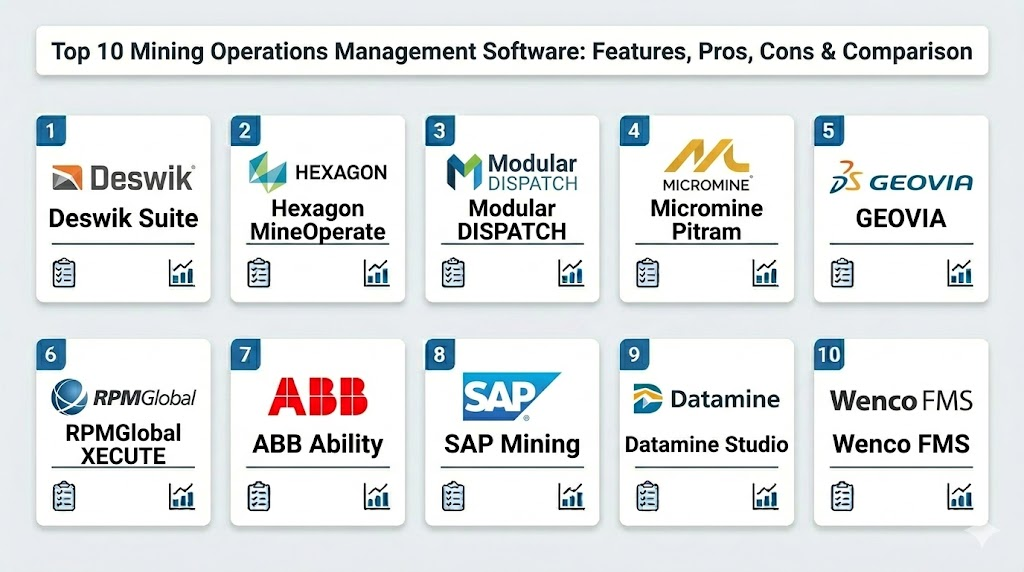
Top 10 Mining Operations Management Software Tools
1. Deswik Suite
A comprehensive CAD-based platform that has become the benchmark for integrated mine planning and operational scheduling. It is favored for its ability to bridge the gap between engineering design and daily production tasks.
Key Features
- Integrated 3D CAD design environment built specifically for mining geometry.
- Interactive Gantt-chart based scheduling that links directly to spatial 3D models.
- Advanced landform and haulage simulation to optimize truck routes and fuel consumption.
- Automated underground design tools for rapid development and stope optimization.
- Robust reporting and dashboarding for plan-to-actual reconciliation.
Pros
- Exceptionally strong integration between design, scheduling, and production.
- Highly customizable through a powerful internal scripting engine.
Cons
- Steep learning curve requiring specialized training for new engineers.
- Premium pricing model often targets larger enterprise budgets.
Platforms / Deployment
Windows
Local / Hybrid
Security & Compliance
Role-based access controls and project-level permissions.
Not publicly stated.
Integrations & Ecosystem
Integrates deeply with major geological databases and fleet management systems. It supports industry-standard formats like DXF, DWG, and specialized mining formats.
Support & Community
Extensive global support network with dedicated technical consultants and a large community of certified users.
2. Hexagon MineOperate
Part of a massive technology portfolio, this solution focuses on the “operation” phase of mining, providing fleet management, high-precision guidance, and safety systems in a single ecosystem.
Key Features
- Real-time fleet management and dispatch for both open-pit and underground mines.
- High-precision machine guidance for drills, shovels, and dozers.
- Integrated collision avoidance and operator fatigue monitoring systems.
- Asset health monitoring with real-time equipment telemetry ingestion.
- Operations center dashboards for enterprise-wide visibility.
Pros
- Unique combination of hardware (sensors/GPS) and software in one package.
- Strong focus on safety and autonomous mission control.
Cons
- Implementation can be complex due to hardware installation requirements.
- Higher total cost of ownership when including hardware components.
Platforms / Deployment
Windows / Linux / Android (Mobile)
Hybrid (On-premise servers with cloud reporting)
Security & Compliance
Enterprise identity management and secure data encryption.
Not publicly stated.
Integrations & Ecosystem
Seamlessly connects with Hexagon’s planning (MinePlan) and safety suites, as well as third-party ERPs like SAP and Oracle.
Support & Community
A global leader with local support offices in every major mining hub and comprehensive online training portals.
3. Modular Mining DISPATCH
A pioneer in the fleet management space, this software is the standard for large-scale open-pit operations that require high-velocity haulage optimization and real-time equipment assignment.
Key Features
- Industry-leading automated dispatch algorithm based on linear programming.
- Real-time production tracking and material movement reporting.
- Comprehensive equipment health and maintenance management modules.
- Integration with autonomous haulage systems for mixed-fleet environments.
- High-resolution GPS tracking for cycle time and delay analysis.
Pros
- Proven track record in the world’s largest and most productive mines.
- Significant ROI through measurable increases in haulage efficiency.
Cons
- The interface can feel dated compared to newer, web-native competitors.
- Requires a robust on-site wireless network to function at peak performance.
Platforms / Deployment
Windows / Linux
Local / Hybrid
Security & Compliance
Secure communication protocols between field hardware and central servers.
Not publicly stated.
Integrations & Ecosystem
Owned by Komatsu, it integrates naturally with Komatsu equipment but maintains high compatibility with other major OEMs.
Support & Community
Extensive professional services team for on-site implementation and multi-lingual support centers.
4. Micromine Pitram
A specialized production control and fleet management solution that excels in shift-based reporting and real-time data capture for both surface and underground environments.
Key Features
- Real-time voice and data capture for tracking equipment, personnel, and materials.
- Digital shift logs and production reconciliation modules.
- Advanced underground positioning and tracking for safety and utilization.
- Grade control and material blending management.
- Integration with on-board computers and third-party sensors.
Pros
- Highly effective for underground operations where GPS is unavailable.
- User-friendly interface designed for rapid data entry by control room operators.
Cons
- Historically focused on mid-tier mines, though scaling rapidly to enterprise.
- Some advanced AI features are still in the early stages of rollout.
Platforms / Deployment
Windows / Web
Local / Hybrid
Security & Compliance
Standard database security and user authentication protocols.
Not publicly stated.
Integrations & Ecosystem
Integrates seamlessly with Micromine’s exploration and planning tools, providing a closed-loop data flow from geology to production.
Support & Community
Very strong presence in Australia and emerging markets with a reputation for responsive technical support.
5. Dassault Systèmes GEOVIA
Bringing high-end engineering precision to mining, the GEOVIA brand provides tools for geological modeling, pit optimization, and operational management under a unified platform.
Key Features
- Surpac for world-class geological modeling and mine design.
- Whittle for industry-standard open-pit strategic optimization.
- MineSched for automated tactical and strategic scheduling.
- Integration with the 3DEXPERIENCE platform for global collaboration.
- Advanced simulation tools for rock mechanics and ventilation.
Pros
- Unbeatable precision in geological modeling and resource estimation.
- Global standard for pit optimization in complex multi-mineral deposits.
Cons
- Can be resource-heavy, requiring high-end workstations for large models.
- Integration between different legacy modules can sometimes feel fragmented.
Platforms / Deployment
Windows
Local / Hybrid
Security & Compliance
Enterprise-grade data governance and access control via the 3DEXPERIENCE platform.
SOC 2 / ISO 27001 (Cloud versions).
Integrations & Ecosystem
Strong connectivity with other engineering disciplines within the Dassault Systèmes ecosystem.
Support & Community
Massive educational resources and a global network of partners and consultants.
6. RPMGlobal XECUTE
XECUTE is a ultra-short-term planning and execution software that visualizes the mine plan in 3D and allows for shift-by-shift adjustments to ensure adherence to the weekly schedule.
Key Features
- Live 3D visualization of the mine environment and equipment movements.
- Integration of the production plan with real-time equipment availability.
- Drag-and-drop scheduling for rapid response to operational changes.
- Unified data model that connects the mine office to the pit floor.
- Strong focus on financial outcomes and cost-per-ton tracking.
Pros
- Excellent for visualizing and managing the “now” of mining operations.
- Directly bridges the gap between the planning office and site supervisors.
Cons
- Requires high-quality data input from other systems to be effective.
- Primarily focused on scheduling rather than fleet hardware control.
Platforms / Deployment
Windows
Local / Hybrid
Security & Compliance
Role-based security and standard enterprise database controls.
Not publicly stated.
Integrations & Ecosystem
Integrates with all major mine planning software and fleet management systems via a robust API.
Support & Community
Professional support with a strong focus on the financial and economic impact of mining decisions.
7. ABB Ability Operations Management System
This platform focuses on the “Short Interval Control” of mining, specifically designed to optimize the production flow by identifying and removing bottlenecks in real-time.
Key Features
- Automated task assignment and tracking for personnel and equipment.
- Real-time monitoring of energy consumption and process plant performance.
- Integration of maintenance schedules with production planning.
- Digital twin capabilities for simulated process optimization.
- Advanced analytics for identifying hidden operational inefficiencies.
Pros
- Unmatched for integrating the mine with the processing plant and power grid.
- Strongest solution for companies focused on energy efficiency and ESG.
Cons
- More focused on the “process” side than the “geology” side of mining.
- Implementation often requires a high degree of IT/OT integration.
Platforms / Deployment
Web / Windows / Linux
Hybrid / Cloud
Security & Compliance
Industrial-grade cybersecurity protocols and deep audit logging.
ISO 27001 compliant.
Integrations & Ecosystem
Part of the broader ABB Ability industrial ecosystem, connecting easily to PLC and SCADA systems.
Support & Community
World-class corporate support for large-scale industrial transformations.
8. SAP Mining
As an enterprise-wide solution, SAP for Mining focuses on the “Business of Mining,” integrating site operations with finance, HR, and the global supply chain.
Key Features
- End-to-end integration of mine production data with corporate financials.
- Comprehensive asset management and predictive maintenance modules.
- Supply chain and logistics management for pit-to-port operations.
- Real-time environmental and sustainability reporting.
- Workforce management and safety compliance tracking.
Pros
- The absolute leader for enterprise-level financial and operational visibility.
- Provides a “single source of truth” for the entire corporation.
Cons
- Not a specialized tool for 3D mine design or geological modeling.
- Implementation is a multi-year project with significant costs.
Platforms / Deployment
Web / Windows / macOS / Mobile
Cloud (S/4HANA) / Hybrid
Security & Compliance
Top-tier enterprise security with global compliance certifications.
SOC 2 / ISO 27001 / GDPR compliant.
Integrations & Ecosystem
The center of the enterprise universe, integrating with almost every other tool on this list.
Support & Community
Unrivaled global partner ecosystem and dedicated enterprise support.
9. Datamine Studio OP/UG
Datamine provides highly specialized modules for both open-pit and underground operations, known for their powerful optimization algorithms and reliability.
Key Features
- Automated pit design and stope optimization modules.
- Integrated geological database management with high data integrity.
- Advanced drill and blast design and analysis tools.
- Strategic and tactical scheduling with high-resolution visualization.
- Specialized tools for exploration and GIS mapping.
Pros
- Robust and stable software that handles massive datasets with ease.
- Modular design allows mines to buy only the functionality they need.
Cons
- The interface can be complex for occasional or non-technical users.
- Limited native focus on real-time fleet dispatch compared to specialized FMS.
Platforms / Deployment
Windows
Local / Hybrid
Security & Compliance
Secure data management and user-level access permissions.
Not publicly stated.
Integrations & Ecosystem
Connects well with a wide variety of third-party tools via standard file formats.
Support & Community
Long-standing reputation with deep roots in the global mining community.
10. Wenco Fleet Management System
Owned by Hitachi, Wenco provides a practical and high-performance fleet management system that focuses on increasing the productivity of open-pit haulage fleets.
Key Features
- Automated fleet dispatch and production monitoring.
- High-precision machine guidance for excavation and loading.
- Maintenance and equipment health tracking with real-time alerts.
- Safety systems including proximity detection and speed monitoring.
- Comprehensive reporting suite for cycle times and delay analysis.
Pros
- Known for being reliable and “just working” in tough field environments.
- Excellent value for mid-sized mines looking for a professional FMS.
Cons
- Less focus on the geological or long-term planning side of the business.
- Smaller overall feature set compared to the massive Hexagon or Modular suites.
Platforms / Deployment
Windows / Linux / Android
Local / Hybrid
Security & Compliance
Secure on-site server deployment with encrypted data transmission.
Not publicly stated.
Comparison Table
| Tool Name | Best For | Platform(s) Supported | Deployment | Standout Feature | Public Rating |
| 1. Deswik Suite | Integrated Planning | Windows | Hybrid | 3D-Linked Gantt | N/A |
| 2. Hexagon MineOperate | Safety & Autonomy | Win, Linux, Android | Hybrid | Safety/Fleet Bundle | N/A |
| 3. Modular DISPATCH | Large Open-Pit FMS | Windows, Linux | Local | Dispatch Algorithm | N/A |
| 4. Micromine Pitram | Underground Operations | Windows, Web | Hybrid | Shift Data Capture | N/A |
| 5. GEOVIA | Pit Optimization | Windows | Hybrid | Whittle Engine | N/A |
| 6. RPMGlobal XECUTE | Short-Term Planning | Windows | Local | Execution Visuals | N/A |
| 7. ABB Ability | Process Integration | Web, Windows | Cloud | Energy Optimization | N/A |
| 8. SAP Mining | Enterprise Finance | Web, Win, Mobile | Cloud | Global ERP Sync | N/A |
| 9. Datamine Studio | Resource Estimation | Windows | Local | Data Integrity | N/A |
| 10. Wenco FMS | Mid-Size Fleet Ops | Win, Linux, Android | Local | Operational Reliability | N/A |
Evaluation & Scoring
| Tool Name | Core (25%) | Ease (15%) | Integrations (15%) | Security (10%) | Perf (10%) | Support (10%) | Value (15%) | Total |
| 1. Deswik | 10 | 4 | 9 | 8 | 9 | 9 | 6 | 8.10 |
| 2. Hexagon | 9 | 5 | 10 | 9 | 10 | 9 | 6 | 8.30 |
| 3. Modular | 9 | 6 | 8 | 8 | 10 | 8 | 7 | 8.05 |
| 4. Pitram | 8 | 8 | 8 | 7 | 9 | 8 | 8 | 8.00 |
| 5. GEOVIA | 10 | 5 | 8 | 9 | 8 | 8 | 5 | 7.70 |
| 6. RPMGlobal | 8 | 7 | 9 | 8 | 9 | 8 | 7 | 7.85 |
| 7. ABB Ability | 7 | 6 | 10 | 9 | 9 | 9 | 7 | 7.85 |
| 8. SAP Mining | 6 | 5 | 10 | 10 | 9 | 10 | 5 | 7.40 |
| 9. Datamine | 9 | 5 | 8 | 8 | 9 | 8 | 7 | 7.80 |
| 10. Wenco | 8 | 7 | 7 | 7 | 9 | 7 | 9 | 7.75 |
These scores are based on the comparative strengths of each platform in a professional mining environment. A lower score in “Ease” for tools like Deswik or GEOVIA does not reflect a poor product, but rather the extreme complexity and power of the toolset. Conversely, SAP scores lower in “Core” functionality for mine site operations but is the undisputed leader in enterprise-wide integrations and security. Choosing a tool with a total score above 8.0 typically indicates a platform that has successfully balanced specialized mining depth with modern software standards.
Which Mining Operations Management Software Tool Is Right for You?
Solo / Freelancer
Independent mining consultants should focus on Deswik or Datamine, as these are the industry languages required for contract work with major producers.
SMB
Small to medium mines often find the best value in Micromine Pitram or Wenco FMS, as they provide professional-grade tracking and reporting without the massive overhead of a tier-one enterprise system.
Mid-Market
Growing mining houses should look at RPMGlobal XECUTE to ensure their operations are meeting their financial goals, combined with Deswik for robust technical planning.
Enterprise
Global mining majors require the high-end integration of Hexagon, Modular Mining, or SAP. These tools offer the security and scalability needed to manage thousands of machines across multiple continents.
Budget vs Premium
Budget-conscious operators should prioritize high-value tools like Wenco, while those requiring the absolute best in safety and automation should invest in the premium offerings of Hexagon or Modular.
Feature Depth vs Ease of Use
If your team consists of highly specialized engineers, Deswik and Houdini provide infinite depth. If you need supervisors to start using the system quickly, Pitram is a better choice.
Integrations & Scalability
For a mine that plans to double in size, Hexagon and SAP provide the most secure growth path due to their extensive API ecosystems and hardware independence.
Security & Compliance Needs
Operations in strictly regulated regions must choose vendors with clear compliance trails, such as SAP or ABB, to ensure all environmental and safety data is audit-ready.
Frequently Asked Questions (FAQs)
1. What is the main goal of mining operations management software?
The primary goal is to maximize production efficiency while ensuring safety by providing real-time visibility and control over all mining activities.
2. Can these tools work underground where there is no GPS?
Yes, specialized underground systems like Pitram use localized tracking, Wi-Fi, and RFID tags to monitor personnel and equipment movements.
3. Is it possible to integrate these tools with our existing ERP?
Most professional mining software offers APIs or pre-built connectors to integrate with enterprise systems like SAP, Oracle, or Microsoft Dynamics.
4. How does the software help with safety?
By monitoring vehicle locations, identifying fatigue in operators, and ensuring that all equipment is operating within safe physical limits in real-time.
5. What is “Short Interval Control” in a mining context?
It is the practice of monitoring and managing production in short time blocks (e.g., hourly) to ensure that the shift targets are met.
6. Do we need a dedicated IT team to manage this software?
For enterprise systems, a dedicated IT/OT team is essential to maintain the network, manage hardware sensors, and ensure data integrity across the site.
7. How long does a typical implementation take?
A small-scale deployment can take 3–6 months, while a full enterprise-wide roll-out at a large mine site can take 12–18 months.
8. Can the software help us reduce our carbon footprint?
Yes, by optimizing truck routes to reduce fuel consumption and monitoring energy usage in real-time to identify wasted power in processing.
9. What happens if the mine site loses internet connectivity?
Professional mining tools are built with “store-and-forward” capabilities, allowing them to function offline and sync data once a connection is restored.
10. Why is “plan-to-actual” reconciliation so important?
It allows management to see exactly where the operation deviated from the plan, helping to correct inefficiencies and improve the accuracy of future planning.
Conclusion
The selection of a mining operations management platform is a pivotal strategic move that dictates a mine’s long-term viability and safety posture. In an industry defined by volatile commodity prices and increasing environmental scrutiny, the ability to make data-driven decisions at a moment’s notice is the only true competitive advantage. Whether you prioritize the deep engineering capabilities of Deswik or the enterprise-wide financial visibility of SAP, the core objective remains the same: transforming raw data into actionable intelligence. By carefully matching a platform’s strengths to your site’s specific geological and operational constraints, you ensure a more predictable, profitable, and safer mining future.

Best Cardiac Hospitals Near You
Discover top heart hospitals, cardiology centers & cardiac care services by city.
Advanced Heart Care • Trusted Hospitals • Expert Teams
View Best Hospitals