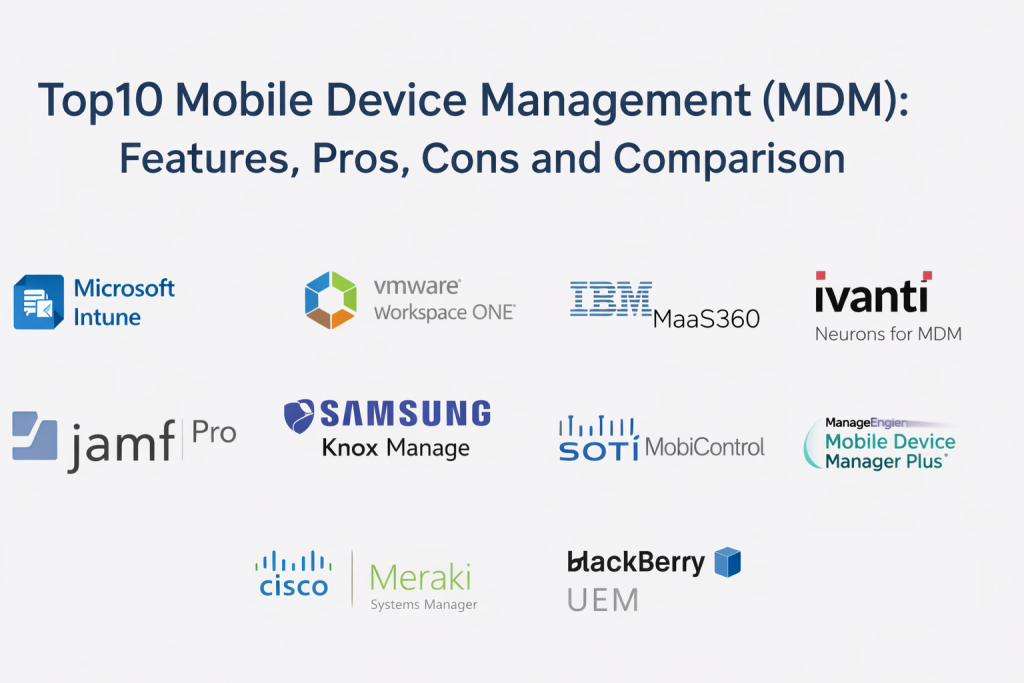
Introduction
Mobile Device Management tools help organizations enroll, configure, secure, and support smartphones and tablets from a central console. In simple terms, MDM is how IT teams make sure mobile devices follow company rules, have the right apps, protect business data, and can be locked or wiped if lost. It is a core building block for secure mobile work because people use phones for email, chat, documents, customer apps, and sometimes sensitive business systems.
This matters now because mobile devices carry business identity and access everywhere. Remote work, field teams, and bring-your-own-device programs increase risk. At the same time, companies need fast onboarding and consistent compliance enforcement. Real-world use cases include device enrollment for new employees, app distribution for sales or field operations, kiosk mode for retail and frontline devices, policy enforcement for screen locks and encryption, certificate-based access, compliance reporting, and remote actions when a phone is lost. When evaluating MDM tools, buyers should assess enrollment methods, policy depth, app management, compliance reporting, security controls, identity integration, support workflows, automation, multi-platform coverage, and cost.
Best for: IT administrators, security teams, managed service providers, and organizations with mobile-first staff, field operations, retail devices, or strong compliance requirements.
Not ideal for: very small teams without sensitive mobile access needs. If mobile use is limited to basic email and you already use a managed ecosystem, lightweight controls might be enough, but you will lose visibility and response capability for lost devices.
Key Trends in Mobile Device Management Tools
- Stronger “zero-touch” enrollment and automated setup for new devices
- More use of compliance posture to control app access and data sharing
- Deeper integration with identity systems for conditional access patterns
- Increased need for privacy controls in BYOD models
- Growing demand for kiosk mode and frontline device management
- Better app lifecycle management for updates, rollbacks, and approvals (Varies / Not publicly stated)
- Stronger reporting expectations for audits and compliance evidence
- More cross-platform consistency across iOS, Android, and rugged devices
- Increased focus on secure browser and app container controls (Varies / Not publicly stated)
- Greater need for remote support features built into MDM suites
How We Selected These Tools
- Strong credibility and adoption for mobile device management
- Proven coverage for enrollment, policy enforcement, app distribution, and compliance reporting
- Fit across different segments: SMB, mid-market, enterprise, and frontline device programs
- Integration ecosystem for identity, security, and service workflows
- Governance controls for role-based access, auditability, and administrative separation
- Balanced list including enterprise UEM suites and mobile-first management leaders
Top 10 Mobile Device Management Tools
1 — Microsoft Intune
Microsoft Intune is widely used for managing mobile devices alongside broader endpoint governance. It fits organizations that want mobile compliance tied to identity-driven access controls.
Key Features
- Mobile device enrollment and configuration policies
- Compliance policies and access control alignment (Varies / Not publicly stated)
- Application deployment and management workflows
- Device security baselines and policy templates (Varies / Not publicly stated)
- Reporting for compliance, device inventory, and policy status
- Remote actions for lock, wipe, and compliance enforcement (Varies / Not publicly stated)
Pros
- Strong fit for Microsoft-centered identity environments
- Works well for mixed device fleets and hybrid work
- Scales effectively for large organizations
Cons
- Depth of mobile controls varies by platform and licensing scope
- Admin experience depends on policy design and structure
- Some advanced mobile security controls may require additional services
Platforms / Deployment
- Platforms: Web, iOS, Android
- Deployment: Cloud
Security and Compliance
Not publicly stated
Integrations and Ecosystem
Microsoft Intune typically integrates with identity and security ecosystems so mobile posture can influence access.
- Identity integration patterns for access control (Varies / Not publicly stated)
- Security tooling alignment for device posture (Varies / Not publicly stated)
- APIs for automation and reporting exports (Varies / Not publicly stated)
- Service workflow integration patterns (Varies / Not publicly stated)
Support and Community
Large documentation base and community. Support varies by contract; many teams benefit from standardized policy frameworks and phased rollouts.
2 — VMware Workspace ONE
VMware Workspace ONE is a unified endpoint platform with strong MDM capabilities. It fits enterprises that want consistent mobile governance alongside broader endpoint management.
Key Features
- Mobile enrollment and policy management for iOS and Android
- App distribution and lifecycle controls (Varies / Not publicly stated)
- Compliance enforcement and posture-based policy workflows (Varies / Not publicly stated)
- Reporting dashboards for inventory and compliance
- Automation for onboarding and device lifecycle events (Varies / Not publicly stated)
- Support for kiosk and frontline workflows (Varies / Not publicly stated)
Pros
- Strong cross-platform governance for large mobile programs
- Good fit for enterprise-scale rollout models
- Works well when mobile is part of a broader endpoint strategy
Cons
- Implementation and administration can be complex
- Cost depends on modules and scope
- Requires strong operational ownership and standards
Platforms / Deployment
- Platforms: Web, iOS, Android
- Deployment: Cloud / Self-hosted (Varies / Not publicly stated)
Security and Compliance
Not publicly stated
Integrations and Ecosystem
Workspace ONE often integrates with identity and security systems to enforce mobile access policies.
- Identity and conditional access alignment patterns (Varies / Not publicly stated)
- APIs for automation and compliance reporting exports (Varies / Not publicly stated)
- Integration options with service workflows (Varies / Not publicly stated)
Support and Community
Enterprise support options are common. Documentation exists; partner services are often used for complex rollout design and ongoing operations.
3 — IBM MaaS360
IBM MaaS360 is used for mobile device management with structured policy enforcement and compliance reporting. It fits teams that want governed mobile programs with clear admin controls.
Key Features
- Mobile device enrollment and policy enforcement
- Application management and distribution workflows (Varies / Not publicly stated)
- Compliance policies and reporting for audits
- Remote actions for lock, wipe, and security responses (Varies / Not publicly stated)
- Device inventory and governance dashboards
- Integration options for enterprise workflows (Varies / Not publicly stated)
Pros
- Practical policy and compliance governance for mobile devices
- Useful reporting for compliance and inventory visibility
- Supports multi-platform mobile fleets
Cons
- Admin experience depends on configuration choices
- Some advanced capabilities depend on plan and add-ons
- Desktop endpoint depth may be limited if you want one platform for everything
Platforms / Deployment
- Platforms: Web, iOS, Android
- Deployment: Cloud
Security and Compliance
Not publicly stated
Integrations and Ecosystem
MaaS360 integrates with identity, directory, and security tooling depending on environment.
- Identity alignment patterns for access governance (Varies / Not publicly stated)
- APIs for automation and reporting exports (Varies / Not publicly stated)
- Service workflow integrations vary by setup (Varies / Not publicly stated)
Support and Community
Support varies by contract. Documentation exists; best results come with clear policy standards and a stable operating model.
4 — Ivanti Neurons for MDM
Ivanti Neurons for MDM is used to manage mobile devices with compliance controls and lifecycle workflows. It fits organizations that want mobile governance connected to IT operations processes.
Key Features
- Mobile enrollment and configuration policies
- Compliance enforcement and posture workflows (Varies / Not publicly stated)
- App distribution and update management patterns (Varies / Not publicly stated)
- Inventory and reporting for governance visibility
- Remote actions and security response workflows (Varies / Not publicly stated)
- Integration patterns with IT operations tools (Varies / Not publicly stated)
Pros
- Practical governance for mobile fleet management
- Useful reporting for compliance and device visibility
- Supports structured lifecycle workflows for onboarding and offboarding
Cons
- Feature depth varies by edition and configuration
- Integration planning is important for best results
- Advanced mobile security controls depend on setup and environment
Platforms / Deployment
- Platforms: Web, iOS, Android (Varies / Not publicly stated)
- Deployment: Cloud (Varies / Not publicly stated)
Security and Compliance
Not publicly stated
Integrations and Ecosystem
Ivanti Neurons for MDM often integrates with service operations and identity tooling based on the stack.
- APIs for automation and reporting exports (Varies / Not publicly stated)
- Identity alignment patterns for access governance (Varies / Not publicly stated)
- Service workflow integrations (Varies / Not publicly stated)
Support and Community
Support varies by contract. Documentation exists; enterprise rollouts improve with clear policies and consistent device governance.
5 — Jamf Pro
Jamf Pro is widely recognized for Apple device management. For organizations with iPhones and iPads at scale, it provides deep iOS and iPadOS controls and end-user workflows.
Key Features
- Apple-focused device enrollment and configuration policies
- App distribution and lifecycle management for Apple devices (Varies / Not publicly stated)
- Compliance and inventory reporting for mobile fleets
- Automation workflows for onboarding and setup (Varies / Not publicly stated)
- Self-service experiences for app access and support (Varies / Not publicly stated)
- Policy controls for Apple device governance
Pros
- Deep Apple management and strong user experience
- Strong fit for organizations with Apple mobile standardization
- Mature workflows for onboarding and app management
Cons
- Not a full multi-platform MDM on its own
- Android management requires another tool
- Some advanced workflows require careful configuration
Platforms / Deployment
- Platforms: Web, iOS
- Deployment: Cloud / Self-hosted (Varies / Not publicly stated)
Security and Compliance
Not publicly stated
Integrations and Ecosystem
Jamf Pro integrates with identity and security ecosystems to enforce posture and access policies for Apple devices.
- Identity integration patterns (Varies / Not publicly stated)
- Security tooling alignment for device posture (Varies / Not publicly stated)
- APIs for automation and reporting exports (Varies / Not publicly stated)
Support and Community
Strong community and documentation. Support tiers vary; many teams adopt best practices for policy structure and onboarding journeys.
6 — Cisco Meraki Systems Manager
Cisco Meraki Systems Manager is commonly used for mobile device management, especially in organizations already using Meraki network infrastructure and cloud administration patterns.
Key Features
- Mobile device enrollment and policy enforcement
- App management and distribution workflows (Varies / Not publicly stated)
- Compliance reporting for governance visibility
- Remote actions for lock, wipe, and policy enforcement (Varies / Not publicly stated)
- Inventory views for managed mobile devices
- Ecosystem alignment with Meraki network controls (Varies / Not publicly stated)
Pros
- Simple setup for Meraki-centered environments
- Practical MDM workflows for common mobile needs
- Centralized visibility for managed mobile fleets
Cons
- Advanced enterprise mobile governance may be limited
- Depth varies by platform and requirements
- Some capabilities depend on broader Meraki stack choices
Platforms / Deployment
- Platforms: Web, iOS, Android
- Deployment: Cloud
Security and Compliance
Not publicly stated
Integrations and Ecosystem
Meraki Systems Manager often aligns with network and device governance workflows.
- Meraki ecosystem alignment patterns (Varies / Not publicly stated)
- APIs for automation and reporting exports (Varies / Not publicly stated)
- Identity integration depends on environment (Varies / Not publicly stated)
Support and Community
Support varies by contract. Documentation is accessible; best fit is typically within organizations already standardized on Meraki.
7 — SOTI MobiControl
SOTI MobiControl is widely used for managing mobile and rugged devices in frontline environments. It fits teams managing operational fleets where reliability and remote support matter.
Key Features
- Enrollment and management for mobile and rugged endpoints
- Remote control and troubleshooting workflows (Varies / Not publicly stated)
- Kiosk mode and device lockdown patterns (Varies / Not publicly stated)
- App distribution and configuration policies (Varies / Not publicly stated)
- Compliance reporting for fleet governance
- Lifecycle workflows for frontline device operations (Varies / Not publicly stated)
Pros
- Strong for rugged devices and frontline fleets
- Useful remote troubleshooting for operational environments
- Practical for kiosk and dedicated-use device programs
Cons
- Not designed as a primary platform for enterprise desktop management
- Some enterprise mobile governance needs may require additional tools
- Integration breadth depends on your environment
Platforms / Deployment
- Platforms: Web, iOS, Android (Varies / Not publicly stated)
- Deployment: Cloud / Self-hosted (Varies / Not publicly stated)
Security and Compliance
Not publicly stated
Integrations and Ecosystem
SOTI MobiControl integrates with operational workflows depending on use case.
- APIs for automation and reporting exports (Varies / Not publicly stated)
- Integration options vary by deployment model (Varies / Not publicly stated)
- Identity alignment depends on environment (Varies / Not publicly stated)
Support and Community
Support tiers vary. Documentation exists; operational rollouts succeed when device policies and frontline workflows are clearly defined.
8 — ManageEngine Mobile Device Manager Plus
ManageEngine Mobile Device Manager Plus is often chosen by SMB and mid-market teams that want practical MDM coverage with policy management, app distribution, and compliance reporting.
Key Features
- Enrollment and policy enforcement for mobile devices
- App distribution and mobile application management patterns (Varies / Not publicly stated)
- Compliance reporting and device inventory visibility
- Remote actions for lock, wipe, and compliance responses (Varies / Not publicly stated)
- Kiosk mode capabilities (Varies / Not publicly stated)
- Integration options with related IT operations tools (Varies / Not publicly stated)
Pros
- Practical MDM coverage for common mobile governance needs
- Often easier to adopt and manage for mid-size teams
- Useful reporting for compliance and device tracking
Cons
- Advanced enterprise governance may be limited versus larger suites
- Feature depth depends on edition and configuration
- Integration scope can vary depending on your stack
Platforms / Deployment
- Platforms: Web, iOS, Android
- Deployment: Cloud / Self-hosted (Varies / Not publicly stated)
Security and Compliance
Not publicly stated
Integrations and Ecosystem
Typically integrates with directory services and related operations tools to support governance.
- Directory-based user mapping patterns
- APIs for automation and reporting exports (Varies / Not publicly stated)
- Integrations with related ManageEngine modules (Varies / Not publicly stated)
Support and Community
Documentation is practical. Support tiers vary; many SMBs can implement standard policies and app management without heavy consulting.
9 — Samsung Knox Manage
Samsung Knox Manage is used for managing Samsung Android devices, often in organizations that standardize on Samsung hardware for frontline or corporate mobility programs.
Key Features
- Device enrollment and policy enforcement for Samsung devices
- Kiosk mode and dedicated-use device workflows (Varies / Not publicly stated)
- App management and distribution patterns (Varies / Not publicly stated)
- Compliance reporting for device governance visibility
- Remote actions for lock, wipe, and troubleshooting support (Varies / Not publicly stated)
- Controls aligned with Samsung device management capabilities (Varies / Not publicly stated)
Pros
- Strong fit for Samsung-standardized Android fleets
- Useful kiosk and frontline device controls
- Practical governance for dedicated-use devices
Cons
- Focused on Samsung devices rather than full cross-platform MDM
- Broader enterprise mobility needs require additional tooling
- Feature scope depends on device models and program requirements
Platforms / Deployment
- Platforms: Web, Android
- Deployment: Cloud (Varies / Not publicly stated)
Security and Compliance
Not publicly stated
Integrations and Ecosystem
Knox Manage integrates with enterprise workflows depending on environment and device program design.
- API options and integrations vary (Varies / Not publicly stated)
- Identity alignment depends on use case (Varies / Not publicly stated)
- Service workflow linkage depends on setup (Varies / Not publicly stated)
Support and Community
Support varies by program and region. Documentation exists; best outcomes come when devices are standardized and policies are consistent.
10 — BlackBerry UEM
BlackBerry UEM is used in organizations that need strong governance for mobile endpoints, often where security and compliance are key drivers. It fits teams managing regulated environments.
Key Features
- Mobile device enrollment and policy enforcement
- Application management and secure workspace patterns (Varies / Not publicly stated)
- Compliance policies and reporting for governance
- Remote actions and security response workflows (Varies / Not publicly stated)
- Role-based administration and governance controls (Varies / Not publicly stated)
- Integration options for enterprise systems (Varies / Not publicly stated)
Pros
- Strong governance focus for regulated programs
- Practical policy enforcement for enterprise mobility
- Suitable for organizations with strict control requirements
Cons
- Admin experience depends on configuration and environment
- Feature depth and platform focus vary by licensing scope
- Integration and rollout planning are important for best results
Platforms / Deployment
- Platforms: Web, iOS, Android
- Deployment: Cloud / Self-hosted (Varies / Not publicly stated)
Security and Compliance
Not publicly stated
Integrations and Ecosystem
BlackBerry UEM typically integrates with identity and enterprise systems to enforce mobility governance.
- Identity alignment patterns for access governance (Varies / Not publicly stated)
- APIs for automation and reporting exports (Varies / Not publicly stated)
- Service workflow integrations vary by setup (Varies / Not publicly stated)
Support and Community
Support varies by contract. Documentation exists; many deployments succeed when governance, policy standards, and device program scope are clearly defined.
Comparison Table
| Tool Name | Best For | Platform(s) Supported | Deployment | Standout Feature | Public Rating |
|---|---|---|---|---|---|
| Microsoft Intune | Identity-driven mobile governance | Web, iOS, Android | Cloud | Compliance linked to access control patterns | N/A |
| VMware Workspace ONE | Enterprise mobility programs at scale | Web, iOS, Android | Cloud / Self-hosted (Varies / Not publicly stated) | Cross-platform governance and automation | N/A |
| IBM MaaS360 | Structured policy and compliance governance | Web, iOS, Android | Cloud | Practical compliance reporting | N/A |
| Ivanti Neurons for MDM | Mobility governance tied to IT operations | Web, iOS, Android (Varies / Not publicly stated) | Cloud (Varies / Not publicly stated) | Lifecycle workflows and reporting visibility | N/A |
| Jamf Pro | Apple mobile fleets | Web, iOS | Cloud / Self-hosted (Varies / Not publicly stated) | Deep Apple management and user experience | N/A |
| Cisco Meraki Systems Manager | Meraki-centered mobile device control | Web, iOS, Android | Cloud | Simple MDM within Meraki ecosystem | N/A |
| SOTI MobiControl | Frontline and rugged device fleets | Web, iOS, Android (Varies / Not publicly stated) | Cloud / Self-hosted (Varies / Not publicly stated) | Kiosk and operational fleet management | N/A |
| ManageEngine Mobile Device Manager Plus | Practical MDM for SMB and mid-market | Web, iOS, Android | Cloud / Self-hosted (Varies / Not publicly stated) | Balanced policy and app distribution | N/A |
| Samsung Knox Manage | Samsung Android fleets and kiosks | Web, Android | Cloud (Varies / Not publicly stated) | Samsung-focused device controls | N/A |
| BlackBerry UEM | Regulated mobility programs | Web, iOS, Android | Cloud / Self-hosted (Varies / Not publicly stated) | Governance focus for strict control environments | N/A |
Evaluation and Scoring of Mobile Device Management Tools
Scoring model
- Each criterion uses a 1–10 score
- Weighted total is a comparative score from 0–10
- Scores reflect typical positioning and capability breadth
- Your best fit depends on platform mix, security needs, and operational maturity
Weights used
- Core features – 25%
- Ease of use – 15%
- Integrations and ecosystem – 15%
- Security and compliance – 10%
- Performance and reliability – 10%
- Support and community – 10%
- Price and value – 15%
| Tool Name | Core (25%) | Ease (15%) | Integrations (15%) | Security (10%) | Performance (10%) | Support (10%) | Value (15%) | Weighted Total (0–10) |
|---|---|---|---|---|---|---|---|---|
| Microsoft Intune | 9 | 7 | 9 | 8 | 8 | 8 | 7 | 8.05 |
| VMware Workspace ONE | 9 | 6 | 8 | 8 | 8 | 7 | 6 | 7.55 |
| IBM MaaS360 | 7 | 7 | 6 | 7 | 7 | 6 | 7 | 6.85 |
| Ivanti Neurons for MDM | 7 | 7 | 6 | 7 | 7 | 6 | 7 | 6.85 |
| Jamf Pro | 8 | 7 | 7 | 7 | 8 | 8 | 6 | 7.25 |
| Cisco Meraki Systems Manager | 6 | 8 | 6 | 6 | 7 | 7 | 7 | 6.70 |
| SOTI MobiControl | 7 | 7 | 5 | 6 | 7 | 6 | 7 | 6.55 |
| ManageEngine Mobile Device Manager Plus | 7 | 8 | 6 | 6 | 7 | 7 | 9 | 7.35 |
| Samsung Knox Manage | 6 | 7 | 5 | 6 | 7 | 6 | 7 | 6.25 |
| BlackBerry UEM | 7 | 6 | 6 | 8 | 7 | 6 | 6 | 6.65 |
How to interpret the scores
- Use the weighted total to shortlist tools, not to declare a universal winner
- If compliance and access control are your drivers, prioritize Core plus Security
- If fast rollout matters, prioritize Ease plus Support
- If budget is tight, prioritize Value and validate what is included in your plan
Which Mobile Device Management Tool Is Right for You?
Solo / Freelancer
Most solo users do not need a full MDM. If you do handle business data on mobile, prioritize strong device lock, encryption, and account security. In Google-centric setups, basic controls may be enough, but for company-owned fleets MDM becomes more valuable.
SMB
SMBs need quick enrollment, app distribution, and the ability to lock or wipe devices. ManageEngine Mobile Device Manager Plus can be a practical choice for balanced MDM needs. Microsoft Intune is a strong option if your identity and collaboration stack is Microsoft-centered. Cisco Meraki Systems Manager works well in Meraki-centered environments.
Mid-Market
Mid-market teams often need stronger compliance reporting and scalable policy structure. Microsoft Intune and VMware Workspace ONE are strong choices depending on identity and endpoint strategy. Jamf Pro is often essential for Apple-heavy mobile fleets. IBM MaaS360 and Ivanti Neurons for MDM can fit governance-driven programs.
Enterprise
Enterprises typically need role-based administration, audit trails, consistent compliance enforcement, and scalable onboarding automation. Microsoft Intune and VMware Workspace ONE are common enterprise choices for large mobile programs. BlackBerry UEM can fit regulated environments with strict policy controls. Samsung Knox Manage is strong when Samsung devices are standardized for frontline fleets. SOTI MobiControl stands out when rugged devices and kiosk deployments are central.
Budget vs Premium
Budget programs should focus on basic enrollment, security baselines, and remote actions. Premium suites become valuable when compliance requirements are strict and automation reduces operational load.
Feature Depth vs Ease of Use
Some platforms deliver deep policy controls but require more admin effort. Others favor simpler experiences with fewer advanced options. Choose based on your team’s operational capacity and the level of control you truly need.
Integrations and Scalability
MDM success depends on identity integration, app distribution processes, and reporting outputs. Validate conditional access patterns, directory sync, and how policies are applied at scale. Make sure group design and admin roles are clean and maintainable.
Security and Compliance Needs
Confirm strong admin authentication, role-based access, audit trails, encryption policies, and remote lock or wipe capabilities. Also validate how the platform handles BYOD privacy, because user trust can break adoption.
Frequently Asked Questions
- What is MDM used for in real life?
MDM is used to enroll devices, apply security policies, distribute apps, track compliance, and lock or wipe devices if they are lost or compromised. - Is MDM only for company-owned devices?
No. Many organizations use MDM for BYOD too, but policies often differ to respect privacy. Capabilities depend on platform and configuration. - How does MDM improve security?
It enforces screen locks, encryption, app controls, and compliance policies. It also enables remote actions and reporting that help respond to lost devices or risky behavior. - What should I implement first in an MDM rollout?
Start with enrollment, basic security policies, and compliance reporting. Then add app distribution, kiosk mode, and automated offboarding once adoption is stable. - Can MDM manage apps too?
Yes. Many MDM tools support app distribution, updates, and access controls. The depth depends on the platform and whether you use managed app approaches. - What is kiosk mode and who needs it?
Kiosk mode locks a device to one app or a small set of apps. It is common in retail, logistics, field services, and frontline environments. - How do I handle iOS and Android together?
Choose a cross-platform MDM like Microsoft Intune or VMware Workspace ONE, then use specialized tools if needed for deeper platform control, such as Jamf Pro for Apple fleets. - What are common mistakes in MDM programs?
Overly strict policies at the start, unclear BYOD privacy rules, weak group design, and poor user onboarding. Another mistake is not testing app and OS updates before wide rollout. - Do MDM tools help with compliance audits?
They help by producing compliance reports and showing policy enforcement history. However, audit success depends on consistent governance and accurate reporting cycles. - How do I pilot an MDM tool properly?
Enroll a small representative group, test core policies, distribute required apps, run compliance checks, validate reporting, and test lock or wipe actions. Then scale with standardized policies and clear ownership.
Conclusion
Mobile Device Management tools help organizations control mobile risk, support mobile work, and enforce consistent security policies across phones and tablets. Microsoft Intune is a strong choice for identity-driven environments and large mobility programs. VMware Workspace ONE fits enterprises needing cross-platform governance and automation. Jamf Pro is often essential for Apple-focused fleets. ManageEngine Mobile Device Manager Plus is a practical option for SMB and mid-market teams that want balanced policies and app distribution without heavy complexity. IBM MaaS360 and Ivanti Neurons for MDM can fit structured governance programs, while Cisco Meraki Systems Manager works best in Meraki-centered environments. SOTI MobiControl stands out for rugged devices and kiosk deployments, Samsung Knox Manage is strong for Samsung-standardized fleets, and BlackBerry UEM can fit regulated environments with strict controls. A smart next step is to shortlist two or three tools, run a pilot with real enrollment and app rollout needs, validate compliance reporting and remote actions, then scale with clear policy ownership and ongoing review.

Best Cardiac Hospitals Near You
Discover top heart hospitals, cardiology centers & cardiac care services by city.
Advanced Heart Care • Trusted Hospitals • Expert Teams
View Best Hospitals