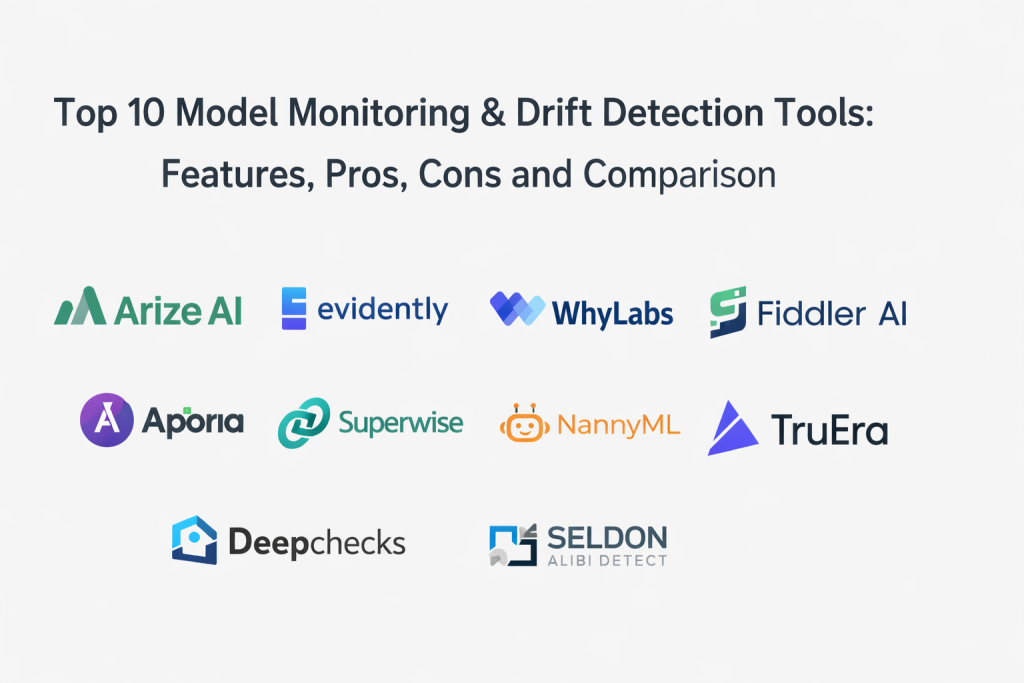
Introduction
Model monitoring and drift detection tools help teams keep machine learning models reliable after deployment. A model that performs well during testing can degrade quietly in production because real-world data changes, user behavior shifts, sensors drift, or upstream pipelines break. Monitoring tools detect these problems early by tracking data quality, feature drift, prediction drift, performance signals, bias risk, and operational metrics like latency and errors.
This matters because production ML is a living system. If drift goes unnoticed, you can get wrong approvals, bad recommendations, missed fraud, unfair decisions, or costly operational mistakes. Real-world use cases include fraud detection, credit risk scoring, churn prediction, demand forecasting, recommendation systems, medical triage support, and predictive maintenance. Buyers should evaluate coverage of drift types, alerting workflows, explainability and root-cause analysis, integration with ML stacks, monitoring at scale, governance controls, and cost of ongoing usage.
Best for: ML engineers, data scientists, MLOps teams, risk and compliance teams, and product owners who depend on stable model outcomes; organizations with multiple models in production and frequent data changes.
Not ideal for: teams running only offline models with no production impact; very small projects where manual checks and basic logging are enough; organizations without access to ground-truth labels or feedback loops (though drift monitoring can still help).
Key Trends in Model Monitoring and Drift Detection Tools
- Monitoring is moving beyond drift to include data quality, pipeline health, and business KPI impact.
- More teams use “label-free” monitoring because labels arrive late or are expensive to collect.
- Root-cause workflows are improving, including slice analysis and feature-level attribution for drift.
- Model fairness and bias monitoring is becoming part of standard production checklists.
- Monitoring is expanding to cover LLM-like systems and complex prediction pipelines (Varies by tool).
- Alert fatigue is a major issue, so tools are adding smarter thresholds and anomaly detection.
- Teams are standardizing retraining triggers based on drift plus performance signals.
- Integration with feature stores and data catalogs is becoming more important for governance.
- Privacy and access control expectations are increasing as monitoring touches sensitive data.
- Cost control is becoming a decision factor as event volume and model count grow.
How We Selected These Tools (Methodology)
- Included widely used monitoring tools with strong drift and quality coverage.
- Prioritized practical production capabilities: alerts, dashboards, and root-cause workflows.
- Included a balanced mix of open-source options and enterprise SaaS platforms.
- Considered support for both tabular ML and more advanced model types (where applicable).
- Looked for ecosystem fit with common deployment patterns and MLOps workflows.
- Considered operational scalability: many models, high traffic, and multiple teams.
- Avoided claiming certifications, compliance badges, or public ratings when uncertain.
- Kept tool names consistent across the tools section, comparison table, and scoring table.
Top 10 Model Monitoring and Drift Detection Tools
Tool 1 — Arize AI
Arize AI is a production monitoring platform focused on catching drift, performance issues, and data problems across deployed models. It is commonly used for visibility across many models and for investigation workflows when something goes wrong.
Key Features
- Data drift and prediction drift monitoring (Varies)
- Performance tracking with labels when available (Varies)
- Slice-based analysis to find where performance drops
- Alerting workflows for changes and anomalies (Varies)
- Model observability dashboards for teams (Varies)
- Support for multiple deployment patterns (Varies)
- Investigation tooling for root-cause workflows (Varies)
Pros
- Strong investigation workflows for diagnosing issues
- Useful for teams managing multiple models at scale
- Good fit for ongoing model quality operations
Cons
- Setup effort depends on instrumentation and data flow
- Costs can rise with high event volume and model count
- Some advanced capabilities depend on plan and configuration
Platforms / Deployment
- Web
- Cloud (Varies)
Security & Compliance
- Not publicly stated
Integrations & Ecosystem
Arize AI typically integrates with model inference logging, data pipelines, and common ML stacks to collect predictions, features, and labels.
- Works with common ML frameworks through logging patterns (Varies)
- Integration with data platforms and pipelines (Varies)
- Alerting integrations into team workflows (Varies)
- Supports multiple model types depending on setup (Varies)
- Fits into broader MLOps processes for retraining triggers (Varies)
Support & Community
Vendor-led support is common for production rollouts. Community resources and documentation vary by plan.
Tool 2 — Evidently
Evidently is widely used for monitoring and reporting on data drift, data quality, and model performance with an open approach. Many teams use it for drift reports, dashboards, and checks inside pipelines.
Key Features
- Data drift detection for features and distributions
- Data quality checks and validation patterns
- Performance analysis when labels exist (Varies)
- Reports and dashboards for monitoring workflows (Varies)
- Custom metrics and monitoring rules (Varies)
- Works well in batch monitoring and CI-style checks (Varies)
- Flexible integration into existing pipelines (Varies)
Pros
- Strong for teams that want flexible monitoring building blocks
- Useful for both pipeline checks and ongoing monitoring
- Good transparency and controllable monitoring logic
Cons
- Requires ownership to design alerts and operational workflows
- Advanced enterprise workflows may require extra tooling
- Scaling patterns depend on how you deploy it
Platforms / Deployment
- Linux / Windows / macOS
- Cloud / Self-hosted / Hybrid (Varies)
Security & Compliance
- Not publicly stated
Integrations & Ecosystem
Evidently is commonly integrated into data pipelines, notebooks, and monitoring jobs to compute drift and quality metrics.
- Integrates with batch pipelines and monitoring jobs (Varies)
- Works with common data formats and stores (Varies)
- Can be used to gate deployments and retraining triggers (Varies)
- Supports custom metrics and checks (Varies)
- Fits well with broader MLOps stacks through automation
Support & Community
Strong community usage and practical documentation. Support depends on how you adopt and deploy it.
Tool 3 — WhyLabs
WhyLabs focuses on data and model monitoring with an emphasis on tracking changes, detecting anomalies, and supporting governance-style workflows. It is commonly used for drift, quality, and monitoring across many models.
Key Features
- Data drift monitoring and anomaly signals (Varies)
- Data quality monitoring for pipeline issues (Varies)
- Feature-level change tracking and alerts (Varies)
- Monitoring dashboards across models and datasets (Varies)
- Alerting integrations for operations teams (Varies)
- Works with delayed labels where available (Varies)
- Supports large-scale monitoring programs (Varies)
Pros
- Strong focus on operational monitoring and alerts
- Useful for teams managing monitoring at scale
- Helpful for catching upstream data pipeline issues
Cons
- Setup depends on data collection and logging discipline
- Some features depend on plan and configuration
- Investigation workflows depend on how you structure metadata
Platforms / Deployment
- Web
- Cloud (Varies)
Security & Compliance
- Not publicly stated
Integrations & Ecosystem
WhyLabs is typically integrated where teams can continuously collect data statistics and model signals.
- Integrates with inference logging and data pipelines (Varies)
- Works with common cloud and warehouse workflows (Varies)
- Alerting into operations channels (Varies)
- Supports monitoring across multiple environments (Varies)
- Fits with retraining and data quality response playbooks
Support & Community
Vendor support is a key part of many rollouts, with documentation and community resources available.
Tool 4 — Fiddler AI
Fiddler AI emphasizes explainability, monitoring, and governance for production ML, often used in regulated or high-stakes environments. It is commonly chosen when teams want strong investigation and interpretability around model behavior.
Key Features
- Monitoring for drift and performance changes (Varies)
- Explainability tooling for understanding predictions (Varies)
- Slice analysis for segment-level performance drops (Varies)
- Model debugging workflows for root cause (Varies)
- Governance-style review and reporting patterns (Varies)
- Alerting for abnormal behavior and drift (Varies)
- Supports multiple model types depending on setup (Varies)
Pros
- Strong explainability for investigation and trust
- Useful for high-stakes and governance-driven deployments
- Helps connect drift signals to business impact
Cons
- Setup can be heavier due to governance and explainability goals
- Cost and rollout effort can be higher for small teams
- Some workflows depend on integration depth
Platforms / Deployment
- Web
- Cloud / Self-hosted / Hybrid (Varies)
Security & Compliance
- Not publicly stated
Integrations & Ecosystem
Fiddler AI is typically used with model inference logs and supporting metadata to analyze behavior and track changes over time.
- Integrates with ML pipelines and inference services (Varies)
- Supports interpretability workflows (Varies)
- Works with monitoring and alerting integrations (Varies)
- Fits regulated approval and review processes (Varies)
- Works best when data access and governance are defined
Support & Community
Strong vendor support is common, particularly for enterprise deployments and governance-driven setups.
Tool 5 — TruEra
TruEra is focused on model quality, explainability, and monitoring, helping teams detect drift and understand performance drops. It is often used when teams want actionable insights rather than only drift metrics.
Key Features
- Drift and performance monitoring workflows (Varies)
- Explainability and feature impact analysis (Varies)
- Slice analysis for identifying weak segments (Varies)
- Debug workflows for data and model issues (Varies)
- Monitoring dashboards and alerts (Varies)
- Supports multiple deployment patterns (Varies)
- Tools for model improvement loops (Varies)
Pros
- Strong for diagnosing why performance changed
- Helpful for improving models and data pipelines
- Useful for teams that want actionable monitoring
Cons
- Requires structured logging and metadata to be most effective
- Cost and complexity can increase at scale
- Some capabilities depend on plan and configuration
Platforms / Deployment
- Web
- Cloud / Self-hosted / Hybrid (Varies)
Security & Compliance
- Not publicly stated
Integrations & Ecosystem
TruEra typically connects to inference logs, feature pipelines, and evaluation datasets to support monitoring and investigation.
- Integrates with ML stacks and evaluation workflows (Varies)
- Supports monitoring plus debugging workflows (Varies)
- Works with alerting and collaboration integrations (Varies)
- Helps inform retraining and data fixes (Varies)
- Fits well into model improvement playbooks
Support & Community
Vendor support is typical for onboarding and operationalizing workflows. Documentation and training resources vary.
Tool 6 — Aporia
Aporia focuses on production model monitoring with drift, quality checks, and alerting workflows. It is often used by teams that want fast visibility into model health and practical dashboards.
Key Features
- Data drift and prediction drift monitoring (Varies)
- Data quality checks for missing values and anomalies (Varies)
- Alerts for abnormal patterns (Varies)
- Monitoring dashboards for model health (Varies)
- Segmentation and slicing for investigation (Varies)
- Supports delayed label monitoring where available (Varies)
- Works across multiple model types depending on setup (Varies)
Pros
- Practical dashboards and monitoring workflows
- Strong alerting value for production incidents
- Useful for teams scaling multiple models
Cons
- Requires good instrumentation for best outcomes
- Costs can rise with volume and model count
- Root-cause depth depends on configuration
Platforms / Deployment
- Web
- Cloud (Varies)
Security & Compliance
- Not publicly stated
Integrations & Ecosystem
Aporia typically integrates with model inference services and data pipelines to collect signals for monitoring.
- Integration via logging and pipeline connectors (Varies)
- Alerting integrations into team workflows (Varies)
- Works with common ML deployment patterns (Varies)
- Supports monitoring for multiple environments (Varies)
- Fits into incident response and retraining loops
Support & Community
Vendor-led onboarding is common, with documentation for integrations and standard monitoring playbooks.
Tool 7 — Superwise
Superwise is designed for monitoring models in production, focusing on drift, data issues, and performance signals. It is often used when teams want scalable monitoring across many models with structured alerting.
Key Features
- Drift detection across features and predictions (Varies)
- Data quality monitoring signals (Varies)
- Performance monitoring with labels when available (Varies)
- Alert rules and notification workflows (Varies)
- Dashboards for multi-model environments (Varies)
- Slicing and segmentation for investigation (Varies)
- Supports monitoring automation patterns (Varies)
Pros
- Strong for managing monitoring at scale
- Useful alerting workflows for operations teams
- Helps standardize monitoring across teams
Cons
- Setup depends on how events, features, and labels are logged
- Investigation depth varies by configuration
- Costs scale with monitoring scope and volume
Platforms / Deployment
- Web
- Cloud (Varies)
Security & Compliance
- Not publicly stated
Integrations & Ecosystem
Superwise is commonly integrated with production inference logging and data pipelines to compute drift and quality metrics.
- Integration via data pipelines and inference logs (Varies)
- Alerting integrations into collaboration tools (Varies)
- Works with common ML stacks through connectors (Varies)
- Supports multi-model monitoring programs (Varies)
- Fits retraining trigger workflows (Varies)
Support & Community
Vendor support is typical for operational rollouts. Documentation helps teams implement monitoring patterns faster.
Tool 8 — NannyML
NannyML focuses on monitoring ML models, including approaches for tracking performance when labels are delayed or unavailable in real time. It is often used by teams that need practical monitoring under real-world label constraints.
Key Features
- Drift detection for input features and predictions
- Performance estimation patterns for delayed labels (Varies)
- Data quality checks and monitoring metrics (Varies)
- Works well for batch monitoring and scheduled checks (Varies)
- Analysis tools for understanding change drivers (Varies)
- Supports model evaluation workflows (Varies)
- Flexible integration patterns into MLOps stacks (Varies)
Pros
- Useful when labels are delayed or incomplete
- Practical for continuous monitoring in real conditions
- Good fit for teams building custom monitoring pipelines
Cons
- Requires thoughtful setup and baseline definition
- Scaling depends on deployment and orchestration choices
- Advanced enterprise features may require extra tooling
Platforms / Deployment
- Linux / Windows / macOS
- Cloud / Self-hosted / Hybrid (Varies)
Security & Compliance
- Not publicly stated
Integrations & Ecosystem
NannyML is often used as part of a monitoring workflow that runs regularly to compute drift and performance signals.
- Works with common data stores and pipelines (Varies)
- Can be integrated into scheduled monitoring jobs (Varies)
- Supports custom reporting and alert logic (Varies)
- Fits retraining criteria design (Varies)
- Complements other MLOps components for deployment and registry
Support & Community
Good community interest and documentation. Support depends on how you operationalize the tool.
Tool 9 — Deepchecks
Deepchecks provides checks for data integrity, model validation, and monitoring signals. It is commonly used to catch data issues early and detect changes that can break model performance.
Key Features
- Data quality checks for common failure modes
- Drift detection and distribution monitoring (Varies)
- Validation checks for model behavior and stability (Varies)
- Custom check framework for team standards (Varies)
- Useful for CI-style gating of datasets and models (Varies)
- Reporting outputs for monitoring workflows (Varies)
- Integrates into broader MLOps stacks through automation
Pros
- Strong for building standardized checks and guardrails
- Helps catch pipeline issues before production impact
- Useful for both pre-deployment and post-deployment workflows
Cons
- Requires discipline to define and maintain checks
- Monitoring at scale depends on deployment approach
- Some features depend on how you integrate it
Platforms / Deployment
- Linux / Windows / macOS
- Cloud / Self-hosted / Hybrid (Varies)
Security & Compliance
- Not publicly stated
Integrations & Ecosystem
Deepchecks is frequently adopted as a set of reusable checks that teams run in pipelines and monitoring jobs.
- Integrates into data pipelines and CI workflows (Varies)
- Works with common ML frameworks through adapters (Varies)
- Can be used for dataset validation and drift checks (Varies)
- Supports custom standards for teams (Varies)
- Complements monitoring dashboards and alerting systems
Support & Community
Community resources are available and growing. Support depends on how you deploy and operationalize it.
Tool 10 — Seldon Alibi Detect
Seldon Alibi Detect is focused on drift detection and outlier detection, often used by teams that want a flexible detection library that can be embedded into services or pipelines. It is commonly used as a building block in custom monitoring stacks.
Key Features
- Drift detection methods for tabular and other data types (Varies)
- Outlier and anomaly detection techniques (Varies)
- Works as a library embedded in monitoring workflows
- Supports batch and near real-time detection patterns (Varies)
- Flexible configuration for thresholds and detectors (Varies)
- Integrates into serving pipelines through code (Varies)
- Useful for custom detection strategies
Pros
- Flexible building block for custom monitoring stacks
- Useful when you want control over detection methods
- Fits teams that prefer code-first monitoring
Cons
- Not a full monitoring platform with dashboards by itself
- Requires engineering effort to operationalize alerts and reporting
- Scaling and governance depend on your implementation
Platforms / Deployment
- Linux / Windows (Varies) / macOS (Varies)
- Cloud / Self-hosted / Hybrid (Varies)
Security & Compliance
- Not publicly stated
Integrations & Ecosystem
Seldon Alibi Detect is typically used inside services or scheduled jobs to compute drift signals that feed alerts and dashboards.
- Integrates with Python-based ML stacks (Varies)
- Can be embedded into inference services (Varies)
- Fits batch monitoring jobs and pipelines (Varies)
- Complements external alerting and dashboards
- Works best with strong logging and response playbooks
Support & Community
Community support is available, especially among teams building Kubernetes and production ML stacks.
Comparison Table (Top 10)
| Tool Name | Best For | Platform(s) Supported | Deployment | Standout Feature | Public Rating |
|---|---|---|---|---|---|
| Arize AI | Multi-model observability and investigation | Web | Cloud | Slice-based investigation workflows | N/A |
| Evidently | Flexible drift and quality reports | Linux / Windows / macOS | Cloud / Self-hosted / Hybrid | Customizable drift and quality metrics | N/A |
| WhyLabs | Large-scale data and model monitoring | Web | Cloud | Data change detection and alerts | N/A |
| Fiddler AI | Explainability plus monitoring for trust | Web | Cloud / Self-hosted / Hybrid | Investigation with explainability focus | N/A |
| TruEra | Actionable model quality diagnostics | Web | Cloud / Self-hosted / Hybrid | Debug workflows for performance drops | N/A |
| Aporia | Production monitoring with alerts | Web | Cloud | Practical monitoring dashboards | N/A |
| Superwise | Monitoring programs across many models | Web | Cloud | Standardized drift and alert workflows | N/A |
| NannyML | Monitoring with delayed labels | Linux / Windows / macOS | Cloud / Self-hosted / Hybrid | Performance estimation patterns | N/A |
| Deepchecks | Guardrails and checks for ML pipelines | Linux / Windows / macOS | Cloud / Self-hosted / Hybrid | Reusable check framework | N/A |
| Seldon Alibi Detect | Code-first drift and outlier detection | Linux / Windows (Varies) / macOS (Varies) | Cloud / Self-hosted / Hybrid | Flexible detectors as a library | N/A |
Evaluation & Scoring of Model Monitoring and Drift Detection Tools
Weights used: Core features 25%, Ease of use 15%, Integrations & ecosystem 15%, Security & compliance 10%, Performance & reliability 10%, Support & community 10%, Price / value 15%. Scores are comparative across common monitoring needs and should be validated with a pilot using your event volume, alerting needs, and team workflows.
| Tool Name | Core (25%) | Ease (15%) | Integrations (15%) | Security (10%) | Performance (10%) | Support (10%) | Value (15%) | Weighted Total |
|---|---|---|---|---|---|---|---|---|
| Arize AI | 8 | 7 | 8 | 6 | 7 | 7 | 6 | 7.15 |
| Evidently | 7 | 7 | 7 | 5 | 7 | 7 | 9 | 7.20 |
| WhyLabs | 8 | 7 | 7 | 6 | 7 | 7 | 6 | 7.05 |
| Fiddler AI | 8 | 6 | 7 | 6 | 7 | 7 | 5 | 6.75 |
| TruEra | 8 | 6 | 7 | 6 | 7 | 7 | 5 | 6.75 |
| Aporia | 7 | 7 | 7 | 6 | 7 | 6 | 6 | 6.75 |
| Superwise | 7 | 7 | 7 | 6 | 7 | 6 | 6 | 6.75 |
| NannyML | 7 | 6 | 6 | 5 | 6 | 6 | 8 | 6.55 |
| Deepchecks | 7 | 6 | 6 | 5 | 6 | 6 | 8 | 6.55 |
| Seldon Alibi Detect | 6 | 5 | 6 | 5 | 6 | 6 | 9 | 6.10 |
How to interpret the scores
- Use the weighted total to shortlist tools, then validate against your real monitoring gaps.
- If you need dashboards and alerts with minimal effort, prioritize Ease and Core together.
- If you are building a custom monitoring stack, prioritize Value and Integrations.
- Always test drift sensitivity, alert noise, and investigation speed with a pilot.
Which Model Monitoring and Drift Detection Tool Is Right for You?
Solo / Freelancer
If you are working alone, focus on tools that help you build monitoring discipline without heavy setup. Evidently, NannyML, and Deepchecks can support scheduled checks and reports. Seldon Alibi Detect can be useful if you prefer a code-first approach and want to embed drift detection directly into your services.
SMB
SMBs need quick visibility and simple alerting. Aporia, WhyLabs, and Arize AI can work well when you want dashboards and alert workflows that reduce manual effort. If you want to keep costs lower and accept more engineering work, Evidently combined with basic alerting can be a practical approach.
Mid-Market
Mid-market teams often manage multiple models and need consistent playbooks. Arize AI and WhyLabs are strong choices when you need investigation workflows and scalable monitoring. Superwise can fit when you want structured monitoring across many models. Deepchecks helps standardize guardrails across pipelines, which reduces surprises during releases.
Enterprise
Enterprises usually need governance, investigation depth, and strong collaboration workflows. Fiddler AI and TruEra are good options when explainability and root-cause analysis are critical. Arize AI and WhyLabs can support monitoring across broad model portfolios. For teams building Kubernetes-heavy stacks, Seldon Alibi Detect can be part of a custom detection layer, but it should be paired with dashboards and incident workflows.
Budget vs Premium
Open-source style tools and libraries can reduce licensing cost but require more engineering ownership. Full platforms can reduce operational effort but may scale cost with volume. Choose based on whether your biggest constraint is budget or staff time, and model the cost using your expected event volume and number of models.
Feature Depth vs Ease of Use
If you want fast adoption and dashboards, platforms like Arize AI, WhyLabs, Aporia, Superwise, and vendor tools tend to be easier to operate. If you want deeper control and custom checks, Evidently, Deepchecks, NannyML, and Seldon Alibi Detect can be strong building blocks, but you must operationalize alerts and response playbooks.
Integrations & Scalability
For high scale, make sure the tool fits your logging approach, data storage, and alerting systems. Platforms are typically easier when you already have consistent inference logs and metadata. Building-block tools fit best when you can run scheduled jobs and integrate results into your own monitoring and incident tools.
Security & Compliance Needs
Monitoring touches sensitive data, so access control and logging discipline matter. Define who can view raw features, what gets retained, and how alerts are handled. Do not assume compliance claims; validate through your normal review process. A good governance process plus careful data minimization often matters as much as tool choice.
Frequently Asked Questions (FAQs)
1. What is model drift in simple terms?
Model drift happens when the data or behavior the model sees in production changes compared to what it was trained on. This can cause accuracy and decision quality to drop over time.
2. What is the difference between data drift and concept drift?
Data drift is when input distributions change, like different customer profiles or device types. Concept drift is when the relationship between inputs and the correct output changes, like fraud patterns evolving.
3. Can I monitor models without labels?
Yes. Many teams track data drift, prediction drift, and data quality signals even when labels arrive late. You can also use delayed labels to backfill performance checks.
4. How do I avoid too many false alerts?
Start with a few critical metrics, calibrate thresholds using historical baselines, and add alert grouping. It also helps to alert on sustained change rather than single spikes.
5. Which metrics should I monitor first?
Start with data completeness, missing values, outliers, feature drift, prediction distribution shifts, latency, error rates, and performance metrics when labels exist.
6. What is the best way to investigate drift quickly?
Use slice analysis to find which segment changed, then drill into feature-level drift and upstream pipeline health. Having clear baselines and metadata makes this much faster.
7. How often should I retrain a model when drift is detected?
It depends on business risk and label availability. Many teams retrain when drift is sustained and performance drops, or when business KPIs show impact.
8. Do these tools work for real-time systems and batch scoring?
Many tools support both patterns, but implementation differs. Real-time often needs streaming logs and fast alerts, while batch can rely on scheduled checks and reports.
9. What is the biggest reason monitoring programs fail?
Lack of ownership and unclear response playbooks. Alerts without action rules create noise, and teams stop trusting the monitoring.
10. What is a safe way to start with monitoring?
Pick one high-impact model, define a small set of metrics and thresholds, set alert routing, run a short pilot, and document response steps. Then expand to more models with templates.
Conclusion
Model monitoring and drift detection tools protect production ML from silent failure. The right choice depends on how many models you operate, how quickly data changes, and whether you need dashboards out of the box or prefer code-first building blocks. Platforms like Arize AI, WhyLabs, Aporia, and Superwise can reduce operational work with ready monitoring and alerting workflows, while tools like Evidently, Deepchecks, and NannyML help teams build flexible checks and repeatable monitoring jobs. Explainability-driven tools like Fiddler AI and TruEra can be valuable when investigation and trust are critical. A good next step is to shortlist two or three tools, pilot one production model, measure alert noise, investigation speed, and integration effort, then standardize monitoring templates and response playbooks before scaling.

Best Cardiac Hospitals Near You
Discover top heart hospitals, cardiology centers & cardiac care services by city.
Advanced Heart Care • Trusted Hospitals • Expert Teams
View Best Hospitals