Introduction
Model Risk Management (MRM) software is a specialized class of governance technology designed to identify, measure, and mitigate the risks associated with the use of mathematical models. In a professional landscape, a “model” is any quantitative method or system that applies statistical, economic, or financial theories to process input data into estimates. As organizations increasingly rely on complex algorithms for credit scoring, fraud detection, and automated trading, the potential for financial loss or reputational damage due to model errors—often called “model risk”—has become a critical board-level concern.
In the current environment, MRM is no longer just a checkbox for large banks; it is a fundamental requirement for any data-driven enterprise. With the surge in artificial intelligence and machine learning, models have become “black boxes” that are harder to audit and validate. Modern software solutions provide a centralized inventory to track a model’s entire lifecycle, from initial development and independent validation to ongoing monitoring and decommissioning. These tools ensure that every algorithm is performing as intended and remains compliant with evolving global standards.
Real-World Use Cases
- Financial Services: Managing credit risk models to ensure lending decisions are based on accurate probability-of-default estimates.
- Insurance: Validating actuarial models used for pricing premiums and calculating long-term reserves.
- Cybersecurity: Monitoring AI-driven threat detection models to prevent “concept drift” where the model fails to recognize new types of attacks.
- Retail & E-commerce: Overseeing dynamic pricing algorithms to ensure they do not accidentally trigger predatory pricing or legal violations.
- Manufacturing: Managing predictive maintenance models that determine when critical machinery requires servicing to prevent costly downtime.
Evaluation Criteria for Buyers
- Inventory Management: Can the software maintain a comprehensive, searchable database of all models in use?
- Lifecycle Workflow: Does it support customized workflows for development, validation, and annual reviews?
- Documentation Automation: How well does it generate the technical reports required by regulators and auditors?
- Monitoring & Alerts: Can it track performance metrics in real-time and alert stakeholders when a model’s accuracy drops?
- AI & ML Governance: Does it have specific features for explaining “black box” machine learning outputs (Explainable AI)?
- Regulatory Mapping: Is the platform aligned with standards like SR 11-7, Basel III, or the EU AI Act?
Best for: Tier-1 and Tier-2 financial institutions, large insurance providers, and technology firms that utilize high-stakes predictive modeling and require strict regulatory compliance.
Not ideal for: Small businesses with minimal data dependencies or organizations that use simple, non-automated spreadsheets for basic forecasting.
Key Trends in Model Risk Management Software
- Agentic AI Governance: The rise of AI agents that can autonomously validate other models by running millions of “stress test” scenarios in the background.
- Continuous Monitoring: A shift from periodic annual reviews to real-time performance tracking that catches model degradation the moment it begins.
- Explainability as a Standard: New tools specifically designed to “unwrap” complex neural networks, providing human-readable justifications for automated decisions.
- Integrated GRC Ecosystems: MRM is moving out of its silo and becoming a core component of broader Governance, Risk, and Compliance platforms.
- Ethical Bias Detection: Automated scanning for “algorithmic bias” to ensure models are not inadvertently discriminating based on race, gender, or age.
- Regulatory Technology (RegTech) Integration: Direct feeds from global regulators that automatically update the software’s compliance checklists.
- Model Inventory Democratization: User-friendly interfaces that allow non-technical business leaders to see the risk profile of the models they rely on.
- Quantitative Risk Impact: Tools that translate a model failure into a specific dollar amount, helping executives prioritize which risks to mitigate first.
How We Selected These Tools
- Market Presence in Finance: We focused on tools that are deeply embedded in the banking and insurance sectors where MRM requirements are strictest.
- Depth of Validation Features: Priority was given to software that offers robust testing environments for independent model validation.
- Regulatory Alignment: We selected platforms that explicitly support global standards such as SR 11-7 and the EU AI Act.
- Automation Capabilities: We looked for tools that reduce the manual burden of documentation and evidence collection.
- Support for Modern Tech Stacks: The selection includes software capable of governing traditional statistical models alongside modern deep learning algorithms.
- Vendor Stability and Support: We prioritized established vendors with a proven track record of supporting large-scale enterprise deployments.
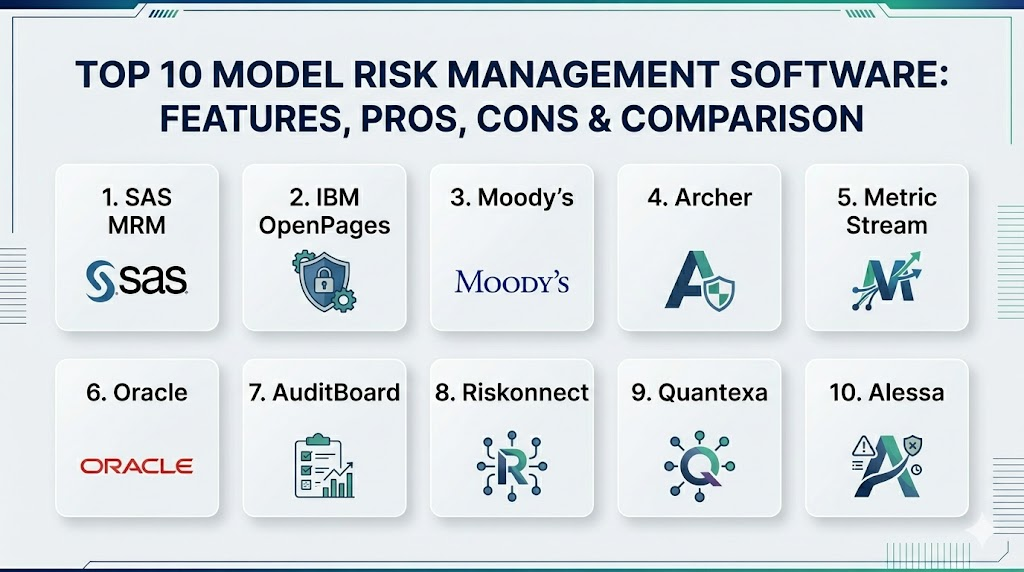
Top 10 Model Risk Management Software Tools
1. SAS Model Risk Management
This platform is a dominant force in the financial sector, providing a comprehensive environment for managing the entire model lifecycle. It excels in large-scale environments where thousands of models must be inventoried and validated simultaneously.
Key Features
- Centralized model inventory with customizable attributes and risk ratings.
- Robust workflow engine for managing model development and independent validation.
- Advanced performance monitoring with automated alerts for model decay.
- Deep integration with the broader SAS risk and analytics ecosystem.
- Automated generation of regulatory-compliant documentation.
Pros
- Exceptional scalability for global institutions managing massive model portfolios.
- Highly mature toolset with decades of industry-specific best practices built-in.
Cons
- Can be complex and time-consuming to configure for specific local needs.
- Requires a significant investment in both licensing and specialized personnel.
Platforms / Deployment
Windows / Linux
Cloud / Hybrid
Security & Compliance
Enterprise-grade encryption, MFA, and detailed audit trails.
SR 11-7, Basel III, and GDPR compliant.
Integrations & Ecosystem
It integrates seamlessly with other SAS products for data management and AML, while also supporting connections to common data science languages.
Support & Community
Professional support is high-level, offering dedicated account managers and a vast network of certified consultants and user groups.
2. IBM OpenPages Model Risk Governance
Part of a larger GRC suite, this tool provides a highly structured approach to model governance. It is particularly strong in using AI to help risk managers identify emerging model threats.
Key Features
- AI-driven assistants to help categorize models and suggest risk levels.
- Dynamic dashboards for executive-level visibility into the total model risk appetite.
- Automated documentation capture during the model development phase.
- Support for a wide range of model types including traditional and AI-based.
- Integrated issue management to track and remediate model findings.
Pros
- Excellent for organizations that want to integrate MRM with broader operational risk.
- Modern, intuitive interface that simplifies the user experience for non-quant users.
Cons
- Implementation can be lengthy if integrating with multiple external data sources.
- Certain advanced AI features may require additional IBM Watson licenses.
Platforms / Deployment
Web / Windows / macOS
Cloud / Self-hosted
Security & Compliance
SSO, RBAC, and SOC 2 Type II compliance.
Aligned with international banking and AI governance standards.
Integrations & Ecosystem
Part of the IBM ecosystem, it connects directly with Watson OpenScale for AI monitoring and various enterprise ERP systems.
Support & Community
Extensive corporate support with global reach, including a robust online knowledge base and professional training programs.
3. Moody’s Analytics MRM Solution
Moody’s provides a specialized solution that leverages their deep expertise in credit and financial modeling. It is designed for institutions that need to balance fast model deployment with rigorous oversight.
Key Features
- Specialized templates for credit, market, and operational risk models.
- Automated validation workflows that follow industry-standard “three lines of defense.”
- Comprehensive model inventory with version control and audit history.
- Real-time monitoring of model performance against pre-defined thresholds.
- Executive-level reporting on model concentrations and aggregate risk.
Pros
- Unrivaled expertise in financial modeling embedded directly into the software.
- Highly effective at reducing the time spent on manual validation tasks.
Cons
- Very focused on financial services; may feel overly specialized for other industries.
- The reporting engine can be rigid and difficult to customize for niche needs.
Platforms / Deployment
Web-based
Cloud / Hybrid
Security & Compliance
Enterprise-grade data protection and user access controls.
Not publicly stated.
Integrations & Ecosystem
Integrates with other Moody’s analytics tools and common banking core systems through standard APIs.
Support & Community
High-end professional services and a community of users within the global financial elite.
4. Archer Model Risk Management
Archer is a leader in the GRC space, and its MRM module provides a flexible, no-code environment for tracking model assets. It is ideal for firms that need to quickly adapt their governance processes.
Key Features
- Flexible, no-code platform for building custom model risk registers.
- Automated assessment campaigns to verify model data and ownership annually.
- Integration of model risk with enterprise-wide risk heat maps.
- Centralized storage for model documentation, code snippets, and test results.
- Detailed task management for tracking validation findings and exceptions.
Pros
- Extremely customizable to match the unique workflows of any organization.
- Strongest capability for linking model risk to other types of business risk.
Cons
- The high level of flexibility can lead to “configuration fatigue.”
- The interface can feel data-heavy compared to more modern, AI-first tools.
Platforms / Deployment
Web / Windows
Cloud / Self-hosted
Security & Compliance
Robust SAML/SSO support and granular permission controls.
Compliant with most major international risk frameworks.
Integrations & Ecosystem
Strongest in its ability to connect with other Archer modules like Third-Party Risk and IT Security.
Support & Community
One of the largest GRC communities in the world, with extensive forums and annual user conferences.
5. MetricStream Model Risk Management
MetricStream offers a highly visual and collaborative platform for MRM. It focuses on breaking down silos between developers, validators, and the business users who rely on the models.
Key Features
- Collaborative workspace for developers and validators to share notes and code.
- Visual model lineage tracking to see how data flows through various algorithms.
- Automated reminders and escalation for overdue model reviews.
- Library of pre-built risk indicators specifically for quantitative models.
- Mobile-responsive dashboards for executive oversight on the go.
Pros
- Excellent user adoption due to its modern and clean interface.
- Strongest tools for cross-departmental collaboration and communication.
Cons
- Can require significant initial setup to map complex organizational structures.
- Advanced analytics features may require custom development in some cases.
Platforms / Deployment
Web / iOS / Android
Cloud / Hybrid
Security & Compliance
ISO 27001 and SOC 2 compliant infrastructure.
Not publicly stated.
Integrations & Ecosystem
Offers a wide range of connectors for common data science platforms like R and Python.
Support & Community
Professional support is well-regarded, particularly for its onboarding and implementation services.
6. Oracle Financial Services Model Risk Management
Oracle provides an enterprise-grade solution built on its powerful database technology. It is specifically designed for high-volume environments where data integrity and auditability are paramount.
Key Features
- Massive scalability for storing and processing model metadata.
- Integrated data governance to ensure the quality of model inputs.
- Automated workflow routing based on model materiality and risk levels.
- Comprehensive audit logs that capture every change made to a model record.
- Advanced reporting engine for generating complex regulatory filings.
Pros
- The most stable and high-performance option for massive data environments.
- Deeply integrated with Oracle’s wider suite of financial services applications.
Cons
- The interface can feel more technical and “database-centric” than competitors.
- Implementation typically requires a team of specialized Oracle consultants.
Platforms / Deployment
Windows / Linux
Cloud / Self-hosted
Security & Compliance
Built on Oracle’s high-security database architecture with advanced encryption.
Basel III and international financial standards compliant.
Integrations & Ecosystem
Best suited for organizations already using Oracle’s financial or ERP ecosystems.
Support & Community
Standard Oracle Premier Support with global 24/7 availability and extensive training resources.
7. AuditBoard RiskOversight
AuditBoard has disrupted the market with a highly automated, user-friendly platform. While it covers broader risk, its specialized MRM capabilities are favored by internal audit teams.
Key Features
- Automated evidence collection to prove models are being monitored.
- Direct integration between model risk and internal audit workpapers.
- Intuitive “risk owner” portals that make it easy for non-experts to update records.
- Real-time syncing between the model inventory and executive dashboards.
- Collaborative workspace for managing and resolving audit findings.
Pros
- The fastest implementation time among enterprise-grade MRM solutions.
- Exceptional user experience that drives high engagement from business units.
Cons
- May lack some of the deeper “quantitative testing” features found in SAS or Moody’s.
- Targeted more toward audit and compliance than the “front-end” model development.
Platforms / Deployment
Web-based
Cloud (SaaS)
Security & Compliance
SOC 2 Type II and HIPAA compliant.
Focuses heavily on supporting SOX and internal audit standards.
Integrations & Ecosystem
Strongest in its ability to connect with other audit and compliance tools via a robust API.
Support & Community
Highly rated for customer success and a growing community of modern audit professionals.
8. Riskonnect Model Risk Governance
Riskonnect uses the power of the Salesforce platform to provide a highly flexible and integrated MRM solution. It excels in organizations that want a single “source of truth” for all types of risk.
Key Features
- Built on the Salesforce platform, allowing for massive customization.
- Integrated AI (Agentforce) to automate risk scoring and reporting.
- Comprehensive relationship mapping between models, data sources, and vendors.
- Real-time collaboration tools for risk committees and model owners.
- Highly visual dashboards with drag-and-drop report building.
Pros
- Benefits from the security and reliability of the global Salesforce infrastructure.
- Unmatched ability to customize the platform without writing custom code.
Cons
- Pricing can be high due to the combination of platform and module fees.
- Can feel overwhelming if the organization does not already use Salesforce.
Platforms / Deployment
Web / iOS / Android
Cloud
Security & Compliance
Salesforce Shield security including field-level encryption and audit trails.
Not publicly stated.
Integrations & Ecosystem
Seamless integration with thousands of apps in the Salesforce AppExchange.
Support & Community
Global support network with specialized expertise in integrated risk management.
9. Quantexa Decision Intelligence Platform
Quantexa takes a data-first approach to model risk, using advanced “entity resolution” to understand how models and data are interconnected across the entire enterprise.
Key Features
- Advanced network visualization to see “hidden” dependencies between models.
- Real-time data quality monitoring for model inputs.
- Automated detection of data drift and model bias.
- Scalable architecture designed to handle billions of data points.
- Decision-oriented dashboards that highlight the most critical risks.
Pros
- The best tool for understanding the “ripple effect” of a single model failure.
- Exceptional at identifying data quality issues before they impact model results.
Cons
- Requires a high level of data maturity to get the most value.
- More of a data platform than a traditional “check-the-box” governance tool.
Platforms / Deployment
Linux / Windows
Cloud / Hybrid
Security & Compliance
Enterprise-grade data security with support for private cloud deployments.
Not publicly stated.
Integrations & Ecosystem
Integrates deeply with big data environments and cloud data warehouses.
Support & Community
Professional support focused on high-end data engineering and risk analytics.
10. Alessa by Tier1 Financial Solutions
Alessa is a unified platform that combines AML, fraud, and risk scoring. Its MRM features are built specifically to govern the models used in financial crime detection.
Key Features
- Specialized governance for AML and transaction monitoring models.
- Automated “challenger model” testing to compare different algorithms.
- Real-time scoring of model health based on recent performance data.
- Integrated case management for tracking model-related issues.
- Simplified reporting for regulatory examiners and auditors.
Pros
- The most focused tool for governing “financial crime” models specifically.
- Very efficient at managing the specific regulatory demands of AML auditors.
Cons
- May be too narrow for firms looking to manage a broad range of industrial models.
- Interface is functional but less “modern” than some leading GRC tools.
Platforms / Deployment
Web / Windows
Cloud / Self-hosted
Security & Compliance
Standard financial-grade security and user access management.
Not publicly stated.
Integrations & Ecosystem
Strongest when used as part of the broader Alessa compliance suite.
Support & Community
Good professional support with a focus on compliance and regulatory expertise.
Comparison Table
| Tool Name | Best For | Platform(s) Supported | Deployment | Standout Feature | Public Rating |
| 1. SAS MRM | Global Banks | Win, Linux | Hybrid | Quantitative Depth | N/A |
| 2. IBM OpenPages | Integrated GRC | Win, macOS | Cloud | AI Assistants | N/A |
| 3. Moody’s | Credit Risk | Web-based | Hybrid | Credit Expertise | N/A |
| 4. Archer | Custom Workflows | Web, Windows | Hybrid | No-Code Flexibility | N/A |
| 5. MetricStream | Collaboration | Web, Mobile | Hybrid | Visual Lineage | N/A |
| 6. Oracle | Data Integrity | Win, Linux | Self-hosted | Massive Scalability | N/A |
| 7. AuditBoard | Audit Readiness | Web-based | Cloud | User Experience | N/A |
| 8. Riskonnect | Unified Risk | Web, Mobile | Cloud | Salesforce Platform | N/A |
| 9. Quantexa | Data Dependencies | Win, Linux | Hybrid | Entity Resolution | N/A |
| 10. Alessa | AML Compliance | Web, Windows | Cloud | AML Specificity | N/A |
Evaluation & Scoring
| Tool Name | Core (25%) | Ease (15%) | Integrations (15%) | Security (10%) | Perf (10%) | Support (10%) | Value (15%) | Total |
| 1. SAS MRM | 10 | 4 | 9 | 9 | 9 | 9 | 5 | 8.00 |
| 2. IBM OpenPages | 9 | 7 | 9 | 9 | 8 | 8 | 6 | 8.05 |
| 3. Moody’s | 9 | 6 | 8 | 8 | 9 | 8 | 6 | 7.70 |
| 4. Archer | 8 | 5 | 10 | 9 | 8 | 9 | 7 | 7.95 |
| 5. MetricStream | 8 | 8 | 8 | 8 | 8 | 8 | 7 | 7.85 |
| 6. Oracle | 9 | 4 | 9 | 10 | 10 | 8 | 6 | 7.85 |
| 7. AuditBoard | 7 | 10 | 9 | 9 | 8 | 9 | 8 | 8.25 |
| 8. Riskonnect | 8 | 7 | 10 | 9 | 8 | 8 | 7 | 8.00 |
| 9. Quantexa | 9 | 5 | 8 | 9 | 10 | 7 | 7 | 7.75 |
| 10. Alessa | 7 | 7 | 7 | 8 | 8 | 7 | 9 | 7.35 |
The scoring above is based on how well each tool addresses the needs of a modern enterprise. AuditBoard and IBM OpenPages score highly due to their balance of powerful features and high usability, which is critical for driving adoption across non-technical departments. SAS and Oracle remain the gold standard for pure performance and depth, but their lower scores in “Ease of Use” and “Value” reflect the significant resource investment they require.
Which Model Risk Management Software Tool Is Right for You?
Solo / Freelancer
For a consultant or independent auditor, a full enterprise MRM suite is likely overkill. However, AuditBoard offers the most accessible path if you are hired to manage risk for a client, due to its intuitive interface and rapid setup.
SMB
Small to mid-sized firms should prioritize MetricStream or Alessa. These tools provide the necessary governance without the overwhelming complexity of a Tier-1 banking platform, making them easier to manage with a smaller team.
Mid-Market
Growing organizations that already use a major CRM or ERP should look for integration. Riskonnect is the logical choice for Salesforce users, while Archer provides the flexibility to grow your risk program as your model inventory expands.
Enterprise
For global institutions with thousands of complex models, SAS Model Risk Management or Oracle are the only tools with the necessary “quantitative muscle” to handle the workload. These platforms are designed specifically for the extreme audit and regulatory pressure of the enterprise level.
Budget vs Premium
If budget is a primary concern, focusing on a SaaS-based platform like AuditBoard will reduce infrastructure costs. If you need a premium, “best-in-class” solution for financial risk, Moody’s Analytics provides the most industry-specific value.
Feature Depth vs Ease of Use
If your team consists of high-level quantitative analysts, the depth of SAS or Houdini-style procedural logic in Quantexa will be appreciated. If your goal is to get business managers to take ownership of risk, IBM OpenPages or AuditBoard are much better choices.
Integrations & Scalability
For organizations looking to scale, Oracle and Archer provide the most robust frameworks for adding thousands of records and connecting to a wide variety of external data sources.
Security & Compliance Needs
If you are operating in a highly regulated environment like the EU or a major financial hub, SAS, IBM, and Oracle provide the most documented evidence of compliance with international security and financial standards.
Frequently Asked Questions (FAQs)
1. Why is model risk management suddenly so important?
As models and AI take over more business decisions, a single error can scale instantly across thousands of transactions, leading to massive financial losses before a human can intervene.
2. What is the “three lines of defense” in MRM?
It is an industry standard where the first line (developers) builds the model, the second line (validators) checks it, and the third line (internal audit) ensures the entire process is working correctly.
3. Can these tools govern AI and Large Language Models (LLMs)?
Yes, modern MRM tools have been updated specifically to track the unique risks of AI, such as “hallucinations,” data bias, and the lack of transparency in neural networks.
4. How does MRM software help with the EU AI Act?
It provides the mandatory documentation, risk assessments, and transparency records that regulators require for “high-risk” AI systems under the new law.
5. What is “Model Drift” and how does the software catch it?
Model drift happens when the real-world data changes so much that the model’s predictions become inaccurate. The software monitors this by constantly comparing predictions to actual outcomes.
6. Do we need a dedicated “Model Validator” team?
For highly regulated industries like banking, yes. Most MRM software is designed to facilitate a “hand-off” between the developers and an independent validation team.
7. Is it possible to manage model risk in a simple spreadsheet?
While possible for 5-10 simple models, it becomes impossible to maintain audit trails, version control, and real-time monitoring for dozens or hundreds of models without specialized software.
8. How long does it take to implement an MRM platform?
A SaaS-based tool can be up in 4-8 weeks, while a full enterprise deployment for a global bank can take 6 months to a year.
9. What is “Explainable AI” (XAI) in these tools?
XAI features provide a “reasoning” for why an AI model made a specific decision, which is a legal requirement in many financial and medical applications.
10. Can these tools identify ethical bias in my algorithms?
Many modern tools include “fairness” scanners that check if your model is producing different outcomes for protected groups, helping you stay ahead of ethical and legal challenges.
Conclusion
Model Risk Management has transitioned from a niche requirement for high-end finance to a universal necessity for any organization deploying automated decision-making. The software you choose will define your ability to innovate safely while staying ahead of increasingly aggressive global regulators. Whether you opt for the quantitative power of a legacy giant or the agile automation of a modern cloud platform, the ultimate goal remains the same: ensuring that your models are assets, not liabilities. By centralizing oversight and automating validation, you turn risk management from a burden into a strategic advantage that fosters trust and long-term resilience.

Best Cardiac Hospitals Near You
Discover top heart hospitals, cardiology centers & cardiac care services by city.
Advanced Heart Care • Trusted Hospitals • Expert Teams
View Best Hospitals