Introduction
Municipal tax collection systems are specialized financial platforms designed for local government authorities to manage the entire lifecycle of revenue generation. These systems handle the assessment, billing, collection, and distribution of local taxes—most notably property taxes, business licenses, and utility fees. In an era defined by fiscal transparency and digital transformation, these platforms serve as the financial heart of a city, ensuring that the revenue needed for public services like infrastructure, safety, and education is collected efficiently and equitably.
In the current landscape, the shift toward cloud-native architectures and integrated GIS (Geographic Information Systems) has redefined how municipalities interact with their constituents. Modern systems prioritize citizen self-service, allowing residents to view assessments and pay bills from any device, which significantly reduces the administrative burden on government staff. Furthermore, as data security and regulatory compliance become increasingly complex, these systems provide the necessary guardrails to protect sensitive taxpayer information while ensuring that all collections adhere to local and state statutes.
Best for: City and county treasurers, tax assessors, municipal finance directors, and local government IT managers seeking to automate high-volume revenue cycles and improve citizen engagement.
Not ideal for: Small private businesses, federal-level tax agencies, or organizations that do not manage geographic-based taxing districts or parcel-level data.
Key Trends in Municipal Tax Collection Systems
- Hyper-Automation of Billing: Systems now utilize robotic process automation to generate thousands of tax bills instantly, reducing manual errors and mailing delays.
- GIS-Centric Analysis: Integrating spatial data allows tax collectors to visualize revenue trends, identify unassessed parcels, and manage special taxing districts on a map.
- Citizen-Centric Portals: Round-the-clock digital access for taxpayers to manage exemptions, appeal valuations, and set up automated payment plans.
- AI-Driven Delinquency Prediction: Machine learning algorithms analyze historical payment patterns to predict which accounts are at risk of default, enabling proactive outreach.
- Real-Time Data Synchronization: Seamless connectivity between the assessor’s office and the treasurer’s office ensures that any change in property value is immediately reflected in the billing system.
- Contactless Payment Integration: Support for mobile wallets, digital checks, and real-time bank transfers has become a standard requirement for increasing collection rates.
- Quantum-Resistant Security: As cyber threats evolve, municipal systems are adopting advanced encryption to protect the massive repositories of personal and financial data they hold.
- Sustainability Tracking: New modules are being introduced to track environmental taxes and incentives, aligning municipal revenue with green city initiatives.
How We Selected These Tools
- Public Sector Specialization: We focused on platforms built specifically for the unique legal and financial requirements of local governments.
- Proven Scalability: The selected tools have a track record of managing massive tax rolls for major metropolitan areas and diverse counties.
- Security and Compliance: Priority was given to systems that meet rigorous standards for data protection and financial auditing.
- Interoperability: We evaluated how easily these systems connect with existing municipal ERPs, GIS databases, and banking interfaces.
- Citizen Feedback Loops: Systems were chosen based on the quality of the end-user experience for residents and business owners.
- Innovation Trajectory: We included providers that are actively investing in artificial intelligence and cloud-native features to future-proof municipal operations.
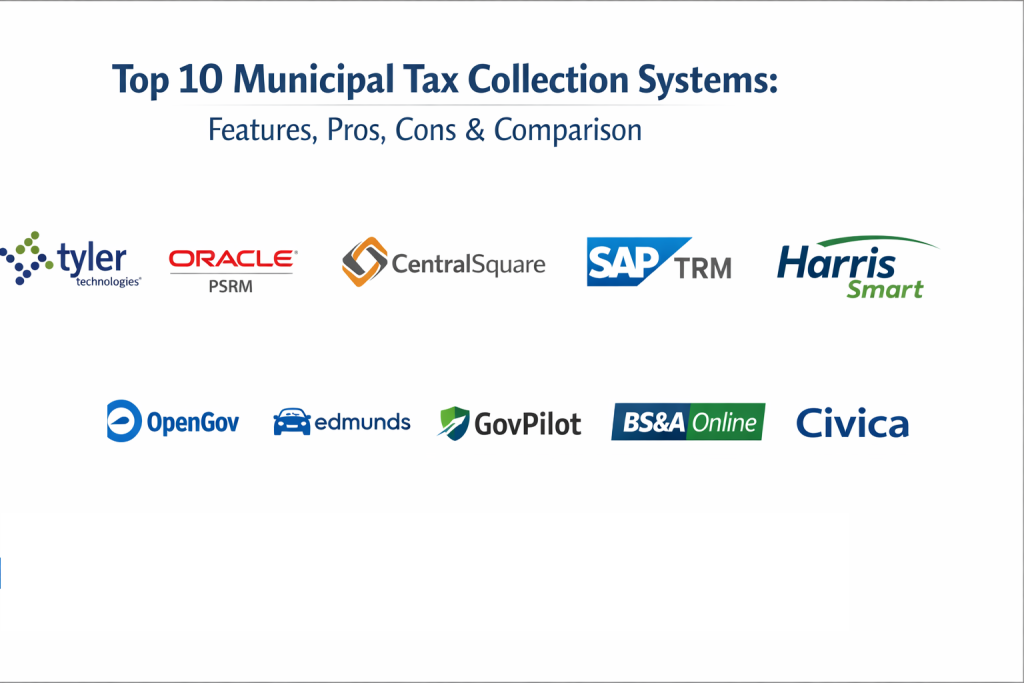
Top 10 Municipal Tax Collection Systems
1. Tyler Technologies Enterprise ERP
A dominant force in the public sector, this platform (formerly known as Munis) provides a comprehensive revenue management suite that covers everything from property appraisal to delinquent collections. It is designed to be the single source of truth for a municipality’s financial data.
Key Features
- Full parcel lifecycle management from assessment to final payment.
- Automated reconciliation with bank files to eliminate manual balancing issues.
- Integrated GIS tools for spatial analysis of tax districts and property values.
- Advanced tax sale and foreclosure management workflows.
- Citizen self-service portal for bill viewing and electronic payments.
Pros
- Deepest feature set for complex legislative and tax rule configurations.
- Seamless integration with a wider suite of government ERP modules.
Cons
- Implementation process is extensive and requires significant staff training.
- Higher price point compared to smaller, niche-focused competitors.
Platforms / Deployment
Windows / Web
Cloud / Hybrid
Security & Compliance
FedRAMP authorized with FIPS 140-2 encryption standards.
Not publicly stated.
Integrations & Ecosystem
Integrates natively with Tyler’s broader ecosystem, including appraisal and community development tools. It also supports robust APIs for third-party financial institutions.
Support & Community
One of the largest user communities in the industry with dedicated state-level user groups and extensive documentation.
2. Oracle Public Sector Revenue Management
Designed for large-scale operations, Oracle’s solution is built to handle millions of transactions with high-speed batch processing. It is favored by major metros and state-level agencies that require extreme performance and reliability.
Key Features
- High-performance billing engine capable of processing massive tax rolls.
- Configurable rules engine for managing complex and shifting tax laws.
- Holistic 360-degree view of the taxpayer across all revenue types.
- Automated workflow management for multi-step approval processes.
- Robust audit trails for every financial transaction and record modification.
Pros
- Unmatched scalability for the world’s largest government entities.
- Highly flexible configuration for unique regional tax structures.
Cons
- Requires a highly technical IT team to manage and maintain.
- User interface can be more complex than modern cloud-native startups.
Platforms / Deployment
Web / Windows / Linux
Cloud / Hybrid
Security & Compliance
ISO 27001 and SOC 2 compliant with global data privacy adherence.
Not publicly stated.
Integrations & Ecosystem
Part of the broader Oracle ecosystem, it connects seamlessly to global financial and reporting tools used by large-scale government organizations.
Support & Community
Global professional support network with 24/7 availability and extensive enterprise-level training programs.
3. CentralSquare Property Tax
This cloud-native solution is built on a modern infrastructure to provide a secure and scalable platform for tax billing and collection. It focuses on simplifying complex tax configurations and improving the speed of revenue collection.
Key Features
- Cloud-based architecture ensuring high availability and disaster recovery.
- Automated billing and delinquent notice generation.
- Real-time reporting dashboards for monitoring revenue performance.
- Configurable interest and penalty calculation methods.
- Secure online payment processing for all resident types.
Pros
- Rapid deployment compared to traditional on-premise systems.
- Intuitive user interface that reduces the learning curve for staff.
Cons
- Some advanced customization options may be limited compared to enterprise suites.
- Internet dependency means performance relies on local connectivity.
Platforms / Deployment
Web / Windows
Cloud (AWS Hosted)
Security & Compliance
Built on highly secure AWS infrastructure with standard data encryption.
Not publicly stated.
Integrations & Ecosystem
Strong focus on interoperability with other municipal modules like building permits and utility billing.
Support & Community
Active customer success programs and a growing community of cloud-focused municipal finance professionals.
4. SAP Tax and Revenue Management
SAP provides an integrated approach that connects tax collection directly to the wider organizational ERP. It is ideal for “smart cities” that want a unified view of all financial activities from a single dashboard.
Key Features
- Single source of truth for all taxpayer interactions and history.
- Real-time financial insights and predictive revenue forecasting.
- Automated compliance checks and anomaly detection for fraud prevention.
- Self-service portals that support multiple languages and payment types.
- Scalable architecture for both mid-sized cities and massive metros.
Pros
- Exceptional for data-driven organizations focused on long-term strategy.
- Integrates tax data directly into the city’s overall financial planning.
Cons
- Cost of ownership is high, often requiring specialized consultants.
- The system can be more “rigid” than platforms built only for tax.
Platforms / Deployment
Web / Windows / Linux
Cloud / On-Premise
Security & Compliance
Compliant with global standards including GDPR and ISO 27001.
Not publicly stated.
Integrations & Ecosystem
Deeply embedded in the SAP ecosystem, allowing for seamless data flow between HR, Finance, and Public Works.
Support & Community
Massive global support network with a focus on enterprise-level business transformation.
5. Harris Local Government (SmartFusion)
SmartFusion is designed specifically for small to mid-sized municipalities. It provides a powerful and integrated tax billing module that is affordable for towns that don’t need the complexity of a global enterprise system.
Key Features
- Integrated suite covering finance, tax, and utility billing.
- Streamlined property tax billing and receipting workflows.
- Automated delinquent tracking and penalty applications.
- User-friendly interface tailored for smaller municipal teams.
- Robust reporting for monthly and annual financial audits.
Pros
- Excellent value-to-performance ratio for smaller budget cities.
- Highly responsive customer support tailored to local government needs.
Cons
- May lack some of the cutting-edge AI features found in larger platforms.
- Reporting customization can be less flexible than top-tier enterprise tools.
Platforms / Deployment
Windows
Cloud-Hosted / On-Premise
Security & Compliance
Standard financial security protocols and audit logging.
Not publicly stated.
Integrations & Ecosystem
Functions as an all-in-one suite for small governments, reducing the need for multiple third-party integrations.
Support & Community
Known for a “small-town” service feel with high levels of personal support and specialized user training.
6. OpenGov Revenue
OpenGov has disrupted the traditional market with a sleek, cloud-native platform focused on transparency and user experience. It is a favorite for modern finance directors who want to move away from legacy paper-based processes.
Key Features
- Import wizard that validates tax data before final processing.
- Real-time revenue dashboards for elected officials and the public.
- Automated digital billing that can reduce postage costs by 30%.
- Seamless integration with national credit card and e-check providers.
- Mobile-friendly interface for field assessors and public users.
Pros
- The most modern and aesthetically pleasing user interface in the category.
- Drastically reduces the time spent on manual data entry and phone calls.
Cons
- Relatively newer in the market compared to 80-year-old incumbents.
- Feature depth for very specific, obscure tax laws is still growing.
Platforms / Deployment
Web / iOS / Android
Cloud
Security & Compliance
SOC 2 compliant with advanced encryption and identity management.
Not publicly stated.
Integrations & Ecosystem
Built to be part of the OpenGov cloud, it connects perfectly with budgeting and communication modules.
Support & Community
Highly rated for its modern onboarding process and proactive customer success team.
7. Edmunds GovTech
A staple for local governments, especially on the East Coast of the US, Edmunds is known for its reliable and feature-rich tax modules that have been refined over decades of use.
Key Features
- Integrated GIS GeoAnalyst for spatial tax visualization.
- Support for Personal Property, Real Estate, and Utility taxes.
- Automated reconciliations with bank lockbox files.
- Robust tax sale management and lien tracking.
- Citizen portal for 24/7 billing access and payments.
Pros
- Extremely reliable and stable, even during high-volume billing cycles.
- Deeply understood by auditors and government financial professionals.
Cons
- Only available on Windows for local installations.
- The interface is functional but lacks the modern look of cloud-only tools.
Platforms / Deployment
Windows
Cloud-Hosted / Local
Security & Compliance
Detailed audit logs and secure transaction processing.
Not publicly stated.
Integrations & Ecosystem
Strong internal ecosystem that connects tax to finance and project management within the Edmunds suite.
Support & Community
Very loyal user base with a long history of professional support and regional training events.
8. GovPilot
GovPilot takes a modular approach to digitizing government, offering a specific tax assessment and collection workflow that focuses on eliminating paper-heavy processes and improving efficiency.
Key Features
- Parcel-level integration with interactive GIS maps.
- Automated workflow for property assessment and tax appeals.
- Digital forms for address changes and tax list requests.
- Automated email and SMS reminders for tax deadlines.
- Real-time reporting on collection rates and delinquent accounts.
Pros
- Incredibly flexible and can be customized to match any local workflow.
- Affordable for small and medium-sized local governments.
Cons
- As a modular platform, it may require more setup time to get exactly right.
- The “all-in-one” ERP features are not as deep as Tyler or Oracle.
Platforms / Deployment
Web / iOS / Android
Cloud
Security & Compliance
Cloud-based disaster recovery and secure data encryption.
Not publicly stated.
Integrations & Ecosystem
Built to connect with a wide variety of third-party payment processors and GIS providers.
Support & Community
Modern support model with extensive video libraries and rapid-response technical assistance.
9. BS&A Online
BS&A is widely regarded for having some of the highest customer satisfaction ratings in the industry. Its tax and assessing modules are known for being both powerful and exceptionally easy to use.
Key Features
- Seamless linkage between Assessing, Tax, and Finance databases.
- Automated demand notices and professional tax bill printing.
- Powerful mass-update tools for changing millage rates across the city.
- Intuitive “Property Search” feature for both staff and the public.
- Strict audit trails that record every change made to a record.
Pros
- Consistently rated as having the best customer support in the business.
- The interface is designed specifically for the way tax clerks actually work.
Cons
- Geographic availability has traditionally been focused on specific regions.
- Primarily focused on Windows environments for non-web tasks.
Platforms / Deployment
Windows / Web
Cloud / Hybrid
Security & Compliance
Secure transaction processing with detailed audit logging.
Not publicly stated.
Integrations & Ecosystem
Excellent internal integration that ensures data only needs to be entered once for the entire organization.
Support & Community
Exceptional reputation for support, with many users citing their technicians as industry experts.
10. Civica Financials
Civica is a major international player, providing comprehensive financial management solutions tailored for local authorities in regions like the UK, Australia, and parts of Asia.
Key Features
- Integrated financial management suite (GL, AP, AR, and Tax).
- Real-time analytics and business intelligence for finance directors.
- Automated compliance for local tax laws and VAT.
- Citizen-facing self-service portals for billing and inquiries.
- Scalable architecture designed for both small councils and large metros.
Pros
- Excellent for international municipalities with complex regulatory needs.
- Strong focus on data-driven decision-making and public transparency.
Cons
- Less common in the North American market compared to Tyler or Edmunds.
- The full suite can be a significant investment for smaller organizations.
Platforms / Deployment
Web / Windows
Cloud / Hybrid
Security & Compliance
ISO 27001 certified with strict adherence to regional data privacy laws.
Not publicly stated.
Integrations & Ecosystem
Built to be a central financial system that handles all municipal revenue and expenditure in one place.
Support & Community
Strong international presence with dedicated regional support teams and a focus on digital government innovation.
Comparison Table
| Tool Name | Best For | Platform(s) Supported | Deployment | Standout Feature | Public Rating |
| 1. Tyler Tech | Large Enterprise | Win, Web | Hybrid | GIS Integration | N/A |
| 2. Oracle PSRM | Tier 1 Metros | Web, Win, Linux | Hybrid | Batch Processing | N/A |
| 3. CentralSquare | Cloud Adoption | Web, Win | Cloud | AWS Infrastructure | N/A |
| 4. SAP TRM | Smart Cities | Web, Win, Linux | Hybrid | Unified ERP | N/A |
| 5. Harris (Smart) | SMB Towns | Windows | Hybrid | Integrated Suite | N/A |
| 6. OpenGov | Transparency | Web, iOS, Android | Cloud | Digital Billing | N/A |
| 7. Edmunds | Local Stability | Windows | Hybrid | GeoAnalyst GIS | N/A |
| 8. GovPilot | Workflow Digits | Web, iOS, Android | Cloud | Modular Maps | N/A |
| 9. BS&A Online | User Experience | Win, Web | Hybrid | Data Linking | N/A |
| 10. Civica | International | Web, Windows | Hybrid | Global Compliance | N/A |
Evaluation & Scoring
| Tool Name | Core (25%) | Ease (15%) | Integrations (15%) | Security (10%) | Perf (10%) | Support (10%) | Value (15%) | Total |
| 1. Tyler Tech | 10 | 5 | 10 | 10 | 9 | 9 | 6 | 8.55 |
| 2. Oracle PSRM | 10 | 3 | 9 | 10 | 10 | 8 | 5 | 7.70 |
| 3. CentralSquare | 8 | 8 | 8 | 9 | 8 | 8 | 7 | 7.95 |
| 4. SAP TRM | 9 | 4 | 10 | 10 | 9 | 9 | 5 | 8.05 |
| 5. Harris (Smart) | 7 | 9 | 7 | 8 | 7 | 9 | 9 | 7.85 |
| 6. OpenGov | 8 | 10 | 9 | 9 | 8 | 9 | 8 | 8.85 |
| 7. Edmunds | 8 | 7 | 8 | 8 | 8 | 9 | 8 | 8.00 |
| 8. GovPilot | 7 | 9 | 8 | 8 | 7 | 8 | 9 | 7.95 |
| 9. BS&A Online | 8 | 10 | 8 | 8 | 8 | 10 | 8 | 8.50 |
| 10. Civica | 8 | 7 | 8 | 9 | 8 | 8 | 7 | 7.70 |
The scoring model above emphasizes that while some platforms excel in technical power, others offer superior value and accessibility. A high total score for OpenGov reflects its leadership in modernizing the user experience, while Tyler Technologies remains the high-water mark for deep core features and security. For smaller towns, platforms like BS&A or Harris offer higher scores in ease of use and support, which are often more critical than the sheer processing power required by an Oracle-tier system.
Which Municipal Tax Collection Software Tool Is Right for You?
Solo / Freelancer
Local government software is rarely used by solo operators; however, a freelance assessor or tax consultant would find GovPilot or OpenGov the most accessible due to their cloud-native, browser-based nature.
SMB
Smaller towns and villages with limited IT staff should look toward Harris (SmartFusion) or BS&A Online. These systems are designed to be “out of the box” solutions that don’t require a dedicated team of server administrators to keep them running.
Mid-Market
Mid-sized cities and larger counties need the robust feature sets of Edmunds GovTech or CentralSquare. These platforms provide the necessary balance of deep local government functionality and modern cloud scalability.
Enterprise
For Tier 1 cities and state-level agencies, Tyler Technologies and Oracle PSRM are the standard. These organizations require the absolute maximum in security, transaction volume handling, and complex inter-departmental data flow.
Budget vs Premium
- Budget: GovPilot or Harris provide the best feature-to-cost ratio for smaller budgets.
- Premium: Tyler Technologies and SAP TRM represent the high-end investment for organizations that need a complete, city-wide transformation.
Feature Depth vs Ease of Use
If your priority is the staff’s ability to pick up the software in a single afternoon, BS&A Online is the winner. If your priority is the ability to handle every possible edge case of tax law, Tyler Technologies provides the necessary depth.
Integrations & Scalability
OpenGov and Civica are built for the future of the integrated city, offering modern APIs that connect tax data to every other part of the municipal digital infrastructure.
Security & Compliance Needs
Large counties handling hundreds of millions of dollars should prioritize Oracle or Tyler, as they have the most established track records in meeting the highest levels of government security compliance (FedRAMP, FIPS).
Frequently Asked Questions (FAQs)
1. How long does it take to implement a new tax system?
A typical implementation for a mid-sized city takes between 6 to 12 months, involving data conversion, staff training, and rigorous testing before the go-live date.
2. Can these systems handle water and utility billing as well?
Many of the integrated suites like Tyler, Harris, and Edmunds offer utility modules that share the same parcel and customer database as the tax system.
3. What is the benefit of moving municipal tax data to the cloud?
Cloud deployment ensures better disaster recovery, easier software updates, and the ability for staff and citizens to access information securely from any location.
4. Do these systems help with tax appeals?
Yes, modern platforms like GovPilot and OpenGov include specific modules for citizens to submit appeals online and for assessors to track the status of those disputes.
5. How do these systems prevent financial fraud?
They utilize strict role-based access controls (RBAC), multi-factor authentication, and immutable audit logs that record every transaction and record change.
6. Can a municipality use a system from a different country?
While possible, it is not recommended unless the software has been specifically localized for the tax laws and reporting standards of the municipality’s region.
7. How often should a city upgrade its tax software?
Most cities look to modernize every 10 to 15 years, though cloud-native systems now receive continuous updates that eliminate the need for massive “once-a-decade” overhauls.
8. Is GIS integration really necessary for tax collection?
While not strictly required, GIS is highly recommended as it allows assessors to visually identify missed revenue opportunities and better manage complex taxing districts.
9. Can these systems send automated SMS tax reminders?
Yes, the newest platforms like OpenGov and GovPilot include automated communication engines that can notify residents of deadlines via text, email, and mobile apps.
10. Do these platforms support digital signatures?
Most modern tax systems now integrate with e-signature tools to allow for the paperless filing of exemptions and other legal documents.
Conclusion
The modernization of municipal tax collection is no longer a luxury but a fundamental requirement for sustainable governance. The transition from legacy, paper-driven systems to cloud-native platforms like those highlighted in this guide allows local governments to increase revenue accuracy while drastically improving the resident experience. Choosing the right system requires a deep understanding of your municipality’s specific transaction volume, technical resources, and long-term digital goals. By selecting a platform that prioritizes security, interoperability, and citizen engagement, city leaders can ensure a resilient financial future for their communities. Round-the-clock digital access for taxpayers to manage exemptions, appeal valuations, and set up automated payment plans.

Best Cardiac Hospitals Near You
Discover top heart hospitals, cardiology centers & cardiac care services by city.
Advanced Heart Care • Trusted Hospitals • Expert Teams
View Best Hospitals