Introduction
Nutrition practice management tools are specialized software platforms designed to streamline the clinical and administrative workflows of dietitians, nutritionists, and health coaches. These systems consolidate several fragmented tasks—such as scheduling appointments, maintaining electronic health records (EHR), creating meal plans, and managing insurance billing—into a single digital command center. By automating the “business” side of a practice, these tools allow practitioners to dedicate more time to client care and metabolic analysis rather than manual paperwork.
In the current professional landscape, digital-first care is the standard. Clients now expect seamless mobile access for food logging, asynchronous messaging for accountability, and instant telehealth connections. For a modern practice, these tools serve as a bridge between clinical expertise and client adherence. They provide the infrastructure necessary to scale from a solo consultancy to a multi-location clinic while ensuring that all data remains secure and compliant with global health regulations.
Real-World Use Cases
- Automated client onboarding where intake forms and legal consents are signed digitally before the first session.
- Real-time food journal monitoring that allows practitioners to provide instant feedback on a client’s dietary choices via a mobile app.
- Secure telehealth consultations that include screen-sharing for reviewing blood work or complex nutrient analysis reports.
- Seamless insurance claim submission (CMS-1500) and superbill generation for practices that operate on a reimbursement model.
- Group coaching program delivery where educational content and meal plans are released to multiple participants on a set schedule.
Evaluation Criteria for Buyers
- The depth of nutrition-specific features such as calorie/macro databases and meal plan generators.
- Compliance with data privacy standards including HIPAA, GDPR, and other regional health information acts.
- Ease of use for both the practitioner’s back-office and the client’s mobile interface.
- Availability of integrated billing systems for credit card processing and insurance management.
- Strength of automation features like appointment reminders, recurring invoices, and automated follow-up emails.
- Scalability for adding additional team members or managing multiple office locations.
- Quality of technical support and the presence of an active professional community for networking.
Best for: Registered dietitians, certified nutrition specialists, health coaches, and multidisciplinary wellness clinics seeking to digitize their operations.
Not ideal for: General administrative assistants who do not handle clinical data, or fitness trainers who only require basic workout tracking without nutritional analysis.
Key Trends in Nutrition Practice Management Tools
- The integration of artificial intelligence to automate food recognition from photos, drastically reducing the time clients spend logging meals.
- A shift toward “dynamic” nutrition planning where meal plans adjust in real-time based on a client’s activity data from wearables.
- Increased focus on “white-label” solutions that allow practices to have their own branded apps in the App Store.
- The rise of automated habit tracking that nudges clients to stay hydrated or take supplements through push notifications.
- Enhanced integration with laboratory platforms, allowing practitioners to order blood tests and receive results directly within the client’s chart.
- Shift toward hybrid care models that combine live video sessions with pre-recorded educational “vaults” or courses.
- Improved AI-assisted note-taking that can transcribe a telehealth session and suggest ADIME or SOAP note entries.
- Growth in genomic and microbiome data integration for truly personalized precision nutrition protocols.
How We Selected These Tools
The selection of these top ten nutrition management tools is based on an evaluation of their professional utility within the dietetic and wellness industry. We prioritized platforms that offer a specialized “nutrition-first” experience rather than generic medical software. The methodology focused on the reliability of their nutritional databases, the robustness of their HIPAA-compliant security measures, and their reputation among active practitioners. We also ensured a balance between tools that excel in clinical insurance-based settings and those designed for cash-pay coaching models. Final consideration was given to user feedback regarding the mobile app experience, as client engagement is a primary driver of success in nutrition counseling.
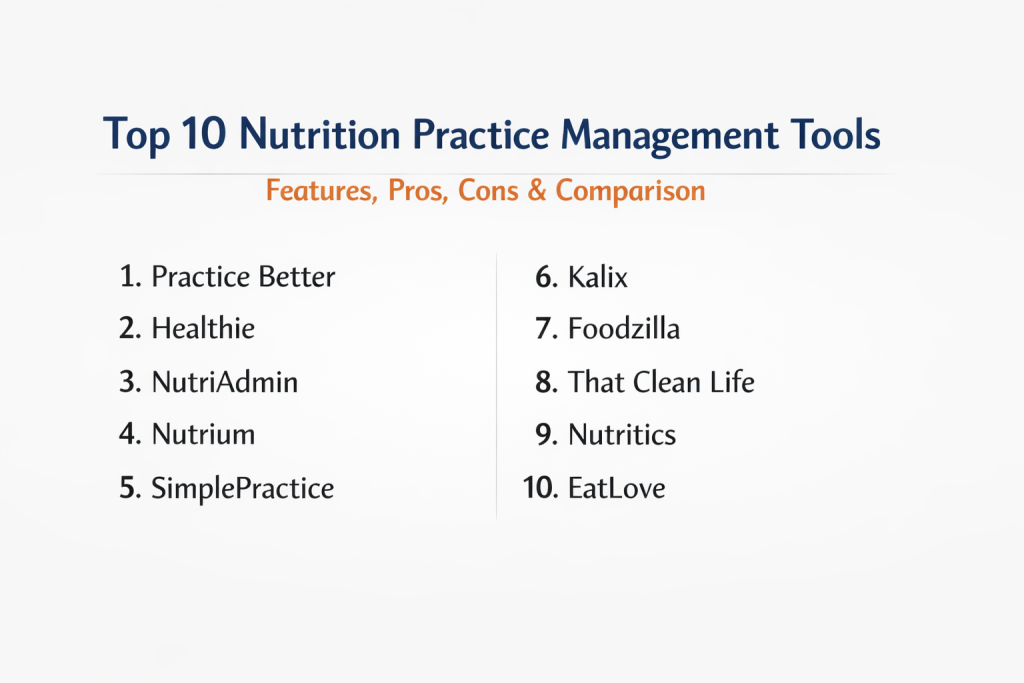
Top 10 Nutrition Practice Management Tools
1. Practice Better
Practice Better is widely recognized as the industry leader for wellness-focused practices. It offers an exceptionally deep feature set that covers everything from initial booking to the delivery of complex, multi-week coaching programs. It is highly praised for its automation capabilities and its polished client mobile app.
Key Features
- Comprehensive client portal for secure messaging, food logging, and document sharing.
- Advanced program builder for delivering automated courses and group coaching.
- Professional protocol builder for creating detailed supplement and lifestyle recommendations.
- Seamless integration with third-party labs and meal planning tools.
- Robust automation for scheduling, reminders, and payment processing.
Pros
- The most complete “all-in-one” experience for nutrition professionals.
- Excellent mobile app that keeps clients highly engaged.
Cons
- The high number of features can be overwhelming for a brand-new solo practitioner.
- Advanced automation is only available in the higher-priced tiers.
Platforms / Deployment
Web / iOS / Android — Cloud
Security & Compliance
HIPAA, GDPR, and PIPEDA compliant with advanced data encryption.
Integrations & Ecosystem
It features strong links with That Clean Life for meal planning and Rupa Health for lab testing. It also syncs with major calendars and payment processors like Stripe.
Support & Community
A very active user community and the “Practice Better Academy” provide extensive training for building a successful digital practice.
2. Healthie
Healthie is a powerful EHR and practice management platform that shines in clinical and insurance-based environments. It is designed to scale with large organizations and offers deep functionality for both individual practitioners and multidisciplinary teams.
Key Features
- HIPAA-compliant EHR with customizable charting templates (ADIME/SOAP).
- Integrated insurance billing including CMS-1500 forms and eligibility checks.
- Secure telehealth platform built directly into the system for individual and group sessions.
- Comprehensive food and metric tracking with photo logging for clients.
- Sophisticated reporting for tracking business growth and client outcomes.
Pros
- The strongest choice for practices that rely heavily on insurance reimbursement.
- Highly scalable for group practices and enterprise-level clinics.
Cons
- The interface can feel more clinical and less “lifestyle-oriented” than some competitors.
- Pricing is generally higher, reflecting its enterprise-grade capabilities.
Platforms / Deployment
Web / iOS / Android — Cloud
Security & Compliance
SOC 2 Type II, HIPAA, and HITRUST certified for maximum data protection.
Integrations & Ecosystem
Integrates with specialized billing platforms like Claim.MD and major health trackers like Apple Health and Fitbit.
Support & Community
Provides dedicated account managers for larger teams and a comprehensive “Healthie University” for onboarding.
3. NutriAdmin
NutriAdmin is a specialized tool that focuses on the core needs of nutritionists: client records and meal planning. It is known for its “no-fluff” approach, providing a clean and logical interface that avoids unnecessary medical jargon.
Key Features
- Advanced meal plan generator that can create full plans in under a minute based on specific macros.
- Customizable intake questionnaires that automatically populate client records upon completion.
- Professional report builder for providing clients with high-quality summary documents.
- Built-in nutrition analysis for recipes and daily food logs.
- Integrated calendar for managing appointments and automated reminders.
Pros
- Extremely efficient for practitioners who focus heavily on bespoke meal planning.
- One of the most straightforward and easy-to-learn platforms on the market.
Cons
- Lacks a dedicated native mobile app (uses a mobile-responsive web portal).
- Fewer features for hosting group courses or community forums.
Platforms / Deployment
Web — Cloud
Security & Compliance
HIPAA and GDPR compliant with secure, encrypted data storage.
Integrations & Ecosystem
Strong integration with Stripe for payments and Google Calendar for schedule syncing.
Support & Community
Highly responsive technical support and a wealth of written tutorials for quick troubleshooting.
4. Nutrium
Nutrium is a clinical-focused software that prioritizes nutritional science and dietary analysis. It is an excellent choice for practitioners who want to provide highly technical dietary guidance supported by accurate data.
Key Features
- Deep nutritional analysis with a massive international food database.
- Automated calculation of basal metabolic rate (BMR) and caloric requirements.
- Client-facing mobile app for tracking water intake, meals, and physical activity.
- Built-in tools for managing a professional website and booking page.
- Integrated messaging for maintaining a continuous line of communication with clients.
Pros
- Best-in-class tools for detailed micro and macronutrient targeting.
- Very strong features for international practitioners with support for multiple languages.
Cons
- The billing and payment features are not as robust as Practice Better or Healthie.
- Can feel overly technical for coaches who take a more habit-based approach.
Platforms / Deployment
Web / iOS / Android — Cloud
Security & Compliance
GDPR and HIPAA compliant.
Integrations & Ecosystem
Syncs with popular fitness apps and wearables to provide a holistic view of client health.
Support & Community
Provides a strong blog for professional development and a proactive customer success team.
5. SimplePractice
While SimplePractice is a general healthcare management tool, it is widely used by nutritionists who want a simple, visually clean platform. It excels at the “business” side of a practice, making billing and scheduling effortless.
Key Features
- An exceptionally intuitive client portal for booking and secure document sharing.
- Fully paperless intake process with electronic signature capabilities.
- Integrated credit card processing with “AutoPay” for recurring clients.
- Secure telehealth platform with no additional software downloads required.
- Simple insurance filing and claim tracking for solo practitioners.
Pros
- The most user-friendly and aesthetically pleasing interface in the industry.
- Simplifies financial management and tax preparation better than most tools.
Cons
- Lacks deep nutrition-specific tools like meal plan generators or calorie databases.
- Customization of clinical notes is not as flexible as platforms like Healthie.
Platforms / Deployment
Web / iOS / Android — Cloud
Security & Compliance
HITRUST and HIPAA compliant with bank-level encryption.
Integrations & Ecosystem
Limited third-party nutrition integrations, focusing more on its own internal tools.
Support & Community
Offers a massive knowledge base and “SimplePractice Learning” for continuing education credits.
6. Kalix
Kalix is a cost-effective, clinically focused EHR designed for dietitians who need a robust system without the high price tag. It is often cited as the best value for solo practitioners just starting their journey.
Key Features
- Flexible clinical charting templates that follow professional dietetic standards (ADIME).
- Intelligent appointment and payment reminders via text, voice, and email.
- Simplified insurance billing and superbill generation.
- Secure faxing capabilities, which are often necessary for coordinating with doctors.
- Client messaging and secure document storage.
Pros
- One of the most affordable professional-grade options available.
- Highly customizable templates allow you to work exactly how you want.
Cons
- The user interface can feel slightly dated compared to newer modern platforms.
- Meal planning tools are basic and may require a separate third-party tool.
Platforms / Deployment
Web — Cloud
Security & Compliance
HIPAA compliant and aligned with professional healthcare standards.
Integrations & Ecosystem
Integrates with Stripe for payments and offers standard export features for clinical data.
Support & Community
Strong documentation and a reputation for helpful, one-on-one technical support.
7. Foodzilla
Foodzilla is a modern, tech-forward platform that utilizes AI to improve client adherence. It is specifically designed for the next generation of nutritionists who want to offer a high-tech, engaging experience.
Key Features
- AI-powered food logging that allows clients to log meals simply by taking a photo.
- Automated meal plan generation with a focus on high-quality visual presentation.
- Real-time communication and progress tracking via a sleek mobile app.
- Professional recipe management with automated nutritional labeling.
- Advanced analytics for tracking client goals and behavioral trends.
Pros
- High client engagement rates due to the effortless AI food logging.
- Very modern feel that appeals to tech-savvy clients.
Cons
- Being newer to the market, it may lack some of the deep clinical charting found in older tools.
- The web-based dashboard for practitioners is not as feature-rich as the mobile app.
Platforms / Deployment
Web / iOS / Android — Cloud
Security & Compliance
Secure data handling and privacy protocols in line with modern standards.
Integrations & Ecosystem
Growing list of integrations with wearables and fitness tracking platforms.
Support & Community
Active development team and a growing community of forward-thinking nutritionists.
8. That Clean Life
That Clean Life is primarily a meal planning and recipe management tool that has evolved to offer robust practice features. It is the gold standard for practitioners who prioritize the “food-first” part of their guidance.
Key Features
- A massive, professionally vetted recipe database with beautiful food photography.
- Drag-and-drop meal plan builder with automated grocery list generation.
- Ability to filter recipes by hundreds of specific allergens, diets, and nutrient targets.
- Branded handouts and meal plans that look like professional cookbooks.
- Collaboration tools for teams to share recipe collections and templates.
Pros
- Unmatched quality of visual presentation for meal plans and recipes.
- Saves hours of time every week on recipe research and formatting.
Cons
- Not a full-featured EHR; it is often used alongside another management tool.
- Does not handle insurance billing or complex clinical charting.
Platforms / Deployment
Web — Cloud
Security & Compliance
Secure platform for managing and sharing nutritional content.
Integrations & Ecosystem
Strong official integration with Practice Better, allowing you to use its meal plans inside their portal.
Support & Community
Excellent customer support and a community that shares professional meal planning strategies.
9. Nutritics
Nutritics is a heavy-duty clinical and research-grade nutrition tool. It is often the choice for elite sports nutritionists, hospitals, and those working with complex medical cases where every milligram of data matters.
Key Features
- Research-grade accuracy for nutritional analysis with validated food databases.
- Advanced clinical reporting tools for metabolic and dietary monitoring.
- Patient-facing app for high-fidelity food logging and habit tracking.
- Professional menu and recipe analysis with integrated labeling features.
- Multi-user capabilities for large clinical teams and research institutions.
Pros
- Unrivaled data accuracy for clinical and academic purposes.
- Exceptional visual reports that help clients understand complex data.
Cons
- The high level of detail can be “overkill” for a standard weight-loss coach.
- Pricing is high and can be complex based on the modules you need.
Platforms / Deployment
Web / iOS / Android — Cloud
Security & Compliance
ISO 27001 certified, GDPR, and HIPAA compliant.
Integrations & Ecosystem
Widely used in academic and professional sporting environments with specialized data exports.
Support & Community
High-level enterprise support and extensive academic documentation.
10. EatLove
EatLove focuses on personalized nutrition at scale, using an intelligent recommendation engine to provide 24/7 dietary guidance to clients based on their specific health conditions.
Key Features
- Personalized meal recommendations for over 30 health conditions and dietary preferences.
- Dynamic meal swaps that maintain the practitioner’s prescribed nutrient targets.
- Integration with grocery delivery services (like Instacart) for easy plan execution.
- Branded practitioner dashboard for monitoring client adherence in real-time.
- Automated recipe scaling and nutritional analysis.
Pros
- The best choice for providing high-value “concierge” nutrition guidance at scale.
- High client adherence due to the convenience of the grocery integrations.
Cons
- Less focused on traditional “practice management” tasks like scheduling and billing.
- Requires clients to be active users of the app to get the most value.
Platforms / Deployment
Web / iOS / Android — Cloud
Security & Compliance
HIPAA compliant and secure data handling.
Integrations & Ecosystem
Strongest grocery fulfillment integrations in the industry.
Support & Community
Strong onboarding support and regular professional webinars for users.
Comparison Table (Top 10)
| Tool Name | Best For | Platform(s) Supported | Deployment | Standout Feature | Public Rating |
| 1. Practice Better | All-in-One Wellness | Web, iOS, Android | Cloud | Automation & Programs | 4.9/5 |
| 2. Healthie | Insurance-Based Teams | Web, iOS, Android | Cloud | Insurance Workflows | 4.8/5 |
| 3. NutriAdmin | Rapid Meal Planning | Web | Cloud | Fast Plan Generator | 4.7/5 |
| 4. Nutrium | Clinical Analysis | Web, iOS, Android | Cloud | Macro/Micro Targeting | 4.6/5 |
| 5. SimplePractice | Administrative Ease | Web, iOS, Android | Cloud | Billing & UX Simplicity | 4.6/5 |
| 6. Kalix | Budget-Conscious RDs | Web | Cloud | Affordable EHR | 4.4/5 |
| 7. Foodzilla | Tech-Savvy Clients | Web, iOS, Android | Cloud | AI Food Photo Logging | 4.5/5 |
| 8. That Clean Life | Food-First Planning | Web | Cloud | Premium Recipe Library | 4.8/5 |
| 9. Nutritics | Research & Elite Sport | Web, iOS, Android | Cloud | Research-Grade Data | 4.6/5 |
| 10. EatLove | Concierge Guidance | Web, iOS, Android | Cloud | Grocery Fulfillment | 4.5/5 |
Evaluation & Scoring of Nutrition Practice Management Tools
| Tool Name | Core (25%) | Ease (15%) | Integrations (15%) | Security (10%) | Perf (10%) | Support (10%) | Value (15%) | Total |
| 1. Practice Better | 10 | 8 | 10 | 9 | 10 | 9 | 7 | 8.9 |
| 2. Healthie | 10 | 7 | 9 | 10 | 10 | 10 | 6 | 8.7 |
| 3. NutriAdmin | 8 | 10 | 7 | 8 | 9 | 8 | 9 | 8.4 |
| 4. Nutrium | 9 | 8 | 7 | 8 | 9 | 8 | 8 | 8.2 |
| 5. SimplePractice | 7 | 10 | 6 | 9 | 10 | 9 | 8 | 8.2 |
| 6. Kalix | 8 | 6 | 6 | 8 | 8 | 8 | 10 | 7.5 |
| 7. Foodzilla | 7 | 9 | 7 | 8 | 9 | 8 | 8 | 8.0 |
| 8. That Clean Life | 9 | 10 | 8 | 7 | 9 | 9 | 7 | 8.7 |
| 9. Nutritics | 10 | 5 | 8 | 9 | 9 | 8 | 5 | 7.6 |
| 10. EatLove | 8 | 8 | 9 | 8 | 9 | 8 | 7 | 8.0 |
This scoring model compares tools across the essential pillars of a professional nutrition practice. High scores in core features represent the platform’s ability to handle complex clinical tasks, while value scores reflect the return on investment for small to mid-sized businesses.
Which Nutrition Practice Management Tool Is Right for You?
Solo / Freelancer
If you are just starting your business, Practice Better or SimplePractice offer the best combination of ease of use and professional appearance. If budget is your primary constraint, Kalix provides the most essential EHR features at the lowest price point.
SMB (Small to Medium Business)
For growing practices that handle a mix of 1:1 clients and group programs, Practice Better is the undisputed champion of efficiency and automation. It allows you to scale your impact without scaling your administrative workload.
Mid-Market & Multi-Location
If your practice manages 20+ clients and has multiple practitioners, Healthie is designed for your complexity. Its robust reporting and team management features ensure that you have oversight across the entire organization.
Enterprise & Clinical Research
Large hospitals or elite sports organizations should prioritize Nutritics. The research-grade accuracy and enterprise-level data protection (ISO 27001) are mandatory requirements for these high-stakes environments.
Budget vs Premium
- Budget: Kalix or the lower tiers of NutriAdmin.
- Premium: Practice Better (Pro/Plus) or Healthie (Group/Enterprise). Premium tools save significantly more time through advanced automation.
Feature Depth vs Ease of Use
If you need to generate 50 meal plans a week, NutriAdmin or That Clean Life will save you the most time. If you prioritize a beautiful, simple client experience for general health coaching, SimplePractice is the most intuitive.
Integrations & Scalability
If you plan on ordering labs and supplements regularly, Practice Better has the best ecosystem. If you are focused on insurance reimbursement, Healthie is the standard for scalability.
Security & Compliance Needs
Practices operating in the clinical medical model must choose Healthie or Nutritics, as they hold the highest levels of third-party security certifications (SOC 2 and HITRUST) beyond standard HIPAA compliance.
Frequently Asked Questions (FAQs)
1. Do I really need a dedicated practice management tool?
Yes, using fragmented tools like Excel and standard email is often not HIPAA compliant and leads to “tool fatigue.” A dedicated platform centralizes your data and makes your practice look more professional.
2. Are these tools suitable for tele-nutrition?
Most of the tools listed, such as Practice Better, Healthie, and SimplePractice, have fully integrated, HIPAA-compliant video conferencing built directly into the platform.
3. Can I manage both meal plans and clinical notes in one place?
All-in-one tools like Practice Better, NutriAdmin, and Healthie allow you to keep everything in one client file, ensuring your dietary advice is always aligned with your clinical notes.
4. How do these tools handle data security?
Professional platforms use high-level encryption and follow HIPAA (US) and GDPR (EU) regulations to ensure that sensitive health information is protected from unauthorized access.
5. Do my clients have to download an app?
While most platforms offer a client app for better engagement, almost all of them also have a web portal that clients can access through any standard browser on their computer.
6. Can these tools help me get more clients?
Many platforms include “lead magnets,” professional booking pages, and integrated marketing tools that help you convert website visitors into paying clients.
7. Is it hard to move my data from one tool to another?
Most platforms offer data import assistance, allowing you to move your client list and appointment history via CSV files, though clinical notes sometimes require manual migration.
8. Can I use these tools if I am a solo health coach?
Absolutely. Many of these tools have “Solo” or “Starter” plans designed specifically for individuals who don’t need the complex team features of a large clinic.
9. Do these tools integrate with fitness trackers like Fitbit?
Yes, tools like Healthie, Practice Better, and Foodzilla sync directly with Apple Health, Google Fit, and Fitbit to pull in activity data automatically.
10. What is “White-Labeling”?
White-labeling allows you to replace the software’s branding with your own logo and colors, giving your clients the impression that they are using your practice’s own custom-built app.
Conclusion
The selection of a nutrition practice management tool is a critical investment in the future of your business. The “best” tool is the one that minimizes your administrative burden while maximizing your client’s success. Whether you prioritize the clinical depth of Healthie, the automation of Practice Better, or the simplicity of SimplePractice, each of these platforms provides the foundation for a modern, efficient practice. The shift toward digital health is not just about convenience; it is about providing more accurate, data-driven care that leads to better long-term outcomes for your clients. Choosing a platform should be a deliberate process. I recommend shortlisting the two tools that best match your primary business model—whether that is insurance-based clinical work or a private coaching program. By utilizing their free trials, you can experience the workflow firsthand and ensure the interface feels natural for you and your team. Once you have a centralized “command center” for your practice, you will find that scaling your services becomes a much more manageable and rewarding process.

Best Cardiac Hospitals Near You
Discover top heart hospitals, cardiology centers & cardiac care services by city.
Advanced Heart Care • Trusted Hospitals • Expert Teams
View Best Hospitals