Introduction
Obligation tracking tools are specialized software solutions designed to help organizations identify, monitor, and fulfill the specific commitments buried within their contracts and regulatory requirements. In a business context, an obligation isn’t just a signed paper; it is a live requirement—such as a service level agreement (SLA), a recurring payment, a delivery milestone, or a compliance certification—that carries financial or legal risk if ignored. Without centralized tracking, these “hidden” duties often slip through the cracks of manual spreadsheets, leading to contract leakage, penalties, and damaged vendor relationships.
The complexity of global supply chains and the rapid shift toward AI-driven governance have made these tools indispensable. Organizations are no longer looking for simple digital filing cabinets; they need active systems that can “read” a contract, extract the specific duties owed by each party, and trigger automated workflows to ensure those duties are met. Whether it is ensuring a vendor meets a cybersecurity standard or a customer receives their volume discount, effective obligation tracking transforms passive documents into active strategic assets.
Real-World Use Cases
- Procurement & Supply Chain: Monitoring vendor delivery timelines and quality benchmarks to ensure the business receives the value it is paying for.
- Regulatory Compliance: Automatically flagging upcoming audits or reporting deadlines required by frameworks like GDPR, SOC 2, or industry-specific mandates.
- Financial Management: Tracking payment triggers, discount eligibility, and price adjustment clauses to prevent revenue loss.
- IT & Service Management: Ensuring cloud providers and software vendors maintain agreed-upon uptime percentages and support response times.
- Human Resources: Managing employee certification renewals and mandatory training cycles across a distributed workforce.
Evaluation Criteria for Buyers
- AI Extraction Capabilities: Can the tool automatically find and categorize obligations from legacy PDF documents?
- Alerting & Escalation: Does it provide multi-level notifications (email, Slack, in-app) to both owners and secondary reviewers?
- Ownership Mapping: Can you assign specific duties to internal stakeholders with clear accountability trails?
- Reporting & Dashboards: Does it offer a “bird’s-eye view” of all pending, completed, and overdue obligations across the enterprise?
- Integration Depth: How well does it sync with existing CRM, ERP, and project management ecosystems?
- Audit Readiness: Does every action taken toward an obligation leave a permanent, timestamped record?
Best for: Legal operations teams, procurement departments, and compliance officers at mid-sized to large enterprises who manage high volumes of complex, long-term agreements.
Not ideal for: Small businesses with fewer than fifty active contracts or organizations where “obligations” are simple, one-time transactions that do not require ongoing monitoring.
Key Trends in Obligation Tracking Software
- Agentic AI Workers: Software is moving beyond simple “reminders” to AI agents that can draft impact assessments and pre-populate compliance reports for human review.
- Continuous Monitoring: A shift from periodic “snapshot” audits to real-time tracking of system events and access logs to verify compliance instantly.
- USD and Common Data Models: Adoption of standardized frameworks that allow obligation data to flow seamlessly between legal, finance, and IT departments.
- Predictive Risk Scoring: Using machine learning to identify which contracts or vendors are most likely to miss a deadline based on historical performance patterns.
- NLP-Driven Extraction: Natural Language Processing that understands the “intent” of a clause, distinguishing between a firm mandate and a best-effort suggestion.
- ESG Integration: Automated tracking of Environmental, Social, and Governance commitments, which are becoming mandatory in many international jurisdictions.
- Zero-Trust Governance: Ensuring that only authorized personnel can mark an obligation as “complete,” backed by cryptographic audit trails.
- Automated Remediation: Systems that can automatically trigger a “ticket” in Jira or ServiceNow the moment a contract milestone is missed.
How We Selected These Tools
- Market Adoption and Reliability: We focused on tools used by Fortune 500 companies and large regulated enterprises.
- Technical Maturity: Preference was given to platforms with proven AI-extraction and real-time alerting engines.
- User Experience: We evaluated how easily a non-technical user can navigate the dashboard and respond to a task.
- Security Posture: Selected tools must offer enterprise-grade identity management and secure data handling.
- Integration Ecosystem: The ability to pull data from—and push tasks to—major business applications was a critical filter.
- Scalability: We looked for solutions that can handle thousands of obligations across global regions without performance lag.
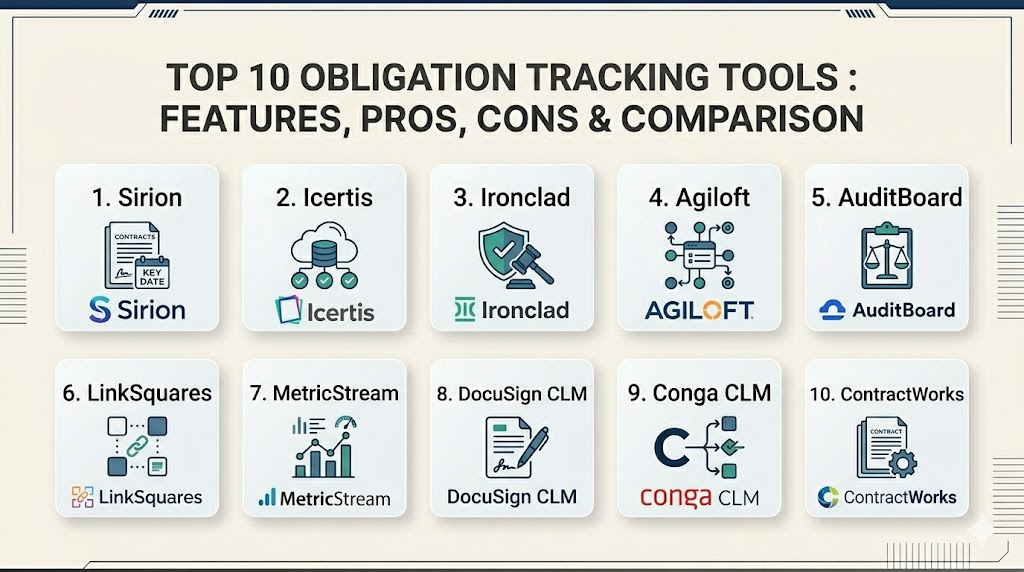
Top 10 Obligation Tracking Tools
1. Sirion
Sirion is an AI-native platform built on an agentic architecture specifically designed for the “Manage” phase of a contract. It uses specialized “Extraction Agents” to pull structured obligations and “Obligation Agents” to track fulfillment in real-time.
Key Features
- AI-driven extraction of service levels, milestones, and financial terms.
- Automated performance tracking against complex vendor SLAs.
- Collaborative dashboards for both buyers and sellers to view obligation status.
- Integration with financial systems to reconcile invoices against contract performance.
- Real-time risk scoring for non-compliant contract sections.
Pros
- Exceptionally deep focus on post-signature performance and value realization.
- Strong at preventing “value leakage” in large-scale procurement.
Cons
- Can be overly complex for organizations only needing basic date reminders.
- Enterprise-level pricing is a significant investment.
Platforms / Deployment
Web / Windows / macOS
Cloud
Security & Compliance
SSO/SAML, MFA, and SOC 2 Type II compliant.
ISO 27001 and GDPR compliant.
Integrations & Ecosystem
Integrates deeply with ERP systems like SAP and Oracle, as well as CRMs like Salesforce to ensure that contract duties align with financial and sales operations.
Support & Community
High-end enterprise support with dedicated customer success managers and extensive technical documentation.
2. Icertis Contract Intelligence
Icertis is a leading enterprise-grade platform known for its ability to turn contracts into strategic data. It provides a massive library of pre-built compliance frameworks and advanced AI for global obligation management.
Key Features
- Intelligent obligation discovery across millions of legacy contract pages.
- Mapping of obligations to internal corporate policies and external regulations.
- Advanced reporting for global governance and audit transparency.
- Low-code configuration for specialized industry workflows.
- Real-time monitoring of regulatory changes that impact existing contracts.
Pros
- Unmatched scalability for multinational organizations with complex cross-border needs.
- Highly secure environment preferred by heavily regulated industries.
Cons
- Lengthy implementation timeline due to its comprehensive nature.
- Requires significant internal resources to manage and configure.
Platforms / Deployment
Web / Windows / macOS
Cloud / Hybrid
Security & Compliance
SOC 1, SOC 2, ISO 27001, and HIPAA compliant.
SSO and multi-org support.
Integrations & Ecosystem
Strong partnerships with Microsoft, SAP, and Salesforce, allowing it to act as the “source of truth” for contract data across the entire enterprise stack.
Support & Community
Global support network with 24/7 coverage and a mature user community through the Icertis “Experience” events.
3. Ironclad
Ironclad is a modern, highly intuitive platform that focuses on “digital contracting” and workflow automation. It is a favorite among fast-growing tech companies for its ease of use and powerful data-tagging capabilities.
Key Features
- Visual Workflow Designer for automating approval and obligation routing.
- AI-powered “Smart Repository” that automatically tags key dates and duties.
- Seamless collaboration tools for internal legal and business teams.
- Deep two-way data sync with Salesforce and other CRM platforms.
- Dynamic dashboards to track contract volume and upcoming milestones.
Pros
- Extremely fast time-to-value compared to traditional enterprise CLM.
- Beautiful, modern interface that drives high user adoption across departments.
Cons
- Post-signature obligation tracking is less granular than Sirion or Icertis.
- Pricing can escalate quickly as user counts and contract volumes grow.
Platforms / Deployment
Web / iOS / Android
Cloud
Security & Compliance
SOC 2 Type II, GDPR, and CCPA compliant.
Audit trails and granular role-based access.
Integrations & Ecosystem
Native integrations with Salesforce, Slack, DocuSign, and Google Drive, making it easy to incorporate into daily work routines.
Support & Community
Excellent digital documentation and a growing community of legal operations professionals.
4. Agiloft
Agiloft is a highly configurable, no-code platform that allows organizations to build custom obligation tracking workflows without writing a single line of code. It is ideal for teams with unique or evolving processes.
Key Features
- No-code engine for creating custom data fields and automation rules.
- Advanced obligation and compliance monitoring for complex SLAs.
- Configurable approval chains that can change based on contract value or risk.
- Robust reporting engine that allows for deep data slices.
- Automated email and text alerts for upcoming deadlines.
Pros
- Infinite flexibility to mirror exactly how your organization works.
- Known for high customer satisfaction and a transparent implementation process.
Cons
- The interface can feel more utilitarian and “database-like” than modern competitors.
- Extensive customization can lead to a more complex setup if not managed carefully.
Platforms / Deployment
Web / Windows / macOS / Linux
Cloud / Self-hosted / Hybrid
Security & Compliance
SOC 2, HIPAA, and GDPR compliant.
Granular permissions and encryption at rest.
Integrations & Ecosystem
A vast library of pre-built connectors for Adobe Sign, DocuSign, Salesforce, and NetSuite, as well as an open API for custom needs.
Support & Community
Excellent support with high ratings for responsiveness; offers a unique “Money-Back Guarantee” on implementations.
5. AuditBoard
While primarily a GRC (Governance, Risk, and Compliance) tool, AuditBoard is powerful for tracking regulatory obligations and internal controls. it is the top choice for internal audit and compliance teams.
Key Features
- Automated evidence collection and control testing for major frameworks.
- Centralized dashboard for tracking all compliance-related obligations.
- AI-powered documentation and workflow automation for audit readiness.
- Real-time risk alerts and gap analysis for regulatory updates.
- Collaborative workspace for managing corrective action plans.
Pros
- Designed specifically for the “three lines of defense” in corporate governance.
- drasticaly reduces the manual effort required for audit preparation.
Cons
- Not a full contract management suite; less focused on commercial terms.
- Can be expensive as organizations add more modules for ESG or InfoSec.
Platforms / Deployment
Web
Cloud
Security & Compliance
SOC 2 Type II and ISO 27001 certified.
SSO/SAML and advanced encryption.
Integrations & Ecosystem
Integrates with Jira, ServiceNow, and Slack to turn compliance gaps into actionable tasks for IT and operations teams.
Support & Community
Strong professional community and highly-rated onboarding services.
6. LinkSquares
LinkSquares is an AI-first platform that excels at analyzing existing contract repositories to surface hidden risks and obligations. It is built to help legal teams answer “What is in our contracts?” in seconds.
Key Features
- High-accuracy AI for extracting clauses and obligations from PDFs.
- Centralized, searchable repository with automated metadata tagging.
- Visual dashboards to track contract lifecycle and renewal dates.
- Simplified drafting and approval workflows for new agreements.
- AI-driven contract summaries for quick stakeholder review.
Pros
- Exceptional search and analysis capabilities for legacy documents.
- Clean, focused interface that avoids unnecessary enterprise bloat.
Cons
- Workflow automation is less customizable than Agiloft.
- Best suited for legal-led organizations rather than complex procurement.
Platforms / Deployment
Web
Cloud
Security & Compliance
SOC 2 Type II and GDPR compliant.
Standard encryption and access controls.
Integrations & Ecosystem
Strong integration with Salesforce and DocuSign, with a focus on streamlining the sales-to-legal handoff.
Support & Community
Known for a high-touch customer success model and proactive training.
7. MetricStream
MetricStream is a comprehensive GRC platform that manages complex regulatory environments for Fortune 500 companies. It excels at mapping “The Law” to “The Obligation” at an enterprise scale.
Key Features
- AI-driven regulatory change management that monitors global feeds.
- Federated data model that maps control statements to thousands of regulations.
- Centralized library for all policies, obligations, and audit artifacts.
- Real-time executive dashboards for enterprise-wide risk visibility.
- Automated incident response and exception management workflows.
Pros
- The “heavy hitter” for organizations in banking, healthcare, and energy.
- Powerful ability to unify cybersecurity, ESG, and financial compliance.
Cons
- The sheer scale of the tool makes it overkill for many mid-market firms.
- Requires a significant technical and financial commitment to deploy.
Platforms / Deployment
Web
Cloud / Hybrid
Security & Compliance
Meets the highest global security standards for enterprise software.
SOC 2, ISO 27001, and HIPAA ready.
Integrations & Ecosystem
Deeply integrated with major ERP systems like SAP and Oracle to ensure compliance data is tied to business performance.
Support & Community
Mature enterprise support with global reach and a wide network of consulting partners.
8. DocuSign CLM
Formerly SpringCM, DocuSign CLM leverages the world’s most popular e-signature ecosystem to provide a seamless flow from signing to obligation management.
Key Features
- Conditional workflow logic that automates tasks based on contract metadata.
- Integrated AI (DocuSign Insight) for obligation and risk extraction.
- Collaborative editing and redlining directly within the platform.
- Pre-built reporting for contract health and upcoming renewals.
- Native integration with the DocuSign eSignature platform.
Pros
- Natural expansion for organizations already standardized on DocuSign.
- Massive global reach and reliability.
Cons
- Implementation can be longer and more expensive than expected.
- Interface can feel less cohesive than purpose-built modern CLMs.
Platforms / Deployment
Web / iOS / Android
Cloud
Security & Compliance
Industry-leading security with SOC 1, SOC 2, and ISO 27001 certifications.
HIPAA and GDPR compliant.
Integrations & Ecosystem
One of the most extensive integration libraries in the market, particularly strong with Salesforce and SAP.
Support & Community
Vast resources, global support tiers, and a massive ecosystem of implementation partners.
9. Conga CLM
Conga is built primarily for the Salesforce ecosystem, making it the top choice for revenue-focused organizations that need to track obligations tied to sales and renewals.
Key Features
- Quote-to-Contract automation for fast, compliant deal cycles.
- Automated extraction and tracking of financial and delivery obligations.
- High-end document generation using pre-approved templates.
- Real-time alerts for contract milestones and price adjustments.
- Integrated redlining and version control for negotiation speed.
Pros
- The deepest integration with Salesforce of any tool on this list.
- Exceptional at managing high-volume, repetitive commercial contracts.
Cons
- Can feel limited for organizations that do not use Salesforce as their primary CRM.
- The feature set is more focused on “Revenue” than “General Governance.”
Platforms / Deployment
Web
Cloud
Security & Compliance
SOC 2 and GDPR compliant.
Advanced user permissions tied to Salesforce roles.
Integrations & Ecosystem
Optimized for the Salesforce Revenue Cloud, as well as Slack and Microsoft 365.
Support & Community
Large user base with extensive online training through Conga University.
10. ContractWorks
ContractWorks is the “easy-to-use” option for companies transitioning from manual tracking. It focuses on the essentials—secure storage, search, and milestone alerts—without the enterprise complexity.
Key Features
- Rapid implementation that can be completed in as little as 24 hours.
- Automated OCR and keyword search for all uploaded documents.
- Simple, effective email alerts for contract dates and obligations.
- User-friendly reporting for quick audits and board meetings.
- Unlimited user seat licensing on most plans.
Pros
- incredibly simple to set up and use from day one.
- predictable, transparent pricing that is accessible for SMBs.
Cons
- Lacks advanced AI features for deep obligation extraction.
- No complex workflow or redlining tools for negotiation.
Platforms / Deployment
Web
Cloud
Security & Compliance
SOC 2 and HIPAA compliant.
Data encryption and granular folder-level permissions.
Integrations & Ecosystem
Focused on the core essentials; integrates with standard e-signature tools.
Support & Community
Highly rated for simple, human-to-human technical support.
Comparison Table
| Tool Name | Best For | Platform(s) Supported | Deployment | Standout Feature | Public Rating |
| 1. Sirion | Procurement Value | Win, macOS | Cloud | Obligation Agents | N/A |
| 2. Icertis | Global Governance | Win, macOS | Hybrid | Compliance Library | N/A |
| 3. Ironclad | Digital Workflows | iOS, Android | Cloud | Visual Designer | N/A |
| 4. Agiloft | Custom Processes | Win, macOS, Linux | Hybrid | No-code Configuration | N/A |
| 5. AuditBoard | Internal Audit | Web | Cloud | Automated Evidence | N/A |
| 6. LinkSquares | Legacy Analysis | Web | Cloud | AI Clause Extraction | N/A |
| 7. MetricStream | Regulatory Change | Web | Hybrid | Federated Data Model | N/A |
| 8. DocuSign CLM | Signature Continuity | iOS, Android | Cloud | Native eSign Sync | N/A |
| 9. Conga CLM | Revenue Operations | Web | Cloud | Salesforce Depth | N/A |
| 10. ContractWorks | Quick Adoption | Web | Cloud | Unlimited Users | N/A |
Evaluation & Scoring
| Tool Name | Core (25%) | Ease (15%) | Integrations (15%) | Security (10%) | Perf (10%) | Support (10%) | Value (15%) | Total |
| 1. Sirion | 10 | 5 | 9 | 9 | 10 | 8 | 6 | 8.15 |
| 2. Icertis | 10 | 4 | 10 | 10 | 10 | 9 | 5 | 8.20 |
| 3. Ironclad | 8 | 10 | 9 | 8 | 9 | 9 | 7 | 8.45 |
| 4. Agiloft | 9 | 7 | 9 | 9 | 8 | 10 | 8 | 8.55 |
| 5. AuditBoard | 7 | 8 | 8 | 10 | 9 | 9 | 7 | 7.85 |
| 6. LinkSquares | 8 | 9 | 8 | 8 | 9 | 9 | 8 | 8.45 |
| 7. MetricStream | 10 | 3 | 9 | 10 | 9 | 8 | 5 | 7.75 |
| 8. DocuSign CLM | 8 | 7 | 10 | 10 | 9 | 8 | 6 | 7.95 |
| 9. Conga CLM | 9 | 6 | 10 | 9 | 9 | 8 | 7 | 8.15 |
| 10. ContractWorks | 5 | 10 | 6 | 8 | 8 | 9 | 10 | 7.35 |
The scoring provided above serves as a comparative benchmark to assist in navigating a crowded marketplace. High total scores generally indicate platforms that offer a superior balance of modern user experience, deep integration, and core feature strength. For instance, Agiloft and Ironclad score highly because they adapt easily to a wide range of business sizes while maintaining high security. Conversely, a tool like ContractWorks may have a lower “Core” score because it lacks advanced AI, yet it remains the top choice for value and ease for smaller teams.
Which Obligation Tracking Tool Is Right for You?
Solo / Freelancer
If you are managing a small personal portfolio, ContractWorks or even a basic project management tool like Trello is usually sufficient. The goal is simple date tracking rather than complex legal analysis.
SMB
Small to medium businesses should prioritize Ironclad or LinkSquares. These platforms allow you to modernize quickly without needing a dedicated IT team to manage the software, while still providing powerful AI tools.
Mid-Market
For organizations with several departments and hundreds of contracts, Agiloft offers the best balance. Its no-code engine allows you to build custom workflows for legal, finance, and procurement without expensive consultant fees.
Enterprise
Large multinational firms should look at Icertis or Sirion. These tools are built to handle the sheer volume and complexity of global operations, ensuring that nothing is lost across multiple languages and jurisdictions.
Budget vs Premium
- Budget: ContractWorks offers a low-cost, high-speed path to basic organization.
- Premium: Icertis or MetricStream provide the highest levels of governance and automation for a premium price.
Feature Depth vs Ease of Use
- Depth: MetricStream and Sirion provide unparalleled detail for the most demanding compliance needs.
- Ease of Use: Ironclad and Juro are widely considered the most user-friendly platforms available today.
Integrations & Scalability
If your entire company lives in Salesforce, Conga CLM is the logical choice. If you need a tool that can scale from one department to twenty, Agiloft and Icertis are the most proven platforms.
Security & Compliance Needs
For projects with high security requirements (e.g., government or medical contracts), AuditBoard and DocuSign CLM offer the most robust and recognized security certifications in the industry.
Frequently Asked Questions (FAQs)
1. What is the difference between CLM and obligation tracking?
Contract Lifecycle Management (CLM) covers the entire life of a document from drafting to signature, while obligation tracking focuses specifically on ensuring the promises made in that document are fulfilled after the signature.
2. Can AI really extract obligations accurately?
Modern AI can extract standard obligations (dates, payments) with over 90% accuracy, but complex legal mandates still require human review to ensure context and intent are fully understood.
3. Why should we stop using spreadsheets for contract tracking?
Spreadsheets lack automated alerts, have no audit trails, and are prone to human error, which significantly increases the risk of missing a high-value renewal or a critical compliance deadline.
4. How long does it take to implement these tools?
Simple tools like ContractWorks can be ready in days, while enterprise-grade systems like Icertis or MetricStream can take six to twelve months to fully integrate with all business systems.
5. Do these tools handle regulatory compliance as well as contracts?
Yes, tools like AuditBoard and MetricStream are built specifically to map external regulatory changes directly to internal corporate obligations and control tests.
6. Can obligation tracking help with vendor management?
Absolutely. By tracking vendor SLAs and delivery milestones, you can hold suppliers accountable and negotiate better terms based on their actual performance data.
7. Is cloud or self-hosted better for obligation tracking?
Cloud is the modern standard for speed and collaboration, but highly sensitive industries like defense or high-finance sometimes choose hybrid or self-hosted models for total data control.
8. What is “value leakage” in a contract?
Value leakage occurs when a company pays for services it doesn’t receive, or fails to claim discounts and penalties it is entitled to because the contract terms weren’t tracked properly.
9. Do I need a lawyer to manage the software?
While legal teams often “own” the software, modern tools are designed to be managed by “Legal Ops” or procurement professionals who don’t necessarily need a law degree to operate the system.
10. How do these tools integrate with Slack or Microsoft Teams?
Most modern platforms can send automated notifications directly to team channels, allowing stakeholders to view and mark tasks as complete without ever leaving their primary chat app.
Conclusion
Fulfilling contractual duties is a critical component of professional governance that directly impacts a company’s bottom line and legal standing. Transitioning from manual, fragmented tracking to a dedicated obligation management platform is no longer a luxury but a necessity in a fast-paced, highly regulated global market. By choosing a tool that aligns with your organization’s specific complexity and integration needs, you can move from a reactive posture to a proactive strategy that secures value and minimizes risk. The “best” tool is the one that your team will actually use, so prioritize adoption and integration to ensure long-term success.

Best Cardiac Hospitals Near You
Discover top heart hospitals, cardiology centers & cardiac care services by city.
Advanced Heart Care • Trusted Hospitals • Expert Teams
View Best Hospitals