Introduction
Operating Room (OR) scheduling software is a specialized class of healthcare technology designed to coordinate the complex logistics of surgical departments. At its core, it manages the allocation of operating theaters, surgical teams, anesthesia providers, and high-value medical equipment. Unlike general appointment tools, OR software must account for “block time” (pre-assigned slots for specific surgeons), case duration variability, and the high-stakes transition between elective and emergency procedures.
The operating room is no longer just a clinical space; it is the financial engine of the hospital. With surgical services often accounting for over 60% of hospital revenue, the shift toward AI-driven predictive scheduling has become essential. Modern systems now utilize real-time data to “nudge” surgeons to release unused time, predict case overruns before they happen, and automate the grueling task of staff credentialing and shift swapping. This ensures that the most expensive square footage in the hospital is utilized to its maximum potential while reducing clinician burnout.
Real-World Use Cases
- Block Utilization Optimization: Automatically identifying patterns where surgeons consistently underutilize their assigned time and offering those slots to others.
- Emergency Case Integration: Using real-time “traffic control” dashboards to slot urgent trauma cases into the schedule with minimal disruption to elective lists.
- Vendor & Equipment Tracking: Coordinating with external vendors to ensure specialized implants or robotic systems are onsite and sterilized before the patient arrives.
- Predictive Staffing: Aligning the surgical schedule with nursing and anesthesia availability to prevent room delays caused by personnel shortages.
- Patient Readiness Monitoring: Tracking whether pre-operative clearances (labs, cardiac consults) are complete to prevent day-of-surgery cancellations.
Evaluation Criteria for Buyers
- EHR Integration Depth: Does the tool live natively within the patient record (like Epic or Cerner) or act as a “best-of-breed” overlay?
- Predictive Accuracy: How well does the AI predict actual case lengths based on historical surgeon performance versus “estimated” times?
- Mobile Accessibility: Can surgeons and staff check their schedules, swap shifts, or receive delay alerts on their personal devices?
- Anesthesia Coordination: Does the software include modules for managing anesthesia groups and their specific specialty requirements?
- Credentialing & Compliance: Does the system automatically block uncredentialed staff from being assigned to specific high-risk procedures?
- Reporting & Analytics: Are there “one-click” dashboards for measuring turnover time, prime-time utilization, and surgeon-specific cost-per-case?
Best for: Hospital administrators, surgical directors, and perioperative managers in large health systems or busy ambulatory surgery centers (ASCs) focused on maximizing surgical throughput and revenue.
Not ideal for: Small, single-room diagnostic clinics or outpatient facilities with low volume where the cost and complexity of an enterprise-grade OR system would outweigh the efficiency gains.
Key Trends in Operating Room Scheduling Software
- Predictive AI “Nudging”: Modern systems now send automated mobile alerts to surgeons suggesting they release block time they are unlikely to use based on historical data.
- Real-Time Visibility Displays: Large-screen “flight control” boards in the OR hub that provide a live, color-coded view of every room’s status, from “Cleaning” to “In-Progress.”
- Automated Surgeon Preference Cards: Digital cards that update automatically based on actual supply usage, ensuring the right instruments are prepped for every case.
- Cloud-Native Interoperability: A shift toward platforms that can pull data from multiple different EHRs, allowing health systems to manage multiple sites from a single dashboard.
- Patient-Centric Transparency: Portals that provide families with real-time, anonymized updates on a patient’s progress through the surgical pipeline.
- Dynamic Capacity Modeling: Using “digital twin” technology to simulate how changes in the schedule (like adding a new robotic room) will impact staffing and recovery room beds.
- Integrated Supply Chain Management: Linking the schedule directly to inventory systems to trigger “just-in-time” ordering for specialized surgical kits.
- Staff Well-being Modules: AI-driven rostering that ensures fair distribution of on-call shifts and prevents excessive overtime for specialized surgical nurses.
How We Selected These Tools
- Market Presence and Reliability: We focused on tools that are currently used by high-volume academic medical centers and leading health networks.
- Clinical Workflow Integration: Preference was given to systems that minimize data entry for nurses and allow surgeons to interact with the schedule via mobile.
- AI and Predictive Capabilities: Each tool was evaluated on its ability to move beyond “static” scheduling toward dynamic, data-driven optimization.
- Security and Compliance Posture: Selection was limited to vendors with established HIPAA compliance and robust security protocols for handling sensitive patient data.
- Interoperability Standards: We prioritized software that supports modern data exchange standards like FHIR and HL7 for seamless EHR connectivity.
- Proven ROI Metrics: The tools included have demonstrated clear success in increasing surgical volume or reducing turnover times in peer-reviewed case studies.
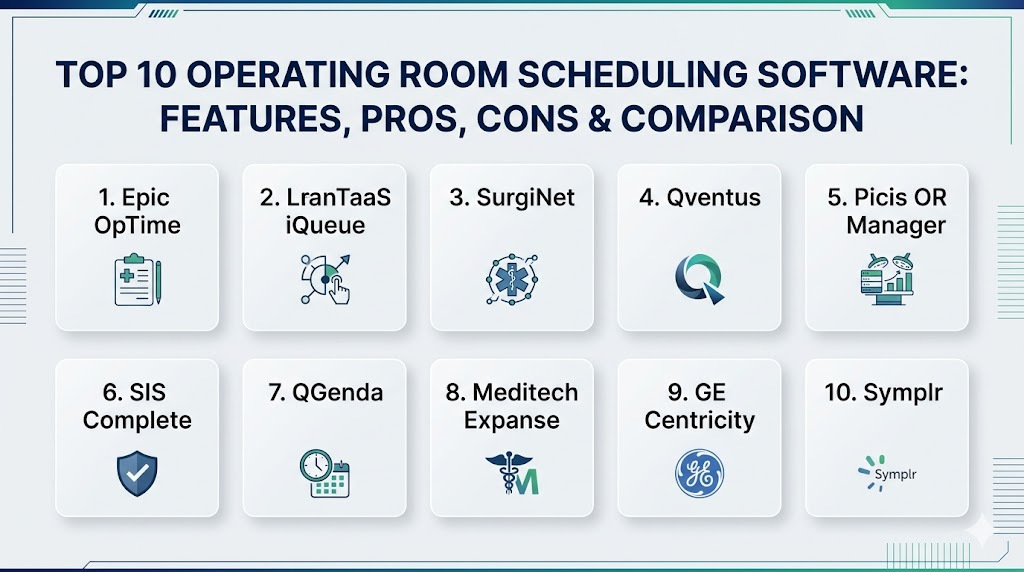
Top 10 Operating Room Scheduling Software Tools
1. Epic OpTime
As the surgical module of the world’s most widely used EHR, Epic OpTime provides a completely integrated experience. It ensures that every detail—from the surgeon’s initial office visit to the final recovery room note—is housed within a single, unified record.
Key Features
- Unified clinical documentation that flows directly into the surgical schedule.
- Advanced “Snapshot” views for anesthesia and nursing staff.
- Integrated preference cards that link directly to hospital inventory.
- Real-time utilization dashboards accessible via the Epic “Status Board.”
- Automated billing triggers based on documented intraoperative events.
Pros
- Eliminates the need for complex interfaces between scheduling and the patient record.
- Industry-leading security framework and widespread familiarity among medical staff.
Cons
- Extremely high cost and complex implementation for non-Epic hospitals.
- UI can be dense, requiring significant training for new administrative staff.
Platforms / Deployment
Windows / iOS / Android
Hybrid (On-premise with cloud-hosted management)
Security & Compliance
HIPAA, SOC 2, and FIPS 140-2 compliant with full audit trails.
ISO 27001 certified.
Integrations & Ecosystem
Lives natively within the Epic ecosystem. Connects seamlessly to MyChart for patient updates and Haiku/Canto for surgeon mobile access.
Support & Community
Extensive “UserWeb” community and 24/7 dedicated support. Benefit from a massive global network of Epic-certified analysts.
2. LeanTaaS iQueue for Operating Rooms
A pioneer in AI-driven “math-based” scheduling, iQueue acts as an optimization layer that sits on top of existing EHRs. It focuses specifically on solving the mathematical problem of block utilization.
Key Features
- Proactive “Nudge” technology to encourage surgeons to release unused block time.
- Predictive modeling that identifies open “white space” in the schedule weeks in advance.
- Automated block exchange marketplace where surgeons can trade time.
- High-fidelity analytics that strip out “data noise” to show true OR performance.
- Surgeon-specific performance profiles visible on mobile devices.
Pros
- Proven to increase surgical volume without adding new rooms or staff.
- High engagement from surgeons due to the “fairness” of the data-driven model.
Cons
- Requires a secondary login if not deeply integrated into the hospital’s primary portal.
- Effectiveness depends entirely on the quality of data pulled from the core EHR.
Platforms / Deployment
Web / iOS / Android
Cloud
Security & Compliance
HIPAA compliant, SOC 2 Type II certified.
Encrypted data transmission and anonymized analytics.
Integrations & Ecosystem
Strongest integrations with Epic, Cerner, and Meditech. Uses secure APIs to pull real-time surgical data.
Support & Community
A “Customer Success” model that includes regular strategic reviews with data scientists to ensure hospitals meet their ROI goals.
3. Oracle Health (Cerner) SurgiNet
SurgiNet is the perioperative backbone for hospitals using the Oracle Health ecosystem. It provides a comprehensive view of the surgical patient’s journey, focusing on clinical precision and workflow continuity.
Key Features
- Dynamic scheduling that updates based on real-time intraoperative progress.
- Integrated anesthesia documentation that flows into the patient’s vitals record.
- Post-operative recovery tracking to ensure bed availability.
- Surgeon preference management with automatic supply cost tracking.
- Comprehensive “Case Selection” tools for easy booking from the clinic.
Pros
- Strongest clinical workflow alignment for hospitals already on the Millennium platform.
- Powerful reporting tools for tracking multi-site hospital operations.
Cons
- Updates can be technically demanding for hospital IT departments.
- Some users find the interface less modern than newer SaaS-only competitors.
Platforms / Deployment
Windows / iOS
Hybrid
Security & Compliance
HIPAA, GDPR, and ISO 27001 compliant.
SOC 1 and SOC 2 verified.
Integrations & Ecosystem
Deeply integrated with Cerner Millennium. Supports various medical device integrations for automated vital sign capture.
Support & Community
Broad global infrastructure with extensive documentation and regional user groups focused on Oracle Health.
4. Qventus
Qventus focuses on “operational AI,” using machine learning to automate the manual work of OR coordinators. It specializes in reducing the administrative friction between surgeons and the hospital.
Key Features
- AI-driven “Growth Engine” that identifies high-value cases to fill empty slots.
- Automated “Nudges” to surgeons and office schedulers via secure text.
- Real-time intervention tools to prevent delays before they happen.
- Intelligent block release logic that predicts when a surgeon won’t fill their time.
- Advanced “Marketplace” for booking open OR time in one click.
Pros
- Significant reduction in the manual back-and-forth phone calls between offices.
- Modern, intuitive mobile interface that surgeons actually enjoy using.
Cons
- Focuses more on optimization than on initial clinical documentation.
- Implementation requires a cultural shift in how block time is managed.
Platforms / Deployment
Web / iOS / Android
Cloud
Security & Compliance
HIPAA compliant and SOC 2 Type II certified.
Enterprise-grade encryption for all mobile communications.
Integrations & Ecosystem
Strongest partnerships with Epic and Cerner. Offers a “wrap-around” experience for legacy EHR systems.
Support & Community
High-touch implementation teams that focus on “change management” to ensure surgeon adoption.
5. Picis OR Manager
Picis is a “best-of-breed” solution designed specifically for the most complex high-acuity environments. It excels in trauma centers and large heart/neuro-surgical departments where detail is paramount.
Key Features
- Sophisticated anesthesia record-keeping and coordination.
- Detailed supply and implant tracking linked to the surgical schedule.
- Specialized workflows for high-complexity trauma and transplant cases.
- Real-time visual tracking of every patient in the perioperative suite.
- Powerful “Smartsheet” style scheduling for rapid-fire adjustments.
Pros
- Unmatched depth in clinical documentation for complex surgeries.
- Highly customizable for specialized departments that find general EHRs too rigid.
Cons
- Maintaining interfaces between Picis and a separate EHR can be complex.
- The feature set may be “overkill” for simple outpatient surgery centers.
Platforms / Deployment
Windows / Web
Local / Hybrid
Security & Compliance
HIPAA and FIPS-compliant data security.
Robust role-based access controls for sensitive clinical data.
Integrations & Ecosystem
Connects to virtually all major EHRs via HL7 and FHIR. Deeply integrated with anesthesia monitors and hardware.
Support & Community
Known for providing highly technical, clinically-aware support staff who understand the OR environment.
6. SIS Complete (Surgical Information Systems)
SIS has built a strong reputation by focusing on the specific needs of Ambulatory Surgery Centers (ASCs). It provides an all-in-one suite that covers scheduling, clinical notes, and billing.
Key Features
- Web-based scheduling that allows surgeons to book from anywhere.
- Role-based dashboards for schedulers, nurses, and billing staff.
- Integrated “Surgeon Portal” for viewing schedules and preference cards.
- Real-time tracking of patient arrival through discharge.
- Automated billing and claims management built directly into the schedule.
Pros
- Exceptionally easy to use and fast to implement for outpatient centers.
- Recognized as a leader in the ASC market by independent industry analysts.
Cons
- Not ideally suited for the extreme complexity of multi-organ transplant centers.
- Reporting features are strong but less “predictive” than AI-specific players.
Platforms / Deployment
Web / iOS / Android
Cloud
Security & Compliance
HIPAA compliant and SOC 2 Type II certified.
Encrypted data at rest and in transit.
Integrations & Ecosystem
Features a wide range of integrations with diagnostic and billing platforms commonly used in the ASC space.
Support & Community
Very active user group and high scores for technical responsiveness and person-to-person support.
7. QGenda OR Scheduling
QGenda is a leader in clinician-centric scheduling. Having started with physician shifts, it has expanded to a full OR suite that focuses on the perfect alignment of staff and space.
Key Features
- Unified platform for both surgeon shift scheduling and OR room booking.
- Automated rules engine that prevents “illegal” shifts or credentialing lapses.
- Mobile-first design for staff to request swaps or check room assignments.
- Real-time synchronization between clinical staff availability and OR capacity.
- Detailed tracking of “clinician footprints” across different hospital sites.
Pros
- The absolute best tool for solving “personnel-based” scheduling conflicts.
- Very strong mobile experience for surgeons and anesthesiologists.
Cons
- The OR module is a newer addition compared to its established staff scheduling.
- Integration with clinical EHR documentation is less deep than native suites.
Platforms / Deployment
Web / iOS / Android
Cloud
Security & Compliance
ISO 27001, SOC 2, and HIPAA certified.
HITRUST certified security framework.
Integrations & Ecosystem
Strong integrations with HRIS and payroll systems like Workday, alongside major EHR connectivity.
Support & Community
Excellent enterprise support with dedicated implementation consultants for high-complexity health systems.
8. Meditech Expanse OR Management
For hospitals on the Meditech platform, the Expanse OR module provides a modern, web-based interface that simplifies the administrative side of surgery.
Key Features
- Modern “Navigator” interface that works seamlessly on tablets.
- Streamlined “Case Request” workflows for surgeon offices.
- Direct integration with the patient’s longitudinal health record.
- Real-time status boards for tracking patient progress.
- Integrated supply management and automated billing.
Pros
- High level of user loyalty due to the clean, streamlined interface.
- Excellent cost-to-value ratio for mid-size community hospitals.
Cons
- Most effective only within a Meditech environment.
- Less focus on high-end predictive AI compared to standalone optimization tools.
Platforms / Deployment
Web / Windows / iOS
Local / Hybrid
Security & Compliance
HIPAA compliant with standard healthcare security controls.
Robust audit logging and SSO support.
Integrations & Ecosystem
Fully unified with the Meditech Expanse EHR. Supports standard clinical device integrations.
Support & Community
A very loyal user community (MUSE) and a reputation for reliable, person-to-person technical support.
9. GE HealthCare Centricity OR
Centricity is a veteran in the perioperative space, known for its extreme reliability and its ability to handle massive amounts of medical device data.
Key Features
- Deep integration with anesthesia and medical imaging hardware.
- Highly configurable block scheduling for large academic centers.
- Comprehensive “Clinical Information System” for the entire surgical suite.
- Advanced performance benchmarking against national standards.
- Global fleet management for multi-hospital health systems.
Pros
- Exceptional stability and reliability in high-volume environments.
- Massive global infrastructure for both on-site and remote support.
Cons
- The user interface can feel more traditional than modern SaaS startups.
- Moving to newer versions can be a significant IT undertaking.
Platforms / Deployment
Windows / Web
Local / Hybrid
Security & Compliance
HIPAA, ISO 27001, and SOC 2 compliant.
FIPS-compliant encryption for sensitive government hospital contracts.
Integrations & Ecosystem
One of the most widely integrated platforms, connecting to virtually all clinical and financial systems.
Support & Community
Massive global presence with extensive technical resources and specialized consultants.
10. Symplr (formerly Hallmark/API Healthcare)
Symplr provides a unique perspective by focusing on “Workforce Management” as the driver of OR efficiency. It ensures the room schedule is perfectly aligned with the people working in it.
Key Features
- Direct connection between OR scheduling and time-and-attendance.
- Automated credentialing checks that prevent staff assignments without valid licenses.
- Real-time monitoring of nursing ratios and labor costs within the OR.
- Centralized dashboard for managing surgical volume across an entire region.
- Integrated “Surgeon Access” portal for mobile schedule management.
Pros
- The best tool for hospital systems focused on managing labor costs and compliance.
- Very strong for “Enterprise” level visibility across multiple hospital sites.
Cons
- Less focus on the specific clinical details of the surgery itself.
- Can be complex to set up due to the deep HR and payroll integrations.
Platforms / Deployment
Web / iOS / Android
Cloud
Security & Compliance
ISO 27001, SOC 2, HIPAA, and HITRUST certified.
Advanced data privacy controls for employee information.
Integrations & Ecosystem
Strongest integration with enterprise HRIS platforms and hospital-wide workforce tools.
Support & Community
Large enterprise support structure with regional training centers and a professional user base.
Comparison Table
| Tool Name | Best For | Platform(s) Supported | Deployment | Standout Feature | Public Rating |
| 1. Epic OpTime | Large Health Systems | Win, iOS, Android | Hybrid | Native EHR Integration | N/A |
| 2. LeanTaaS iQueue | OR Optimization | Web, iOS, Android | Cloud | AI Predictive Nudging | N/A |
| 3. SurgiNet | Oracle/Cerner users | Win, iOS | Hybrid | Continuum of Care | N/A |
| 4. Qventus | Operations Growth | Web, iOS, Android | Cloud | Operational AI Engine | N/A |
| 5. Picis OR Manager | High-Acuity/Trauma | Win, Web | Local | Anesthesia Depth | N/A |
| 6. SIS Complete | ASCs / Outpatient | Web, iOS, Android | Cloud | All-in-One ASC Suite | N/A |
| 7. QGenda | Clinician Alignment | Web, iOS, Android | Cloud | Staff/Room Sync | N/A |
| 8. Meditech Expanse | Community Hospitals | Web, Win, iOS | Hybrid | Web-based Navigator | N/A |
| 9. GE Centricity | Academic Centers | Win, Web | Local | Device Connectivity | N/A |
| 10. Symplr | Workforce/Payroll | Web, iOS, Android | Cloud | Credential Integration | N/A |
Evaluation & Scoring
| Tool Name | Core (25%) | Ease (15%) | Integrations (15%) | Security (10%) | Perf (10%) | Support (10%) | Value (15%) | Total |
| 1. Epic OpTime | 10 | 4 | 10 | 10 | 9 | 9 | 5 | 8.20 |
| 2. LeanTaaS | 9 | 8 | 9 | 9 | 10 | 9 | 8 | 8.80 |
| 3. SurgiNet | 9 | 5 | 10 | 9 | 8 | 8 | 6 | 7.85 |
| 4. Qventus | 8 | 9 | 9 | 9 | 9 | 8 | 8 | 8.50 |
| 5. Picis | 10 | 4 | 8 | 8 | 10 | 8 | 6 | 7.70 |
| 6. SIS Complete | 8 | 10 | 7 | 9 | 9 | 10 | 9 | 8.65 |
| 7. QGenda | 7 | 8 | 9 | 10 | 9 | 8 | 8 | 8.20 |
| 8. Meditech | 7 | 9 | 8 | 9 | 8 | 8 | 9 | 8.15 |
| 9. GE Centricity | 9 | 5 | 9 | 10 | 10 | 8 | 6 | 8.05 |
| 10. Symplr | 7 | 7 | 10 | 10 | 8 | 8 | 8 | 7.90 |
The scoring model above emphasizes that the “best” tool often depends on whether you are prioritizing initial data capture or ongoing operational optimization. For example, LeanTaaS and Qventus score highly on total weighted value because they deliver immediate revenue growth through AI, whereas Epic OpTime scores lower on “Value” due to its massive price tag—despite being the most powerful “Core” clinical tool. SIS Complete is a standout for ease of use and support, making it the highest-rated option for smaller, high-speed facilities like ASCs.
Which Operating Room Scheduling Software Tool Is Right for You?
Solo / Freelancer
While not applicable to individual surgeons, independent surgical consultants should prioritize LeanTaaS for its mobile-first data transparency, allowing them to provide high-level advice based on objective utilization metrics.
SMB
For a small surgery center, SIS Complete is the gold standard. It is specifically built to handle the high-speed, lower-complexity workflows of an outpatient facility without the massive overhead of a hospital system.
Mid-Market
Community hospitals should evaluate Meditech Expanse or Oracle Health. These provide a solid balance between modern web-based interfaces and deep clinical documentation without requiring a full army of IT specialists to maintain.
Enterprise
For massive multi-state health systems, Epic OpTime or GE Centricity are the only tools with the proven scalability to manage thousands of rooms. These should be paired with an optimization layer like LeanTaaS to ensure that enterprise volume is actually being maximized.
Budget vs Premium
SIS Complete and Meditech offer the best budget-to-performance ratio for smaller groups. Epic and LeanTaaS represent the premium tier, where the high upfront cost is justified by the massive revenue recovery from reclaimed OR minutes.
Feature Depth vs Ease of Use
If you need deep clinical documentation for complex transplant surgery, Picis or Epic are essential despite their complexity. If you need a fast, intuitive booking tool for office schedulers, Qventus or SIS are far superior.
Integrations & Scalability
For a system that needs to grow, Epic remains the leader due to its native integration. For systems that want to “bolt-on” modern efficiency to an old EHR, LeanTaaS provides the most scalable optimization logic.
Security & Compliance Needs
Hospitals working under government oversight or strict privacy mandates must choose Epic, GE, or Symplr, as these vendors have the most established experience in meeting high-level federal security requirements like FIPS 140-2.
Frequently Asked Questions (FAQs)
1. What is the difference between an EHR-native scheduler and an optimization tool?
An EHR-native tool like Epic OpTime focuses on documentation and the patient record. An optimization tool like LeanTaaS uses AI to find and fix inefficiencies in the schedule that the EHR might ignore.
2. How does AI “predict” case lengths accurately?
AI analyzes hundreds of past cases for a specific surgeon and procedure, accounting for factors like the patient’s health and the time of day, rather than relying on a static “guess” by an office scheduler.
3. Will surgeons actually use a mobile scheduling app?
Yes, evidence shows that when surgeons are given “one-click” mobile tools to release time or view their performance against peers, engagement increases significantly compared to manual systems.
4. How long does it take to implement a new OR scheduling system?
A standalone optimization layer can take 3–4 months, while a full EHR-native OR suite implementation typically takes 9–18 months depending on the size of the health system.
5. Can these tools help with nursing shortages?
Yes, by aligning the surgical schedule with actual nursing availability, these tools prevent over-booking rooms that can’t be staffed, reducing nurse burnout and last-minute cancellations.
6. Is it possible to manage both inpatient and outpatient surgeries in one system?
Most enterprise tools like Epic and Oracle handle both, but many systems prefer using a specialized ASC tool like SIS for their dedicated outpatient centers to maintain high turnover speeds.
7. How do these tools handle emergency or “add-on” cases?
Modern systems use real-time dashboards to identify gaps or “overruns” in the daily schedule, allowing coordinators to slot in emergency cases where they will cause the least disruption.
8. Is the patient data secure in the cloud?
Yes, all reputable vendors in 2026 are HIPAA and SOC 2 compliant, using high-level encryption both when data is stored and when it is being sent to mobile devices.
9. Can these systems track surgical implants and expensive equipment?
Yes, top-tier tools link the schedule to “preference cards” which trigger the sterilization of specific trays and the ordering of expensive implants before the case starts.
10. What is “Block Release” and why is it important?
Block release is when a surgeon gives up their pre-assigned room time. If this happens too late, the room stays empty. AI tools predict these releases earlier so the time can be filled by other surgeons.
Conclusion
Selecting the right operating room scheduling software is a strategic decision that directly impacts both patient safety and hospital financial health. The move toward predictive AI and real-time operational transparency has turned the OR schedule into a dynamic asset rather than a static calendar. Whether you are seeking a deeply integrated clinical suite like Epic or an agile optimization layer like LeanTaaS, the goal remains the same: maximizing the availability of surgical care while minimizing administrative waste. As we progress the hospitals that embrace data-driven scheduling will be the ones that succeed in a highly competitive and resource-constrained healthcare environment.

Best Cardiac Hospitals Near You
Discover top heart hospitals, cardiology centers & cardiac care services by city.
Advanced Heart Care • Trusted Hospitals • Expert Teams
View Best Hospitals