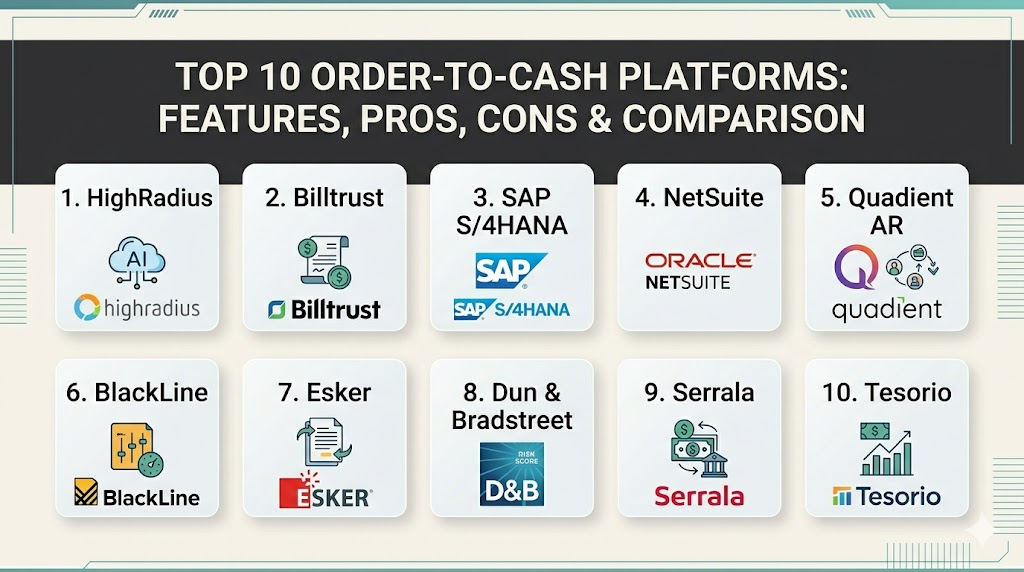
Introduction
The Order-to-Cash (O2C) process is the entire lifecycle of a customer sales transaction, beginning from the moment an order is placed and ending when the payment is received and settled in the company’s accounts. Order-to-Cash platforms are specialized software suites designed to automate and integrate every step of this journey—including order management, credit reviews, electronic invoicing, collections, and cash application. In the high-speed business environment manual O2C processes are no longer viable. Organizations now rely on these platforms to eliminate data silos, reduce Days Sales Outstanding (DSO), and ensure that the transition from a “sale” to “actual cash” is as seamless and frictionless as possible.
Managing the O2C cycle effectively is critical for maintaining healthy working capital and providing a superior customer experience. Modern platforms leverage artificial intelligence to predict payment behaviors and automate dispute resolutions, which allows finance teams to focus on strategic growth rather than administrative chasing. Whether a company is dealing with high-volume e-commerce transactions or complex enterprise service contracts, an integrated O2C platform ensures that no revenue is left on the table due to clerical errors or slow processing times.
Best for: Finance departments, CFOs, and operations managers in mid-market to enterprise-level companies who need to accelerate cash flow, improve accuracy in financial reporting, and scale global billing operations.
Not ideal for: Very small businesses with low transaction volumes who can manage billing through basic accounting software, or companies that operate entirely on a cash-on-delivery basis with no credit terms.
Key Trends in Order-to-Cash Platforms
- Hyper-Automation of Cash Application: Advanced AI models now match incoming payments to open invoices with nearly 100% accuracy, even when remittance data is missing or incomplete.
- Predictive Payment Analytics: Platforms use historical data to forecast exactly when a specific customer is likely to pay, allowing collections teams to prioritize high-risk accounts before they become overdue.
- Self-Service Customer Portals: There is a major shift toward giving customers a digital space to view invoices, manage disputes, and make payments, reducing the burden on internal support teams.
- E-Invoicing Compliance: With global regulations shifting toward mandatory electronic invoicing, platforms now include built-in localized compliance for different tax jurisdictions and digital signatures.
- Blockchain for Dispute Resolution: Some leading platforms are exploring distributed ledgers to provide an immutable record of orders and deliveries, significantly shortening the time spent on invoice disputes.
- Real-Time Credit Monitoring: Instead of static credit scores, O2C tools now integrate with live data feeds to adjust customer credit limits dynamically based on current market conditions.
- Unified Commerce Integration: Platforms are moving away from being “back-office” tools to becoming central engines that connect sales CRM data directly to the general ledger in real-time.
- Sustainable Finance Reporting: New modules help companies track the carbon footprint or ESG scores of their supply chain partners during the order fulfillment process.
How We Selected These Tools
- Breadth of Automation: We prioritized platforms that cover the full end-to-end O2C cycle rather than just niche billing or collection tools.
- Enterprise Scalability: Each selection was evaluated on its ability to handle multi-currency, multi-entity, and high-volume global transactions.
- AI and Machine Learning Maturity: Preference was given to tools that offer meaningful predictive insights rather than just basic rule-based automation.
- ERP Compatibility: We looked for platforms that offer deep, pre-built integrations with major financial systems like SAP, Oracle, and Microsoft Dynamics.
- User Experience: Both the internal finance team’s interface and the external customer payment portal were factored into the selection.
- Security and Compliance: Only platforms with robust data protection and global financial regulatory compliance features were included.
Top 10 Order-to-Cash Platforms
1. HighRadius
HighRadius is a leading provider of AI-driven finance software that specializes in automating the office of the CFO. Its autonomous software for O2C uses machine learning to transform the entire credit-to-cash cycle for large enterprises.
Key Features
- Autonomous collections that use AI to draft and send personalized follow-up emails.
- AI-powered cash application that handles complex parent-child hierarchy matching.
- Real-time credit risk monitoring with automated scoring and approval workflows.
- Electronic Invoice Presentment and Payment (EIPP) portal for streamlined customer interactions.
- Advanced deduction management to identify and resolve short-payments and disputes.
Pros
- Superior AI capabilities for predicting payment delays and customer behavior.
- Highly scalable for the world’s largest global corporations.
Cons
- Implementation can be complex and time-consuming.
- Higher price point compared to entry-level automation tools.
Platforms / Deployment
Web / Windows / macOS
Cloud
Security & Compliance
SSO, MFA, SOC 1 & SOC 2 Type 2, GDPR, and PCI-DSS compliant.
Not publicly stated.
Integrations & Ecosystem
Strong native connectors for SAP (S/4HANA), Oracle NetSuite, and Microsoft Dynamics. It supports a wide range of bank file formats for global cash application.
Support & Community
Comprehensive support with a dedicated customer success manager for enterprise accounts and an extensive library of white papers and webinars.
2. Billtrust
Billtrust focuses heavily on streamlining the transition from manual to digital payments. It is widely recognized for its strong B2B payments network and its ability to simplify complex invoicing environments.
Key Features
- The Business Payments Network (BPN) which connects buyers and suppliers for digital transactions.
- Automated invoice delivery across multiple channels including email, portal, and AP portals.
- Smart cash application that captures data from various payment sources automatically.
- Customized collections workflows based on customer segments and risk profiles.
- Detailed reporting and analytics on DSO and cash flow trends.
Pros
- Excellent for companies looking to move a large percentage of customers to electronic payments.
- Strong focus on user experience for both the merchant and the end-customer.
Cons
- Some advanced reporting features may require additional setup.
- Focus is primarily on the North American and European markets.
Platforms / Deployment
Web
Cloud
Security & Compliance
PCI-DSS Level 1, SOC 2, and data encryption at rest and in transit.
Not publicly stated.
Integrations & Ecosystem
Integrates with over 100 different ERP systems, including niche and industry-specific financial software.
Support & Community
Robust online training through the Billtrust Academy and responsive technical support teams.
3. SAP S/4HANA Finance
As a cornerstone of enterprise resource planning, SAP’s O2C capabilities are deeply embedded within its core finance module, offering unparalleled data consistency across global organizations.
Key Features
- Fully integrated order management that flows directly into financial accounting.
- Real-time credit management with deep links to sales and distribution modules.
- Advanced dispute management that tracks issues across the entire supply chain.
- SAP Cash Application using machine learning for high-volume invoice matching.
- Comprehensive localized tax and regulatory compliance for almost every country.
Pros
- Unmatched data integrity as part of a total enterprise ecosystem.
- Extremely powerful for managing multi-national, multi-currency operations.
Cons
- Requires significant technical expertise to manage and configure.
- Can feel rigid compared to modern, agile cloud-native platforms.
Platforms / Deployment
Web / Windows / Linux
Cloud / Self-hosted / Hybrid
Security & Compliance
World-class enterprise security, SAP Cloud Trust Center, SOC, and ISO certifications.
Not publicly stated.
Integrations & Ecosystem
Native integration with all other SAP modules and an enormous ecosystem of third-party consultants and developers.
Support & Community
Global support network with 24/7 coverage and a massive community of users and technical experts.
4. Oracle NetSuite
NetSuite provides a unified cloud business management suite that includes highly effective order-to-cash features designed for fast-growing mid-market companies.
Key Features
- Seamless conversion of quotes into approved sales orders.
- Automated invoicing based on fulfillment triggers or specific project milestones.
- Integrated credit card processing and electronic bank transfers.
- Real-time visibility into the status of every order and payment.
- Multi-currency management for expanding international businesses.
Pros
- Very fast to deploy compared to traditional enterprise software.
- All data lives in a single database, eliminating reconciliation issues.
Cons
- Customizing workflows often requires specialized NetSuite developers.
- Monthly costs can scale quickly as more modules are added.
Platforms / Deployment
Web / iOS / Android
Cloud
Security & Compliance
SOC 1, SOC 2, PCI-DSS, and robust role-based access controls.
Not publicly stated.
Integrations & Ecosystem
Strong ecosystem of “SuiteApps” that extend functionality into niche areas like advanced collections or tax automation.
Support & Community
Tiered support levels from basic to premium, with a large user group community and extensive online documentation.
5. Quadient AR (formerly YayPay)
Quadient AR offers a modern, highly visual approach to accounts receivable and O2C, with a focus on making financial data actionable for collections teams.
Key Features
- Intuitive dashboards that provide a real-time health check of accounts receivable.
- Automated communication templates that maintain a human touch in collections.
- CRM-style notes and task management for finance teams.
- Predictive analytics that identify at-risk payments before they are late.
- Customer self-service portal for easy invoice management and payment.
Pros
- Very short implementation time compared to enterprise rivals.
- Interface is modern and requires very little training for new staff.
Cons
- May lack some of the deepest supply chain features found in full ERPs.
- Best suited for mid-market rather than massive conglomerates.
Platforms / Deployment
Web
Cloud
Security & Compliance
SOC 2 compliant and adheres to standard modern data protection laws.
Not publicly stated.
Integrations & Ecosystem
Excellent connectors for Sage, Intacct, NetSuite, and Microsoft Dynamics Business Central.
Support & Community
High customer satisfaction ratings for onboarding and ongoing technical support.
6. BlackLine
While primarily known for financial close automation, BlackLine’s AR automation suite provides powerful cash application and credit management tools for complex organizations.
Key Features
- Intelligent cash application that handles multi-source payment data.
- Automated credit scoring and limit reviews based on real-time data.
- Unified platform for all accounts receivable activities.
- Deep audit trails that simplify the financial audit process.
- Direct integration with bank statements for rapid reconciliation.
Pros
- Exceptional for companies with very strict audit and compliance requirements.
- Integrates seamlessly with existing accounting and close workflows.
Cons
- Can be more expensive than standalone AR automation tools.
- Requires a disciplined approach to financial data management.
Platforms / Deployment
Web
Cloud
Security & Compliance
SOC 1, SOC 2, SOC 3, ISO 27001, and advanced encryption standards.
Not publicly stated.
Integrations & Ecosystem
Known for its “ERP-agnostic” approach, working equally well with SAP, Oracle, and others.
Support & Community
Excellent enterprise support and a professional community focused on financial transformation.
7. Esker
Esker specializes in AI-driven process automation across the entire O2C cycle, with a particularly strong reputation in order management and digital document delivery.
Key Features
- AI-powered order processing that extracts data from any format (PDF, EDI, fax).
- Global electronic invoicing compliance in over 60 countries.
- Digital payment portal with support for multiple global payment methods.
- Automated credit management and risk assessment.
- Smart collections with collaborative workflow tools for team-based chasing.
Pros
- Top-tier optical character recognition (OCR) for handling manual paper orders.
- Strong global footprint with excellent support for international regulations.
Cons
- User interface can feel a bit technical for non-finance users.
- Some advanced features require fine-tuning for specific industries.
Platforms / Deployment
Web / iOS / Android
Cloud
Security & Compliance
SSO, MFA, SOC 2, and localized data residency options.
Not publicly stated.
Integrations & Ecosystem
Seamlessly integrates with SAP, Oracle, and Microsoft Dynamics through certified connectors.
Support & Community
Strong worldwide presence with local support teams in many different countries.
8. Dun & Bradstreet Finance Analytics
Leveraging the world’s largest commercial database, this platform focuses on data-driven credit-to-cash decisions, combining internal data with global market insights.
Key Features
- Integration of D&B credit scores directly into the O2C workflow.
- Automated credit approvals and risk monitoring for global portfolios.
- AI-driven collections prioritization based on external risk factors.
- Global invoicing and payment capabilities.
- In-depth benchmarking of your O2C performance against industry peers.
Pros
- Unmatched insight into customer credit risk and market trends.
- Ideal for companies managing large, complex global customer bases.
Cons
- Heavy reliance on the D&B data ecosystem.
- May provide more data than a smaller company can realistically act upon.
Platforms / Deployment
Web
Cloud
Security & Compliance
Enterprise-standard security and compliance as expected from a major data provider.
Not publicly stated.
Integrations & Ecosystem
Integrates with major ERPs and CRMs to ensure data flows across sales and finance.
Support & Community
Professional support and deep industry expertise provided through consultative account management.
9. Serrala
Serrala offers an end-to-end automated payment suite that is particularly strong for organizations running on SAP, focusing on “clarity in cash.”
Key Features
- Universal cash application that handles any payment format globally.
- Advanced credit and risk management modules embedded in the finance workflow.
- Digital invoicing with automated dispute and deduction handling.
- Smart collections with behavioral analysis for personalized chasing.
- Integrated archiving and document management for all O2C records.
Pros
- One of the most robust “inside SAP” solutions available.
- Excellent for high-volume environments with extremely complex payment rules.
Cons
- Interface is highly geared toward technical finance specialists.
- Less common outside of the SAP and enterprise European market.
Platforms / Deployment
Web / Windows / Linux
Cloud / Hybrid
Security & Compliance
Certified SAP integration and standard enterprise security protocols.
Not publicly stated.
Integrations & Ecosystem
Deepest possible integration with SAP ERP and S/4HANA environments.
Support & Community
High-level professional services and technical support for large-scale transformations.
10. Tesorio
Tesorio focuses on “Connected Finance,” providing a modern, fast-moving platform for accounts receivable and O2C that prioritizes team collaboration and cash flow predictability.
Key Features
- Real-time cash flow forecasting based on actual O2C data.
- Collaborative collections workspace with shared history and task lists.
- Automated, personalized dunning campaigns that feel human.
- Centralized customer portal for payment and communication.
- Deep insights into DSO trends and collection efficiency.
Pros
- Extremely agile and easy for non-technical teams to use.
- Excellent at turning O2C data into forward-looking cash forecasts.
Cons
- May lack some of the deeper “order fulfillment” features of larger ERPs.
- Primarily focused on AR and cash flow rather than full manufacturing supply chain.
Platforms / Deployment
Web
Cloud
Security & Compliance
SOC 2 Type 2 compliant and follows strict modern encryption standards.
Not publicly stated.
Integrations & Ecosystem
Excellent modern API-based connectors for NetSuite, Intacct, and Salesforce.
Support & Community
Very high ratings for customer support and a helpful, fast-moving online community.
Comparison Table
| Tool Name | Best For | Platform(s) Supported | Deployment | Standout Feature | Public Rating |
| 1. HighRadius | Enterprise AI | Web, Win, macOS | Cloud | Autonomous AI | N/A |
| 2. Billtrust | Digital Payments | Web | Cloud | Payments Network | N/A |
| 3. SAP S/4HANA | Global Conglomerates | Web, Win, Linux | Hybrid | Ecosystem Depth | N/A |
| 4. NetSuite | Mid-Market Growth | Web, iOS, Android | Cloud | All-in-One Database | N/A |
| 5. Quadient AR | Visual AR Tracking | Web | Cloud | Intuitive UX | N/A |
| 6. BlackLine | Compliance & Audit | Web | Cloud | Audit Integrity | N/A |
| 7. Esker | Document Automation | Web, iOS, Android | Cloud | OCR Data Extraction | N/A |
| 8. Dun & Bradstreet | Credit-Led Growth | Web | Cloud | Global Risk Data | N/A |
| 9. Serrala | SAP Power Users | Web, Win, Linux | Hybrid | Payment Clarity | N/A |
| 10. Tesorio | Cash Forecasting | Web | Cloud | Collaboration Sync | N/A |
Evaluation & Scoring
| Tool Name | Core (25%) | Ease (15%) | Integrations (15%) | Security (10%) | Perf (10%) | Support (10%) | Value (15%) | Total |
| 1. HighRadius | 10 | 4 | 9 | 9 | 10 | 8 | 6 | 8.10 |
| 2. Billtrust | 9 | 7 | 8 | 9 | 9 | 8 | 7 | 8.15 |
| 3. SAP S/4HANA | 10 | 3 | 10 | 10 | 10 | 9 | 5 | 8.05 |
| 4. NetSuite | 8 | 8 | 9 | 9 | 8 | 8 | 7 | 8.05 |
| 5. Quadient AR | 7 | 10 | 8 | 8 | 8 | 9 | 8 | 8.15 |
| 6. BlackLine | 8 | 7 | 9 | 10 | 9 | 9 | 6 | 7.95 |
| 7. Esker | 9 | 7 | 9 | 9 | 9 | 8 | 7 | 8.15 |
| 8. Dun & Bradstreet | 8 | 6 | 8 | 9 | 9 | 8 | 7 | 7.65 |
| 9. Serrala | 9 | 4 | 9 | 9 | 10 | 8 | 6 | 7.75 |
| 10. Tesorio | 7 | 9 | 8 | 8 | 9 | 9 | 9 | 8.15 |
The scoring provided above evaluates how these platforms meet the diverse needs of modern finance departments. HighRadius and SAP dominate in core features and performance due to their immense depth, though they are more challenging to implement. On the other hand, platforms like Quadient AR and Tesorio score very highly on “Ease of Use” and “Value,” making them excellent choices for companies that need to see a faster return on investment and a better user experience for their staff.
Which Order-to-Cash Platform Tool Is Right for You?
Solo / Freelancer
At this level, a full O2C platform is likely overkill. Focus on simple accounting tools like QuickBooks or FreshBooks which handle basic invoicing and payments well without the complexity of an enterprise system.
SMB
For smaller companies looking to grow, Tesorio or Quadient AR offer the best balance. They provide modern, clean interfaces that allow a small finance team to act like a much larger one through smart automation.
Mid-Market
Growing businesses often find Oracle NetSuite to be the best fit. Since it combines the ERP with the O2C cycle, it provides a “single source of truth” that is vital as transaction volumes begin to increase.
Enterprise
For global organizations, HighRadius or SAP S/4HANA Finance are the standard. They offer the power required to handle millions of transactions across dozens of countries while maintaining strict compliance.
Budget vs Premium
If budget is the primary concern, cloud-native specialized AR tools often provide more “bang for your buck” than large ERP modules. However, premium platforms like Dun & Bradstreet offer data insights that can prevent millions in bad debt.
Feature Depth vs Ease of Use
Esker and Serrala offer incredible depth in specific areas like document processing and SAP integration but require more training. Billtrust is often seen as a more user-friendly alternative for general digital payment transformation.
Integrations & Scalability
If your company uses a variety of different software across departments, BlackLine is an excellent choice due to its ERP-agnostic nature. For those staying strictly within one ecosystem, native modules are usually more scalable.
Security & Compliance Needs
Companies in highly regulated industries like healthcare or finance should look toward BlackLine or SAP, as they have the most established histories of meeting the world’s most stringent audit and data protection standards.
Frequently Asked Questions (FAQs)
1. What is the difference between Order-to-Cash and Accounts Receivable?
Accounts Receivable is just one part of the O2C cycle; O2C covers everything from the initial order entry and credit check through to the final cash application and reporting.
2. How can an O2C platform reduce Days Sales Outstanding (DSO)?
By automating the delivery of invoices, providing easy payment portals, and using AI to prioritize collections, these platforms ensure payments are received much faster than manual processes.
3. Do these platforms replace my current ERP?
No, most of these tools are designed to sit on top of or integrate directly with your existing ERP to enhance its financial automation capabilities.
4. Can O2C software help with international taxes and VAT?
Yes, many top-tier platforms have built-in localized compliance engines that automatically calculate and apply the correct taxes for global transactions.
5. How does AI improve the cash application process?
AI can “read” remittance advice from emails or bank files and automatically match payments to the correct open invoices, even when account numbers are missing.
6. Is it difficult to migrate from a manual process to an O2C platform?
While it requires a clear strategy and data cleanup, modern cloud platforms offer implementation frameworks that can get most companies running in a matter of weeks.
7. Can these tools help resolve customer disputes?
Yes, they provide a central place to track disputes, attach supporting documents like proof of delivery, and manage the communication between the customer and the warehouse.
8. What are the security risks of using a cloud-based O2C tool?
Most reputable providers use high-level encryption and meet SOC 2 standards; the risk is generally lower than keeping sensitive financial data in unencrypted spreadsheets.
9. Do I need to be a developer to customize the workflows?
Most modern O2C platforms are “low-code,” meaning finance managers can set up rules and automation paths using a visual interface without writing code.
10. How do these platforms handle credit checks for new customers?
They can automatically pull data from credit bureaus and apply your company’s specific risk rules to approve or deny credit limits instantly during the order process.
Conclusion
Transitioning to a modern Order-to-Cash platform is no longer just about efficiency; it is about building a resilient and predictable revenue engine. By automating the transition from a sales order to liquid cash, organizations can significantly lower their operational costs while improving their relationships with customers through transparent and easy payment processes. Whether you prioritize deep AI insights or seamless ERP integration, the right platform will act as a force multiplier for your finance team. The best approach is to evaluate your specific transaction volume and complexity, then choose a partner that can scale with your global ambitions.

Best Cardiac Hospitals Near You
Discover top heart hospitals, cardiology centers & cardiac care services by city.
Advanced Heart Care • Trusted Hospitals • Expert Teams
View Best Hospitals