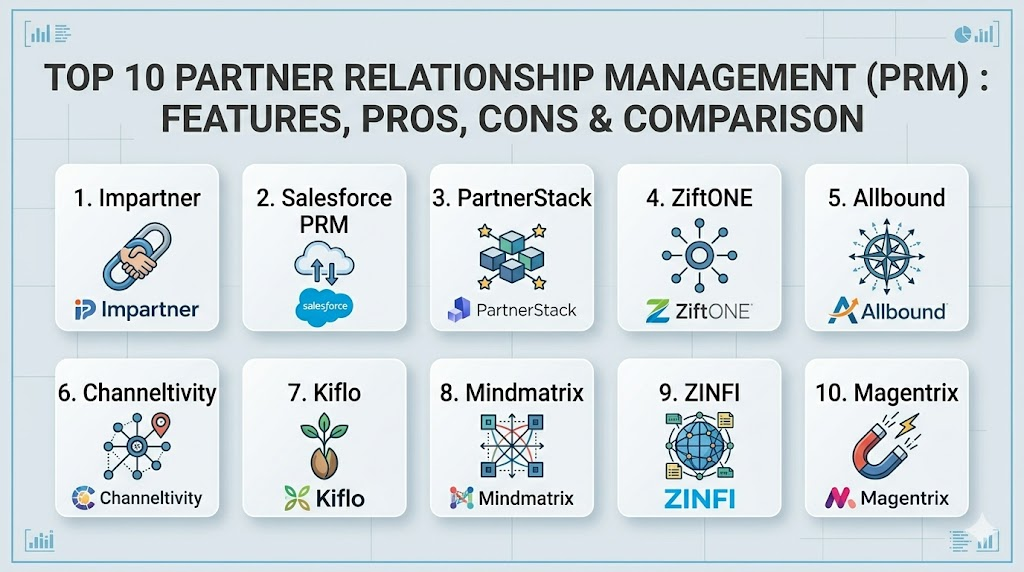
Introduction
Partner Relationship Management (PRM) software is a specialized suite of digital tools designed to help companies manage, track, and optimize their indirect sales channels and partner ecosystems. Unlike a traditional Customer Relationship Management (CRM) system that focuses on direct interactions with end-users, PRM is built to empower third-party entities—such as resellers, distributors, affiliates, and technology partners—to sell more effectively on behalf of a vendor. In the current landscape, where decentralized sales models and complex ecosystems are the norm, PRM acts as the central hub for collaboration, ensuring brand consistency and operational efficiency across global markets.
As we move deeper into a partner-led economy, the role of PRM has shifted from being a simple file-sharing portal to an intelligent enablement engine. Modern platforms now focus on reducing “partner friction” by automating administrative hurdles and providing real-time data insights. Businesses today utilize these systems to scale their reach rapidly without increasing their internal headcount, making the partner experience a primary competitive advantage.
Real-World Use Cases
- SaaS and Software Distribution: Managing a global network of resellers and ensuring they have the latest product certifications and marketing assets.
- Manufacturing and Hardware: Coordinating with distributors and physical retailers to manage inventory, deal registration, and localized promotions.
- Financial Services: Tracking referral partners and ensuring all external agents are compliant with regional financial regulations and disclosures.
- Telecom and Infrastructure: Distributing leads to localized service providers and tracking the fulfillment of complex installation projects.
- Affiliate and Influencer Marketing: Automating the tracking of high-volume digital referrals and managing complex commission structures.
Evaluation Criteria for Buyers
- Partner Portal Quality: Is the interface intuitive and mobile-ready for partners who may be managing multiple vendors?
- Deal Registration Workflows: Does the system effectively prevent channel conflict by clearly attributing leads and opportunities?
- Training and Enablement: How easily can you create learning paths, quizzes, and certifications for your partners?
- Integration Maturity: Does it offer bi-directional sync with your existing CRM and marketing automation platforms?
- Incentive Management: Can it handle complex Market Development Funds (MDF), rebates, and multi-tier commission payouts?
- Scalability: Is the platform capable of growing from a dozen partners to several thousand across different regions and languages?
- Automation Capabilities: To what extent can the software automate the onboarding journey and lead distribution?
- Security Framework: Does the platform offer role-based access control and meet enterprise-level data protection standards?
Mandatory Paragraph
- Best for: Companies with established or growing indirect sales channels, multi-tier distribution models, or large-scale affiliate programs that require structured enablement and automated oversight.
- Not ideal for: Small businesses that sell 100% directly to consumers, or organizations with very simple, low-volume referral agreements that can be managed via a basic spreadsheet or CRM.
Key Trends in Partner Relationship Management Software
- Agentic AI for Enablement: Intelligent assistants now proactively suggest the right marketing collateral or training modules to partners based on their current deal stage.
- Ecosystem Orchestration: A move toward “Partner-to-Partner” (P2P) collaboration, where vendors encourage their partners to co-sell and integrate with one another within the platform.
- Self-Service Onboarding: Automated workflows that allow new partners to sign NDAs, complete training, and gain portal access without any manual intervention from channel managers.
- Predictive Performance Analytics: Using historical data to forecast which partners are likely to hit their targets and which ones require additional support or intervention.
- Mobile-First Partner Portals: Recognizing that many channel partners work in the field, platforms are prioritizing high-performance mobile apps and responsive web designs.
- Localized Global Management: Advanced support for multi-currency, multi-language, and region-specific tax compliance for global partner payouts.
- Through-Channel Marketing Automation: Enabling partners to run pre-approved, co-branded marketing campaigns directly from the PRM portal to ensure brand alignment.
- Zero-Trust Partner Security: Implementing stricter access controls and identity verification to protect sensitive lead data and intellectual property in shared environments.
How We Selected These Tools
- Market Adoption and Longevity: We focused on tools that have proven their stability and reliability across diverse industries over multiple years.
- User Experience (UX) Standards: Priority was given to platforms that demonstrate high partner adoption rates due to ease of use.
- Depth of Feature Set: We evaluated the completeness of the partner lifecycle—from initial recruitment to performance optimization.
- Enterprise-Ready Infrastructure: Each tool was checked for its ability to handle complex organizational structures and high data volumes.
- Integration Ecosystem: We looked for platforms that provide native connectors to the most common CRM and ERP systems.
- Feedback and Industry Sentiment: Evaluation of consistent positive outcomes in real-world deployment scenarios across small, medium, and large enterprises.
Top 10 Partner Relationship Management Tools
1. Impartner
Commonly recognized as one of the most comprehensive PRM suites available, this platform excels in managing the full partner lifecycle for large-scale enterprises with high-performance requirements.
Key Features
- Advanced Partner Portal with deep branding and layout customization options.
- Intelligent Deal Registration to prevent channel conflict and track pipeline accurately.
- Integrated Learning Management System (LMS) for structured training and certification.
- Automated MDF management for tracking and approving market development funds.
- Detailed analytics and reporting suite with customizable performance dashboards.
- Asset library for distributing co-branded marketing materials and sales playbooks.
Pros
- Extremely feature-rich, covering almost every conceivable partner management need.
- High levels of scalability for global organizations managing thousands of entities.
Cons
- The setup process can be complex and typically requires a dedicated implementation phase.
- Pricing is aimed at the mid-market and enterprise levels, which may be high for startups.
Platforms / Deployment
Web / Windows / macOS / iOS / Android
Cloud
Security & Compliance
SSO/SAML, MFA, and robust encryption protocols.
SOC 2 and GDPR compliant.
Integrations & Ecosystem
Strong bi-directional sync with major CRM platforms. It also offers a wide range of APIs for connecting to custom internal systems and specialized marketing tools.
Support & Community
Professional enterprise support with dedicated account managers and an extensive online knowledge base for self-service troubleshooting.
2. Salesforce PRM
A powerful extension of the world’s leading CRM, this platform is the natural choice for organizations that already manage their direct sales within the Salesforce ecosystem.
Key Features
- Built natively on the Salesforce platform, ensuring seamless data flow between direct and indirect sales.
- Community-driven portals that allow for high levels of partner engagement and collaboration.
- Einstein AI integration for predictive lead scoring and partner performance insights.
- Automated lead distribution based on partner certifications, territory, or capacity.
- Guided setup wizards to help channel managers launch new partner programs quickly.
Pros
- Eliminates data silos by keeping all revenue-generating activities in one single source of truth.
- Leverages the massive Salesforce AppExchange for nearly infinite extensibility.
Cons
- Requires a significant investment in the broader Salesforce ecosystem to realize full value.
- Can become very expensive as user counts and feature requirements increase.
Platforms / Deployment
Web / iOS / Android
Cloud
Security & Compliance
Enterprise-grade security, including custom sharing rules and comprehensive audit trails.
ISO 27001, SOC 2, and HIPAA compliant.
Integrations & Ecosystem
Inherits the full power of the Salesforce integration engine, allowing for native connections to thousands of third-party business applications.
Support & Community
Access to the global Trailblazer community and professional premier support tiers for enterprise customers.
3. PartnerStack
Specifically designed for the B2B SaaS industry, this platform focuses heavily on automating the financial and administrative aspects of diverse partner programs, including affiliates and resellers.
Key Features
- Automated commission calculations and payouts for global partner networks.
- Partner Marketplace that helps vendors discover and recruit new, relevant partners.
- Dedicated portals for different partner types (affiliates, referrals, resellers).
- Built-in tools for tracking link clicks, sign-ups, and revenue attribution.
- Customizable onboarding journeys that automate the journey from applicant to active partner.
Pros
- Excellent for managing the financial complexity of high-volume affiliate and referral programs.
- Very user-friendly interface that leads to high partner adoption rates.
Cons
- Best suited for SaaS; may lack some specialized features for physical manufacturing or distribution.
- Customization of the portal layout is somewhat more limited compared to enterprise-only tools.
Platforms / Deployment
Web
Cloud
Security & Compliance
Secure payment processing and standard data encryption.
Not publicly stated.
Integrations & Ecosystem
Strong focus on integrations with SaaS-centric tools like HubSpot, Slack, and various billing and payment platforms.
Support & Community
Good documentation and a responsive support team focused on the needs of growing software companies.
4. ZiftONE
This platform integrates PRM with channel marketing and sales enablement, making it a “unified” solution for companies that want to drive partner-led demand generation.
Key Features
- Through-Channel Marketing Automation (TCMA) for executing campaigns through partners.
- Unified dashboard for managing marketing, sales, and operations in one view.
- Robust deal registration and lead management workflows.
- Partner training and certification modules to ensure technical proficiency.
- Incentives and rewards management to drive consistent partner engagement.
Pros
- Unique focus on marketing enablement helps partners generate their own leads.
- Provides a very cohesive experience by combining multiple channel tools into one platform.
Cons
- The breadth of features can lead to a steeper learning curve for administrative users.
- Pricing can be high for organizations that only need basic portal functionality.
Platforms / Deployment
Web
Cloud
Security & Compliance
Standard enterprise security protocols and data isolation.
Not publicly stated.
Integrations & Ecosystem
Strong connections to major CRM systems and specialized marketing tools, ensuring a clean flow of lead data.
Support & Community
Provides professional onboarding services and ongoing technical support for global channel teams.
5. Allbound
A modern, simplified approach to PRM that prioritizes partner engagement through gamification and a highly intuitive, mobile-optimized user experience.
Key Features
- Content management system designed for easy distribution of sales and marketing assets.
- Gamified partner incentives to encourage portal logins and activity.
- Deal registration and lead sharing with automated approval workflows.
- Collaborative prospect pages that allow partners and vendors to co-sell more effectively.
- Learning tracks and certifications to keep partners up to date on new features.
Pros
- Excellent user interface that feels modern and approachable for partners.
- Faster implementation times compared to more traditional, heavy enterprise suites.
Cons
- May lack some of the deepest custom-coding capabilities required by highly complex industrial firms.
- Analytics are solid but may not be as granular as those found in larger enterprise-only systems.
Platforms / Deployment
Web / iOS / Android
Cloud
Security & Compliance
Secure role-based access and standard cloud security measures.
Not publicly stated.
Integrations & Ecosystem
Native integrations with popular CRMs like Salesforce and HubSpot, along with Slack and various marketing tools.
Support & Community
Strong focus on customer success and a community of “Allbound Experts” who share best practices for channel growth.
6. Channeltivity
Focused on being “easy to use” and “fast to deploy,” this tool is a favorite for mid-market companies that need a structured partner program without the overhead of an enterprise-level suite.
Key Features
- Straightforward partner portal for resource sharing and communication.
- Simplified deal registration to track partner-led opportunities.
- Module for managing MDF and co-op funds with approval tracking.
- Partner training and certification tracking to manage competency.
- Joint business planning tools to align vendor and partner goals.
Pros
- Known for its transparent pricing and quick deployment cycles.
- Extremely intuitive for both channel managers and their partners.
Cons
- Might be missing some of the advanced AI and predictive features of high-end competitors.
- Best suited for standard channel models; may struggle with highly unconventional ecosystem types.
Platforms / Deployment
Web
Cloud
Security & Compliance
Robust encryption and secure hosting environments.
Not publicly stated.
Integrations & Ecosystem
Provides solid, dependable integrations with the most common CRMs and marketing platforms used by the mid-market.
Support & Community
Excellent customer support reputation with a focus on helping smaller teams scale their partner programs.
7. Kiflo
A newer, agile PRM solution designed specifically for SMBs and startups that are building their first structured partner programs. It focuses on clarity and immediate value.
Key Features
- Unified view of all partner types (affiliates, referrals, and resellers) in one place.
- Automated partner onboarding workflows and asset distribution.
- Simple deal and lead tracking with a clear visual pipeline.
- Collaboration tools for real-time communication between vendors and partners.
- Performance tracking with simple, clean reporting dashboards.
Pros
- Very affordable and easy to set up, making it ideal for growing teams.
- Clean, modern interface that requires almost zero training to navigate.
Cons
- Lacks the deep enterprise “hooks” and complex multi-tier management of larger tools.
- Feature set is focused on the essentials; specialized needs may require workarounds.
Platforms / Deployment
Web
Cloud
Security & Compliance
Basic secure access controls and data protection.
Not publicly stated.
Integrations & Ecosystem
Connects easily to HubSpot, Pipedrive, and other CRMs favored by startups and mid-market companies.
Support & Community
Highly personal support experience with a focus on helping customers launch their partner programs.
8. Mindmatrix
This platform focuses on “Full-Funnel” enablement, combining PRM with sales and marketing tools to give partners everything they need to close a deal.
Key Features
- Advanced through-channel marketing with personalized campaign execution.
- Direct sales enablement tools that provide partners with playbooks and scripts.
- Multi-tier channel management for complex distribution networks.
- Detailed partner performance analytics across the entire sales funnel.
- Incentives and loyalty program management to keep partners motivated.
Pros
- Very powerful for organizations that want to provide “marketing-as-a-service” to their partners.
- Highly customizable for specific industry needs, including telecom and manufacturing.
Cons
- The interface is dense and can take time for partners to fully navigate.
- Implementation is a significant project that requires careful planning.
Platforms / Deployment
Web
Cloud / Hybrid
Security & Compliance
Enterprise-grade security and data isolation for different partner tiers.
Not publicly stated.
Integrations & Ecosystem
Extensive list of integrations with CRMs, marketing platforms, and professional services automation tools.
Support & Community
Professional implementation services and a deep library of technical documentation.
9. ZINFI
A modular “Unified Partner Management” platform that allows companies to pick and choose the specific modules they need as their program grows.
Key Features
- Modular architecture covering partner recruitment, onboarding, and enablement.
- Advanced lead management with automated distribution rules.
- Through-channel marketing tools for global campaign management.
- Financial management module for incentives, rebates, and payouts.
- Global scalability with support for over 100 countries and dozens of languages.
Pros
- Highly flexible; you only pay for the modules and features you actually use.
- One of the best options for truly global programs with complex regional needs.
Cons
- Navigating the various modules can be complex for new administrators.
- The modular nature means that total costs can rise as you add more functionality.
Platforms / Deployment
Web
Cloud
Security & Compliance
Comprehensive security settings and global data privacy compliance.
Not publicly stated.
Integrations & Ecosystem
Offers a wide range of connectors and a robust API for building custom enterprise integrations.
Support & Community
Global support presence with specialized teams for different regional needs.
10. Magentrix
A highly customizable platform that specializes in building “Community Portals” for partners, customers, and employees, often focusing on the Salesforce ecosystem.
Key Features
- Fully customizable portal themes and layouts to match your brand exactly.
- Secure document and asset sharing with granular permission settings.
- Integrated training and e-learning modules with progress tracking.
- Deal registration and lead distribution synchronized with your CRM.
- Discussion forums and collaboration tools to build a true partner community.
Pros
- Exceptional flexibility in how the portal is designed and presented.
- Very deep synchronization with Salesforce data and custom objects.
Cons
- While it works with other CRMs, its strongest value is for Salesforce users.
- High levels of customization may require some internal technical knowledge.
Platforms / Deployment
Web
Cloud
Security & Compliance
Robust user management and secure cloud infrastructure.
Not publicly stated.
Integrations & Ecosystem
Excellent integration with the Salesforce suite and other common cloud business applications.
Support & Community
Strong professional services team to help with custom portal builds and ongoing support.
Comparison Table
| Tool Name | Best For | Platform(s) Supported | Deployment | Standout Feature | Public Rating |
| 1. Impartner | Global Enterprise | Win, macOS, Mobile | Cloud | End-to-End Lifecycle | N/A |
| 2. Salesforce PRM | Salesforce Users | Web, Mobile | Cloud | Native CRM Sync | N/A |
| 3. PartnerStack | B2B SaaS | Web | Cloud | Automated Payouts | N/A |
| 4. ZiftONE | Marketing Focus | Web | Cloud | Channel Automation | N/A |
| 5. Allbound | Engagement / UX | Web, Mobile | Cloud | Gamification Tools | N/A |
| 6. Channeltivity | Mid-Market | Web | Cloud | Ease of Deployment | N/A |
| 7. Kiflo | Startups / SMBs | Web | Cloud | Simple Navigation | N/A |
| 8. Mindmatrix | Sales Enablement | Web | Cloud/Hybrid | Full-Funnel Support | N/A |
| 9. ZINFI | Modular Needs | Web | Cloud | Modular Flexibility | N/A |
| 10. Magentrix | Custom Portals | Web | Cloud | Portal Branding | N/A |
Evaluation & Scoring
| Tool Name | Core (25%) | Ease (15%) | Integrations (15%) | Security (10%) | Perf (10%) | Support (10%) | Value (15%) | Total |
| 1. Impartner | 10 | 5 | 10 | 9 | 9 | 9 | 6 | 8.30 |
| 2. Salesforce PRM | 9 | 6 | 10 | 10 | 9 | 9 | 5 | 8.15 |
| 3. PartnerStack | 8 | 9 | 8 | 8 | 9 | 8 | 8 | 8.25 |
| 4. ZiftONE | 9 | 7 | 8 | 8 | 8 | 8 | 7 | 7.75 |
| 5. Allbound | 8 | 10 | 8 | 8 | 9 | 8 | 8 | 8.30 |
| 6. Channeltivity | 7 | 10 | 8 | 7 | 8 | 9 | 9 | 8.20 |
| 7. Kiflo | 6 | 10 | 7 | 6 | 8 | 9 | 10 | 7.85 |
| 8. Mindmatrix | 9 | 5 | 9 | 8 | 8 | 8 | 7 | 7.75 |
| 9. ZINFI | 9 | 6 | 9 | 8 | 9 | 8 | 8 | 8.05 |
| 10. Magentrix | 8 | 7 | 9 | 8 | 8 | 8 | 8 | 7.95 |
The scoring model above emphasizes that a higher total score often indicates a tool that balances deep professional features with high accessibility. For instance, Allbound and Impartner both score highly but for different reasons: one excels in feature depth, while the other excels in user engagement. Tools like Kiflo score exceptionally high in Value and Ease, making them the best choice for smaller programs, even if they lack the absolute core depth of an enterprise suite like Salesforce PRM.
Which Partner Relationship Management Tool Is Right for You?
Solo / Freelancer
If you are an individual consultant managing a handful of partnerships, a lightweight and affordable tool like Kiflo is the most sensible choice. It provides the necessary structure without the high costs and complexity of an enterprise system.
SMB
Small to medium businesses should look for a balance of power and simplicity. Channeltivity or Allbound are excellent options here, offering enough features to grow while ensuring that the partners actually enjoy using the system.
Mid-Market
For companies with a more established channel, PartnerStack (for SaaS) or ZINFI (for traditional channels) provide the necessary automation to handle increasing volume without overwhelming the internal team.
Enterprise
Global organizations with multi-layered distribution models require the power of Impartner or Salesforce PRM. These tools offer the necessary security, scalability, and deep reporting required to manage billions in indirect revenue.
Budget vs Premium
- Budget: Kiflo or the standard tier of Channeltivity.
- Premium: Impartner or Salesforce PRM, especially when combined with advanced AI modules.
Feature Depth vs Ease of Use
- Depth: Mindmatrix and Impartner offer the most control for complex, industrial, or highly regulated environments.
- Ease of Use: Allbound and Kiflo are designed to be “partner-first,” focusing on a friction-less experience.
Integrations & Scalability
If your entire business lives in Salesforce, Salesforce PRM or Magentrix are the most scalable options. For those looking for a “best-of-breed” approach that connects to multiple different SaaS tools, PartnerStack is often the superior choice.
Security & Compliance Needs
In highly regulated sectors like finance or healthcare, prioritize Salesforce PRM or Impartner, as they provide the most robust identity management, audit trails, and global compliance certifications.
Frequently Asked Questions (FAQs)
1. How does a PRM differ from a standard CRM?
A CRM is built for managing direct relationships with customers, while a PRM is built to help a vendor manage and enable a network of third-party partners who sell to those customers.
2. Is it difficult to migrate from a manual system to a PRM?
While the initial setup requires planning and data cleanup, most modern PRM platforms offer import tools and professional services to help transition your partner data smoothly.
3. Do I need a PRM if I only have five partners?
Not necessarily. For very small programs, a spreadsheet may suffice. However, if you plan to scale, implementing a PRM early ensures that your processes are structured and repeatable from day one.
4. Can a PRM help reduce channel conflict?
Yes, deal registration is a core feature of most PRM tools. It allows partners to “claim” a lead, ensuring they are protected and rewarded for the work they do on a specific opportunity.
5. How do partners benefit from using these portals?
Partners gain 24/7 access to sales collateral, training, technical support, and real-time visibility into their commissions and performance metrics.
6. Can PRM tools help with partner marketing?
Most high-end PRM tools include through-channel marketing automation, allowing vendors to provide pre-approved, co-branded campaign materials for partners to use.
7. Are these platforms secure for sharing proprietary documents?
Yes, professional PRM systems use role-based access control, ensuring that each partner only sees the specific documents and data intended for them.
8. What is the typical implementation time for a PRM?
Lightweight tools can be launched in a few weeks, while complex enterprise implementations may take three to six months to fully integrate and customize.
9. Can I track partner training and certifications in a PRM?
Yes, most PRM suites include or integrate with a Learning Management System (LMS) to track partner progress and automatically grant portal access based on certification status.
10. Do PRM tools support global partner payouts?
Advanced platforms like PartnerStack and ZINFI are built to handle multi-currency payments and regional tax compliance for partners located all over the world.
Conclusion
In an era where indirect sales can account for a significant portion of a company’s revenue, selecting the right Partner Relationship Management software is a foundational business decision. The move toward intelligent automation, real-time collaboration, and ecosystem-wide visibility means that the “best” tool is no longer just a portal—it is a strategic asset. Whether you prioritize the deep enterprise capabilities of a veteran suite or the agile, user-focused experience of a modern startup tool, the ultimate goal remains the same: empowering your partners to succeed. By focusing on enablement and reducing administrative friction, you can transform a chaotic network into a high-performance growth engine.

Best Cardiac Hospitals Near You
Discover top heart hospitals, cardiology centers & cardiac care services by city.
Advanced Heart Care • Trusted Hospitals • Expert Teams
View Best Hospitals